Parents dance wedding songs are no longer limited to the traditional father-daughter and mother-son format. Modern families are blended, non-traditional, chosen, and deeply varied and wedding traditions have started adapting to reflect that reality.
The best parents dance songs are the ones that make every important person in the room feel included, whether that means biological parents, step-parents, grandparents, same-sex parents, or the people who stepped into those roles over time.
This guide covers inclusive parents dance wedding songs for every family structure as part of a complete collection of wedding songs for every moment of the day, along with how combined family dances work, when they make more sense than separate dances, and how to structure the moment naturally at the reception.
Combined Family Dance Songs
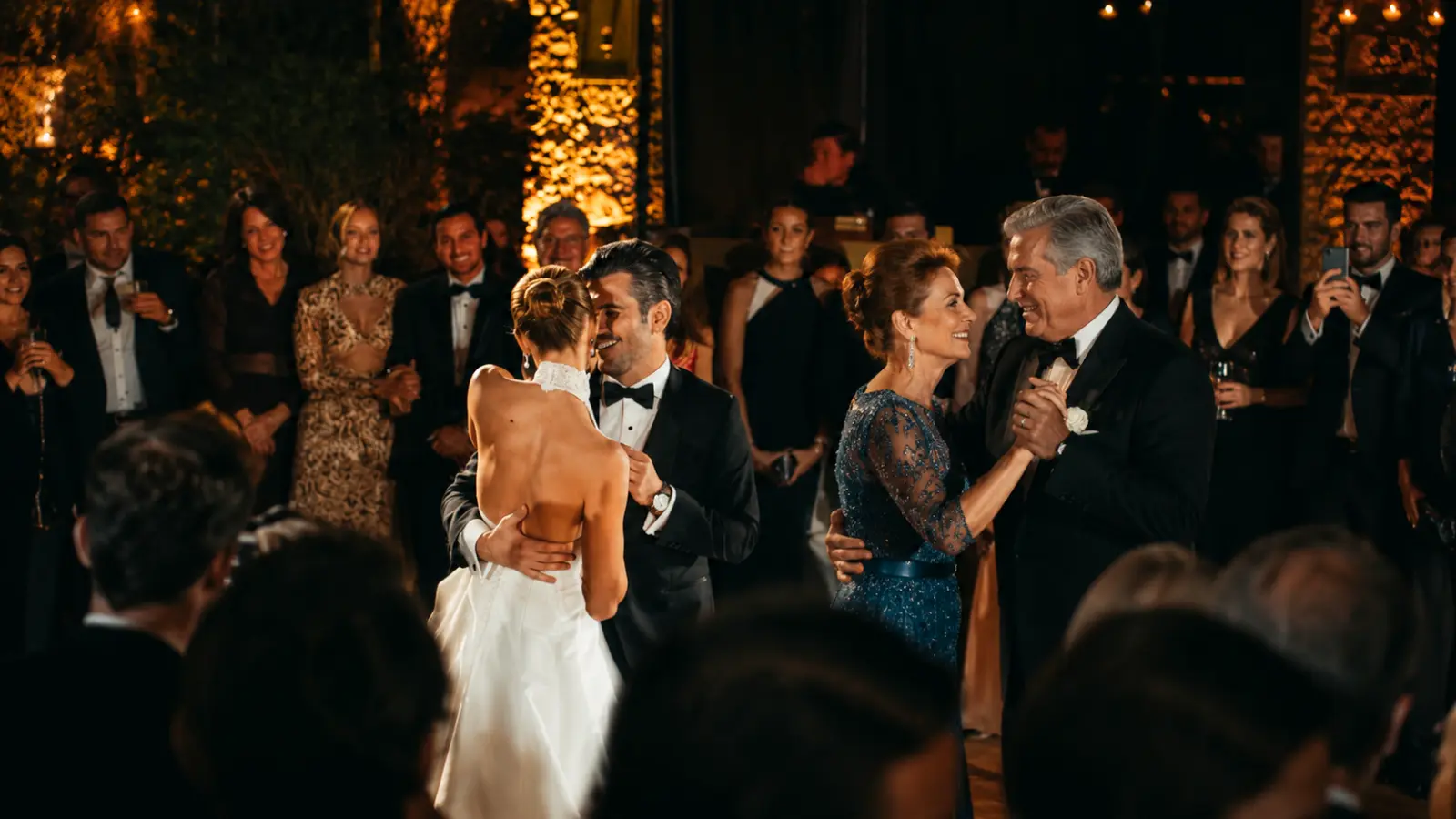
A combined family dance is a single song during which all parents — bride’s parents and groom’s parents — dance simultaneously. The most common format: the couple shares the first dance, then the DJ invites all parents to the floor for a second song. Both sets of parents dance together (or with the couple) during the same track. The moment is unified rather than sequential, which avoids any sense of one family being featured more than the other.
The best songs for a combined family dance are warm, celebratory, and emotionally accessible to every generation in the room, which makes this one of the most personal parts of how to choose wedding music. They should not specifically reference one parental role — “mama” or “daddy” — unless all parents being honored share that role. The goal is a song that belongs to everyone on the floor simultaneously.
| Song | Artist | Why It Works for a Combined Dance |
|---|---|---|
| What a Wonderful World | Louis Armstrong | Warm, universal, and immediately emotional — the lyric is gratitude for existence, which is exactly what the moment is |
| You Are the Sunshine of My Life | Stevie Wonder | Joyful and role-neutral; works for any parent-child combination without specifying gender or relationship type |
| Stand by Me | Ben E. King | The promise in the title is exactly what parents offer; role-neutral and emotionally warm |
| Here Comes the Sun | The Beatles | Celebratory rather than tearful — sets the tone for a joyful family moment rather than a bittersweet one |
| How Sweet It Is (To Be Loved by You) | James Taylor | Warm and uplifting; appropriate for the moment without being gender-specific |
| Unforgettable | Nat King Cole | Elegant and emotionally resonant; “that’s what you are” can describe any meaningful relationship |
| I Will | The Beatles | Short, sincere, and role-neutral — perfect for a brief combined dance |
| Count on Me | Bruno Mars | Modern choice that works across age groups; the lyric is a promise of presence that fits the parent role perfectly |
| Home | Michael Bublé | Emotionally resonant for parents whose children are starting new families; the feeling of “home” goes both ways |
| The Best | Tina Turner | High energy and celebratory; for families who want a joyful moment rather than an emotional one |
| Brown Eyed Girl | Van Morrison | Warm and familiar; works especially well when the reception tone is celebratory and the families are outgoing |
| September | Earth, Wind & Fire | For combined family dances where the families want to celebrate rather than be sentimental — this is the most joyful option on this list |
Pro tip: For combined family dances, avoid songs whose title is specifically a parent role (“Mama,” “Daddy”) unless all parents being honored share that role. A song that references “you” — “you are the sunshine,” “stand by me,” “what a wonderful world” — works for everyone on the floor simultaneously, which is the entire point of combining the dance.
Blended Family Wedding Dance Songs
Blended family dance moments are among the most emotionally complex choreography decisions at any wedding — and one of the most meaningful when handled thoughtfully. The challenge is honoring both biological parents and step-parents without making any one relationship feel secondary, and without creating a visible hierarchy that families will analyze in photographs for decades.
There is no single right format. What matters is that every parent who raised the bride or groom feels included — not tokenized — and that the couple has talked to each parent individually before the wedding about what format feels right.
Songs that work for blended family dances
| Song | Artist | Why It Works for Blended Families |
|---|---|---|
| You’ve Got a Friend in Me | Randy Newman | Originally from Toy Story; the lyric is a promise of unconditional presence that transcends biological relationship — works beautifully for step-parents who showed up |
| Humble and Kind | Tim McGraw | The lyric is parental wisdom from any parent figure; resonates across biological and step-parent relationships equally |
| Count on Me | Bruno Mars | The promise to always be there resonates for any parent who was consistently present — biological or chosen |
| Lean on Me | Bill Withers | A promise of support that describes the step-parent role specifically — present for the hard times, not just the official ones |
| You Raise Me Up | Josh Groban | Works for any parent who raised the child — biological, step, adoptive, or chosen |
| My Wish | Rascal Flatts | A parent’s hopes for a child — the lyric does not specify a biological relationship and works for any parent figure |
| A Song for Mama | Boyz II Men | If the groom’s mother and stepmother both raised him, this works for a dance that honors both — have both step-dance with him during a medley |
| Wind Beneath My Wings | Bette Midler | “Did you ever know that you’re my hero” — describes the step-parent role as clearly as any song written |
| Forever Young | Rod Stewart | A parent’s wish for a child’s life — works for any parent who wishes them well, biological or not |
| Home | Michael Bublé | For step-parents who became home — the place the child returned to — regardless of when they entered the family |
The medley format for blended families
The most common practical approach for complex blended family situations is the medley: the biological parent dances first (approximately 90 seconds of Song 1), then the step-parent joins during the second song (approximately 90 seconds of Song 2), making the dance a deliberate two-part tribute. This acknowledges both relationships without pretending they are identical.
Work with your DJ to plan the transition between songs specifically — a jarring musical cut undermines the moment. A smooth blend or fade between two songs in a compatible key creates a seamless transition. Ask your DJ if they can preview the transition for you before the wedding.
Songs for Non-Traditional Family Structures
Non-traditional family structures — same-sex parents, single parents, grandparents as primary parents, chosen family, families with absent or deceased parents — are the reality of a significant portion of American couples in 2026. The wedding tradition of a gendered, two-parent dance format was designed for a specific family structure that many couples simply do not have. Adapting the tradition thoughtfully is more meaningful than following it mechanically.
Same-sex parents
When the bride has two mothers or the groom has two fathers, the simplest approach is to use the standard parent dance format — one parent dances with the bride or groom — and invite the second parent to join after a verse or chorus. The song choice matters here: avoid songs with gendered parent language unless both parents share that identity. Songs that reference “you” without a role (“you are the sunshine,” “stand by me”) honor both parents without requiring a workaround.
Single parents
A single parent who raised the bride or groom alone deserves a full, dedicated dance — not a shared moment. The single parent dance is one of the most emotionally powerful of any wedding parent dance, precisely because the relationship it honors is singular and complete. Use the full mother-son or father-daughter dance format and give it the full emotional weight it deserves.
Grandparents as parents
Grandparents who raised the bride or groom are parents in every meaningful sense and should be honored as such. The format is the same — a dedicated dance with whatever song reflects their relationship. The song “Wind Beneath My Wings” works particularly well for grandparents who stepped in, as does “You Raise Me Up” and “How Sweet It Is.”
Chosen family
For couples whose closest family is chosen — an aunt and uncle who raised them, a mentor who became family, friends who showed up when biological family did not — the combined family dance is the most inclusive format. The song choice should reflect the relationship specifically. “Lean on Me” and “Count on Me” work particularly well for chosen family members whose role was one of consistent presence and support rather than biological kinship.
| Song | Artist | Family Structure It Suits |
|---|---|---|
| Lean on Me | Bill Withers | Chosen family, step-parents, anyone whose role was consistent support rather than biological connection |
| Count on Me | Bruno Mars | Any non-biological parent figure; “I’ll be there” is the entire point |
| You’ve Got a Friend in Me | Randy Newman | Chosen family; step-parents; mentors who became family — the warmth is unconditional without specifying a role |
| Stand by Me | Ben E. King | Any family structure — the promise is of presence, not of role |
| Wind Beneath My Wings | Bette Midler | Grandparents as parents; step-parents; anyone who supported from behind the scenes |
| You Raise Me Up | Josh Groban | Grandparents; adoptive parents; any parent figure who provided foundation |
| Forever Young | Rod Stewart | Any parent — the wish for a child’s flourishing transcends biological relationship |
| Beautiful Boy | John Lennon | Single fathers; fathers of grooms; same-sex male parents; any father honoring a son |
| In My Life | The Beatles | “There are places I’ll remember all my life” — for anyone who was formative, regardless of role |
| The Best Thing | Relient K | Christian option that is role-neutral and works for any significant relationship |
When to Do a Combined Parents Dance Instead of Separate Dances
The traditional format mother-son dance, then father-daughter dance works well when both are present, the relationships are equally strong, and time allows. It does not always work well, and knowing when to replace it with a combined dance saves both couples and families from unnecessary awkwardness.
Do a combined parents dance when:
- The family structure is complex. When there are step-parents, estranged biological parents, or deceased parents, the combined format allows you to honor the people who actually raised the bride and groom without drawing attention to who is absent.
- You want to avoid visible hierarchy. Two separate dances with two different songs implicitly compares the relationships. If both sets of parents have been equally present, a combined dance treats them as equals.
- Time is limited. A 4-hour reception with a full program benefits from combining the parent dances into one 3-minute moment rather than two 2.5-minute moments separated by transitions.
- One partner does not have both parents available. If the groom’s father is deceased and the bride’s father is present, a father-daughter dance followed by a mother-son dance creates an unavoidable comparison. A combined parents dance honors the families that exist rather than highlighting the one that does not.
- Both families are close and the combined energy is celebratory. A combined dance can be joyful rather than sentimental — particularly effective for families who are warm and participatory.
Keep separate dances when:
- Each parent relationship is distinct and specific enough to deserve its own moment and song
- The families involved are sensitive to perceived hierarchy and separate honors feel more respectful
- The couple has a specific song for each dance that is deeply meaningful to that particular relationship
- The reception timeline allows for both without compressing other program elements
How to Structure a Combined Parent Dance
A combined parents dance requires more advance choreography than a standard parent dance — not in terms of movement, but in terms of coordination. These are the decisions to make and communicate before the wedding.
Decide who dances with whom
The most common combined parent dance formats:
- Couple dances with all parents: The bride and groom start the dance together, then each turns to dance briefly with each of their parents — rotating once or twice during the song. Works beautifully for families that are physically close and emotionally warm.
- Parents dance with their own partners: All four parents dance with their spouses (or partners) on the floor simultaneously while the couple watches or dances alongside. More comfortable for parents who are not physically close to the couple.
- Groom dances with his mother, bride dances with her father — simultaneously: This is the most common combined format. Both parent dances happen to the same song at the same time, which doubles the emotional impact without doubling the time. Both parents share the same moment of being honored.
- All parents and couple together: The couple stands in the center and rotates to each parent for a brief individual moment. This works for ceremonies with up to six parent figures; beyond that, the logistics become awkward.
Coordinate the rotation
If the dance includes rotations — the couple moves from one parent to another during the song — plan the specific moments. Tell your DJ which sections of the song correspond to which dance partner, and ask them to watch the floor and call out the transitions if needed. Brief your parents on where to stand and when to step in. A rotation that is not rehearsed produces the most photographed awkward moment of the entire reception.
Brief the emcee explicitly
Give your DJ or emcee the exact language for introducing the combined parents dance. “And now we invite all four parents to the floor for a combined family dance” is clearer than “parents are invited to join.” Specify the parents by name if you want each one acknowledged — many couples do, particularly when honoring step-parents or non-traditional family members who may not be visibly identified by the crowd.
Account for step-parents in the introduction
If step-parents are included in the dance, include them in the emcee introduction. Being named aloud — “And her stepfather, [Name]” — publicly acknowledges their role in a way that the dance alone cannot. This matters to step-parents more than most couples realize. It is a thirty-second gesture that communicates inclusion to the entire room.
Decide when to open the floor
The combined parents dance is most effective when it transitions directly into the broader wedding reception songs flow with an upbeat track that invites all guests to the floor. The emotional peak of the parent dance, immediately followed by an invitation for everyone to join, creates a natural release of emotion into celebration. Brief your DJ on the exact song to follow the parents dance and ensure the transition is seamless.
Special Situations — Deceased Parents, Absent Parents, Grandparents
When a parent has passed away
This is one of the most emotionally delicate moments in any wedding program. The options are not limited to dancing with the surviving parent — there are several meaningful ways to acknowledge both the loss and the relationship.
- Dance with the surviving parent and use the deceased parent’s favorite song. This honors both relationships without pretending the absence does not exist.
- Add a visual tribute during the dance. A framed photo of the deceased parent on the dance floor, an empty chair with flowers, or a candle lit in their memory transforms the dance into a tribute without requiring words.
- Include a surrogate. A grandparent, aunt, uncle, or close family friend who held a parental role can stand in for the parent dance. Brief your officiant or emcee to acknowledge this substitution gently and specifically — it honors both the surrogate and the absent parent.
- Play the song without dancing. Some couples choose to have the DJ play the deceased parent’s favorite song as a moment of remembrance — guests stand, the couple stands, no one dances. The silence is the tribute. This can be more powerful than any dance.
Songs particularly suited to honoring a deceased parent during the dance
- “Dance with My Father” — Luther Vandross — Written specifically about the loss of a father; emotionally direct and widely recognized
- “I Will Always Love You” — Whitney Houston / Dolly Parton — Works for any parent relationship; the love described survives absence
- “Wind Beneath My Wings” — Bette Midler — “Did you know you’re my hero” is gratitude that transcends presence
- “In My Life” — The Beatles — “There are places I remember all my life, though some have changed” describes the relationship with a deceased parent precisely
- “See You Again” — Wiz Khalifa ft. Charlie Puth — Used at many memorial moments; the lyric is specific to loss and reunion
- “Angels” — Robbie Williams — Widely used at British and American weddings as a tribute to deceased loved ones
- “Gone Too Soon” — Michael Jackson — More somber; appropriate when the couple wants to acknowledge the loss directly
When a parent is estranged
An estranged biological parent — one who is absent by choice rather than death — requires a different approach. The simplest and often most effective: treat the parent role as vacant and honor the people who actually showed up. A surrogate who held the parental role (stepparent, grandparent, mentor) dances in their place. The emcee does not need to explain the absence — simply introduce the people who are present.
Parents Dance Wedding Songs Playlist
Listen to the full playlist of parents dance wedding songs below, featuring inclusive picks for blended families, combined parent dances, step-parents, single parents, and modern family structures. Use it to find songs that feel natural for your family not just traditional.
Final thoughts
The best parents dance moments are not the ones that follow tradition perfectly — they are the ones that reflect the real people who helped shape the couple standing in the center of the room.
Whether your family structure is traditional, blended, chosen, complicated, or completely unique, the goal is the same: to create a moment where the people who showed up for you feel genuinely honored.
And when the song matches the reality of the relationship, everyone in the room feels it immediately.
Frequently asked questions (FAQ)
What is a combined parents dance at a wedding?
A combined parents dance is a single dance where all parents are honored together instead of having separate mother-son and father-daughter dances. It is commonly used for blended families, non-traditional family structures, or shorter reception timelines.
What are the best songs for a combined parents dance?
Popular choices include “What a Wonderful World,” “Stand by Me,” “Count on Me,” and “Here Comes the Sun.” The best songs are warm, inclusive, and not tied to a specific parent role.
How do you include step-parents in a wedding parents dance?
Many couples include step-parents in a combined dance, use a short medley where they join halfway through, or publicly acknowledge them during the introduction. The best format depends on the family dynamic.
Should you do separate parent dances or one combined dance?
Separate dances feel more personal and emotional, while a combined dance is more inclusive and efficient. Combined dances work especially well for blended families or weddings with limited reception time.
How long should a parents dance last at a wedding?
A combined parents dance usually lasts between 2.5 and 3.5 minutes. If separate dances are used, each one is typically around 2 to 3 minutes long.
About the Author
Débora Justo
Founder and editor of EVORÉ, creating practical wedding planning resources, thoughtful inspiration and useful tools for the decisions that shape a celebration.
Read more about the author →