
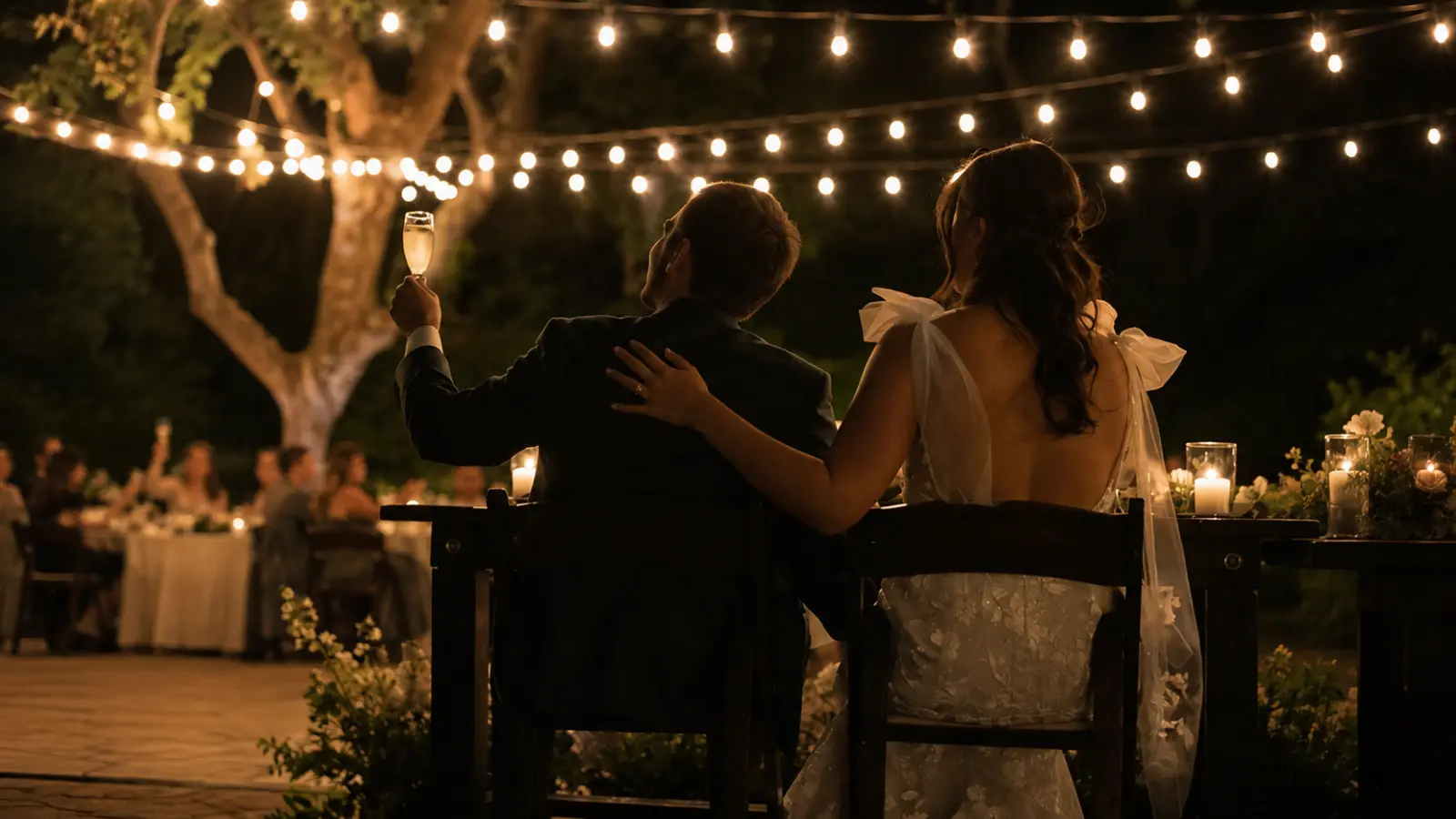
Learning how to plan an intimate wedding is not about stripping the celebration down until only the essentials remain. It is about designing the day around closeness: fewer social layers, more meaningful interaction, and a scale that allows the people in the room to feel genuinely connected to the couple and to one another.
That is also why “intimate” should not be treated as a synonym for inexpensive. A couple may choose a smaller guest list and still invest deeply in food, photography, music, design, or hospitality. The defining feature is not the total spend; it is the quality of the shared experience.
This guide shows how to plan an intimate wedding that feels complete by shaping the guest list, venue, ceremony, shared meal, toasts, activities, photography, and décor around the scale of the group. The goal is not to imitate a larger wedding with fewer people, but to let closeness become part of the design.
Define What “Intimate” Means for Your Wedding
An intimate wedding is best defined by the experience you are trying to create, not by one universal guest-count cutoff. Major wedding publications use different numerical ranges for “small” and “intimate,” which is a good reason not to build the entire plan around an arbitrary threshold.
Instead, define the relational outcome. Do you want enough time to speak with every guest? Do you want everyone at one dinner table or within one conversational zone? Do you want the ceremony to feel almost like a family gathering rather than a public performance?
Those answers will tell you more than whether the final list contains 28, 42, or 55 people. Small intimate wedding planning works best when the guest count is low enough to support the interaction you want.
Intimate Wedding Planning at a Glance
The table below shows how familiar wedding elements can be reframed around closeness rather than reduced simply because fewer people are attending.
| Element | Intimate Approach | Why | Avoid |
|---|---|---|---|
| Guest List | Invite people with active, meaningful relationships | Makes conversation and emotional connection feel natural | Expanding the list through obligation until the social dynamic changes |
| Venue | Use a room or property that feels comfortably occupied | Supports warmth and shared energy | Oversized spaces with empty zones |
| Ceremony | Bring seating close to the couple | Lets guests experience the vows at close range | A long aisle and rows designed for a much larger crowd |
| Meal | Prioritize shared dining and conversation | Dinner becomes part of the relationship experience | Separating a tiny group across too many tables |
| Toasts | Keep them personal and selective | Every speech carries more emotional weight in a small room | Turning dinner into an endless microphone rotation |
| Activities | Choose things the whole group can realistically join | Creates shared memory instead of audience/performer separation | Large-scale entertainment that overwhelms the room |
| Photography | Document interactions and relationships deeply | Fewer guests make more complete storytelling possible | Treating the day as though only couple portraits matter |
| Décor | Concentrate design where guests actually experience it | Small rooms reward detail and proportion | Overscaling décor to imitate a ballroom wedding |
The common thread is proportion. Each element should become more intentional as the guest count becomes more concentrated.
Invite for Relationship Depth, Not Just a Smaller Number
An intimate guest list works when most people in the room have a meaningful connection to the couple or to one another. Simply cutting a larger list in half does not automatically create that feeling.
Start with the people whose presence would meaningfully shape the day. Then decide how spouses and established partners, plus-ones, children, extended family, coworkers, and parental invitations fit the boundary you are trying to protect.
Be careful with “one exception.” In a very small room, each additional household changes the social mix more noticeably than it would at a large wedding—the aim is not exclusivity for its own sake, but a room where the relationships feel coherent enough that closeness is genuine rather than staged.
Choose a Venue That Supports Closeness
The venue should make a small group feel gathered, not scattered. Restaurants, private dining rooms, courtyards, gardens, homes, boutique hotels, and smaller spaces inside larger venues can all support an intimate format when the proportions are right.
Look at how the room feels at your actual expected count, not only its stated maximum capacity. Ask where dinner happens, how far guests sit from the ceremony, whether there are dead zones, and whether the room can transition naturally from vows to cocktails to dinner.
A smaller venue can also create stronger continuity because guests are less likely to disappear into separate rooms or distant lounge areas. A well-chosen intimate venue does not make the wedding feel tiny—it makes the group feel intentionally together.
Design a Ceremony Guests Can Feel Part Of
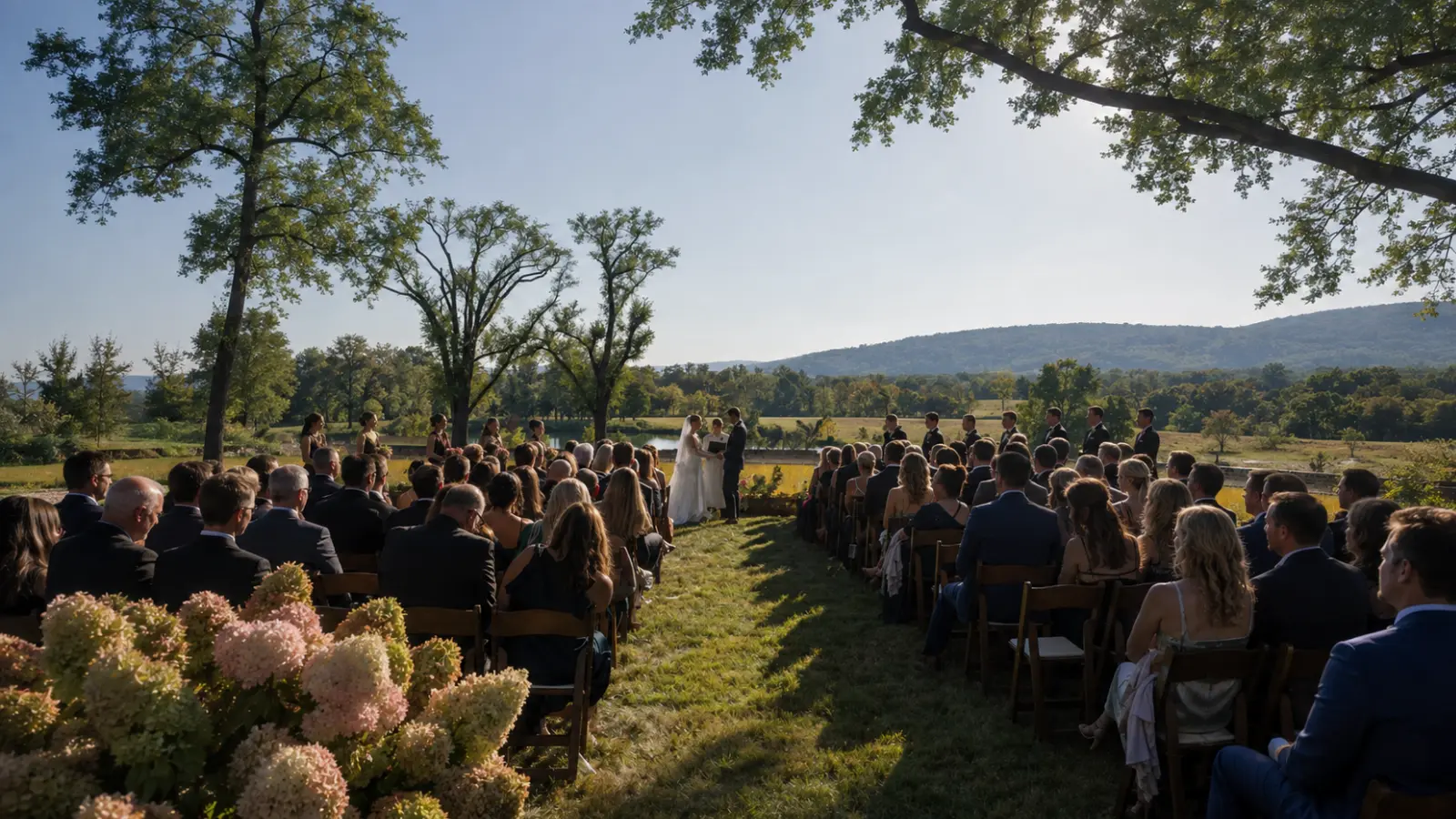
An intimate ceremony benefits from physical proximity. Guests can see expressions, hear the vows more naturally, and feel less like an audience watching from a distance.
Bring chairs closer when the space allows. Consider semicircular or slightly angled seating rather than rigid rows if that improves sightlines. A shorter aisle can also feel more natural when the group is compact.
Personal vows, readings from people who are genuinely close to the couple, or a family or cultural ritual can carry more emotional weight in this setting because everyone can experience it at close range. Do not confuse intimacy with informality—a close ceremony can still be highly formal; the distinction is distance, not dress code.
Make the Shared Meal a Centerpiece
For many intimate weddings, dinner is where the celebration feels most complete. A smaller group can turn the meal into the social center of the wedding instead of simply the period between cocktail hour and dancing.
One long table, a U-shaped arrangement, several closely connected tables, or a private restaurant dining room can all work. Family-style service, a tasting menu, plated dinner, or another format may be practical depending on the venue and budget.
Design the meal so guests can actually talk across and along the table. A beautiful tablescape matters less if the layout makes conversation difficult.
Use Toasts to Create Connection, Not a Long Program
Toasts can feel especially powerful at an intimate wedding because everyone listening is likely to understand the people, references, and relationships being described.
That also means speeches do not need to be numerous. Choose a few people who can add something genuinely personal and give them enough structure that the toasts stay focused.
You can also move away from the formal “one person at the microphone” model. A parent may speak at dinner, a sibling may offer a short welcome, or the couple may thank each guest collectively before the meal—the smaller the room, the more each voice matters, so use that intimacy deliberately rather than filling time.
Choose Activities That Work With a Small Group
Intimate wedding ideas planning should prioritize participation over spectacle. A smaller group can share experiences that would be difficult to organize for hundreds of people.
Depending on the wedding, that might mean a wine tasting, family-style dessert moment, live acoustic performance, lawn games, a group photo, a shared welcome activity, or simply a long dinner followed by dancing.
The point is not to keep everyone constantly entertained. Intimate weddings often benefit from open space in the timeline because conversation itself is part of the experience—if an activity makes guests stop interacting with one another for a long period, it may be interrupting the atmosphere rather than supporting it.
Plan Photography Around Relationships

A smaller guest list gives photography an opportunity to tell a more complete relational story. The photographer can realistically document more interactions, reactions, and family connections throughout the day.
That does not mean coverage should automatically be shorter. Getting ready, ceremony, portraits, dinner, toasts, dancing, and evening moments still happen on a timeline.
Instead, tell the photographer which relationships matter most. With fewer people, it may be realistic to capture photographs with every household, a complete group portrait, or more candid sequences involving parents, grandparents, siblings, and close friends—use the scale to deepen the archive, not simply reduce the shot list.
Scale Décor to the Room, Not to Pinterest
Décor at an intimate wedding often benefits from concentration. A smaller room does not need fewer ideas; it needs fewer competing focal points.
Invest where guests spend time: ceremony backdrop, dining table, lighting, place settings, flowers at conversational height, candles where permitted, menus, stationery, or one meaningful installation.
Large floral structures, oversized signage, or production-heavy décor can still work if the venue supports them, but they should not visually overpower the people in the room. At intimate scale, details are viewed from much closer distances, so refinement often matters more than volume.
What Makes an Intimate Wedding Feel Complete?
An intimate wedding feels complete when the day has a full emotional arc rather than a full inventory of traditional wedding elements.
You do not need every convention. You do need enough structure for the celebration to move naturally from one meaningful moment to the next:
- Arrival: guests know where they belong and feel welcomed.
- Ceremony: the marriage itself receives real attention.
- Transition: there is a natural shift into celebration rather than an awkward gap.
- Shared meal: guests have time to connect with the couple and one another.
- Personal moments: toasts, music, dancing, or another element reflects the relationships in the room.
- Closing: the evening ends intentionally rather than simply running out of scheduled activities.
That is the distinction between a wedding that feels small and one that feels intimate: scale becomes part of the experience instead of something the couple has to compensate for.
Let Closeness Shape the Celebration
An intimate wedding does not need to prove that it is a “real” wedding by reproducing every large-event tradition at a smaller scale. Let closeness do the work. When the room, ceremony, meal, toasts, photography, and design all reinforce the relationships in it, the celebration feels complete because nothing important feels distant.
Use the smaller social scale as an advantage rather than something to compensate for. The more intentionally each part of the wedding supports connection, the more the day feels full, personal, and complete without needing more people, more activities, or more production.
Frequently asked questions (FAQ)
How do you plan an intimate wedding?
Start by deciding what kind of closeness you want the wedding to create, then build the guest list, venue, ceremony, meal, seating, and schedule around that experience. Choose a scale that lets guests interact naturally, keep the room appropriately occupied, and prioritize the parts of the day that strengthen connection rather than adding traditions simply because they are expected.
How many guests make a wedding intimate?
There is no universal number. The better test is whether the guest count allows the level of interaction you want, such as speaking meaningfully with most guests, sharing a meal in one conversational space, or creating a ceremony where everyone feels close to the couple. The number should serve the experience rather than define it.
Is an intimate wedding the same as a small wedding?
Not exactly. A small wedding describes the size of the guest list, while an intimate wedding describes how the celebration feels. A wedding can have relatively few guests and still feel disconnected if the venue is oversized, the seating is scattered, or the schedule separates people instead of bringing them together.
Does an intimate wedding have to be inexpensive?
No. Fewer guests may reduce some per-person costs, but intimacy is not a budget category. Couples may choose to spend less overall or redirect more of the budget toward food, photography, music, flowers, hospitality, or other details that matter to the people attending.
What kind of venue works best for an intimate wedding?
Choose a venue that feels comfortably occupied at your actual guest count. Private dining rooms, restaurants, courtyards, gardens, homes, boutique hotels, and smaller event spaces can work especially well when guests remain physically connected throughout the celebration. Avoid choosing a room so large that the group feels scattered or the wedding looks unfinished.
What makes an intimate wedding feel complete?
A complete intimate wedding needs a meaningful flow, not every traditional wedding element. Give the day a clear beginning, a ceremony with real emotional focus, a natural transition into celebration, time for a shared meal and conversation, a few personal moments such as music or toasts, and an intentional ending. When each part suits the scale of the group, the wedding feels full rather than abbreviated.