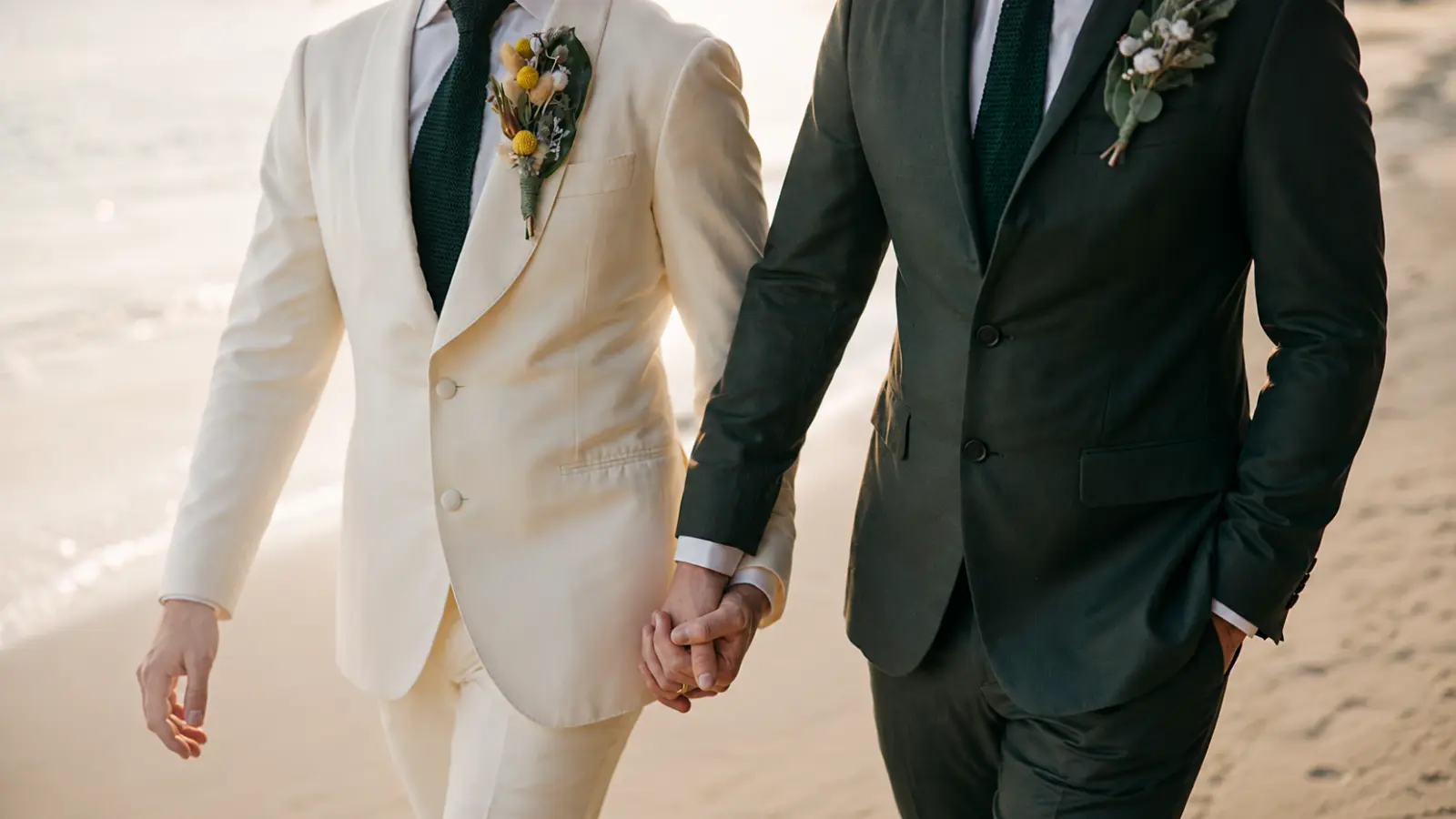
Same-sex wedding planning becomes much easier when the wedding is built around the couple instead of forcing the couple into traditional bride-and-groom roles. Assumptions can appear in invitation templates, processional diagrams, wedding-party labels, vendor forms, ceremony scripts, and even the way professionals talk about responsibilities.
Most of those structures do not need to be discarded. They simply need to be reviewed intentionally. Couples can choose the language that fits them, design a processional around their actual relationships, organize attendants without gendered sides, adapt family traditions, and make sure vendors and forms reflect the wedding they are actually planning.
This guide covers the parts of same-sex wedding planning where those choices matter most, including roles and language, processional order, wedding parties, attire, family traditions, vendor experience, forms, and ceremony wording. The goal is not to reinvent the wedding — it is to remove assumptions that do not belong and keep the traditions and structures that genuinely fit.
Choose Your Own Roles and Language First
Decide early how you want to be referred to, both as a couple and individually, because that decision touches almost everything else in the plan. “Bride and groom,” “two brides,” “two grooms,” “partners,” and “spouses” are all in active use, and there’s no single correct choice. What matters is picking language you’re both comfortable with before a vendor, officiant, or family member has to guess.
The same applies to how you want to be pronounced at the end of the ceremony. “Husband and husband,” “wife and wife,” “spouses,” and “married” all appear in real ceremonies, and the right one is simply the one that feels like you. Share this with your officiant well before the rehearsal, not on the day itself, so it becomes a natural line instead of a moment anyone has to think through live.
Once you’ve settled on language for yourselves, pass it along. Officiants, planners, emcees, and anyone giving a toast should know your preferred terms in advance — not so they can recite a script, but so they don’t default to the language they’re used to simply because no one told them otherwise.
Design a Processional That Fits Two People, Not a Template
A traditional processional was built around one person being walked down the aisle to meet the other waiting at the front, a structure that assumes different roles for two different people. You don’t have to use it, and you don’t have to invent an entirely new one either. Most couples land somewhere between “keep the tradition” and “start over.”
Common approaches include entering separately, each escorted by parents or another meaningful person; entering together, side by side; walking down two aisles that meet in the middle; or skipping a formal entrance altogether in favor of being present as guests arrive. None of these is more correct than another. The right one depends on what actually reflects your relationship and your families, not on what looks familiar in someone else’s wedding video.
If you like the traditional format but not the assumptions built into it, keep the structure and change the pairing. Two people can each be escorted by their own parents, siblings, or a combination of the two, without either person taking on a role the tradition wasn’t originally built for. Walk your choice through with your officiant and photographer ahead of time so the ceremony flow — and the shot list — actually reflects the order you’ve chosen.
Build a Wedding Party Around People, Not Gendered Sides
Bridesmaids and groomsmen are role labels tied to an assumption that no longer has to apply. The people closest to you don’t need to be sorted by gender to stand up for you. Choose who stands with each of you based on the relationship, not on which “side” they’re expected to belong to.
A wedding party can be mixed on both sides, entirely made up of one gender, split unevenly, or organized around some other logic entirely: close friends on one side, family on the other, or simply the people each of you asked. Attire can follow the same principle: matching looks, complementary but different looks, or fully individual choices based on what each person is comfortable wearing, regardless of which side of the aisle they’re standing on.
If you’re using a coordinator or day-of planner, tell them how the party is organized before the wedding day, not during it. Someone directing a processional or a lineup for photos needs the actual structure, not an assumption borrowed from a standard template.
Plan Attire Around the Couple, Not a Matching Set
Attire for the couple has the same opening built in as everything else on this list: there’s no requirement that one person wears a gown and the other a suit, or that both looks need to match in formality or style. Some couples choose two gowns, two suits, one of each, a shared color palette in different silhouettes, or two entirely different levels of formality that still work together.
Start the conversation with what each of you actually wants to wear, not with what a “matching” wedding-day look is supposed to look like. Retailers, designers, and tailors experienced with same-sex couples will be used to fitting two similar or two very different looks in parallel — ask directly about that experience when you’re choosing where to shop.
Coordinate timing the same way any couple would: confirm fitting schedules, alteration windows, and delivery dates for both looks independently, since they may not follow the same production timeline even if they’re coming from the same store.
Handle Family Traditions Without Assuming Who They Belong To
Many wedding traditions were written with a specific role in mind: a father-daughter dance, a mother’s blessing over the bride, a family heirloom passed to “the bride.” None of that has to disappear; it just may need a new owner. Decide, as a couple, which traditions matter enough to keep, then assign them to the person and relationship that actually fits, rather than defaulting to whichever partner the tradition was historically “supposed” to belong to.
A first dance with a parent can happen for one partner, both partners, or neither, depending on what feels meaningful. A blessing, toast, or ritual object can move to whichever family member or relationship it genuinely reflects. If a tradition was clearly built around a role neither of you occupies, it’s reasonable to retire it, adapt it, or replace it with something that means the same thing to your specific family.
Talk to family members directly about any tradition that involves them, rather than assuming they’ll understand the adjustment on their own. Most of these conversations go more smoothly than couples expect, especially when they happen early and the couple leads with what they’d like to do rather than opening with what they’re changing.
Evaluate Vendors for Real Experience, Not Just a Rainbow Logo
A vendor’s willingness to work with a same-sex couple is the minimum, not the qualification. What actually matters is whether they have real experience: intake forms that don’t default to “bride” and “groom,” a portfolio that shows same-sex couples rather than a single token photo, and a team that won’t need basic guidance mid-planning.
Ask directly during your first conversation with any vendor: how many same-sex weddings have they worked, and what would they do differently for yours versus a different-sex wedding. A vendor with real experience will have a concrete answer about intake forms, photo posing, seating logic, or ceremony structure. A vague answer about being “totally open to it” is a sign they’re willing, not necessarily experienced.
The venue deserves the same scrutiny as any other vendor, not less. Ask whether they’ve hosted same-sex weddings before, whether their marketing materials show same-sex couples, and whether their staff, not just management, is comfortable with the ceremony structure you’re planning. A venue that is willing to host your wedding is not necessarily the same as a venue that will make the day feel genuinely welcome.
Expect to Correct Forms Built for a Different Couple
Most wedding paperwork (save-the-date templates, RSVP cards, seating software, vendor contracts) was designed with “bride” and “groom” fields baked in, and correcting that is usually simple once you know to look for it. Check early rather than assuming a platform or vendor has already accounted for it.
For digital tools like wedding websites, RSVP platforms, and seating chart software, look for a setting that lets you rename or relabel default fields before you build out the rest of your site. Retrofitting labels after guests have started responding creates more cleanup than catching it up front. For printed materials, review a proof carefully before anything goes to production, since a template default can slip through even when a vendor knows better.
Marriage license applications and other government forms vary by state in how they’re labeled, and some jurisdictions still use legacy language on older forms even where the requirements themselves are fully gender-neutral. Confirm the current form and any renaming or clerical corrections available in your specific jurisdiction with the office issuing the license — a form’s outdated wording doesn’t reflect a legal restriction, but it’s worth clarifying with the clerk directly rather than assuming.
Write Ceremony Language That Actually Fits
Beyond the pronouncement, most ceremony scripts include smaller phrases that quietly assume a bride and groom: “you may now kiss the bride,” references to “husband and wife,” or vow language written for one specific pairing. An officiant experienced with same-sex ceremonies will already have alternatives ready; one who isn’t may simply not have thought about it.
Review the full script in advance, not just the pronouncement line. Small phrases scattered throughout, in introductions, transitions, and blessings, carry the same assumptions as the final line, and they’re easier to catch on paper than to hear for the first time during the ceremony.
Since same-sex marriage has been legally recognized nationwide since the 2015 Supreme Court ruling in Obergefell v. Hodges, there’s no longer a legal reason for a script to differ from any other wedding’s — any remaining “traditional” phrasing in a script is a drafting habit, not a requirement. If your officiant offers a standard script, ask whether it was written with a same-sex couple in mind or adapted from a different-sex template, and revise accordingly.
Where Assumptions Show Up — and What to Do Instead
Some of the more common defaults are worth checking against your own plan before they show up unannounced in a form, a script, or a seating chart. The table below isn’t exhaustive, but it covers the areas that trip up couples most often.
| Area | Assumption to Avoid | Inclusive Approach |
|---|---|---|
| Pronouncement | Defaulting to “husband and wife” | Choose your own phrasing with the officiant in advance |
| Processional | One person “given away” to the other | Design an order that reflects your actual relationship |
| Wedding party | Splitting attendants by gender into two “sides” | Group people by relationship, not gender |
| Attire | One gown, one suit, by default | Let each partner choose independently |
| Forms and websites | Fixed “bride” and “groom” fields | Confirm relabeling options before building the site |
| Family traditions | Assigning a ritual to whichever partner “fits” the old role | Reassign, adapt, or retire it based on what fits now |
Most of these fixes take a single conversation or a five-minute form edit. The work isn’t complicated — it just has to happen before the assumption shows up in front of your guests instead of after.
Build the Wedding Around the Couple
Same-sex wedding planning does not require rebuilding every tradition from the ground up. It means noticing where a form, script, processional, wedding-party structure, or vendor process assumes roles that do not fit your relationship, then changing those details before they become part of the wedding by default.
Keep the traditions that feel meaningful, adapt the ones that need a different structure, and let go of the assumptions that serve no purpose. When the language, roles, vendors, and ceremony reflect the couple who is actually getting married, the wedding feels natural because the plan was built around them from the beginning.
Frequently asked questions (FAQ)
How do you plan a same-sex wedding without traditional bride and groom roles?
Start by deciding which traditions and labels actually fit the two of you instead of assigning responsibilities or ceremony roles by gender. Choose your preferred language, processional structure, wedding-party organization, attire, family traditions, and pronouncement intentionally, then share those decisions with your planner, officiant, vendors, and anyone else who needs to execute them.
What do you call the couple at a same-sex wedding?
There is no single required term. Couples may use “two brides,” “two grooms,” “partners,” “spouses,” their names, or another description that feels natural to them. Decide on the language you prefer early and share it with your officiant, planner, emcee, vendors, and anyone speaking during the wedding so nobody has to guess.
Who walks down the aisle first at a same-sex wedding?
There is no required order. You can enter separately, walk together, use different aisles that meet at the ceremony, have each partner escorted by parents or another meaningful person, or skip a formal processional entirely. Choose the structure that reflects your relationships and then rehearse it with the officiant, coordinator, and photographer.
How should you organize the wedding party at a same-sex wedding?
Choose attendants based on the relationships that matter to you rather than separating people by gender. Wedding parties can be mixed, uneven, organized around each partner’s closest people, or structured without traditional “sides” at all. Titles and attire can also be adapted so each person has a role that fits rather than one inherited from a standard template.
How do you find LGBTQ+-experienced wedding vendors?
Look for evidence of real experience rather than a general statement of inclusivity. Ask whether the vendor has worked with same-sex couples before, review portfolios and intake forms, and listen for specific answers about ceremony structure, posing, language, forms, or other parts of their process. The goal is to hire professionals who can work naturally with your wedding without relying on assumptions.
What should you check for inclusive language in wedding planning?
Review vendor forms, wedding websites, invitation templates, ceremony scripts, contracts, seating tools, and any materials that automatically use “bride” and “groom.” Replace those defaults with the terms you actually use, and check the full ceremony script for smaller phrases that may carry the same assumptions. Making those corrections early prevents repeated explanations later.