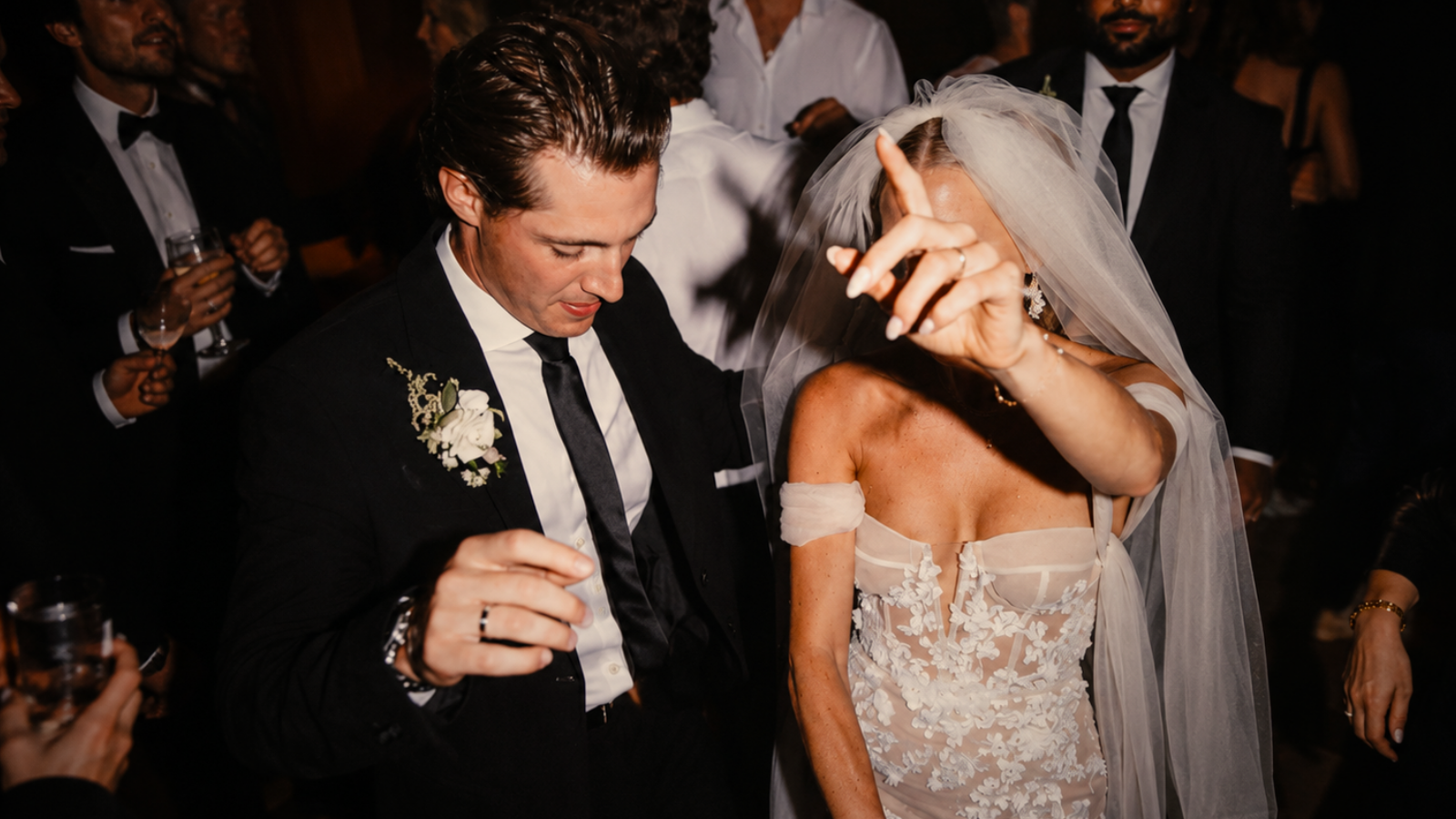

Wedding recessional songs are the songs played as the couple walks back up the aisle together at the end of the ceremony, immediately after the first kiss. This moment marks the emotional release of the entire ceremony — the shift from anticipation to celebration.
Unlike the processional, which builds emotion, the recessional is where that energy finally comes out. The right song turns that walk into a moment guests feel — not just watch. A slow or mismatched song can flatten the energy, while the right one makes the entire room react instantly.
This guide brings together the best wedding recessional songs for every style as part of a complete collection of wedding songs for every moment of the day — including upbeat, romantic, classic, country, Catholic, and non-traditional picks — along with practical guidance on timing, energy, and how to end your ceremony on exactly the right note.
What Is a Wedding Recessional — and How Does It Work?
The recessional is the exit that closes the ceremony. After the officiant pronounces the couple married and they share their first kiss, the wedding party walks back up the aisle — couple first, then the wedding party in pairs behind them. The recessional song plays throughout this exit.
Unlike the processional — which builds toward an emotional peak — the recessional releases that built emotion. The ceremony has just been the most meaningful thing these people have witnessed together. The recessional’s job is to let that feeling out. A joyful, high-energy song communicates: we did it, we are married, this is a celebration. A slow or quiet recessional communicates the opposite — and the room, which is ready to cheer, has nowhere for that energy to go.
Most experienced DJs recommend that the recessional be the most upbeat song of the entire ceremony. Not every couple goes this route, and a romantic exit can be genuinely beautiful — but if you are unsure which direction to choose, go more celebratory — one of the most useful principles when learning how to choose wedding music.
Best Upbeat Wedding Recessional Songs
These are the songs that make guests stand up, cheer, and immediately feel like the party has started. They are consistently the most effective recessional choices because they match the emotional energy of the room — which, right after a first kiss, is ready to celebrate.
| Song | Artist | Why It Works |
|---|---|---|
| Signed, Sealed, Delivered I’m Yours | Stevie Wonder | The most reliably effective upbeat recessional in American wedding history — universally loved, immediately joyful |
| Don’t Stop Me Now | Queen | Builds energy fast; the room reacts before the couple reaches the door |
| Happy | Pharrell Williams | Sets the most joyful possible tone; works for every age group |
| Best Day of My Life | American Authors | Thematically perfect; immediately identifiable |
| I Got You (I Feel Good) | James Brown | The most energetic possible exit — guests often start dancing in the aisle |
| September | Earth, Wind & Fire | Gets every generation moving; no one in the room dislikes this song |
| Walking on Sunshine | Katrina and the Waves | Bright, unmistakable, makes outdoor summer ceremonies feel perfect |
| Marry You | Bruno Mars | Used as both a processional and recessional; works in the exit role especially |
| You Make My Dreams | Hall & Oates | Joyful and genuinely underused as a recessional |
| Jump Jive an’ Wail | Louis Prima | Big band energy; perfect for couples who love a vintage feel |
| Beautiful Day | U2 | Anthemic and emotionally warm; strong intro that hits immediately |
Pro tip: Ask your DJ to start the recessional song at the chorus or a strong melodic moment — not the very beginning. Guests should hear the most recognizable part of the song immediately when the couple turns to walk out. The intro can build, but for an exit of 60 to 90 seconds, start strong.
Romantic Wedding Exit Songs
Not every ceremony calls for an upbeat exit. Intimate ceremonies, smaller weddings, and couples whose relationship is more quietly sincere than outwardly celebratory can exit beautifully to a romantic song. The key is tempo — even a romantic recessional should move. A song that is too slow makes the walk feel endless for both the couple and the guests watching.
| Song | Artist | Vibe |
|---|---|---|
| All You Need Is Love | The Beatles | The singalong element means guests participate; romantic and uplifting simultaneously |
| Here Comes the Sun | The Beatles | Gentle and joyful; one of the most beloved recessionals for outdoor ceremonies |
| What a Wonderful World | Louis Armstrong | Warm, timeless, works at any age and any ceremony style |
| Lovely Day | Bill Withers | Builds beautifully; that single held note lands every time |
| Better Together | Jack Johnson | Relaxed and warm; popular at beach and outdoor ceremonies |
| At Last | Etta James | Romantic exit for couples who want a soulful, classic feel |
| L-O-V-E | Nat King Cole | Swing feel; elegant and celebratory without being over the top |
| Grow Old With Me | Tom Odell | For intimate ceremonies where the couple wants to exit quietly and sincerely |
Note on “All You Need Is Love”: This is the rare recessional song that bridges upbeat and romantic. The singalong quality — nearly every guest in the room knows the chorus — creates a collective participation that lifts the room even though the song itself is not high-energy. It is one of the most reliable recessional choices across every ceremony style.
Classic and Timeless Recessional Songs
Classic recessional songs are those that have appeared at American weddings for decades — not classical in the orchestral sense, but songs that have proven themselves across enough ceremonies to be genuinely timeless rather than trend-dependent. These are safe choices in the best sense of the word: you are almost certainly not going to regret them in ten years.
| Song | Artist | Era / Style |
|---|---|---|
| Can’t Help Falling in Love | Elvis Presley | Works for both processional and recessional; enduringly romantic |
| Stand by Me | Ben E. King | Timeless; the promise in the title feels perfect as an exit |
| Twist and Shout | The Beatles | High energy classic; guests often start clapping immediately |
| I Will | The Beatles | Short, sweet, and perfectly sincere |
| Come Fly With Me | Frank Sinatra | Elegant and celebratory; suits formal venues |
| Fly Me to the Moon | Frank Sinatra | Classic Sinatra; warm and romantic |
| La Vie en Rose | Édith Piaf / various | Works as both a processional and recessional; instantly romantic |
| Signed, Sealed, Delivered I’m Yours | Stevie Wonder | Classic soul; has been a recessional standard for over 30 years |
Classical and Instrumental Recessional Music
Classical wedding songs used as recessionals are especially common at Catholic, Episcopal, and formal Protestant ceremonies. Many religious venues require or strongly prefer liturgically appropriate music throughout the ceremony — the recessional is often where they have more flexibility, but confirming with your music director is essential.
| Piece | Composer | Character |
|---|---|---|
| Wedding March | Mendelssohn | The traditional classical recessional; triumphant, formal, immediately recognizable |
| Ode to Joy | Beethoven | Triumphant and joyful; works in formal and informal settings |
| Trumpet Voluntary | Jeremiah Clarke | Grand and ceremonial; announces the exit emphatically |
| Toccata and Fugue in D Minor | Bach | Dramatic and unexpected; memorable for the right couple |
| Finale from Symphony No. 5 | Beethoven | The most triumphant possible classical exit |
| Joyful Joyful We Adore Thee | Beethoven / arr. | Common in Catholic and Protestant ceremonies; congregation often knows the words |
| Hallelujah Chorus | Handel | Reserved for formal religious ceremonies; guests often stand |
| Canon in D (up-tempo arrangement) | Pachelbel | A fast arrangement of Canon in D can work as a recessional if you want tonal consistency with the processional |
Note on the Wedding March: Mendelssohn’s Wedding March — not Wagner’s Bridal Chorus — is the traditional classical recessional. They are frequently confused. The Bridal Chorus (“Here Comes the Bride”) is the processional; the Wedding March is the exit. If you want the traditional classical recessional, you want Mendelssohn.
Country Wedding Recessional Songs
Country wedding recessional songs work across a wide range of ceremony styles — from barn weddings and outdoor venues to more formal church settings. The country genre has produced some genuinely excellent exit songs because Nashville songwriters understand the specific emotional beat of a couple walking out together for the first time.
| Song | Artist | Vibe |
|---|---|---|
| Best Day of My Life | American Authors | Country-adjacent pop; the most on-theme exit song title in existence |
| Life is a Highway | Rascal Flatts | High energy; works especially well for outdoor country ceremonies |
| It’s a Great Day to Be Alive | Travis Tritt | Thematically perfect for a wedding exit |
| This Is It | Kenny Rogers | Classic country recessional; warm and celebratory |
| Neon Moon | Brooks & Dunn | For a slower, more romantic country exit |
| Brand New Man | Brooks & Dunn | Upbeat traditional country feel |
| Sweet Home Alabama | Lynyrd Skynyrd | Not country by genre but works at country-style weddings; crowds respond immediately |
| Die a Happy Man | Thomas Rhett | Modern country recessional for couples who want emotion over energy |
| Yours | Russell Dickerson | Quiet, sincere exit for intimate country ceremonies |
Catholic Wedding Recessional Songs
Catholic wedding recessional songs are subject to the same considerations as all Catholic ceremony music: what is permitted depends significantly on your specific parish and diocese. Many Catholic churches require liturgically approved music throughout Mass, which is why Christian wedding songs remain a popular choice for ceremony music — which is technically the post-ceremony music rather than part of the Mass itself. Always confirm with your priest or music director before finalizing any song.
The safest approach is to have two options ready: one that is unambiguously liturgically appropriate (classical, traditional hymn) and one that is your personal preference. Discuss both with your church’s music coordinator well in advance.
| Song / Piece | Composer / Artist | Notes |
|---|---|---|
| Wedding March | Mendelssohn | The traditional Catholic recessional; accepted at virtually every parish |
| Ode to Joy | Beethoven | Joyful and liturgically appropriate; frequently used |
| Joyful Joyful We Adore Thee | Beethoven / hymn text | Common in Catholic and Protestant churches; congregation often sings along |
| Trumpet Voluntary | Jeremiah Clarke | Grand and triumphant; accepted at formal Catholic ceremonies |
| All Creatures of Our God and King | Traditional hymn | Uplifting hymn recessional; well-suited to the moment |
| Hallelujah Chorus | Handel | Reserved for formal occasions; guests stand at many Catholic churches |
| How Great Thou Art | Traditional hymn | Classic hymn recessional for Catholic and broadly Christian ceremonies |
Note for Catholic couples: Many parishes have a dedicated music director or organist who works with couples specifically on ceremony music. This is your most valuable resource for navigating what is permitted at your church. Schedule a meeting early in your planning process — ideally 6 months before the wedding.
Funny and Non-Traditional Recessional Songs
Non-traditional and funny recessional songs are one of the most shareable wedding moments — videos of unexpected recessionals consistently go viral. They work best when both partners are completely aligned on the choice, when the song reflects something genuine about the couple, and when the wedding party is in on it and plays along.
The risk is real: a funny recessional that does not land leaves a slightly deflated feeling at the close of the ceremony. Confirm with your officiant that they are comfortable with the tone, and make sure the full wedding party knows what is coming so no one looks caught off guard.
| Song | Artist | Effect |
|---|---|---|
| Jump Around | House of Pain | The crowd reaction is immediate and total; guests who know it cannot help but move |
| Mr. Brightside | The Killers | Non-traditional in the best sense; younger guests especially love this |
| Africa | Toto | The internet’s unofficial wedding song; genuinely beloved despite the irony |
| Bohemian Rhapsody | Queen | The intro lands perfectly for an exit; guests react to the first chord |
| I’m a Believer | The Monkees / Smash Mouth | Shrek association aside — genuinely joyful and singable |
| We Are the Champions | Queen | For the couple who has no reservations about being theatrical |
| The Final Countdown | Europe | Comedic but effective; the buildup to the walk-out is genuinely dramatic |
| Here Comes the Hotstepper | Ini Kamoze | High energy surprise exit; works for the couple who wants the unexpected |
Pro tip: The most effective funny recessionals are not the ones that are obviously a joke from the first note. They are the ones where the first two seconds could be anything — and then the song reveals itself and the room erupts. The element of surprise is most of the effect.
Wedding Recessional Songs Playlist
Listen to the full playlist of wedding recessional songs below, featuring upbeat exit songs, romantic favorites, and classic picks that match the moment you walk out as a married couple. Use it to find what feels right — not just what sounds familiar.
How to End Your Ceremony on a High Note
The recessional is the last impression the ceremony makes. Everything else — the venue, the flowers, the vows, the tears — lands in a room that then immediately hears whatever song you have chosen for this exit. That song either crystallizes the emotion of everything that just happened or it deflates it. Here is how to make sure it does the former.
Match the song to the ceremony tone, not just your taste. If your ceremony was intimate and emotional, a suddenly aggressive upbeat song can feel jarring. If your ceremony was joyful and celebratory from the start, a quiet exit feels anticlimactic. The recessional should feel like the natural conclusion of the emotional arc of the ceremony — not a genre shift.
Tell your DJ to play it loud. The recessional is not background music. It is the soundtrack to one of the most photographed walks of your life. The volume should be high enough that guests feel it — not so high that it is uncomfortable, but loud enough that the room knows the ceremony is celebrating, not ending quietly.
Let it play until everyone is out. One of the most common mistakes is cutting the recessional song as soon as the couple exits. The wedding party is still walking. Guests are still standing. Let the music continue until the last wedding party member has cleared the venue. The song ending while people are still mid-aisle undercuts the moment.
Consider the transition to cocktail hour. What plays immediately after the recessional sets the tone for cocktail hour. Brief your DJ on whether you want a natural transition (the recessional fades into cocktail music) or a deliberate pause before the next segment begins.
What to Tell Your DJ About the Recessional
Most ceremony music problems are communication problems. Give your DJ the following information in writing at least two weeks before the wedding:
- The exact song title and artist — not just the song name; specify the original version or a specific cover if you have a preference
- The timestamp to start from — if you want the chorus to hit when you appear at the aisle, tell them to start at 1:02 (or wherever the appropriate point is) rather than the beginning
- How long to play it — either a specific duration or “until all wedding party members have exited”
- Whether to fade or let it play to the end — for short exits, fading out is cleaner; for longer ones, letting the song conclude naturally often works better
- The transition to cocktail hour — whether you want a pause, a direct transition, or something specific to follow the recessional
- Volume — specify if you want it notably louder than ceremony music; most DJs need explicit permission to turn it up for this moment
Final thoughts
The recessional is not just the end of the ceremony. It is the moment everything releases.
After the vows, the anticipation, and the emotion of the first kiss, the music you choose determines how that moment lives in memory. A strong recessional does not just accompany the exit — it transforms it into something guests feel immediately.
If the song matches the energy of the moment, you will not notice it playing. You will simply feel it — and that is what makes it unforgettable.
Frequently asked questions (FAQ)
What are wedding recessional songs?
Wedding recessional songs are the songs played at the end of the ceremony when the couple walks back up the aisle together after the first kiss. They are typically the most upbeat and celebratory songs of the ceremony.
What are the best wedding exit songs?
The best wedding exit songs are upbeat and recognizable, such as “Signed, Sealed, Delivered I’m Yours,” “Happy,” and “Don’t Stop Me Now.” These songs match the energy of the moment and create a strong emotional finish.
Should wedding recessional songs be upbeat or romantic?
Most couples choose upbeat songs because the recessional is a celebration. However, romantic songs can work well for smaller or more intimate ceremonies, as long as they are not too slow.
How long should a wedding recessional song be?
Wedding recessional songs typically last between 2 and 3 minutes, which is enough time for the couple and the entire wedding party to exit the ceremony space.
Can you use the same song for processional and recessional?
It is not recommended. The processional builds emotion, while the recessional releases it. Using different songs creates a stronger emotional contrast and makes both moments more impactful.

About the Author
Débora Justo
Founder and editor of EVORÉ, creating practical wedding planning resources, thoughtful inspiration and useful tools for the decisions that shape a celebration.
Read more about the author →