Learning How to Correct a Marriage Certificate starts with identifying exactly where the error exists. A mistake on an unrecorded marriage license, incorrect information in the official marriage record, and an error that appears only on one printed copy may require different correction procedures.
Once the marriage has been recorded, changing the official information generally requires the authorized record custodian’s correction or amendment process. Depending on the jurisdiction and type of error, that may involve an application, supporting evidence, identification, signatures, notarization, fees, or additional legal documentation. Ordering another copy, editing a scan, or writing on the certificate does not change the underlying record.
This guide explains How to Correct a Marriage Certificate step by step, including how to identify the correct record and office, distinguish a correction from an amendment or replacement, gather supporting documents, submit the request, handle fees and processing, obtain updated certified copies, and determine what to do if the correction is denied or requires a more complex legal process.
Identify the Document Before Starting
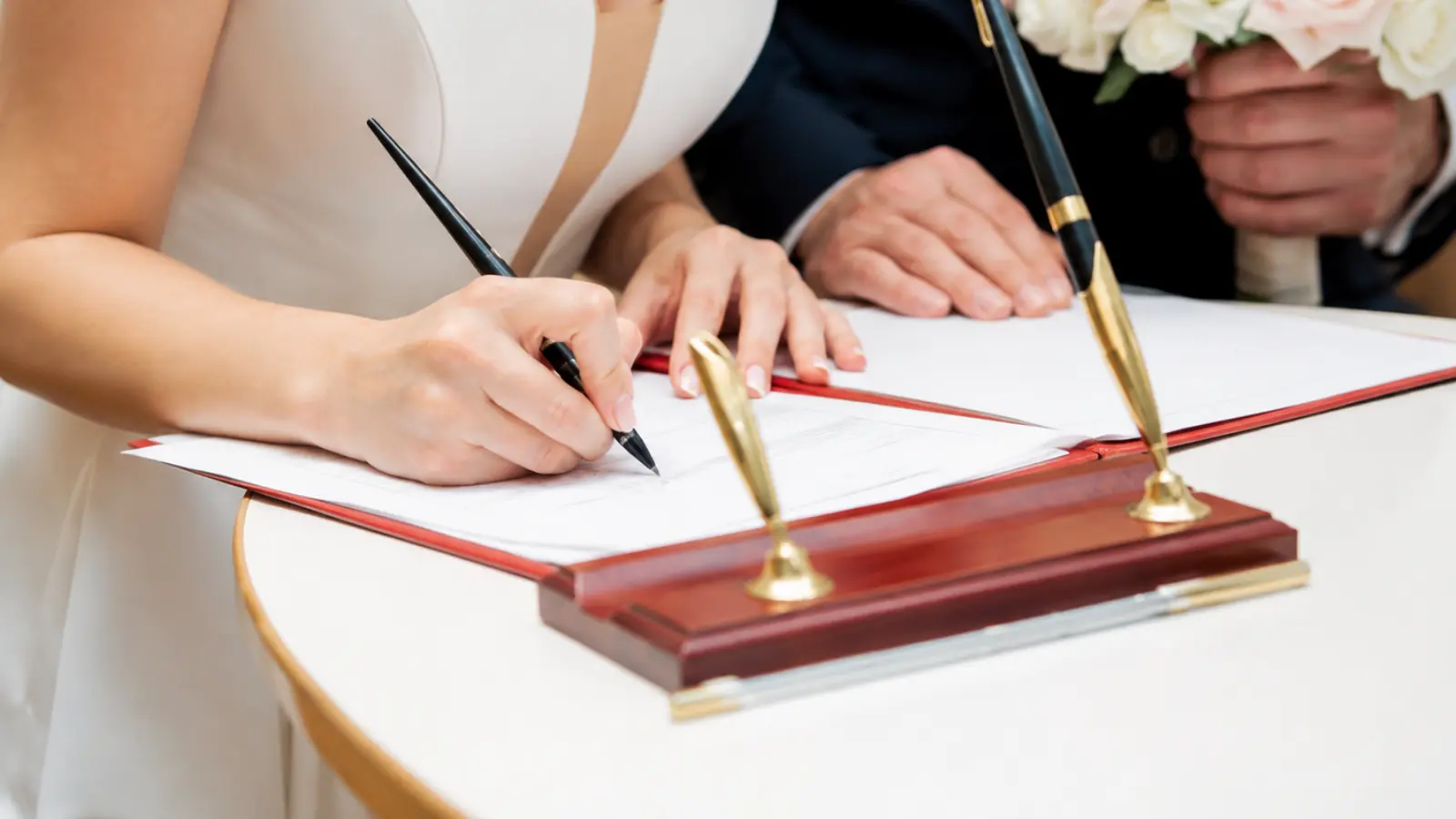
A marriage license authorizes the marriage before the ceremony. After the ceremony, the completed license is returned and recorded, creating the official marriage record from which certificates or certified copies are issued.
EVORÉ’s marriage license vs marriage certificate guide explains that difference in detail. For correction purposes, timing determines the starting point:
- If the license has not been used or recorded, contact the issuing office immediately.
- If the ceremony occurred but the document has not been returned, contact the issuing office and officiant.
- If the marriage was recorded, follow the custodian’s formal amendment process.
- If only one printed copy appears wrong, compare it with the official record before requesting an amendment.
A new marriage license may be required when a pre-ceremony error cannot be corrected on the existing license. Do not assume a correction available before recording remains available after the certificate is created.
Correction, Amendment and Replacement Are Different
Offices may use “correction” for a typographical or data-entry mistake and “amendment” for the formal process that adds, changes, or clarifies information in the record. Other jurisdictions use the words interchangeably.
A replacement certificate is simply another copy of the record currently on file. Ordering a replacement does not correct an error in the source record.
An amended certificate is issued after an authorized change is accepted. The jurisdiction may replace the presentation copy, attach an amendment, add a notation, preserve the original information in the record history, or use another legally required format.
Common Marriage Certificate Errors
Potential errors include:
- misspelled names or misplaced name components;
- incorrect date or place of marriage;
- wrong birth date, birthplace, residence, or identifying information;
- incorrect information about a previous marriage;
- errors in parent information where the record includes it;
- officiant, witness, ceremony, or license information entered incorrectly;
- information omitted from a required field;
- a transcription error introduced when the record was indexed or printed.
Not every unexpected entry is an error. The certificate may preserve names as they appeared on the application or at the time of the wedding, use standardized abbreviations, omit confidential fields from public copies, or display an amendment differently from another state’s certificate.
Clerical Error vs Substantive Change
A clerical error generally involves inaccurate recording of a fact that was correct when the marriage occurred. A substantive change asks the office to alter a legal fact, identity, status, or historical information rather than correct a transcription.
Substantive requests may require stronger evidence, consent from additional people, a separate administrative route, or a court order. The applicant should describe the fact accurately instead of selecting a “minor error” category simply because it appears easier.
Which Office Corrects a Marriage Certificate?
There is no federal marriage-certificate correction office. U.S. marriage records are maintained through state and local systems.
USAGov’s official marriage certificate guidance directs people married in the United States to the vital records office in the state where the marriage occurred. That office can identify the cost, required information, and available request methods.
The actual custodian may be a:
- state vital records office;
- county clerk or recorder;
- city or town clerk;
- clerk of court;
- local registrar or another designated office.
The CDC’s Where to Write for Vital Records directory organizes official contact information by the state or area where the event occurred. It also makes clear that the federal government does not distribute individual vital-record certificates.
Start with the Office Named on the Record
Look at the seal, certification statement, issuing office, state file number, local file number, and county shown on the certificate. Then use the official government website to find amendment instructions for that exact record type and year.
If the state and county both issue copies, ask which office has authority to amend the source record. An office that can sell a copy may not be the office authorized to approve the change.
Marriage Certificate Correction Starting Points
The right first call depends less on what the error is than on when it happened. This table maps the most common situations to a likely starting office and what to have ready.
| Situation | Likely Starting Office | Typical Evidence | Possible Extra Step | Confirm Before Filing |
|---|---|---|---|---|
| Error before ceremony | Marriage license issuing office | Application, ID, and correct source document | Corrected or new license | Whether the original remains usable |
| Error after recording | Record custodian or vital records office | Amendment form and supporting records | Additional signatures or court order | Correct amendment category |
| One copy differs from record | Office that issued the copy | Copy, receipt, and identity details | Replacement printing | Whether the source record is correct |
| Requested legal change | Custodian named by local law | Court order or authorized proof | Separate legal process | Whether amendment is legally permitted |
The table is a routing framework, not a national rule. Use the terminology and form provided by the custodian rather than sending a generic affidavit from another state.
How to Correct a Marriage Certificate Step by Step
The exact form and office change by jurisdiction, but the sequence below holds for most amendment requests.
- Obtain the current record. Review a recent certified or official copy rather than relying on memory or an unofficial database.
- Mark the exact field. Write down what the certificate shows and what the correct information should be.
- Identify the custodian. Confirm which state or local office has amendment authority.
- Choose the correct request. Ask whether the issue is a correction, amendment, supplemental record, replacement print, or court-ordered change.
- Read eligibility rules. Determine who may request the change and whether both spouses or another participant must sign.
- Gather evidence. Use the document types and date ranges accepted by that office.
- Complete the form accurately. Match names, file numbers, dates, and signatures to the official instructions.
- Submit the fee and request. Use the approved payment and delivery method.
- Track the response. Preserve receipts, confirmation numbers, and requests for additional evidence.
- Order updated certified copies. Verify the correction before using the amended record elsewhere.
EVORÉ’s marriage certificate copy guide explains online, mail, and in-person ordering. An amendment request may use a different form and address from an ordinary copy request.
Supporting Documents for an Amendment Request
The office may ask for evidence that existed before the correction dispute and independently shows the correct fact. Possible records include:
- government-issued identification;
- birth or naturalization records;
- the marriage license application or ceremony return;
- passport, Social Security, school, medical, military, or employment records;
- prior marriage termination records where relevant;
- a sworn affidavit from the spouses, officiant, witness, or clerk;
- a court order authorizing a legal change;
- a certified copy of the current marriage record.
Not every office accepts every document, and a recent document may not prove what was true when the marriage occurred. Follow the custodian’s evidence list and ask whether copies must be certified, notarized, translated, or original.
Who Must Sign?
A simple clerical correction may require one applicant’s signature. Other amendments may require both spouses, the officiant, the original clerk, a notary, or a court. A spouse’s inability or refusal to sign can change the available process.
California provides a useful example of jurisdictional variation. Its official marriage-record amendment guidance distinguishes state-handled records from confidential marriage records that must be amended through the county clerk. That example should not be treated as another state’s procedure.
Fees, Payment Methods and Processing Time
An amendment may involve a filing fee, search fee, certified-copy fee, expedited service, notarization, translation, court filing, or mailing cost. Some offices include one corrected copy with the amendment fee; others require a separate order.
Verify the current amount and accepted payment method on the official website. Do not mail cash or assume an ordinary certificate-copy fee covers amendment review.
Processing time can differ from standard copy processing because staff may need to verify evidence, obtain approval, match state and local files, or return an incomplete submission. Avoid purchasing nonrefundable travel or scheduling a hard deadline based on an estimate.
Certified Copies After the Correction
A correction to the source record does not update certificates already issued. Order new certified copies when an agency needs the corrected information.
EVORÉ’s guide to a certified copy of a marriage certificate explains why a government-certified copy is different from a photocopy or a notarized reproduction. Ask whether the amended copy carries a notation, attachment, replacement page, or new issue date.
Before submitting the corrected certificate elsewhere, check every changed field, seal, certification, and attachment. If the correction was accepted but the new copy is still wrong, contact the issuing office promptly with the amendment approval and receipt.
Name Change After Marriage Is Usually a Separate Process
A person may choose to use a spouse’s surname, retain a prior name, hyphenate, or use another format permitted by applicable law. Updating identity records after marriage is not automatically a correction to the historical marriage certificate.
EVORÉ’s legal name change after marriage guide covers Social Security, state ID, passport, employer, financial, and other updates. Those agencies may use the marriage certificate as evidence while leaving the certificate itself unchanged.
An amendment may be appropriate when the certificate recorded a name incorrectly or the jurisdiction expressly authorizes a change to that field. Ask the custodian which name the certificate is legally supposed to show before filing.
Indexes, Search Results and Official Records
An online marriage index may contain a transcription error even when the official certificate is correct. Correcting a website entry is not necessarily the same as amending the legal record.
EVORÉ’s marriage records guide distinguishes indexes, public searches, verifications, informational copies, and certified documents. Compare the official record before beginning a legal amendment.
Third-party genealogy or people-search sites cannot amend a government record. If their listing is inaccurate, use their correction process separately and do not send sensitive identity documents unless the service and request are legitimate.
Correction Before Apostille or International Use
If the marriage certificate will be used abroad, correct the source record before requesting authentication, apostille, or translation. An apostille verifies the public official’s signature or seal; it does not repair incorrect facts inside the certificate.
EVORÉ’s marriage certificate apostille guide explains the document-first sequence for international use. Ask the foreign receiving authority whether it needs the amended certificate, amendment attachment, translation, or another version.
If the Correction Is Denied or the Request Is Complex
Read the written reason for rejection. Common problems include the wrong office, incomplete form, missing signature, unacceptable evidence, inconsistent documents, incorrect fee, lack of eligibility, or a request that requires a court order.
Ask whether the office allows supplementation, reconsideration, administrative review, or a new application. Preserve the rejected package and correspondence rather than submitting conflicting versions.
When Professional Guidance May Be Appropriate
Consider qualified legal guidance when:
- the requested change affects identity, marital validity, parentage, property, benefits, or immigration;
- the spouses disagree about the correct information;
- a party, officiant, or necessary signer is unavailable or deceased;
- the office requires a court order or denies the amendment;
- documents from different jurisdictions conflict;
- there is concern about fraud, false information, or unauthorized alteration;
- an agency deadline depends on obtaining the corrected record.
This guide does not explain how to change facts unlawfully, conceal prior information, or create evidence. Knowingly submitting false statements or altered documents can have serious consequences.
Marriage Certificate Amendment Checklist
Use this sequence as a final check before submitting anything, especially if more than one office or document type is involved.
- Confirm the error on a current official copy.
- Identify the state, county, custodian, and file number.
- Determine whether the issue concerns the license, recorded certificate, or printed copy.
- Download the current official amendment form.
- Gather the accepted supporting documents.
- Obtain every required signature, notarization, translation, or court order.
- Verify the fee, payment method, address, and processing estimate.
- Keep a complete copy of the submission and tracking information.
- Review the amended record and order updated certified copies.
- Replace the document with agencies that relied on the incorrect information.
Working through the list in order avoids the most common delay: discovering a missing signature or document only after the office has already reviewed the file.
Correct the Official Record, Not the Copy
How to Correct a Marriage Certificate begins with identifying the source of the error and using the amendment process authorized by the office that maintains the official marriage record. Confirm the affected field, gather the evidence required to support the correct information, complete the appropriate form, obtain any necessary signatures or approvals, and follow the custodian’s current submission instructions.
Once the correction is accepted, review the amended record carefully and obtain new certified copies when corrected proof is needed. Copies issued before the amendment do not update automatically, and altering an existing certificate, scan, or photocopy cannot replace a formal change to the government record.
Frequently asked questions (FAQ)
How do you correct a marriage certificate step by step?
Start by confirming that the error appears in the official recorded marriage record rather than only on one printed copy. Then identify the government office authorized to amend that record, determine whether the request is treated as a correction, amendment, supplemental filing, or court-ordered change, gather the required supporting evidence and signatures, submit the official form and fee, and order updated certified copies after the amendment is approved.
Can a spelling error on a marriage certificate be corrected?
Often, yes. The official record generally must be corrected through the authorized records custodian rather than by changing the certificate yourself. The office may require an amendment application, identification, supporting records showing the correct spelling, signatures, notarization, and a fee. The exact process depends on the jurisdiction and the type of error.
Where do I correct a marriage certificate?
Start with the government office that issued, recorded, or currently maintains the marriage record. Depending on the jurisdiction, this may be a state vital records office, county clerk, city or town clerk, recorder, court clerk, registrar, or another designated authority. Confirm that the office has amendment authority, because an office that can issue copies may not necessarily be the office that can change the source record.
What documents are needed to amend a marriage certificate?
Requirements vary, but possible documents include the official amendment form or affidavit, government-issued identification, a certified copy of the current marriage record, and records that support the correct information. Depending on the change, the office may also require signatures from both spouses, the officiant, a clerk, witnesses, notarization, translated documents, or a court order.
Is changing a last name after marriage a certificate correction?
Usually not. Updating a surname with Social Security, a driver’s license, passport, employer, bank, or other organization is generally a separate post-marriage identity process. A marriage-certificate correction is appropriate when the official marriage record itself contains incorrect information or when the jurisdiction specifically permits a change to that field.
Do I need new certified copies after a marriage record is amended?
Usually, yes, if an agency needs the corrected information. Certificates issued before the amendment do not update automatically. After the source record is corrected, order new certified copies as needed and confirm whether the amendment fee includes a replacement copy, whether prior copies must be returned, and how the corrected information will appear on the new certificate.

About the Author
Débora Justo
Founder and editor of EVORÉ, creating practical wedding planning resources, thoughtful inspiration and useful tools for the decisions that shape a celebration.
Read more about the author →