
Marriage License: Requirements, Application and Timeline

By  Updated on August 31, 2026

A Marriage License is an official document issued through the government process that allows a couple to complete a legal marriage under the rules of the jurisdiction where the license applies. Depending on the location, obtaining one may involve eligibility requirements, identification, previous-marriage information, an application, a fee, a waiting period, an expiration date, and instructions governing how the document must be used and completed.

The Marriage License is only one stage of the legal marriage process. Obtaining it does not by itself prove that the marriage occurred. The license still has to be used according to the applicable requirements, completed by the required participants, and returned or otherwise submitted for recording through the procedure established by the jurisdiction.

This guide explains what a Marriage License does, who issues it, which requirements commonly vary, how the application process works, how waiting periods and expiration affect timing, who may need to sign the document, what happens after the ceremony, and when recorded proof of the marriage becomes available.

What Is a Marriage License?

A marriage license is a government-issued document that authorizes two eligible people to complete a legal marriage. It is generally issued before the wedding and is valid only under the conditions established by the issuing jurisdiction, including any limits on time, place, officiant, witnesses, or ceremony procedure.

What a License Does Not Prove

When couples ask, “What is a marriage license?” the most important answer is what it is not. It is not automatically proof of marriage. The document normally must be used in a legally valid ceremony, completed by the required participants, and returned to the appropriate office for recording.

USA.gov’s official marriage document guidance states the distinction directly: a marriage license legally allows a couple to marry, while a marriage certificate proves the marriage occurred. Some offices use different document names, but the authorization-versus-proof distinction remains essential.

Marriage licenses are also jurisdiction-specific. A license issued in one state is not a nationwide permit, and even offices within the same state may have different application procedures. Couples should follow the instructions attached to their actual license rather than relying on a friend’s experience in another county.

Who Issues Marriage Licenses?

The issuing authority depends on state law and local government structure. A county clerk is common, but licenses may also come from a city or town clerk, probate court, county recorder, marriage bureau, circuit court clerk, or another designated office. Phrases like “county clerk marriage license,” “city hall marriage license,” and “courthouse marriage license” don’t describe three different legal documents; they usually describe the government office or building through which a local jurisdiction delivers the same basic licensing function.

If you are searching for “where to get marriage license” information, begin with the official website for the state and locality where the ceremony will take place. Confirm that the page is for marriage license applications, not only certified records or courthouse ceremonies. The office that issues the license may be different from the office that performs the ceremony or stores the final record.

Because issuing structures and rules differ across the country, the separate Marriage License by State guide is the correct place to compare state-level starting points. This pillar focuses on the process couples need to understand before opening a local application.

Marriage License Requirements

Marriage license requirements determine whether the applicants are eligible, what information they must provide, how the application is completed, and when the license can be used. The following table is a verification framework, not a substitute for local instructions.

RequirementMeaningCommon VariationWhen to VerifyOfficial Source
EligibilityWhether both applicants may legally marryAge, capacity, existing marriage, and prohibited relationshipsBefore applyingState law and issuing office
IdentificationEvidence of identity and ageAccepted ID types and whether secondary documents are neededBefore the appointmentIssuing office document list
Previous marriageInformation showing an earlier marriage endedDates only, decree, annulment record, or death certificateBefore gathering recordsIssuing office instructions
ResidencyWhether applicants must live in the jurisdictionNo residency rule, local rule, or different fee or processBefore choosing where to applyState and local government
ApplicationHow applicants submit information and attest it is accurateOnline start, remote process, or in-person appearanceBefore booking travelOfficial application portal
FeeCharge for processing and issuing the licenseAmount, payment method, discount, or waiverImmediately before applyingCurrent county or city fee schedule
Waiting periodDelay between issuance and the earliest ceremony timeNone, a fixed interval, or an available waiverBefore choosing the ceremony dateIssuing office and state law
ValidityPeriod and place in which the license may be usedExpiration date and geographic limitsBefore applying and again at pickupLicense instructions
SignaturesWho completes the marriage recordCouple, officiant, and one or more witnessesBefore the ceremonyLicense packet and recording office
Return and filingHow the completed document reaches the recording officeResponsible person, deadline, and delivery methodBefore leaving the ceremonyRecording office instructions

The supporting marriage license requirements guide can examine this document checklist in greater detail. On this page, the priority is understanding how every requirement affects the timing and legal use of the license.

Eligibility, Identification, and Previous Marriages

Every applicant clears three checkpoints before a license is issued: proof of eligibility, accepted identification, and, if either person was married before, documentation showing how that marriage ended. The specific list is set locally, but each checkpoint plays a distinct role in the application.

Eligibility and Legal Capacity

Applicants must be legally eligible to marry. Common questions concern minimum age, consent for younger applicants, whether either person is already married, prohibited degrees of relationship, and the ability to give valid consent. These rules come from the law of the relevant jurisdiction and should not be inferred from the application form alone.

Residency is a separate issue. Many popular wedding destinations issue licenses to nonresidents, but couples should not assume that every office follows the same rule or that a license can be used outside the state that issued it. Confirm both who may apply and where the ceremony may occur.

Identification and Personal Information

The marriage license application commonly asks for legal names, birth dates, addresses, birthplaces, parental information, Social Security numbers where applicable, and details about previous marriages. Accepted identification may include a driver’s license, state identification card, passport, birth certificate, or another document listed by the office.

The accepted list is not universal, and application procedures can vary just as much as document requirements. One jurisdiction may require both applicants to appear in person, while another may allow part of the process to begin online or use a different remote or hybrid procedure. Follow the issuing office’s current instructions for both identification and appearance requirements.

Previous Marriage Documentation

If either applicant was previously married, the office may ask when, where, and how the marriage ended. Depending on the jurisdiction and how recently it ended, the applicant may need a certified divorce decree, annulment record, death certificate, or other official evidence.

Do not bring an unofficial screenshot or ordinary photocopy unless the office says it is acceptable. If a record is in another language, ask whether a certified translation is required. If names differ across the records, confirm what supporting document will connect them.

How to Apply for a Marriage License

Getting a marriage license usually begins by identifying the correct office, reviewing its current instructions, gathering documents, and completing the marriage license application. The application may be submitted in person, started online before an appointment, completed remotely, or handled through another process allowed locally.

Couples who want to apply for marriage license services online should read the final step carefully. “Apply online” may mean only entering preliminary information. The couple may still need to appear for identity verification, take an oath, sign in front of a clerk, pay the fee, or collect the issued license.

  1. Choose the ceremony jurisdiction. Identify where the legal marriage will occur.
  2. Find the official issuing office. Confirm that it issues licenses for that ceremony location.
  3. Review eligibility and documents. Check accepted ID, prior-marriage records, residency, and appearance rules.
  4. Complete the application. Enter names and personal information exactly as instructed.
  5. Attend any required appointment. Bring original or certified documents where required.
  6. Pay the current fee. Use an accepted payment method and keep the receipt.
  7. Review the issued license. Check names, dates, expiration, geographic limits, and ceremony instructions before leaving.

Obtaining a marriage license does not automatically reserve an officiant, courthouse ceremony, or venue. The step-by-step How to Get a Marriage License guide separates the application appointment from the ceremony arrangements so neither is accidentally missed.

Fees, Waiting Periods, Validity, and Expiration

A marriage license runs on its own internal clock: what it costs, how soon it can be used, and how long it stays valid. Each figure is set locally, so treat the guidance below as a planning framework rather than a quote for your specific county.

Marriage License Fee

The license fee is set by the issuing jurisdiction and may differ by location, license type, service method, or program. Some offices accept only particular payment methods. A discount or fee reduction may be available after an approved premarital education course, while a waiver may exist only in limited circumstances.

Verify the amount shortly before applying. A fee quoted in an older article, search result, or wedding forum may no longer be current, and a courthouse ceremony fee may be separate from the license fee.

Waiting Period

A waiting period is the time between issuance of the license and the earliest moment the legal ceremony may occur. It is not the same as appointment lead time. One is a legal or administrative delay after issuance; the other reflects calendar availability.

Some jurisdictions impose a waiting period after the license is issued, while others allow the marriage to occur without one. Where a waiting period exists, the length, starting point, and availability of any waiver depend on local law and procedure. The dedicated marriage license waiting period guide explains how to place this rule into a wedding timeline without assuming one national answer.

Validity and Expiration

The validity period is the window during which the license may be used for the ceremony. Applying too early can be as disruptive as applying too late. If the wedding occurs after expiration, the couple may need to obtain and pay for a new license before completing a valid ceremony.

Marriage license validity periods vary substantially by jurisdiction. Some licenses remain usable for a relatively short window, while others stay valid much longer. Confirm the exact expiration date and geographic limits shown by the issuing office rather than relying on a duration from another state.

Confirm the issue date, earliest ceremony date, final valid date, and permitted ceremony location. The separate marriage license expiration guide addresses what couples should check if plans change or a license is lost, damaged, or no longer valid.

Using the Marriage License at the Ceremony

The issued license must be available and valid when the legal marriage takes place. Depending on local procedure, the couple brings the paper document, the officiant accesses a record, or the ceremony office already holds the license. Do not assume a courthouse can retrieve a license issued elsewhere without advance confirmation.

The ceremony must satisfy the jurisdiction’s legal requirements. This commonly includes valid consent before an authorized officiant and any required witnesses. Personal vows, rings, readings, music, and religious language may be optional, but they do not replace the legally required act of marriage.

Couples arranging a government ceremony can use the courthouse wedding guide to coordinate the license with the appointment, identity check, witness rules, guest limits, and ceremony-day procedure.

Who Signs the Marriage License?

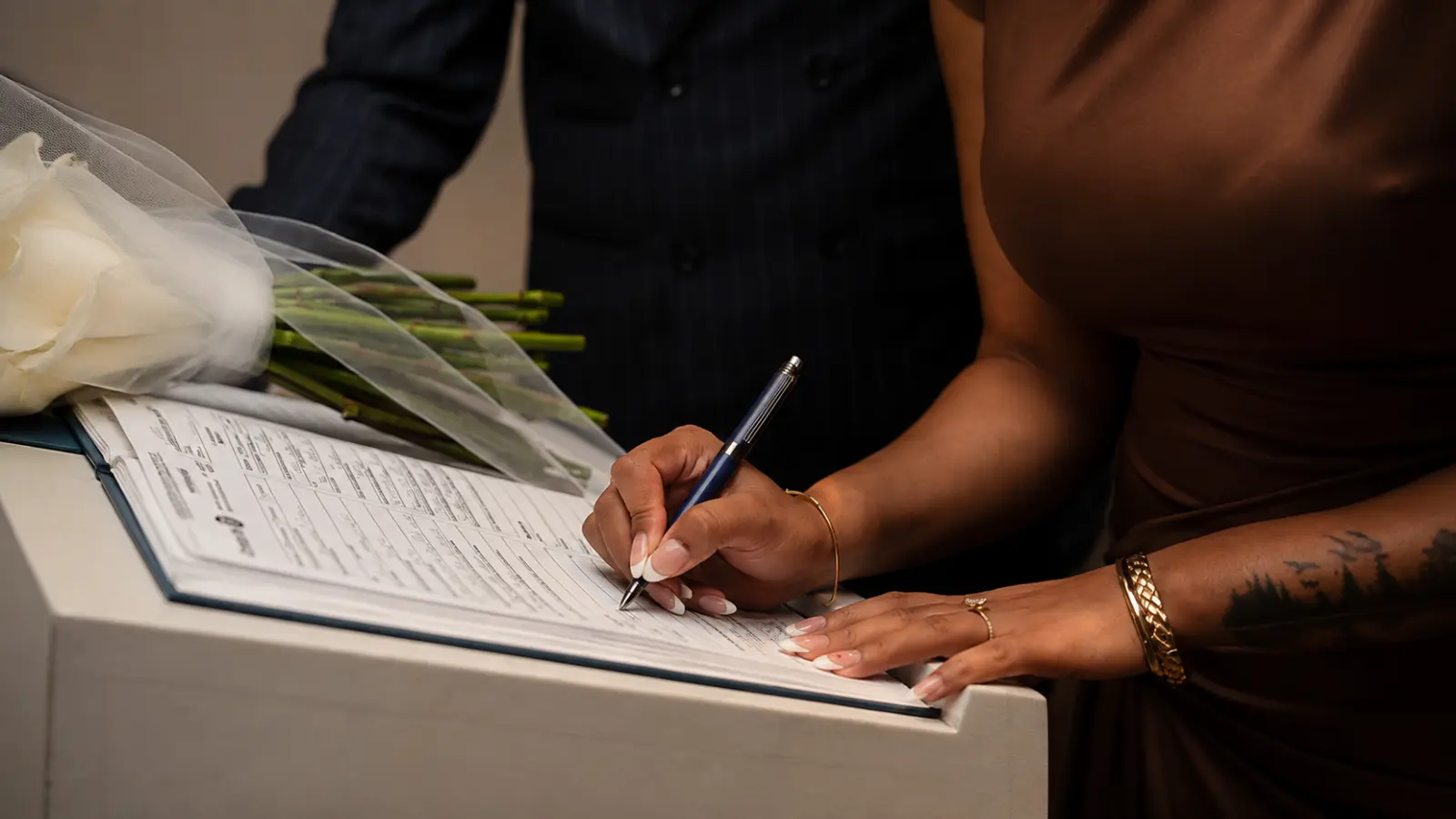
The required signers commonly include the couple and the authorized officiant. One or more witnesses may also sign where required. The exact signature blocks, names, titles, dates, locations, and timing are controlled by the license form and local instructions.

Read the form before the ceremony without completing restricted sections early. Use the names and date format the office requires. If someone makes an error, contact the issuing or recording office before erasing, crossing out, using correction fluid, or replacing information. Unauthorized alterations can delay recording.

The focused Who Signs the Marriage License? guide explains the roles of the applicants, officiant, and witnesses. It also helps couples distinguish a required legal signature from a ceremonial guest-book signature.

Return and Filing After the Ceremony

After the ceremony, the completed marriage document must reach the correct recording office within the required procedure and deadline. In many places the officiant handles the return, but couples should verify responsibility rather than assume it. The return method may be in person, by mail, through a government office, or through an electronic system available to authorized officiants; the receiving office then reviews the document and records the marriage once it meets the applicable requirements. A ceremony keepsake is not a substitute for this filing step.

Return responsibilities and filing deadlines can be highly specific. The officiant, couple, or another authorized person may be responsible for submitting the completed marriage document, and the permitted method and deadline vary by jurisdiction. Follow the instructions attached to the actual license and confirm any uncertainty with the issuing or recording office.

Before leaving the ceremony, know who has the original document, where it is going, how it will be delivered, and how the couple can confirm acceptance. Keep photographs or copies only if permitted; the official process still depends on returning the required original or approved record.

What Happens After the Marriage Is Recorded?

Once the office accepts and records the completed document, the marriage becomes part of the jurisdiction’s official records. The couple may receive an informational document automatically, have a certificate mailed, or need to order certified copies separately.

The terminology can be confusing because some jurisdictions record the original marriage license and issue certified copies of that recorded document as proof. Others commonly call the proof a marriage certificate. The marriage license vs. marriage certificate guide explains the functional difference without assuming that every state uses identical labels.

A certified copy may later be requested for a name change, benefits, insurance, taxes, immigration, estate matters, or other administrative purposes. Those copies are a separate topic from obtaining the original license, so the marriage certificate guide covers ordering, certified status, and common uses in greater detail.

Marriage License Timeline

The safest timeline works backward from the legal ceremony date. It allows enough time to gather documents and complete the application without obtaining the license so early that it expires.

  1. Before choosing an application date: identify the correct issuing office and confirm residency, appearance, document, waiting-period, and expiration rules.
  2. Before applying: gather accepted identification, previous-marriage records, translations, payment, and appointment confirmation.
  3. At application or pickup: verify every printed detail and note when and where the license may be used.
  4. Before the ceremony: confirm the officiant’s authority, witness requirements, possession of the license, and each person’s signing role.
  5. Immediately after the ceremony: check that all required fields and signatures are complete and that the responsible person has the document.
  6. After return: confirm that the office recorded the marriage and determine whether certified proof is automatic or must be ordered.

Do not use one generic deadline for every couple. The correct application date is the point that satisfies the local waiting period, falls within the validity window, and leaves reasonable time to resolve missing documents or appointment problems.

A Marriage License Is Permission, Not Proof

A Marriage License begins the legal marriage process but does not complete it by itself. The couple must obtain the appropriate license, understand when and where it can be used, satisfy the applicable ceremony and signature requirements, and make sure the completed marriage record reaches the correct office for recording.

Treat each stage separately: verify the local requirements, apply at the correct time, review the issued document carefully, complete the ceremony according to the applicable process, and follow the record through filing. Once the marriage has been recorded, the appropriate certificate or certified copy can serve as official proof according to the jurisdiction’s document system.

How does a marriage license work?

A marriage license is obtained before the wedding from the government office authorized to issue it for the ceremony jurisdiction. The couple must meet local eligibility and document requirements, apply within the correct timing window, and use the license while it is valid. At the ceremony, the required consent and signatures are completed, and afterward the document must be returned for recording. The license authorizes the marriage process; it does not by itself prove that the marriage was completed and recorded.

Where do you get a marriage license?

Depending on the jurisdiction, marriage licenses may be issued by a county clerk, city or town clerk, probate court, marriage bureau, recorder, circuit court clerk, or another designated government office. Start with the official government website for the place where the legal ceremony will occur and confirm which office actually issues licenses for that location.

Can you apply for a marriage license online?

Sometimes. Some jurisdictions allow couples to begin or even complete parts of the application online, while others still require one or both applicants to appear in person for identification, signatures, an oath, payment, or license pickup. An online application form does not necessarily mean the entire licensing process can be completed remotely.

How long is a marriage license valid?

The validity period depends on the issuing jurisdiction. A license may become usable immediately or only after a waiting period, and it may expire after a specific number of days or months. Confirm the issue date, earliest legal ceremony date, final valid date, and any geographic restrictions printed on or provided with the license.

Is a marriage license the same as a marriage certificate?

No. A marriage license generally authorizes the couple to marry, while a marriage certificate or certified copy of the recorded marriage document proves that the marriage occurred and was officially recorded. The exact document names vary by jurisdiction, but the authorization-versus-proof distinction remains the same.

Who signs the marriage license?

The required signers vary by jurisdiction, but the couple and authorized officiant commonly sign the marriage document, and one or more witnesses may also sign where required. Follow the instructions attached to the actual license and do not add, erase, cross out, or correct information without guidance from the issuing or recording office.

Marriage License: Requirements, Application and Timeline

By  Updated on August 31, 2026

A Marriage License is an official document issued through the government process that allows a couple to complete a legal marriage under the rules of the jurisdiction where the license applies. Depending on the location, obtaining one may involve eligibility requirements, identification, previous-marriage information, an application, a fee, a waiting period, an expiration date, and instructions governing how the document must be used and completed.

The Marriage License is only one stage of the legal marriage process. Obtaining it does not by itself prove that the marriage occurred. The license still has to be used according to the applicable requirements, completed by the required participants, and returned or otherwise submitted for recording through the procedure established by the jurisdiction.

This guide explains what a Marriage License does, who issues it, which requirements commonly vary, how the application process works, how waiting periods and expiration affect timing, who may need to sign the document, what happens after the ceremony, and when recorded proof of the marriage becomes available.

What Is a Marriage License?

A marriage license is a government-issued document that authorizes two eligible people to complete a legal marriage. It is generally issued before the wedding and is valid only under the conditions established by the issuing jurisdiction, including any limits on time, place, officiant, witnesses, or ceremony procedure.

What a License Does Not Prove

When couples ask, “What is a marriage license?” the most important answer is what it is not. It is not automatically proof of marriage. The document normally must be used in a legally valid ceremony, completed by the required participants, and returned to the appropriate office for recording.

USA.gov’s official marriage document guidance states the distinction directly: a marriage license legally allows a couple to marry, while a marriage certificate proves the marriage occurred. Some offices use different document names, but the authorization-versus-proof distinction remains essential.

Marriage licenses are also jurisdiction-specific. A license issued in one state is not a nationwide permit, and even offices within the same state may have different application procedures. Couples should follow the instructions attached to their actual license rather than relying on a friend’s experience in another county.

Who Issues Marriage Licenses?

The issuing authority depends on state law and local government structure. A county clerk is common, but licenses may also come from a city or town clerk, probate court, county recorder, marriage bureau, circuit court clerk, or another designated office. Phrases like “county clerk marriage license,” “city hall marriage license,” and “courthouse marriage license” don’t describe three different legal documents; they usually describe the government office or building through which a local jurisdiction delivers the same basic licensing function.

If you are searching for “where to get marriage license” information, begin with the official website for the state and locality where the ceremony will take place. Confirm that the page is for marriage license applications, not only certified records or courthouse ceremonies. The office that issues the license may be different from the office that performs the ceremony or stores the final record.

Because issuing structures and rules differ across the country, the separate Marriage License by State guide is the correct place to compare state-level starting points. This pillar focuses on the process couples need to understand before opening a local application.

Marriage License Requirements

Marriage license requirements determine whether the applicants are eligible, what information they must provide, how the application is completed, and when the license can be used. The following table is a verification framework, not a substitute for local instructions.

RequirementMeaningCommon VariationWhen to VerifyOfficial Source
EligibilityWhether both applicants may legally marryAge, capacity, existing marriage, and prohibited relationshipsBefore applyingState law and issuing office
IdentificationEvidence of identity and ageAccepted ID types and whether secondary documents are neededBefore the appointmentIssuing office document list
Previous marriageInformation showing an earlier marriage endedDates only, decree, annulment record, or death certificateBefore gathering recordsIssuing office instructions
ResidencyWhether applicants must live in the jurisdictionNo residency rule, local rule, or different fee or processBefore choosing where to applyState and local government
ApplicationHow applicants submit information and attest it is accurateOnline start, remote process, or in-person appearanceBefore booking travelOfficial application portal
FeeCharge for processing and issuing the licenseAmount, payment method, discount, or waiverImmediately before applyingCurrent county or city fee schedule
Waiting periodDelay between issuance and the earliest ceremony timeNone, a fixed interval, or an available waiverBefore choosing the ceremony dateIssuing office and state law
ValidityPeriod and place in which the license may be usedExpiration date and geographic limitsBefore applying and again at pickupLicense instructions
SignaturesWho completes the marriage recordCouple, officiant, and one or more witnessesBefore the ceremonyLicense packet and recording office
Return and filingHow the completed document reaches the recording officeResponsible person, deadline, and delivery methodBefore leaving the ceremonyRecording office instructions

The supporting marriage license requirements guide can examine this document checklist in greater detail. On this page, the priority is understanding how every requirement affects the timing and legal use of the license.

Eligibility, Identification, and Previous Marriages

Every applicant clears three checkpoints before a license is issued: proof of eligibility, accepted identification, and, if either person was married before, documentation showing how that marriage ended. The specific list is set locally, but each checkpoint plays a distinct role in the application.

Eligibility and Legal Capacity

Applicants must be legally eligible to marry. Common questions concern minimum age, consent for younger applicants, whether either person is already married, prohibited degrees of relationship, and the ability to give valid consent. These rules come from the law of the relevant jurisdiction and should not be inferred from the application form alone.

Residency is a separate issue. Many popular wedding destinations issue licenses to nonresidents, but couples should not assume that every office follows the same rule or that a license can be used outside the state that issued it. Confirm both who may apply and where the ceremony may occur.

Identification and Personal Information

The marriage license application commonly asks for legal names, birth dates, addresses, birthplaces, parental information, Social Security numbers where applicable, and details about previous marriages. Accepted identification may include a driver’s license, state identification card, passport, birth certificate, or another document listed by the office.

The accepted list is not universal, and application procedures can vary just as much as document requirements. One jurisdiction may require both applicants to appear in person, while another may allow part of the process to begin online or use a different remote or hybrid procedure. Follow the issuing office’s current instructions for both identification and appearance requirements.

Previous Marriage Documentation

If either applicant was previously married, the office may ask when, where, and how the marriage ended. Depending on the jurisdiction and how recently it ended, the applicant may need a certified divorce decree, annulment record, death certificate, or other official evidence.

Do not bring an unofficial screenshot or ordinary photocopy unless the office says it is acceptable. If a record is in another language, ask whether a certified translation is required. If names differ across the records, confirm what supporting document will connect them.

How to Apply for a Marriage License

Getting a marriage license usually begins by identifying the correct office, reviewing its current instructions, gathering documents, and completing the marriage license application. The application may be submitted in person, started online before an appointment, completed remotely, or handled through another process allowed locally.

Couples who want to apply for marriage license services online should read the final step carefully. “Apply online” may mean only entering preliminary information. The couple may still need to appear for identity verification, take an oath, sign in front of a clerk, pay the fee, or collect the issued license.

  1. Choose the ceremony jurisdiction. Identify where the legal marriage will occur.
  2. Find the official issuing office. Confirm that it issues licenses for that ceremony location.
  3. Review eligibility and documents. Check accepted ID, prior-marriage records, residency, and appearance rules.
  4. Complete the application. Enter names and personal information exactly as instructed.
  5. Attend any required appointment. Bring original or certified documents where required.
  6. Pay the current fee. Use an accepted payment method and keep the receipt.
  7. Review the issued license. Check names, dates, expiration, geographic limits, and ceremony instructions before leaving.

Obtaining a marriage license does not automatically reserve an officiant, courthouse ceremony, or venue. The step-by-step How to Get a Marriage License guide separates the application appointment from the ceremony arrangements so neither is accidentally missed.

Fees, Waiting Periods, Validity, and Expiration

A marriage license runs on its own internal clock: what it costs, how soon it can be used, and how long it stays valid. Each figure is set locally, so treat the guidance below as a planning framework rather than a quote for your specific county.

Marriage License Fee

The license fee is set by the issuing jurisdiction and may differ by location, license type, service method, or program. Some offices accept only particular payment methods. A discount or fee reduction may be available after an approved premarital education course, while a waiver may exist only in limited circumstances.

Verify the amount shortly before applying. A fee quoted in an older article, search result, or wedding forum may no longer be current, and a courthouse ceremony fee may be separate from the license fee.

Waiting Period

A waiting period is the time between issuance of the license and the earliest moment the legal ceremony may occur. It is not the same as appointment lead time. One is a legal or administrative delay after issuance; the other reflects calendar availability.

Some jurisdictions impose a waiting period after the license is issued, while others allow the marriage to occur without one. Where a waiting period exists, the length, starting point, and availability of any waiver depend on local law and procedure. The dedicated marriage license waiting period guide explains how to place this rule into a wedding timeline without assuming one national answer.

Validity and Expiration

The validity period is the window during which the license may be used for the ceremony. Applying too early can be as disruptive as applying too late. If the wedding occurs after expiration, the couple may need to obtain and pay for a new license before completing a valid ceremony.

Marriage license validity periods vary substantially by jurisdiction. Some licenses remain usable for a relatively short window, while others stay valid much longer. Confirm the exact expiration date and geographic limits shown by the issuing office rather than relying on a duration from another state.

Confirm the issue date, earliest ceremony date, final valid date, and permitted ceremony location. The separate marriage license expiration guide addresses what couples should check if plans change or a license is lost, damaged, or no longer valid.

Using the Marriage License at the Ceremony

The issued license must be available and valid when the legal marriage takes place. Depending on local procedure, the couple brings the paper document, the officiant accesses a record, or the ceremony office already holds the license. Do not assume a courthouse can retrieve a license issued elsewhere without advance confirmation.

The ceremony must satisfy the jurisdiction’s legal requirements. This commonly includes valid consent before an authorized officiant and any required witnesses. Personal vows, rings, readings, music, and religious language may be optional, but they do not replace the legally required act of marriage.

Couples arranging a government ceremony can use the courthouse wedding guide to coordinate the license with the appointment, identity check, witness rules, guest limits, and ceremony-day procedure.

Who Signs the Marriage License?

The required signers commonly include the couple and the authorized officiant. One or more witnesses may also sign where required. The exact signature blocks, names, titles, dates, locations, and timing are controlled by the license form and local instructions.

Read the form before the ceremony without completing restricted sections early. Use the names and date format the office requires. If someone makes an error, contact the issuing or recording office before erasing, crossing out, using correction fluid, or replacing information. Unauthorized alterations can delay recording.

The focused Who Signs the Marriage License? guide explains the roles of the applicants, officiant, and witnesses. It also helps couples distinguish a required legal signature from a ceremonial guest-book signature.

Return and Filing After the Ceremony

After the ceremony, the completed marriage document must reach the correct recording office within the required procedure and deadline. In many places the officiant handles the return, but couples should verify responsibility rather than assume it. The return method may be in person, by mail, through a government office, or through an electronic system available to authorized officiants; the receiving office then reviews the document and records the marriage once it meets the applicable requirements. A ceremony keepsake is not a substitute for this filing step.

Return responsibilities and filing deadlines can be highly specific. The officiant, couple, or another authorized person may be responsible for submitting the completed marriage document, and the permitted method and deadline vary by jurisdiction. Follow the instructions attached to the actual license and confirm any uncertainty with the issuing or recording office.

Before leaving the ceremony, know who has the original document, where it is going, how it will be delivered, and how the couple can confirm acceptance. Keep photographs or copies only if permitted; the official process still depends on returning the required original or approved record.

What Happens After the Marriage Is Recorded?

Once the office accepts and records the completed document, the marriage becomes part of the jurisdiction’s official records. The couple may receive an informational document automatically, have a certificate mailed, or need to order certified copies separately.

The terminology can be confusing because some jurisdictions record the original marriage license and issue certified copies of that recorded document as proof. Others commonly call the proof a marriage certificate. The marriage license vs. marriage certificate guide explains the functional difference without assuming that every state uses identical labels.

A certified copy may later be requested for a name change, benefits, insurance, taxes, immigration, estate matters, or other administrative purposes. Those copies are a separate topic from obtaining the original license, so the marriage certificate guide covers ordering, certified status, and common uses in greater detail.

Marriage License Timeline

The safest timeline works backward from the legal ceremony date. It allows enough time to gather documents and complete the application without obtaining the license so early that it expires.

  1. Before choosing an application date: identify the correct issuing office and confirm residency, appearance, document, waiting-period, and expiration rules.
  2. Before applying: gather accepted identification, previous-marriage records, translations, payment, and appointment confirmation.
  3. At application or pickup: verify every printed detail and note when and where the license may be used.
  4. Before the ceremony: confirm the officiant’s authority, witness requirements, possession of the license, and each person’s signing role.
  5. Immediately after the ceremony: check that all required fields and signatures are complete and that the responsible person has the document.
  6. After return: confirm that the office recorded the marriage and determine whether certified proof is automatic or must be ordered.

Do not use one generic deadline for every couple. The correct application date is the point that satisfies the local waiting period, falls within the validity window, and leaves reasonable time to resolve missing documents or appointment problems.

A Marriage License Is Permission, Not Proof

A Marriage License begins the legal marriage process but does not complete it by itself. The couple must obtain the appropriate license, understand when and where it can be used, satisfy the applicable ceremony and signature requirements, and make sure the completed marriage record reaches the correct office for recording.

Treat each stage separately: verify the local requirements, apply at the correct time, review the issued document carefully, complete the ceremony according to the applicable process, and follow the record through filing. Once the marriage has been recorded, the appropriate certificate or certified copy can serve as official proof according to the jurisdiction’s document system.

How does a marriage license work?

A marriage license is obtained before the wedding from the government office authorized to issue it for the ceremony jurisdiction. The couple must meet local eligibility and document requirements, apply within the correct timing window, and use the license while it is valid. At the ceremony, the required consent and signatures are completed, and afterward the document must be returned for recording. The license authorizes the marriage process; it does not by itself prove that the marriage was completed and recorded.

Where do you get a marriage license?

Depending on the jurisdiction, marriage licenses may be issued by a county clerk, city or town clerk, probate court, marriage bureau, recorder, circuit court clerk, or another designated government office. Start with the official government website for the place where the legal ceremony will occur and confirm which office actually issues licenses for that location.

Can you apply for a marriage license online?

Sometimes. Some jurisdictions allow couples to begin or even complete parts of the application online, while others still require one or both applicants to appear in person for identification, signatures, an oath, payment, or license pickup. An online application form does not necessarily mean the entire licensing process can be completed remotely.

How long is a marriage license valid?

The validity period depends on the issuing jurisdiction. A license may become usable immediately or only after a waiting period, and it may expire after a specific number of days or months. Confirm the issue date, earliest legal ceremony date, final valid date, and any geographic restrictions printed on or provided with the license.

Is a marriage license the same as a marriage certificate?

No. A marriage license generally authorizes the couple to marry, while a marriage certificate or certified copy of the recorded marriage document proves that the marriage occurred and was officially recorded. The exact document names vary by jurisdiction, but the authorization-versus-proof distinction remains the same.

Who signs the marriage license?

The required signers vary by jurisdiction, but the couple and authorized officiant commonly sign the marriage document, and one or more witnesses may also sign where required. Follow the instructions attached to the actual license and do not add, erase, cross out, or correct information without guidance from the issuing or recording office.

Edit Template

© 2026 EVORÉ. All rights reserved.