
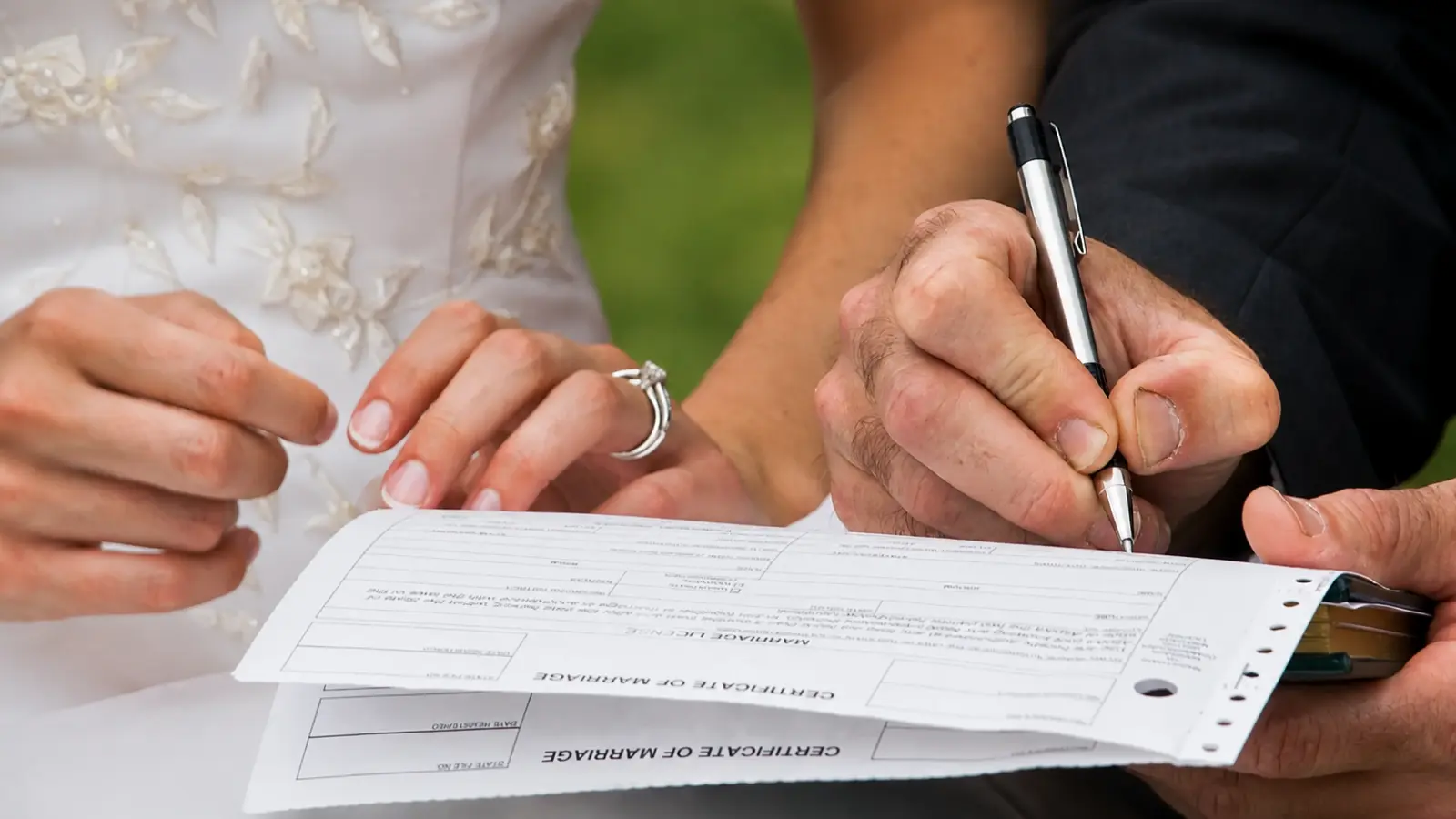
Marriage License Cost is not one nationwide price. The amount is set by the state or local authority that issues the license, and the final total can vary depending on the application method, payment channel, available discounts, replacement needs, and any additional services connected to the transaction.
The most important budgeting rule is to separate the marriage license fee from the costs around it. A license fee may cover only the application and issuance of the document, while a civil ceremony, certified copies, online or card-processing charges, waiting-period waivers, replacement licenses, expedited services, or other administrative costs may be billed separately.
This Marriage License Cost guide explains the main fee categories, what the base license charge may include, which extra costs can appear, how discounts or waivers may work, what refund rules to check, and how to verify the current total with the official office before paying.
How Much Does a Marriage License Cost?
There is no single national answer. Current official county pages illustrate the spread: King George County, Virginia, publishes a $30 fee, while Clark County, Washington, lists a $172 fee. These are time-sensitive examples, not recommended locations or a national range guarantee. They show why the issuing office’s current fee schedule is more useful than an average.
People often search “how much does marriage license cost” expecting one number. A more accurate calculation is: required license charge + mandatory processing or payment fee + selected optional services − any approved discount = amount due at application.
Costs after the ceremony should be counted separately. They may include certified copies, shipping, expedited records service, or correction fees. The cost of marriage license issuance and the cost of proving the recorded marriage are related, but they are not necessarily paid to the same office or at the same time.
Marriage License Fees at a Glance
Before comparing numbers, it helps to see every charge that can attach to a marriage license in one place. The table below sorts each fee by whether it is required or optional and points to the office that actually controls it.
| Fee | Required or Optional | When Charged | Why It Varies | Official Source |
|---|---|---|---|---|
| License or application fee | Required | At application, processing, or issuance | Set by state law or local authority | Issuing clerk, court, recorder, or marriage bureau |
| Online service fee | Sometimes required for the selected channel | At online submission or payment | Government portal or third-party provider | Official application portal checkout |
| Card convenience fee | Optional when another payment method exists | At card payment | Flat fee or percentage-based processor charge | Office payment-method page |
| Waiting-period waiver | Optional where legally available | When requesting the waiver | Different legal procedure and approving authority | Issuing office or court instructions |
| Replacement or new license | Required if the original cannot legally be used | Before a rescheduled ceremony | Loss, damage, expiration, or local reissuance policy | Original issuing office |
| Government ceremony fee | Optional unless that ceremony service is chosen | At scheduling or ceremony appointment | Officiant, facility, day, and local service | Court, clerk, or ceremony office |
| Certified copy | Optional unless proof is needed | At prepayment or after recording | Per-copy price, certification, delivery, and ordering method | Recording or vital records office |
| Premarital-course discount | Optional reduction where available | Applied at the license appointment | State program, approved provider, course length, and proof | Issuing office and statutory program |
The step-by-step application guide explains when the application payment occurs. Couples should confirm the amount shortly before that step because older screenshots and third-party wedding pages may show an outdated fee.
Application Fee and License Processing
The marriage license application fee is generally the core required charge. An office may call it an application fee, license fee, issuance fee, statutory fee, or a combined application-and-license charge. The label matters less than understanding what the posted amount includes.
Ask whether payment is due when the online form is submitted, when identity is verified, at the in-person appointment, or when the license is issued. A preliminary online form may be free even though payment is required later.
The license fee usually supports reviewing the application, confirming required information, and issuing the legal document. It does not automatically include the officiant, ceremony room, witnesses, certificate copies, shipping, or a future correction. Before paying, make sure both applicants meet the office’s document and eligibility rules—the marriage license requirements guide helps prevent a nonrefundable payment from being paired with a missing document or an application made through the wrong jurisdiction.
Online Charges and Card Convenience Fees
An online application can involve several different charges. The government fee may remain the same, while a portal, payment processor, or records vendor adds a convenience or service charge. Expedited processing, mailing, identity verification, and card payment may also have separate prices.
Cuyahoga County Probate Court’s official page, for example, lists the marriage license fee and a separate convenience charge for credit or debit card payment. That structure is common enough to check for, but the amount and payment options differ by office.
Review the final payment screen before submitting. Look for the base government fee, service or convenience charge, delivery fee, and total. If the office accepts cash, money order, cashier’s check, personal check, or another method, compare whether using it avoids the card charge. A third-party website should clearly identify itself and the service it provides—start from the official government page so you know whether the vendor is authorized and whether its fee is optional.
Certified-Copy Costs Are Separate
A certified copy is not the same purchase as the original authorization to marry. It becomes relevant after the ceremony and recording, when the couple needs official proof of the marriage.
USA.gov explains that the license allows the couple to marry and the certificate proves the marriage occurred. It directs couples to the state vital records office for current copy costs and ordering methods.
Some jurisdictions include one copy, allow a couple to prepay for a copy with the license, or mail an informational document. Others charge for every certified copy, and online ordering, telephone ordering, shipping, rush processing, and authentication can add separate amounts. The marriage license vs. marriage certificate guide clarifies which document is being purchased, while the marriage certificate guide covers certified status and ordering without mixing those later costs into the application fee.
Replacement License, Expiration, and Reapplication
If a license is lost, damaged, or expires before the ceremony, the solution is not always a low-cost duplicate. The office may require a new application and the full fee again. Other jurisdictions may offer a replacement or correction procedure under defined circumstances.
USA.gov advises couples to apply for a new license if the original expires or is lost before they marry. The exact local process should still be confirmed with the original issuing office before submitting or paying for anything.
Applying at the correct time is the best protection against avoidable reapplication. The marriage license expiration guide helps couples calculate the usable window, and the marriage license waiting period guide identifies the earliest ceremony date.
The Ceremony Fee Is Not the License Fee
Obtaining a license does not necessarily schedule a ceremony or pay an officiant. A court, clerk, judge, marriage commissioner, or other government service may charge separately for conducting the ceremony. The fee may depend on the office, facility, weekday or weekend availability, and whether witnesses or another service are provided.
Even when the same office offers both services, treat them as two transactions. Confirm whether the ceremony appointment requires prepayment, whether it is refundable, and whether missing or expired license documents will cause the ceremony to be canceled without a refund.
Couples using a government ceremony can consult the courthouse wedding cost guide for the ceremony-side categories. This article remains focused on the license and closely related document charges.
Premarital-Course Discounts
Some states or local programs reduce the marriage license fee when both applicants complete approved premarital education. The couple may need a certificate or educator statement containing exact wording, legal names, provider credentials, course hours, dates, signatures, notarization, or an institutional seal.
Hennepin County’s official fee page, for example, publishes a regular fee and a reduced fee for couples who complete the required premarital education and submit an educator statement. Florida Court Clerks & Comptrollers likewise explains that an approved premarital preparation course can lower the application fee when its requirements are met.
Do the math before enrolling solely for the discount. Consider the course price, time, transportation, document fee, and whether the provider is officially approved. A useful course may offer value beyond the fee reduction, but an unapproved course may not qualify.
Waivers and Reduced Charges
A fee waiver and a waiting-period waiver are different. The first reduces or removes a monetary charge; the second changes when the ceremony may occur. In some jurisdictions, requesting a waiting-period waiver creates an additional fee rather than a discount.
A reduced or no-charge service may exist for a narrowly defined purpose, government benefit, military use, or court-approved circumstance. Availability is controlled by statute or local policy. General financial hardship does not automatically create a nationwide right to free marriage licensing.
Ask the issuing office which waiver or reduction exists, who qualifies, what proof is required, when it must be presented, and whether approval must occur before payment. Once a nonrefundable fee is processed, a later document may not produce a retroactive refund.
Payment Methods and Refund Policies
Government offices may accept different combinations of cash, personal check, cashier’s check, money order, debit card, credit card, or online payment. Some do not accept large bills or personal checks. Others add a flat or percentage-based card fee.
Verify the payee name for checks and money orders, whether exact change is required, and whether the payment method differs for mail, online, or in-person applications. Do not assume that the method used for the license can also be used for the ceremony or certified copies.
Refund policies are often strict. Hennepin County explicitly describes its marriage license fees as nonrefundable, and other offices publish similar rules—an unused license, canceled wedding, duplicate submission, missed appointment, changed venue, or rejected payment method may not qualify for reimbursement. If an office cancels a service or a payment is charged twice, follow its published correction or refund procedure rather than disputing the entire license transaction without documentation.
Why Marriage License Prices Differ
Prices differ because marriage licensing is governed and administered at the state and local level. Statutes may set a base charge, direct portions to public programs, authorize county additions, create discounts, or establish separate amounts for different license types.
The way a couple uses the service also affects the total. Card processing, remote verification, mailing, expedited service, certified copies, a government ceremony, a supplied witness, and a waiting-period waiver can each sit outside the base fee.
Document labels can create apparent differences as well. One office may publish a single “marriage license fee,” while another breaks application, issuance, certification, and convenience charges into separate lines. Compare what is included, not only the largest number on the page.
How to Verify the Current Total
With the fee categories above in mind, work through them in this order before paying anything. Each step catches a different kind of surprise charge.
- Identify the official office authorized to issue the license for the ceremony location.
- Open its current marriage license page and fee schedule.
- Confirm whether the posted amount is per couple or per applicant.
- Check accepted payment methods and card or online service charges.
- Determine whether the ceremony is a separate service.
- Check whether a certified copy is included, prepaid, or ordered later.
- Review course discounts and waiver requirements before paying.
- Read the refund, cancellation, expiration, and replacement policies.
- Save the dated page, receipt, and payment confirmation.
Recheck the fee shortly before the appointment. Search-result snippets and wedding articles can remain visible after an official price changes.
Price the License, Ceremony and Records Separately
Marriage License Cost becomes much easier to understand when every charge is separated by purpose. Start with the base license or application fee, then check whether the payment method adds a service charge, whether any discount applies, and whether replacement or waiver costs could become relevant to your situation.
Keep ceremony fees and certified-copy costs separate unless the issuing office explicitly says they are included. The most accurate total is the one built from the current official fee schedule for the office handling your application, not a national average or an old third-party price list.
Frequently asked questions (FAQ)
How much does a marriage license cost?
There is no national marriage license price. The fee is set by the state or local issuing authority and can range from a few tens of dollars to well over $100. Check the current official fee schedule for the office issuing your license, including any mandatory processing or payment charges, before applying.
What does the marriage license fee include?
The base fee generally covers processing the application and issuing the marriage license. It does not automatically include a civil ceremony, officiant, certified copies, card or online convenience charges, waiting-period waivers, expedited services, or replacement if the license is lost, damaged, or expires.
Is the ceremony included in the marriage license cost?
Usually not. Obtaining a marriage license generally does not reserve or pay for a civil ceremony. A courthouse, clerk, judge, marriage commissioner, or other government provider may charge a separate ceremony fee, so confirm the license and ceremony costs as two different services.
Are certified copies included in the marriage license fee?
Not always. Some jurisdictions include a copy or allow couples to prepay for one, while others charge separately for every certified copy after the completed marriage record has been filed and recorded. Additional fees may also apply for mailing, online ordering, expedited service, or extra copies.
Can a premarital course reduce the marriage license fee?
In some jurisdictions, yes. An approved premarital education course may qualify the couple for a reduced license fee when the required course and documentation standards are met. Eligibility, provider requirements, course length, proof, and the amount of the discount vary, so confirm the program before enrolling specifically for the savings.
Are marriage license fees refundable?
Often they are not. Many issuing offices treat the fee as nonrefundable once the application has been processed or the license issued. A canceled wedding, changed venue, unused or expired license, or application mistake does not automatically entitle the couple to a refund. Review the issuing office’s current refund and replacement policy before paying.