
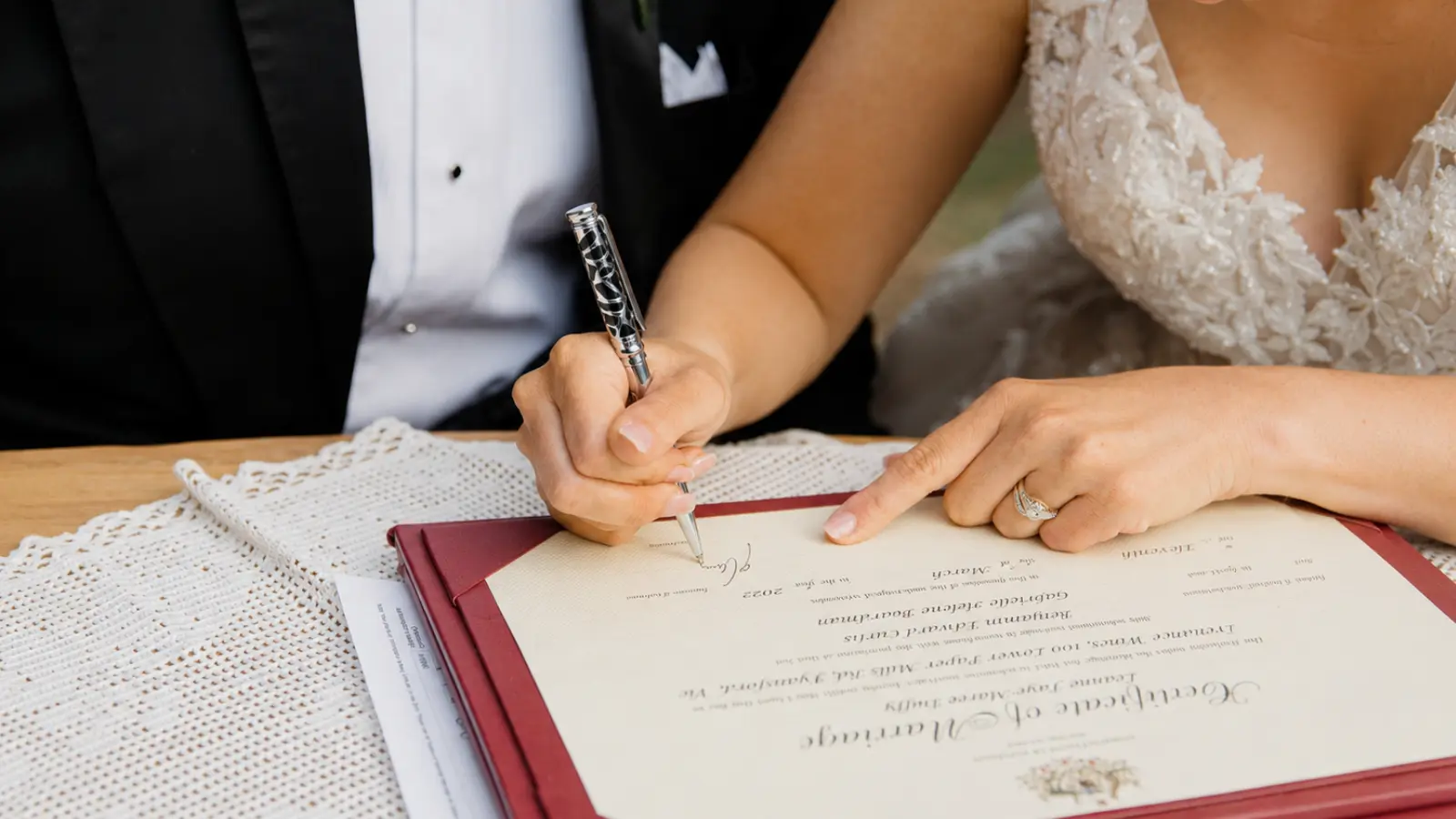
A Marriage Certificate is official proof that a marriage was completed and recorded by the responsible government authority. Depending on the jurisdiction, that proof may be a separate certificate, a certified copy of the completed marriage license, or another officially certified marriage record.
The important distinction is not how decorative or formal the paper looks, but whether it comes from the government office that maintains the marriage record and whether the version you have is accepted for the purpose you need. A commemorative certificate, plain photocopy, informational copy, certified abstract, and certified copy can serve very different functions.
This Marriage Certificate guide explains how the official record is created, who keeps it, which document versions may exist, what information it can contain, how certified copies work, how to obtain a copy, how online, mail, and in-person orders differ, what affects processing time and cost, and what to do if the certificate is lost or contains an error.
What Is a Marriage Certificate?
A marriage certificate is a government-issued or government-certified document showing that a marriage was legally recorded. The phrase certificate of marriage is often used for the same purpose, although the exact title printed on the document can vary.
USA.gov summarizes the distinction clearly: a marriage license legally allows the couple to marry, while a marriage certificate proves that they got married. The certificate therefore belongs to the post-ceremony record stage.
The word “certificate” can describe more than one physical format, and offices don’t all handle it the same way:
- A separate certificate: some offices generate a standalone document once the marriage is recorded.
- A certified copy of the license: others treat the completed license itself as the official record and issue certified copies of it.
- A certified abstract: some jurisdictions provide a shorter document containing only selected facts pulled from the full record.
What gives any of these versions official value is its connection to the recorded government record—not decorative paper, calligraphy, or a frame.
How a Marriage Certificate Is Created
The exact workflow differs, but the record usually develops in this order:
- A licensing authority issues a valid marriage license.
- The couple completes a legally recognized ceremony or marriage process.
- The officiant, couple, and witnesses complete the signatures or certifications required locally.
- The responsible person returns the completed document to the designated office.
- The office reviews the document and records the marriage.
- The couple can obtain official proof according to that office’s procedure.
The first document in that sequence is covered separately in EVORÉ’s marriage license pillar. This article begins where the legal ceremony and return process create a record that can later be certified.
A signed paper does not always become searchable or available for copies immediately. The office may need to receive, review, index, scan, and register it first. An incomplete or incorrectly completed return can delay that transition.
Some jurisdictions use one combined form through both stages. Santa Clara County’s official instructions, for example, explain that after the signed license is received and recorded, it becomes a marriage certificate. That is an illustration of a combined form, not a rule about every state’s document design.
Marriage License vs Marriage Certificate
The simplest distinction is permission before the marriage versus proof after it. An issued license normally shows that the couple was authorized to proceed under the jurisdiction’s rules. It does not by itself establish that the ceremony occurred.
After the ceremony, the required people complete the marriage document and the responsible office records it. The resulting certificate or certified recorded document can then serve as proof. EVORÉ’s marriage license vs marriage certificate comparison explains combined forms, signatures, filing, and common proof requests in greater detail.
Do not rely only on the heading printed across the top. A document labeled “Marriage License and Certificate” may be a blank authorization before the ceremony or an official certified record afterward. Completion, recording, and certification determine what it proves.
Who Keeps and Issues the Marriage Record?
A state, county, city, town, or court-level vital records office keeps the record, depending on where the marriage happened—there’s no single national agency to contact. Figuring out exactly which one is the real first step.
Finding the Right Office
There is no single federal marriage-certificate office for marriages performed in the United States. The record is maintained through the state, territorial, county, city, town, court, or other local system designated by law.
The office that issued the license may record the marriage and provide copies. In other places, a local office records it first and forwards information to a state vital records agency, and older records may be held by a different archive or office than recent ones.
Start with the jurisdiction where the marriage license was issued or where the marriage was recorded—not necessarily where the couple now lives. USA.gov directs people seeking a U.S. marriage record to the appropriate state vital records office, which can explain cost, availability, and ordering methods.
The Original Record vs. Your Copy
The government database or bound record maintained by the custodian is the original official record. The paper a couple orders is generally a copy, extract, or certification generated from that record, and it’s the custodian’s version that controls, not the copy in a couple’s file.
For research beyond a single personal copy request, EVORÉ’s separate guide to marriage records explains record custodians and access distinctions in more depth.
Marriage Certificate Versions
Document labels are not perfectly consistent across the country. Use this table as a functional guide, then confirm the terminology used by the office holding the record.
| Document Version | Legal Status | Uses | Where Obtained |
|---|---|---|---|
| Original marriage record | Official record retained by the custodian | Government registration and creation of official copies | Held by the designated local or state records authority |
| Certified copy | Official copy certified by the record custodian | Formal proof, subject to the receiving agency’s rules | County, city, town, court, registrar, recorder, or vital records office |
| Certified abstract | Official summary where offered | Uses accepted by the requesting organization | Official record custodian |
| Informational copy | Officially issued but may be restricted from identity or legal use | Personal information or research where permitted | Record custodian under local access rules |
| Plain photocopy or scan | Not independently certified | Convenience when a receiving organization permits it | Made from a copy already held by the couple |
| Decorative or commemorative certificate | Generally not official proof by itself | Keepsake and display | Ceremony provider, officiant, venue, or retailer |
A document can be “officially issued” yet still have limited permitted uses. California’s Department of Public Health, for example, distinguishes a certified authorized copy that can establish identity from a certified informational copy that cannot. Other jurisdictions use different names and access rules.
For that reason, ask the receiving organization whether it needs a certified copy, an authorized certified copy, an abstract, or another specific version. “Send the certificate” may not be precise enough.
What Does a Marriage Certificate Look Like?
There’s no national template for what a marriage certificate looks like. It may be a dedicated certificate, a photographic reproduction of the completed license, a printed record abstract, or a document titled “License and Certificate of Marriage.”
Common information may include:
- The legal names used by the spouses at the time of the marriage.
- The date and place of the marriage.
- The date the document was issued, received, registered, or recorded.
- The officiant’s name, title, signature, or certification.
- Witness information where required and included in the public record.
- A record, file, certificate, book, page, or registration number.
- The issuing authority’s seal, stamp, signature, security paper, or certification statement.
Some records contain additional application information; others display only a limited extract. Privacy and public-access rules can also affect what appears on a copy. The absence of a gold seal or ornamental design does not make a government-certified record invalid.
Certified Copies and Marriage Certificate Certification
A certified copy is produced by the government custodian and carries features showing that it is an official reproduction or extract of the record. Marriage certificate certification comes from that authorized records office—not from a couple printing a scan or asking a private notary to certify a photocopy.
Certification features vary by office, but commonly include:
- An embossed or raised seal, or a traditional ink seal
- The registrar’s signature and a written certification statement
- Security paper, a barcode, or another anti-alteration feature
The exact combination varies, and electronic verification may supplement paper in some systems. A certified copy is commonly the safest version to request when an agency wants formal proof, but the receiving organization still controls its own evidence standard. EVORÉ’s certified copy of a marriage certificate guide covers eligibility, certification features, and ordering choices in more depth.
Certification is also different from an apostille. An apostille is a separate authentication used for certain documents presented abroad. If an overseas authority requests one, follow the dedicated marriage certificate apostille guide and the instructions of the destination authority.
How to Get a Marriage Certificate
Getting marriage certificate proof mostly comes down to two things: whether the marriage has already been recorded, and which office holds that record now. Use this sequence:
- Confirm that the completed marriage document was returned after the ceremony.
- Identify the office that recorded or now maintains the record.
- Ask which certificate version the receiving organization requires.
- Check who is eligible to order that version.
- Prepare the names, marriage date and place, identification, and any required relationship or authorization information.
- Choose an official online, mail, or in-person ordering method.
- Pay the copy, search, processing, vendor, and delivery fees that apply.
- Review the delivered copy before using it.
If the marriage was very recent, the office may not have finished recording it. If the record is older, the date range may determine whether a county, state archive, court, town, or another custodian handles the request.
The detailed operational process belongs in EVORÉ’s guide to getting a copy of a marriage certificate. This pillar establishes the document types and decision points first.
Marriage Certificate Online, by Mail, or in Person
Online Orders
A marriage certificate online order may begin on the government office’s website or through a vendor officially named by that office. Online ordering does not necessarily produce an instant digital certificate; it may submit the request for a certified paper copy delivered later.
Check the website domain, vendor authorization, eligibility rules, accepted identification, delivery method, and total price before entering personal information. A commercial records-search page is not automatically the official ordering channel.
Mail Orders
Mail requests commonly use an application form and may require a copy of identification, a sworn or notarized statement, payment in a specified form, and a return envelope. Send only the materials listed by the official custodian and use a traceable delivery option when the request contains sensitive information.
In-Person Orders
In-person service can be useful when the office offers same-day copies, but appointments, identity requirements, cut-off times, and payment methods vary. Confirm that the location actually holds the record before traveling.
California’s official marriage-record guidance, for example, points requesters to the county office where the marriage was registered for in-person copies. This illustrates why identifying the correct custodian is more important than choosing a method first.
How Long Does It Take to Get a Marriage Certificate?
Couples asking how long it takes to get a marriage certificate are usually combining three separate timelines without realizing it:
- Return time: how long it takes the responsible person to deliver the completed marriage document.
- Recording time: how long the office takes to review, accept, and register it.
- Copy time: how long the certificate request and delivery take after the record is available.
A local office may make a recent record available within days, while another process can take weeks or longer. Mail delivery, record age, incomplete applications, identity verification, archival searches, corrections, and seasonal demand can add time.
Do not plan a benefits deadline, international submission, or name-change appointment around a generic internet estimate. Ask the filing office when recent records become available, then check the current processing estimate for the ordering method you intend to use.
How Much Does a Marriage Certificate Cost?
The certificate-copy fee is separate from the marriage-license fee in many jurisdictions. Charges may include the certified copy, additional copies, a record search, online processing, vendor service, expedited handling, shipping, or payment-card convenience fees.
Some search or application fees are nonrefundable even when no record is found. Additional copies ordered in the same transaction may or may not cost less. Check the current fee schedule on the record custodian’s official website and confirm which payment methods it accepts.
A private vendor can charge more than the government copy fee because delivery and service charges are added. Compare the final amount, not only the advertised certificate price.
What Is a Marriage Certificate Used For?
A certified certificate is frequently used when an organization needs formal proof of a recorded marriage. The exact evidence depends on the transaction.
Name Change
A marriage certificate can support a marriage-based name change when it shows the information required by the agency. The Social Security Administration, for example, tells eligible online applicants to have their marriage certificate and identification available.
Marriage does not automatically update every record, and the certificate does not guarantee that every requested name format is permitted. EVORÉ’s name change after marriage guide organizes the sequence for Social Security, identification, financial, employment, and other records.
Benefits, Insurance, and Financial Administration
Employers, insurers, retirement plans, financial institutions, and government programs may request proof when a spouse is added, coverage changes, a beneficiary is updated, or marital status affects eligibility. Ask whether the organization accepts an uploaded copy or requires a certified paper document.
Many post-wedding tasks have their own deadlines and forms. EVORÉ’s after-marriage administrative checklist helps couples track them without suggesting that one certificate updates every organization.
Taxes
A marriage can change federal filing options, but couples generally do not attach a marriage certificate to a routine federal income tax return solely to declare marital status. The Taxpayer Advocate Service, an independent organization within the IRS, explains that marital status as of December 31 determines filing options for the year.
Keep the official record accessible in case proof is requested for a particular tax, benefits, identity, or audit issue. Tax situations involving nonresident spouses, prior filings, dependent questions, or conflicting records may require individualized professional advice.
Errors and Corrections
Review names, dates, places, and other key information as soon as an official copy arrives. A printing problem on one copy may be handled differently from an error in the underlying registered record.
Do not write over, erase, laminate, or otherwise alter an official certificate in an attempt to fix it. Instead, contact the office that issued the copy or maintains the record and ask which amendment procedure applies. Depending on the error, that office may ask for:
- A formal application for correction
- Identity evidence and supporting records
- Affidavits or additional signatures
- A court order, in some circumstances
- A processing fee
California’s official amendment page demonstrates that even within one state, the correct office and process can depend on the type of marriage record. Use EVORÉ’s marriage certificate correction guide to prepare questions and documents, then follow the controlling office’s instructions.
Correct the record before ordering multiple certified copies whenever possible. A name adopted after marriage is not automatically an error in the historical marriage record; amendment rules determine what can and cannot be changed.
Lost or Damaged Marriage Certificate
Losing the paper does not usually erase the government marriage record. Order another official copy from the custodian rather than relying on an altered scan, unofficial template, or recreated document.
If the missing certificate may have exposed sensitive personal information, consider the privacy and identity-security steps appropriate to the information displayed. When a certificate is damaged but readable, ask the receiving organization whether it will accept it or whether a new certified copy is required.
Store certified copies in a secure, dry location. Keep a private reference scan for your own records if appropriate, but do not assume that a scan has the same status as a certified copy.
Before You Order: A Five-Question Check
Before requesting a copy, run through a short gut-check. These five questions catch the mistakes that slow down most marriage certificate requests:
- Has the completed marriage document been recorded?
- Which government office currently holds the record?
- Which version does the receiving organization require?
- Who is eligible to order that version, and what identification is needed?
- What are the current fee, processing time, and delivery method?
Answering those questions prevents the most common problems: ordering too early, contacting the wrong office, paying for the wrong document type, or receiving a copy that the requesting organization will not accept.
The Official Record Matters More Than the Title
A Marriage Certificate may appear as a separate document, a certified copy of the completed license, an abstract, or another official record format. What gives it legal and administrative value is its connection to the government marriage record and the certification or status required by the organization requesting proof.
Before ordering or submitting anything, confirm that the marriage has been recorded, identify the correct record custodian, and ask which version the receiving organization accepts. That prevents confusion between an official certificate, a certified copy, an informational record, a plain photocopy, and a decorative keepsake.
Frequently asked questions (FAQ)
What is a marriage certificate?
A marriage certificate is official evidence that a marriage was completed and recorded by the responsible government authority. Depending on the jurisdiction, it may be a separate certificate, a certified copy of the completed and recorded marriage license, or another officially certified marriage record.
How do you get a marriage certificate?
First, make sure the completed marriage document has been returned and officially recorded. Then identify the government office that maintains the record, confirm which version you need, check who is eligible to order it, and request the certificate through an approved online, mail, or in-person process.
Can you get a marriage certificate online?
Many jurisdictions allow marriage certificate requests to be submitted online, either through the official government website or an authorized vendor. An online order does not necessarily produce an instant digital certificate; the result may still be a certified paper copy delivered by mail. Confirm eligibility, identification, fees, processing time, and delivery before paying.
What does a marriage certificate look like?
There is no single national design. A marriage certificate may be a dedicated certificate, a certified reproduction of the completed license, or an official record abstract. Common features can include the spouses’ names, marriage date and location, recording information, an official seal or stamp, registrar signature, certification statement, or other security features.
How long does it take to get a marriage certificate?
The timeline usually includes three separate stages: return of the completed marriage document, government recording of the marriage, and processing and delivery of the requested copy. Depending on the office, record age, ordering method, corrections, and delivery, the process may take days, weeks, or longer. Check the current estimate with the office holding the record.
What is a certified copy of a marriage certificate?
A certified copy is an official reproduction or extract issued by the government custodian of the marriage record and certified as a true copy of that record. It is different from an ordinary photocopy, scan, or privately notarized copy and is commonly the version requested for formal legal and administrative uses.