
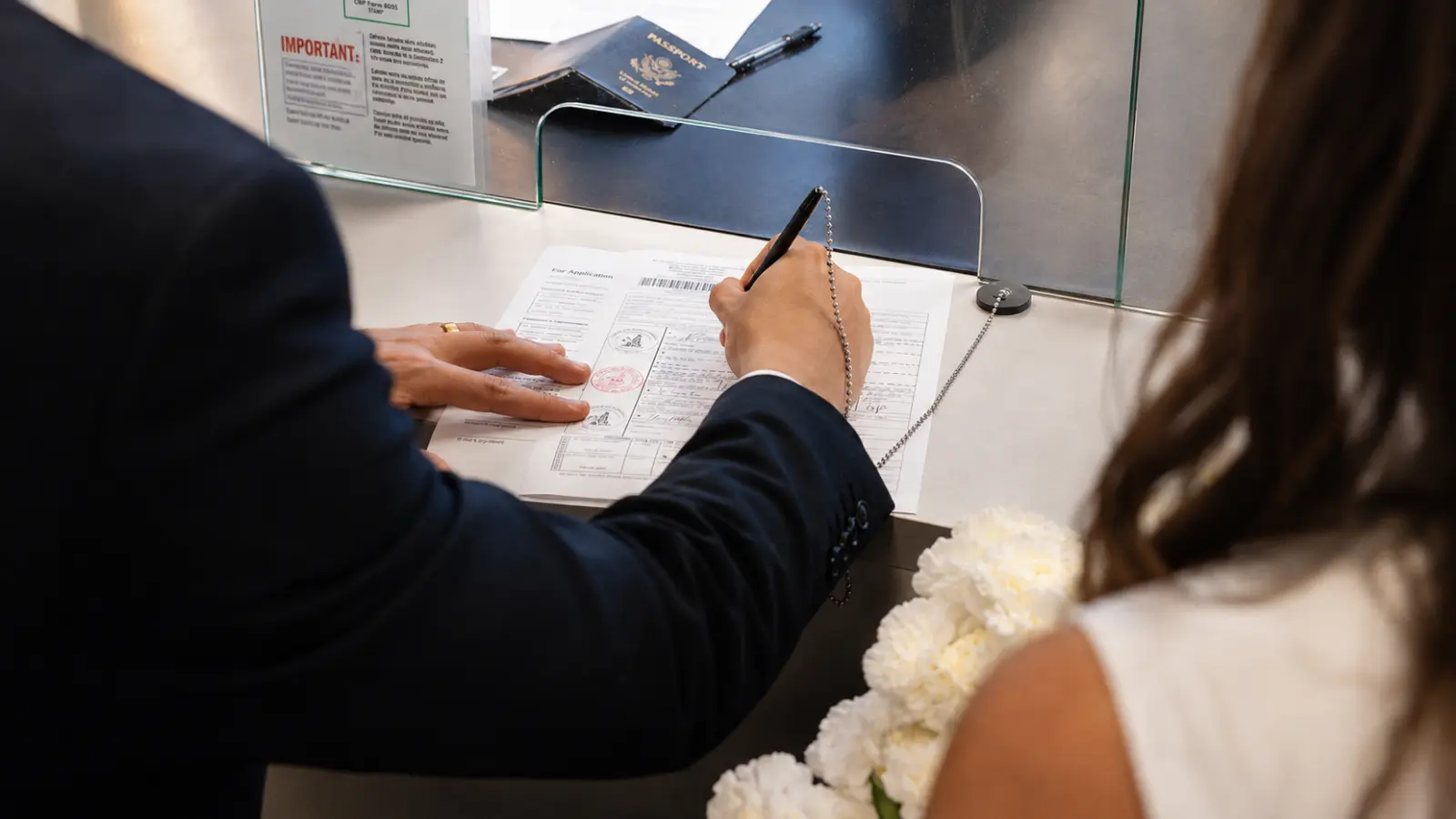
Learning How to Get a Marriage License starts with the location of the legal ceremony. That location determines which jurisdiction’s rules apply, which office issues the license, what documents are required, when the couple should apply, and how the completed marriage record must be handled after the wedding.
The process is easiest when completed in the correct order. Identify the issuing office, confirm eligibility, choose an application date that fits any waiting period and expiration window, gather the required documents, complete the application, attend any required appointment, review the issued license carefully, and make sure the completed marriage record is returned and accepted for recording.
This guide explains How to Get a Marriage License step by step, from finding the correct office through confirming that the marriage record was recorded. Because application methods, identification, appearance requirements, fees, timing, signatures, and filing procedures vary by jurisdiction, use the official issuing office’s current instructions as the final authority for every operational step.
Marriage License Application at a Glance
This table shows the order of operations. Replace every general item with the exact instruction published by the office issuing your license.
| Step | What to Prepare | Possible Variation | Deadline |
|---|---|---|---|
| 1. Find the office | Ceremony state, county, and city | County clerk, city clerk, court, recorder, or marriage bureau | Before completing any application |
| 2. Check eligibility | Age, current marital status, capacity, and relationship | Consent or additional documents may apply | Before paying or booking travel |
| 3. Choose the date | Wedding date, waiting period, and validity window | No wait, fixed wait, waiver, or different expiration | Before scheduling the application |
| 4. Gather ID | Accepted identification and personal information | One document, multiple documents, or a translation | Before the appointment |
| 5. Gather prior records | Divorce, annulment, or death information if applicable | Date only or certified documentation | Before submitting the application |
| 6. Apply | Legal names and requested personal data | Online start, remote completion, or in-person form | Within the permitted application window |
| 7. Schedule | Confirmation number and applicant availability | Appointment required, recommended, or walk-in | Early enough to secure availability |
| 8. Attend and pay | Applicants, documents, and accepted payment | Both present, one present, notarized, or remote | At the assigned appointment or service time |
| 9. Review | Names, dates, location, expiration, and instructions | Paper license, packet, or approved electronic process | Before leaving or accepting the license |
| 10. Complete ceremony | Valid license, officiant, and required witnesses | Different signature and witness rules | Inside the license validity window |
| 11. File and confirm | Completed record and return instructions | Officiant or another responsible person files it | By the local return deadline |
Treat this table as a checkpoint list, not a substitute for the office’s own instructions. The steps below walk through each row in the order they typically happen.
Step 1: Find the Correct Marriage License Office
Start with the location of the legal ceremony, not the couple’s home address. Search the official website for that state and locality to learn which office issues licenses that can be used there. Depending on the jurisdiction, it may be a county clerk, city or town clerk, probate court, county recorder, circuit court clerk, marriage bureau, or another authority.
USA.gov directs couples to the government responsible for the state where they will marry. A state vital records page may provide the starting point, but the application itself is often handled by a county or city office.
Confirm that the page concerns new marriage licenses. A page for certified records, ceremony appointments, or court services may belong to a different department. If you are asking, “Where can I get a marriage license?” the correct answer is the office authorized for your intended ceremony location, not simply the nearest courthouse. The Marriage License by State guide can help identify the official state-level starting point, but the final instructions should come from the local issuing office.
Step 2: Confirm That Both Applicants Are Eligible
Before entering personal information or paying a nonrefundable fee, confirm that both applicants meet the jurisdiction’s eligibility rules. Check minimum age, consent requirements where applicable, legal capacity, current marital status, prohibited degrees of relationship, and any residency or location rule.
Do not assume that eligibility in one state guarantees the same application process in another. Even when the couple is unquestionably allowed to marry, offices may request different evidence or use different procedures for younger applicants, nonresidents, applicants unable to appear, or people whose previous marriage ended recently.
Use the marriage license requirements guide to organize the questions, then compare its framework with the issuing office’s current list.
Step 3: Choose the Right Application Date
Choose the application date only after checking the waiting period and expiration rule. Applying too late may leave no time for a required delay or appointment. Applying too early may cause the license to expire before the ceremony.
A waiting period measures the interval between issuance and the earliest legal ceremony time. It is different from the time needed to obtain an appointment. Some jurisdictions impose a waiting period, while others do not, and any waiver depends on local law and procedure.
The marriage license waiting period guide explains how to identify the first usable date. Then check the last usable date: validity periods also vary by jurisdiction, so confirm the exact expiration window before choosing the earliest possible application slot. If the wedding date could move, review the marriage license expiration guide as well.”
Step 4: Gather the Required Identification
Use the issuing office’s exact document list. Accepted identification may include a driver’s license, state identification card, passport, birth certificate, tribal identification, military identification, consular identification, or another approved document. An office may require one item, a combination, or additional proof of age or identity.
Also gather the personal information requested by the application. Common fields include legal names, birth dates, birthplaces, current addresses, parental information, Social Security numbers where applicable, and the number and end date of previous marriages.
Check expiration dates, name consistency, original-versus-copy rules, and translation requirements. If the identification uses a different name from another supporting record, ask which linking document the office will accept before the appointment.
Step 5: Prepare Previous-Marriage Records
An applicant who was previously married may need to disclose when, where, and how that marriage ended. The office may ask only for information, or it may require a certified divorce decree, annulment record, death certificate, or another official document.
Requirements may depend on how recently the previous marriage ended or where the record was issued. Do not assume a phone photograph, ordinary photocopy, court docket screenshot, or unofficial translation will be accepted. If the official instructions are unclear, contact the issuing office and describe the document you have.
This step should be completed early because retrieving a certified record or approved translation can take longer than filling out the license application itself.
Step 6: Complete the Marriage License Application
To understand how to apply for marriage license services in your jurisdiction, read the entire official workflow—not only the button labeled ‘Apply.’ A marriage license online form may be a preliminary data entry step, a reservation, a fully remote application, or one part of an in-person process. Different jurisdictions use different combinations of online submission, identity verification, applicant appearance, signatures, payment, and license pickup, so ‘marriage license online’ does not always mean the entire process can be completed remotely.
Couples who apply for marriage license online should record the confirmation number, submission date, expiration of the unfinished application, next required action, and documents to bring. Do not treat a submitted online form as an issued license unless the office explicitly confirms that status.
Enter names and dates exactly as instructed. Review spelling before submission, especially suffixes, middle names, former names, birthplaces, and prior-marriage information. Guessing can create a correction problem later.
Step 7: Schedule the Marriage License Appointment
A marriage license appointment may be mandatory, recommended, or unnecessary. Check whether the calendar is for applying, verifying documents, collecting the license, or attending a ceremony. Those services can use separate appointments even when they are offered by the same government office.
Before reserving a time, confirm who must attend. Some offices require both applicants. Others permit one applicant to appear with a notarized form from the other, offer a remote process, or make accommodations in specific situations.
Save the confirmation email or screenshot, office address, room or counter number, parking and security information, cancellation policy, and list of required documents. If travel is involved, confirm holiday closures and time-zone differences before booking transportation.
Step 8: Attend the Appointment and Pay the Fee
Bring every requested applicant, document, form, and payment method. Arrive early enough for parking, building security, and check-in. A late arrival or missing document may force the couple to reschedule, especially where appointments are limited.
During the appointment, the clerk may verify identity, review application answers, administer an oath or affirmation, collect signatures, explain license restrictions, and accept payment. Ask whether the fee is nonrefundable and whether an additional fee applies to a ceremony or another service.
If the office does not issue the license immediately, obtain a clear explanation of the next step: when it will be ready, whether it will be mailed or collected, and whether the validity period begins at application, approval, issuance, or pickup.
Step 9: Review the License Before You Leave
Inspect the license as soon as it is issued. Verify legal names, spellings, birth information, issue date, earliest ceremony date, expiration date, geographic restrictions, and any printed instruction concerning the officiant, witnesses, signatures, or return.
If anything appears wrong, ask the issuing office to correct it through the approved procedure. Do not erase, overwrite, use correction fluid, or ask the officiant to improvise a change. An alteration that seems harmless can delay or prevent recording.
Store the license flat, dry, and secure. Decide who will bring it to the ceremony and who will safeguard it afterward. If the document is lost or damaged, contact the issuing office immediately rather than assuming a photocopy can be used.
Step 10: Complete the Ceremony, Filing, and Recording
The ceremony must happen while the license is valid and in a location where it may legally be used. The couple must complete the required legal consent before an authorized officiant or through another procedure permitted by the jurisdiction. Any required witnesses must participate.
Afterward, the appropriate people complete the document. The Who Signs the Marriage License? guide separates the roles of the couple, officiant, and witnesses so the required blocks are not confused with ceremonial signatures.
Before everyone leaves, review the document for missing fields without changing anything outside your assigned section. Confirm who has the original, who must return it, where it goes, which delivery method is permitted, and the filing deadline. Return rules can be strict, and both the responsible person and filing deadline vary by jurisdiction. Confirm who must return the completed marriage document, which delivery method is permitted, and when it must reach the recording office. The broader wedding officiant guide explains why post-ceremony record handling should be discussed before the wedding day, not after.
Step 11: Confirm That the Marriage Was Recorded
Do not stop tracking the document when the ceremony ends or when it enters the mail. Use the issuing or recording office’s stated process to confirm that the completed marriage record was received, accepted, and recorded.
If the office reports a problem, ask who must correct it and which form or affidavit is required. Do not submit a second marriage license application unless the office directs you to do so. A missing signature, incomplete title, incorrect date, or unauthorized alteration may require a specific correction procedure.
Recording is the step that separates an unused authorization from an official marriage record. The marriage license vs. marriage certificate guide explains that distinction without moving this operational article into certified-copy procedures.
Application Mistakes That Cause Delays
- Applying through the office nearest home instead of the office authorized for the ceremony location.
- Choosing an application date before checking both the waiting period and expiration date.
- Assuming an online form completes the entire licensing process.
- Bringing an unaccepted ID, ordinary copy, expired document, or incomplete translation.
- Entering a nickname or inconsistent legal name.
The remaining mistakes tend to surface later, once the paperwork is already in motion—during the appointment itself or in the handling of the license afterward.
- Scheduling the wrong type of appointment.
- Assuming the application appointment also reserves a ceremony.
- Leaving without checking printed names and validity dates.
- Allowing unapproved corrections on the document.
- Failing to assign responsibility for returning and tracking the completed license.
A five-minute review with the official instructions before submitting the application is usually faster than correcting a legal record after the ceremony.
Complete the Process, Not Just the Application
Knowing How to Get a Marriage License means managing the document from the first official search through final recording. The application is only one stage in that process.
Choose the correct office, apply inside the right time window, bring exactly what the issuing authority requires, review the license before leaving, complete the ceremony within the permitted rules, and confirm who is responsible for returning the record. The process is complete only when the marriage document has been accepted and recorded according to the jurisdiction’s procedure.
Frequently asked questions (FAQ)
What are the steps to get a marriage license?
Start by identifying the government office that issues marriage licenses for the location where the legal ceremony will take place. Then confirm eligibility, waiting-period and expiration rules, gather the required identification and previous-marriage records, complete the application, attend any required appointment, pay the fee, and review the issued license carefully. After the ceremony, make sure the document is properly completed, returned by the responsible person, and accepted for official recording.
How do I get a marriage license?
Identify the office authorized to issue a license for your ceremony location, review its current eligibility and document requirements, choose an application date that fits the waiting period and validity window, complete the application, attend any required appointment, pay the fee, and verify the issued license before leaving.
Where can I get a marriage license?
Depending on the jurisdiction, the issuing office may be a county clerk, city or town clerk, probate court, recorder, marriage bureau, circuit court clerk, or another designated authority. Use an official state or local government source for the place where the legal ceremony will occur rather than assuming the nearest courthouse is the correct office.
Can I apply for a marriage license online?
Sometimes. Some jurisdictions allow the entire process to be completed remotely, while others use an online form only as the first step and still require one or both applicants to appear for identification, signatures, an oath, payment, or license pickup. Read the complete official workflow before assuming an online submission means the license has been issued.
What documents do I need to get a marriage license?
Requirements vary by jurisdiction, but applicants commonly need approved identification and may also need information or certified records related to a previous marriage. The issuing office may have specific rules for accepted ID, name discrepancies, translations, original versus certified documents, and supporting records, so use its current document list.
How far in advance should I get a marriage license?
Apply early enough to complete any required appointment and waiting period, but not so early that the license expires before the ceremony. The correct application date depends on the jurisdiction’s earliest usable date, expiration period, appointment availability, and any time needed to obtain supporting documents.