
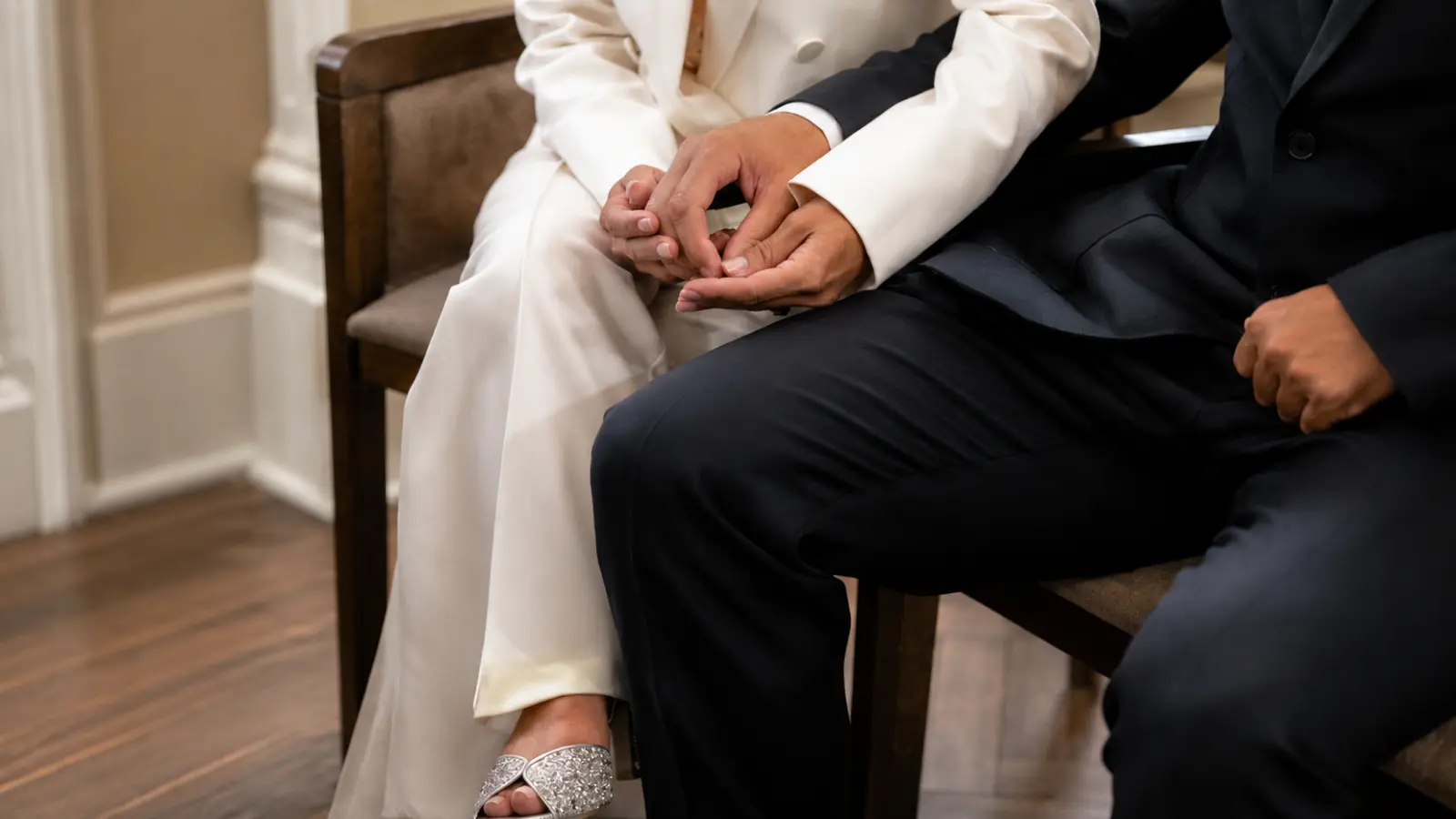
A Courthouse Wedding is a legal marriage ceremony arranged through a courthouse, clerk’s office, marriage bureau, or another government-authorized office. The exact process varies by jurisdiction, but it usually involves several separate steps: confirming eligibility, obtaining a marriage license, completing the ceremony with an authorized officiant, returning the signed license for recording, and obtaining proof of the recorded marriage afterward.
The important part is not to assume that every courthouse handles all of those steps in the same place. The office that issues the marriage license may be different from the location where the ceremony occurs, appointments may be required, witness rules can vary, and receiving a marriage certificate may involve a separate process after the ceremony.
This Courthouse Wedding guide explains how the process fits together, what to confirm before making an appointment, which documents may be required, how a marriage license differs from a marriage certificate, what happens during the ceremony, and what needs to happen afterward. Because marriage procedures vary by state and local jurisdiction, use this guide to understand the process and confirm the final requirements with the appropriate official office where you plan to marry.
What Is a Courthouse Wedding?
A courthouse wedding is a legally recognized marriage ceremony handled through a government office or an official authorized by that office. Where exactly it happens depends on the jurisdiction: inside an actual courthouse, at a clerk’s window, in a marriage bureau, at city hall, or in whatever room the authorized officiant works out of.
The name is a bit of a trap, honestly. “Courthouse” suggests one uniform process, but plenty of courthouses don’t marry anyone at all. Some only issue the license and let a county clerk, judge, magistrate, justice of the peace, or civil celebrant handle the actual ceremony somewhere else. Others run both the license desk and a short civil ceremony under one roof, but strictly by appointment. Two couples using the phrase “courthouse wedding” in the same city can end up describing two different buildings.
Which is why the first real task isn’t picking an outfit or drafting a guest list. It’s figuring out which office actually covers your county or city, and what that specific office does and doesn’t offer. The place that issues the license, the person who performs the ceremony, and the office that later records the paperwork can be three different desks, sometimes three different buildings entirely.
Courthouse Wedding vs. Civil Wedding
A courthouse wedding and a civil wedding get used interchangeably, but they’re answering different questions. “Courthouse wedding” describes the setting and government process. “Civil wedding” describes the legal nature of the ceremony itself, meaning it’s performed under civil authority rather than as a religious rite.
| Term | What It Describes | Possible Location |
|---|---|---|
| Courthouse wedding | A marriage arranged through a courthouse, clerk’s office, or related government office. | Courthouse, marriage bureau, clerk’s office, or another designated room. |
| Civil wedding | A legally recognized ceremony conducted by civil authority or an authorized civil officiant. | Courthouse, city hall, private venue, outdoor location, or another approved setting. |
People use the two terms as synonyms in everyday conversation, and most of the time nothing goes wrong because of it. For planning purposes, though, it helps to separate two questions: “Where can we legally complete the ceremony?” and “Who is authorized to perform it?” That distinction catches a mistake couples make more than you’d expect, which is assuming that any picturesque civil-ceremony venue can also issue a license or record a marriage. It usually can’t.
If you want the fuller picture of what makes a ceremony civil rather than religious, the dedicated civil wedding guide covers that separately. This article stays anchored to the courthouse process itself.
How the Courthouse Wedding Process Works
The process follows a fairly predictable chain, even though the fine print shifts from state to state: eligibility unlocks the license, the license unlocks the ceremony, the completed ceremony triggers filing, and filing produces the marriage certificate. Miss a link and everything downstream stalls.
- Choose the jurisdiction. Decide where you intend to marry and identify the official office responsible for marriage licenses and ceremonies there.
- Confirm eligibility and local rules. Check age requirements, identification, prior-marriage documentation, residency rules, waiting periods, witness requirements, and whether both applicants must appear in person.
- Apply for the marriage license. Complete the application online or in person if that option is available. Pay the current fee and confirm how long the license remains valid.
- Schedule the legal ceremony. Some offices require a separate appointment. Applying for a license does not necessarily reserve a ceremony time.
- Attend the ceremony. Bring the required documents, arrive according to the office’s instructions, and complete the short civil ceremony with the authorized officiant.
- Sign the marriage license. The couple, officiant, and witnesses, if required, complete the appropriate sections. Do not assume that every person signs in the same place or at the same time.
- Return the completed license. The officiant, couple, or another authorized person may be responsible for returning it. The exact responsibility and deadline must be confirmed locally.
- Obtain proof of the recorded marriage. After the license is recorded, the jurisdiction may issue a certificate automatically, send it by mail, or require the couple to order certified copies.
The part couples underestimate almost every time is step eight. Exchanging vows and signing a document feels like the finish line, but it isn’t. Nothing about that moment guarantees the license actually made it back to the recording office. Before you use the marriage for a name change, an insurance update, or an immigration filing, confirm the record was returned and accepted, not just signed.
For the license itself, the dedicated marriage license guide is a better resource than trying to force every state’s rule into one national procedure. If you want to compare how states differ side by side, that’s what the Marriage License by State guide is for.
What to Confirm Before Making an Appointment
A courthouse wedding goes sideways less often because of the ceremony and more often because of a phone call that never happened. Government offices run on limited ceremony hours, holiday closures, appointment-only booking, and sometimes a completely separate department for licenses versus ceremonies, none of which shows up clearly on a general courthouse website.
| Stage | What to Confirm | Who Usually Handles It | Local Rule to Check |
|---|---|---|---|
| Eligibility | Who may apply and whether both people must appear | Marriage license office or clerk | Residency, age, and prior-marriage requirements |
| License | Application method, fee, waiting period, and expiration | Issuing clerk or vital records office | Online versus in-person process |
| Ceremony | Whether the office performs ceremonies and how to schedule one | Court, clerk, marriage bureau, or officiant | Appointment availability, room, and ceremony hours |
| Guests | Witnesses, guest limit, children, and photography rules | Ceremony office or courthouse staff | Room capacity and security procedures |
| Recording | Who returns the license and how to order certified copies | Officiant, clerk, or vital records office | Return deadline and certificate delivery method |
Write down what you’re told, who told you, and when. It sounds excessive until a front-desk answer contradicts what the website said, which happens more than couples expect, especially when a general courthouse page hasn’t been updated to reflect a separate clerk’s or marriage bureau’s current policy.
If you’d rather work from a running list than reread this section on your wedding morning, the courthouse wedding checklist turns these confirmations into a chronological task list you can actually check off.
What Documents Do You Need for a Courthouse Wedding?
Most offices want government-issued identification plus whatever information the marriage license application requires. The specific list changes by jurisdiction, so treat what follows as a planning framework, not a guarantee of what your office will ask for.
Identification and Personal Information
A marriage license office typically asks for current identification, such as a driver’s license, state ID, passport, or another accepted document, plus details like Social Security numbers, birth information, or addresses for the application itself. Here’s the detail people miss: a document that gets you through airport security isn’t automatically the document your license office accepts. Confirm their specific list before you go, not the general assumption of “a valid ID.”
Previous Marriage Documents
If either person was married before, the application will likely ask how that marriage ended. Some offices want a certified divorce decree, annulment record, or death certificate; others only need the date and location of the final event. This is one of the least uniform parts of the whole process, so don’t assume the rule that applied to a friend’s courthouse wedding in another state applies to yours.
Bring originals or certified copies when required. Photos, scans, or an unofficial photocopy often won’t be accepted without extra steps, and if a name on your ID doesn’t match a prior record exactly, ask the issuing office what evidence bridges that gap before you schedule the ceremony, not the week of it.
Translations and Special Documents
Documents issued in another language sometimes need a certified English translation before they’re accepted. If you’re using a foreign birth or divorce record, or either applicant is not a U.S. citizen, ask early about translation, authentication, or apostille requirements. These rules depend heavily on both the issuing jurisdiction and what the document will ultimately be used for, so a generic answer isn’t useful here.
One habit worth building: don’t let a blog checklist, including this one, stand in for the actual official list. Use it to know what to ask, then confirm the final version directly with the office issuing your license.
Marriage License vs. Marriage Certificate
These are not the same document, and mixing them up is one of the most common courthouse missteps. The license gives you permission to proceed with the legal marriage process. The certificate is proof that the marriage actually happened and was recorded. USA.gov draws the same line: a marriage license legally allows a couple to marry, while a marriage certificate proves that the marriage occurred.
| Document | Main Function | When It Matters |
|---|---|---|
| Marriage license | Authorizes the couple to complete the legal marriage process. | Before and during the ceremony. |
| Marriage certificate | Shows that the completed marriage was recorded. | After the ceremony, when proof of marriage is needed. |
The license doesn’t get replaced by the certificate automatically; it has to be signed correctly and returned to the recording office first, and what that final document is even called can vary by state. Some jurisdictions treat a certified copy of the recorded license as the official proof of marriage, full stop.
Don’t expect a certificate to be handed over at the courthouse the moment the ceremony ends. The office usually has to process the signed license first, and certified copies are frequently a separate request. The marriage certificate guide walks through that stage in more detail.
What Happens at a Courthouse Wedding?
A courthouse ceremony is short and built around what the jurisdiction legally requires, not around tradition. The exact script differs by state, but the shape is usually the same: an identity check, a declaration of intent or equivalent legal language, the ceremony itself, signatures, and instructions for returning the license.
Arrival and Check-In
Give yourself more time than the appointment length suggests. You’ll likely pass through security, hunt down the correct office, and find the ceremony room, and courthouses often restrict bags, outside food, or decorations in ways a wedding venue wouldn’t. Bring your confirmation and whatever documents the office told you to have on hand.
The Legal Ceremony
The officiant confirms each person’s identity and willingness to marry, then moves through whatever combination of formal declaration, short reading, vows, or ring exchange the office allows. Don’t assume personal vows, music, or a particular format come standard. If those details matter to you, ask what’s permitted before the day, not while you’re standing at the counter.
Signing the License
After the ceremony, the couple and officiant complete their sections of the marriage license, and witnesses may need to sign too depending on local law. Use your name and information exactly as instructed, and ask before correcting anything yourself. An unauthorized change to a legal record, even a small one, can hold up recording.
For the fuller experience of vows, rings, guests, and witnesses, the separate courthouse wedding ceremony guide goes deeper than this article needs to. Here, the focus stays on how the legal steps connect.
Witnesses, Guests, Officiant, Vows, and Rings
These are the details couples worry about most, and they’re also the ones controlled entirely by local rules and office policy rather than by any single national courthouse standard.
Witnesses
Some jurisdictions require witnesses to sign the marriage record; others don’t. A courthouse can also add its own witness rule for the ceremony it performs, even if state law would otherwise allow something looser. Confirm the number, minimum age, identification, and whether the office can supply a witness or expects you to bring your own.
Guests and Children
Many offices allow a small number of guests, but the real limit usually comes down to room size or security procedure, not policy on paper. Children might be welcome, restricted, or simply counted against the room limit like anyone else. Ask about total headcount, arrival instructions, accessibility, and photography before you send a single invitation.
Who Performs the Ceremony?
The officiant might be a judge, magistrate, clerk, justice of the peace, civil celebrant, or another person the jurisdiction has authorized. Getting ordained online does not automatically grant legal authority everywhere; some states recognize it, others don’t. If you’re hoping a friend or family member can officiate, verify both their legal authority and the paperwork it requires well before the date. EVORÉ’s wedding officiant guide covers that role on its own.
Vows and Rings
Personal vows and rings can matter to you personally, but neither is universally required for a valid courthouse marriage; any legally required declaration of intent or consent depends on the jurisdiction and ceremony procedure. Some ceremonies allow a short personal statement inside a standard script; others stick strictly to official legal wording. Rings can be exchanged during the ceremony, worn without an exchange, or skipped entirely, and none of that changes the marriage’s legal standing.
How Long Is a Courthouse Wedding?
The ceremony itself might run just a few minutes, but the appointment isn’t only that. Build in time for security, check-in, document review, waiting for the officiant, signatures, and any questions about filing. If the office quotes a ceremony duration, treat it as the spoken portion, not the whole visit.
What Happens Immediately After a Courthouse Wedding?
Right after the ceremony, find out what happens to the signed marriage license. In some jurisdictions, the officiant handles the return; in others, the couple is responsible for getting it back to the issuing clerk. Ask whether filing happens automatically, whether there’s a deadline, and how you’ll know the record was actually accepted, rather than assuming “signed” means “done.”
Once the marriage is recorded, find out how to get certified copies. You’ll likely need one for a legal name change, an employer or insurance update, immigration paperwork, or another administrative task. USA.gov directs couples to the vital records office in the state where they married for details on ordering a certified certificate, including current cost and whether online, mail, or in-person requests are available.
None of this rules out a bigger celebration later. A courthouse ceremony and a reception don’t have to share a date or even a year; plenty of couples marry legally first and host the party whenever it makes sense for their families or budget.
If a name change is on your list, hold off until you know exactly which certified document the relevant agencies will accept. That next phase belongs in the after-marriage checklist and the guide to changing your name after marriage, not squeezed into a courthouse ceremony article.
Common Courthouse Wedding Mistakes to Avoid
Courthouse weddings rarely go wrong because of a dramatic legal problem. They go wrong because of a small planning assumption that’s hard to fix once you’re already standing at the window.
- Assuming every courthouse performs weddings: Some offices issue licenses but don’t run ceremonies at all. Confirm the actual service before choosing a location.
- Confusing the license with the certificate: The license enables the ceremony; the certificate proves it happened. They serve different purposes at different stages.
- Booking the wrong appointment: A license appointment and a ceremony appointment aren’t always the same booking. Ask whether you need both.
- Relying on another state’s rules: Waiting periods, license validity, witness rules, fees, and accepted ID can all look completely different one state over.
- Bringing incomplete prior-marriage documents: A screenshot of a divorce decree usually won’t cut it if the office wants a certified copy.
- Inviting guests before checking the limit: Ceremony rooms are often smaller than couples picture, and the number allowed can surprise people.
- Forgetting the return step: Know who’s returning the signed license and how certified copies get ordered once it’s recorded.
- Planning a detailed ceremony without asking: Personal vows, rings, photography, and readings may all be restricted by the office or officiant, so check first.
None of these mistakes are about drama or decoration. They’re about sequence. Get the legal order right first, and the personal details fall into place around whatever the jurisdiction can actually accommodate.
Complete the Legal Process, Not Just the Ceremony
A Courthouse Wedding may be simple, but the legal process still has several separate steps. Confirm which jurisdiction handles your marriage, understand the marriage license requirements, determine whether a separate ceremony appointment is needed, bring the documents the office requires, and make sure the completed license is returned for recording afterward.
Do not treat the ceremony itself as the final administrative step. Confirm how the marriage is recorded and how certified proof becomes available before relying on it for a name change, benefits, insurance, or another legal or administrative purpose. Once those requirements are handled correctly, the size, style, guests, rings, and celebration surrounding the courthouse wedding are entirely yours to decide.
Frequently asked questions (FAQ)
How does a courthouse wedding work?
A courthouse wedding usually involves several separate steps: confirm that you are eligible to marry in the jurisdiction, apply for and receive the marriage license, complete any required waiting period, schedule or attend the civil ceremony, sign the license with the officiant and any required witnesses, and make sure the completed license is returned for recording. After it is recorded, you can obtain the marriage certificate or certified copies according to the local process.
What is a courthouse wedding?
A courthouse wedding is a legally recognized marriage ceremony arranged through a court, clerk’s office, marriage bureau, city hall, or another government-authorized office. The exact location and procedure vary by jurisdiction, and the office that issues the marriage license may not be the same place that performs the ceremony.
Can you get married the same day you apply for a marriage license?
Sometimes, but not everywhere. Some jurisdictions allow couples to receive a marriage license and complete the ceremony the same day, while others require a waiting period or a separate ceremony appointment. Confirm both the waiting-period rules and ceremony availability with the office that issues the license.
How long does a courthouse wedding take?
The ceremony itself may be brief, but the complete legal process can take much longer. You may need time to apply for the marriage license, wait for it to become usable, schedule the ceremony, check in, complete the ceremony and signatures, return the license for recording, and obtain certified proof of the marriage. The total timeline depends on the jurisdiction.
Do you get a marriage certificate immediately after a courthouse wedding?
Not necessarily. After the ceremony, the signed marriage license generally must be returned to the appropriate office and recorded. Depending on the jurisdiction, a marriage certificate or certified copy may then be mailed automatically or may need to be ordered separately. Confirm how the office handles recording and certified copies before assuming the ceremony completes the paperwork.
Is a courthouse wedding the same as a civil wedding?
Not exactly. A courthouse wedding describes the setting or government process through which the marriage is arranged, while a civil wedding describes a legally recognized nonreligious ceremony performed under civil authority. Most courthouse weddings are civil weddings, but a civil wedding can also take place at city hall, a private venue, or another legally authorized location.