
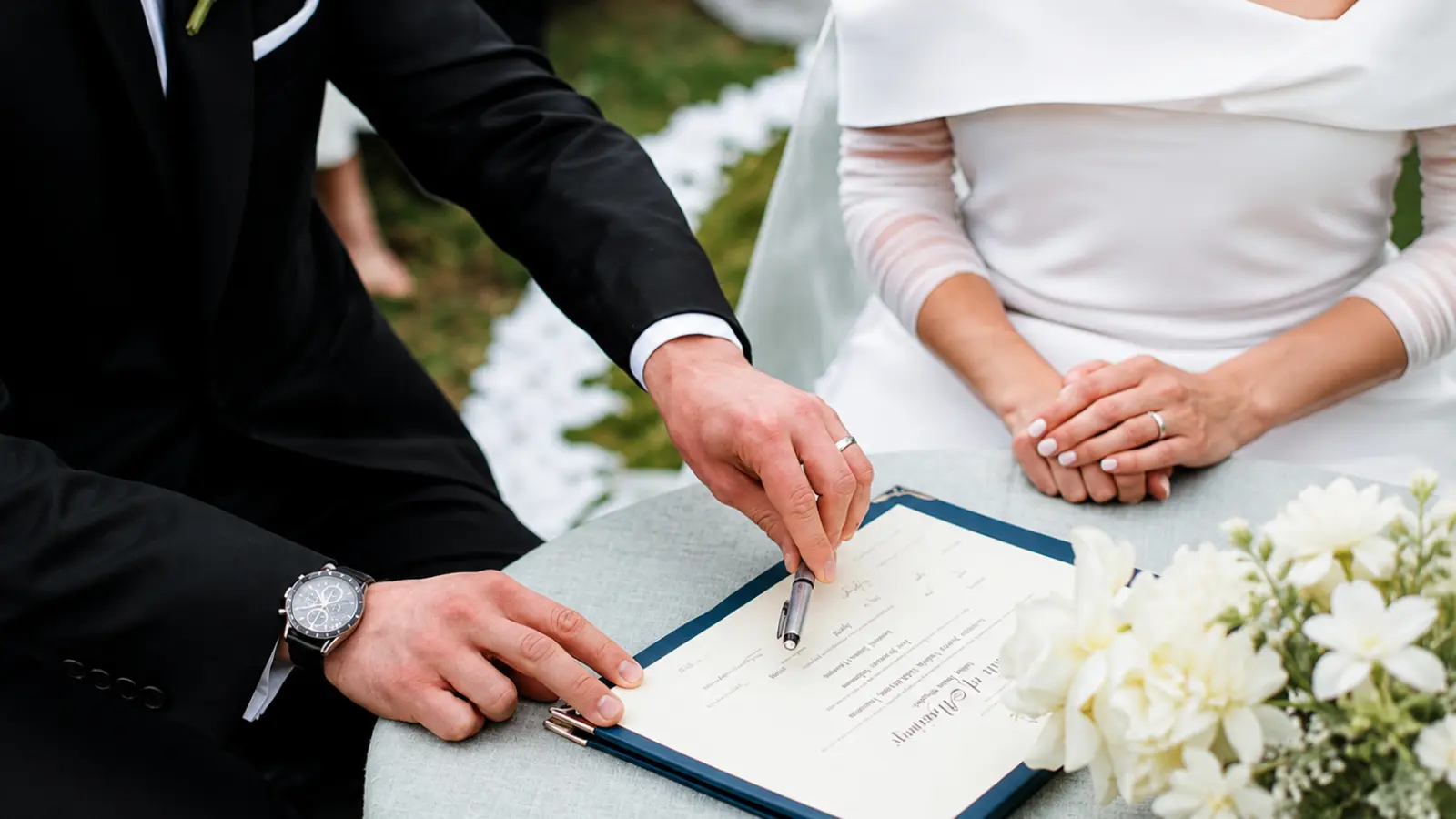
A Courthouse Wedding Ceremony is usually brief and focused on completing the legal marriage ceremony, but the exact experience depends on the office and jurisdiction. The appointment may include check-in, identity and document review, legal consent, an officiant-led civil ceremony, any permitted vows or ring exchange, required signatures, and a final pronouncement.
The basic structure is often similar, but the details are not standardized. One office may use a fixed script and allow only the couple and required witnesses, while another may permit guests, personal vows, rings, photography, or a private ceremony room.
This Courthouse Wedding Ceremony guide explains what can happen from arrival through the end of the appointment, including who may conduct the ceremony, how legal consent fits into the process, whether personal vows and rings are allowed, how witnesses and guests differ, what photography rules may apply, and what happens after the ceremony ends.
What Happens at a Courthouse Wedding Ceremony?
The ceremony usually moves through five practical moments: check-in, legal consent, optional personal elements, signatures, and pronouncement. The officiant may explain the order before beginning, especially when the office uses a standard civil script.
| Ceremony Element | Usually Required | Usually Optional | Who Decides | Confirm Ahead |
|---|---|---|---|---|
| Identity and license review | Yes | No | Issuing and ceremony office | Accepted ID and documents |
| Declaration of intent or legal consent | Generally | Personal wording | State law and officiant | Required response and language |
| Standard civil vows | Commonly included | Alternative phrasing | Officiant and office policy | Whether the script is fixed |
| Personal vows | No | Yes | Officiant and office policy | Length and placement |
| Ring exchange | No | Yes | Couple and officiant | Whether time is included |
| Witness signatures | Varies | Extra guests | Jurisdiction and license type | Number, age, and ID |
| Photography | No | Yes | Court or office policy | Where and when it is allowed |
| Pronouncement | Commonly included | Preferred wording | Officiant and legal format | How the ceremony closes |
The required legal core may be very small, which is why rings and personalized vows can be meaningful without being necessary. The office’s script and appointment policy determine how much can be added around that core.
Arrival, Check-In, and Identity Review
Arrive at the time the office recommends, allowing for security, parking, elevators, and finding the correct room. Some courthouses ask couples to arrive fifteen minutes early; others do not have space for people waiting far ahead of their appointments.
At check-in, staff may review identification, the marriage license, appointment confirmation, witness information, and any outstanding payment. Names and dates should match the legal record. If staff identifies an error, ask how it must be corrected instead of writing over the document.
The courthouse wedding checklist covers what to bring and what to reconfirm before arrival. The marriage license guide explains the document itself; this ceremony article assumes that the required license stage has already been completed.
Who Conducts a Courthouse Wedding Ceremony?
A courthouse wedding may be conducted by a judge, magistrate, clerk, marriage commissioner, justice of the peace, civil celebrant, or another person authorized under the law of that jurisdiction. The person standing at the front of the room is not always a judge, even when the ceremony takes place in a courthouse.
The officiant’s responsibility is more than reading a few lines. That person confirms the ceremony can proceed, obtains the required declarations, completes the officiant portion of the marriage record, and follows the local return or filing procedure.
EVORÉ’s wedding officiant guide explains the role, while Who Can Officiate a Wedding? addresses legal authority when a couple wants to use a friend, relative, or outside officiant instead of the government-provided option.
Declaration of Intent and Legal Language
The declaration of intent is the part in which each person clearly expresses the legal consent required to marry. It may sound like a question from the officiant followed by a direct response, or it may be incorporated into the civil wording used by that office.
There is no single federal courthouse ceremony script. The legally required declaration, the people who must be present, and the wording or procedure used during the ceremony depend on state law and the jurisdiction’s approved process. Confirm the required response and ceremony format with the office or officiant handling your marriage.
The exact terms reflect state law and the office’s approved script, so do not replace the legal response with a poem, joke, private gesture, or personalized vow. Personal wording can come after the required consent when the officiant permits it.
Courthouse Wedding Vows and Personalized Vows
Courthouse wedding vows are often short and civil rather than religious. The officiant may ask the couple to repeat standard wording about taking one another as spouses, or the legal consent may serve as the complete spoken commitment.
Personalized vows are optional and office-dependent. Some ceremony providers allow a brief addition after the legal language; others use a fixed script and do not permit changes. Hennepin County, for example, states that its brief civil script cannot be personalized, which illustrates why couples should ask rather than assume.
If personal vows are allowed, keep them concise enough for the appointment. A few specific sentences can feel more intimate than trying to fit a full private ceremony into a government time slot. The wedding officiant script guide explains complete ceremony structure elsewhere; this article intentionally does not provide a full script.
Do You Need Rings for a Courthouse Wedding?
No. Rings are generally symbolic, not a legal requirement for a courthouse marriage. A couple can exchange rings during the ceremony, put them on beforehand, wear them later, or marry without rings.
If you want an exchange, tell the officiant before the ceremony begins. The officiant may include one short line or signal when to place the rings. Keep the rings somewhere secure and immediately accessible rather than buried in a bag when the appointment is moving quickly.
Not having rings does not make the ceremony less official or less meaningful. Legal consent and proper completion of the marriage record are what matter to the civil process.
Witnesses, Guests, and Children
Witnesses and guests are not interchangeable categories. A witness may have to meet an age rule, bring identification, observe the legal ceremony, and sign the marriage record. A guest attends but has no legal role unless selected and qualified to serve as a witness.
Courthouse Wedding Witnesses
The required number varies by jurisdiction and sometimes by license type. Confirm how many witnesses to bring, whether the office can provide one, and how names and addresses should appear on the record. Do not add extra witness signatures unless the form and officiant allow them.
Courthouse Wedding Guests
Guest limits usually reflect room size, court security, and appointment format. Some offices permit only the required witness; others allow a small group or reserve larger ceremony rooms. Clark County’s official civil marriage service, for example, publishes a specific guest limit in addition to the required witness, showing how precise local policies can be.
Can Children Attend?
Children may be welcome, but they can count toward the guest limit and must be able to follow courthouse security and room rules. Ask whether strollers, diaper bags, food, or waiting outside the ceremony room create restrictions. If a child is expected to carry rings or stand beside the couple, confirm that the ceremony format allows it.
Guest count can also affect the available room or ceremony fee. The courthouse wedding cost guide keeps those administrative charges separate from optional celebration spending.
Photography Rules and Personal Items
Photography rules can change from the courthouse entrance to the ceremony room. A court may prohibit cameras or video in hallways while allowing them during the marriage ceremony. Another office may permit a photographer but restrict tripods, lighting equipment, movement, or time after the pronouncement.
Ask who may take photographs, where that person may stand, whether video is allowed, and whether there is time for a few posed images. Do not assume a general public-building photography policy overrides courtroom or security rules.
Keep personal items compact. Rings, a short written vow, a small bouquet, and a phone or camera may be manageable, while confetti, candles, balloons, large signs, music speakers, food, or decorations may be prohibited. The goal is to personalize the moment without interrupting the office’s schedule or public function.
How Long Is a Courthouse Wedding Ceremony?
The spoken ceremony is often about five to fifteen minutes, while the full appointment may take longer. Official local examples range from an approximately five-minute civil ceremony to ten-minute counter ceremonies and thirty-minute appointments that include paperwork or ceremony time.
Plan separately for security, check-in, waiting, document review, the ceremony, signatures, and any permitted photographs. A five-minute ceremony does not mean the couple should allow only five minutes between parking and the next reservation.
If the office publishes a time slot, treat it as the maximum window rather than a promise that every minute belongs to personalized content. Late arrival can shorten the experience or require rescheduling.
Signing, Pronouncement, and What Happens After
Completing the Marriage Record
The marriage record may be signed immediately before or after the spoken ceremony, depending on the office. The couple, officiant, and required witnesses should complete only the sections assigned to them. Review spelling before signing and ask staff about any error.
After the Pronouncement
The officiant commonly ends with a pronouncement that the couple is married. This is the emotional finish of the ceremony, but the administrative process continues. The completed record still needs to be returned and recorded according to local procedure.
Ask who is responsible for returning the document and when proof of marriage will become available. A souvenir paper handed over after the ceremony may not be the certified record needed for legal or administrative use. The marriage certificate guide explains what happens after the record is filed.
A courthouse ceremony is one form of civil wedding, but its setting creates practical limits that a private civil ceremony may not have. Knowing those limits beforehand lets the couple appreciate the moment instead of negotiating logistics while the officiant is ready to begin.
A Short Ceremony Can Still Feel Complete
A Courthouse Wedding Ceremony does not need a long script or elaborate setting to feel meaningful. What matters most is understanding the legal core of the ceremony, knowing which personal elements the office allows, and arriving prepared for the format you have actually booked.
Confirm the required ceremony process, witnesses, guest limits, photography rules, vows, rings, and any signing instructions before the appointment. Once those details are clear, the ceremony can stay simple without feeling uncertain or incomplete.
Frequently asked questions (FAQ)
What is included in a courthouse wedding ceremony?
A courthouse wedding ceremony usually includes check-in, identity and document review, an authorized officiant, the legal declaration of intent or equivalent consent, any permitted vows or ring exchange, required signatures, and a pronouncement. Witness participation, personal vows, rings, guests, photography, and other additions depend on the jurisdiction and the office’s ceremony policy.
What happens at a courthouse wedding ceremony?
After checking in, the couple typically meets the authorized officiant, confirms identity and required paperwork, gives the legal consent needed to marry, completes any permitted personal elements, signs the marriage record with required witnesses, and is pronounced married. The exact sequence and wording vary by jurisdiction.
How long is a courthouse wedding ceremony?
The spoken ceremony is often brief, commonly around five to fifteen minutes, but the full appointment may take longer once security, check-in, document review, waiting, signatures, and permitted photographs are included. Some offices use very short counter ceremonies, while others reserve longer appointment windows.
Do you have to say vows at a courthouse wedding?
You must give whatever legal consent the jurisdiction requires, but traditional or personalized wedding vows are not universally required. Some offices use only a fixed civil script, while others allow a short personal vow after the required legal wording. Confirm personalization rules before the ceremony.
Do you need rings for a courthouse wedding?
No. Rings are symbolic rather than a general legal requirement for a courthouse marriage. Couples can exchange rings if the officiant and office allow it, wear them without a formal exchange, or skip them entirely without changing the legal status of the marriage.
Can guests and children attend a courthouse wedding ceremony?
Often, yes, but guest limits depend on the ceremony room, security procedures, appointment type, and local office policy. Children may be allowed but can count toward the total capacity. Confirm the exact guest limit, arrival rules, and any restrictions before inviting people.