
You can hire a florist, a caterer, a photographer. There is no one to outsource the most important words of your life to. You sit down with a blank page, and the pressure of the moment is so enormous that even people who write for a living go completely blank.
If that is you — you are not struggling because you do not have anything to say. You are struggling because you do not have a structure.
This guide gives you that structure. It is the most complete, practical guide to how to write wedding vows available covering every style, every person, and every scenario. Whether you are writing vows for the groom, wedding vows for her, vows that are short, funny, personal, or deeply traditional the method is here, and so are the examples.
If you want to explore every wedding vow style, script, example, and ceremony format in one place, you can also read our complete wedding vows guide.
1. Why Most People Struggle to Write Their Vows
Before we get into the method, it helps to understand why this feels so hard. Most people who struggle with how to write wedding vows are experiencing one of three specific problems:
Problem 1: The Pressure Is Too High
Wedding vows are said once, in public, at the single most emotionally charged moment of your life. The combination of permanence and audience creates a kind of paralysis. You know these words will be remembered. You know people are counting on them to be good. That pressure shuts down the creative, honest voice you need and replaces it with a performance voice — and performance voice produces generic vows.
The fix: Write your first draft as if no one will ever read it. Give yourself permission to be messy, rambling, and even bad. The editing process is where vows become good. The first draft just needs to exist.
Problem 2: You Are Trying to “Sound Like Wedding Vows”
Most people write vows that sound like the vows they have heard at other weddings — poetic, formal, elevated. And those vows never feel quite right, because they are not coming from the authentic voice of the person writing them. The result is vows that are technically fine but emotionally hollow.
The fix: Write in the exact voice you use with your partner in private. Not the voice you use in work emails. Not the voice you think a wedding vow should have. The voice that sounds like you on a normal Tuesday.
Problem 3: You Do Not Have a Structure
A blank page with “write something beautiful and meaningful about the love of your life” as the only instruction is an impossible task. Structure removes the paralysis. When you know what the four parts of a vow are, you are not staring at a blank page — you are filling in a framework.
The fix: Use the 7-step method in this guide. You are not starting from nothing — you are working a proven process.
2. What Makes Wedding Vows Truly Great
Before you write a single word, you need to know what you are aiming for. Great wedding vows share three qualities — none of which have anything to do with eloquence, poetic language, or writing ability.
Quality 1: They Sound Like You
The single most important quality of a great vow is authenticity of voice. Guests who know you well — and most guests at your wedding will — can tell immediately when vows sound scripted, borrowed, or performed. The moment they hear something that sounds genuinely like you speaking, the emotional connection is instant and total. Your vows do not need to be beautifully written. They need to sound exactly like the person giving them.
Quality 2: They Are Specific
“You are kind, you are patient, you make me laugh” — this could be said by anyone about anyone. It lands as information, not as feeling. Compare it to: “You are the person who texted me every day after my dad got sick — not to check in, just to make me smile. That is who you are.” That lands. Specificity is what creates the moment where the room goes silent. The more particular and real your vow is, the more universally it connects.
Many couples find it helpful to review real wedding vows examples before writing their own, especially to understand the difference between generic language and truly personal moments.
Quality 3: They Include Real Promises
A vow is, by definition, a promise. Many personal vows are beautifully written love declarations that contain no actual promises. Love declarations are wonderful — but they are not vows. Your vows need to include at least two or three forward-looking commitments: things you will actually do, consistently, as a result of this ceremony. Not “I will love you forever” — that is a declaration. But “I promise to choose this — and you — even on the days when it requires a decision” — that is a promise.
| Good vow element | Weak version | Strong version |
|---|---|---|
| Opening | “From the moment I met you…” | “The third time we got coffee, you ordered the same strange thing I thought only I liked. That was the moment.” |
| Description | “You’re kind, patient, and funny.” | “You are the person who stayed on the phone for two hours when I was scared and had nothing useful to say. That is what kind looks like.” |
| Promise | “I will always be there for you.” | “I promise to listen before I react — especially when what I want to do is react.” |
| Closing | “I love you more than words can say.” | “I have loved you every day since I knew. That is not changing. That is the one thing I am absolutely certain of.” |
3. How to Write Wedding Vows — The 7-Step Method
This is the core of the guide. The following seven steps are the exact process used by professional vow writers — adapted for couples who want to write something genuine themselves. Work through each step in order.
Step 1: Block Your Timeline (Do This First)
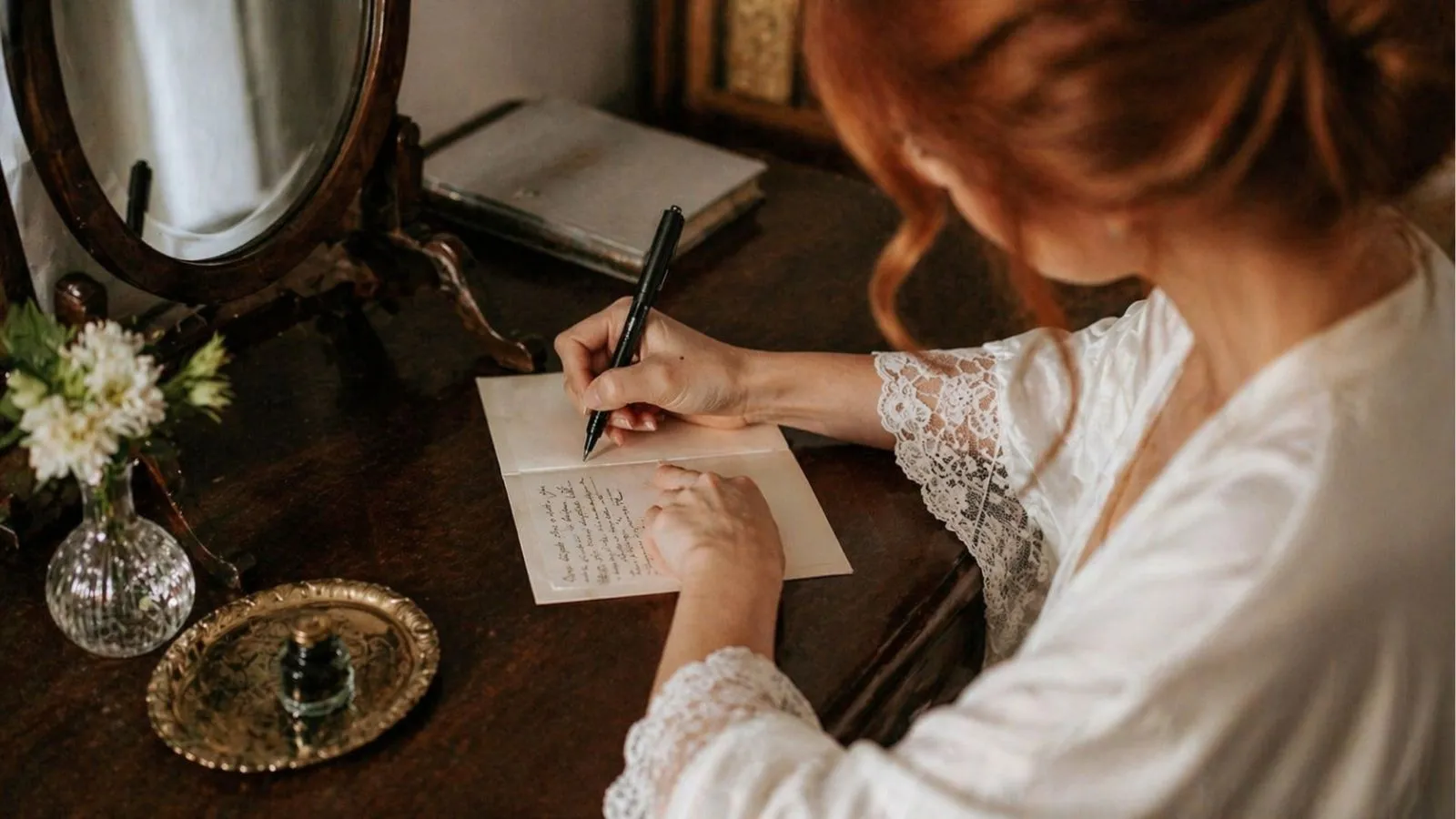
The most important step happens before you write anything. Set your timeline. Start six to eight weeks before your wedding — not because vows take that long to write, but because they need time to arrive at. You need time to think, draft, walk away, return, and refine without the pressure of a wedding week bearing down on you.
Specifically, block:
- Week 1: Answer the questions in Step 2 (writing, not typing — pen and paper works better here)
- Week 2–3: Write your first full draft
- Week 4: Walk away completely — do not read it
- Week 5: Return, revise, cut
- Week 6–7: Finalize and practice out loud daily
- Wedding week: One final read-through per day, no major changes
Step 2: Answer These 8 Questions (Before You Write Anything)
Do not skip this step. Do not try to write vows before you do this. These questions are the raw material — the specifics that turn generic vows into something no one else could say.
Write your answers freely. Do not edit. Do not try to make them sound good. Just answer honestly.
- What is the specific moment when you knew? Not “when I met them” — a scene. A date. A sentence they said. What exactly happened?
- What do you love most about them that they might not know you notice? The small, private things. Not the obvious ones.
- What has being in this relationship changed in you? How are you different because of them?
- What is the hardest thing you have been through together? What did it show you about them — and about you as a team?
- What are two or three things that are uniquely “you two”? Shared habits, phrases, rituals, memories that only you would understand.
- What are three specific promises you want to make? Not general ones. Ones that mean something particular in your relationship.
- What do you most want your partner to feel when you are done?
- If you could say one single thing — and nothing else — what would it be?
Your answers to these questions already contain your vow. The writing process is simply about shaping them into something that flows when spoken aloud.
Step 3: Write Your First Draft — Long and Messy
Most people’s first drafts are too short because they self-edit as they go. Do not do this. Write everything that comes. Write more than you need. Include the repetitive parts, the obvious parts, the parts that feel too simple. You are not writing the final vow — you are getting your material on paper.
Give yourself at least 45 uninterrupted minutes. Put your phone away. Use pen and paper if you can — studies consistently show that handwriting produces more emotionally authentic language than typing. Do not aim for anything other than completeness. You can make it good later. Right now, just make it real.
Step 4: Build the Four-Part Structure
Once you have your raw material, shape it using the four-part vow structure. Every great personal vow — regardless of tone or length — contains these four elements:
Couples who want a faster starting point can also use a complete wedding vows template before personalizing the structure with their own memories and promises.
| Part 1 The Past | Open with a specific moment or memory. This grounds the vow in something real and immediately signals to your partner — and everyone watching — that this is personal. Duration: 2–4 sentences. |
| Part 2 The Person | Describe who this person is to you right now. Specific qualities, specific ways they show up, specific things only you could say about them. Duration: 3–5 sentences. |
| Part 3 The Promises | 3 to 5 specific, forward-looking commitments. This is the actual vow. Replace any generic promise with a version that could only come from your relationship. Duration: 4–6 sentences. |
| Part 4 The Close | End with the single most important thing. A declaration, a callback to your opening, or a simple forward-looking commitment. One to two sentences. Make it land. Duration: 1–2 sentences. |
Step 5: Cut Everything Generic
Take your draft and go sentence by sentence. Ask this question about each one: “Could this sentence have been written by someone else about someone else?” If the answer is yes — cut it or replace it with something specific.
Common sentences to cut or fix:
“You are my best friend and my soulmate”→ Replace with what that actually looks like in your relationship“You make me laugh every day”→ Replace with a specific moment they made you laugh“I never knew what love was until I met you”→ This is heard at every wedding; cut it“I promise to always be there for you”→ Replace with what “being there” means specifically to you“I love you more than words can say”→ If you cannot say it, find a different closing line
Step 6: Say It Out Loud — Many Times
Reading vows silently and saying them at the altar are completely different experiences. You will discover:
- Sentences that are too long to say in one breath
- Words that feel unnatural in your mouth
- The specific moments where emotion rises — which tells you those lines are right
- Pacing issues you cannot see on a page
Time yourself. Aim for 90 seconds to 2 minutes. Practice until it does not just sound like words — until it sounds like you, speaking clearly, to the person you love.
If you are unsure whether your vows are too short or too long, this wedding vow length guide breaks down ideal timing, word count, and pacing for different ceremony styles.
Step 7: Prepare Your Card
Whether you memorize your vows or not, always bring a card. Write or print your final vows on a clean index card, a small notecard, or a vow book. The card is not a failure of preparation — it is professionalism. Even the most prepared speakers use notes. Nerves, emotion, and the faces of the people you love create an environment where memory cannot be fully trusted.
4. The Wedding Vow Template You Can Actually Use
This is the most practical tool in this entire guide. Use this fill-in-the-blank template to write your first complete draft in under 30 minutes. Do not aim for perfection — aim for honesty. You will refine it later.
✍️ The Complete Wedding Vow Template
[THE PAST — Opening with a specific moment]
I remember when _______________.
That was the moment I knew _______________.
[THE PERSON — Who they are to you]
You are the person who _______________.
You have taught me _______________.
What I love most — the thing I am not sure you even know I notice — is _______________.
[THE PROMISES — 3 to 5 real commitments]
I promise to _______________.
I promise to _______________.
I promise to _______________.
I promise to _______________, even when _______________.
[THE CLOSE — The one thing]
Today, I choose you. And I will keep choosing you — every single day — for the rest of my life.
This template produces a vow that is approximately 150–200 words when filled out — right in the ideal range. Once you have completed it, go back through the method in Section 3 to make it more distinctly yours.
5. How Long Should Wedding Vows Be? (With Timing Guide)
One of the most common questions couples have about how to write wedding vows is also one of the most practical: how long is long enough, and how long is too long?
| Word Count | Spoken Time | Verdict |
|---|---|---|
| Under 100 words | Under 45 sec | ⚠️ Feels incomplete — use only for short/elopement format |
| 150–250 words | 1–2 min | ✅ Ideal for most couples |
| 250–400 words | 2–3 min | ⚡ Acceptable — only if every sentence earns its place |
| Over 400 words | Over 3 min | ❌ Begins to lose emotional impact — cut before publishing |
6. How to Write Wedding Vows for the Groom
Writing wedding vows for the groom presents a specific challenge that does not get discussed enough: most men are not socialized to speak about love in public, in depth, without feeling exposed. The result is grooms who write vows that are technically correct but emotionally distant — too brief, too formal, too careful.
Here is the truth about groom vows in 2026: the grooms who are willing to be emotionally vulnerable in their vows get the most powerful response. Not because vulnerability performs well — but because it is rare. When a groom says something real, the room feels it completely.
What Makes Great Groom Vows Different
For more complete examples written specifically for grooms, explore these real wedding vows for him examples and inspiration ideas.
The best vows for the groom do three things that average groom vows do not:
- They acknowledge change. “You have made me better” is a powerful male-coded vow because it is honest about growth without being self-flagellating.
- They make specific promises about behavior. Not “I will be there for you” — but “I promise to put my phone down when you are talking to me about something that matters.”
- They close with something clear and decisive. Strong, direct closing lines land well from a groom: “I am yours. That is not changing.”
Prompts Specifically for the Groom
- When did you first realize this was going to be permanent? What were you doing?
- What is something about her that makes you proud — that you would want everyone in this room to know?
- What has she changed in you that you would not want to change back?
- What is the hardest thing about loving someone the way you love her? How are you going to handle it?
- If she could hear only one sentence from you right now — what would it be?
Example: How to Write Wedding Vows for the Groom (Full Sample)
“I am not the kind of person who is easy to love. I know that. You knew that going in — and you stayed anyway, not out of patience but because you actually wanted to. I have not always understood that. But I understand it now, completely.
You have changed the way I move through the world. I am calmer because of you. I am more honest because of you. I am a better version of a person I was not sure I could become.
Today I promise to show up for you the way you have always shown up for me — without being asked. I promise to listen first. I promise to choose us in every room I walk into. And I promise to spend the rest of my life making sure you know that choosing me was worth it.
I am yours. Completely. That is not changing.”
7. How to Write Wedding Vows for the Bride (From Him to Her)
When a groom is writing wedding vows for her — the woman he is marrying — the frame shifts. The challenge here is not emotional access (as it is for many grooms writing their own vows) — it is specificity. Vows from groom to bride that guests remember are almost always distinguished by how precisely they describe the woman being married, not by how eloquently they describe love in general.
What She Actually Wants to Hear
These wedding vows for her examples explore emotional, romantic, and deeply personal promise styles that feel authentic rather than generic.
Speaking to officiants and couples post-ceremony, the vows that move brides most consistently contain these elements:
- A moment when he saw her clearly — not idealistically, but really
- Acknowledgment of something about her that she works hard at but does not always feel recognized for
- A promise that sounds like it was written for her specifically — not a general promise any groom might make
- A closing that conveys certainty — not romance for its own sake, but the steady, unshakeable quality of a decision made and meant
Example: Wedding Vows Written for Her (Full Sample)
“You are the most remarkable person I have ever known — and I say that having watched you for long enough to mean it. I have seen you at your best and at your most exhausted, and I find you extraordinary in both.
You carry more than anyone knows. You give more than you take. You make every room you walk into a better room, and I am not sure you fully believe that — so I intend to spend the rest of my life making sure you do.
I promise to protect you — not from the world, but from ever feeling alone in it. I promise to be the person in your corner unconditionally, in every room, in every version of this life. I promise to honor the weight of what you carry and to help bear it, always.
You are the answer to a question I did not know I was asking. I love you with a certainty I have never felt about anything else. Today I make it official — and forever.”
8. How to Write Personal Wedding Vows — Your Own Words
Learning how to write your own wedding vows that are entirely original and personal, not adapted from a template — requires one thing above all else: permission to say what is actually true rather than what sounds impressive.
Personal vows are not about being a writer. They are about being honest. The couples who write the most memorable personal vows are almost never the most skilled writers. They are the most willing to say the real thing, plainly, without decoration.
Couples looking for more original and creative promise ideas can also explore these unique wedding vows examples and modern vow styles.

The Private Vow: What to Do When You Want Something Intimate
Some couples want to write private wedding vows — promises that are deeply personal, perhaps including details or references too intimate to share with a full audience. There are two ways to handle this:
Option 1: The Two-Part Vow. Write a set of public vows for the ceremony — sincere and personal but appropriate for a full audience. Then separately write and exchange private notes before or after the ceremony, containing the things you wanted to say that were only for each other.
Option 2: The Whisper. Some officiants accommodate a brief moment at the altar where each partner whispers something to the other — a line or two that only they can hear. This is not standard, but many officiants will build it in if asked.
Writing Prompts for Personal Vows
Prompts That Unlock Personal Vows:
- “The thing no one else knows about how you love me is…”
- “Before you, I thought love was ___. You showed me it was actually ___.”
- “The moment that comes back to me most when I think of us is…”
- “I have never told you this, but the thing that made me certain was…”
- “In ten years, I hope we still ___.”
- “The promise I most want to keep — the one I will work hardest at — is…”
- “What I want you to know, in front of everyone here, is…”
9. How to Write Short Wedding Vows
Short vows are not a compromise — they are a style choice. The decision to write short wedding vows is legitimate, meaningful, and often produces the most emotionally direct moments in a ceremony. The key is that short vows must have zero filler. In a long vow, a weak sentence costs you a few seconds. In a short vow, a weak sentence costs you everything.
Some of the strongest ceremony moments come from short wedding vows that say something deeply personal in very few words.
The Rule of Short Vows: One Idea Per Sentence
Short vows work on the principle of compression. Every sentence carries maximum weight because there are very few of them. This means:
- Each sentence must earn its place completely
- There is no room for preamble or setup
- The opening line must hit immediately
- The closing line must land with full force
How to Write Short Vows: The Compression Method
Start by writing a full-length vow using the 7-step method. Then cut it to its essential core: the single most important thing from the past, the single most important thing about who they are, three promises, one closing. Strip everything else.
Short Vow Example 1 — Under 90 Seconds
“I choose you. Not just today — every day, in every version of our lives. I promise to love you without conditions, to show up without reservation, and to fight for us before I ever fight against it. You are it for me. That is not changing.”
Short Vow Example 2 — Simple and Direct
“I promise to love you completely, to respect you always, and to keep choosing this — especially when choosing is hard. You are my best friend and the love of my life. I am honored to stand here and make this promise to you.”
Short Vow Example 3 — For a Minimalist Ceremony
“From this day forward, you will not face anything alone. I promise to be beside you in every season — in joy, in difficulty, and in everything in between. I love you. I am yours.”
10. How to Write Funny Wedding Vows (The Right Way)
Humor in wedding vows is one of the highest-risk, highest-reward moves in ceremony planning. When it works, a funny vow gets the biggest response of the day — laughter that releases the tension of the ceremony and then immediately gives way to something sincere and moving. When it does not work, it flattens the energy of the most important moment of the day.
The difference is in understanding what makes vow humor actually work.
These funny wedding vows examples show how couples balance humor and sincerity without losing the emotional weight of the ceremony.
The Four Rules of Funny Wedding Vows
Rule 1: Specific beats general. “I promise to let you have the remote” is generic and has been heard at a thousand weddings. “I promise to never complain about the three hours of real estate shows we watch every Sunday — even though I have seen enough countertop renovations to last me a lifetime” is specific and lands completely differently.
Rule 2: Punch warm, never hard. The joke must be about the relationship — a shared habit, a mutual quirk, something you do together. It cannot be at your partner’s expense in a way that edges toward actual criticism. The test: would you say it in front of their most traditional family member, without any awkwardness?
Rule 3: One or two moments of humor, not a comedy set. The funniest vows contain one or two well-placed jokes embedded in a sincere vow. An entirely comedic vow lands as a performance, not a promise. The humor works precisely because it is surrounded by sincerity.
Rule 4: Always, always close sincere. Whatever you do in the body of your vow, the final lines must be emotionally real. The last thing your partner hears should be something they will carry with them for the rest of their lives — not a punchline.
Funny Vow Example 1 — Warm and Relationship-Specific
“I vow to always let you pick the restaurant — even when you say you do not care and then veto every single option I suggest. I vow to pretend I do not see the pile of clothes you leave on the chair every night. I vow to support every project you start, including the ones that do not finish, without a single word about the craft supplies in the basement.
But mostly, I vow to love you through every ridiculous, wonderful, infuriating chapter of this life. I am so grateful you are mine.”
Funny Vow Example 2 — The Honest Promise
“I promise to love you even when you take too long to get ready. I promise not to say “I told you so” — or to try very hard not to. I promise to always find your charger when you lose it and to never, ever hold it over your head.
And I promise to love you every day for the rest of our lives — with more depth and sincerity than any of the above might suggest.”
11. How to Write Christian Wedding Vows
Writing Christian wedding vows involves holding two things in balance: the theological weight of marriage as a covenant — a sacred commitment before God — and the genuine personal voice of the couple making that covenant. The best Christian vows are not liturgically impressive. They are honest, humble, and rooted in faith in a way that feels lived rather than performed.
Couples planning faith-based ceremonies may also want to explore traditional Christian wedding vows and denomination-specific script examples.
The Foundation: Marriage as Covenant, Not Contract
In Christian theology, a marriage vow is a covenant — a binding commitment made before God and witnesses, modeled on God’s own covenantal love. This framework distinguishes Christian vows from civil ones: the promises are made not just to each other but before God, who is understood as a witness and sustainer of the marriage. Many Christian couples choose to make this explicit in their vows.
Scriptural Foundations to Draw From
- Ruth 1:16–17 — “Where you go I will go, and where you stay I will stay” — the most-used scripture in wedding ceremonies
- 1 Corinthians 13:4–7 — “Love is patient, love is kind…” — can be personalized: “I will be patient with you when patience is hard. I will be kind when kindness costs me something.”
- Colossians 3:14 — “And over all these virtues put on love, which binds them all together in perfect unity”
- Song of Solomon 3:4 — “I found the one my heart loves” — a powerful opening for a personal Christian vow
Example: Christian Wedding Vow — Personal and Scriptural
“I believe God wrote our story long before we found each other. Standing here today, I feel the weight of that grace.
You have shown me what it looks like to love with patience, with faithfulness, and with the kind of steadiness that can only come from a heart rooted in something greater than ourselves.
Before God and these witnesses, I promise to love you as Christ loves — selflessly, sacrificially, without condition. I promise to lead our home with humility and with your good always as my first concern. I promise to pray with you and for you every day of this life. And I promise to be faithful — in the covenant of this marriage and in the faith that made it possible.
You are the answer to prayers I did not know I was praying. I am honored to call you mine.”
Traditional Christian Vow (Formal / Denominational)
“I, [Name], take you, [Name], to be my wedded wife/husband. And I do promise and covenant, before God and these witnesses, to be your loving and faithful husband/wife, in plenty and in want, in joy and in sorrow, in sickness and in health, as long as we both shall live.”
⚠️ Important
If you are having a denominational ceremony — Catholic, Methodist, Presbyterian, Southern Baptist, Lutheran — confirm your vow script with your pastor or priest well before the wedding. Many denominations have specific approved language, and your personal vow may need to supplement rather than replace the official script.
12. How to Write Wedding Renewal Vows
Writing vow renewal vows is a fundamentally different task than writing wedding vows — because the context is completely different. You are not making a promise for the first time. You are making it again, from the other side of experience: having lived it, tested it, and chosen to reaffirm it. That context is what makes renewal vows uniquely powerful.
Couples celebrating milestone anniversaries often use vow renewal scripts and ceremony ideas as inspiration before rewriting their promises.
What Vow Renewal Vows Should Do That Wedding Vows Do Not
- Acknowledge the years. The time between the original vow and this renewal is the substance. Reference it specifically — what you have been through, what you have built, what you have survived.
- Name the growth. How have you both changed? How has your love changed? Renewal vows have the opportunity to describe a love that has deepened through actual life — something wedding vows, by definition, cannot do.
- Re-choose with full knowledge. The most powerful line in any renewal vow acknowledges that you know now exactly what you signed up for — and you are choosing it again anyway. That is the renewal’s unique power.
Prompts for Writing Vow Renewal Vows
- What is one thing you have learned about your partner in the years since your wedding that you could not have known then?
- What is the hardest thing you have been through together — and what did making it through that show you?
- What is something you promised then that you now know the full weight of?
- What is a promise you want to add that you did not make on your wedding day?
- If you could say one thing to the version of yourself standing at the altar years ago — what would it be?
Vow Renewal Example — Milestone Anniversary
“I made you a promise [X] years ago. I meant it then — but I had no idea yet what it would mean. I know now. I know exactly what I was committing to, what it would ask of me, what it would give back. And standing here today, knowing all of it — I am choosing you again. Not out of habit. Out of certainty. I would choose this in every version of my life. I love you more than I did the first time — and I will love you more still tomorrow.”
Vow Renewal Example — After a Hard Season
“We have been through things I could not have predicted when I stood before you the first time. We have been tested in ways I did not know a marriage could be tested. And we are still here. We chose each other through all of it — and we are choosing each other now. That is not something I take lightly. It is the thing I am most proud of. Today I want to say, in front of the people who love us: I would do it all again. Every chapter. Every hard season. Because it brought me here — to you, still.”
13. Real Wedding Vow Examples — By Style and Situation
The following are complete, ready-to-use vow examples organized by style. Use any of them as a foundation — then replace the generic moments with specific ones from your own relationship. The parts in italics are the sections most worth personalizing.
You can also explore traditional wedding vows, non-religious vow examples, and denomination-specific scripts depending on the tone and ceremony style you want.
Example 1 — Romantic and Classic (Universal)
“From the moment I knew, something settled in me — like a question I had been carrying for years finally had its answer. You are that answer. Today I promise to be your safe place and your greatest adventure. I promise to hold your hand through every storm and to celebrate every ordinary day like it matters — because with you, it does. I choose you. I will keep choosing you. Today, tomorrow, and every day I am lucky enough to call you mine.”
Example 2 — Sincere and Direct (Works for Anyone)
“I am not the kind of person who is easy with words like these. But I know what is true, and what is true is this: you are the best thing in my life. You make me more patient, more honest, and more grateful than I was before you. Today I promise to show up for you every day — not just the big days, but the Tuesdays and the hard weeks and the years when life gets heavy. I will be your person. Always.”
Example 3 — For a Long-Term Couple (Living Together Pre-Wedding)
“We have already lived a thousand days together before this one. You have seen me at my worst — tired, impatient, afraid — and you stayed. Not out of obligation. Because you chose to. Today I am making that same choice formally, publicly, and permanently. Nothing changes — except now there is a ring. I love you. I choose you. That was always the answer.”
Example 4 — Second Marriage
“I had convinced myself that one chapter was all I was going to get. Then you walked into my life and quietly, completely rewrote that story. Today I promise to love you with everything I have learned and everything I am still learning. I promise to protect what we have built, to fight for it every day, and to never take for granted the extraordinary gift of getting to do this again — with you.”
Example 5 — The Non-Writer (Simple and Powerful)
“I am not a person who usually finds the right words. But I know what is true. I love you more than I have ever loved anything. I promise to be here — not just for the big moments, but for all the small ones in between. I promise to put you first. I promise to keep choosing this. You are the best decision I have ever made.”
Example 6 — Poetic and Deep
“I have loved you in a hundred quiet ways — in the way I reach for you without thinking, in the way your presence changes the quality of any room. Today I make it official. I vow to be patient when patience is hard, to be honest when honesty is uncomfortable, and to love you not just in the easy seasons but in the ones that test us. You are my person. That is not going to change.”
Example 7 — For the Groom (Strong and Grounded)
“You made me want to be better — not because you asked me to, but because I wanted to be worthy of you. Today I vow to love you without conditions, to fight for us without apology, and to build a life with you that makes us both proud. I will hold your hand through every hard season and dance with you through every good one. You are my person. This is my promise.”
14. The Biggest Mistakes When Writing Wedding Vows
These are the most common errors couples make — organized by impact and frequency.
Mistake 1: Starting Too Late
The most universal error. Starting one week before the wedding means writing vows while managing final vendor calls, RSVPs, family logistics, and your own nerves. The vows written under those conditions almost always feel like it — rushed, generic, and not fully representative of what you actually wanted to say. Start six to eight weeks out. Even if you only write notes at first, you need the runway.
Mistake 2: Copying Examples Verbatim
Templates and examples exist to teach you structure and inspire specificity — not to be repeated word for word. Guests who know you well can tell immediately when vows sound borrowed. Use the examples in this guide to understand the framework, then replace every generic moment with something from your actual relationship.
Mistake 3: Writing Too Long
More words do not mean more sincerity. The emotional peak of a vow is typically in the first 90 seconds — after that, even the most attentive guests begin to drift. Every sentence that does not earn its place is diluting the impact of the sentences that do. Cut to the bone, then check that every remaining sentence is specific and real.
Mistake 4: Trying to Sound Impressive
Vows written to impress the audience almost always fail to move the partner. Vows written honestly to the partner, in a voice that sounds like you, almost always move the audience without trying to. The paradox of vow writing: the more you write for one person, the more everyone else feels it.
Mistake 5: Not Practicing Out Loud
Non-negotiable. A vow that reads beautifully on paper can sound completely different when spoken aloud. You will find sentences that are too long, words that feel unnatural, and pacing that needs adjustment — none of which you can discover on paper. Practice out loud, multiple times, until the delivery feels like breathing.
Mistake 6: Generic Promises
“I will always be there for you.” “I will love you forever.” “I will support you in everything.” These promises are true — but they are not vows. A vow is specific. Replace each generic promise with the version of that promise that could only come from your specific relationship.
Mistake 7: No Backup Card
Memorizing is wonderful. Losing your vows mid-delivery because emotion overwhelmed you is something that happens to confident, prepared people at every wedding. Always bring a card. It is not a sign of weakness — it is the mark of someone who takes the moment seriously enough to protect it.
Mistake 8: Mismatched Length or Tone With Your Partner
If one partner delivers three minutes of deeply personal, tearful poetry and the other gives 45 seconds of brief statements, the contrast is jarring for everyone — including the partner who received less. Coordinate before writing: agree on approximate length and general tone. Keep the content secret. Share the parameters.
15. How to Deliver Your Wedding Vows – Presence, Pacing, and Emotion
The writing is complete. The delivery is what makes it real in the room. Here is everything you need to know about standing at the altar and saying what you wrote.
Pace Yourself — Slower Than You Think
Emotion and adrenaline make people speak faster. The natural instinct at the altar is to get through it quickly — to get past the vulnerability and reach the safety of the other side. Resist this. Slow down by at least 30% from your normal pace. Let the pauses exist. Let the words land before you move to the next sentence. The silence between your sentences is not empty — it is where the emotion lives.
Eye Contact — The Hardest and Most Important Part
Look at your partner, not at the card. The card is a tool — glance at it to stay on track, then deliver each sentence directly to the person in front of you. Eye contact during vows is what photographs are made of, what memories are made of, what the moment actually is. Practice looking up from the card during your rehearsals at home.
Managing Tears — When Emotion Rises
You will probably cry. Many couples cry. This is not a problem — it is the point. When you feel tears rising: take a deliberate breath, look slightly upward for a moment (this physiologically slows the process), then continue. The room will wait. They want to feel this with you. Do not rush through it to avoid the emotion. Let yourself feel it and then continue. The moments of overcome emotion are often the ones people remember most.
Voice and Volume
Speak to the back of the room — especially at outdoor ceremonies with no amplification. Project from your diaphragm. Every guest present deserves to hear every word. This is not a performance for the person in front of you only — it is a public declaration. Make sure it reaches the back row.
The Day-Of Practice
In the final hour before the ceremony, find five quiet minutes alone. Read your vows out loud — slowly, once. Not to memorize — you should be past that point. Just to reconnect with the words and the person you wrote them for. This small ritual centers you and ensures that the first time you say those vows at full emotional depth, it is at the altar — not in a panic backstage.
Final thoughts
Writing your wedding vows is not about saying something impressive. It is about saying something true — something that feels real when you look at the person in front of you and know that this moment matters.
You are not trying to perform. You are not trying to meet expectations. You are simply choosing, in words, the person you already chose in your life.
Years from now, you will not remember every detail of the day. But you will remember how it felt to stand there, speak honestly, and mean every word.
If your vows do that — they are already exactly right.
Frequently asked questions (FAQ)
Is it okay to use a vow template?
Yes — as a starting point. Use the template in this guide, or any template, to generate your first draft. Then replace every fill-in-the-blank moment with something specific from your actual relationship. A vow that starts as a template and ends as something real is far better than either a pure template or a blank page panic
What is the right structure for wedding vows?
The four-part structure: a specific moment from the past → a description of who your partner is to you now → three to five concrete promises → a clear, powerful closing line. This structure works for vows of any length, tone, or style. Follow it and your vow will have a beginning, a middle, and an end that lands.
How do you write funny wedding vows without ruining the moment?
Embed one or two specific, warm jokes into a sincere vow — never write a vow that is entirely comedic. Make the humor about shared experiences or habits, never at your partner’s expense. And close with something completely sincere. Funny vows work because the humor is surrounded by genuine emotion, not because humor is the point.
Do you need to memorize your wedding vows?
No — but you should practice them often enough that they feel natural and unhurried. Read from a card without apology. What matters is that your delivery feels present and genuine, not that you performed it from memory. Most officiants actively recommend bringing a card regardless of how well you have practiced.
What makes wedding vows memorable?
Specificity, authenticity, and real promises. Vows that use specific memories instead of general descriptions, that sound like the person saying them rather than a wedding script, and that contain promises that could only have been written for this relationship — those are the vows that people carry with them for years after the ceremony.