Planning a wedding can feel like managing a high-stakes production. Timelines, vendors, budgets, and a hundred small decisions happen all at once. But writing your vows is different.
This is where everything slows down. Logistics fade. What remains is your connection — what you’ve built, and what you’re choosing moving forward.
If you feel stuck, it’s not because you don’t have anything to say. It’s usually because you’re trying to say it the “right way.”
If you’re still figuring out where to begin, our complete guide on how to write wedding vows breaks the process down step by step — from brainstorming ideas to writing promises that actually sound personal.
1. What Are Wedding Vows — And Why Do They Matter?
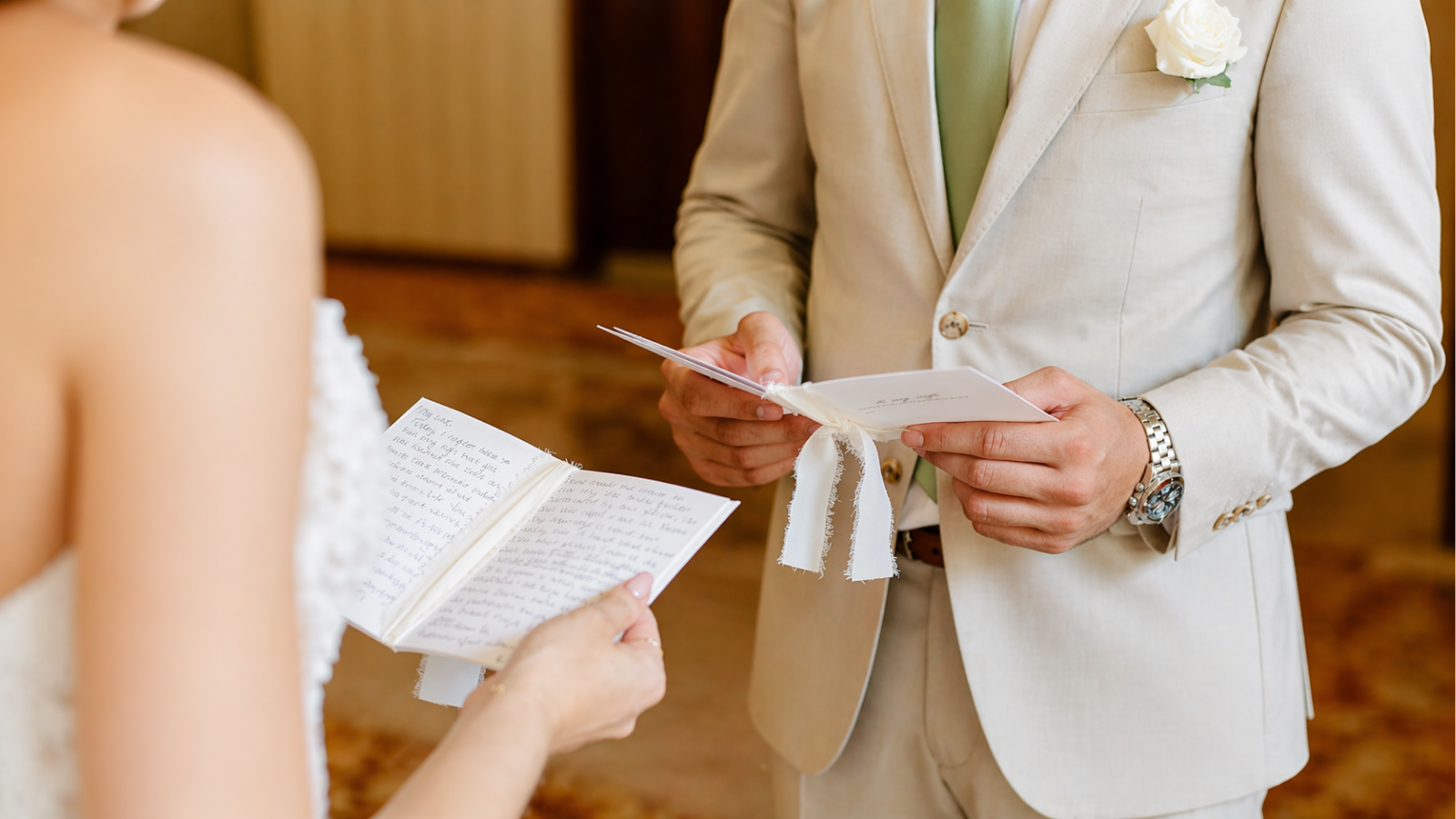
Wedding vows are the verbal promises exchanged between two people at the center of a marriage ceremony. They are the spoken agreement — witnessed publicly — through which two individuals commit their lives to one another. In most U.S. states, the exchange of vows is a legal component of the marriage ceremony. Without it, the marriage may not be considered valid.
But beyond the legal function, wedding vows carry a weight that no other words in a person’s life typically carry. They are said once, in front of everyone you love, at the highest emotional point of one of the most significant days of your life. That combination — the singularity, the audience, the emotion — is why the exchange of vows is consistently cited as the most powerful moment of any wedding ceremony.
Historically, marriage vows in the Western tradition trace back to the Anglican Book of Common Prayer (1549), which introduced the familiar phrase “to have and to hold, from this day forward, for better for worse, for richer for poorer, in sickness and in health, to love and to cherish, till death us do part.” That script has been adapted, modernized, personalized, and reinvented millions of times — but those original words remain at the foundation of almost every wedding vow spoken in English today. Couples interested in the deeper history behind modern marriage promises can also explore where wedding vows come from and how these traditions evolved over centuries.
If you want to explore the full history behind modern marriage vows, including where traditional scripts originated, read our guide on where wedding vows come from and how they evolved over time.
In contemporary American weddings, vows serve several purposes simultaneously:
- Relational: They set the tone for how the couple will show up for each other
- Legal: They form the verbal contract of the marriage
- Emotional: They are the most personal, vulnerable moment of the ceremony
- Narrative: They tell the story of the couple to everyone present
2. Where Vows Fit in the Wedding Ceremony — Full Order of Events
Understanding where wedding vows fall in the ceremony order helps couples prepare for the full context — and helps officiants structure a cohesive, flowing event. Here is the standard order of a non-denominational American wedding ceremony in 2026:
| Stage | What Happens | Approx. Time |
|---|---|---|
| Prelude | Guests arrive; soft music plays; ushers seat attendees | 20–30 min before |
| Processional | Wedding party walks down the aisle; bride/partner enters last | 5–10 min |
| Welcome & Opening | Officiant welcomes guests and introduces the ceremony | 3–5 min |
| Readings | Optional poems, scripture, or literary passages read by guests | 3–8 min |
| Officiant Address | Officiant speaks about the couple and the meaning of marriage | 5–10 min |
| Declaration of Intent | “Do you take this person…” / “I do” — the legal declaration | 1–2 min |
| ✦ Exchange of Vows | Each partner says their vows — the emotional heart of the ceremony | 4–8 min total |
| Ring Exchange | Partners exchange rings with brief ring vow phrases | 2–3 min |
| Unity Ceremony | Optional candle lighting, sand ceremony, handfasting, etc. | 2–5 min |
| Pronouncement | “I now pronounce you married.” The legal declaration complete. | 1 min |
| The Kiss | First kiss as a married couple | The best part |
| Recessional | Couple exits down the aisle; guests celebrate | 3–5 min |
One of the most common questions couples ask is who actually says wedding vows first during the ceremony. The answer depends on tradition, religion, and ceremony style.
Notice that the exchange of vows sits at the exact center of the ceremony — everything before it is buildup, and everything after it is celebration. It is the fulcrum. This is why vows deserve far more preparation than most couples give them.
3. The 3 Main Types of Wedding Vows — Compared
Before choosing your vow style, understand the three main formats used in American weddings. Each has a different feel, a different level of preparation required, and works better in different ceremony contexts.
Type 1: Traditional (Repeat-After-Me) Vows
The officiant speaks the vow line by line and the couple repeats after them. These are pre-written, universally recognized, and require almost no preparation from the couple. They work beautifully in religious ceremonies where the script has doctrinal significance, and in formal ceremonies where the couple values the shared language of tradition over personal expression.
Preparation required: Minimal — just know you’ll be repeating
Emotional tone: Solemn, reverent, universally understood
Best for: Catholic, Jewish, Protestant, and formal civil ceremonies
Type 2: Personal (Written) Vows
If you’re planning to write your own vows, these real wedding vow examples can help you find the right tone, structure, and emotional balance.
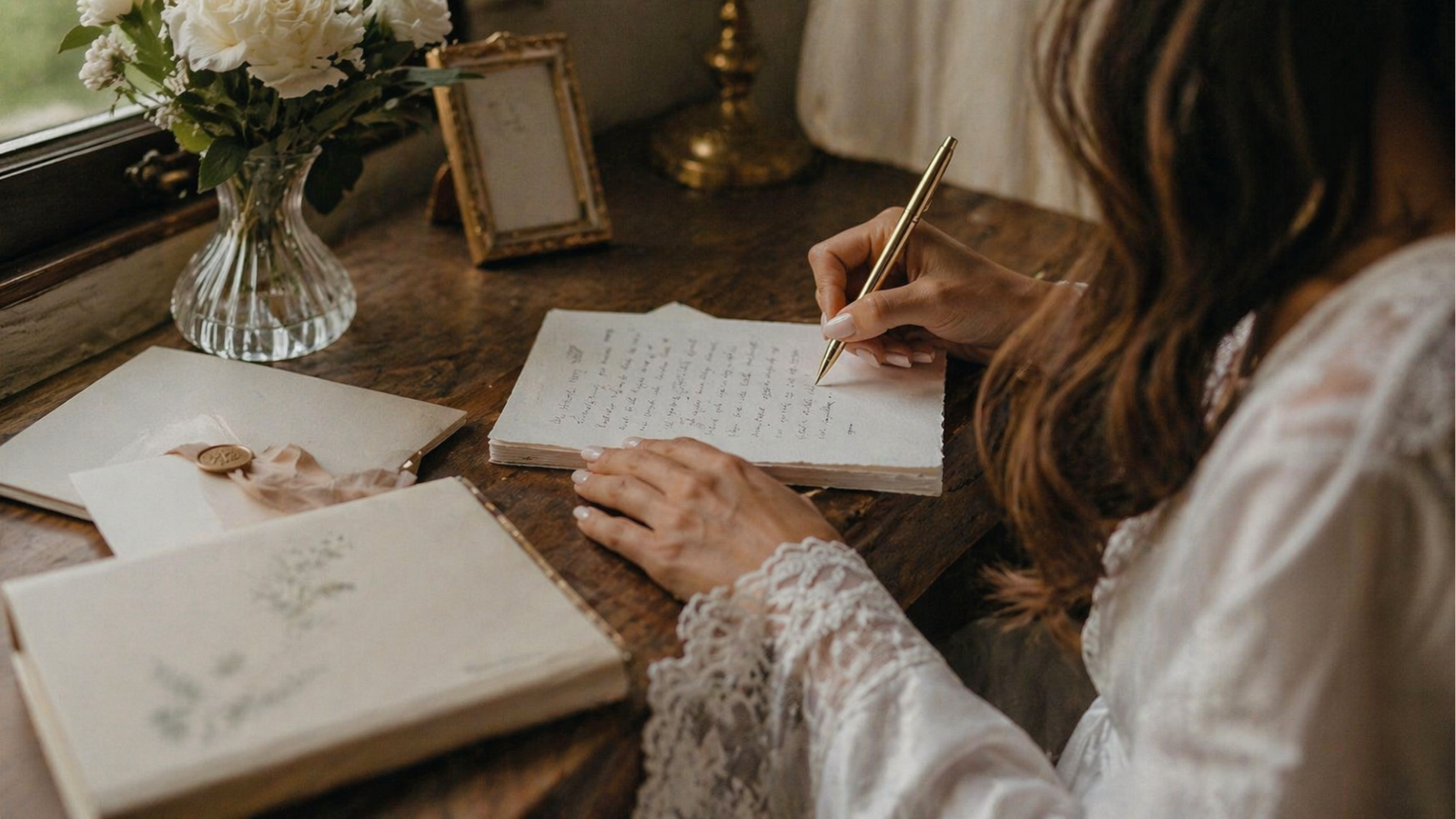
Each partner writes their own vows and reads or recites them at the altar. This is now the dominant format in American weddings. Personal vows are entirely flexible — they can be funny, poetic, narrative, or direct. They require significant preparation but produce the most emotionally memorable moments.
Preparation required: High — 1 to 3 weeks of writing and editing
Emotional tone: Intimate, personal, often deeply moving
Best for: Non-religious, outdoor, destination, and intimate weddings
Type 3: Call and Response (“I Do”) Vows
The officiant asks each partner a series of questions and the couple answers “I do” or “I will.” This is the simplest, most efficient format and works well in short ceremonies, elopements, and micro-weddings where the couple prefers brevity over performance.
Preparation required: None
Emotional tone: Clean, direct, legally clear
Best for: Elopements, micro-weddings, civil ceremonies, courthouse weddings
💡 Can You Mix Types?
Absolutely. Many couples use a call-and-response “I do” as their legal declaration, then follow it with personal vows as their emotional exchange. This gives you the legal clarity of the official format plus the intimacy of personalized promises. Ask your officiant if this structure works for your ceremony.
4. Traditional Wedding Vows — Complete Scripts
Traditional vows have endured for centuries because they work. Their power is cumulative — they carry the weight of every couple who has spoken them before you. Below are the most widely used traditional wedding vow scripts in the United States, ready to use exactly as written or adapt as needed.
Different faiths and denominations use very different vow structures. Some couples prefer traditional Christian wedding vows, while others choose Catholic or fully modern non-religious scripts.
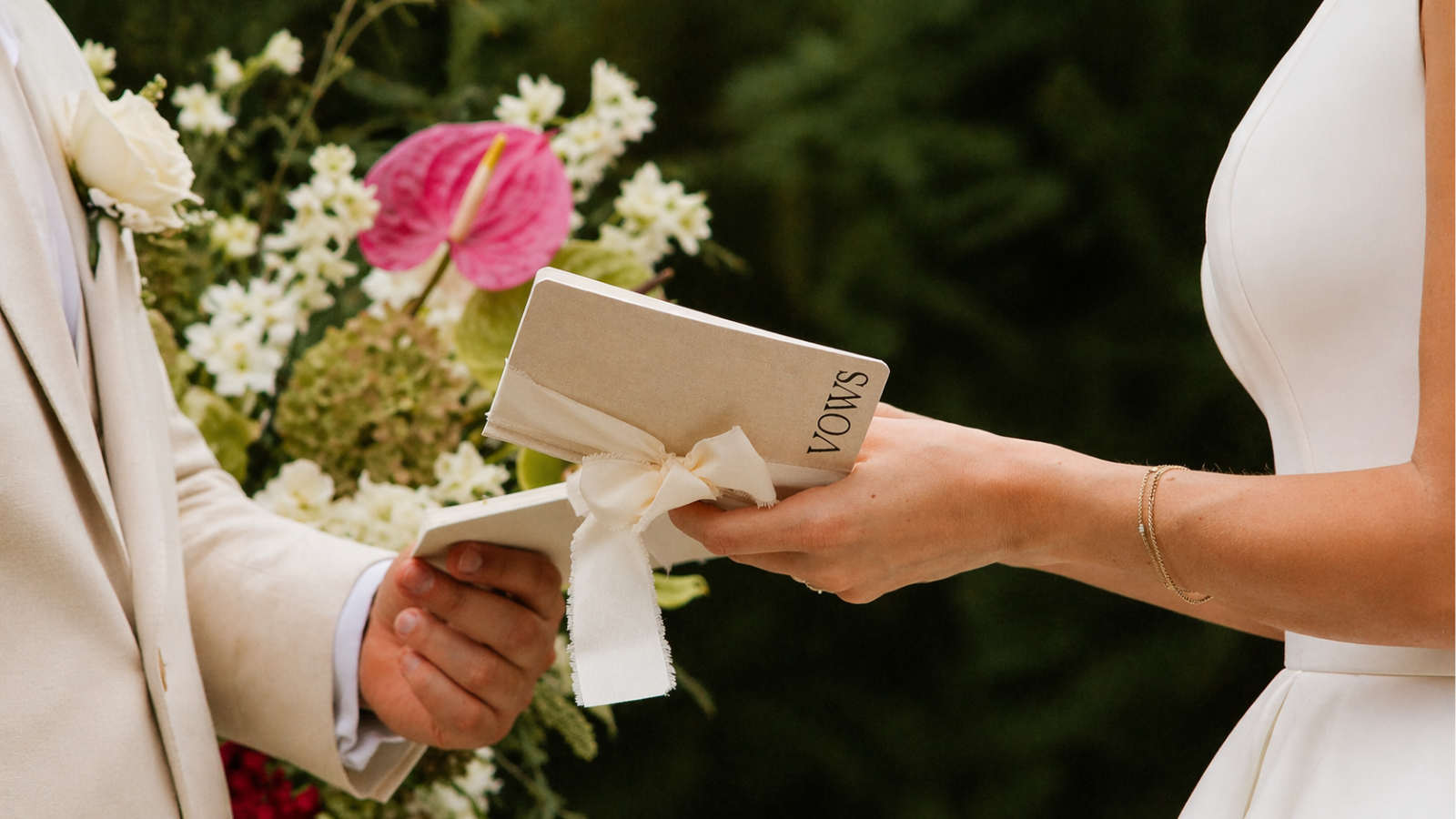
Classic Protestant / Non-Denominational Vows — The Most Common in America
This is the script most Americans picture when they think of wedding vows. It works in religious and non-religious ceremonies alike and forms the basis of countless adapted versions.
I, [Name], take you, [Name], to be my lawfully wedded husband/wife — to have and to hold from this day forward, for better or for worse, for richer, for poorer, in sickness and in health, to love and to cherish, until death do us part. According to God’s holy ordinance, I pledge thee my troth.
Modern Non-Denominational Version
A contemporary rewrite of the classic that removes religious language for secular ceremonies:
I, [Name], take you, [Name], to be my partner in life. I promise to love and respect you, to support and comfort you, to be faithful and honest with you, and to build a life with you — in joy and in sorrow, in times of plenty and in times of need, for as long as we both shall live.
Simple Traditional Vow — Short and Powerful
I take you to be my husband/wife. I will love you, comfort you, honor and keep you, in sickness and in health. Forsaking all others, I will be faithful to you as long as we both shall live.
Call and Response — “I Do” Full Script
Couples looking for a complete ceremony structure can also explore full wedding vow scripts and officiant wording examples.
This is the complete officiant script for the question-and-answer format. Your officiant will read this aloud; you simply respond.
[Officiant to Partner 1:]Do you, [Name], take [Name] to be your lawfully wedded husband/wife? Do you promise to love, comfort, honor, and keep them, for better or for worse, for richer or for poorer, in sickness and in health, and forsaking all others, be faithful to them, for as long as you both shall live?
[Partner 1 responds:]I do.
[Officiant to Partner 2:][Repeats the same question]
[Partner 2 responds:]I do.
5. Wedding Vows by Religious Denomination
Religious wedding vows vary significantly by faith tradition. Each denomination has its own approved language, theological emphasis, and ceremonial context. Here is a complete guide to the most common religious wedding vow formats in the United States.
Couples planning faith-based ceremonies often choose between traditional Christian wedding vows, official Catholic scripts, or modern non-religious alternatives depending on their beliefs and ceremony style.
Catholic Wedding Vows
Catholic vows follow a form approved by the Roman Catholic Church. The exact wording is prescribed by canon law, though minor variations exist between dioceses. Always confirm with your priest or deacon before finalizing your script.
Couples looking for the full official wording and deeper explanation behind Catholic marriage traditions can also explore our complete Catholic wedding vows guide.
I, [Name], take you, [Name], for my lawful wife/husband, to have and to hold from this day forward, for better, for worse, for richer, for poorer, in sickness and in health, until death do us part. I will love you and honor you all the days of my life.
In many Catholic ceremonies, the priest/deacon also asks the couple to confirm their intent with three questions before the vows:
- “Have you come here freely and without reservation to give yourselves to each other in marriage?”
- “Will you love and honor each other as husband and wife for the rest of your lives?”
- “Will you accept children lovingly from God and bring them up according to the law of Christ and his Church?” (for couples open to children)
Jewish Wedding Vows
Traditional Jewish ceremonies do not technically feature vows in the Western sense — the binding agreement is the ketubah (marriage contract). However, many modern Jewish weddings incorporate vow exchanges, often in both Hebrew and English.
I, [Name], take you, [Name], to be my husband/wife, to love, to cherish, and to honor. I will be faithful to you and will consecrate our home with the light of Torah and the light of love. With this ring, I thee wed.
Protestant / Methodist / Baptist Vows
I, [Name], take thee, [Name], to be my wedded wife/husband. And I do promise and covenant, before God and these witnesses, to be thy loving and faithful husband/wife, in plenty and in want, in joy and in sorrow, in sickness and in health, as long as we both shall live.
These traditional Christian wedding vows remain some of the most widely used ceremony scripts in the United States today.
Episcopal / Anglican Wedding Vows
From the Book of Common Prayer, one of the oldest surviving wedding vow scripts in the English-speaking world:
I, [Name], take thee, [Name], to be my wedded wife/husband, to have and to hold from this day forward, for better for worse, for richer for poorer, in sickness and in health, to love and to cherish, till death us do part, according to God’s holy ordinance; and thereto I plight thee my troth.
Hindu Wedding Vows — The Seven Vows (Saptapadi)
In Hindu ceremonies, the central vows are called Saptapadi — “seven steps.” The couple takes seven symbolic steps together around a sacred fire, each step representing a vow. The exact wording varies by regional tradition and pandit, but the essence of each step is:
- First Step (Prathama): We will share nourishment and do everything to make our lives prosperous
- Second Step (Dvitiya): We will move together in physical, mental, and spiritual strength
- Third Step (Tritiya): We will share the joy of wealth and responsibilities
- Fourth Step (Chaturtha): We will fill our hearts with love, happiness, and peace
- Fifth Step (Panchama): We will raise strong, virtuous children
- Sixth Step (Shashthi): We will enjoy the fruits of our seasons together
- Seventh Step (Saptama): We are companions now and will remain lifelong friends and partners
Buddhist Wedding Vows
Buddhism has no single prescribed wedding ceremony, but many Buddhist-inspired ceremonies incorporate vows rooted in the principle of compassionate love (metta).
I vow to honor and cherish you. I vow to be with you through joy and sorrow, abundance and loss. I promise to grow with you, learn from you, and meet you always with an open heart. May our love be a refuge and a light — for each other, and for those around us.
Muslim Marriage — The Nikah
In Islamic tradition, the marriage contract (Nikah) is a legal agreement witnessed by family and community. The exchange is formalized through the Ijab-wa-Qubul — offer and acceptance — spoken in Arabic, usually by the groom and the bride’s representative (wali). Many Muslim couples in the U.S. also add a personal vow exchange in English for the comfort of non-Muslim guests.
Many couples today also combine traditional religious vow structures with more personal writing styles to create ceremonies that feel both meaningful and authentic.
⚠️ Important Note on Religious Vows
Always confirm your exact vow script with your religious officiant — priest, rabbi, pastor, imam, or pandit — well before your wedding day. Many denominations require specific approved wording for the marriage to be recognized within that faith tradition. What you find online may differ from what your specific house of worship requires.
6. Personal Wedding Vows — 10+ Full Examples
Personal vows are now the first choice for the majority of American couples — and when written well, they create the most unforgettable moments in any wedding ceremony. The secret is specificity. The more personal, the more universal. The more exact your details, the more every guest in the room will feel something.
Below are ten full personal vow examples ranging in tone from deeply romantic to quietly sincere. Use any of them as a foundation, then make them yours.
Looking for more inspiration? These wedding vows examples include romantic, funny, modern, emotional, and realistic vow styles for every type of couple.
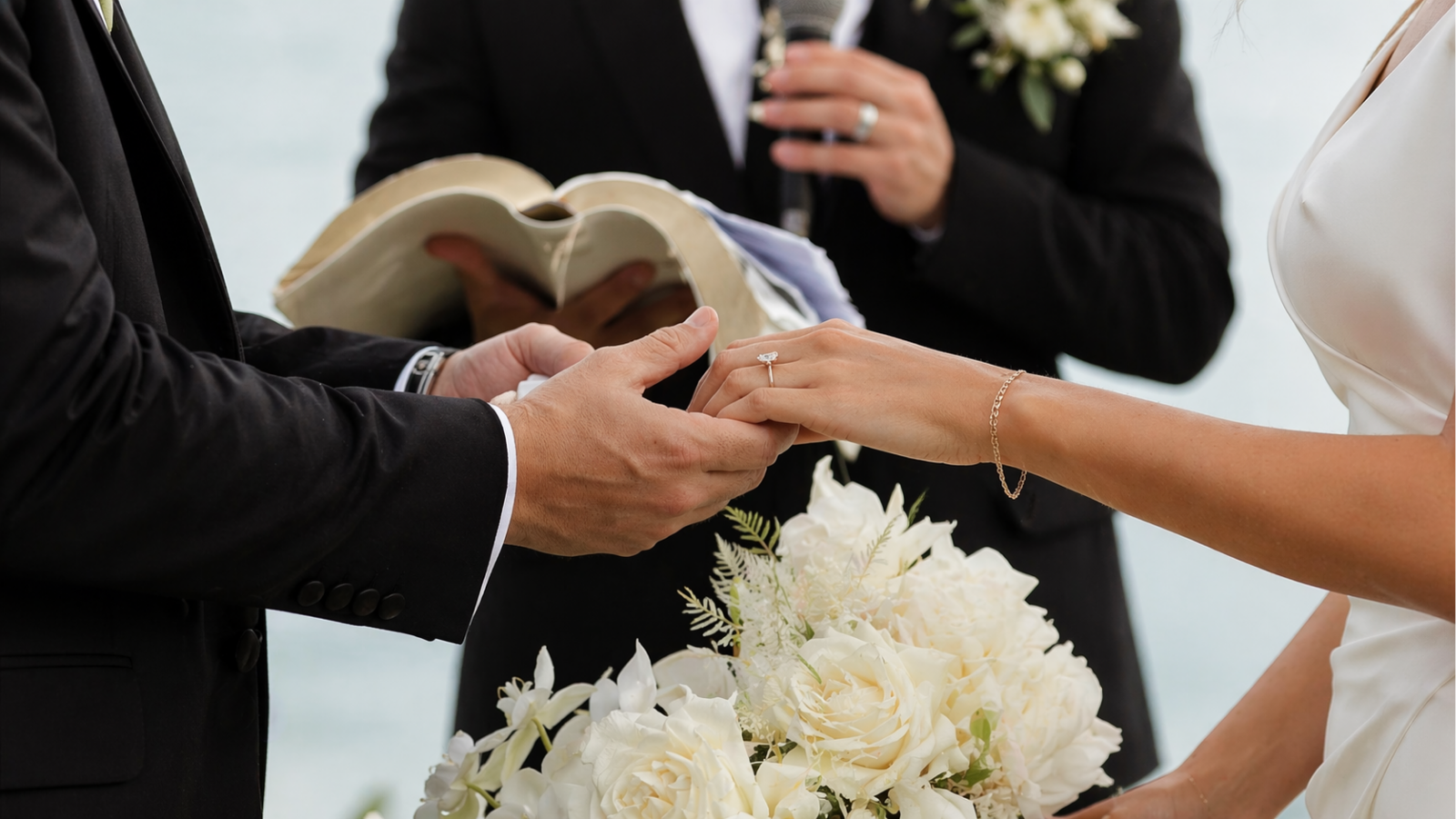
Personal Vow 1 — Romantic and Classic
From the moment I met you, something shifted in me — like I had been looking for something I did not even know was missing, and there you were. Today, I promise to be your safe place and your greatest adventure. I promise to hold your hand through every storm and to celebrate every ordinary Tuesday like it matters — because with you, it does. I choose you. I will keep choosing you. Today, tomorrow, and every day I am lucky enough to call you mine.
Personal Vow 2 — Deep and Poetic
I have loved you in a hundred quiet ways — in the way I reach for you in the middle of the night, in the way your laugh is the only sound that can stop my thoughts. Today I make it official. I vow to be patient when patience is hard, to be honest even when honesty is uncomfortable, and to love you not just in the easy seasons, but in the ones that change us. You are my person. That will never change.
Personal Vow 3 — Warm and Conversational
Here is what I know for certain: life before you was fine. Life with you is something entirely different. You make ordinary days feel like events. You make hard things feel survivable. Today I am standing here promising you the same thing I have been quietly promising you every day since I knew — that I am yours, completely and without reservation. I cannot wait to see what we build together. Let us go make a life.
Personal Vow 4 — For the Non-Poetic Writer
I am not a person who usually has the right words. But I know this: I love you more than I have ever loved anything. I promise to show up for you every day — not just the big days, but the Tuesdays and the bad weeks and the years when life gets heavy. I promise to be the person you can count on, always. You are the best thing that has ever happened to me, and I will spend the rest of my life making sure you know it.
Personal Vow 5 — Sincere and Direct
I promise to love you intentionally — not just when it is easy, but when it requires effort. I promise to listen before I speak and to fight for our relationship before I fight against it. I promise to be your partner in every sense of that word. I promise to grow alongside you and to cheer for the person you are becoming. You deserve a love that is steady, honest, and full of joy — and that is exactly what I plan to give you.
Personal Vow 6 — For a Second Marriage
I did not always believe I would be standing here again. I had convinced myself that one chapter was all I got. Then you walked into my life and quietly, patiently, entirely rewrote that story. Today I promise to love you with everything I have learned and everything I am still learning. I promise to protect what we have built, to fight for it every single day, and to never take for granted the extraordinary gift of a second chance at a great love.
Personal Vow 7 — Blended Family / Including Children
I am not just marrying you today. I am choosing this family — all of it. I promise to love you completely, to support you in everything, and to show up for the people who matter most to you as if they matter most to me — because they do. I vow to be patient, to be present, and to build something with you that all of us can be proud to call home. I love you. I love what we are becoming. Let us do this together.
Personal Vow 8 — Minimalist and Philosophical
Love is not a feeling — it is a decision. And today, in front of everyone I love, I am making that decision clearly and completely. I choose you. I choose us. I choose the work and the wonder of a life built alongside you. Whatever comes — and something always comes — I will face it with you. That is my promise.
Personal Vow 9 — For a Long-Term Couple
We have already lived a thousand days together before this one. You have already seen me at my worst — exhausted, impatient, afraid — and you stayed. Not because you had to. Because you chose to. Today I am making that same choice formally, publicly, permanently. I choose you. I chose you then, I choose you now, and I will choose you every day from here. Nothing has changed — except now there is a ring.
Personal Vow 10 — Narrative and Story-Based
The first time I saw you, I thought: that person is interesting. The second time, I thought: I want to know them better. By the third time, I knew. I just did not have the courage to say it yet. Today I have the courage. Today I am saying it in front of every person who matters to me: I am in love with you, I am proud of you, and I cannot imagine a version of my life that does not have you in it. You are it for me. You have always been it.
7. Wedding Vows for Him — From Her (5 Complete Examples)
These wedding vows for him are written from a bride’s perspective. Each is complete, emotional, and ready to personalize with your own specific memories and details. The most powerful thing you can do is replace any generic moment with a real one from your relationship.
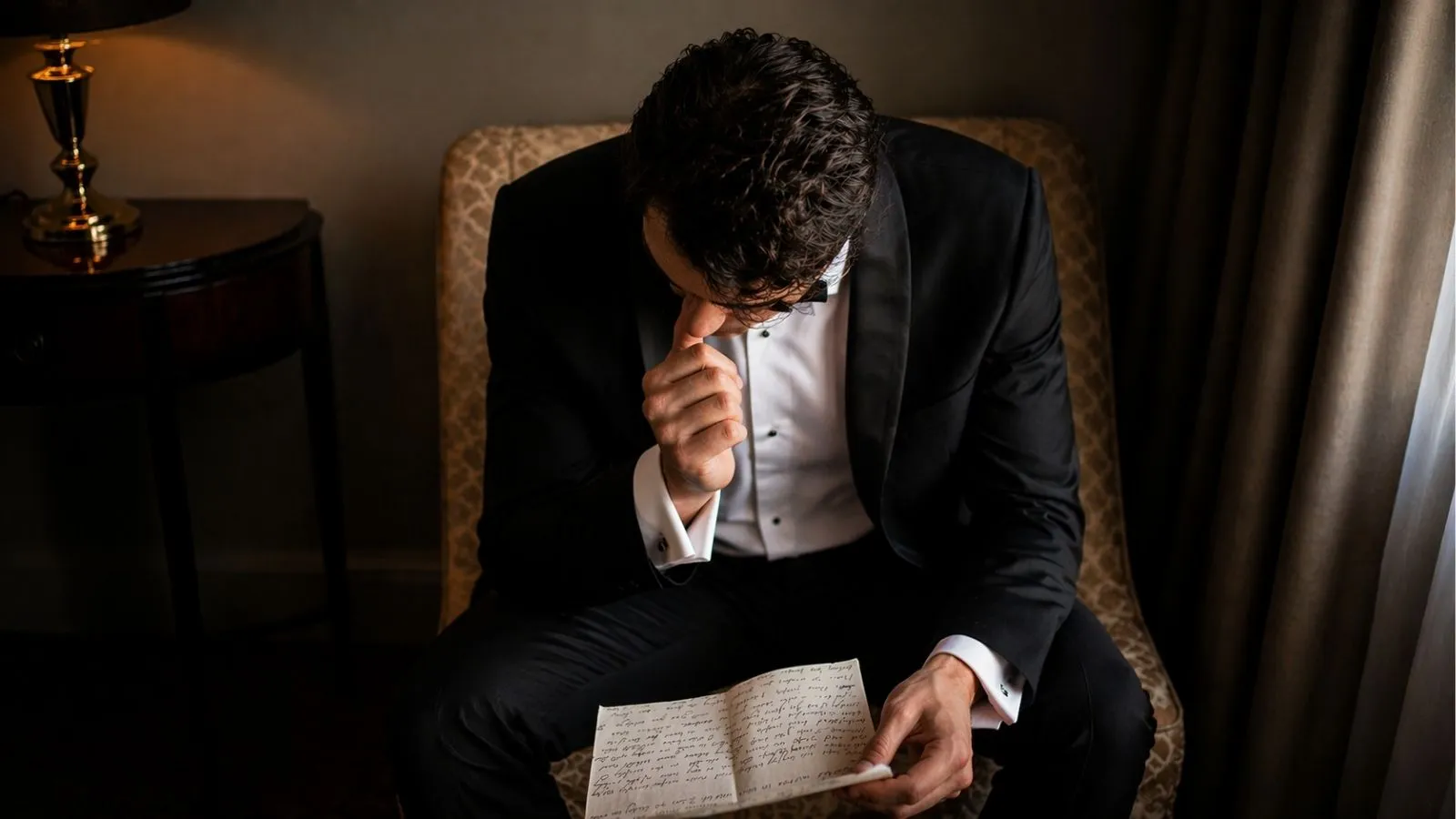
Vow for Him — Classic and Timeless
I never knew what I was looking for until I found you. You are the most steady, most kind, most infuriating-in-the-best-possible-way person I have ever met. Today I vow to stand beside you always — not behind you, not in front of you, but right there beside you, as your equal and your partner. I promise to love you fiercely, to support your dreams as if they were my own, and to make you laugh every single day. I love you. Let us do this.
Vow for Him — Home and Belonging
You are my home. Not a place — a person. And I promise today to protect that home, to keep it warm and safe, and to show up for you the way you have always shown up for me. I promise to be your biggest fan, your loudest cheerleader, and your most honest voice when you need one. I love you more than I will ever find the words to say — but I will spend the rest of my life trying.
Vow for Him — Vulnerable and Real
I am not perfect. I know that. You know that better than anyone. But I promise to spend every day of our marriage trying to be better — for myself, and for you. I promise to tell you when I am struggling and to ask for help instead of pulling away. I promise to be brave enough to be completely honest with you, even when honesty is hard. I love you not despite the realness of who you are, but because of it. Here is to real.
Vow for Him — Lighthearted and Warm
You are the person who makes every version of my day better. Good days are better because of you. Hard days are survivable because of you. Boring days barely exist because of you. I promise to always be the person who makes your days better too — to bring the energy on the hard ones, to celebrate hard on the good ones, and to sit quietly beside you on the ones where we just need the company. I love you endlessly.
Vow for Him — Short, Direct, Powerful
I promise to love you on purpose every single day — not just when it is easy, but especially when it is not. I promise to fight for us, to laugh with you, and to always, always choose you. You are the greatest yes of my life.
8. Wedding Vows for Her — From Him (5 Complete Examples)
These wedding vows for her are written from a groom’s perspective. Showing genuine emotion in your vows is not weakness — it is the most memorable thing a groom can do. At every wedding, the groom who cries gets the loudest response from the room.

Vow for Her — Sincere and Heartfelt
I used to think love was supposed to be effortless. Then I met you, and I realized love is not effortless — it is a choice. And every single day, choosing you is the easiest decision I make. Today I promise to protect your heart with mine. I promise to be the kind of man who deserves you. I promise to show up, to listen, to grow. I will love you in the way you need to be loved — even when I have to learn what that means. You are my greatest blessing. I am proud to be yours.
Vow for Her — Strong and Poetic
You are the most remarkable person I have ever known. You made me want to be better — not because you asked me to, but because I wanted to be worthy of you. Today I vow to love you without conditions, to fight for us without apology, and to build a life with you that makes us both proud. I promise to hold your hand through every hard season and to dance with you through every good one. You are my person. This is my promise.
Vow for Her — The Partnership Promise
I promise to be your equal partner in every sense — to share the weight when things are heavy, to split the joy when things are great, and to never let you face anything alone. I promise to respect your dreams as much as my own, to listen as often as I speak, and to keep choosing us even on the days when everything feels hard. I love you. That does not begin to cover it — but it is the truest thing I know.
Vow for Her — Simple and Enduring
I have loved you every day since the day I knew. And I plan to love you every day until the last day I have. In between, I promise to be the most steady, most devoted, most present version of myself I know how to be — for you, for us, for the life we are about to build. Thank you for saying yes. You are the answer to every question I have ever asked.
Vow for Her — Vulnerable and Real
Standing here right now, looking at you, I feel something I do not have a word for. It is bigger than happy. It is bigger than grateful. It is the feeling of arriving somewhere you did not know you were headed. Today I promise to honor that feeling — to treat it like the sacred thing it is — every day for the rest of our lives. I am yours. Completely, unreservedly, forever yours.
9. Short Wedding Vows — Powerful in Every Word
Brevity is not a compromise — it is a choice. The most powerful things ever said have often been the shortest. Short wedding vows work best when every word is exactly right and when there is nothing left to cut. Here are the best examples of short vows that carry full emotional weight.
Short Vow 1 — The Promise
I choose you. Not just today, but every day for the rest of my life. I vow to love you completely, to trust you fully, and to be your partner in everything. You are my greatest adventure and my greatest joy. I am yours, completely.
Short Vow 2 — The Declaration
I promise to love you, to respect you, to laugh with you, and to grow with you — for the rest of my life. You are my best friend and the love of my life. I am honored to be yours.
Short Vow 3 — Single Breath
I love you. I choose you. I will always choose you. That is my promise, and I intend to keep it for the rest of my life.
Short Vow 4 — The Commitment
From this day forward, you will never walk alone. I will be beside you in every season, in every version of our lives. My love for you is not a feeling — it is a decision I make every morning, and I will keep making it forever.
10. Funny Wedding Vows That Still Mean Everything
Humor in wedding vows is a fine art. The best funny vows earn a genuine laugh and a genuine tear — often within the same sentence. They are deeply specific to the couple, they acknowledge real quirks and habits without being cruel, and they always — without exception — land on something sincere. Here is how to do it right, with examples.
📌 The Golden Rule of Funny Vows
Punch up, never down. The jokes should be about things the couple has together — shared habits, mutual quirks, specific memories. Never jokes that could make your partner feel criticized in front of family. And always close on something that makes them feel loved.
Funny Vow 1 — Relatable and Warm
I vow to always let you pick the restaurant — even when you say you do not care and then veto every single option I suggest. I vow to pretend I do not see the pile of clothes you leave on the chair every night. I vow to be your person through all of life’s great moments and all of its deeply mundane ones. I love every ridiculous, wonderful, maddening part of you. Let us grow old and argue about the thermostat together.
Funny Vow 2 — Lighthearted and Real
I promise to love you even when you take too long to get ready. I promise not to say “I told you so” — or at least to try very, very hard not to. I promise to always find your charger when you lose yours and to never once hold it over your head. Most of all, I promise to love you every day for the rest of our lives — and to mean it even more than I mean it right now.
Funny Vow 3 — For the Netflix-and-Chill Couple
I vow to never watch ahead in our shows — no matter how good the next episode is and no matter how many days you are behind. I vow to always let you have the last bite. I vow to laugh at your jokes even when I have heard them three times — and to only laugh slightly less on the fourth. But mostly, I vow to be your person in every season of this wild, beautiful, sometimes baffling life. I love you.
Funny Vow 4 — The Honest Promise
I promise to take out the trash before you have to ask. I promise to remember our anniversary — I have it in my phone and on a sticky note on my mirror. I promise to be your co-pilot, your sous chef, and your emergency contact. I promise to never stop reaching for your hand in the car. And I promise to love you with a depth and a steadiness that has absolutely nothing to do with how good I am at remembering where I put my keys. Which is not very good, by the way. But the love part? That part I have figured out.
11. Unique and Creative Wedding Vow Ideas
If traditional and personal vows both feel too familiar, there is a growing movement of couples who are reimagining the format entirely. These approaches preserve the emotional weight of vow-giving while adding an element of surprise and creativity that makes the ceremony uniquely theirs. If you’re looking for more inspiration beyond classic formats, these unique wedding vows examples explore creative ways couples are making their ceremonies feel more personal, modern, and unforgettable.
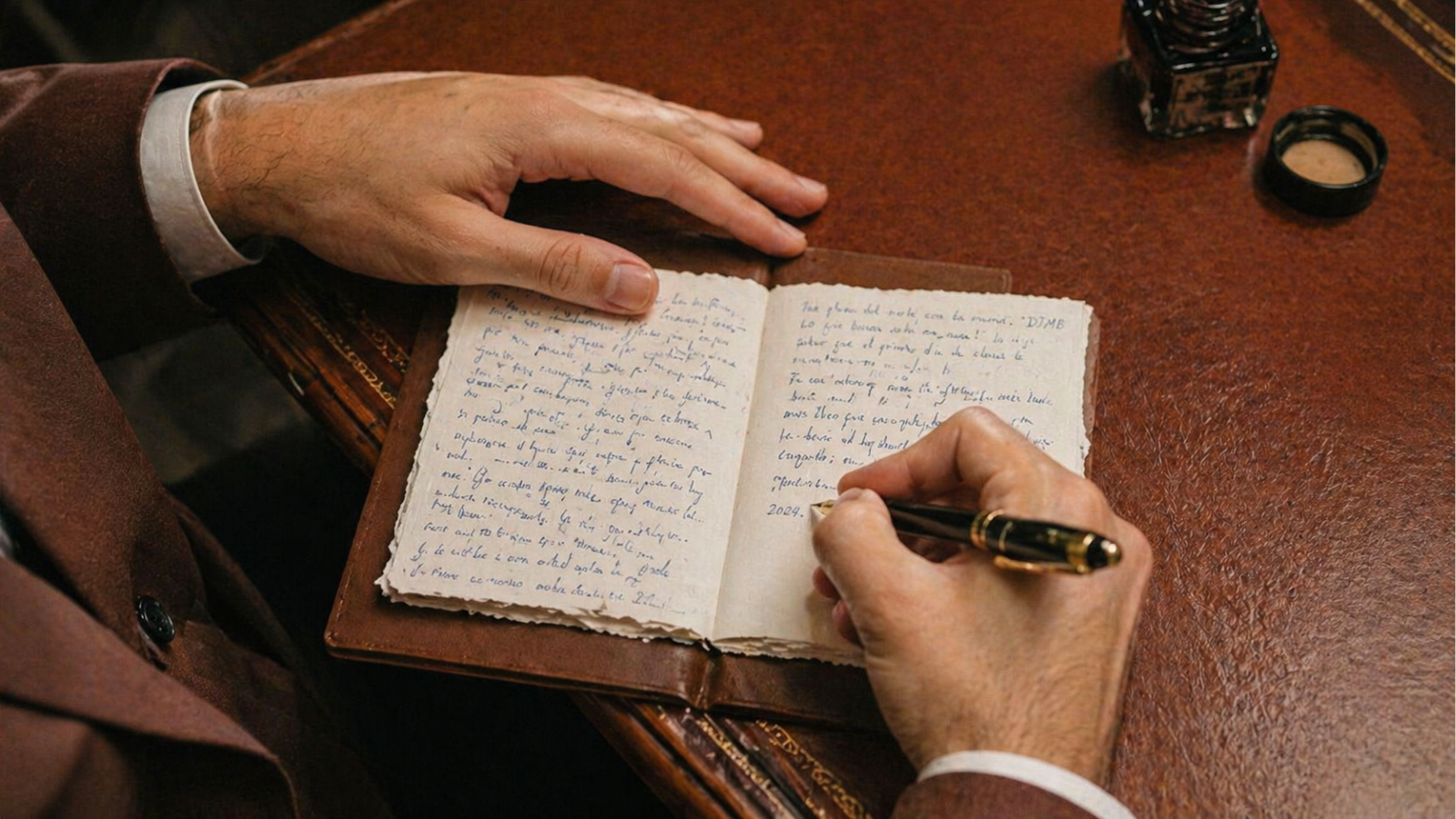
The Letter Format
Instead of standing face-to-face and speaking, some couples write long, deeply personal letters to each other — read aloud at the ceremony. The letter format allows for more narrative flow and tends to feel less like a speech and more like a private conversation happening in public. It often includes specific memories, inside references, and a natural, conversational tone that formal vow structures do not easily accommodate.
The List Format
A growing trend — especially among creative, humorous, or no-frills couples — is structuring vows as a numbered list of promises. This works particularly well when the couple has a long-standing relationship filled with specific shared references. Example:
I promise you ten things:
1. To always make the coffee strong.
2. To never leave for the airport without saying I love you.
3. To take your side, even when you are wrong — and to tell you later, privately.
4. To grow old beside you without embarrassment.
5. To treat every trip to the grocery store as a potential adventure.
6. To hold your hand in the hard rooms.
7. To keep learning you — because you keep becoming someone new.
8. To celebrate your wins louder than anyone in the room.
9. To never stop choosing this — even on the days when it requires effort.
10. To love you. For as long as I am here. Completely.
The Call-and-Response Personal Vow
Some couples write a vow together — lines that one speaks and the other finishes, or a shared promise spoken in unison. This format works beautifully in small, intimate ceremonies and produces a striking visual and auditory effect for guests.
The Poem
If one partner is a writer or genuinely loves language, writing vows in verse form can be extraordinary when executed well. The key is to write for the spoken word — short lines, natural rhythm, nothing that sounds forced when said aloud. Rhyme is optional and often best avoided unless you are confident it will land.
The Time Capsule Vow
A newer trend: each partner writes two sets of vows — one for today, and one sealed in an envelope addressed “To Be Opened on Our 10th Anniversary.” This adds a beautiful layer of meaning to the ceremony and creates an automatic milestone ritual for the future.
Handfasting Vows
Rooted in Celtic tradition, handfasting involves the officiant or loved one binding the couple’s hands together with ribbon or cord while vows are spoken. The phrase “tying the knot” literally comes from this tradition. Handfasting vows are usually shorter, rhythmic, and spoken as the binding happens. Example:
With this cord I bind myself to you — your joy becomes my joy, your sorrow becomes mine to share. As this knot is tied, so too is our love: strong, flexible, and made to hold through everything that comes.
12. Wedding Vows for a Second Marriage
Second marriage vows carry a different weight — and that weight is a gift, not a burden. You bring lived experience, hard-won self-knowledge, and a deeper understanding of what commitment actually requires. The best second-marriage vows acknowledge that reality honestly, without apology.
Second marriages often lead couples to write more intentional and deeply personal vows — especially when they already understand what commitment truly requires. Many couples also choose to use real wedding vows examples or follow a step-by-step vow writing guide to create promises that feel honest, mature, and deeply personal.
Second Marriage Vow — Honest and Hopeful
I did not always believe I would be standing here again. I had convinced myself that one chapter was all I got. Then you walked into my life and quietly, patiently, entirely rewrote that story. Today I promise to love you with everything I have learned and everything I am still learning. I promise to protect what we have built, to fight for it every single day, and to never take for granted the extraordinary gift of a second chance at a great love.
Second Marriage Vow — For the Wiser Heart
I come to you today not as someone who has all the answers, but as someone who has learned the right questions. I know now what love requires. I know the patience it demands and the courage it takes to be truly known by another person. I am not afraid of that anymore — because of you. Today I vow to love you with the fullness of everything I have become, and to keep becoming better, always, for us.
Second Marriage Vow — Short and Clear
I have lived enough life to know how rare you are. I promise to never forget that. I vow to love you completely, to choose you every day, and to build a life with you that we are both proud of — starting right now.
13. Wedding Vows That Include Children — Blended Family Ceremonies
When children are part of the new family being formed, many couples choose to honor that in the ceremony. Including children — whether with a separate set of family vows, a symbolic gesture, or simply mentioning them in personal vows — creates a ceremony that reflects the full reality of the new family.
Family Vow — From Parent to Stepchildren
Spoken directly to the children, in addition to (or as part of) the wedding vows:
[Child’s name], I love your parent with all my heart. And today, I want to make a promise to you, too. I promise to always be there for you — to celebrate your wins, to sit with you in the hard moments, and to be someone you can count on. I am not here to replace anyone. I am here to be one more person in your corner. Always.
Blended Family Vow — To Each Other
I am not just marrying you today. I am choosing this family — all of it. I promise to love you completely, to support you in everything, and to show up for the people who matter most to you as if they matter most to me — because they do. I vow to be patient, to be present, and to build something with you that all of us can be proud to call home.
Symbolic: The Family Unity Ceremony
Many blended families incorporate a Family Unity Ceremony into the wedding, which can include:
- Unity Candle: Each family member holds a candle; all light a central candle together
- Sand Ceremony: Each person pours a different color sand into a single vessel
- Family Medallion: A three-ringed charm presented to children, symbolizing the new family bond
- Puzzle Ceremony: Each family member places a piece into a shared puzzle frame
- Tree Planting: The family plants a tree together as a symbol of growing roots
14. How to Write Your Own Wedding Vows — The Complete Method
This is the section most people need most. Knowing that how to write wedding vows is a learnable skill — not a gift — changes everything. Below is the exact method used by professional vow writers, broken into a process that works for any couple at any writing level.
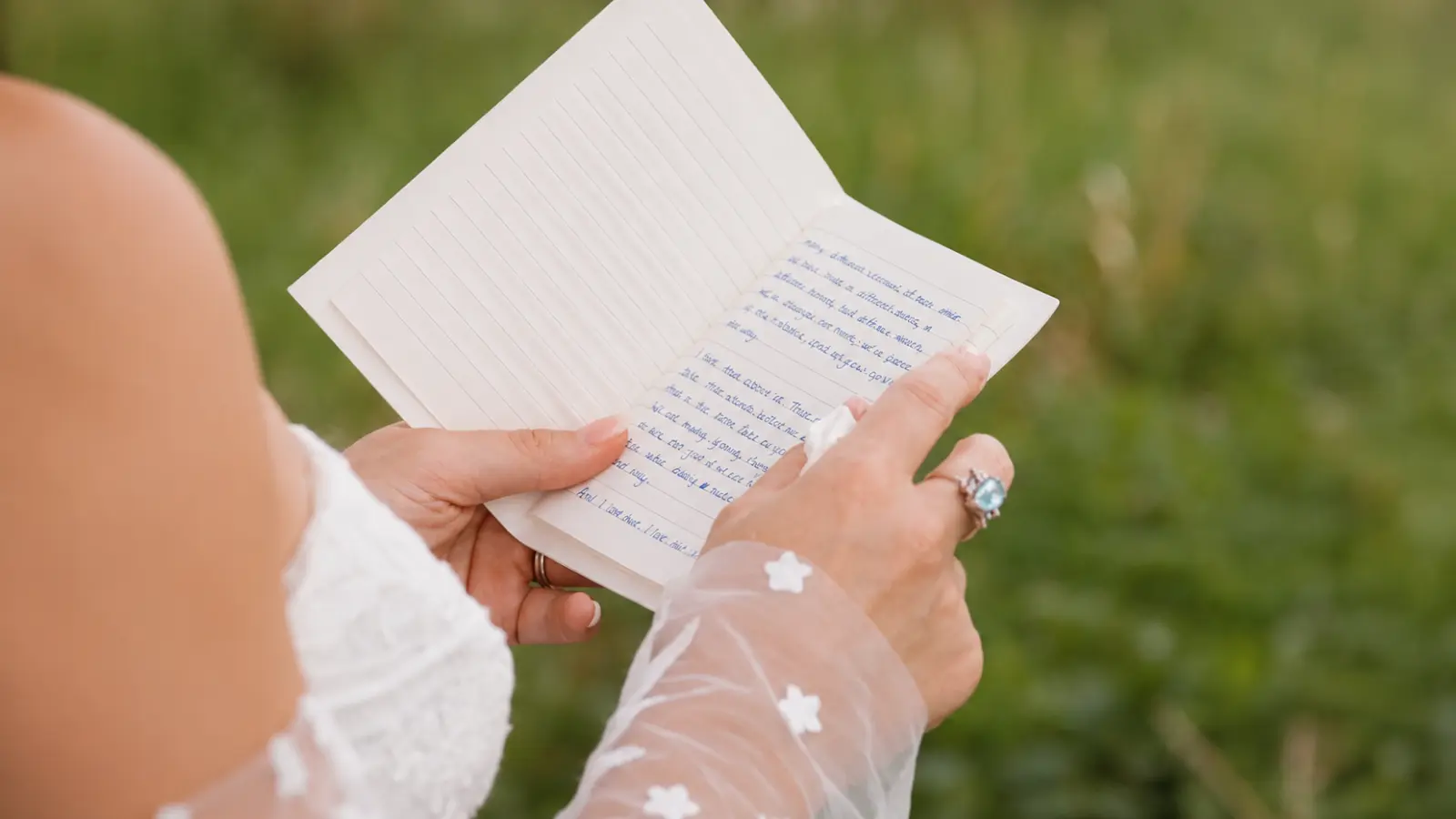
Step 1: Start Early (Further Ahead Than You Think)
Most couples start writing their vows one or two weeks before the wedding. The result is vows that feel rushed. Vow writers recommend beginning six to eight weeks before the ceremony. This is not because vows take that long to write — it is because they take that long to arrive at. You need time to think, draft, walk away, return, and refine. Vows written the night before a wedding almost always feel like it.
Before writing, many couples find it helpful to review a complete wedding vows checklist to make sure their promises feel balanced, personal, and emotionally clear.
Step 2: Set the Right Writing Conditions
Do not try to write your vows at the kitchen table with a laptop open and the TV on. Give this the conditions it deserves. Sit somewhere quiet. Have a drink if that helps. Put your phone away. Give yourself at least an hour of uninterrupted time. Many couples find that writing by hand — rather than typing — produces more emotional, authentic results.
Step 3: Answer These Seven Questions First
Before you write a single word of the actual vow, answer these prompts in writing. Do not edit yourself — just write whatever comes:
- What is the specific moment when you knew this person was the one? (Not “when I met them” — a specific scene, a specific day)
- What is the thing about them that you love most that they might not even know you notice?
- What has being in this relationship taught you about yourself?
- What is the hardest thing you have been through together, and what did it show you about your partner?
- What are three specific promises you want to make — not generic ones, but promises that could only come from you?
- What do you most want your partner to feel when you are done speaking?
- What is the single most important thing you want to say, if you could only say one thing?
Your answers to these questions are your vows — in rough form. The writing process is just about shaping them into something that flows.
Step 4: Use the Three-Part Structure
The most effective personal vows follow a simple three-part structure. This is not a rule — it is a framework. Knowing it helps you avoid the most common failure (vows that meander without a destination).
Couples who prefer more structure often use a wedding vows template before turning their ideas into fully personalized promises.
- The Past: Open with a specific memory or the story of how you got here. This grounds the vow in something real and immediately distinguishes it from anything generic.
- The Present: Move to who this person is to you right now. Specific qualities, specific ways they show up, specific things only you could say.
- The Future (Promises): This is the vow itself. Three to five concrete, personal promises. Not “I will always be there for you” — but what that actually looks like in your specific relationship.
Step 5: Write a Draft — Then Double It, Then Cut It in Half
Most people’s first draft is too short. They hold back. Write more than you think you need — let it be messy and rambling and too long. Then cut ruthlessly. Every sentence that is generic, vague, or that could be spoken by anyone about anyone — cut it. What is left is your real vow.
If you are struggling with introductions or endings, these wedding vow opening lines and strong closings can help your vows feel more natural and emotionally complete.
Step 6: Read It Out Loud — Many Times
This step is non-negotiable. A vow that reads beautifully on paper often sounds very different when spoken aloud. You will find:
- Sentences that are too long to say in one breath
- Words that feel awkward in your mouth
- Moments where you will cry — which tells you they are right
- Pacing issues that need to be fixed
Read your vows to yourself first. Then to a trusted friend. Then time them. Then practice until you can deliver them smoothly at an emotional, unhurried pace.
Most wedding vows sound best when kept between one and three minutes long, depending on ceremony style and tone.
Step 7: Coordinate With Your Partner — Without Spoiling
You do not need to share content — keep the actual vows secret. But you should agree in advance on:
- Approximate length (within 30 seconds of each other)
- General tone (both funny, or both sincere — a mismatch is jarring)
- Format (both reading from cards, or both memorized)
- Whether you are using any shared references that might overlap
Vow Writing Prompts — For When You Are Stuck
✍️ Use These if You Hit a Wall
- “The moment I knew was…”
- “What I love most about you that you probably don’t know I notice is…”
- “You make me feel…” → now replace “feel” with something more specific
- “The thing I am most looking forward to in our life together is…”
- “I promise to…” × 5 — write five, keep three
- “If I could say one thing in front of everyone here, it would be…”
- “You are the kind of person who…” → then give a specific example
15. The Biggest Wedding Vow Mistakes to Avoid
After reviewing thousands of wedding vow examples and speaking with couples who have been through the experience, these are the most common mistakes — and exactly how to avoid them.
Mistake 1: Starting Too Late
The most universal mistake. Starting one week before the wedding means you are writing vows while also managing final RSVPs, vendor calls, and family logistics. Start six to eight weeks out. Even if you only write notes at first, give yourself the runway.
Mistake 2: Using Someone Else’s Vows Verbatim
Templates and examples — including every example in this guide — exist to inspire you, not to be copied. Guests who know you well will feel the inauthenticity immediately. Use examples to understand structure and tone, then replace every generic moment with a specific one from your actual relationship.
Mistake 3: Making Vows Too Long
Anything over three minutes per person begins to lose the room. The emotional peak of a vow is the first 90 seconds — after that, guests start to drift. Longer is not more sincere. More specific is more sincere.
Mistake 4: Jokes That Land Wrong
Humor in vows is wonderful when it is warm. Humor that mocks, embarrasses, or criticizes — even gently, even lovingly intended — can hurt in a way that echoes. The test: would your partner cringe if they heard this in front of their grandmother? If the answer is possibly, cut it.
Mistake 5: Not Practicing Out Loud
Reading your vows silently and then reading them at the altar are completely different experiences. Emotion, nerves, the faces of people you love — all of it compounds. Practice out loud. Practice until the emotion becomes something you can feel and speak through, not something that stops you cold.
Mistake 6: No Backup Plan
Memorizing your vows is admirable. Losing them because you are overwhelmed by emotion is a real possibility. Always bring a card. Write or print your vows on a card you are comfortable holding. This is not a failure of preparation — it is professionalism. Even the most confident speakers use notes.
Mistake 7: Mismatched Length or Tone
If one partner delivers a three-minute heartfelt essay and the other gives 45 seconds of bullet points, the contrast is jarring — both for the audience and for the partner who heard less. Coordinate on length and general tone before you start writing.
Mistake 8: Forgetting the Promises
Some vows are beautiful and moving but contain no actual promises. Love declarations are wonderful. Specific commitments are what a vow technically is. Make sure your vows include at least two or three clear, concrete promises — things you will actually do differently or consistently as a result of this commitment.
16. How to Deliver Your Vows — Performance and Presence
Writing great vows is half the equation. Delivering them well — with presence, pacing, and emotional control — is the other half. Here is everything you need to know about the delivery.
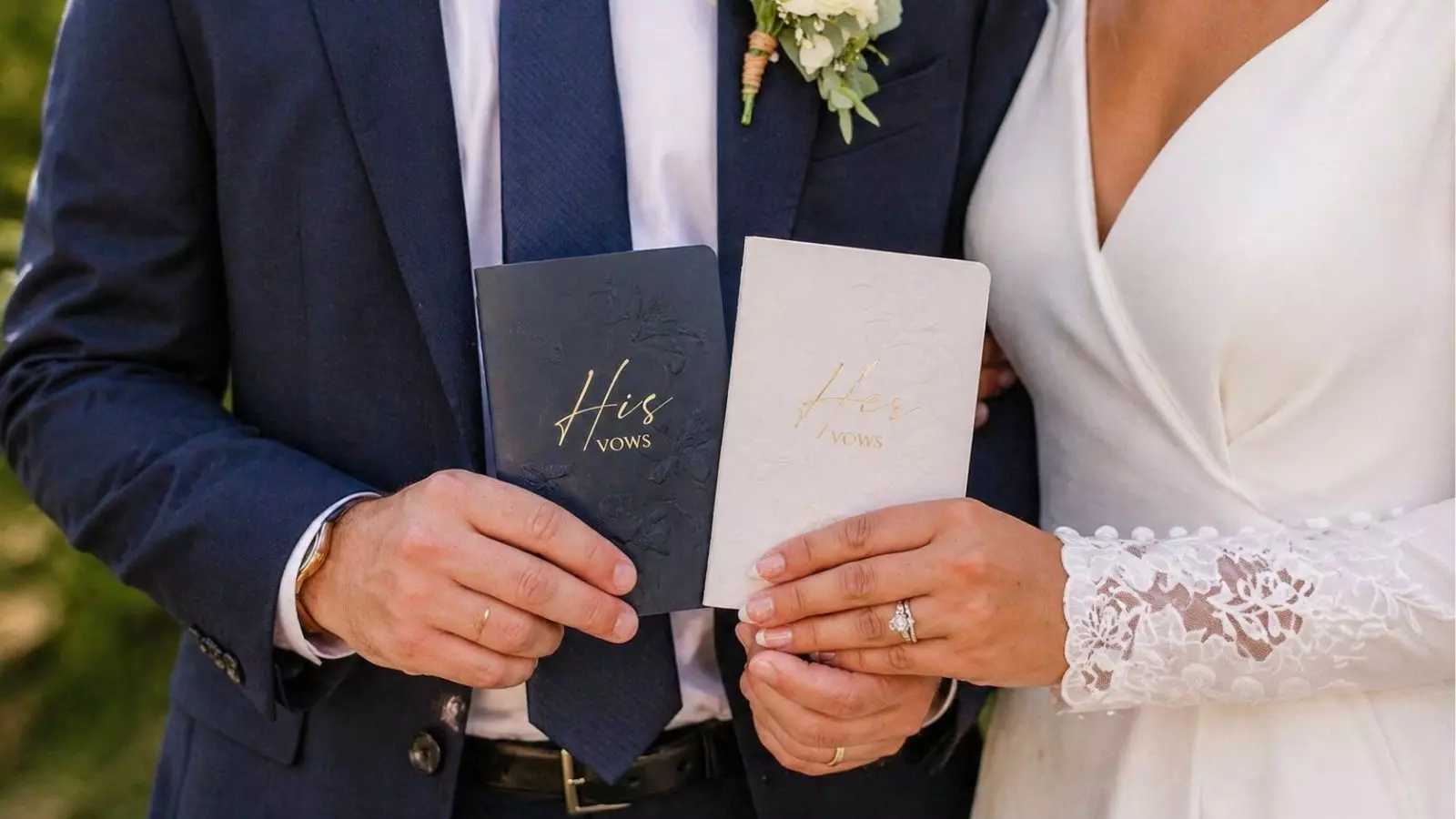
Pacing
Slow down by at least 30% from your normal speaking pace. Emotion makes people speak faster. Nerves make people rush. The instinct to get through it quickly is almost universal — and almost always wrong. Slow down. Let the words land. Breathe between sentences.
Eye Contact
Look at your partner, not at the card. The card is your safety net — glance at it to stay on track, but deliver the words to the person in front of you. Eye contact during vows is what photographs and memories are made of.
Managing Emotion
You will probably cry. That is not a problem — it is the point. If you feel emotion rising, take a breath, look up slightly (helps prevent tears from spilling), and pause. Guests will wait. They want you to feel this. Let yourself feel it and then continue. The moments of overcome emotion are often the ones people remember most.
Voice and Volume
Speak to the back of the room. If there is a microphone, speak clearly into it without going too close. Many outdoor ceremonies have no amplification at all — project from your diaphragm. Your guests need to hear every word. They came for this.
What to Hold
Hold your card in one hand. Hold your partner’s hand with the other when possible — or let the card rest against their hand if it helps. Avoid holding anything in both hands if you can.
The Day-Of Ritual
In the hour before the ceremony, find five quiet minutes alone. Read your vows one final time — out loud, slowly. Not to memorize — you should know them well enough by now. Just to center yourself in the words and reconnect with why you wrote them.
Ring Vows — What to Say During the Exchange
After personal vows, many couples also have short phrases spoken during the ring exchange. Here are the most commonly used ring vow scripts:
Traditional: With this ring, I thee wed.
Modern: This ring is a circle — endless, like my love for you. Wear it as a reminder that you are never alone.
Simple: I give you this ring as a symbol of my love — today and every day from this day forward.
17. Vow Renewal — The Complete Guide
A vow renewal ceremony is one of the most intentional, meaningful gestures a married couple can make. It is not a do-over. It is a re-choosing — a deliberate, public recommitment to a person you have already chosen and a life you have already lived together. That context — the years of real experience between the first vow and the renewal — makes it, in many ways, more powerful than the original wedding.
Couples planning a renewal ceremony often look for vow renewal ideas, scripts, and celebration formats that feel more intimate and personal than a traditional wedding.
When Do Couples Renew Their Vows?
- Milestone anniversaries: 10th, 25th (Silver), 50th (Golden) are the most common
- After a major hardship: Illness, loss, or a significant challenge that the couple survived together
- When the original ceremony was small: Courthouse weddings followed by a larger celebration years later
- Simply because they want to: No occasion needed — many couples renew vows just because they want to publicly recommit
- Destination renewal: Couples who wanted a particular location (Paris, Hawaii, Italy) but could not afford it originally
What Are the Legal Requirements for a Vow Renewal?
None. A vow renewal carries no legal weight — the couple is already legally married. There is no marriage license to file, no officiant license required, no witnesses mandated by law. The ceremony is purely symbolic and entirely up to the couple. Anyone can officiate. Any location works. Any format is valid.
Vow Renewal Script — Milestone Anniversary (10+ Years)
I made you a promise [X] years ago, and today I want to make it again — not because I have to, but because I would choose you again in every version of my life. We have built something beautiful together. We have weathered storms that would have broken lesser things. I have watched you become more fully yourself — and I have fallen more in love with each version of you than the last. I am more in love with you today than I was on the day I first said I do. Let us keep going. Let us keep choosing this. I love you — now and always.
Vow Renewal Script — After Hardship
We have been through things I could not have predicted when I stood before you the first time. We have been tested in ways I did not know relationships could be tested. And we are still here. We are more here than ever. Today I want to say — in front of the people who love us — that I would choose you all over again. Every day of this, every hard season, every moment that changed us. You are still the answer. You will always be the answer.
Vow Renewal Script — Silver Anniversary (25 Years)
Twenty-five years ago, I made you promises I meant with everything I had. Today I can tell you — I meant them even more than I knew. I had no idea then what you would become to me. I had no idea what we would build, what we would survive, what we would celebrate. I know now. I know exactly. And knowing everything I know, I am choosing you again — with more clarity and more gratitude than I have ever felt. Here is to the next twenty-five.
Short Vow Renewal — Simple and Beautiful
[X] years ago, I promised to love you. Today I am here to tell you — I meant every word, and I would do it all over again. Thank you for being my partner, my best friend, and the great adventure of my life. I love you more today than the day we married. And I plan to love you more still tomorrow.
Final thought
Years from now, the details of your wedding day may fade. But the feeling of standing there and meaning every word will stay.
Your vows are not just part of the ceremony. They are the beginning of everything that comes after.
Frequently asked questions (FAQ)
How personal should wedding vows be?
Wedding vows should be as personal as possible while still feeling comfortable to share publicly. The most effective vows include specific details, shared experiences, and genuine emotions that reflect your relationship without trying to impress an audience.
What is the best structure for writing wedding vows?
The best structure for wedding vows includes a meaningful memory, a description of your partner, personal details about your relationship, a set of realistic promises, and a clear final commitment. This format keeps your vows emotional, organized, and easy to follow.
Is it okay to read wedding vows from paper or a book?
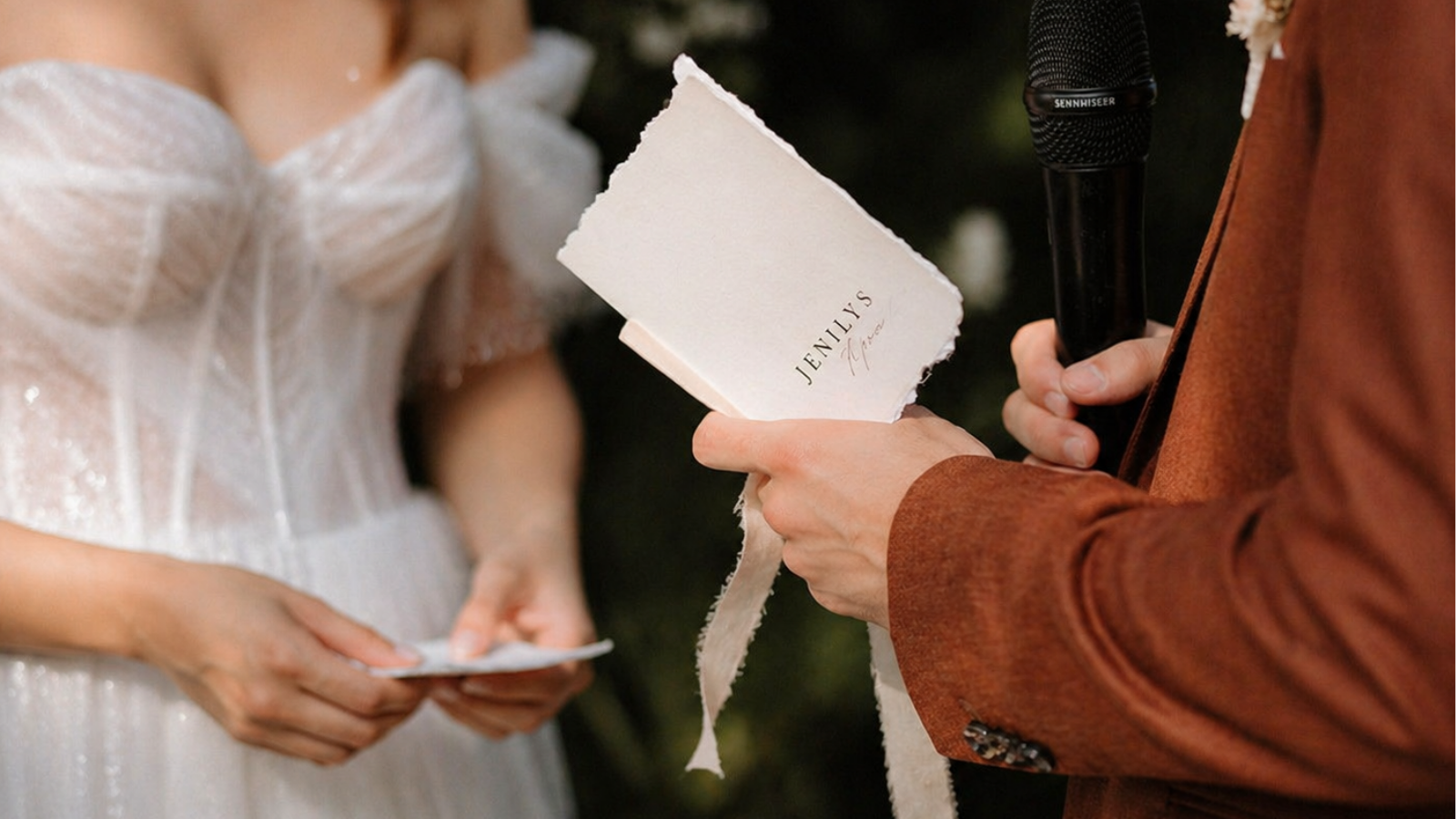
Yes, reading your wedding vows from a vow book or notes is completely acceptable and very common. It helps you stay focused, reduces anxiety, and ensures you don’t forget important parts during such an emotional moment.
How many promises should be included in wedding vows?
Most wedding vows include between three to five meaningful promises. This keeps your vows balanced and impactful without becoming too long or overwhelming during the ceremony.
What makes wedding vows memorable?
Wedding vows become memorable when they feel authentic, specific, and emotionally grounded. Small personal details, honest promises, and a natural tone create a stronger impact than trying to sound overly poetic or perfect.