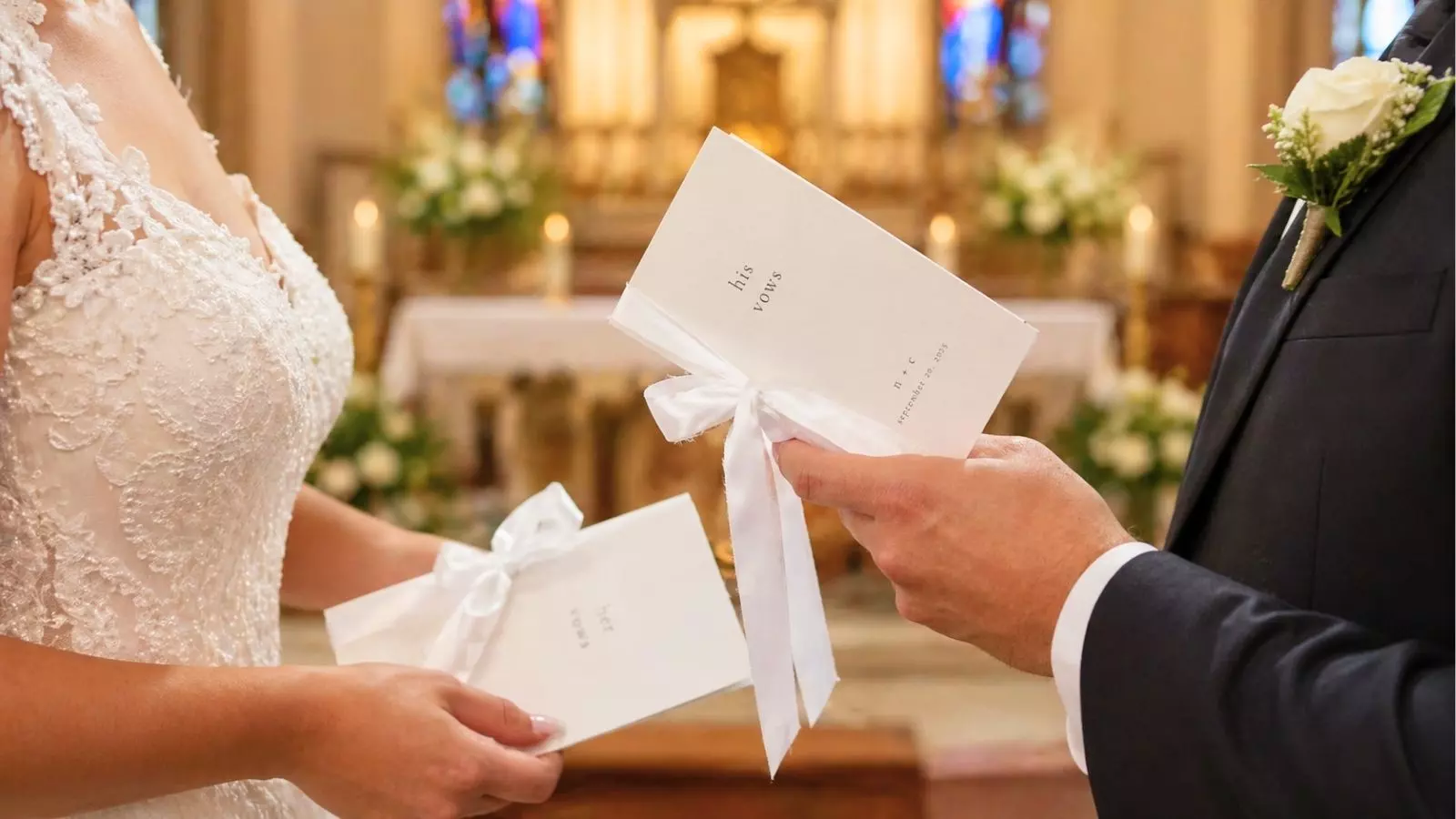
Catholic wedding vows are the official marriage promises used in the Catholic Church, following a fixed structure approved by the Order of Celebrating Matrimony to ensure a valid sacramental union.
Unlike what most couples expect, these vows are not written to reflect personal style or individuality. In a Catholic wedding, they follow a form defined by the Church not to limit expression, but to ensure that the commitment being made is complete and clearly understood.
For a broader explanation of wedding vow structures, ceremony formats, and how different traditions approach marriage promises, start with our complete wedding vows guide.
This guide covers everything you need to know about Catholic wedding vows: the official approved scripts, the meaning behind each phrase, the Declaration of Intent that precedes them, the ring exchange that follows, whether you can write your own, how vow renewals work in the Church, baptismal vows, priest vows, and the Spanish-language versions for bilingual ceremonies.
What Are Catholic Wedding Vows?
Catholic wedding vows also called Catholic marriage vows or Catholic marital vows are the verbal promises exchanged between two baptized Catholics (or a Catholic and a non-Catholic with dispensation) during a Catholic wedding ceremony. Unlike vows in civil or Protestant ceremonies, Catholic vows follow a specific form approved by the Church. This form cannot be replaced by personal vows in a Sacramental marriage, though it may be supplemented in limited ways with permission from the priest or deacon.
In the United States, the approved vow forms are governed by the Order of Celebrating Matrimony (OCM), the Roman Rite’s official liturgical book for marriage, revised in 2016. The U.S. Conference of Catholic Bishops (USCCB) has approved specific English-language translations for use in American Catholic ceremonies.
Who can marry in the Catholic Church?
For a marriage to be a Sacrament in the Catholic Church, at least one party must be baptized Catholic. Both parties must be free to marry (not previously married in the Church, or with an annulment if previously married), and they must have the genuine intent to enter a permanent, faithful, and open-to-children marriage. Couples who do not meet these requirements may still be able to have a Catholic wedding in certain circumstances a priest or deacon will advise on the specifics during marriage preparation.
The Theology Behind Catholic Marriage Vows
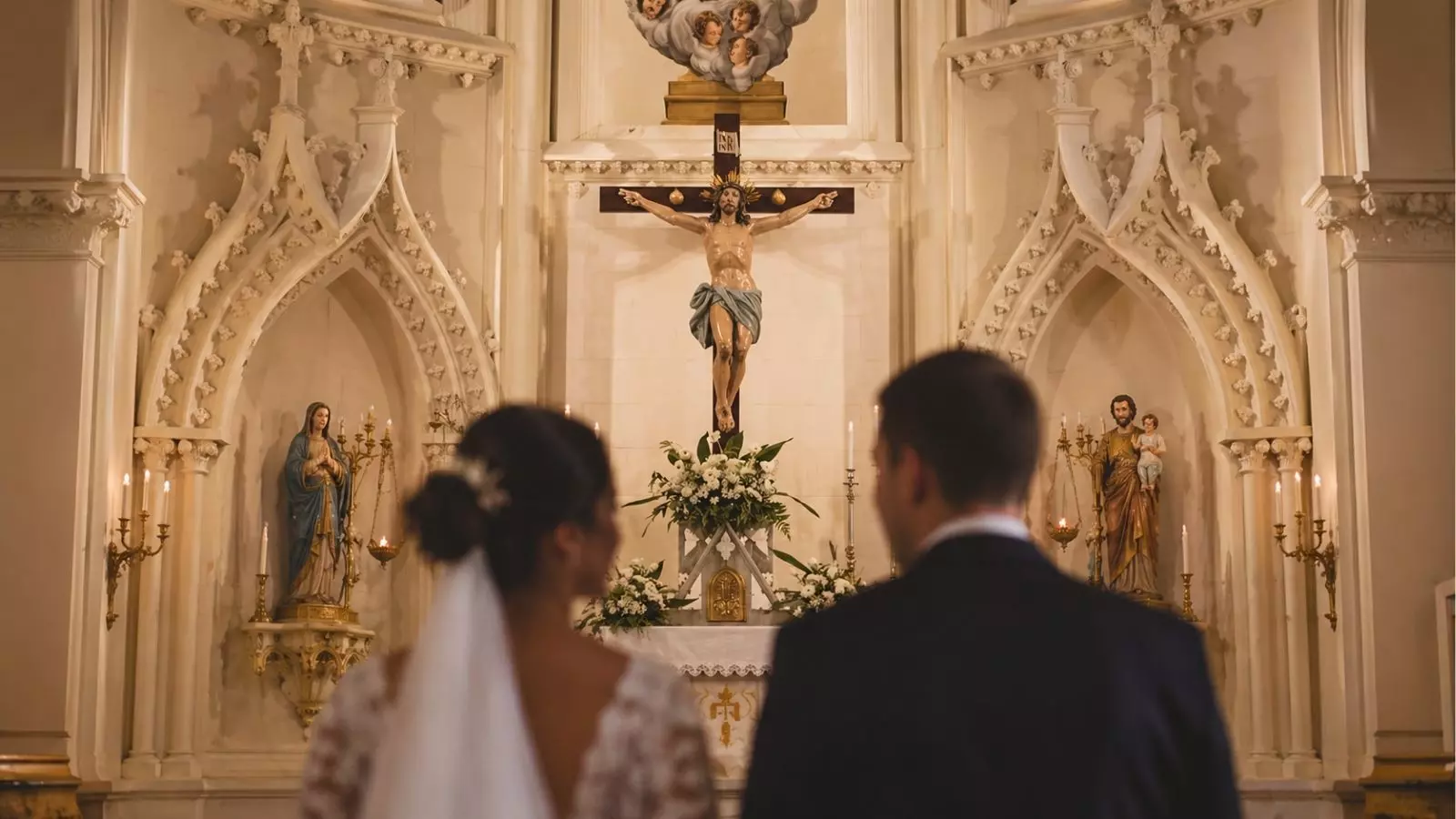
Understanding why Catholic vows are prescribed — why the Church specifies the exact form rather than leaving it to the couple — requires understanding the Catholic theology of marriage.
In Catholic teaching, marriage is one of the seven Sacraments. A Sacrament is a visible sign that brings about the grace it signifies. For marriage, the Sacrament is administered by the couple to each other — not by the priest. The priest (or deacon) is the Church’s official witness. The wedding vows are the moment the Sacrament is conferred: when the spouses consent to one another as husband and wife before God and the Church.
Because the vows are the sacramental act itself — not merely a description of what is happening — the Church requires that they be expressed in a form that clearly conveys the essential properties of Catholic marriage:
- Unity: One man and one woman, exclusively committed to each other
- Indissolubility: A permanent bond — “until death do us part” is not metaphor but doctrine
- Fidelity: Exclusive commitment — forsaking all others
- Openness to children: The marriage must be open to new life in principle
The prescribed vow form ensures all four properties are expressed or implied. This is why personal vows cannot simply replace the official form — a personally written vow might beautifully express love but inadvertently omit one of the essential properties.
Official Catholic Wedding Vow — Form A (Most Common)
This is the most widely used form of Catholic wedding vows in the United States. The couple speaks these words directly to each other, typically repeating after the priest or deacon phrase by phrase. This is the form most Catholics recognize from attending Catholic weddings.
Form A — Full Script
GROOM SPEAKS FIRST, THEN BRIDE REPEATS:
I, [Name], take you, [Name], for my lawful wife/husband, to have and to hold, from this day forward, for better, for worse, for richer, for poorer, in sickness and in health, until death do us part.
ALTERNATIVE CLOSING (both versions are approved):
…to love and to cherish until death do us part.
What each phrase means
“I, [Name], take you, [Name]” — The use of full names is deliberate. This is a specific, identified commitment to a specific person — not a general declaration of love, but a named covenant.
“For my lawful wife/husband” — The word “lawful” places the marriage within the legal and sacramental framework of the Church. It is not merely a personal commitment but one recognized by the community and the Church.
“To have and to hold” — A phrase from the 1549 Anglican Book of Common Prayer that entered Catholic vow language through centuries of parallel development. It expresses the totality of the commitment — both emotional possession and physical presence.
“From this day forward” — The vow is not retroactive. It begins now, with this ceremony, and extends forward without end.
“For better, for worse, for richer, for poorer, in sickness and in health” — The acknowledgment that the vow is unconditional. No circumstance — prosperity or hardship, health or illness — modifies the commitment.
“Until death do us part” — The expression of indissolubility. In Catholic doctrine, a validly celebrated and consummated Sacramental marriage cannot be dissolved by any human authority. This phrase is not poetic. It is doctrinal.
Official Catholic Wedding Vow — Form B (Question and Answer)
Form B is the call-and-response format. The priest or deacon poses the vow as a question and the couple answers “I do.” This format is equally valid sacramentally and is commonly used in shorter ceremonies or when the couple prefers not to repeat a long vow phrase by phrase.
Form B — Full Script
PRIEST/DEACON ASKS GROOM:
[Name], do you take [Name] to be your wife? Do you promise to be faithful to her in good times and in bad, in sickness and in health, to love her and to honor her all the days of your life?
Groom responds: “I do.”
PRIEST/DEACON ASKS BRIDE:
[Name], do you take [Name] to be your husband? Do you promise to be faithful to him in good times and in bad, in sickness and in health, to love him and to honor him all the days of your life?
Bride responds: “I do.”
Both Form A and Form B fulfill the sacramental requirements. The choice between them is typically made with your priest or deacon during marriage preparation. Some parishes have a preference; others leave it entirely to the couple.
Couples comparing Catholic vow formats with other ceremony structures may also want to explore traditional wedding vows used across denominations and historical traditions.
Traditional Catholic Vows — The Historical Form
When people search for traditional Catholic wedding vows, they are often looking for the older, pre-Vatican II language that was standard before the liturgical reforms of the 1960s and 1970s. The current approved form is itself traditional — it draws on centuries of Catholic vow language — but the older form had slightly different phrasing and in some cases included “obey.”
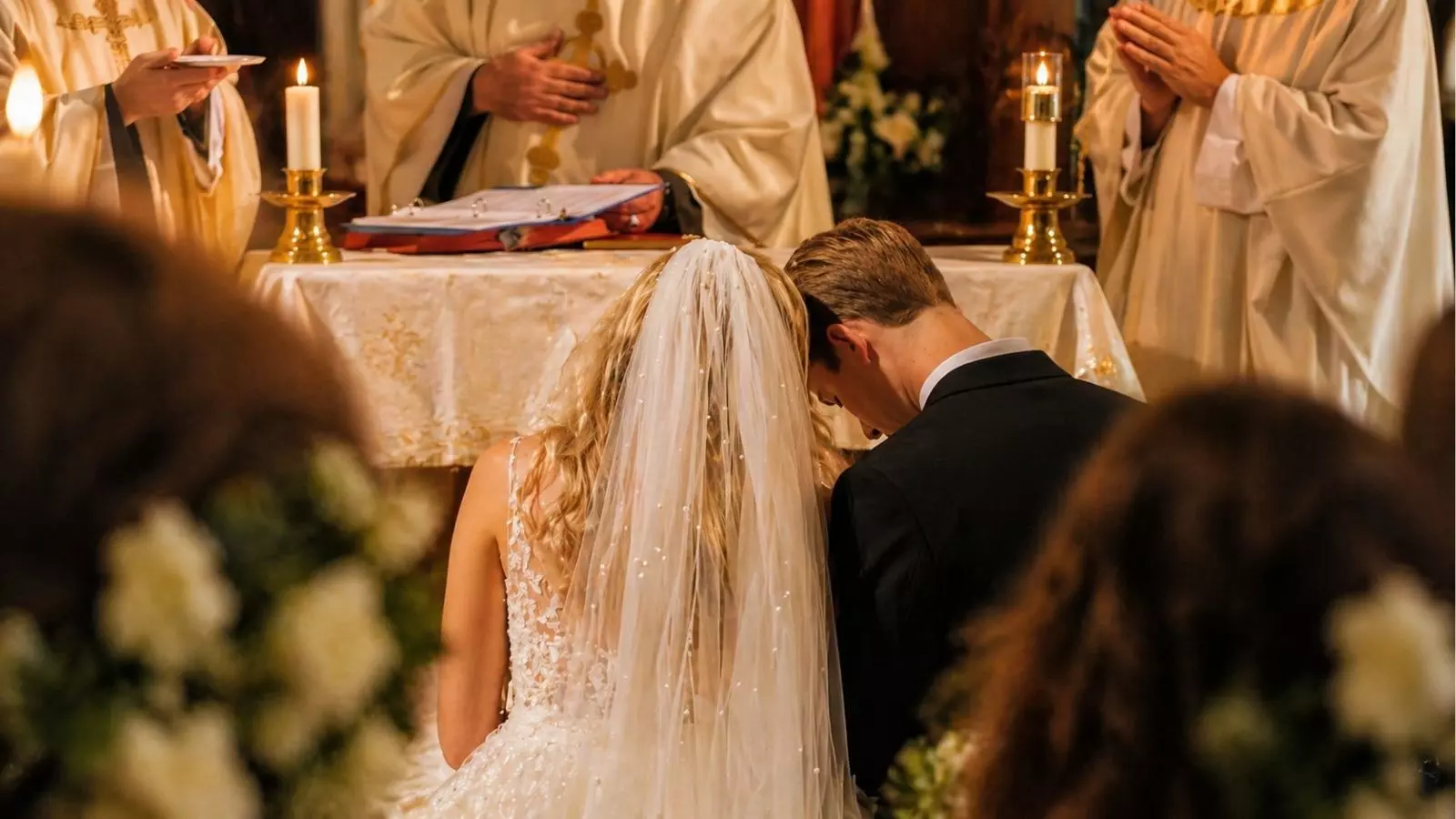
The pre-1969 traditional Catholic vow (historical reference)
I, [Name], take thee, [Name], for my lawful wedded wife/husband, to have and to hold, from this day forward, for better for worse, for richer for poorer, in sickness and in health, to love and to cherish, till death do us part, according to God’s holy ordinance; and thereto I plight thee my troth.
This older form used “thee” and “plight my troth” (Middle English for “pledge my faithfulness”). It also used “till death do us part” rather than “until death do us part.” These differences are linguistic, not doctrinal. The Sacrament was equally valid under the older language.
Many modern wedding vow traditions in English-speaking countries still trace their structure back to these older historical forms.
The current approved form does not include “obey.” The inclusion of “obey” in wedding vows was historically asymmetrical — brides promised it, grooms did not — and reflected the legal status of women in earlier centuries rather than Catholic doctrine. The current approved Catholic vow does not require either spouse to promise obedience to the other.
The Declaration of Intent — Full Script
Before the Catholic wedding vows are exchanged, the priest or deacon poses three questions to the couple. This is called the Declaration of Intent — also sometimes called the Pre-Nuptial Inquiry. It establishes that the couple is entering marriage freely, permanently, and with openness to children.
The Declaration of Intent is a separate liturgical element from the vows themselves. Both are required for a valid Catholic marriage.
Full Declaration of Intent Script
PRIEST/DEACON TO BOTH:
Since you are about to celebrate this Sacrament of Matrimony, I ask you to state your intentions.
Question 1: Have you come here to enter into Marriage without coercion, freely and wholeheartedly?
Both respond: “I have.”
Question 2: Are you prepared, as you follow the path of Marriage, to love and honor each other for as long as you both shall live?
Both respond: “I am.”
Question 3: Are you prepared to accept children lovingly from God and to bring them up according to the law of Christ and his Church?
Both respond: “I am.”
The third question may be omitted if the couple is past childbearing age or if one or both parties is known to be infertile — the Church requires openness to children as a principle, not as a practical possibility. Your priest or deacon will advise on this during preparation.
Catholic Ring Exchange — Full Script
After the vows are exchanged, the priest or deacon blesses the rings and the couple exchanges them with specific words. The ring exchange is a separate liturgical moment from the vows — it is the outward sign of the covenant just made.
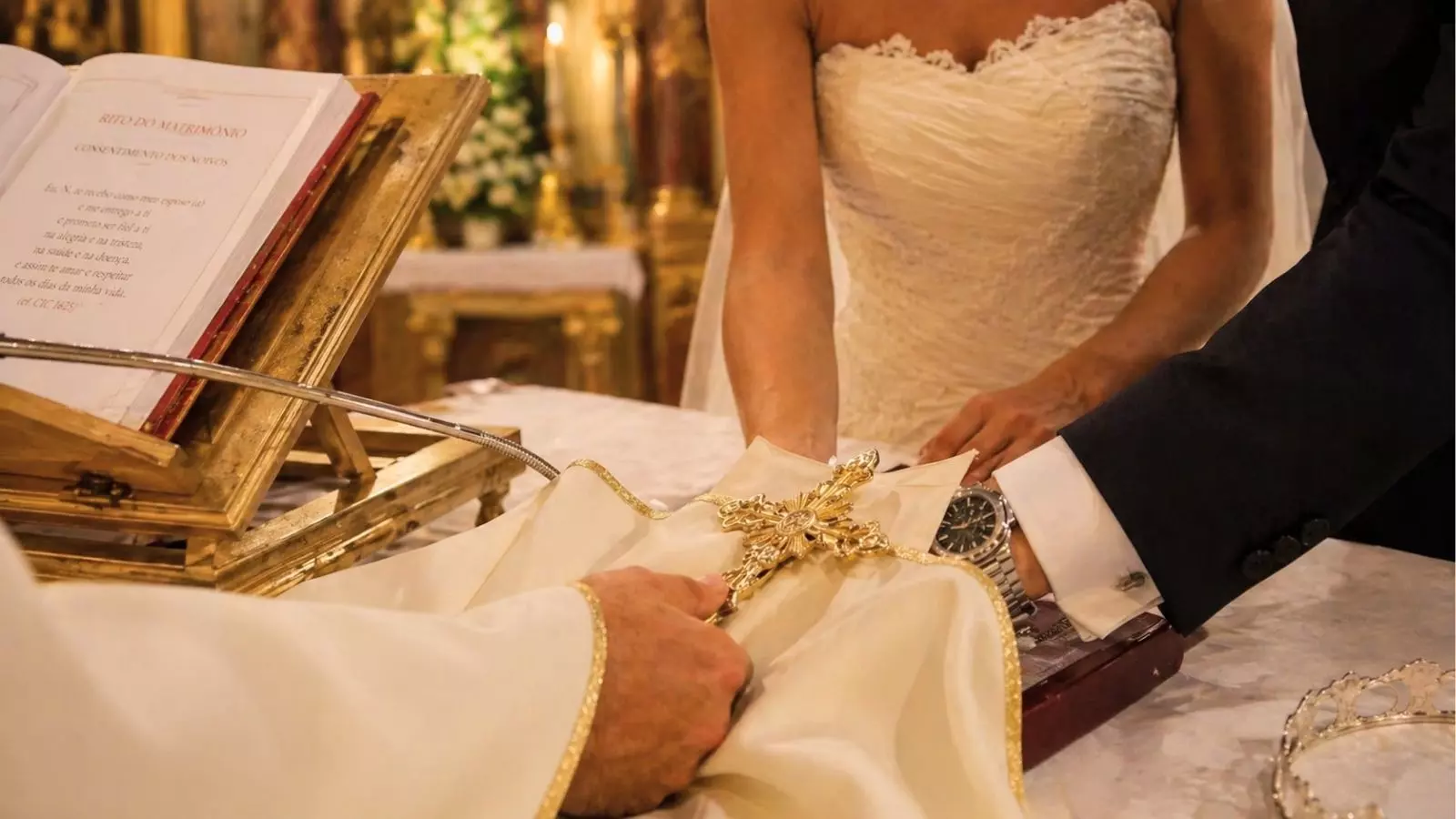
Blessing of the Rings
PRIEST/DEACON BLESSES THE RINGS:
Bless, O Lord, these rings, which we bless in your name, so that those who wear them may remain entirely faithful to each other, abide in peace and in your will, and live always in mutual charity. Through Christ our Lord. Amen.
Ring Exchange Words
EACH SPOUSE PLACES THE RING AND SAYS:
[Name], receive this ring as a sign of my love and fidelity. In the name of the Father, and of the Son, and of the Holy Spirit.
The Trinitarian formula at the end — “In the name of the Father, and of the Son, and of the Holy Spirit” — distinguishes the Catholic ring exchange from secular or Protestant versions. It is not optional in a standard Catholic ceremony.
Couples researching ceremony structure often compare Catholic ring exchanges with broader wedding ceremony scripts and officiant formats used in other traditions.
Can You Write Your Own Vows in a Catholic Wedding?
This is one of the most common questions couples ask when planning a Catholic wedding — and the answer is more nuanced than a simple yes or no.
The short answer: No, you cannot replace the official Catholic vows with personal vows in a Sacramental marriage.
The longer answer: You may be able to add personal elements alongside the official form, with your priest’s permission.
Why personal vows cannot replace the official form
Because the vows are the sacramental act of marriage, they must express the essential properties of Catholic matrimony: unity, indissolubility, fidelity, and openness to children. A personally written vow — however beautiful — cannot be assumed to include all four properties unless it specifically does so. The Church requires the approved form to ensure the Sacrament is validly conferred.
This is different from most Protestant denominations and civil ceremonies, where the couple has complete freedom to write original vows. In the Catholic Church, the freedom is more limited — but the reason for the limitation is theological, not bureaucratic.
What you can do
Many priests and parishes permit the following additions, with advance approval:
- Personal words before the official vow: A brief statement of love, a specific memory, or a personal promise spoken before repeating the official form
- Personal words after the official vow: Some priests allow a short personal addition following the official script — “and I promise you also…” — as long as it does not contradict the official form
- Personal readings: Scripture readings and other readings at the wedding can be chosen by the couple and read by family or friends, offering significant room for personalization
- Personal words in the homily: Many priests incorporate the couple’s story into the homily, effectively weaving in the personal narrative
The key rule: Always discuss with your priest or deacon during marriage preparation — ideally several months before the wedding. Do not assume what is permitted without asking. Policies vary by diocese and by individual parish.
What if you are having a non-Sacramental Catholic ceremony?
If one partner is not Catholic (or not baptized), the wedding may take place as a Convalidation or with a Dispensation from Canonical Form. In these cases, the liturgical requirements may differ. Your priest will advise on what is appropriate given your specific situation.
Catholic Vow Renewal — In the Church
A Catholic vow renewal — also called a renewal of marriage vows in the Catholic Church — is permitted and can be a beautiful liturgical moment. However, it is important to understand what it is and what it is not.
What a Catholic vow renewal is
A renewal of vows is a prayerful, public reaffirmation of the marriage covenant already made. It is a devotional act — an expression of gratitude for the marriage and a recommitment to its vows. It is not a second wedding, not a new Sacrament, and does not strengthen or in any way alter the existing Sacramental bond. That bond, once validly made and consummated, is permanent and does not require renewal to remain valid.
When the Catholic Church permits vow renewals
The Church encourages vow renewals on significant occasions, particularly:
- Milestone anniversaries — especially 25th (Silver) and 50th (Golden)
- At the conclusion of a Marriage Enrichment retreat or program
- During a Mass on a significant feast day or family occasion
- As part of a parish anniversary celebration
How to renew vows in the Catholic Church
Contact your parish priest or deacon to discuss the format. A Catholic vow renewal ceremony can take place within or outside of Mass. Common formats include:
- Within Mass: After the homily, the priest invites the couple (or all married couples present) to reaffirm their vows using an approved renewal formula
- Outside of Mass: A simpler liturgy led by a priest, deacon, or lay minister, including a brief reading, the renewal of vows, a prayer, and a blessing
- Private renewal: Some couples renew their vows privately with a priest present as witness, without a formal ceremony
Catholic vow renewal script
PRIEST/DEACON:
Dear brothers and sisters, [Name] and [Name] wish to renew the vows of their marriage. Let us ask the Lord to bless them and keep them faithful to each other.
THE COUPLE TOGETHER, OR EACH IN TURN:
I, [Name], renew to you, [Name], the promises of our marriage. I reaffirm that I take you as my wife/husband, to have and to hold, from this day forward, for better, for worse, for richer, for poorer, in sickness and in health, until death do us part. And I pledge you my love, now and for all the days of my life.
PRIEST/DEACON CLOSES WITH A BLESSING:
May the Lord bless you and keep you. May his face shine upon you and be gracious to you. May he look upon you with kindness and give you his peace. Amen.
Catholic Wedding Vows in Spanish
For bilingual Catholic ceremonies in the United States — increasingly common in parishes with large Hispanic communities — the vows may be spoken in Spanish. The official Spanish-language version is equally sacramentally valid. Many couples choose to have each partner speak in their preferred language, or to have the vows spoken in both languages.
Form A — Votos Católicos de Matrimonio en Español
EL NOVIO PRIMERO, LUEGO LA NOVIA:
Yo, [Nombre], te recibo a ti, [Nombre], como mi esposa/esposo legítima/o, y me entrego a ti y prometo serte fiel en la prosperidad y en la adversidad, en la salud y en la enfermedad, y así amarte y respetarte todos los días de mi vida.
Form B — Versión de Pregunta y Respuesta
SACERDOTE/DIÁCONO PREGUNTA:
[Nombre], ¿aceptas a [Nombre] como tu esposa/esposo? ¿Prometes serle fiel en lo próspero y en lo adverso, en la salud y en la enfermedad, amarla/amarle y respetarla/respetarle todos los días de tu vida?
Respuesta: “Sí, quiero.”
Ring exchange in Spanish
AL COLOCAR EL ANILLO:
[Nombre], recibe esta alianza en señal de mi amor y fidelidad. En el nombre del Padre, y del Hijo, y del Espíritu Santo.
For a bilingual ceremony, confirm with your priest which sections will be in each language, and whether the entire vow exchange or only portions will be duplicated. Many parishes have experience with bilingual ceremonies and can provide guidance specific to their community.
Catholic Baptismal Vows
Catholic baptismal vows are the promises made at Baptism — either by the person being baptized (if an adult) or by the godparents and parents on behalf of an infant. They are renewed by the entire congregation at the Easter Vigil each year.
The Baptismal vows — full text
PRIEST:
Do you reject Satan?
“I do.”
And all his works?
“I do.”
And all his empty promises?
“I do.”
Do you believe in God, the Father Almighty, Creator of Heaven and earth?
“I do.”
Do you believe in Jesus Christ, his only Son, our Lord, who was born of the Virgin Mary, suffered death and was buried, rose again from the dead and is seated at the right hand of the Father?
“I do.”
Do you believe in the Holy Spirit, the holy Catholic Church, the communion of saints, the forgiveness of sins, the resurrection of the body, and life everlasting?
“I do.”
This is our faith. This is the faith of the Church. We are proud to profess it, in Christ Jesus our Lord.
“Amen.”
Baptismal vows are distinct from wedding vows — they are the foundational promises of Christian life, not the specific promises of marriage. However, they are closely related in Catholic theology: the marriage vows are, in a sense, a lived expression of the baptismal call to love as Christ loves.
What Vows Do Catholic Priests Take?
Catholic priests do not take wedding vows — they are not married. But they do make solemn promises at ordination, and members of religious orders (monks, friars, nuns) take formal religious vows. These are distinct from each other.
Promises made by diocesan priests at ordination
A diocesan priest (a priest who serves a diocese, not a religious order) makes two promises at ordination:
- Celibacy: A promise to remain unmarried and to live chastely as a sign of the Kingdom of God. In the Latin Rite (the most common rite in the U.S.), celibacy is required for ordination to the priesthood. Eastern Catholic rites permit married men to be ordained priests, though bishops must be celibate.
- Obedience: A promise to obey the bishop of their diocese and his successors in all lawful things.
Diocesan priests do not formally take vows of poverty — they are permitted to own personal property. This is a key distinction from religious order priests.
The three vows of religious life
Members of religious orders — Franciscans, Dominicans, Jesuits, Benedictines, and others — take the traditional three evangelical counsels as formal, solemn vows:
- Poverty: No personal ownership of property; everything is held in common by the community
- Chastity: Celibacy and sexual abstinence as a lifelong commitment
- Obedience: Submission to the authority of the superior of the religious community
These three vows together constitute the formal consecration of religious life in the Catholic Church. A religious order priest, therefore, takes all three — including poverty — while a diocesan priest takes only the promises of celibacy and obedience.
Final thoughts
Catholic wedding vows are not meaningful simply because they are traditional. They carry weight because they express something precise a commitment understood not only as a personal promise, but as a sacramental act recognized by the Church.
When you speak these words, you are not creating your own version of marriage. You are entering into something that has been carefully defined, preserved, and lived by countless couples before you. The structure is intentional, not limiting. It ensures that what is promised is complete, not partial.
Understanding the meaning behind each phrase does not make the moment less personal. It makes it more grounded. You are not searching for the right words — they have already been given. What matters is that you say them with clarity, with intention, and with full awareness of what they represent.
In the end, the significance of the vows is not in how they sound, but in what they establish — a commitment that is meant to endure, not just to be remembered.
Frequently asked questions (FAQ)
Can you write your own vows in a Catholic wedding?
No, you cannot replace the official Catholic wedding vows with personal vows in a sacramental marriage. However, some parishes may allow brief personal statements before or after the official vows with the priest’s permission.
What are the official Catholic wedding vows in the United States?
The most common form is: “I, [Name], take you, [Name], to be my wife/husband… for better, for worse, for richer, for poorer, in sickness and in health, until death do us part.” There is also a question-and-answer format where each partner responds “I do.”
Why are Catholic wedding vows not customizable?
Because the vows are the sacramental act of marriage itself. The Catholic Church requires a specific form to ensure the vows clearly express unity, fidelity, permanence, and openness to children.
What is the Declaration of Intent in a Catholic wedding ceremony?
It is a set of three questions asked before the vows. The couple confirms they are entering marriage freely, will remain faithful for life, and are open to children. This step is required for a valid Catholic marriage.
Can you renew your vows in the Catholic Church?
Yes, vow renewals are allowed and encouraged, especially on milestone anniversaries. However, they are not a new sacrament — they are a symbolic reaffirmation of the existing marriage.