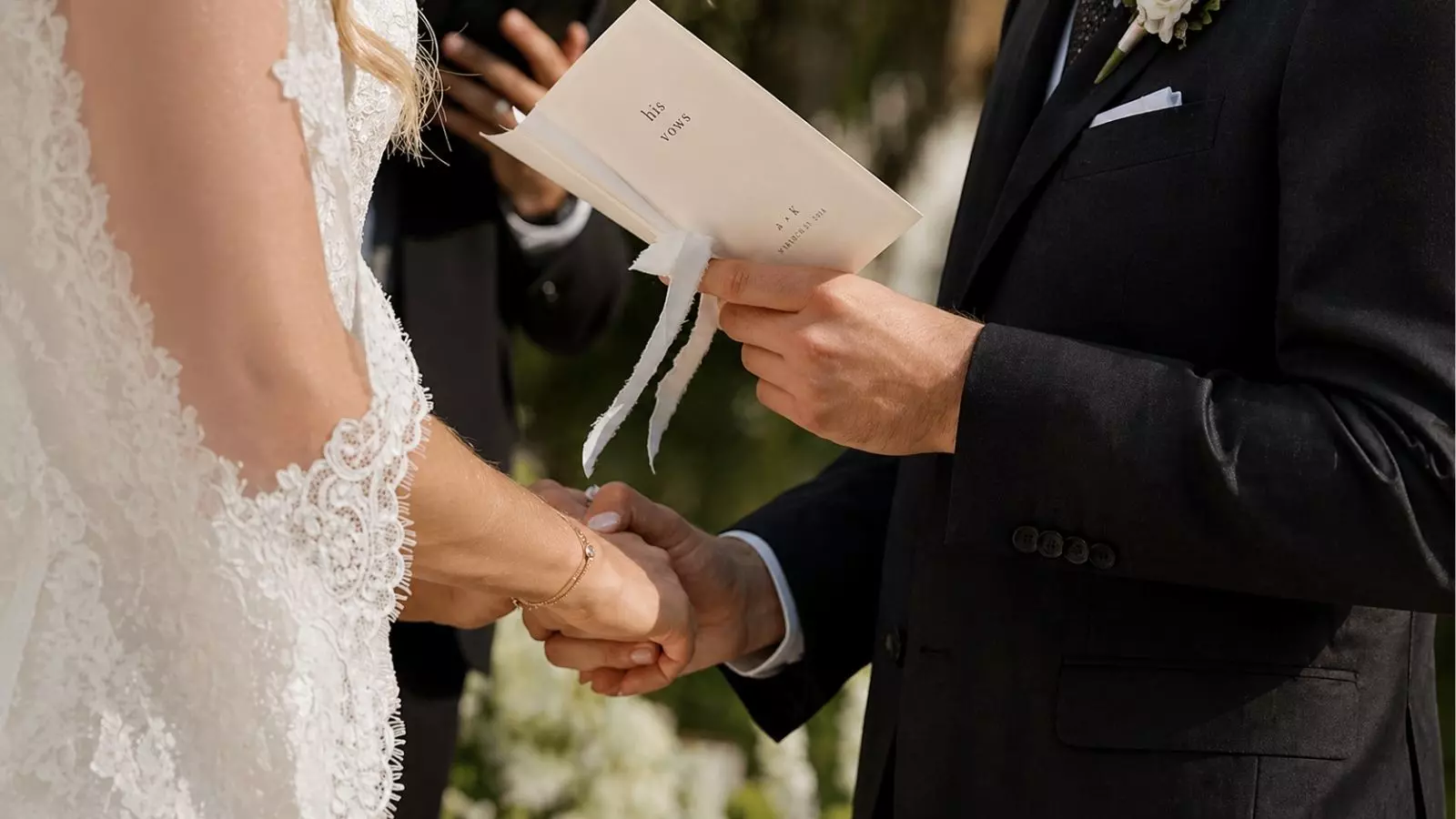
Wedding vows opening and closing lines are the first and last statements in a vow, designed to create emotional connection at the start and leave a lasting impact at the end. The opening and closing lines of your wedding vows carry more weight than any other part of what you say.
The opening is where everything begins, the moment your partner starts listening not just to your words, but to what you truly mean. The closing is what stays with them long after the ceremony ends, the line that feels final and complete when everything else has been said.
Most people do not struggle with what they feel. They struggle with how to begin and how to land. This guide shows you exactly how to start and end your wedding vows with clarity and intention, using real examples, what works, what to avoid, and how to make your first and last lines feel like part of the same complete thought.
The real challenge is usually learning how to write wedding vows in a way that sounds honest instead of overly scripted.
Couples who are still building the full structure of their vows often start with a complete wedding vows guide before refining the opening and closing lines.
Why the Opening Line Matters More Than You Think
Your opening line does three things at once. It tells your partner what kind of vow they are about to hear — emotional, light, direct, or story-driven. It signals to the room whether this is going to be a cry-moment or a laugh-moment. And it sets your own emotional footing before you get to the part that is harder to say.
Most people get this wrong not because they lack feeling but because they reach for familiar language in a high-pressure moment. They open with “From the moment I met you…” or “You are my best friend…” — phrases that are true and warm but so widely used that they slide past without landing. The room hears the sentiment but does not feel it, because familiarity dulls even genuine emotion.
What an opening line actually needs to do is one thing: make your partner feel seen before you have said anything of substance. A specific detail, an honest admission, or an unexpected angle accomplishes this. A familiar phrase, however beautifully delivered, does not.
The good news: you do not need to be a writer to open well. You need to know one true thing about this person or this moment that no one else in the room could have said. That is your opening line.
Three Ways to Open Wedding Vows (With Real Examples)
Every effective vow opening falls into one of three categories. Understanding which one fits your relationship — and your personality — is how you find the right starting point.
Reading complete wedding vows examples can also help couples understand how strong openings naturally transition into promises and emotional closings.
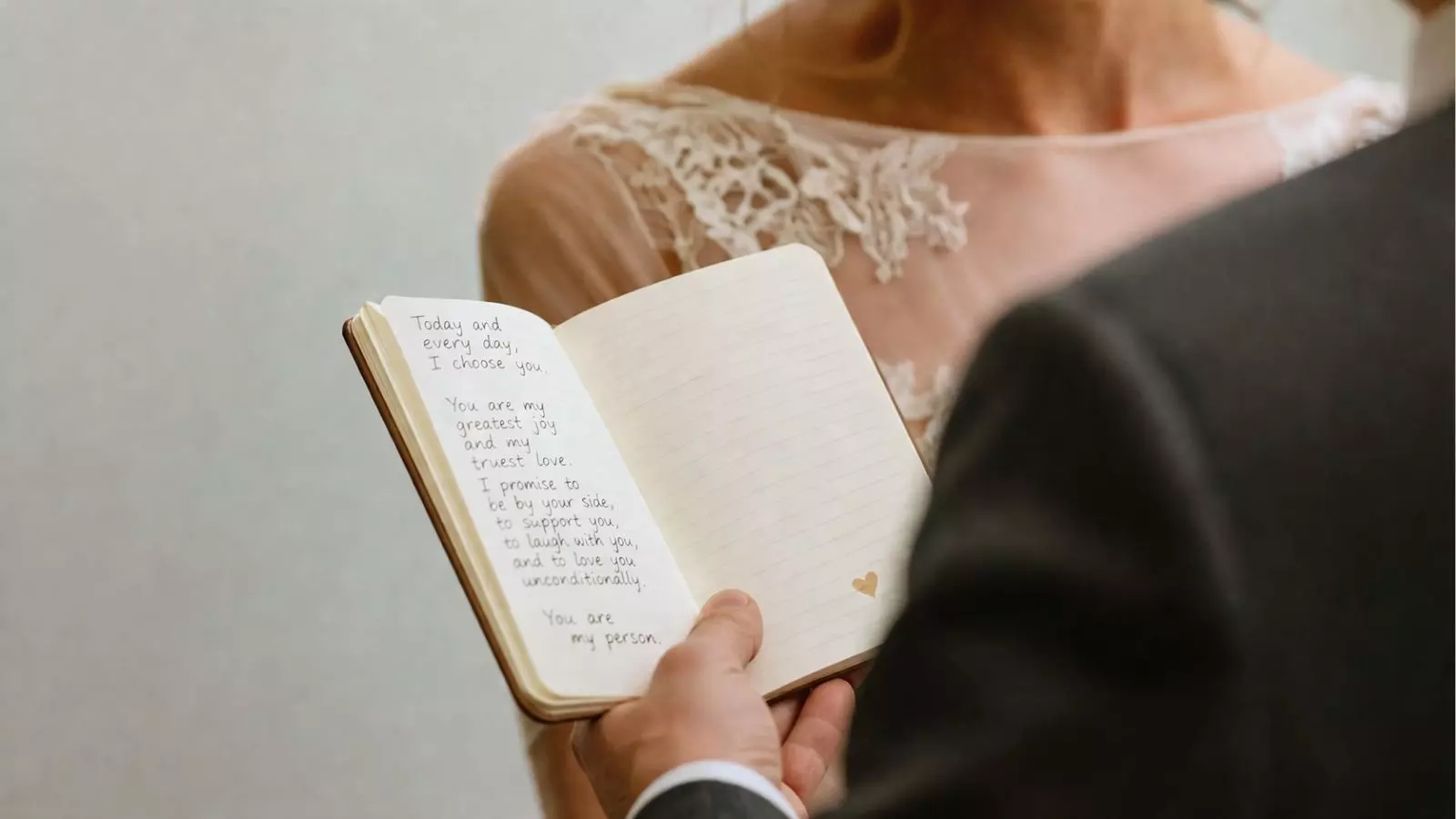
1. The Direct Emotional Open
This is the most powerful opening type when done right. It skips the setup and goes straight to the feeling — but with a specific angle that makes it feel earned rather than announced.
It does not open with “I love you so much” — that is a conclusion, not an opening. It opens with the specific reason, the particular truth, the moment that made the feeling undeniable.
What it sounds like:
“I have been thinking about what to say to you for months. I wrote things down and crossed them out. I started over. And eventually I realized that the reason it was hard is because everything I want to say sounds too simple when I say it out loud.”
“There is a specific moment when I knew. We were in the car on the way back from somewhere unremarkable, and you said something that was not meant to be significant, and I looked at you and thought: I want to be around this person for the rest of my life.”
“I am not someone who says big things easily. So I want you to understand what it means that I am standing here, saying this in front of everyone we love.”
Why these work: each one creates a small tension — a reason to keep listening — before the vow has even started. The first admits difficulty. The second names a specific moment. The third acknowledges the speaker’s own personality, which makes the promise that follows feel more genuine because it is harder for this person to make.
2. The Light or Humorous Open
This works for couples whose relationship has always had humor in it — where a laugh at the altar is not a deflection from the emotion but an expression of it. The rule: the opening can be funny, but the vow cannot stay funny. The humor earns the emotion that follows.
Couples planning a more playful ceremony often look at funny wedding vows examples to balance humor with emotional sincerity.
What it sounds like:
“I practiced a more polished version of this. It was better constructed. It used the word ‘journey.’ I scrapped it.”
“I spent a significant amount of time before meeting you figuring out exactly what I wanted in a partner. I had a list. You met almost none of the criteria. You were better than the list.”
“I have reviewed the terms and conditions of this marriage carefully, and I have a few notes.”
Why these work: each one gets a laugh that releases tension, and then the vow can go somewhere real without feeling heavy. The audience is relaxed. Your partner is smiling. You have already told them something true about your relationship — that you are someone who does not take yourself too seriously — before you say the serious things.
3. The Storytelling Open
This opens with a moment — a specific memory that shows who your partner is or what they mean to you. It is the most cinematic of the three approaches, and when the story is genuinely specific, it is the one that makes the whole room feel like they know both of you better than they did thirty seconds ago.
The most memorable unique wedding vows are usually built around small details and moments that only the couple would recognize.
What it sounds like:
“About a year before we started dating, I watched you do something that I never forgot. You did not know I was paying attention. You probably do not remember it at all. But I have thought about it many times since, because it showed me exactly who you are.”
“There is a letter I wrote you that I never sent. I wrote it about six months before I said any of this out loud. It said everything I was afraid to say — how certain I was about you, how terrifying that was, how I had never wanted anything this much.”
“My mother told me once that you know you have found the right person when being with them feels like relief. I did not fully understand that until the first time I walked into a room and saw you already there.”
Why these work: stories create investment. By the time the vow reaches its promises, the room has been given something real to hold — a detail, a memory, a moment that makes the abstract commitment feel grounded in actual life.
20 Real Opening Lines — Ready to Use or Adapt
These are complete opening sentences, not fragments. Each one is designed to be the first words of a personal vow. Read them out loud — the one that makes your voice change is the one to start from.
Direct Emotional Openings
“I have spent a long time trying to figure out how to say this in a way that does it justice. I have not found a way. So I am going to say the simple version, which is also the true version.”
“I am not going to pretend I did not cry writing this. I am going to pretend I am not crying right now, but I want you to know that this is the most important thing I have ever said out loud.”
“There is one thing I have been absolutely sure of for a long time now, and today I finally get to say it in public.”
“I did not expect you. Not the timing, not the circumstances, not the way it felt from the first week. None of it was what I had planned, and it was better than anything I could have planned.”
“Before I say what I want to say to you, I want to say something to everyone in this room: thank you for being here to witness what is about to happen. It matters that you are here.”
“I have been practicing this in my head for weeks. Every time I got to this sentence, I started crying. So we will see how this goes.”
Light and Humorous Openings
“I told myself I was not going to cry. I am already losing that bet, so let’s just move on.”
“I had a more polished draft of this. It was longer, it used better vocabulary, and it sounded nothing like me. So here is the real version instead.”
“I want to start by saying that I have been ready for this moment for a long time — which is either very romantic or slightly concerning, and I am going to let you decide.”
“When I told my best friend I was writing my own vows, they said: just make sure you actually mean it at the end. So let me confirm upfront that I do.”
“I had a plan for today. The plan was: do not cry, do not ramble, say the important things clearly. I am already zero for one.”
Storytelling Openings
“I want to tell you about the moment I knew. Not when I thought I might love you — I mean the moment I was certain.”
“There is a version of this vow I wrote six months ago that I never sent you. Today I am finally saying it out loud.”
“The year I met you was the hardest year of my life. I did not expect to meet someone worth loving in the middle of it. That is the thing about you — you show up when you are least expected and most needed.”
“I remember the first time I introduced you to my family. On the drive home, my sister called me and said: that’s the one. I already knew.”
“There was a Tuesday about two years ago — nothing special happened, it was just an ordinary day — and I remember thinking: I hope every day feels like this.”
Short and Direct Openings
“I choose you. I want to say everything else, but I want to start there.”
“You are the best decision I have ever made. That is where I want to start.”
“I have been looking forward to saying this to you in public for a long time.”
“Standing here, I want you to know one thing before anything else: I am completely sure.”
Openings That Sound Good But Fall Flat
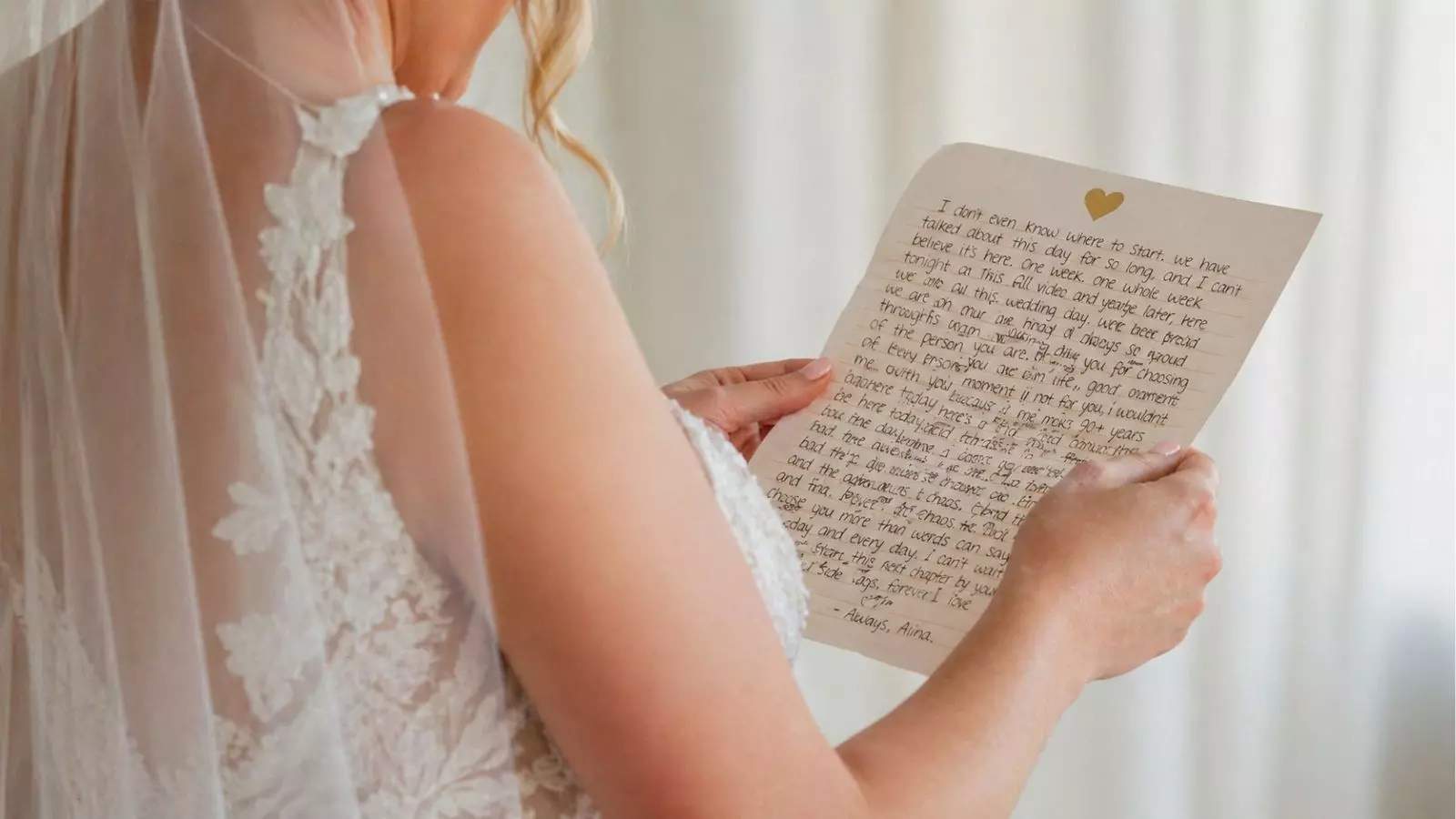
These are the opening lines that feel right when you write them — they are warm, they are genuine, they are things you actually mean — but they have been said so many times that they slide past the room without landing. Avoid them not because they are wrong, but because they do not do the work an opening line needs to do.
“From the moment I met you…” This is the most overused opening in personal vows. It signals to the room that what follows will be familiar. If you want to open with a memory of when you met, make it specific: not “from the moment I met you” but “I remember the exact second I saw you across the room at [place] and thought…” The specific version does what the generic one cannot.
“You are my best friend…” This is true for almost every couple at the altar. It is also something every person in the room has heard before. If this is genuinely the truest thing you can say, then follow it immediately with something specific that proves it: “You are my best friend — and I mean that in the literal sense that you are the first person I call when something happens, good or bad, before I have even decided what I think about it.”
“I never believed in love until I met you.” This one has become a cliché precisely because it sounds romantic. If it is true for you, find a more specific way to say it: what did you not believe, exactly, and what changed? That version is worth saying.
“Today is the happiest day of my life.” Probably true. Also something the officiant, the guests, and every wedding movie ever has said. If you open with this, you have told your partner nothing about them — only about the day. Start with them, not the occasion.
Starting with a quote from someone else. Opening with a line from a poem, a movie, or a famous speech immediately signals that you are borrowing someone else’s language for the most personal thing you will ever say. If you want to reference a quote, use it inside the vow — not as the first words out of your mouth.
Why the Closing Line Is the One They Remember
The closing line of a vow is what people carry out of the ceremony. Not the middle — the end. This is true in speeches, in songs, in stories, and it is especially true in vows, because the closing line is the last thing your partner hears before the officiant pronounces you married. It is followed by a ring, a kiss, and the rest of their life with you. It needs to feel complete.
A vow that ends with “…and I love you” after two minutes of specific, powerful language has not landed — it has stopped. The closing line should feel like a period, not a trailing off. It should create the sense that everything necessary has been said and the speaker is done — not because they ran out of things to say, but because that was the last true thing and everything after it would be less.
The best closing lines do one of three things: they make a final promise that encompasses everything, they land on a specific image or phrase that makes the abstract concrete, or they turn back to the opening and complete a circle. Any of these, done well, produces the feeling of a vow that is finished — not stopped, finished.
Three Ways to Close Wedding Vows (With Real Examples)
1. The Final Promise
This closes on a commitment — specific, clear, and final. Not “I promise to love you always” (too vague) but something that names a particular behavior or stance that encapsulates everything the vow has been building toward.
“I promise to keep choosing you — not just today, but on every ordinary day that comes after this one, especially those.”
“Whatever comes next, I will be there. That is the whole of it. That is my promise.”
“I will stay. Through the hard years and the good ones, through every version of you I have not met yet — I will stay.”
Why these work: they are active, not passive. They name something the speaker will do, not just feel. They end on a verb — choosing, being there, staying — which gives the vow momentum and weight at the very end.
2. The Impactful Final Line
This is the most cinematic closing — a sentence that crystallizes the entire vow into one image or idea. It does not summarize. It lands.
“I love you. That is not changing. That is the one thing I am completely sure of.”
“You are the plan. You have always been the plan. And I am so glad I finally figured that out.”
“I am done. Not because I have run out of things to say — because that was the last true thing, and everything after it would be less. I love you.”
Why these work: they create a sense of completion that lands with the room. The first closes on certainty after a vow about uncertainty. The second closes the loop on a metaphor started earlier. The third acknowledges itself — the vow about being finished with the saying because the feeling is complete.
3. The Simple and Direct Close
Sometimes the most powerful closing is the plainest one — a sentence that says exactly what needs to be said, nothing more. This works best when the vow has been full and specific, and the closing is earned by everything that came before it.
Many couples who prefer short wedding vows focus on clarity and emotional precision instead of long speeches.
“I love you. Let’s go.”
“That is all. I love you.”
“I am yours. I have been for a while. Now it is official.”
“I choose you. Today and every day after this. That is the whole promise.”
Why these work: simplicity after substance hits differently than simplicity alone. When a vow has been full and honest, a short closing lands like a period — clean, final, complete. The brevity is not a limitation. It is the point.
20 Real Closing Lines — Ready to Use or Adapt
Read these out loud. The one that makes you pause — that is the one.
Closings Built on Promise
“I promise to keep showing up — not just on days like this one, but on the ordinary ones that no one remembers. Especially those.”
“I will choose you every morning. That is the promise. Everything else comes from that one.”
“I am not going anywhere. That is the most honest thing I know how to say, and I mean it completely.”
“Whatever comes, I will be there. I will stay in it with you. That is my whole vow.”
“I promise you the long version of this — not just today, but every day we get after this one.”
“When things get hard — and they will get hard — I will be the thing that does not move. I promise you that.”
Closings That Land on an Image or Idea
“I love you. That is not changing. That is the one thing I am completely sure of.”
“You are the best decision I have ever made. Today I am making it official.”
“I have been looking forward to saying all of this out loud for a long time. It feels exactly like I thought it would.”
“I did not plan for you. I am so glad I did not — because I would have planned for something smaller.”
“I love you more than I know how to say. But I am going to spend a long time trying. That is the promise.”
“I used to think love was something you felt. You taught me it is something you do. I am ready to do it — for a very long time.”
Simple and Direct Closings
“I love you. Let’s go.”
“I am yours. I have been for a while. Now it is official.”
“That is everything I know how to say. I love you.”
“I choose you. Today and every day after. That is the whole of it.”
“I am done. Not because I have run out — because that was the last true thing. I love you.”
Closings That Complete a Circle (pair with a matching opening)
“I started by saying I was certain. I want to end there too: I am certain. I love you.”
“I told you I had a plan. The plan worked. I love you.”
“That moment I told you about — when I knew — this is the moment I was waiting for since then. I love you.”
Closings That Feel Unfinished
- Ending mid-thought. The most common mistake. The vow runs out of content and stops rather than closes. “…and I cannot wait to spend the rest of my life with you.” That is a sentence, but it is not a closing line — it is the second-to-last line of a vow that needed one more sentence. Read your draft out loud and ask: does this feel finished, or does it feel like it just stopped?
- Ending with “I love you” alone after a generic vow. “I love you” is a perfect closing line when the vow has been specific and earned. It is a weak closing line when the vow has been general and it adds nothing that was not already said. The test: if you remove the last sentence, does the vow feel less complete? If not, the last sentence is not doing its job.
- Ending with a question. “…and I hope you feel the same?” is not a closing — it is an anxiety. End with a statement, not a hedge.
- Ending with someone else’s words. Closing with a borrowed quote — however beautiful — means the last thing your partner hears is not you. Quotes belong in the body of a vow, not the final line. The closing is yours.
- A closing that does not match the tone of the vow. If your vow has been light and funny throughout and you close with “…and I pledge you my eternal soul,” the tonal whiplash undercuts both the humor and the sincerity. The closing line should be the natural end of the vow you wrote — not a different vow attached at the end.
How to Connect Your Opening and Closing
The most memorable vows feel like one complete thought — a beginning that sets something up, a middle that develops it, and an ending that resolves it. This is not something most people plan consciously, but it is what separates a vow that feels finished from one that feels assembled.
The simplest way to connect your opening and closing is to write the closing first. Ask yourself: what is the single most important thing I want my partner to know by the time I am done? Write that sentence. Then ask: what do I need to say before that sentence for it to land with full weight? That is your opening and middle.
Using a wedding vows template can also help couples organize the emotional flow of the vow before refining the final wording.
Three patterns that work especially well:
- The Full Circle. Open with a question or tension and close with its resolution. Open: “I spent a long time not knowing what I was looking for.” Close: “Now I know. It was you. It was always going to be you.” The closing answers the opening, and the vow feels complete.
- The Bookend. Open and close with the same word, phrase, or idea — but developed. Open: “I choose you.” Close: “I choose you — today, and on every ordinary day that follows, and I will keep choosing you until there are no more days left.” The repetition with development gives the vow architecture.
- The Reveal. Open with a story or memory that seems like context, close with what that story actually meant. Open: “There was a Tuesday about two years ago — nothing happened, it was just an ordinary day.” Close: “That Tuesday is what I am promising you. I want every Tuesday to feel like that one.” The closing reframes the opening and gives it its meaning.
Final thoughts
The beginning and the end of your vows are what give them shape.
The opening draws your partner in and tells them this is something real. The closing lets them know that what you said was complete — not because you ran out of words, but because you said exactly what needed to be said.
Everything in between matters, but these two moments are what hold the entire vow together. When they are clear, intentional, and true to you, the rest naturally falls into place.
If your first line feels honest and your last line feels final, then your vows are already doing what they are meant to do.
Frequently asked questions (FAQ)
How do you start wedding vows in a natural way?
The best way to start wedding vows is with something specific and personal, such as a real memory, an honest admission, or a unique detail about your partner. This helps the opening feel authentic instead of generic.
What is the best opening line for wedding vows?
The best opening line is one that creates emotional connection immediately. It can be direct, slightly vulnerable, or even light and humorous, as long as it feels true to your relationship and natural to say out loud.
How do you end wedding vows so they feel complete?
A strong ending should feel final and intentional. The most effective closings are a clear promise, a simple declaration, or a line that brings everything together in a way that feels finished rather than abrupt.
Can wedding vows start funny and still be meaningful?
Yes, starting with humor can work well if it reflects your personality. The key is to transition into something sincere so the vows feel balanced and emotionally meaningful by the end.
What should you avoid when starting or ending wedding vows?
Avoid generic openings, borrowed quotes, and endings that feel unfinished. The most common mistakes are starting with overused phrases and ending without a clear final statement that feels complete.