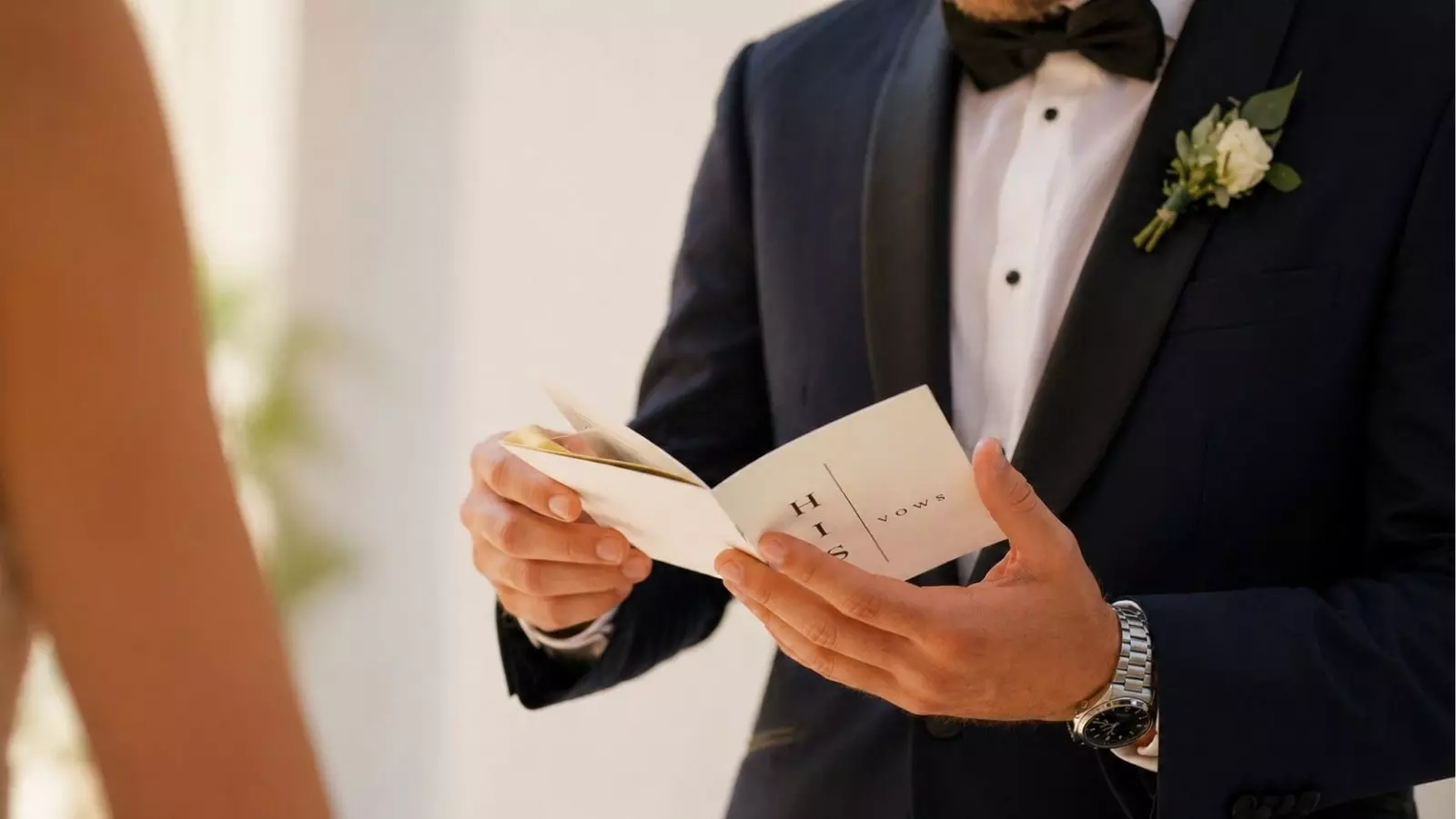
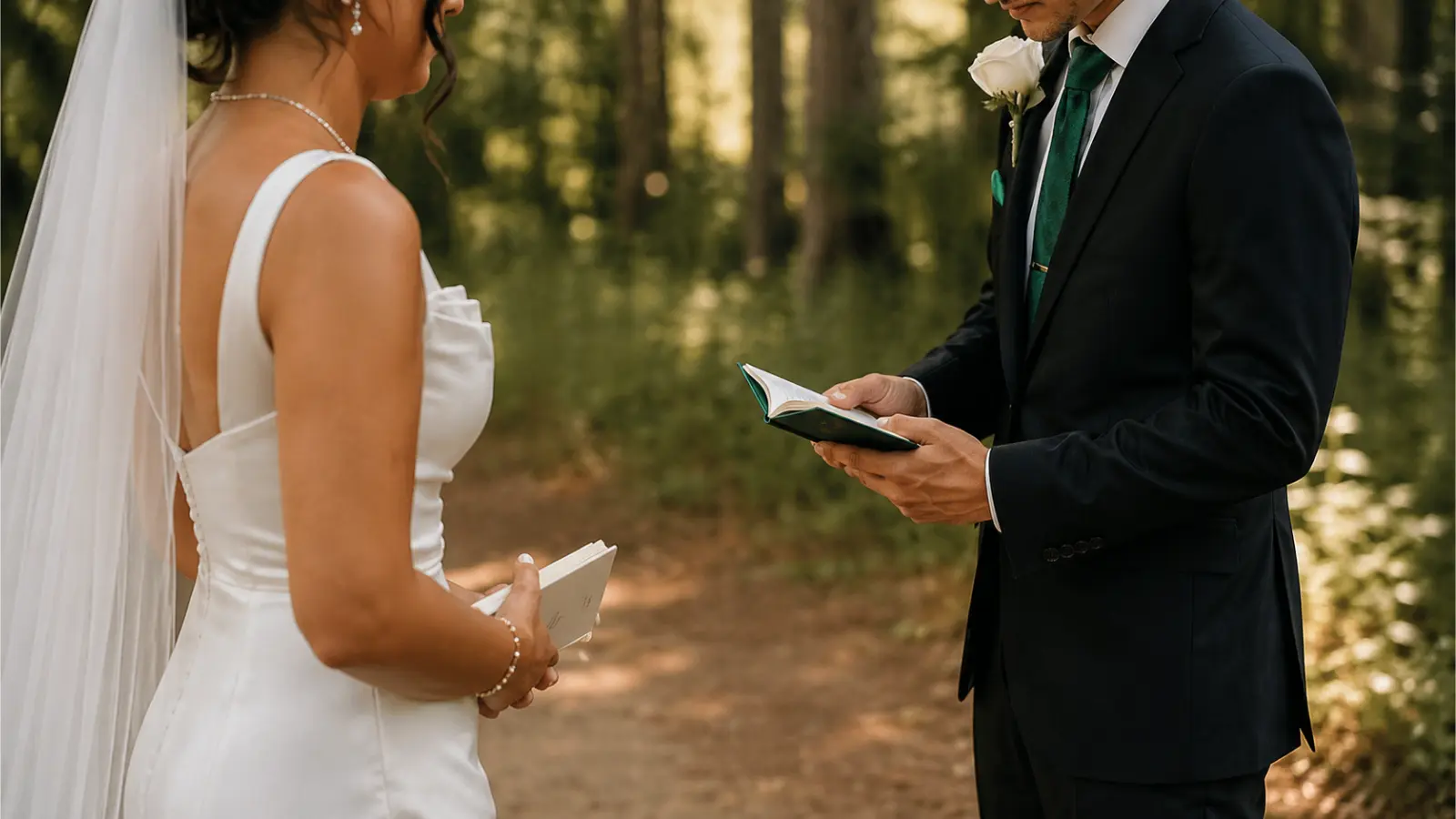
A wedding vows script is what holds a ceremony together. Not just the vows themselves, but every transition, every cue, and every line that guides the moment from beginning to end. When a ceremony feels natural and effortless, it is almost always because there was a clear structure behind it.
Without one, even the simplest wedding can feel uncertain — pauses that last too long, cues that get missed, or moments that lose their rhythm. With a well-written script, everything flows the way it should.
This guide brings together seven complete wedding vows scripts, each designed for a different type of ceremony. From modern and non-religious to traditional, Christian, personal vows, and vow renewals, every version is structured the way officiants actually use them clear, practical, and ready to follow.
What Is a Wedding Vows Script and How It Works
A wedding vows script is the complete written text of a ceremony — from the officiant’s opening words through the pronouncement and the kiss. It is not just the vows themselves. It is everything: the welcome, the readings cues, the exchange of vows, the ring exchange, and the closing.
Most couples and officiants work from a shared script. The couple reviews and approves it before the wedding, the officiant uses it to conduct the ceremony, and both partners have a printed copy at the altar so no one has to rely on memory alone.
There are two ways a script handles the vows section specifically. In the first format — the traditional or scripted format — the officiant speaks the vows line by line and each partner repeats them, or the officiant asks “Do you take…” and each partner answers “I do.” In the second format — used when couples write their own personal vows — the script contains a placeholder where each partner reads their own written vows, and the scripted exchange is replaced entirely.
Many couples also wonder who traditionally says the vows first and whether the order matters during the ceremony.
Every script below is formatted for real use. Speaker labels are in bold. Stage directions are in brackets and italics — these are instructions for the officiant, not words spoken aloud. Names appear as [Partner A] and [Partner B] — replace them with the actual names before sharing.
Script 1 — Modern Non-Religious Wedding Vows Script
This is the most widely used ceremony format in the U.S. today — secular, warm, and adaptable to any couple. It works for courthouse weddings, backyard ceremonies, venue weddings, and everything in between. No religious language, no required denomination. The tone is personal and contemporary.
OFFICIANT: Welcome, everyone. We are gathered here today to celebrate one of life’s greatest moments — the joining of [Partner A] and [Partner B] in marriage.
[Brief pause. Acknowledge the guests.]
OFFICIANT: To the family and friends who have traveled to be here — thank you. Your presence is not a formality. It is a witness. The people in this room are the community that this marriage will grow inside of, and that matters.
OFFICIANT: Marriage is not the beginning of a love story. For [Partner A] and [Partner B], that story is already well underway. What today marks is a choice — made in front of everyone they love — to build something together that neither could build alone.
[Optional: reading by a guest. If included, introduce the reader here.]
OFFICIANT: We have come to the exchange of vows. [Partner A] and [Partner B], please face each other and join hands.
[Couple turns to face each other.]
OFFICIANT: [Partner A], please share your vows.
[PARTNER A reads or repeats vows.]
OFFICIANT: [Partner B], please share your vows.
[PARTNER B reads or repeats vows.]
OFFICIANT: [Partner A] and [Partner B], you have made your promises to each other. These words are yours now — to carry forward, to return to, and to build on.
[If including ring exchange, proceed to ring vows. If not, continue below.]
OFFICIANT: By the power vested in me, and in the presence of your family and friends, I now pronounce you married. You may kiss.
[Couple kisses.]
OFFICIANT: Ladies and gentlemen, it is my honor to present [Partner A] and [Partner B] — married.
[Recessional music begins. Couple exits.]
Script 2 — Traditional Wedding Vows Script (I Do Format)
The traditional “I Do” format is the most recognized ceremony script in the English-speaking world. The officiant asks each partner a question and each responds “I do.” This is the script used in most formal, religious-adjacent, and courthouse ceremonies. It requires no memorization and no written vows from the couple.
OFFICIANT: Dearly beloved, we are gathered here in the presence of these witnesses to join [Partner A] and [Partner B] in holy matrimony — an institution not to be entered into lightly, but thoughtfully and with mutual respect.
OFFICIANT: Who presents this [woman/man/person] to be married?
[Family member or escort responds: “I do” or “Her family does” or similar. This element is optional — omit if not desired.]
OFFICIANT: [Partner A] and [Partner B], please face each other and join hands.
OFFICIANT: [Partner A], do you take [Partner B] to be your lawfully wedded [husband/wife/spouse], to have and to hold from this day forward, for better, for worse, for richer, for poorer, in sickness and in health, to love and to cherish, for as long as you both shall live?
PARTNER A: I do.
OFFICIANT: [Partner B], do you take [Partner A] to be your lawfully wedded [husband/wife/spouse], to have and to hold from this day forward, for better, for worse, for richer, for poorer, in sickness and in health, to love and to cherish, for as long as you both shall live?
PARTNER B: I do.
OFFICIANT: The rings, please.
[Ring bearer or wedding party member presents the rings.]
OFFICIANT: [Partner A], please place the ring on [Partner B]’s finger and repeat after me: With this ring, I thee wed.
PARTNER A: With this ring, I thee wed.
OFFICIANT: [Partner B], please place the ring on [Partner A]’s finger and repeat after me: With this ring, I thee wed.
PARTNER B: With this ring, I thee wed.
OFFICIANT: [Partner A] and [Partner B] have made their vows and exchanged rings as a symbol of their love and commitment. Therefore, by the power vested in me, I now pronounce you [husband and wife / married / partners for life]. You may kiss your [spouse/partner].
[Couple kisses.]
OFFICIANT: It is my honor to present, for the first time, [Partner A] and [Partner B].
Script 3 — Traditional Wedding Vows Script with Ring Exchange
This version uses the repeat-after-me format — the officiant speaks each line of the vow and each partner repeats it phrase by phrase. It is more deliberate and more formal than the “I Do” format, and it includes a full ring exchange with spoken ring vows. This is the format most associated with church ceremonies and formal weddings.
OFFICIANT: We are gathered here today, in the sight of God and these witnesses, to join [Partner A] and [Partner B] in the bonds of holy matrimony.
OFFICIANT: Marriage is the promise between two people who love each other, who trust that love, and who honor one another as individuals in that togetherness. It is not to be entered into carelessly, but with reverence, honesty, and a deep sense of purpose.
OFFICIANT: [Partner A] and [Partner B], please face each other and join hands.
OFFICIANT: [Partner A], please repeat after me.
OFFICIANT: I, [Partner A]…
PARTNER A: I, [Partner A]…
OFFICIANT: take you, [Partner B]…
PARTNER A: take you, [Partner B]…
OFFICIANT: to be my lawfully wedded [husband/wife/spouse]…
PARTNER A: to be my lawfully wedded [husband/wife/spouse]…
OFFICIANT: to have and to hold from this day forward…
PARTNER A: to have and to hold from this day forward…
OFFICIANT: for better, for worse…
PARTNER A: for better, for worse…
OFFICIANT: for richer, for poorer…
PARTNER A: for richer, for poorer…
OFFICIANT: in sickness and in health…
PARTNER A: in sickness and in health…
OFFICIANT: to love and to cherish…
PARTNER A: to love and to cherish…
OFFICIANT: until death do us part. This is my solemn vow.
PARTNER A: until death do us part. This is my solemn vow.
OFFICIANT: [Partner B], please repeat after me.
[Repeat the same vow exchange with Partner B.]
OFFICIANT: The rings, please.
[Rings are presented.]
OFFICIANT: These rings are a symbol of the vows you have made today — a circle with no beginning and no end, just as your love has no limits and your commitment has no conditions.
OFFICIANT: [Partner A], place the ring on [Partner B]’s finger and repeat after me: With this ring, I thee wed. Wear it as a symbol of my love — today, and every day that follows.
PARTNER A: With this ring, I thee wed. Wear it as a symbol of my love — today, and every day that follows.
OFFICIANT: [Partner B], place the ring on [Partner A]’s finger and repeat after me: With this ring, I thee wed. Wear it as a symbol of my love — today, and every day that follows.
PARTNER B: With this ring, I thee wed. Wear it as a symbol of my love — today, and every day that follows.
OFFICIANT: By the power vested in me, I now pronounce you [married / husband and wife]. You may seal your vows with a kiss.
[Couple kisses.]
OFFICIANT: Ladies and gentlemen, it is my great honor to present [Partner A] and [Partner B].
Script 4 — Christian Wedding Vows Script
This script is written for Christian ceremonies — denominational or non-denominational. It includes references to God, scripture, and faith without being tied to a specific church liturgy. It works for Baptist, evangelical, non-denominational, and most Protestant ceremonies. For Catholic ceremonies specifically, the script must follow the Rite of Marriage — check with your priest for the required text.
OFFICIANT: We gather here today in the presence of God and these witnesses to celebrate the marriage of [Partner A] and [Partner B]. Marriage is a sacred covenant — a gift ordained by God for the companionship, the joy, and the mutual support of two people joined together in love.
OFFICIANT: Scripture tells us in 1 Corinthians 13 that love is patient and love is kind — that it does not envy, does not boast, and is not proud. It bears all things, believes all things, hopes all things, endures all things. This is the love that [Partner A] and [Partner B] are committing to today.
OFFICIANT: [Partner A] and [Partner B], please face each other and join hands before God and these witnesses.
OFFICIANT: [Partner A], do you take [Partner B] to be your lawfully wedded [husband/wife/spouse], to have and to hold from this day forward, for better, for worse, for richer, for poorer, in sickness and in health, to love and to cherish, in accordance with God’s holy purpose, for as long as you both shall live?
PARTNER A: I do.
OFFICIANT: [Partner B], do you take [Partner A] to be your lawfully wedded [husband/wife/spouse], to have and to hold from this day forward, for better, for worse, for richer, for poorer, in sickness and in health, to love and to cherish, in accordance with God’s holy purpose, for as long as you both shall live?
PARTNER B: I do.
OFFICIANT: The rings, please.
[Rings are presented.]
OFFICIANT: These rings are outward signs of an inward commitment. As you wear them, let them remind you of the vows you have made today and the God in whose presence you made them.
OFFICIANT: [Partner A], as you place this ring on [Partner B]’s finger, please repeat after me: With this ring, I thee wed — in the name of the Father, the Son, and the Holy Spirit.
PARTNER A: With this ring, I thee wed — in the name of the Father, the Son, and the Holy Spirit.
OFFICIANT: [Partner B], as you place this ring on [Partner A]’s finger, please repeat after me: With this ring, I thee wed — in the name of the Father, the Son, and the Holy Spirit.
PARTNER B: With this ring, I thee wed — in the name of the Father, the Son, and the Holy Spirit.
OFFICIANT: Let us pray.
[Officiant offers a brief prayer for the couple. This can be written in advance or spoken spontaneously.]
Example prayer: “Lord, we thank You for bringing [Partner A] and [Partner B] together. Bless this marriage with patience, with grace, and with the enduring love that only You can give. May their home be a place of joy, of peace, and of Your presence. In Your name we pray, amen.”
OFFICIANT: By the power vested in me and in the presence of God and these witnesses, I now pronounce you [husband and wife / married]. What God has joined together, let no one separate. You may kiss.
[Couple kisses.]
OFFICIANT: It is my joy and honor to present [Partner A] and [Partner B] — joined in marriage before God.
Script 5 — Simple and Short Wedding Vows Script
This script is for couples who want a clean, brief ceremony — elopements, micro weddings, courthouse ceremonies, or any situation where simplicity is the goal. The full ceremony runs under ten minutes. Every word is earning its place. Nothing is filler.
OFFICIANT: We are here today for one reason: [Partner A] and [Partner B] have chosen each other, and they want the people they love to witness that choice.
OFFICIANT: That is what marriage is, at its core — a choice made in front of witnesses. Everything else grows from there.
OFFICIANT: [Partner A] and [Partner B], please face each other.
OFFICIANT: [Partner A], do you take [Partner B] as your [husband/wife/spouse/partner], to love and to cherish, for as long as you both shall live?
PARTNER A: I do.
OFFICIANT: [Partner B], do you take [Partner A] as your [husband/wife/spouse/partner], to love and to cherish, for as long as you both shall live?
PARTNER B: I do.
[If including rings:]
OFFICIANT: The rings.
OFFICIANT: [Partner A], place the ring on [Partner B]’s finger.
PARTNER A: With this ring, I thee wed.
OFFICIANT: [Partner B], place the ring on [Partner A]’s finger.
PARTNER B: With this ring, I thee wed.
OFFICIANT: By the power vested in me, I now pronounce you married. You may kiss.
[Couple kisses.]
OFFICIANT: [Partner A] and [Partner B] — married.
Script 6 — Wedding Ceremony Script with Personal Vows
This is the format most U.S. couples use today when they write their own vows. The script provides the full ceremony structure — the officiant’s words, the ceremony flow, the ring exchange — and the personal vows drop into the exchange section as a replacement for the scripted vow text. The rest of the ceremony stays exactly the same.
In this format, neither partner hears the other’s vows until the ceremony. Each person reads from a card or paper they have prepared in advance. The officiant’s job is to set the moment up and then step back.
OFFICIANT: Welcome. We are gathered here today to witness something that has been a long time coming — the marriage of [Partner A] and [Partner B].
OFFICIANT: I have had the pleasure of spending time with this couple before today, and what I can tell you about them is this: they chose each other deliberately. Not impulsively, not carelessly — deliberately. They know who they are choosing. And that makes what happens here today more meaningful, not less.
[Optional: one or two readings by guests. Introduce each reader by name. This is a natural pause in the ceremony and gives the couple a moment before the vows.]
OFFICIANT: We have come to the part of the ceremony I know you have all been waiting for — the exchange of vows. [Partner A] and [Partner B] have each written their own words to say to each other today. They wrote them separately. Neither has heard the other’s vows until this moment.
OFFICIANT: [Partner A] and [Partner B], please face each other and take each other’s hands.
[Couple faces each other and joins hands.]
OFFICIANT: [Partner A], please share your vows.
[Partner A reads personal vows. Allow silence before continuing — do not rush.]
OFFICIANT: [Partner B], please share your vows.
[Partner B reads personal vows. Allow silence before continuing.]
OFFICIANT: [Partner A] and [Partner B], the words you have spoken today are yours. They belong to this marriage now. Return to them often.
OFFICIANT: The rings, please.
[Ring bearer or wedding party presents the rings.]
OFFICIANT: A ring is a circle — it has no beginning and no end. As you wear these rings, let them be a daily reminder of what you promised here today.
OFFICIANT: [Partner A], place the ring on [Partner B]’s finger and say: I give you this ring as a sign of my love and my promise.
PARTNER A: I give you this ring as a sign of my love and my promise.
OFFICIANT: [Partner B], place the ring on [Partner A]’s finger and say: I give you this ring as a sign of my love and my promise.
PARTNER B: I give you this ring as a sign of my love and my promise.
OFFICIANT: [Partner A] and [Partner B], you have spoken your vows. You have exchanged your rings. You have made your promises in the presence of everyone who matters most to you.
OFFICIANT: By the power vested in me, it is my honor and my joy to pronounce you married. You may kiss your partner.
[Couple kisses.]
OFFICIANT: Ladies and gentlemen, please join me in celebrating [Partner A] and [Partner B] — married.
[Recessional music begins.]
Script 7 — Vow Renewal Script
A vow renewal ceremony is structurally similar to a wedding ceremony but shorter and less formal. The tone is reflective — it acknowledges the years, the history, and the choice to continue. This script works for milestone anniversaries, destination renewals, and informal ceremonies with family and close friends. It runs roughly five to eight minutes.
Some couples also choose to write entirely new renewal vows rather than repeating their original ceremony wording.
OFFICIANT: We are here today because [Partner A] and [Partner B] have decided that the promises they made [X] years ago are worth saying again. Not because those promises have expired — but because they have deepened. Because they know now what they were promising then, and they want to say it again with that knowledge behind it.
OFFICIANT: Thank you all for being here to witness this.
OFFICIANT: [Partner A] and [Partner B], please face each other.
OFFICIANT: [Partner A], in the years since your wedding day, you have built a life together. You have been through things you did not plan for, and you have come through them. Do you choose [Partner B] again today — not as a formality, but as a genuine renewal of your commitment to this marriage and to this person?
PARTNER A: I do.
OFFICIANT: [Partner B], do you choose [Partner A] again today — with everything you have learned about each other, and everything that is still ahead?
PARTNER B: I do.
[If the couple has written personal renewal vows:]
OFFICIANT: [Partner A] and [Partner B] have each written something they want to say to each other today. [Partner A], please share your words.
[Partner A reads renewal vows.]
OFFICIANT: [Partner B], please share your words.
[Partner B reads renewal vows.]
[If including ring exchange or new rings:]
OFFICIANT: [Partner A] and [Partner B] would like to exchange rings as a symbol of this renewal. [Partner A], as you place this ring on [Partner B]’s hand, please say: I loved you then. I love you now. I will love you always.
PARTNER A: I loved you then. I love you now. I will love you always.
OFFICIANT: [Partner B], please say the same: I loved you then. I love you now. I will love you always.
PARTNER B: I loved you then. I love you now. I will love you always.
OFFICIANT: [Partner A] and [Partner B], you came here today not because you had to — but because you wanted to. That choice, made freely and with full knowledge of each other, is the most meaningful vow of all.
OFFICIANT: Please join me in celebrating [Partner A] and [Partner B] — still choosing each other, after all this time.
[Applause. Couple may kiss. Recessional or celebration follows.]
Officiant Script Notes — What the Officiant Needs to Know
If you are the officiant reading this, here is what you need before the ceremony.
Get the full script at least two weeks out. Review it with the couple, confirm all names and pronunciations, and mark any sections they want to modify. The script above is a template — changes are expected and easy to make at this stage. They are not easy to make the day before.
Print two copies. One for you to hold. One as a backup at the altar in case you drop yours or the wind takes it. Staple, do not clip. Outdoor ceremonies especially — paper moves.
The stage directions in brackets are for you only. They are instructions, not text to read aloud. If a direction says [Allow silence before continuing], that means pause — do not fill the silence with words. Those moments are often the most powerful parts of the ceremony.
Know where the vows are in your script before you start. The most common officiant mistake is losing the place during the vow exchange — which is the exact moment when every eye in the room is on you. Tab or highlight that section specifically.
Speak slowly. In ceremonies, people almost always speak faster than they think they are. If you feel like you are going too slowly, you are probably at the right pace. Slow down an extra beat at the pronouncement — that line deserves a breath before it.
If using the repeat-after-me format: speak each phrase in a natural unit — the way you would say it in conversation, not word by word. “To have and to hold” is one unit. “From this day forward” is another. Breaking it into single words makes it feel robotic and throws the partner off their rhythm.
How to Customize Any Wedding Vows Script
Every script on this page is a starting point. Most couples make at least a few changes before the ceremony — and they should. Here is how to do it without breaking what works.
Start by reading the full script out loud. Not in your head — out loud, at speaking pace. This is how you find the lines that feel off. What reads fine on paper sometimes lands awkwardly when spoken. The lines that make you hesitate are the ones to rewrite.
Couples who are writing their own vows for the first time often benefit from using a structured writing guide before customizing the ceremony script itself.
Change the opening to match your tone. The officiant’s opening sets the entire emotional register of the ceremony. If you want something warmer and more personal, replace the formal opening with something that sounds like how the officiant actually talks. If you want something more structured and dignified, keep the language elevated. The opening is the easiest place to customize with the highest impact.
Add a story if you have one. The most memorable ceremonies have one specific detail — a story about how the couple met, a moment that captures who they are together, something the guests might not know. If the officiant knows the couple well enough to include one real story, it transforms the ceremony from a ceremony into an event. Keep it under two minutes and make sure the couple approves it in advance.
Adjust the vow language to fit the couple. If the couple is using the scripted “I Do” format but the traditional language does not quite fit — “to love and to cherish” sounds fine but “lawfully wedded” feels stiff to them — change it. “To love and to build a life with” works just as well legally and sounds more like a real person talking. The legal requirement is the consent, not the specific wording.
Add or remove the ring exchange. The ring exchange is traditional but not mandatory. Some couples do a unity ceremony instead — a candle lighting, a sand ceremony, a handfasting cord. If you are replacing the ring exchange with something else, write it into the script in advance so the officiant knows the cue.
Confirm the pronouncement wording. “I now pronounce you husband and wife” is traditional but not universal. “I now pronounce you married” is gender-neutral and works for all couples. “I now pronounce you partners for life” is also used. Decide in advance — this line gets more attention than almost any other in the ceremony, and the officiant should say it with full confidence, without looking down at the script.
Final thoughts
A wedding ceremony is one of the few moments in life where every word matters. Not because it needs to be perfect, but because it needs to be clear — clear enough for both of you to know exactly what you are saying, and why it matters.
That is what a good script does. It removes uncertainty, gives structure to the moment, and allows you to focus on what is actually happening instead of what comes next.
The best ceremonies are not the most elaborate ones. They are the ones that feel steady, intentional, and fully understood by the people standing at the center of them. If your script does that, it is already exactly right.
Frequently asked questions (FAQ)
What is a wedding vows script used for?
A wedding vows script is used to organize the entire ceremony, including what the officiant says, when the vows happen, and how the ceremony flows from start to finish. It helps avoid confusion and keeps everything structured on the day.
Do you need a wedding vows script for your ceremony?
You don’t always need a full script if your officiant already has one, but it is highly recommended. A written script ensures the ceremony runs smoothly and that both the couple and officiant are aligned.
Can you customize a wedding vows script?
Yes, wedding vows scripts are meant to be customized. You can adjust the opening, change the tone, add personal stories, include or remove the ring exchange, and adapt the language to match your style.
What is the difference between a vows script and personal vows?
A vows script is the full structure of the ceremony, while personal vows are the words each partner writes and says to each other. Personal vows replace only the vow exchange section inside the script.
How long should a wedding vows script be?
Most wedding ceremony scripts last between 15 and 30 minutes. Simple ceremonies can be as short as 10 minutes, while more detailed ones with readings and personal vows can extend to 20–30 minutes.