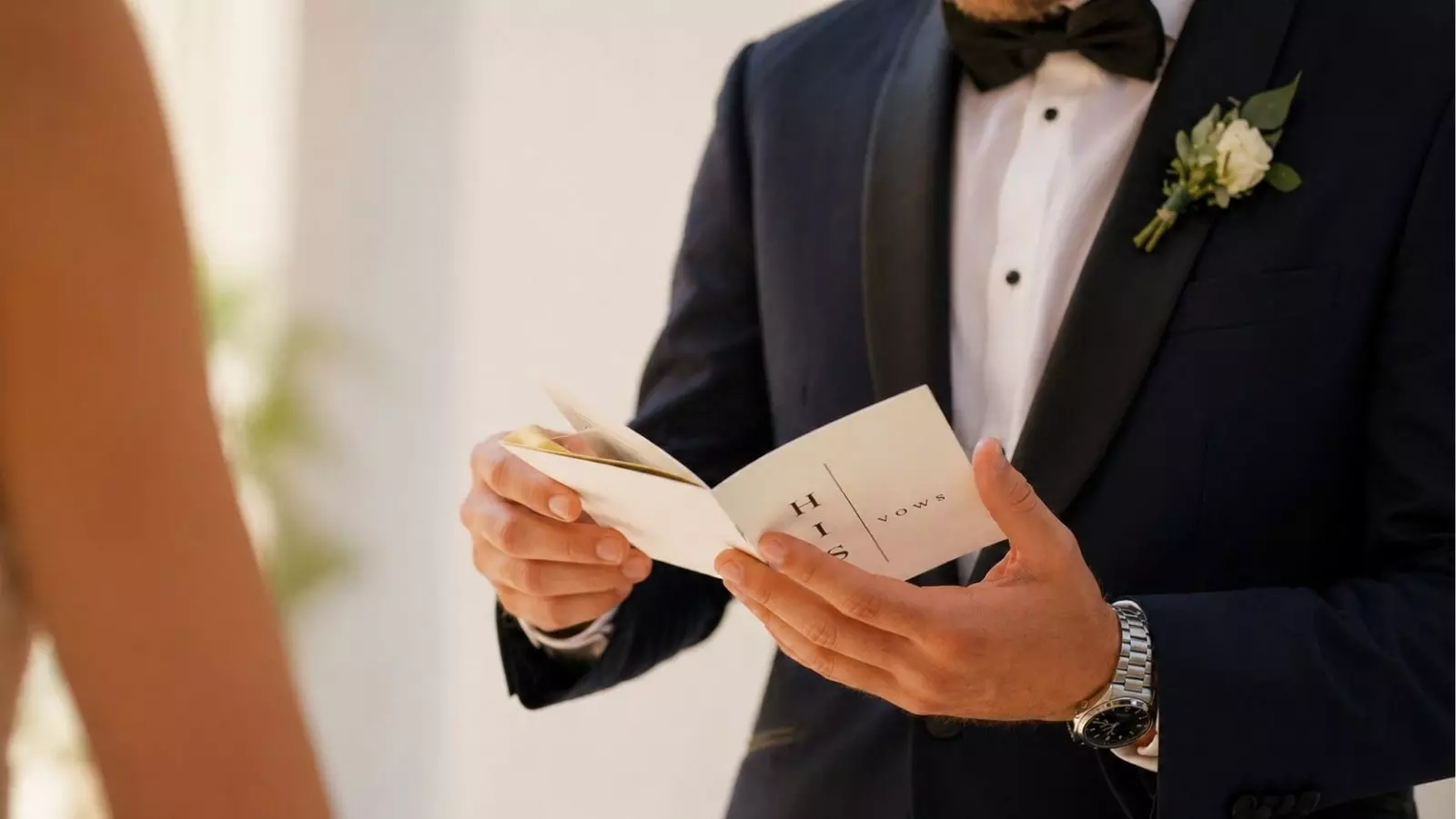
Wedding vows should be long enough to say something real and short enough to keep every word meaningful. The question of how long wedding vows should be comes up for almost every couple, but the answer is simpler than most expect.
Couples who are still building their vows from scratch often start with a complete wedding vows guide before deciding on final length and pacing.
Most couples assume longer vows will feel more emotional, but the opposite is usually true. The more you add, the harder it becomes for each line to land. What people remember is not how much you said, but what stays with them after you finish.
In practice, the ideal length is 1 to 2 minutes per person roughly 150 to 250 words. This guide breaks down exactly why that range works, what different lengths actually sound like, and how to find the right balance for your ceremony and your personality.
The Ideal Length — and Why It Works
The 1-to-2-minute range is not arbitrary. It reflects how attention, emotion, and memory actually work in a wedding ceremony.
A wedding ceremony is an emotionally dense event. Guests are already moved before the vows begin — by the music, the processional, the sight of the couple. When the vows start, attention is at its peak. That peak does not last indefinitely. Research on emotional attention suggests that people retain the beginning and the end of emotionally charged moments most clearly; the middle gets compressed in memory. Vows that run 3 or 4 minutes have a middle section that most guests — and even most couples — will not remember clearly.
One to two minutes is long enough to say something real. It allows for one or two specific memories or observations about the person you are marrying, the core promises you are making, and a closing line that lands. That is all a vow needs to be. The specificity of the memory and the clarity of the promise do more work than the length of the speech.
The hardest part for most couples is not the timing itself, but learning how to write wedding vows that stay emotionally clear without becoming repetitive.
Two minutes also respects the ceremony as a whole. The vows are the emotional center, but they are not the entire event. An officiant’s remarks, readings, ring exchange, and pronouncement all take time. When each partner speaks for 2 minutes, the full vow exchange — including the officiant’s framing — runs about 5 to 6 minutes. That is a meaningful, complete moment without consuming the entire ceremony.
How Many Words Is That?
Most people speak at 120 to 140 words per minute in normal conversation. During a wedding ceremony — with emotion, pauses, and the tendency to slow down when reading something meaningful — the pace drops to 100 to 120 words per minute.
At that pace, the math looks like this:
- 30 seconds = approximately 50–60 words (very short; traditional scripted form)
- 1 minute = approximately 100–120 words (short personal vow)
- 1.5 minutes = approximately 150–180 words (ideal for most couples)
- 2 minutes = approximately 200–240 words (upper end of ideal; works for expressive speakers)
- 3 minutes = approximately 300–360 words (too long for most ceremonies)
- 4+ minutes = 400+ words (genuinely problematic in most contexts)
The practical target is 150 to 250 words. Write at 250, then read aloud timed — if it clocks over 2 minutes, edit. If it clocks under 1 minute, that is fine only if every word is earning its place. Do not add words to hit a target; add them only if they improve the vow.
Real Examples at Every Length
These are original wedding vows examples written to show what each length actually sounds like not theoretical descriptions but real, usable vow text.
Short Vow — ~60 words / ~30–45 seconds
[Name], I love you. I have loved watching you become the person you are, and I cannot wait to watch what comes next. I promise to be your partner — completely, faithfully, joyfully — for the rest of my life. You are my person. That will not change.
When this works: Couples who are private by nature, ceremonies that are intimate or brief, partners who know that trying to be eloquent will make them freeze. Short vows done with conviction land harder than long vows read nervously.
Medium Vow — ~180 words / ~1.5 minutes
[Name], I knew I wanted to marry you the day you [specific memory — e.g., “laughed so hard you cried at something completely unfunny and then apologized for it”]. That was the moment I saw exactly who you are — and who you are is everything I could want.
Today I promise you this: I will love you on the days it is easy and on the days it takes work. I will be honest with you, patient with you, and on your side — always on your side. I will show up for you the way you have shown up for me, every day since we met.
You are my partner and my favorite person. I am yours, fully and faithfully, for the rest of my life.
When this works: Most couples writing personal vows use some kind of wedding vows template structure without realizing it. Long enough to feel personal and specific, short enough to stay focused. This is the length most wedding officiants recommend and most guests consider ideal.
Long Vow — ~300 words / ~2.5–3 minutes
[Name], I have been thinking about what to say to you today for months. And I kept coming back to the same thing: the ordinary moments. Not the big ones — not the trips, not the milestones — but the Tuesday nights, the grocery runs, the times you made me tea when I was exhausted without being asked. That is who you are. And that is what I am promising to love.
I promise to love you on the easy days, when loving you is the simplest thing in my life. I promise to love you on the hard days — to stay, to listen, to choose us over being right. I promise to be curious about you — to keep asking, keep learning, keep noticing the person you are becoming.
I promise to be the kind of partner who makes your life bigger, not smaller. Who celebrates your wins like they are my own, and sits with you in your losses the same way.
I have never been more certain of anything than I am of this: I want to build a life with you. I want to grow old beside you. I want every ordinary Tuesday with you for the rest of my life.
I am yours. Completely, faithfully, joyfully — yours.
When this works: Writers, deeply expressive people, and couples at larger ceremonies where a longer emotional moment is appropriate. Be aware: this is at the upper limit. If either partner stumbles, tears up, or the crowd is restless, a vow this length becomes uncomfortable. Rehearse it until you can deliver it steady.
What Happens When Vows Run Too Long
Vows that run too long do not just test guests’ patience — they can actually undermine the emotional impact of the moment you have spent months preparing for.
- Attention breaks first. Around the 2.5-minute mark, even the most engaged guests begin to lose the thread. They are still there physically, but they are no longer receiving each word. The emotional arc of the vow — the build toward the final promise — flattens because they are no longer tracking it.
- Tears dry up. The first 60 seconds of heartfelt personal vows typically produce the most visible emotional response in guests and in the partner listening. Extend that too far and the emotion has nowhere to go — it has already peaked and receded before you finish.
- The imbalance problem. If one partner speaks for 90 seconds and the other for 4 minutes, the shorter vow — even if it was beautiful — feels inadequate in retrospect, and the longer vow feels like a performance. Neither partner wins. Coordinate length in advance.
- Delivery suffers. The longer the vow, the more opportunities for nerves, stumbling, losing your place, or tearing up and being unable to continue. A 1.5-minute vow that goes slightly sideways recovers quickly. A 4-minute vow that goes sideways at the 2-minute mark has a long way left to go.
Religious Ceremony vs. Personal Vows — How Length Differs
The type of ceremony you are having determines the baseline expectations for vow length — and in some cases, removes the length question entirely.
Traditional / scripted religious vows
In Catholic, most mainline Protestant, and many other religious ceremonies, the vows are prescribed — the couple repeats a set form or responds “I do” or “I will” to the officiant’s questions. These vows run 30 to 60 seconds per person. There is no length decision to make; the form determines the time. If your ceremony uses scripted vows, the question of length simply does not apply.
Personal vows in a religious ceremony
Some religious ceremonies permit personal vows — usually non-denominational Christian, progressive Protestant, or Reform Jewish ceremonies. When personal vows are allowed in a religious context, brevity is typically more valued than in a secular ceremony. The liturgical structure around the vows is already substantial; the personal vows are an addition to that structure, not a replacement for it. Aim for 1 to 1.5 minutes in this context.
Fully personalized / secular ceremonies
When the ceremony is built around personal vows — as is common in non-religious wedding vows and non-denominational weddings — the vows carry more structural weight. There is no liturgy surrounding them; they are often the emotional core of the entire event. Here, 1.5 to 2 minutes is the comfortable target. Going to 2.5 minutes is acceptable if the delivery is confident and the content earns every second.
How to Find Your Right Length Based on Personality
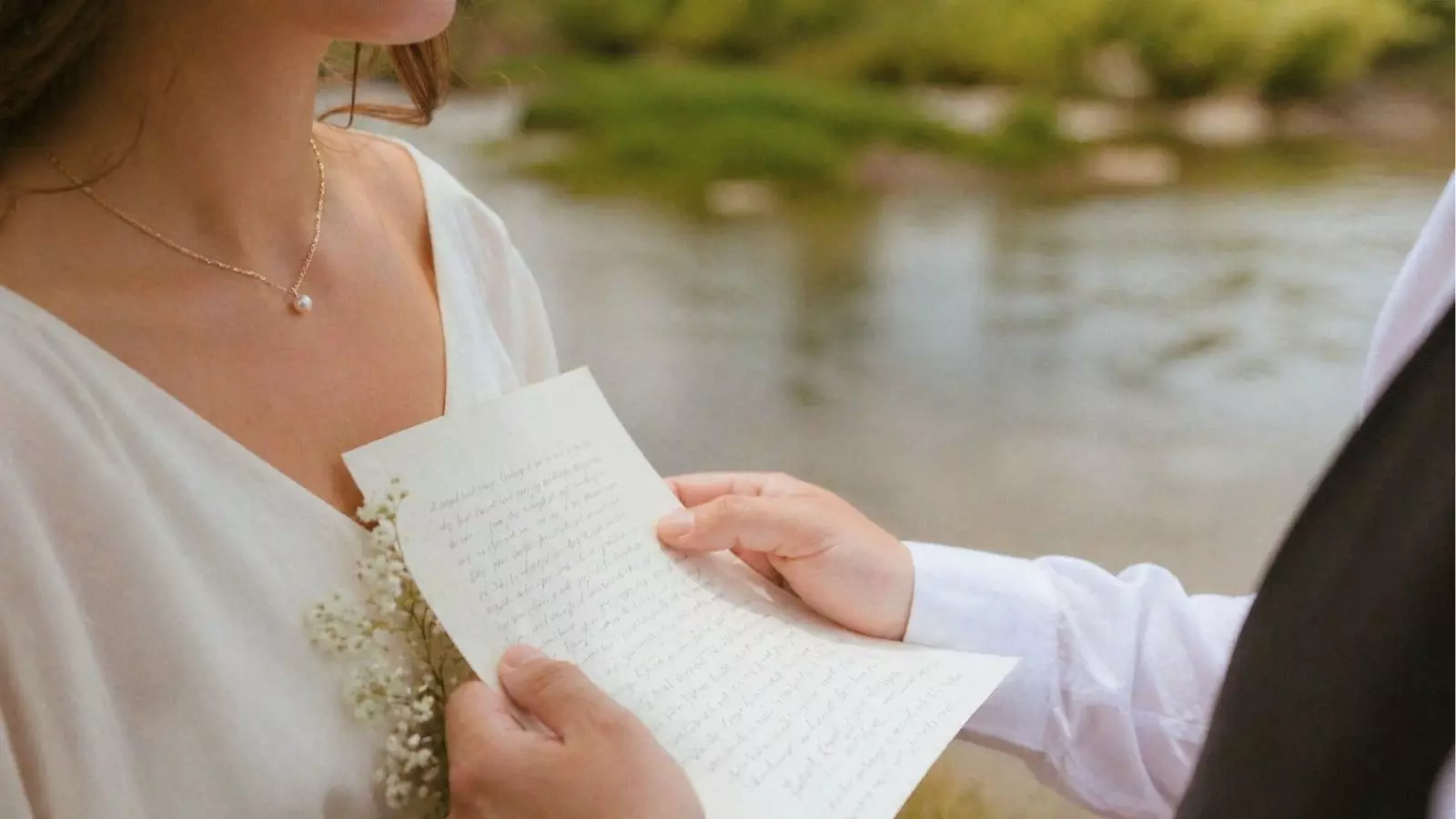
Vow length should match who you actually are — not who you think you should be in front of 150 people.
- If you are private and understated: Write short. A 60-to-90-second vow that is direct and specific will land better than a 3-minute performance that does not feel like you. The people who love you know you, and a vow that sounds like you is worth more than a vow that sounds impressive.
- If you are expressive and verbal: You have permission to go to 2 minutes — but edit ruthlessly. Expressive people tend to over-write and under-cut. Write the long version first. Then read it aloud to a trusted friend and ask them where they started to drift. Cut from there.
- If you are a good writer but nervous public speaker: Write to 1.5 minutes and memorize the opening and closing lines so you have solid footing at the beginning and end. The middle can live on the page — no one will think less of you for glancing at a card. The lines that matter most are the ones you say while looking at your partner.
- If your partner writes long and you write short: Talk about it. Decide together whether you both extend or both cut. An imbalance of more than 45 seconds is noticeable and will bother at least one of you afterward.
The Most Common Mistake: Trying to Impress
The single most common error in personal wedding vow writing is writing for the audience instead of writing for the person standing in front of you.
It sounds like this: elaborate metaphors that impress but do not feel true; literary references chosen to signal sophistication; long lists of promises that cover every contingency instead of saying one clear thing with conviction; humor that plays for laughs from the crowd rather than the emotional balance found in strong funny wedding vows; and extended preambles that circle the actual vow for a full minute before arriving at a promise.
The vow that works is the one that makes your partner feel specifically, unmistakably known and chosen. It does not need to impress anyone else in the room. It needs one true thing — a memory that is yours, a promise that is real, a closing line that makes the person across from you know without any ambiguity that you mean it.
That can be done in 100 words. It often cannot be done in 400.
Write less than you think you should. Then read it aloud, alone, in a quiet room. If you tear up — not because it is sentimental but because it is true — you have the right vow. Length is the last thing to worry about after that.
Final thoughts
The length of your wedding vows matters less than what you choose to say within it.
A short vow that feels honest will always land better than a long one that tries to cover everything. What stays with people is not the number of words, but the clarity of the moment — the feeling that what was said was intentional and complete.
If your vows feel true when you read them out loud, and they hold your partner’s attention from the first line to the last, then they are already the right length. Everything else is just editing.
Frequently asked questions (FAQ)
How long should wedding vows be for most couples?
For most couples, wedding vows should be between one and two minutes long when spoken. This usually equals about 150 to 250 words, which is enough to feel meaningful without losing attention during the ceremony.
Is 2 minutes too long for wedding vows?
No, two minutes is considered the upper end of the ideal range. It gives enough space to include personal details and promises while still keeping the vows engaging and emotionally impactful.
Can wedding vows be shorter than one minute?
Yes, wedding vows can be shorter than one minute, especially in intimate or traditional ceremonies. As long as the message is clear and sincere, shorter vows can feel just as powerful.
What happens if wedding vows are too long?
When vows are too long, they can lose emotional impact and make it harder for guests to stay engaged. The strongest vows stay focused and avoid unnecessary details that do not add meaning.
Should both partners have the same vow length?
They do not need to be exactly the same, but they should be similar in length. Large differences can feel unbalanced during the ceremony, so it is best to align expectations in advance.