Spanish wedding songs carry generations of emotion inside them. From romantic boleros and timeless ballads to salsa, cumbia, mariachi, and modern Latin pop, the music at a Hispanic wedding is rarely just background sound. It shapes the ceremony, defines the reception, connects generations, and turns the celebration into something deeply cultural as well as deeply personal.
This guide covers the best Spanish wedding songs as part of a complete collection of wedding songs for every moment of the day — including romantic first dances, processional songs, father-daughter and mother-son dances, classic boleros, reception favorites, and the songs that continue to define Hispanic weddings across the United States.
The Musical Foundation of a Hispanic Wedding
A Hispanic wedding in the United States is not one cultural event — it is a convergence of traditions that vary by country of origin, generation, and how much the family has blended into broader American culture. A Mexican-American wedding in San Antonio looks different from a Cuban-American wedding in Miami, which looks different from a Dominican-American wedding in New York. What they share is a relationship to music that is more central and more specific than at most non-Latin American weddings.
Music at a Hispanic wedding is not background. It is structure. The bolero opens the ceremony because the bolero has been the language of romantic devotion in Latin America for nearly a century — it communicates love, commitment, and the gravity of marriage more directly than almost any other musical form. The salsa starts the reception because the body responds to it instinctively, and because a wedding without dancing is not a complete wedding in most Latin American families. The cumbia crosses generations at a Latin reception the way Motown crosses generations at an American one — grandparents and children both know it and both move to it.
Understanding this structure helps couples make better choices. The ceremony calls for boleros and romantic ballads — music that is emotionally full and culturally weighted. The family dances call for songs with specific emotional meaning — often tied to the parent-child relationship in ways that go beyond lyrical theme. The reception calls for the genres that have built the Latin dance floor tradition: salsa, cumbia, merengue, bachata, and — for modern and younger crowds — reggaeton at the right moment and in the right measure.
Couples planning a Spanish wedding music program have one structural advantage over couples choosing only English-language music: the cultural tradition does a significant amount of the work for them. The guest list at a Hispanic wedding often already knows which songs belong to which moments. The bolero that starts the ceremony does not need explaining. The salsa that opens the dance floor does not need an announcement. The music and the moment arrive together as a unit — because that is what this tradition has made them.
Romantic Spanish Wedding Songs — Ceremony & First Dance
Romantic Spanish wedding songs for the ceremony and first dance share the same qualities as the best first dance wedding songs: they communicate genuine devotion without oversimplifying it. The great boleros are not saccharine love songs — they are emotionally complex, musically sophisticated, and lyrically specific about the particular feeling of loving someone completely. That emotional depth is exactly what the ceremony and first dance require.
| Song | Artist / Version | Feel & Why It Works |
|---|---|---|
| Bésame Mucho | Consuelo Velázquez · Luis Miguel · Andrea Bocelli | The most universally recognized Spanish-language love song in the world; at a wedding it communicates devotion with an authority no other song quite matches — every guest in every generation knows it |
| Historia de un Amor | Luis Miguel · Nana Mouskouri | One of the most romantic boleros ever written; the Luis Miguel version is the standard at Hispanic weddings — emotionally devastating in the best possible way |
| Sabor a Mí | Eydie Gormé y Los Panchos · Luis Miguel | Intimate and sensory; the lyric is about how deeply one person has become part of another — “you’ll carry my taste even when you forget me” — which communicates permanence more poetically than any vow |
| Contigo a la Distancia | Cristina Fernández · Luis Miguel | One of the most quietly powerful romantic songs in the Spanish-language canon; works for couples in long-distance relationships before the wedding, and for any couple who understands that love outlasts physical presence |
| Quizás Quizás Quizás | Nat King Cole (Spanish version) · Doris Day | Playful and romantic; works slightly better as a first dance or cocktail hour song than as a ceremony piece — the tone is warm and a little flirtatious rather than solemn |
| Solamente Una Vez | Agustín Lara · Julio Iglesias | “Only once in life does love arrive this way” — the lyric is the perfect wedding sentiment; one of the great romantic songs of the 20th century in any language |
| Bésame | Camila | Modern romantic ballad; works for younger couples who want Spanish-language romance without the bolero era — warm, accessible, and genuinely romantic |
| Te Amo | Franco De Vita | One of the most straightforwardly romantic songs in Latin pop — the title is the entire message, and the arrangement delivers it completely |
| Para Siempre | Thalía | The title means “forever” — which is exactly what the first dance is about; pop-forward and accessible for bilingual crowds |
| Por Ti Seré | Il Divo | The Spanish version of “I Will Always Love You” — four operatic voices delivering the greatest romantic declaration in pop music; produces one of the most memorable ceremony moments in wedding music |
| Amor de Mis Amores | Agustín Lara | Classic Mexican bolero; for families with Mexican heritage, this song carries the weight of generations of romantic tradition |
| La Vie en Rose (La Vida en Rosa) | Édith Piaf (French) · Various (Spanish versions) | The Spanish adaptation of one of the greatest love songs ever written; works as a first dance for couples who want something cinematic and cross-cultural |
Spanish Songs for Walking Down the Aisle
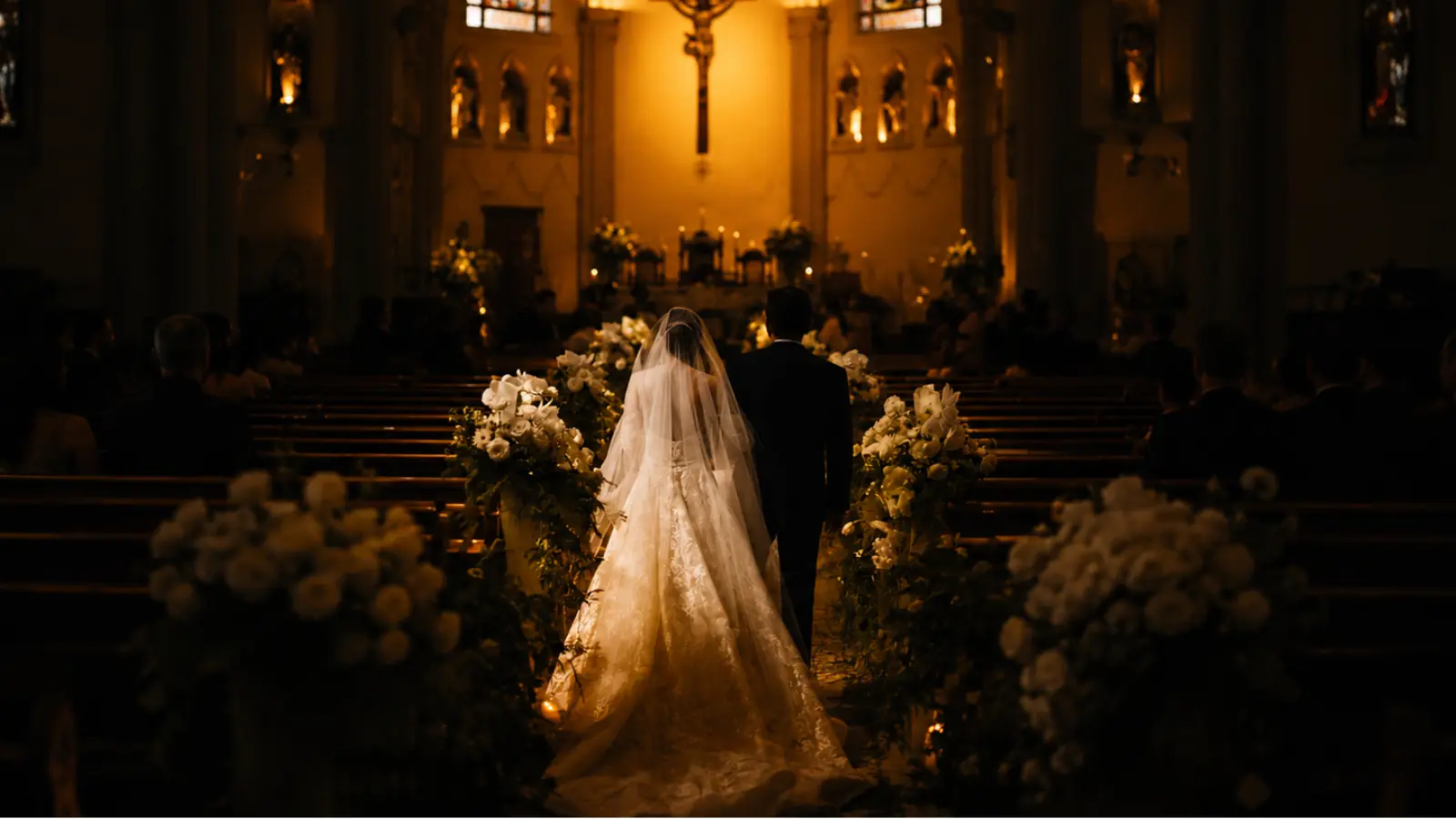
The processional is the most emotionally charged moment of the ceremony — and for Hispanic families, the right song here is not simply an aesthetic choice. It is a cultural statement. A bride walking down the aisle to a bolero is connecting her wedding to every wedding in her family’s history where that music played. A bride choosing a modern Spanish ballad is honoring her roots while placing herself in her own generation. Both are valid. Both mean something.
The most effective Spanish wedding processional songs share the same qualities as their English-language equivalents: a clear opening, a measured walk, and an emotional tone that feels romantic and meaningful. Boleros work exceptionally well because their slow tempo and formal arrangements naturally match the pace of a processional walk.
“Bésame Mucho” — in a string quartet or piano arrangement — is the most effective Spanish processional at American Hispanic weddings. The melody is immediately recognized by every guest, the arrangement is inherently dignified, and the emotional weight it carries into the room is established before the first phrase resolves. A live string quartet playing Bésame Mucho as the bride enters is one of the most culturally resonant processional moments in wedding music.
“Historia de un Amor” works as a processional for couples who want the romance to be slightly more apparent — the melody is fuller and emotionally richer than Bésame Mucho at its opening, and it builds in a way that matches the visual of the bride walking toward the groom.
“Ave María” — in any of its recorded versions — remains the most commonly used processional song at Catholic Hispanic weddings and one of the most emotionally overwhelming processional songs in any tradition. For families with strong Catholic faith, it carries both religious significance and musical beauty in equal measure.
“Contigo a la Distancia” works as a processional for couples whose relationship included long distance — the lyric about love that spans physical separation is particularly resonant when the distance has finally ended at the altar.
“A Dios le Pido” by Juanes is used at processionals at modern Hispanic weddings where the couple wants something from their own generation — it opens with a prayer-like lyric that fits a ceremony context without being liturgical.
Classic Boleros for a Hispanic Wedding
The bolero is to Hispanic wedding music what the Great American Songbook is to English-language wedding music — a tradition of romantic songwriting at the highest level, built across nearly a century, that has proven itself at countless ceremonies and receptions. Boleros are not old-fashioned. They are classics. The distinction matters, because classics endure because they are genuinely excellent, and boleros endure because they communicate romantic love with a sophistication that most contemporary music has not matched.
The bolero tradition spans Mexico, Cuba, Puerto Rico, and most of Latin America — each country with its own regional style but all sharing the slow tempo, the lush instrumentation, and the lyrical focus on amor as the central experience of human life. At a Hispanic wedding, boleros belong to the ceremony and the first dance. They also work beautifully during cocktail hour when played by a live trio or string ensemble — the sound creates an atmosphere of elegance and cultural depth that a playlist through speakers cannot replicate.
| Song | Composer / Key Artist | Why It Belongs at a Wedding |
|---|---|---|
| Bésame Mucho | Consuelo Velázquez · recorded by virtually every major artist in Latin music history | The single most recorded Mexican song in history; communicates romantic devotion with more collective recognition than any other Spanish-language song |
| Sabor a Mí | Alvaro Carrillo · Eydie Gormé y Los Panchos | “Even if years and years pass, many more than a thousand years” — the lyric is explicitly about permanence; one of the great boleros for a wedding first dance |
| Historia de un Amor | Carlos Eleta Almarán · Luis Miguel | About a love so complete it feels like a gift rather than an accident; the Luis Miguel arrangement is the standard version at American Hispanic weddings |
| Quizás Quizás Quizás | Osvaldo Farrés · Nat King Cole (Spanish) · multiple | The most playful of the classic boleros; lighter and more flirtatious than the others — best for the first dance or cocktail hour rather than the processional |
| Solamente Una Vez | Agustín Lara · Julio Iglesias · Nat King Cole | “Only once, you love in life” — the literal wedding message; one of the most emotionally complete bolero lyrics ever written |
| Cucurrucucú Paloma | Tomás Méndez · various | Hauntingly beautiful; more melancholic than most first dance choices, but works for couples who want emotional depth over romantic lightness |
| Sin Ti | Trio Los Panchos | One of the most beautiful expressions of emotional dependency in the bolero canon — “without you, the sun would not shine for me” |
| Usted | Gabriel Ruíz · Eydie Gormé | The formal address (“Usted” rather than “tú”) gives this bolero a courtly elegance that works beautifully at a traditional or formal ceremony |
| La Noche de Mi Bien | Eydie Gormé y Los Panchos | Warm and luminous; one of the most beloved bolero recordings in the Los Panchos catalog — for families with deep roots in the bolero tradition |
Spanish Father-Daughter Dance Songs
The father daughter wedding songs chosen at a Hispanic wedding often carry a specific cultural weight that goes beyond the dance itself. In many Hispanic families, the father-daughter relationship — and the public acknowledgment of a father’s role in his daughter’s life — is one of the emotional centerpieces of the entire celebration. The right song for this moment is not just a slow ballad. It is a song that holds the specific feeling of a father watching his daughter become a wife, and communicates it in the musical language of their shared culture.
| Song | Artist | Why It Lands |
|---|---|---|
| Hija | Marco Antonio Solís | The most specifically father-daughter song in the Spanish-language catalog — written explicitly for this relationship and this moment; “you are my daughter, the most beautiful thing I’ve ever created” lands differently when the father and daughter are actually dancing |
| Cómo Eres Tú | Grupo Niche | A salsa-paced tribute to an adored person; the upbeat tempo allows the father and daughter to actually dance rather than just sway — for families where the father-daughter dance is meant to be celebratory rather than tearful |
| Mi Niña Bonita | Chino y Nacho | Modern and warm; works for fathers who want a more contemporary choice — the lyric is tender without being heavy |
| Princesa | Alejandro Sanz | One of the most romantically generous songs in the Alejandro Sanz catalog — for fathers who want the dance to feel like an expression of unconditional devotion |
| De Qué Me Sirve la Vida | Alejandro Fernández | Emotionally overwhelming; for the father-daughter dance that is meant to produce genuine tears from both participants and the audience — the lyric is about what life means when you have someone to live it for |
| Chiquitita (Spanish version) | ABBA | The Spanish-language version of ABBA’s “Chiquitita” is one of the most unexpected and emotionally effective father-daughter dance songs at Hispanic weddings — every generation of the Latin family knows it, and the tenderness of the lyric matches the moment perfectly |
| Quiero | Chayanne | Broad enough to work for both the father-daughter and the mother-son dance; the lyric is about wanting the best for someone you love completely |
| Amor Eterno | Juan Gabriel | The most emotionally intense song on this list — written by Juan Gabriel about the death of his mother, it is often used at Hispanic weddings as a tribute to family love and loss; work carefully with the family’s emotional history before choosing this one |
| La Niña de Mis Ojos | Rocío Dúrcal · various | “The girl of my eyes” — a term of endearment that is culturally specific to Spanish-speaking fathers for their daughters; for families with Spanish or Mexican heritage where this phrase carries deep personal meaning |
| Lo Que Más | Juanes | Modern and Colombian; for fathers who want something from their own musical generation rather than their parents’ |
Spanish Mother-Son Dance Songs
The mother son wedding songs chosen at a Hispanic wedding often carry deep family meaning and reflect one of the most important relationships in the celebration — in many Latin American cultures, the mother-son bond is one of the most central and explicitly honored relationships in a man’s life, and the wedding is the moment when the son publicly acknowledges everything his mother has meant to him. The song chosen for this dance should carry that weight without sentimentalizing it — it should feel like a genuine tribute rather than a performance of emotion.
| Song | Artist | Feel |
|---|---|---|
| Amor Eterno | Juan Gabriel | The most emotionally powerful song in the Spanish-language catalog for any dance honoring love and loss — for mother-son dances where the relationship has included genuine hardship or sacrifice; prepare for the room to weep |
| Gracias a la Vida | Violeta Parra · Mercedes Sosa | About gratitude for everything that life has brought — the perfect mother-son sentiment; thanking the person who gave you your life by showing her the life you are building |
| Quiero | Chayanne | Warm and genuine; works for both parent dances if the couple coordinates to avoid repetition — the lyric is about wanting every good thing for someone you love |
| Si Tú Supieras | Celia Cruz | Upbeat cumbia-infused; for mother-son dances where the groom and his mother are known for dancing together and want to celebrate rather than mourn the transition |
| Cuando Me Enamoro | Enrique Iglesias ft. Juan Luis Guerra | Modern and warm; for sons who want to honor their mothers in the pop-ballad register rather than the bolero one |
| Mi Todo Eres Tú | Jerry Rivera | Salsa-paced devotion; “you are my everything” — the lyric works for the mother-son relationship when the dance is meant to be celebratory and energetic |
| Sobreviviré | Mónica Naranjo | About resilience and survival through love — for mother-son dances in families who have been through real difficulty and want to honor how they got through it together |
| Cielito Lindo | Traditional Mexican · various | The most recognizable traditional Mexican song in American popular culture — for Mexican-American families where this song is already a part of the family’s musical identity; charming and culturally specific |
| La Bikina | Rubén Fuentes · Luis Miguel | More upbeat than most mother-son choices; for families where the dance is expected to be fun as much as emotional |
Modern Spanish Wedding Songs
Modern Spanish wedding songs give bilingual and younger-generation Hispanic couples a way to honor their Spanish-language musical identity with songs that belong to their own time rather than their parents’ or grandparents’. Latin pop, contemporary bachata, and modern ballads have produced a generation of romantic songs that work at weddings without requiring the couple to choose between authenticity and currency.
| Song | Artist | Moment |
|---|---|---|
| Por Fin Te Encontré | Cali y El Dandee, Juan Magan & Sebastián Yatra | First dance · reception entrance — “I finally found you” is the perfect wedding lyric; upbeat enough to signal celebration, romantic enough for the first dance |
| Amor Secreto | Pablo Alborán | First dance · ceremony — intimate and genuinely romantic; Pablo Alborán is one of the most important Spanish-language romantic artists of the past decade |
| Volver al Amor | Pablo Alborán | First dance — “returning to love” as a concept fits a wedding day perfectly; warm and emotionally open |
| Eres | Café Tacvba | First dance — one of the most lyrically specific love songs in Latin rock; for couples with Mexican heritage who want something from the alternative tradition |
| Contigo | Alvaro Soler | First dance · reception entrance — upbeat, warm, and Latin-pop forward; one of the most accessible modern Spanish wedding songs for bilingual crowds |
| Lento | Julieta Venegas | First dance — slow and intimate; one of the most distinctive romantic songs in modern Latin pop |
| Te Quiero Más | Nacho | First dance — the lyric builds progressively (“I love you more and more”) which matches the emotional arc of a first dance well |
| La Noche de Tu Vida | Jesse & Joy | Reception — “the night of your life” is the wedding itself; upbeat and celebratory |
| El Perdedor | Enrique Iglesias & Marco Antonio Solís | Reception · cocktail hour — a romantic duet between two generations of Latin music royalty; works beautifully as a backdrop to the cocktail hour or the dinner portion of the reception |
| Tú Foto | Justin Quiles | Reception — modern urban Latin; for couples who want to bridge traditional and contemporary sounds at their reception |
Classic Songs Played at Hispanic Weddings
These are the songs that have been at Hispanic weddings for decades — not because they were selected by a committee but because they proved themselves in real rooms with real families and kept getting requested. They cross generations at a Latin reception the way no newly released song can: grandparents recognize them instantly, parents have their own memories attached to them, and younger guests know them because they have been in the background of every family gathering their entire lives.
Marc Anthony is the defining voice of salsa romanticism at American Hispanic weddings. “Vivir Mi Vida” plays at reception entrances and late-night dance floors with equal effectiveness — the melody is so familiar and so culturally embedded that guests react physically before they consciously recognize it. “Tu Amor Me Hace Bien,” “Flor Pálida,” and “Hasta Que Te Conocí” (his version) are all used at Hispanic receptions.
Luis Miguel owns the first dance and the romantic ceremony moment at a specific generation of Hispanic weddings — families where the parents grew up listening to him, and where his voice carries four decades of romantic association. “Historia de un Amor,” “Sabor a Mí,” “La Incondicional,” “Contigo en la Distancia,” and “El Día que Me Quieras” (the Gardel classic) are all used at Hispanic weddings.
Juan Gabriel is one of the most beloved artists in the history of Latin music, and his songs appear at every phase of a Hispanic wedding. “Amor Eterno” at the parent dances. “Se Me Olvidó Otra Vez” or “Querida” at the reception. “Te Lo Pido Por Favor” during the first hour of dancing. His catalog is deep enough that different songs can serve different moments across the same evening.
Julio Iglesias occupies the same space at traditional Hispanic weddings that Frank Sinatra occupies at American ones — a voice so widely associated with romantic elegance that his songs carry cultural authority without requiring explanation. “La Paloma,” “De Niña a Mujer,” “Hey,” and “Begin the Beguine” are all used at Hispanic ceremony and reception music.
Celia Cruz at the reception dance floor is non-negotiable at Cuban-American weddings and common at most Hispanic celebrations. Her voice and her catalog — particularly “La Vida Es un Carnaval,” “Quimbara,” and “Azúcar Negra” — produce a specific kind of joyful energy that no other artist in Latin music replicates.
Popular Latin Wedding Reception Songs
The Latin wedding reception songs are organized around different musical moments, with each choice reflecting a specific cultural and social purpose.
The reception entrance at a Hispanic wedding is usually accompanied by an upbeat salsa or a celebratory Latin pop anthem — a song that signals immediately that the party has arrived. “Vivir Mi Vida” by Marc Anthony, “La Fiesta” by Celia Cruz, “Por Fin Te Encontré” by Cali y El Dandee, and “Suavemente” by Elvis Crespo all work for this moment.
The first hours of the reception — dinner and the beginning of the dance floor — typically move through boleros, ballads, and romantic salsa. This is where the family dances happen and where the older generations are most actively engaged. Songs like “Historia de un Amor,” “La Incondicional,” “Quiero” by Chayanne, and “Cuando Me Enamoro” by Enrique Iglesias work across this phase.
The middle of the reception is where cumbia and merengue enter. These genres are high-energy but accessible — simpler dance steps than salsa, rhythms that every generation in the room can participate in. “La Chismosa” by Carlos Vives, “Oye” by Gloria Estefan, and “Fuego” by Olga Tañon are classics in this window.
The late reception — when the dance floor is full and the energy is at its peak — is where bachata, reggaeton (in appropriate measure), and the songs that have been producing singalongs at Latin celebrations for 30 years come in. This is when “Suavemente” plays, when “La Bamba” gets requested, when the DJ reads the room and plays the next song before anyone realizes they needed it.
Songs That Always Fill the Dance Floor
These are not the most romantic Spanish wedding songs. They are the most effective. Every song on this list has been tested at thousands of Hispanic weddings and has consistently produced a full dance floor within 30 seconds of the first note. That reliability is the standard for this category — not musical sophistication but social function.
| Song | Artist | Genre | Why It Works Every Time |
|---|---|---|---|
| Suavemente | Elvis Crespo | Merengue | The most reliably floor-filling song at any Latin wedding in the United States — the bass line alone clears tables of guests in their 60s who have been sitting for an hour |
| La Bamba | Ritchie Valens · Los Lobos | Son Jarocho / Rock | The crossover song — every American guest knows it alongside every Latin one; produces a singalong that crosses every demographic in the room |
| Conga | Gloria Estefan & Miami Sound Machine | Latin Pop | Bilingual crowds respond to this one universally; produces a conga line within two minutes at any reception where the crowd is willing to move |
| Vivir Mi Vida | Marc Anthony | Salsa | The most optimistic song in the Marc Anthony catalog; the message — live your life, enjoy it, don’t cry over what is lost — is exactly what a wedding reception should feel like |
| Oye Como Va | Santana | Latin Rock | Crosses the Latino and American rock guest bases simultaneously; the guitar intro gets recognition from both demographics within two seconds |
| Devórame Otra Vez | Lalo Rodríguez | Salsa Romántica | One of the most beloved salsa classics at Hispanic receptions — for couples whose families are rooted in the 80s salsa romántica tradition |
| El Gran Varón | Willie Colón | Salsa | A song that every family member over 40 at a Latin wedding recognizes; produces the kind of collective recognition that only songs with decades of cultural weight can |
| Quimbara | Celia Cruz | Salsa | La Reina on the dance floor — Celia Cruz at a Hispanic reception is as close to guaranteed as wedding music gets |
| Bailando | Enrique Iglesias ft. Descemer Bueno & Gente de Zona | Reggaeton / Cuban | The most viewed Spanish-language video in YouTube history for a reason; works across generations and across Latin American nationalities |
| Despacito | Luis Fonsi ft. Daddy Yankee | Reggaeton | The global reach of this song means it works on English-speaking guests who know it as well as Spanish-speaking guests; a legitimate floor-filler at any bilingual reception |
| Danza Kuduro | Don Omar ft. Lucenzo | Reggaeton | Pure energy; best played late in the reception when the floor is already moving and needs a peak moment |
| La Fiesta | Celia Cruz | Salsa | Title translates to “The Party” — as explicit an invitation to celebrate as the catalog offers |
A note on timing: the songs that fill the floor fastest are not necessarily the songs that should play first. The reception builds in energy across the evening. Playing Suavemente or Devórame Otra Vez in the first 30 minutes may produce a floor that peaks too early and cannot sustain. A skilled Latin DJ builds to the floor-fillers — using boleros and ballads in the first hour, introducing merengue and cumbia in the second, and saving the highest-energy salsa and reggaeton for the final 90 minutes when the crowd has been warmed up and is ready to move without being coaxed.
Spanish Songs for the Money Dance
The money dance — el baile del billete or el baile del dólar — is one of the most distinctly Hispanic wedding traditions in the United States. Guests pay to dance briefly with the bride or groom, pinning bills to the couple’s clothing or placing them in a dedicated bag or apron. The tradition varies by family origin and region: Puerto Rican, Mexican, Dominican, and Cuban families each have their own version of the ritual, but the shared logic is celebration and communal support for the new couple.
Songs for the money dance are practical as well as cultural — they need to keep the energy high and the line moving, because the dance can involve 30 to 60 guests taking turns over 20 to 30 minutes. The best money dance songs are upbeat, rhythmically consistent, and long enough (or easy enough to extend through repetition) to accommodate the full line.
The classic choice: “Suavemente” by Elvis Crespo. The merengue rhythm is fast enough to keep energy high, familiar enough that every guest knows when to step in, and energetic enough to sustain a long rotation without losing momentum. “Quimbara” by Celia Cruz works equally well. For families who want the money dance to feel more playful, “La Bamba” produces a participatory energy that crosses language lines — English-speaking family members who might feel uncertain about the tradition become comfortable when they recognize the song.
Some families use a medley — the DJ or bandleader plays 60 to 90 seconds of one song, transitions to another, and cycles through three or four high-energy Latin tracks across the full money dance. This prevents the repetition of a single song from feeling monotonous over a 25-minute rotation.
Mixing Spanish and English at a Bilingual Wedding
The question most bilingual and bicultural couples face is not which language to choose — it is how to integrate both without making the music feel divided or incoherent. The answer is sequencing rather than mixing: letting the emotional logic of each moment determine the language, rather than alternating languages at random.
The ceremony belongs to Spanish. The processional, the first dance, the family dances — these are the moments where cultural identity and family connection are primary, and Spanish-language music honors those roots in a way that English-language choices do not. A bride whose mother and grandmother have been waiting her whole life to hear a bolero at her wedding gives them something irreplaceable by choosing that music for the ceremony. The reception, by contrast, belongs to the full room — and the full room at a bilingual wedding typically includes English-speaking guests who will feel more included in open dancing when some of the music is in their language.
The practical approach: build a wedding day where the ceremony music is predominantly Spanish, the cocktail hour transitions between Spanish standards and English-language classics, and the reception dance floor includes a roughly equal mix. Brief your DJ explicitly: open the dancing with Spanish, bring in English-language songs in the second hour, and close the night with the Spanish floor-fillers that every guest in the room knows. The DJ cannot make this call on their own without direction.
For the first dance specifically: bilingual couples sometimes choose a song in whichever language best expresses what they feel rather than which language fits a demographic plan. A Spanish-speaking bride who has always felt “Can’t Help Falling in Love” as her love song has every reason to use it. An English-speaking groom whose mother introduced him to “Bésame Mucho” has every reason to walk his wife to that music. The best bilingual wedding music honors both identities without requiring the couple to split themselves in half.
Spanish Wedding Songs Playlist
Listen to the full playlist of Spanish wedding songs below, featuring romantic boleros, classic Latin love songs, emotional family dance songs, modern Spanish-language wedding music, salsa and cumbia reception favorites, and timeless songs that continue to define Hispanic weddings across generations.
Final thoughts
The best Spanish wedding songs do more than create atmosphere.
They carry language, memory, family history, culture, and emotion all at the same time — which is why the music at a Hispanic wedding often feels so personal even to guests hearing the songs for the first time.
Whether the celebration leans traditional, modern, bilingual, deeply religious, or fully dance-floor focused, the right Spanish wedding songs connect generations in a way very few other musical traditions can.
And when those songs are chosen well, the entire wedding feels more alive because of them.
Frequently asked questions (FAQ)
What are the most popular Spanish wedding songs?
Popular choices include “Bésame Mucho,” “Historia de un Amor,” “Sabor a Mí,” “Vivir Mi Vida,” and “Suavemente.” These songs remain wedding favorites because they combine romance, tradition, and dance-floor energy.
What are good Spanish songs for a wedding first dance?
“Historia de un Amor,” “Bésame Mucho,” “Solamente Una Vez,” and “Contigo a la Distancia” are among the most romantic Spanish first dance songs because of their emotional lyrics and slow-dance tempo.
What songs always fill the dance floor at a Hispanic wedding?
Songs like “Suavemente,” “La Bamba,” “Vivir Mi Vida,” “Conga,” and “Bailando” consistently fill the dance floor because they are widely recognized across generations.
Can you mix Spanish and English songs at a wedding?
Yes. Many bilingual couples use Spanish songs during the ceremony and family dances, then mix Spanish and English music throughout the reception to reflect both cultures naturally.
What is the money dance at a Hispanic wedding?
The money dance is a tradition where guests dance briefly with the bride or groom while offering money to help the couple start their married life together. Upbeat songs like “Suavemente” are commonly used.

About the Author
Débora Justo
Founder and editor of EVORÉ, creating practical wedding planning resources, thoughtful inspiration and useful tools for the decisions that shape a celebration.
Read more about the author →