Two-tier wedding cakes are wedding cakes built with two stacked tiers, offering a balance between visual presence, serving capacity, and practicality. They are a popular wedding cake format because they provide the classic tiered wedding cake look without the size, cost, or complexity of larger three-tier and four-tier designs.
Many couples worry that a two-tier wedding cake will look too small, especially after seeing dramatic multi-tier cakes in magazines, Pinterest boards, and wedding galleries. In many weddings, a well-proportioned two-tier cake looks more intentional than a larger cake chosen only for height. For weddings under 100 guests, a well-proportioned two-tier cake typically looks more balanced, more elegant, and more appropriate to the scale of the celebration than a larger cake chosen purely for visual impact.
In this guide, you’ll learn exactly how many guests a two-tier wedding cake can serve, the most common size combinations, typical pricing, design options, floral arrangements, flavor combinations, and how to decide whether two tiers or three tiers make more sense for your wedding.
What Is a Two-Tier Wedding Cake?
A two-tier wedding cake is one of the most classic wedding cakes formats, built with two separate tiers, each on its own board and support system, stacked one on top of the other. The tiers are structurally distinct — not simply two layers of sponge and filling, but two complete cake units with their own boards, dowels, and individual frosting. This structural distinction is what allows each tier to be a different flavor, a different diameter, and even a slightly different finish if the design calls for it.
Most couples don’t realize there is a meaningful difference between a two-tier wedding cake and a tall single-layer cake. The tiered structure changes how the cake is cut and served — each tier is removed and cut separately — and how it is transported. A quality bakery will deliver a two-tier cake with the tiers separate, assembled on-site to avoid damage in transit. Understanding this is useful for logistics: if you are picking up your own cake or having it delivered to a venue without a bakery setup team, ask specifically how the assembly will work.
Two tiers are often a natural choice for weddings under 100 guests because the proportion is balanced and practical. The relationship between two tiers — one larger, one smaller — creates a visual hierarchy that reads as considered without requiring the technical complexity of three or four separate units. It is the cake equivalent of a room that has one anchor piece and one accent piece: the composition works because it is deliberate.
Two-Tier Wedding Cake Sizes and Dimensions
Understanding tier sizes is the most practical thing you can know before talking to a bakery. Tier sizes are measured in diameter, and most bakeries work in even-number increments: 6, 8, 10, 12, 14 inches. The size of each tier determines how many guests it serves and how the overall proportion of the cake reads.
One helpful proportion rule in two-tier cakes is to leave enough diameter difference between the tiers, often around 3 to 4 inches, so the cake has a clear visual hierarchy. A 10-inch base with a 6-inch top looks balanced and elegant. A 10-inch base with an 8-inch top looks heavy and short — the tiers are too similar in size to create a clear visual hierarchy. This is the single most common proportion mistake in two-tier cakes, and it is entirely avoidable.
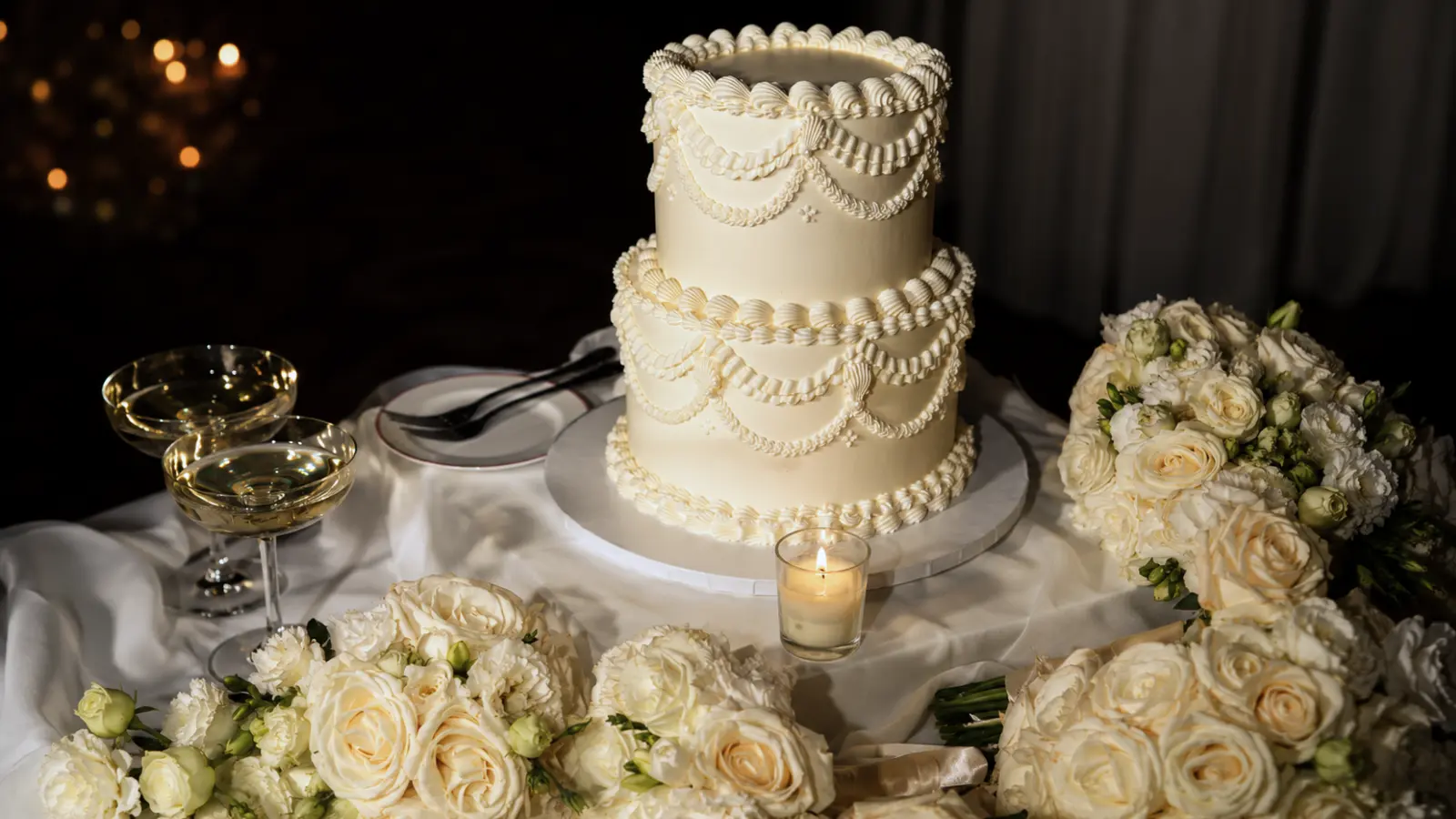
Common two-tier size combinations and who they serve
| Bottom tier | Top tier | Approx. servings | Best for |
|---|---|---|---|
| 8 inch | 5 or 6 inch | 35 to 50 guests | Small and intimate weddings |
| 10 inch | 6 inch | 60 to 75 guests | Most common — the standard two-tier |
| 10 inch | 7 inch | 65 to 80 guests | Mid-size weddings needing more servings |
| 12 inch | 8 inch | 80 to 100 guests | Larger weddings staying with two tiers |
| 12 inch | 9 inch | 90 to 110 guests | Maximum practical two-tier size |
These serving estimates assume standard 1-by-2-inch dessert slices. If your venue is cutting slightly larger or you are serving the cake alongside another dessert (in which case guests may take smaller pieces), adjust accordingly. Ask your baker specifically: “How many guests do you recommend this size combination for, and what slice size are you calculating?”
On tier height: Most bakeries build tiers at 4 inches tall — two layers of cake with filling. Some premium bakeries build at 5 or 6 inches for a more dramatic look. The tier height affects both the total visual height of the cake and the serving count — a taller tier of the same diameter serves more guests. Confirm the tier height your bakery uses before finalizing serving estimates.
Total cake height: A two-tier cake with 4-inch tiers measures approximately 9 to 10 inches of cake (including the base board between tiers). On a cake stand, the total display height typically reaches 14 to 20 inches. This is sufficient for the cake to read clearly from across a reception room and to photograph well without appearing dwarfed by the surrounding decor.
How Many People Does a Two-Tier Wedding Cake Serve?
The short answer: between 35 and 110 guests, depending on the tier sizes. The most common two-tier configuration — 10-inch base, 6-inch top — serves approximately 60 to 75 guests with standard-sized slices.
What many couples don’t know when planning is that “serves X guests” is not a fixed number — it depends on how the cake is cut. A 10-by-6-inch two-tier cake cut in 1-by-2-inch portions produces significantly more servings than the same cake cut in 2-by-2-inch pieces. Professional wedding cake cutting produces more, smaller servings than home cutting — this is why the serving estimates from a bakery are usually higher than what couples calculate at home using online guides.
The practical implication: if you are right at the edge of a serving estimate — 75 guests for a cake that serves 60 to 75 — ask your bakery whether they recommend sizing up to the next tier configuration or supplementing with a sheet cake. Most experienced bakers will recommend one of two approaches:
Size up the tiers. Going from a 10-inch/6-inch to a 10-inch/7-inch or 12-inch/7-inch adds servings without requiring a third tier or dramatically changing the visual proportion.
Add a kitchen sheet cake. Order the display two-tier cake at the size that photographs beautifully, and supplement with a plain sheet cake cut in the kitchen for additional guests. The sheet cake is never displayed — it is cut and served after the display cake is portioned. This approach is used by more couples than most people realize, and it is one of the most practical ways to keep the visual cake exactly as designed while solving serving logistics.
Simple Two-Tier Wedding Cakes
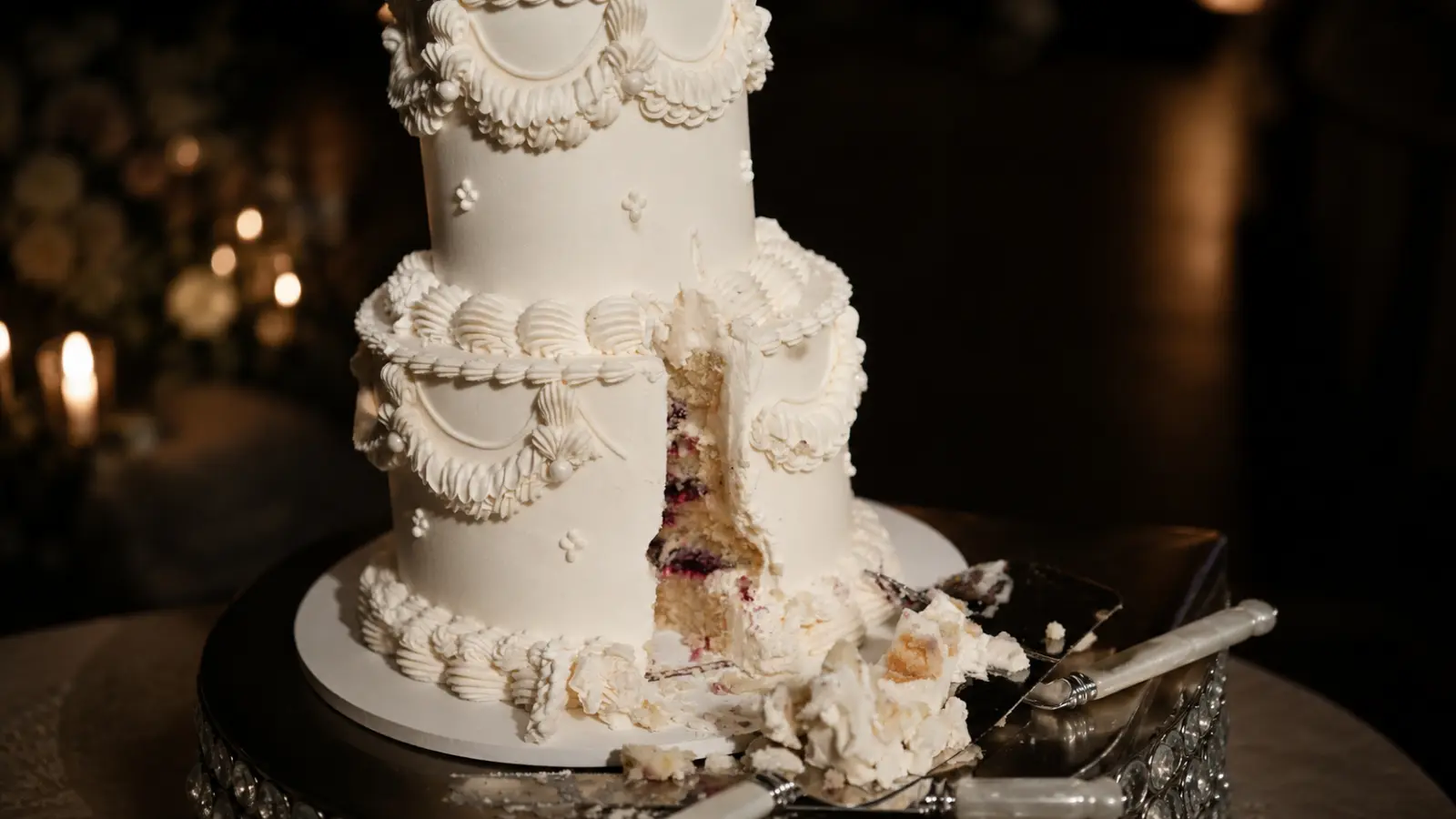
Two tiers and simple design are a natural combination — and the reason is structural. A two-tier cake already has a clear visual hierarchy built into its form. The larger base, the smaller top, the relationship between the two: the composition is already doing work before a single decoration is added. This means a simple or minimal design on two tiers reads as deliberate and considered in a way that the same design on a single tier sometimes does not.
Simple two-tier cakes that work consistently:
Smooth buttercream, same color both tiers, no decoration. The cleanest version. When the finish is excellent — sharp, even edges, professional smoothing — this is one of the most striking cake options available at any price point. The two-tier proportion does the visual work; the frosting communicates quality; the absence of decoration says the couple knew exactly what they wanted.
Textured buttercream, same texture both tiers. Palette knife, combed, or petal-press texture across both tiers with a consistent direction creates visual interest without added decoration. The texture catches light in photographs in a way that smooth frosting does not, adding depth without complexity.
Different textures per tier, same color. Bottom tier smooth, top tier textured — or vice versa. The design uses the two-tier structure to create a conversation between surfaces rather than between colors or decorative elements. Subtle, specific, and unusually sophisticated for how little visual noise it creates.
Simple with one element. Everything clean and simple, with one deliberate addition: a ribbon at the base of the bottom tier in the exact color of the wedding palette, a thin stripe of edible gold at the tier junction, a single botanical sprig laid flat against the top tier. One thing, placed with intention, is what separates a simple cake that looks designed from one that looks unfinished.
For couples who want more simple wedding cake ideas beyond the two-tier format, the complete guide to simple wedding cakes covers all tier options in depth.
Two-Tier Wedding Cake Designs and Ideas
Beyond the simple category, two-tier wedding cake designs work across the full range of wedding aesthetics. Because the format is so structurally versatile — the same tier sizes can carry completely different design languages — two tiers appear equally at minimalist garden weddings and at elaborate black tie receptions.
Buttercream designs
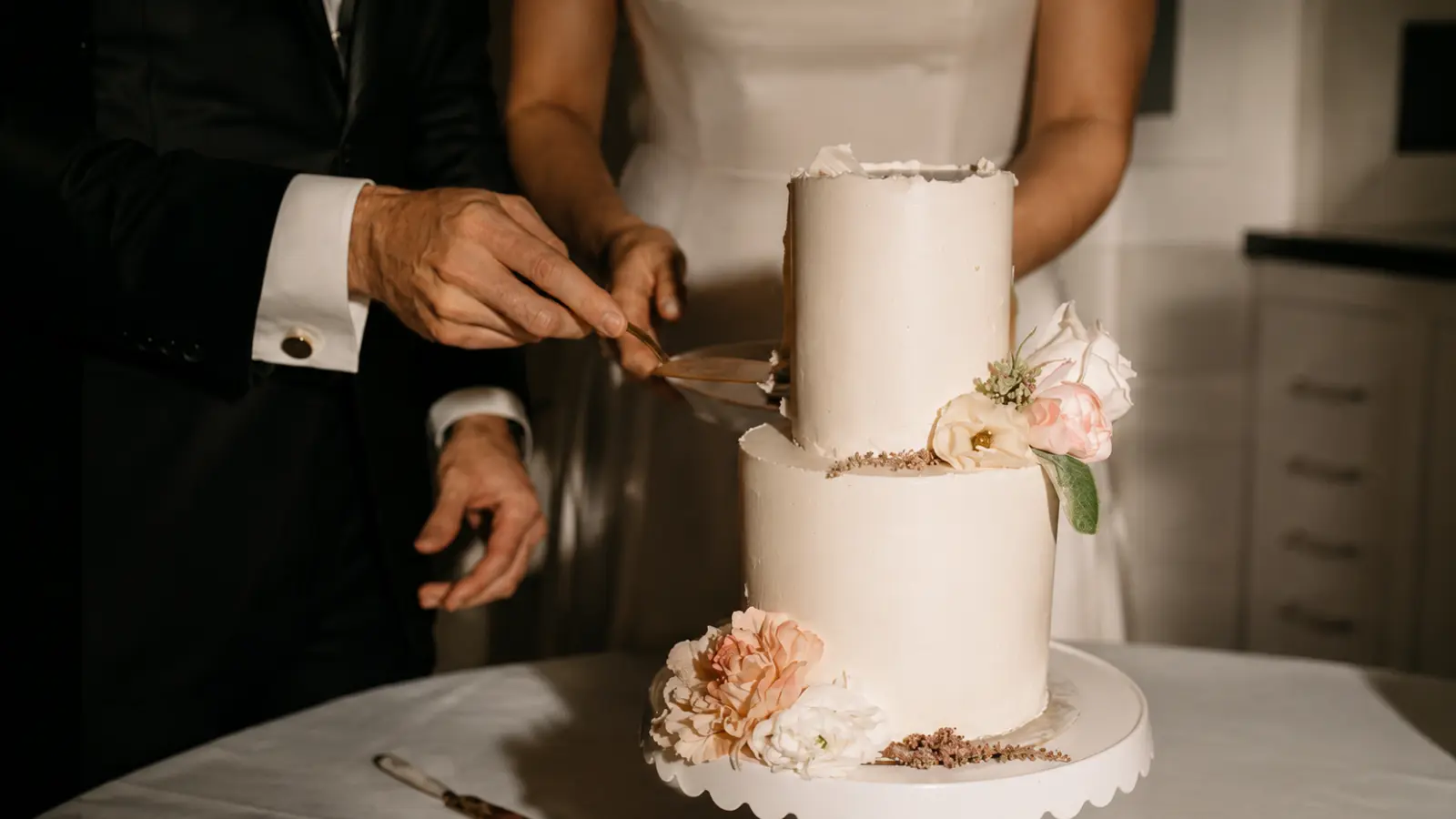
Smooth buttercream with fresh flowers. The most popular two-tier wedding cake design in the U.S. Clean, photographically excellent, and scalable across budgets. Flowers added the day of by the baker or florist — a cluster at the tier junction, a trailing arrangement on one side, or blooms at the base of each tier — give the cake color, texture, and seasonal specificity without any permanent decoration.
Textured palette knife finish. Bold, painterly strokes of buttercream applied in a deliberate direction. Particularly beautiful in ivory or a warm neutral, where the light and shadow in the texture create depth. Photographs well from any angle. The palette knife finish has an organic, handmade quality that translates easily to garden, vineyard, and outdoor settings.
Combed finish. A cake comb dragged around the frosted cake creates horizontal or vertical ridges. Geometric and precise — one of the most architectural simple designs. Works in both directions: a warm ivory combed cake looks traditional and bridal; the same technique in dusty sage or warm terracotta looks contemporary and editorial.
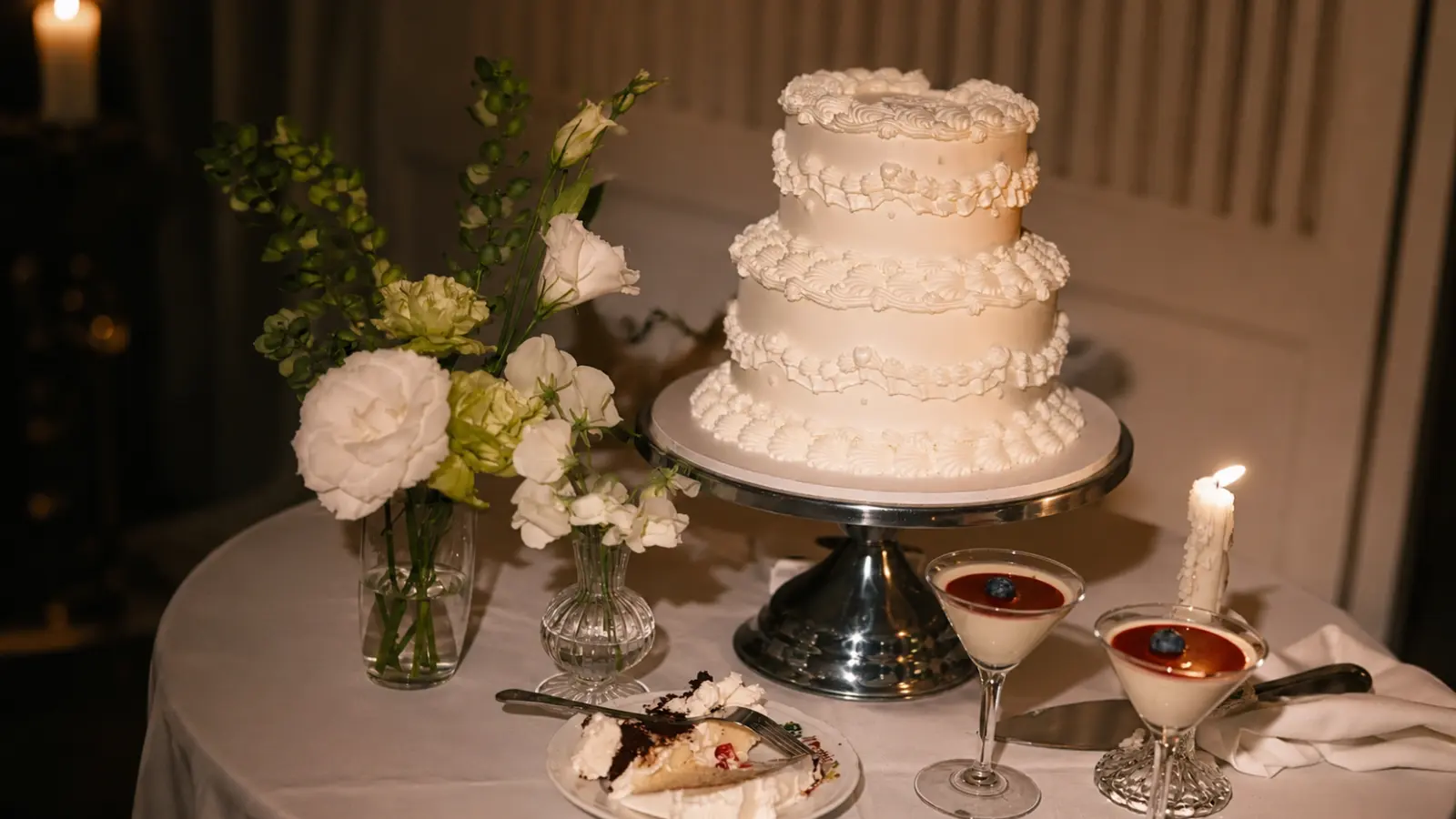
Rosette finish. Piped rosettes covering one or both tiers. More elaborate than the previous options but still within the “simple elegant” category when the rosettes are consistent and the color palette is restrained. Works particularly well on the bottom tier with a smooth top, creating a visual contrast between the two surfaces.
Fondant designs
Smooth white or ivory fondant. The most formal option. Requires impeccable execution — fondant shows every imperfection — but produces a cake surface unlike anything buttercream can achieve. Clean, architectural, and luminous in photographs. Best for formal and black tie weddings where the overall aesthetic demands a high level of finish.
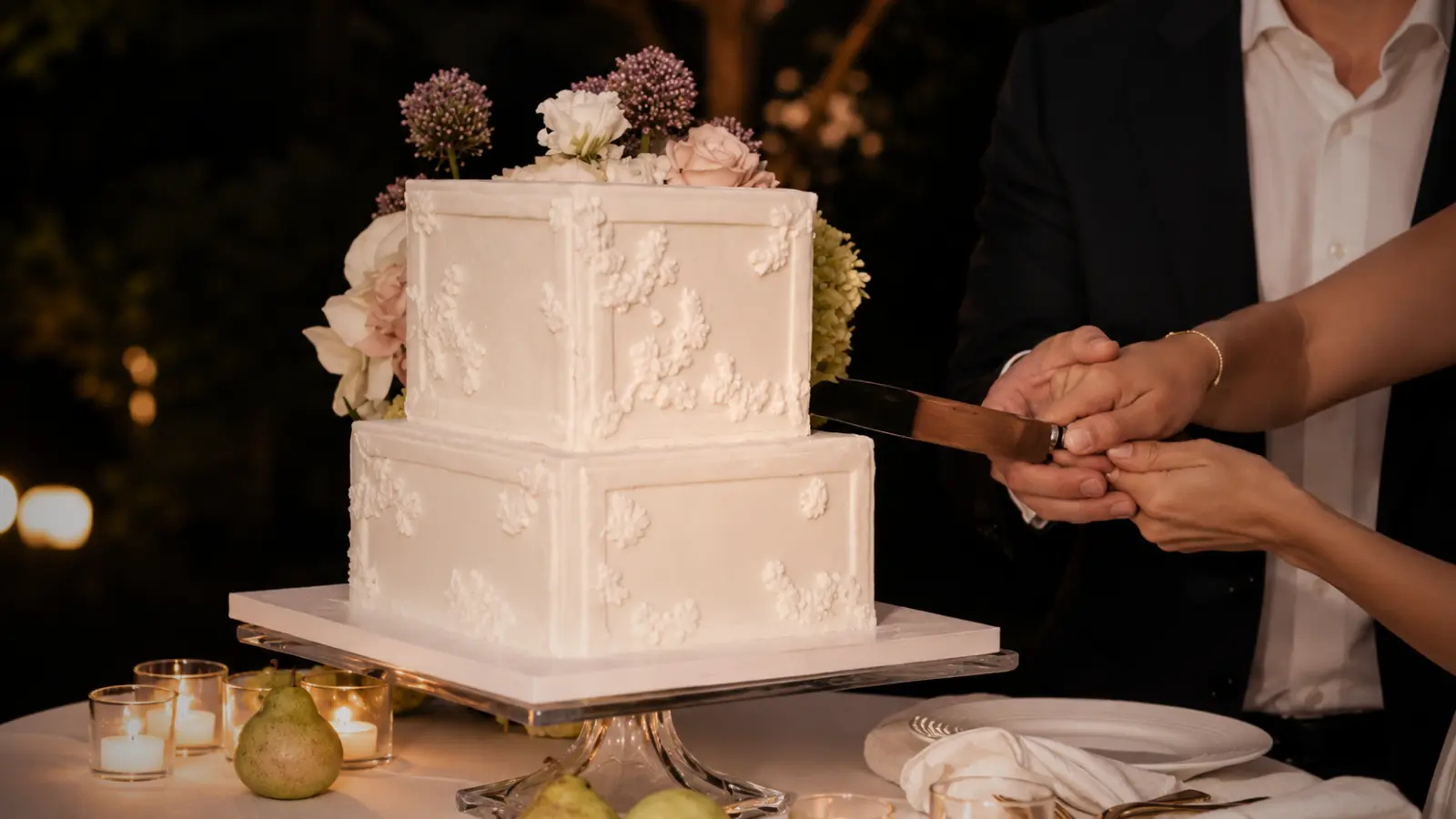
Fondant with pressed lace or pattern. Fondant can be pressed with a lace mat or a pattern tool to create a surface texture that photographs with extraordinary delicacy. Combined with a simple tier structure, this creates a cake that feels luxurious without being busy.
Naked and semi-naked
Naked two-tier. The layers are visible, the frosting is thin and deliberate, and the beauty is in the structural honesty of the cake itself. Particularly beautiful when the layers are distinct colors — alternating chocolate and vanilla sponge, or a red velvet with cream filling that creates a graphic pattern when the cake is cut. Works at outdoor, rustic, and garden weddings; reads as less appropriate at formal indoor events.
Semi-naked. More frosting than a naked cake, less than a fully frosted one — a thin layer that covers the sides loosely, creating a matte, organic surface. More finished than a naked cake, more casual than buttercream. One of the most versatile two-tier designs across settings and seasons.
Offset tiers
An offset two-tier cake positions the top tier slightly to one side of the bottom rather than centered. The asymmetry creates a more dynamic composition without any additional decoration. Flowers, greenery, or a toppling arrangement of blooms on the elevated side of the top tier complement the offset beautifully. One of the most consistently elegant two-tier designs when executed well.
Two-Tier Wedding Cakes with Flowers
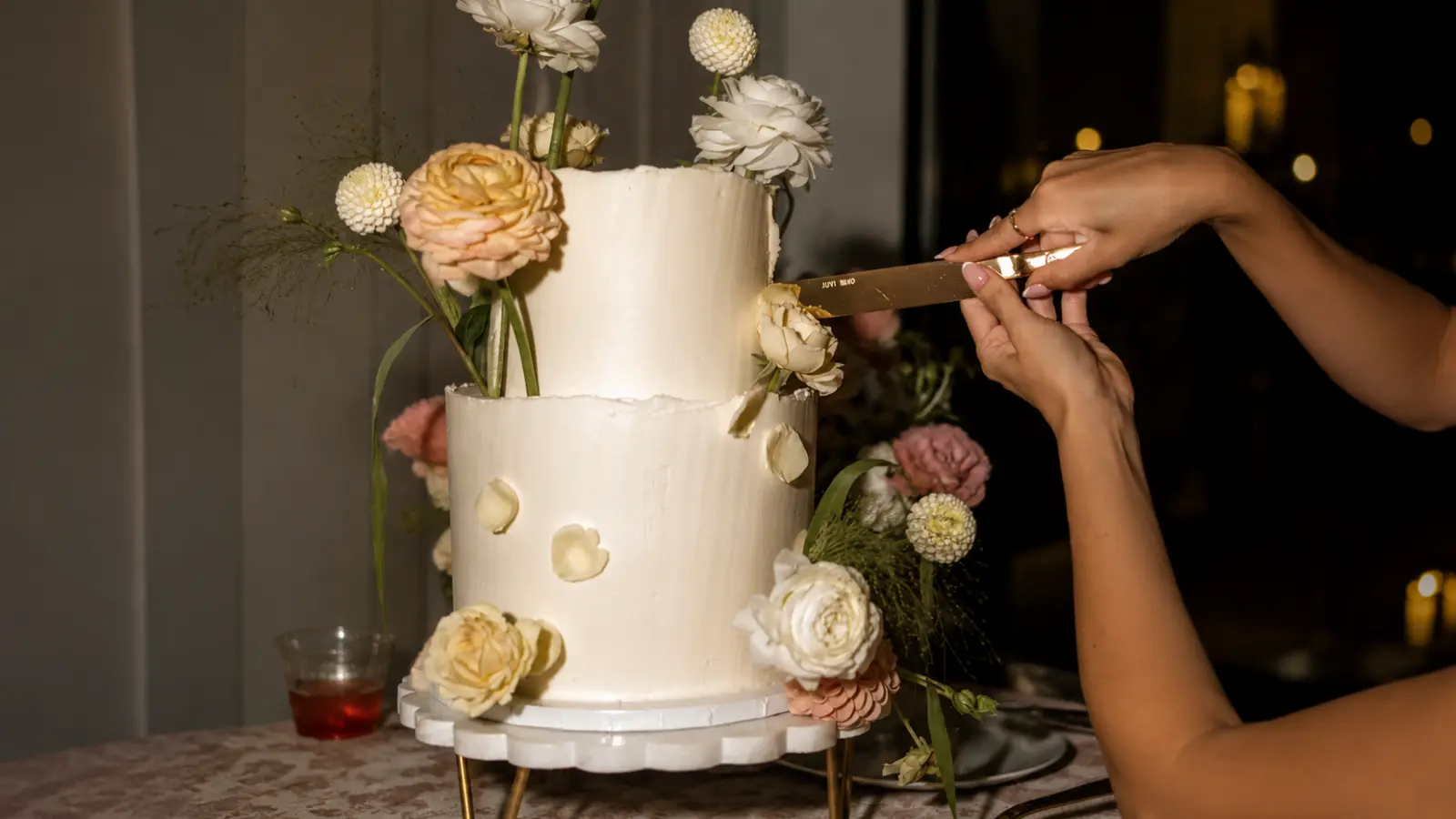
Floral wedding cakes with fresh flowers produce a different effect on a two-tier cake than on a three-tier cake — and it is worth understanding why. On a three-tier cake, flowers are typically used to cascade down from top to bottom, creating a trailing arrangement that covers the height. On a two-tier cake, the height is more modest, which means flowers are concentrated rather than trailing. That concentration — a deliberate, dense cluster of blooms in one or two places — creates visual impact through density rather than through movement.
The most effective flower placements on a two-tier cake:
At the tier junction. A cluster of blooms arranged where the top tier meets the bottom, wrapping partially around the junction point. This is the most classic placement — it draws the eye to the structural meeting point of the two tiers and uses the flowers to soften what would otherwise be a visible seam.
On one side of the top tier only. Flowers placed to one side of the top tier create an asymmetric arrangement that photographs beautifully and gives the cake a sense of natural growth rather than placed decoration. This works especially well with an offset tier — the flowers on the side of the top tier that extends beyond the bottom create a visual balance.
At the base of the bottom tier. Blooms arranged around the base of the cake — either all the way around or on one side — create a foundation of color that grounds the cake on its stand. This placement works particularly well with greenery: eucalyptus, ferns, or herbs arranged around the base create a naturalistic setting for the cake even when it is on a plain cake stand.
A single statement bloom on the top tier. One large flower — a garden rose, a peony, a dahlia — placed on top of the cake or tucked against the top tier is the most minimal floral option. It is deliberate, specific, and works best when the flower is particularly beautiful or has specific meaning (a favorite flower, a bloom from the wedding palette).
Coordination between the cake flowers and the wedding florals matters significantly on two-tier cakes because the flowers are more concentrated and therefore more visible up close. Ask your baker and florist to connect directly about the blooms — what varieties are in season, what colors are in the palette, and exactly which stems will be used on the cake the morning of the wedding.
Two-Tier Wedding Cake Cost
Two-tier wedding cakes generally cost less than three or four-tier designs — but “less” is relative, and several factors affect pricing significantly. Understanding wedding cake cost factors helps couples budget accurately and have more productive bakery conversations.
General U.S. cost ranges
| Design type | Typical range | Notes |
|---|---|---|
| Simple buttercream, no flowers | $350 to $550 | Smooth or textured finish, standard flavors |
| Buttercream with fresh flowers | $450 to $700 | Flowers often billed separately or as add-on |
| Naked or semi-naked | $350 to $600 | Less frosting time; may be slightly less labor-intensive |
| Fondant, simple design | $500 to $800 | Fondant requires more labor and materials than buttercream |
| Fondant with detailed decoration | $650 to $1,100 | Hand-painted, lace, sugar flowers — labor-intensive |
| Premium bakery, any design | $800 to $1,500+ | Top-tier bakeries in major U.S. markets |
These ranges are general U.S. planning estimates. Final pricing depends on your specific bakery, location, design complexity, delivery distance and setup fees, fresh flower add-ons, and guest count. Major metro areas such as New York, Los Angeles, and San Francisco often run higher than these ranges, while rural and smaller markets may be lower.
What drives two-tier cake cost
Frosting type. Fondant costs more than buttercream because of materials and labor. Swiss or Italian meringue buttercream costs more than American buttercream for the same reason — the ingredients and technique are more demanding. When comparing quotes between bakeries, confirm which buttercream type is included, because the quality and cost difference is significant.
Fresh flowers. Many bakeries bill fresh flower placement separately because the flowers themselves are sourced by the florist or purchased the morning of the wedding. A flower add-on for a two-tier cake can vary depending on the flower variety, arrangement size, florist involvement, and whether the baker handles placement. Confirm with your baker whether flowers are included in the quoted price or billed additionally.
Delivery and setup. Delivery fees for a two-tier cake vary by distance, venue access, and setup needs, and on-site assembly may be included or billed separately. If you are picking up the cake yourself, confirm that the bakery will package it for safe transport and give you assembly instructions.
Flavor complexity. Standard flavors (vanilla, chocolate, lemon) are typically included at the base price. More complex fillings — passion fruit curd, champagne buttercream, multi-component mousse layers — often add $1 to $3 per serving to the total cost.
Bakery reputation. Wedding cake pricing reflects the baker’s experience, demand, and reputation more than almost any other variable. A bakery that is fully booked every weekend through the wedding season will charge more than one with open dates. Quality correlates with cost in this category more reliably than in most vendor categories.
Two-Tier vs. Three-Tier — Which Should You Choose?
This is the question most couples eventually get to, and it is worth answering directly rather than deferring to “it depends on your preference.” There are real, practical reasons to choose one over the other.
Choose a two-tier cake when:
Your guest count is under 80. A two-tier cake can serve up to 100 guests with larger tier sizes, but under 80 guests, a two-tier design is the most proportionally appropriate choice. A three-tier cake built to serve 75 people will have smaller, daintier tiers than the structure requires for visual impact — which often reads as top-heavy or fussy.
Your venue is intimate or small-to-medium in scale. A three-tier cake in a small dining room overwhelms the space. A two-tier cake in a large ballroom can look lost. Scale the cake to the venue, not just to the guest count. If you are unsure, ask your bakery: “What tier configuration would you recommend for this size space?”
You prefer a clean, simple, or minimalist aesthetic. Two tiers are more naturally suited to simple designs because there are fewer surfaces and junctions to manage. A minimalist two-tier cake looks resolved. A minimalist three-tier cake can look like something was forgotten.
Budget is a genuine consideration. A two-tier cake typically costs $150 to $400 less than a three-tier in a comparable design. If the budget difference means the difference between a two-tier from an excellent bakery and a three-tier from a bakery you are less confident in, take the two-tier from the better baker every time.
Choose a three-tier cake when:
Your guest count is over 100. Once the guest count exceeds 100 and you need the cake to cover all of them, three tiers are typically needed to avoid unusually large bottom tier dimensions that make the two-tier look unbalanced.
Your venue has high ceilings or large reception spaces. In a grand ballroom or a barn with cathedral ceilings, a two-tier cake can visually disappear. Three tiers have the height to remain a clear focal point in a large space.
The cake is a primary design statement. If the cake is the decorative centerpiece of the reception — the couple is investing in an elaborate design and the cake is meant to be the visual anchor of the room — three tiers give that design the height and surface area it needs to fully express the vision.
The tier count most couples don’t need to worry about
Here is what many bakeries observe after years of consultations: most couples who upgrade from two to three tiers do it because they worry that two tiers will look insufficient, not because they genuinely need the additional servings or height. When they see a well-presented cake in the actual venue setting, many couples realize that two tiers would have created the right amount of visual presence. The third tier was for the guests they imagined were counting tiers — who almost certainly were not.
Two-Tier Cake Stand — Why It Matters More Than You Think
Wedding cake stands are one of the most overlooked decisions in wedding cake planning — and on a two-tier cake, they matter more than they do on a three-tier design. A three-tier cake has enough height to create visual presence on its own. A two-tier cake needs its stand to do some of that work.
A two-tier cake on a flat cake board at table height reads as modest. The same cake elevated 4 to 8 inches on a quality stand photographs differently, displays differently across the room, and reads as intentional rather than placed. This is not a minor difference — it is the difference between a cake that looks like a decoration and a cake that looks like a design decision.
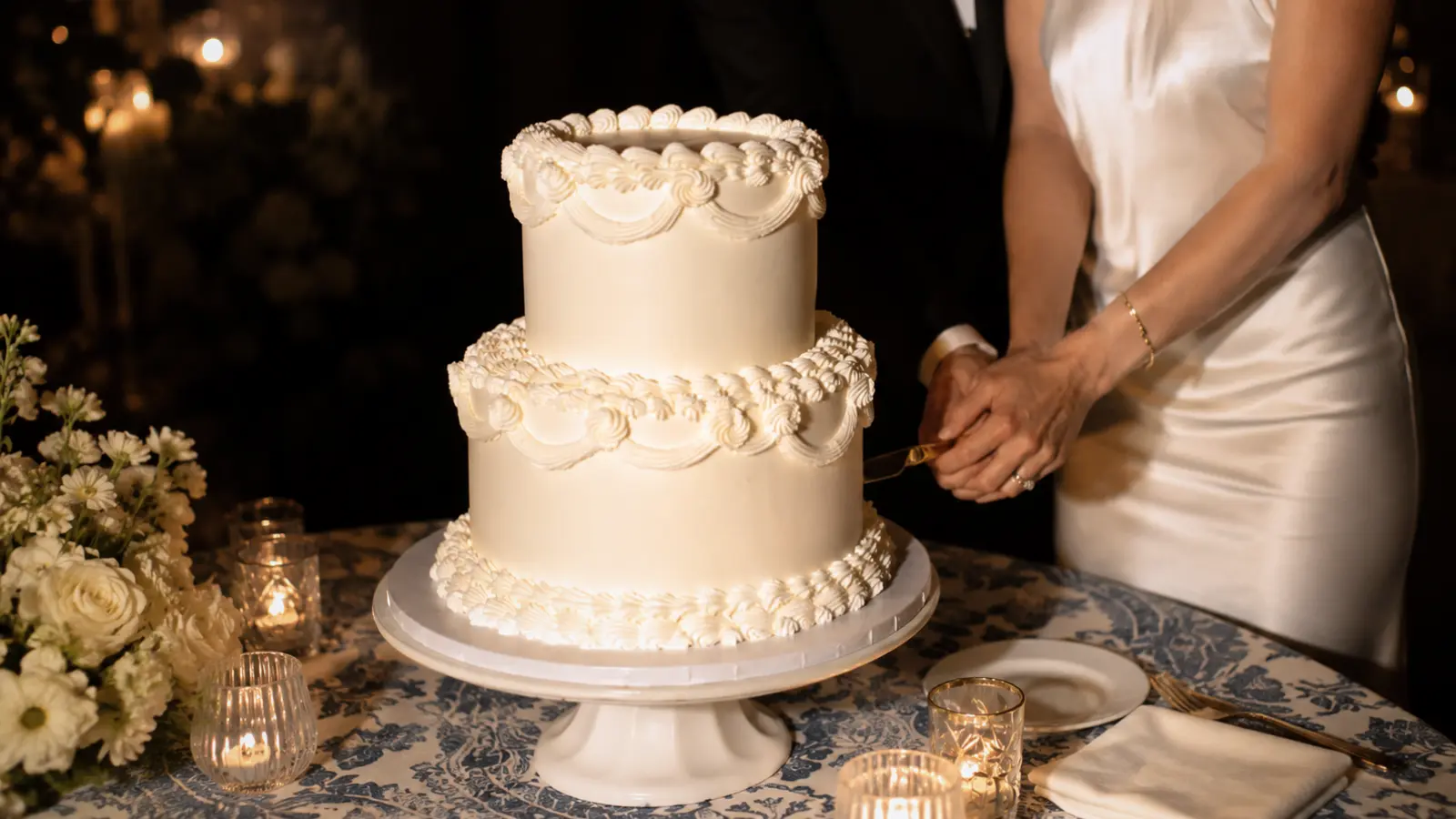
Stand options for two-tier cakes
Marble slab. A thick marble slab (typically 12 to 16 inches in diameter, 1 to 2 inches thick) adds weight and elegance. The cool gray or warm cream of marble coordinates with almost every wedding palette and creates a visual foundation that elevates the cake without competing with it. Can be purchased or rented. Weight is a practical consideration if the cake is being moved.
Wooden slice or slab. A natural wood cross-section provides warmth and an organic quality that works perfectly for garden, rustic, barn, and outdoor weddings. The grain and natural imperfection of the wood contrasts beautifully with clean frosting. Easy to find, relatively inexpensive, and adds a handcrafted quality to the presentation.
Antique silver or gold pedestal stand. The most formal option and the one most closely associated with traditional wedding aesthetics. A silver or gold pedestal adds significant visual height and creates a presentation that reads as celebratory and intentional. Works best at formal indoor receptions and black tie events.
Acrylic pedestal stand. A clear acrylic stand adds height without visual weight — the cake appears to float. Works well for modern and contemporary aesthetics and for any color palette because the transparency does not compete. More affordable than marble or silver and widely available in various heights.
Geometric or sculptural stands. Hexagonal, faceted, or architecturally shaped stands add a design element that reinforces a specific aesthetic (modern, eclectic, art deco). Works when the stand is clearly coordinated with the rest of the table decor; reads as random when it is not.
A practical note: confirm the stand diameter with your bakery before purchasing or renting. A 10-inch bottom tier needs a stand at least 12 inches in diameter to sit properly and look balanced. A stand that is the same diameter as the bottom tier looks cramped; one that is 2 to 4 inches wider looks grounded and proportional.
Two-Tier Cakes for Small Weddings
Small wedding cakes and two-tier formats often work best for weddings under 50 guests. The guest count is served comfortably with standard tier sizes, the visual scale is appropriate for an intimate venue, and the design can be as personal and specific as the couple wants without the surface area of a larger cake requiring it to be filled with decoration.
The specific small wedding configurations that work best:
8-inch base, 5 or 6-inch top. Serves 30 to 50 guests. The proportions are delicate and beautiful — this is a cake that looks genuinely suited to an intimate setting rather than like a reduced version of a larger event cake. On a marble slab or wooden slice, it photographs with remarkable elegance.
10-inch base, 6-inch top. Serves 60 to 75 guests with standard slices. The most versatile two-tier size for small weddings with a slightly larger guest count. The proportion is balanced and the design options are the widest at this size combination.
Many couples with small weddings use the display-cake-plus-sheet-cake approach: order the display two-tier at the smaller size that is proportionally perfect for the setting and photographs correctly, and supplement with a plain sheet cake in the kitchen for additional servings. The result is a cake that looks exactly right in the space and serves every guest without requiring a larger, potentially overwrought, display.
For couples with intimate weddings considering all their small cake options, the complete guide to small wedding cakes covers single-tier and alternative formats alongside two-tier designs.
When a Two-Tier Cake Is Enough
The direct answer to the question most couples are actually asking:
A two-tier cake is enough when it serves your guests, fits your venue, and looks exactly right for your wedding. Those are the only criteria that matter.
It is enough for 40 guests at an intimate dinner reception in a restaurant private room. It is enough for 75 guests at a garden wedding in a tent. It is enough for 90 guests at a cocktail reception in a hotel ballroom when the tier sizes are right. It is not determined by the tier count — it is determined by whether the cake serves the people who are there and looks like it belongs in the space where it is displayed.
What a two-tier cake is specifically better for than a three-tier cake in most cases:
It is better proportioned for small-to-medium venues. It photographs with more clarity and less visual complexity. It is significantly easier to transport and assemble without risk of structural issues. It costs less for the same quality of execution. And it is more likely to be executed beautifully by a wider range of bakeries, because the structural demands of stacking two tiers are meaningfully less than stacking three.
Many couples find that a well-designed two-tier cake feels exactly right once they see it in the actual venue setting. Couples who added a third tier “just in case” often reflect that the third tier added cost, transport complexity, and serving logistics without adding anything that the guests noticed or remembered.
Two-Tier Wedding Cake Flavors
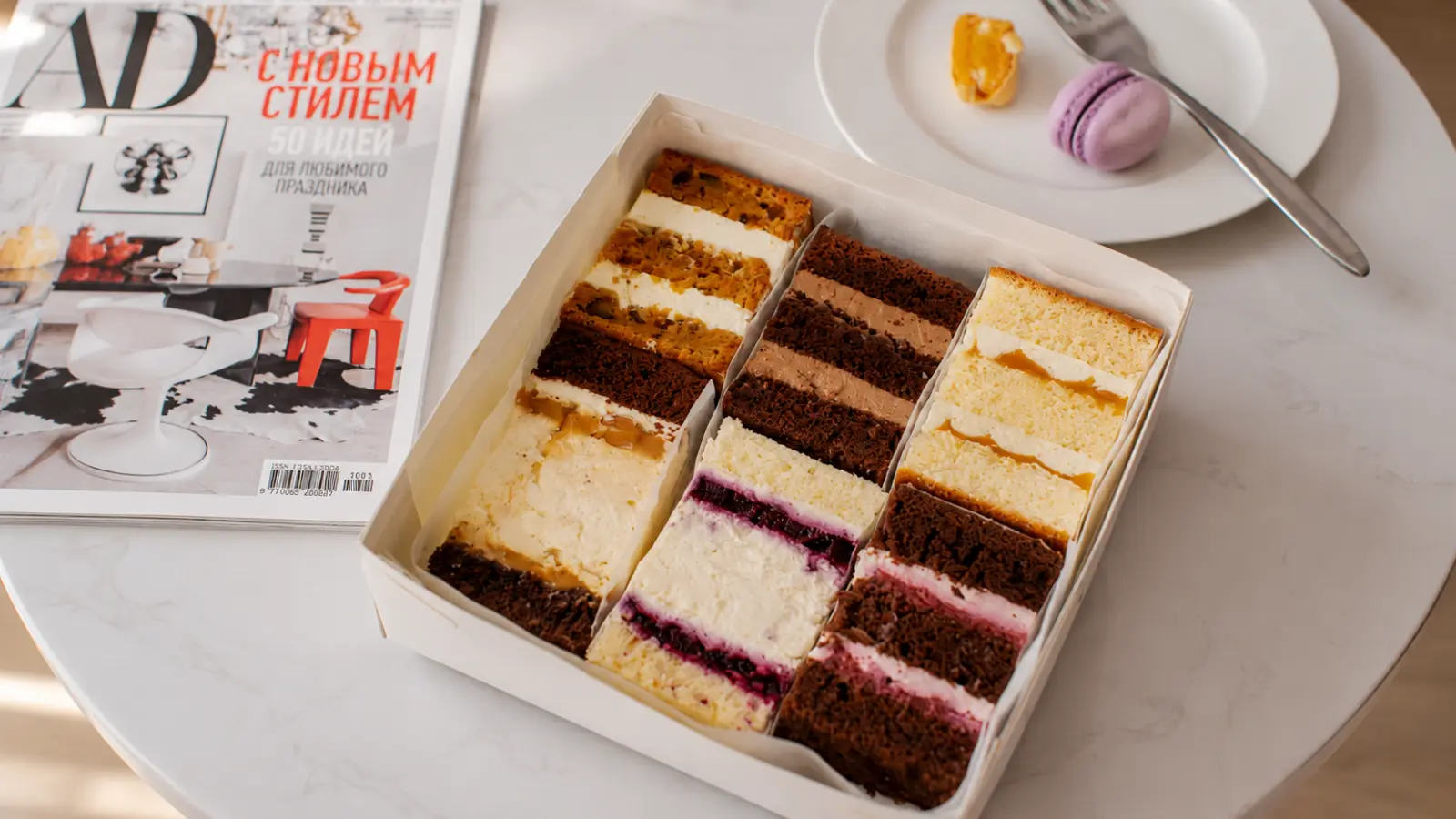
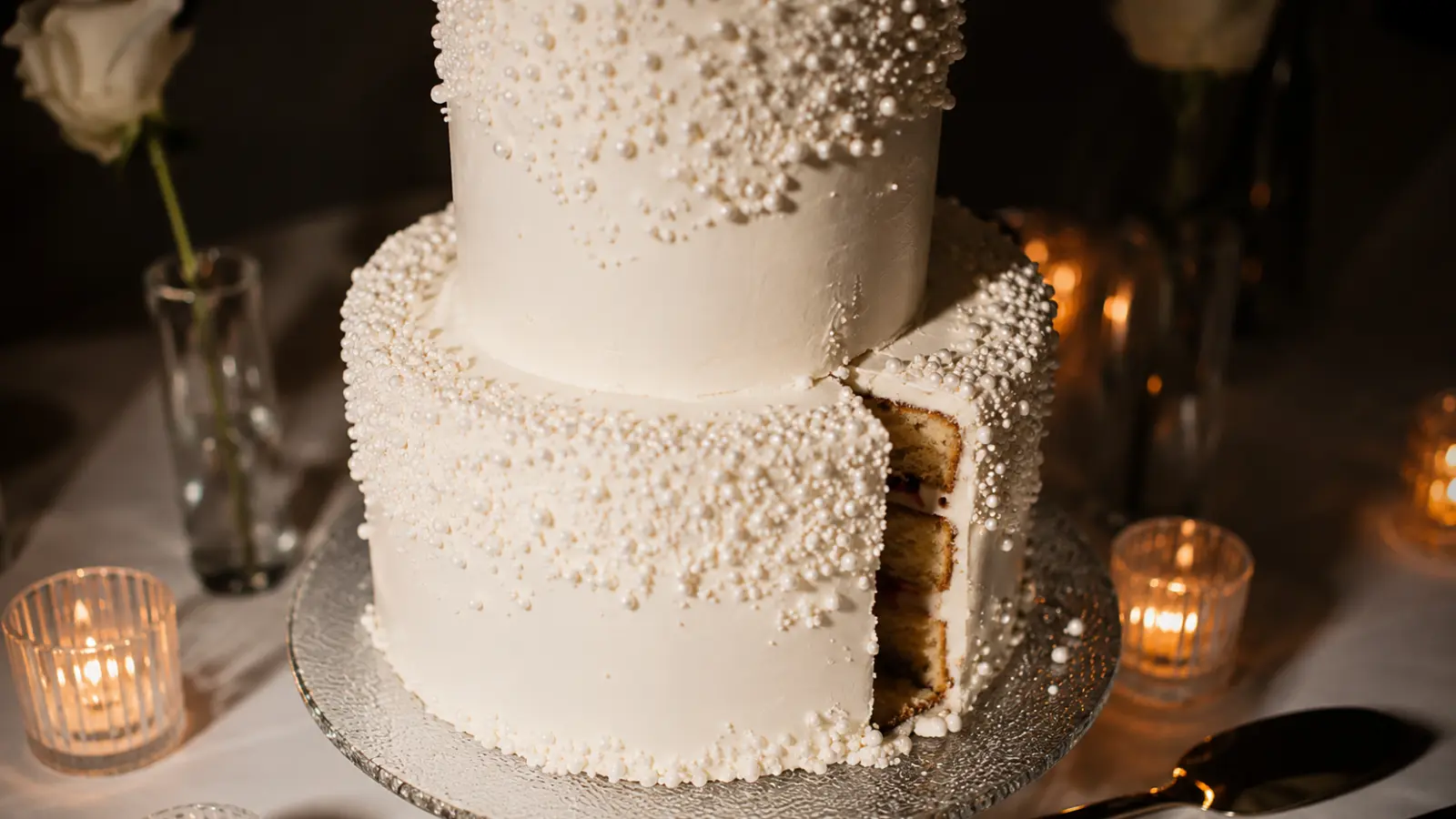
One of the practical pleasures of choosing wedding cake flavors for a two-tier cake is the option to offer two different flavors — one in each tier — without any additional visual complexity. The cake looks exactly the same from the outside; the difference is entirely in the eating. Many couples don’t take advantage of this because they assume one flavor is the standard, when in fact most quality bakeries accommodate different flavors per tier as part of the design consultation.
Classic two-flavor combinations for two-tier cakes
Vanilla bean (bottom) + lemon with lemon curd (top). A classic and widely appealing combination. The bottom tier satisfies guests who want a straightforward, classic cake. The top tier — with its bright, acidic lemon curd filling — gives guests who want something more specific exactly that. Both flavors are crowd-pleasing enough that few guests will be disappointed by either.
Chocolate ganache (bottom) + vanilla almond (top). Rich and classical below, light and fragrant above. The contrast in flavor weight means that guests who want something substantial get it from the bottom tier, and those who want something more delicate have the top. Served with both Swiss meringue buttercream and a thin chocolate ganache layer between the layers of the bottom tier.
Lemon (bottom) + champagne or elderflower (top). A more sophisticated pairing for couples who want both flavors to feel considered and specific. Works particularly well for spring and summer weddings where the lightness of both flavors coordinates with the season.
Carrot with cream cheese (bottom) + vanilla (top). For fall and winter weddings, the spiced warmth of a carrot cake contrasts beautifully with a clean vanilla in the top tier. Guests who love a classic carrot wedding cake get exactly that, and the top tier offers a lighter alternative.
A practical note: when serving a two-flavor two-tier cake, have your baker or caterer clearly communicate which tier is which when slicing. Most experienced wedding caterers handle this naturally — they cut both tiers and can tell guests which is which — but it is worth confirming in advance that the serving staff knows the arrangement.
Two-Tier Wedding Cake Inspiration Board
Before choosing your final design, it helps to see how two-tier wedding cakes can look elegant, modern, romantic, minimalist, or floral depending on their proportions, finish, and styling. Explore our two-tier wedding cake inspiration board for simple buttercream designs, floral two-tier cakes, small wedding cake ideas, textured finishes, elegant cake stands, and beautifully balanced designs that prove two tiers can feel complete and intentional.
Final thoughts
The best two-tier wedding cakes are not smaller versions of something more impressive. They are complete designs when the proportions, servings, stand, and styling all make sense for the wedding around them. A well-executed two-tier cake can feel elegant, confident, and fully intentional without needing extra height simply to satisfy tradition.
When the cake fits the guest count, venue scale, and visual style of the reception, two tiers are often exactly enough. Whether the design is simple buttercream, floral, semi-naked, offset, or fully customized, the strongest two-tier cakes are the ones that look like a deliberate choice rather than a compromise.
Frequently asked questions (FAQ)
Do guests actually notice how many tiers a wedding cake has?
Not usually. Guests tend to remember whether the cake felt beautiful and appropriate for the wedding rather than how many tiers it had. Most people notice the overall presentation, not the tier count itself.
Why do two-tier wedding cakes often look more elegant than larger cakes?
Because the proportions are naturally balanced. With fewer tiers competing for attention, the design feels cleaner, more intentional, and easier to appreciate both in person and in photographs.
Can a two-tier cake still feel luxurious?
Absolutely. Luxury comes from craftsmanship, ingredients, styling, and presentation—not from the number of tiers. A beautifully executed two-tier cake often feels more refined than a larger cake with average execution.
What is the biggest mistake couples make when choosing a two-tier cake?
Adding a third tier because they worry the cake will look too small. In many venues, a properly sized two-tier cake already has the right visual presence. Extra height sometimes solves a problem that never existed.
Does a two-tier cake photograph differently than a three-tier cake?
Yes. Two-tier cakes often photograph with greater clarity because the eye immediately understands the shape and proportions. The design details are easier to see, especially in close-up reception photography.
What do professional bakers notice first about a two-tier cake?
Usually the relationship between the tiers. The diameter difference, height balance, and overall silhouette determine whether the cake feels elegant long before anyone notices the flowers, frosting, or decorative details.
How many guests does a two-tier wedding cake serve?
A two-tier wedding cake can serve roughly 35 to 110 guests depending on the tier sizes, tier height, and slice size. A common 10-inch and 6-inch two-tier cake often works for a medium guest count, but your baker’s serving chart should be the final guide.