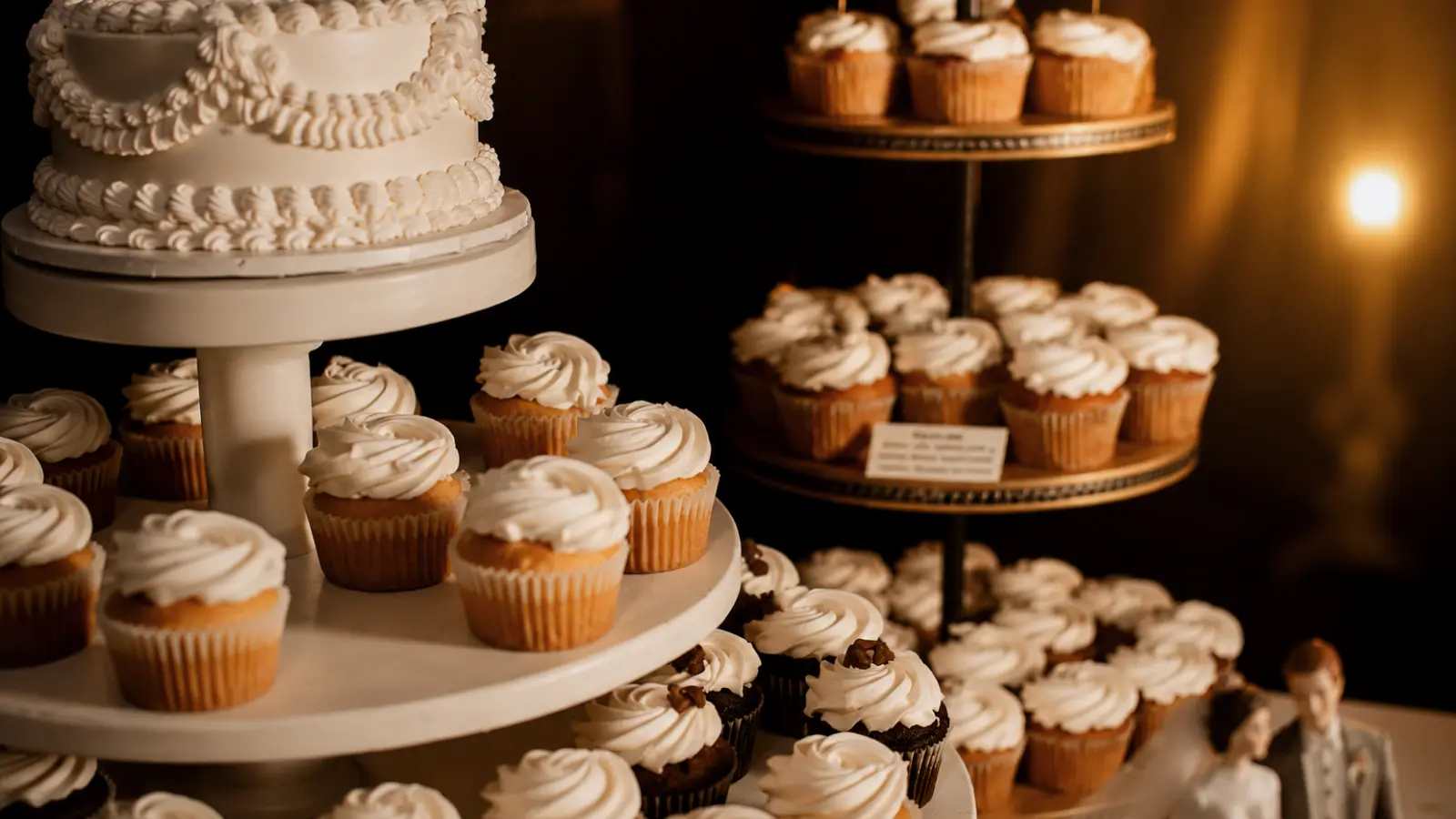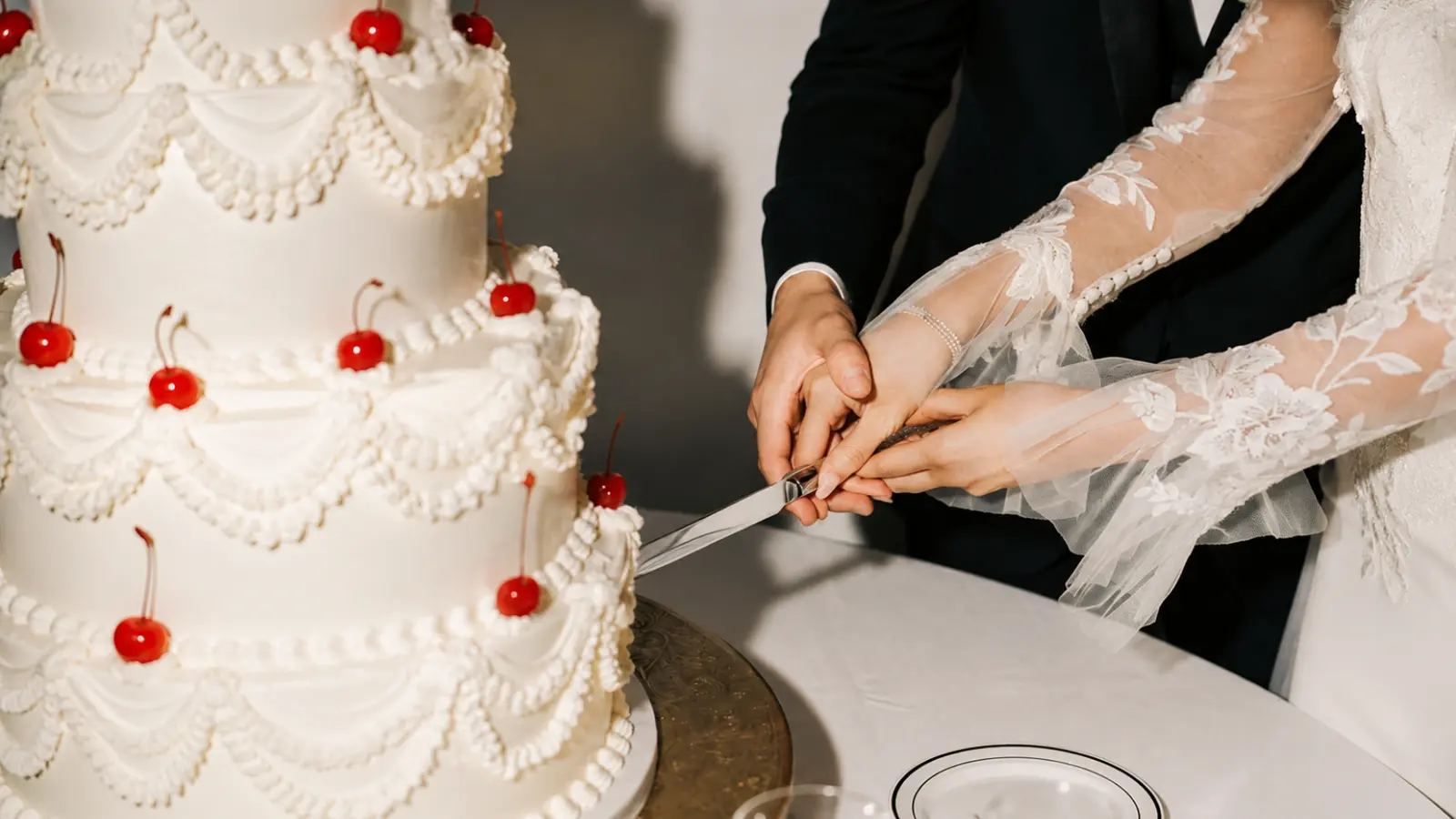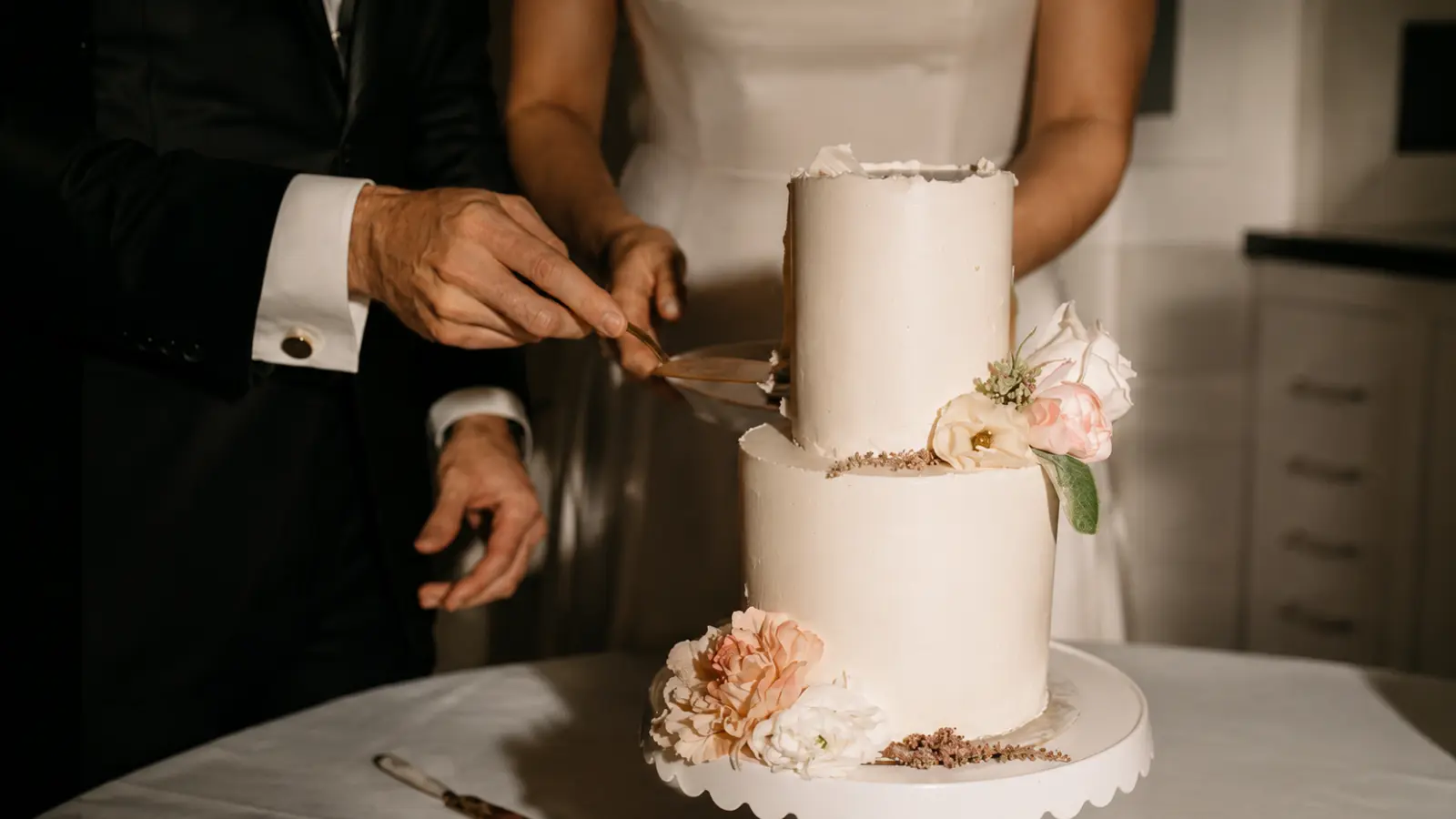
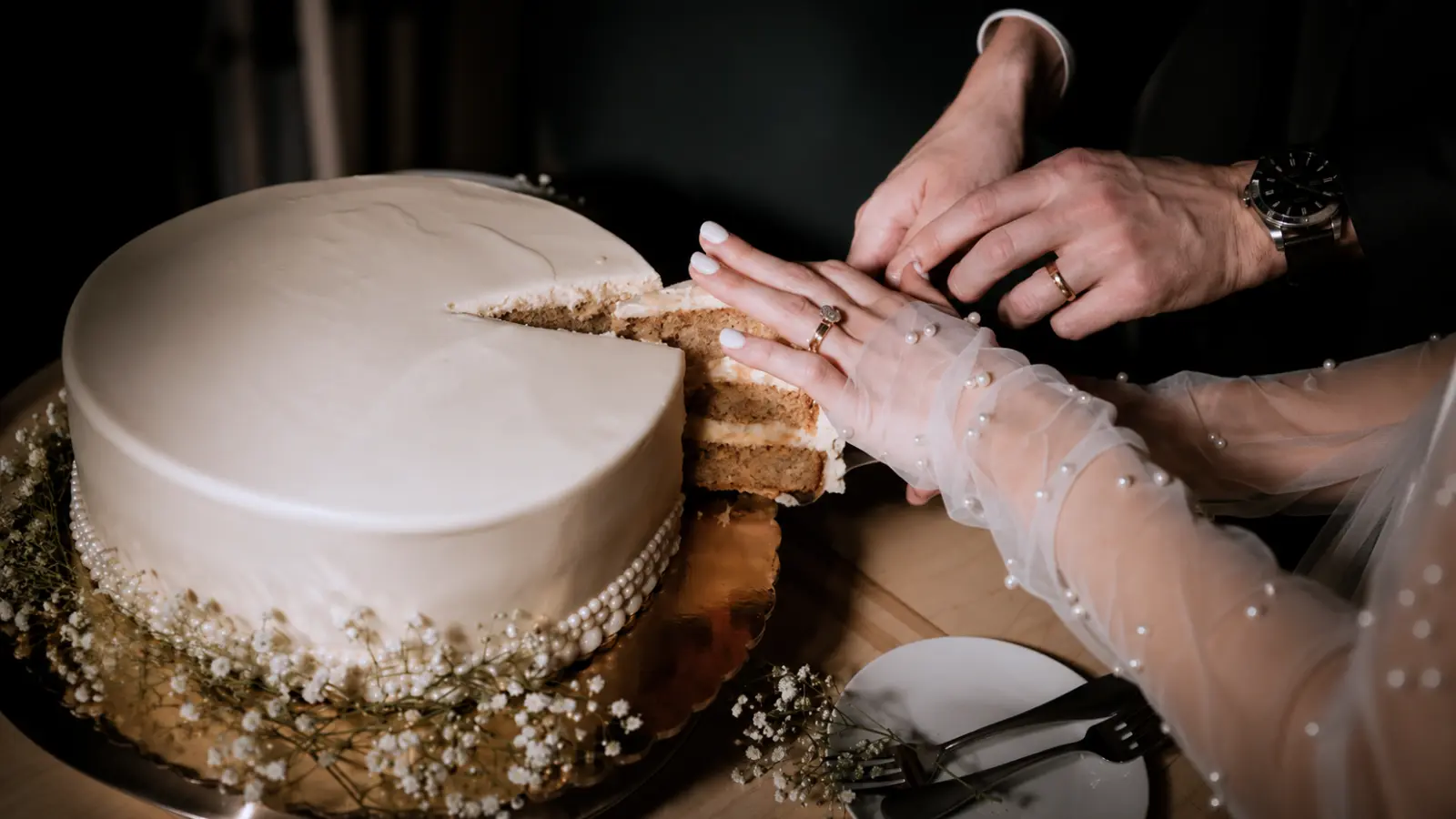
Simple wedding cakes are wedding cakes designed with minimal decoration, clean finishes, and intentional details that prioritize elegance over complexity. Rather than relying on elaborate sugar work or heavily decorated tiers, these cakes focus on proportion, texture, and thoughtful design choices that create a refined and timeless look.
Many couples worry that choosing a simple wedding cake will make the reception feel less special or less impressive. In many weddings, a simple cake can actually feel more refined when the design is intentional and the execution is strong. A simple cake executed exceptionally well tends to photograph more beautifully, complement the venue more naturally, and create a stronger visual impression than a design overloaded with decorative elements that compete for attention.
This guide explores simple wedding cakes within the larger world of wedding cakes, including different styles, finishes, tier counts, buttercream designs, white cakes, floral details, minimalist options, and practical ideas for smaller celebrations. Whether you are planning an intimate celebration or a larger reception, the goal is to understand what makes simplicity feel intentional, elevated, and genuinely memorable.
Simple Wedding Cakes That Still Feel Elegant
Elegance in a wedding cake is not about complexity. It is about proportion, finish, and the quality of one or two considered decisions. A cake that has been designed with clarity — where every element has a purpose and nothing is there by default — looks more expensive, more intentional, and more beautiful than a cake where decoration was added because blank space felt wrong.
What most couples don’t realize is that simple cakes are often more technically demanding for bakers, not less. Smooth buttercream requires a level of technique that heavily textured or decorated cakes can obscure. Naked cakes require layers that are genuinely beautiful on their own. A clean white fondant surface shows every imperfection. Simple does not forgive — it requires the baker to be excellent at the fundamentals.
This is worth knowing when you are selecting a bakery. Ask specifically about simple cakes. Look at their portfolio for examples. A baker who photographs and presents simple cakes with pride — who clearly finds them interesting and beautiful rather than defaulting to them as a lower-tier option — is the baker you want for this design.
The styles that consistently work in the simple category:
Smooth buttercream, one or two colors. The most popular simple wedding cake choice for good reason. When the finish is excellent — sharp-edged or deliberately hand-smoothed — it photographs with a clarity that elaborate cakes cannot replicate. The color palette does the quiet work: warm ivory or white for a classic look, a muted sage or dusty blue for something seasonal and specific.
Textured buttercream. Palette knife texture, swirled finishes, and petal-press effects give a simple cake visual interest without adding decoration. The texture catches light in a way that smooth frosting does not, and it gives the eye something to move across. One of the most reliably photogenic simple cake choices.
Naked and semi-naked. The layers are exposed, the frosting is minimal, and the beauty is in the structure of the cake itself. Naked cakes have a rustic, organic quality that photographs beautifully in natural light — particularly at outdoor, garden, and barn weddings. They require genuinely beautiful layers and a baker who understands how the exposed edge reads in photographs.
Clean fondant. White or ivory fondant with no decoration — nothing but a perfect surface — is one of the most striking simple cake options and one of the least common. Understanding buttercream vs fondant wedding cakes helps couples decide which finish matches the look they want. It requires extraordinary execution: the fondant must be applied immaculately, the tiers must be precisely stacked, and the cake board and stand must be equally considered. When it is done right, it looks architectural and intentional in a way that nothing else does.
What Makes a Simple Cake Look Elevated vs. Flat
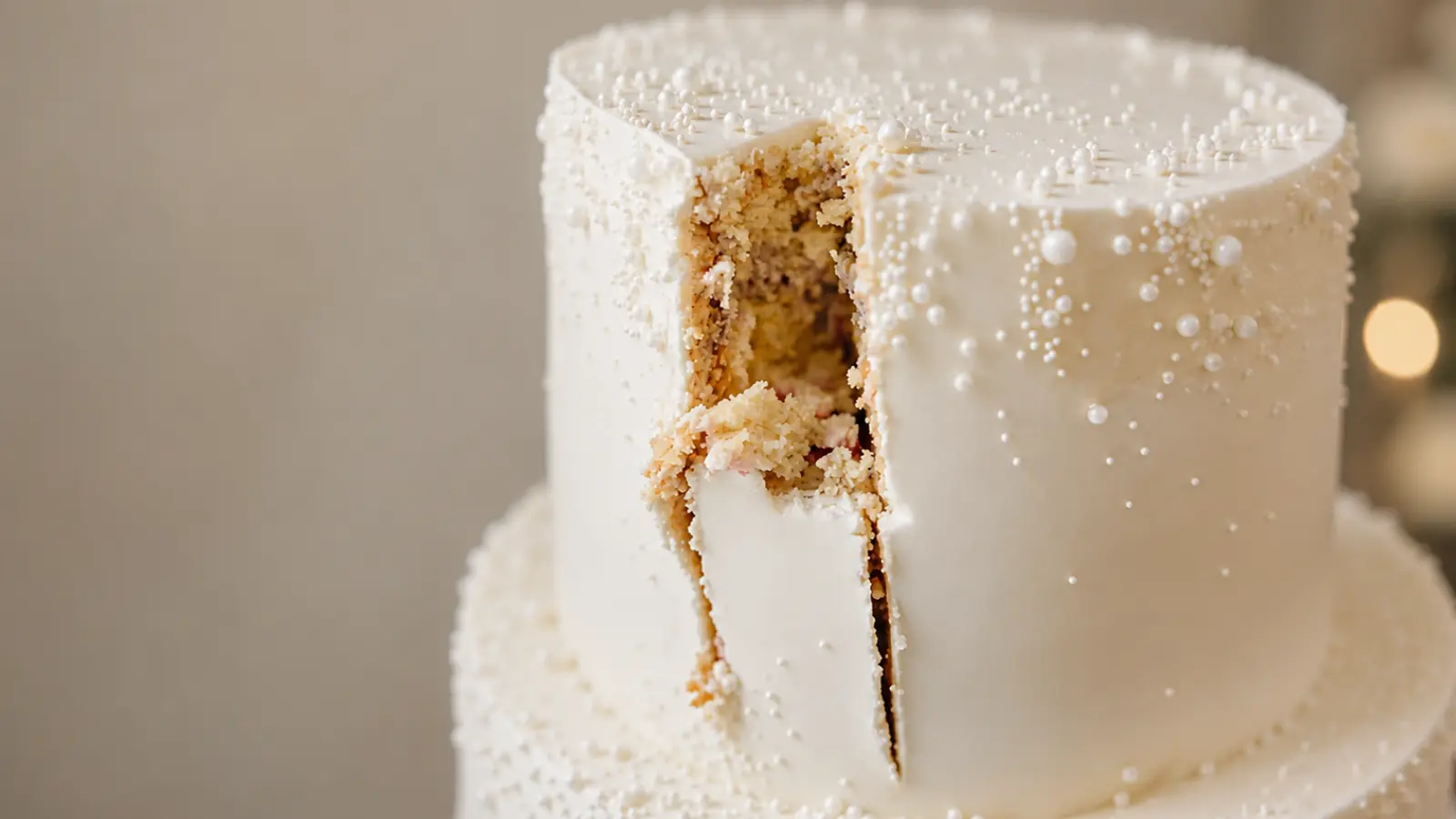
This is the question at the center of every simple cake conversation, and it deserves a direct answer. Three things determine whether a simple cake reads as elegant or underwhelming.
Finish quality. A smooth buttercream with clean, sharp edges communicates expertise and care. A rough or uneven frosting communicates the opposite, regardless of how much the cake cost or how well-intentioned the baker was. This is the single most important factor. When looking at baker portfolios, focus on the edges and the corners of simple cakes. Those are where technical skill — or its absence — becomes visible.
Proportions. A cake that is too small for the table looks lost. A cake that is too tall and narrow for the number of tiers looks unstable. A two-tier cake where the tiers are nearly the same size looks heavy. The proportions of a simple cake have to be genuinely considered — ideally by a baker who understands how the cake will read in the space where it will be displayed.
One considered detail. The difference between a simple cake that looks thoughtful and one that looks like a placeholder is often a single specific design decision: a thin ribbon in the exact color of the wedding palette, a spray of fresh herbs or berries that references the season, a dusting of edible gold at the base of the top tier. This detail does not need to be elaborate — it needs to be specific and intentional. It signals that the simplicity was a choice, not a default.
The cake stand. The wedding cake stand is something many couples do not think about until the day itself, and they end up with a generic rented round stand that does nothing for the cake. The stand is part of the presentation — a marble slab, a wooden slice, an antique silver stand, or a custom acrylic base all contribute significantly to how even the simplest cake reads in the space. Ask your bakery what stands they have available, or rent or purchase one that fits the aesthetic.
Simple White Wedding Cakes
White wedding cakes are as classic as the wedding tradition itself — and they remain one of the most requested choices for a reason. White is inherently bridal, photographs with a luminosity that cream and ivory can approach but rarely match, and works in any season, any venue, and with any wedding palette.
For simple designs, white is particularly powerful because the color is doing real work. There is nothing else to hide behind. A white cake with an impeccable buttercream finish and a modest cluster of white flowers is one of the most beautiful wedding cakes it is possible to order — and one of the most consistently requested at high-end bakeries where simple is understood as a design direction rather than a lesser option.
Simple white wedding cake ideas that work
White smooth buttercream, fresh white flowers. Gardenias, white garden roses, ranunculus, sweet peas — any white bloom placed with intention at the base of the top tier or trailing from one side creates a wedding cake that looks effortlessly bridal without a single sugar flower in sight. The flowers are added day-of, which means they are fresh, specific to the wedding’s floral palette, and impossible to replicate exactly — which is its own kind of luxury.
White fondant, nothing else. For couples who want something almost architectural — clean, graphic, and deliberate — a white fondant cake with perfectly sharp edges and zero additional decoration is genuinely striking when executed well. It requires the best baker you can find for this style, because there is absolutely nothing to conceal imperfection.
White with one texture. A white cake with a single texture element — a hand-painted brushstroke effect, a basket weave pattern, a horizontal ribbed finish — adds enough visual interest to photograph with depth while remaining clearly simple. These techniques require skill but are significantly less labor-intensive than detailed decoration, which means they are often accessible even with a modest cake budget.
White with a single color accent. A thin stripe of a color that appears elsewhere in the wedding — a soft dusty blue ribbon pressed into the bottom tier, a warm terracotta frosting band — connects the cake to the palette while keeping the overall design clean and white.
Simple Buttercream Wedding Cakes
Buttercream is one of the most practical and photogenic frosting choices for simple wedding cakes. It is warmer and more approachable than fondant, easier to work with in outdoor temperatures, and comes in a wider range of finishes — smooth, textured, palette-knife applied, rosette-edged — that all read differently in photographs.
What many couples don’t know: buttercream quality varies enormously between bakeries. American buttercream — the most common — is usually made with butter or shortening and powdered sugar, giving it a sweeter, sturdier texture that some guests find too sweet. Swiss meringue buttercream is silkier, less sweet, and more stable in warm venues. Italian meringue buttercream is the most refined version, with a satiny texture that photographs exquisitely. When choosing a bakery for a simple buttercream cake, ask specifically which type they use — the difference matters significantly both in taste and in how the cake looks on the table.
Simple buttercream cake styles by finish
Smooth finish. The gold standard for simple elegant cakes. Requires a skilled hand and a bench scraper technique — the frosting is applied and scraped smooth until the surface is nearly perfect. Best photographed straight-on where the sharpness of the edges is visible. Works for all tier counts and all color palettes.
Palette knife texture. The frosting is applied in deliberate strokes with a palette knife, creating a painterly, organic surface. More forgiving to produce than a smooth finish and photographically interesting because of how the texture catches light. Works particularly well at outdoor and organic-aesthetic weddings.
Rustic swirl. A loose, swirled application of buttercream that is intentionally imperfect. When done well — with consistent stroke direction and appropriate coverage — it reads as deliberate and tactile. When done poorly, it reads as unfinished. Best for casual, garden, and barn settings where an effortless quality is the goal.
Combed finish. A cake comb is dragged around the frosted cake to create horizontal or vertical lines in the surface. One of the most elegant simple buttercream options because the pattern adds geometric interest without decoration. Works particularly well with a contrasting color between the combed stripes.
Simple Two-Tier Wedding Cakes
Two-tier wedding cakes are the most common format for simple wedding cake designs — and for good reason. The proportion is naturally balanced, the design has enough visual height to photograph well without requiring elaborate decoration, and the tier count is practical for most wedding guest counts between 40 and 100.
What makes a two-tier simple cake look elegant is almost entirely in the proportion of the tiers and how they relate to each other. The most common mistake is tiers that are too similar in size — a 10-inch bottom with a 8-inch top, for example, reads as heavy and short rather than graceful. A 10-inch bottom with a 6-inch top has a clearer visual hierarchy and a lighter appearance. An 8-inch bottom with a 5-inch top is elegant for smaller weddings. When discussing sizes with your bakery, look at photographs of their two-tier cakes specifically and note whether the proportions please you.
Simple two-tier designs that work
Stacked, smooth buttercream, fresh flowers. Both tiers smooth, the same color, stacked directly, flowers added at the junction between tiers or at the base. This is the canonical simple wedding cake and it works because every element is clear and the whole thing reads as intentional.
Offset tiers. The top tier is placed slightly off-center on the bottom tier, creating a more dynamic composition. One of the most reliably elegant simple designs because the asymmetry adds visual interest without any additional decoration. Works for smooth and textured buttercream and fondant.
Different textures per tier. Bottom tier smooth, top tier textured — or vice versa. A two-element design that uses the two tiers as an opportunity to create contrast without changing the color. The difference in texture creates visual movement that makes the cake interesting to look at in photographs.
A single decorative element on one tier. All decoration concentrated in one place: a wrap of ribbon at the base of the bottom tier, a spray of flowers placed on one side of the top tier, a single painted botanical stroke across the bottom tier. Because the decoration is deliberately limited and specific, it reads as a design decision rather than an addition.
Simple Wedding Cakes with Flowers
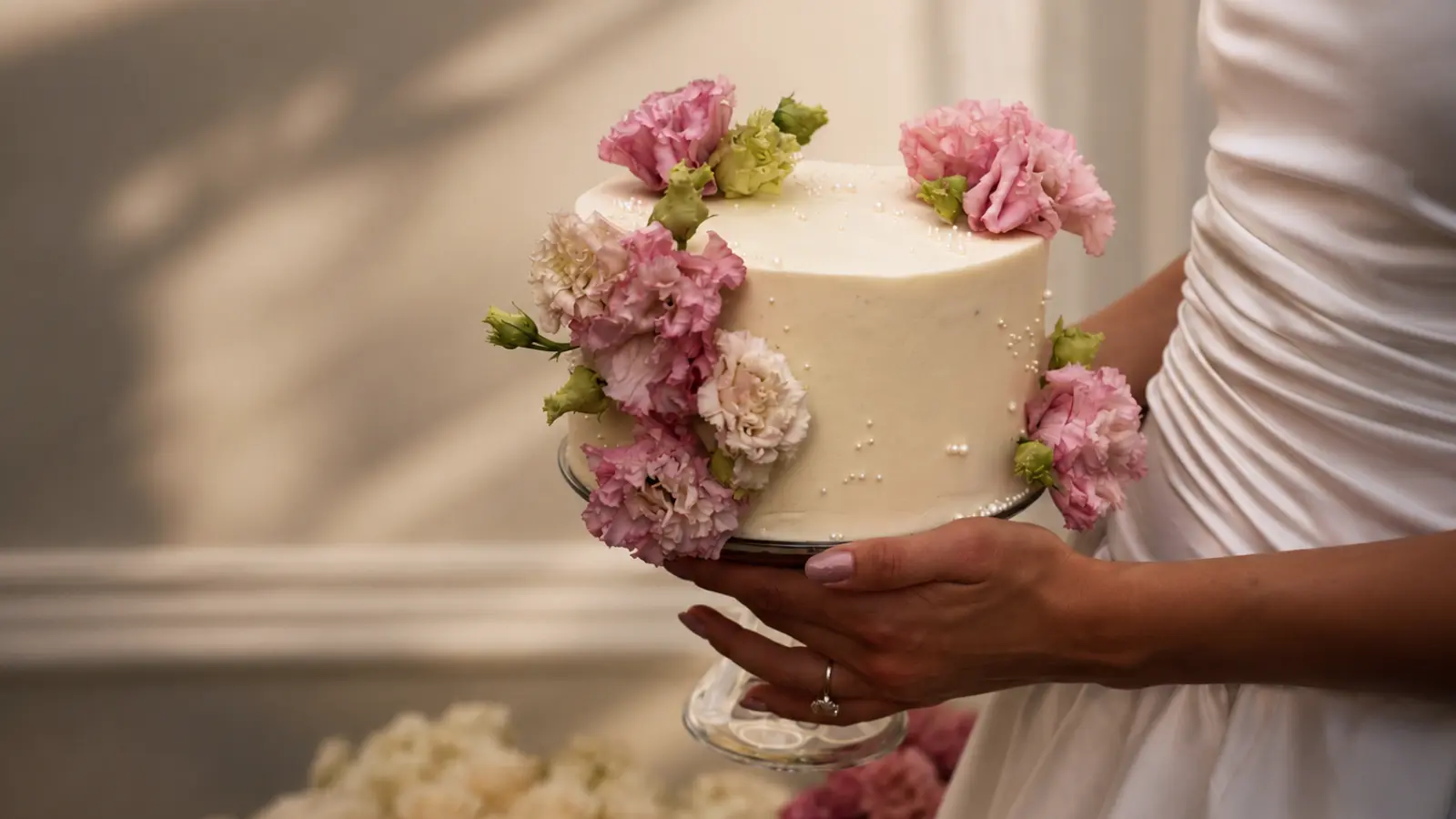
Floral wedding cakes are one of the most effective ways to elevate a simple design without complicating it — and they are widely misunderstood. Many couples either over-flower a cake (adding so many blooms that the flower arrangement becomes the design rather than an accent) or under-flower it in a tentative way that reads as incomplete. The key is understanding that flowers on a cake are a placement exercise, not a coverage exercise.
A few guidelines that make a significant difference:
Flowers should be coordinated with your wedding florals. The blooms on the cake should come from the same palette — and ideally from the same florist — as the ceremony and reception flowers. When the cake flowers match the centerpieces and the bouquet, the whole room feels cohesive in a way that a generic rose placement does not.
Less is almost always more. A single cluster of flowers — three to five blooms in varying sizes, placed at the base of the top tier or trailing down one side — creates a more elegant effect than a fully flowered cake. The contrast between the clean cake surface and the flowers is what creates the visual interest. When flowers cover most of the cake, you lose that contrast.
Placement matters more than quantity. Flowers at the base of the top tier look intentional. Flowers scattered randomly across tiers look unplanned. A trailing arrangement that descends one side of the cake looks designed. Work with your baker and florist together on placement — ideally with a reference photograph of the specific arrangement you want.
Not all flowers are food-safe. This matters. Fresh flowers that contact frosting should be either confirmed food-safe or prepared with food-safe wiring and floral tape so the stems do not contact the cake directly. Your baker should handle this; ask specifically how they manage flower placement on the day of delivery.
Flowers that work beautifully on simple cakes
Garden roses (the loose, romantic version of standard roses — fuller, more petaled, and significantly more beautiful at close range). Ranunculus, which have a layered paper-thin quality that photographs with extraordinary delicacy. Sweet peas in soft pinks and whites. Anemones for contrast and graphic impact. Eucalyptus and greenery as supporting structure. Cosmos, dahlias for fall weddings, and peonies for spring — any bloom from the wedding’s own floral palette that the baker can coordinate with the florist the morning of the wedding.
Minimalist Wedding Cakes
Minimalist wedding cakes are the most demanding version of simple — they take “less is more” to its logical conclusion and ask whether the cake itself, with excellent technique, can be enough. The answer is yes, when the execution is right.
Minimalist is not the same as undecorated. It is the same as intentional. A minimalist cake might have a single painted line, a specific texture, or one sculptural element. What it does not have is anything that is there by default rather than by decision.
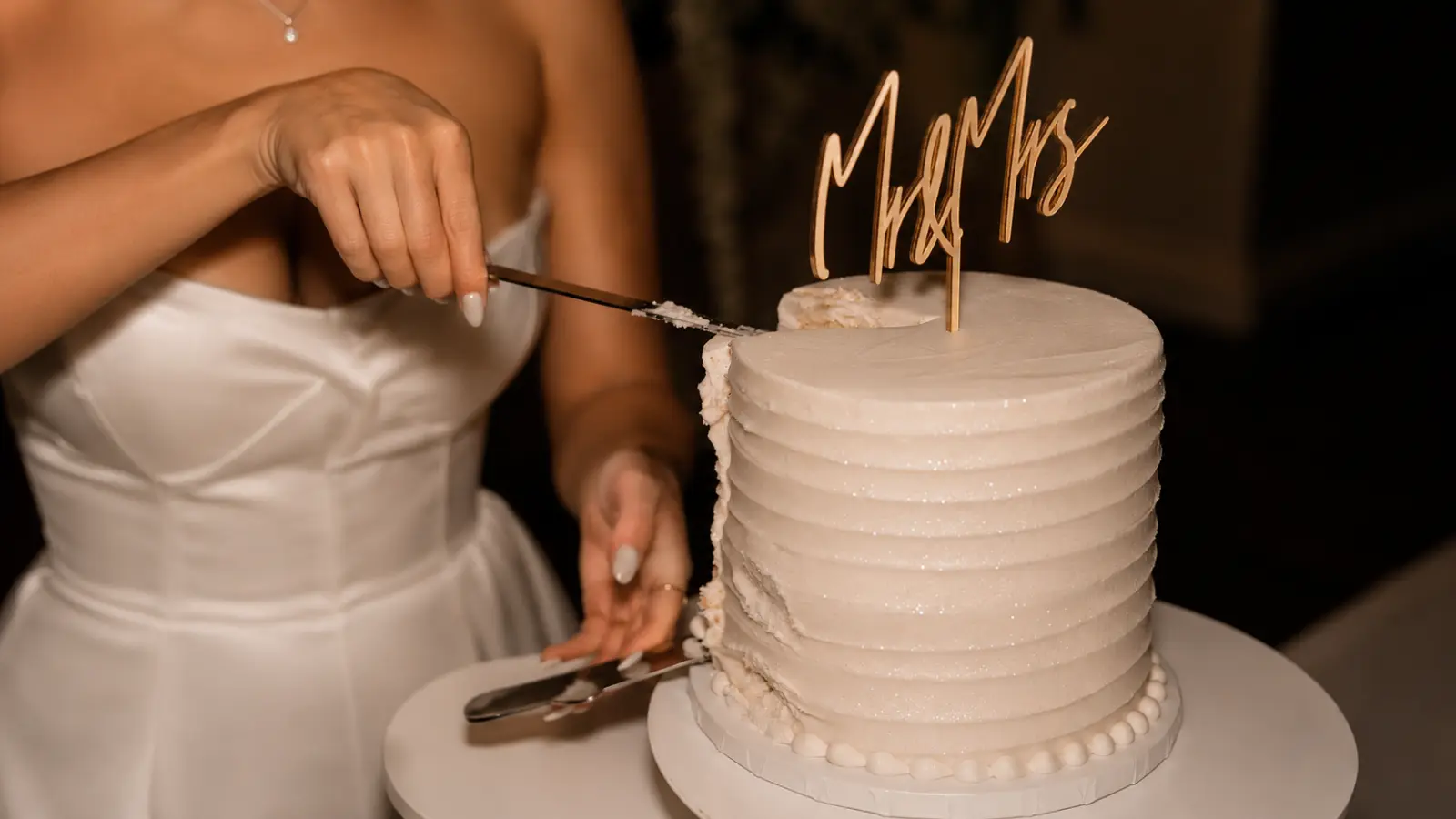
Minimalist cake styles that work
Smooth white or ivory fondant, nothing else. The most minimal option. The cake is a form — each tier is a shape, the stacking is deliberate, and the frosting surface is immaculate. This requires extraordinary execution and a baker who is genuinely interested in this direction. When it works, it creates the kind of clean, architectural look often associated with modern wedding cakes.
White buttercream with a single gold or black edge detail. A thin line of edible gold leaf at the base of each tier, or a single brushstroke of edible black paint across one tier, creates a one-element cake that reads as highly designed. The minimalism is the point, and the single detail is what gives it authority.
One textured tier, other tiers smooth. All tiers the same color; one tier with a textured finish (palette knife, combed, ribbed) and the others smooth. The contrast within the same palette creates visual interest without adding decorative elements.
Tonal color and smooth finish. A pale sage, muted dusty blue, or warm terracotta cake in a smooth finish with no decoration — just the color against the architecture of the tiers. Color as the sole design element is a genuinely minimalist choice, and when the color is well-selected and the finish is excellent, it photographs with remarkable clarity.
Simple Wedding Cakes for Small Weddings
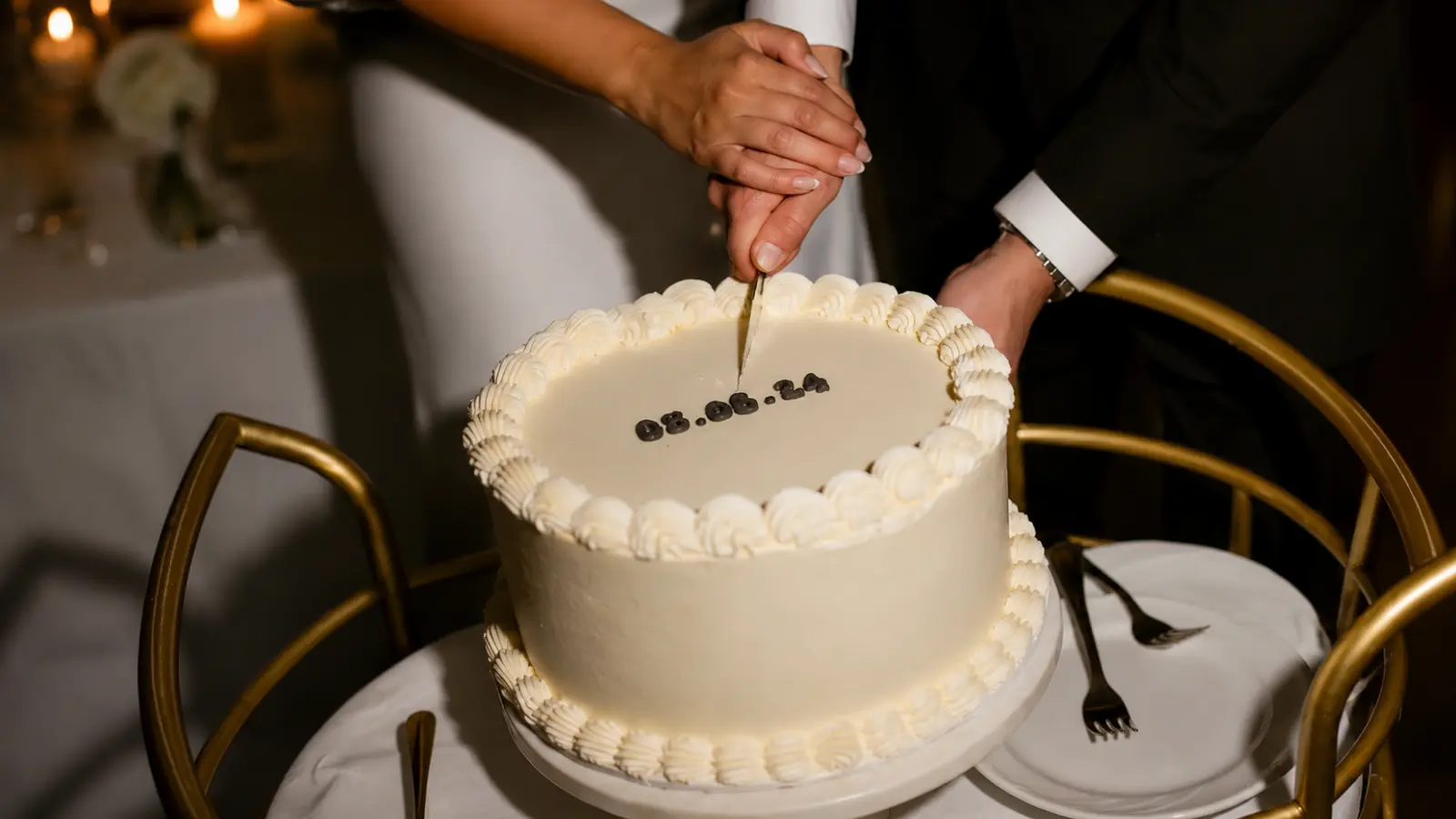
Small wedding cakes offer an opportunity that large weddings rarely do: the chance to have a cake that is genuinely beautiful rather than logistically impressive. A small wedding does not need a cake that serves 150. It needs one that looks right in the space, tastes excellent, and photographs with the intimacy that a smaller celebration allows.
What most small wedding couples don’t realize is that a well-designed single-tier cake is often more visually striking than a three-tier cake that is proportioned for a guest count the wedding does not have. A single tier with exceptional frosting work, on a beautiful stand, surrounded by a small arrangement of the same flowers from the ceremony, is a complete and intentional object. It does not need to be bigger to be better.
Practical options for small wedding cakes
Single tier on a statement stand. A single-tier cake of 8 to 10 inches serves 20 to 35 guests. On a marble slab, a wooden slice, or an antique silver stand, it looks considered and appropriate. The stand is doing significant visual work — choose it with the same care as the cake design.
Two-tier in smaller dimensions. A 6-inch top and 8-inch bottom serves 30 to 50 guests and has more visual height without requiring more guests to justify it. The smaller dimensions give the two-tier a delicacy that larger wedding cakes can lack.
Small display cake plus sheet cake. Order a small, beautifully designed one-tier or two-tier display cake for the photographs and the cutting ceremony, and supplement with a sheet cake in the kitchen cut for all guests. This approach keeps the visual cake exactly as designed while solving the serving logistics. It is one of the most practical and most underused options for small weddings on a careful budget.
Individual cakes or desserts alongside a small cake. A small simple cake at the center of a dessert table that includes macarons, mini tarts, and other individual sweets creates an abundant-looking presentation without requiring a large cake. The combination photographs beautifully and gives guests who do not particularly want cake an alternative.
How to Make a Simple Cake Look Elevated
This is what the question really is — and it deserves a direct, practical answer.
Choose the right baker, not the most decorated portfolio. Simple cakes require technical skill in the fundamentals: smooth frosting, precise stacking, clean edges. Look specifically at a baker’s simple cakes. If their portfolio is all elaborate designs and their simple offerings look like the options they are not proud of, keep looking.
Invest in the finish. If you are choosing between a slightly more elaborate design and a higher-quality finish on a simple design, choose the finish. Smooth Swiss or Italian meringue buttercream in excellent condition often looks more expensive than a decorated American buttercream cake with uneven finishing.
Be specific about color. “White” and “ivory” are not the same, and both look different under different lighting. “Warm white,” “cool white,” “vanilla ivory” — ask the baker for swatches or reference photographs of the specific shade you are choosing. A cake color that fights with the wedding’s warm or cool palette reads as a mistake even if the design is beautiful.
Coordinate the stand and the cake together. Bring a photograph of the cake stand to your baker meeting, or ask what stands they have available. The stand is part of the presentation — a beautiful cake on the wrong stand is not a beautiful presentation.
Add one thing, not several. The elevation of a simple cake comes from restraint applied with confidence. One cluster of fresh flowers. One ribbon. One textured tier. One edible gold element. Resist the temptation to add more when something looks good — more almost always reduces the effect of what was already working.
Think about how the cake sits in the room. A beautiful cake on a table that is too large for it, surrounded by nothing, reads as an afterthought. A simple cake with greenery around its base, on a stand at the right height, with intentional lighting above it, reads as the centerpiece it is supposed to be. Discuss with your venue coordinator how the cake table will be presented — it is one of the most overlooked elements of wedding cake planning.
Simple Wedding Cake Flavors
Simple cake design pairs best with wedding cake flavors that are equally considered but broadly accessible. A highly elaborate flavor combination can work beautifully inside a simple design — but the most consistently appreciated wedding cake flavors are those that taste exceptional to the widest range of guests.
Classic vanilla bean. Classic wedding cake flavors like vanilla bean are crowd-pleasing options and easy to pair with different frosting colors or designs. The key distinction is vanilla bean versus artificial vanilla — real vanilla bean buttercream has a floral, warm depth that the artificial version cannot replicate. Ask your baker specifically which vanilla they use.
Lemon with lemon curd. One of the most requested simple wedding cake flavors, particularly for spring and summer weddings. The brightness of lemon curd as a filling cuts through the sweetness of buttercream and leaves guests wanting a second slice. Pairs beautifully with a white or ivory exterior for a classic-simple combination.
Almond with vanilla buttercream. A flavor combination that many guests describe as “the best wedding cake I’ve ever had” without being able to explain why. Almond cake has a particular warmth that vanilla alone doesn’t, and paired with a good vanilla buttercream, it creates a specific and memorable combination that seems simple but is deeply satisfying.
Classic chocolate. A chocolate cake in a simple white or ivory frosting — beautiful on the outside, rich and dark on the inside — is one of the most striking simple wedding cake choices. The contrast between the exterior and the cut reveals a design moment that requires no decoration. Pair with chocolate ganache filling and vanilla or chocolate Swiss meringue buttercream.
Carrot with cream cheese frosting. For fall and winter weddings, a well-made carrot cake with cream cheese frosting under a layer of smooth buttercream gives the cake both warmth and texture that guests remember. The exterior can be as simple as any other — the flavor is where the complexity lives.
A practical note: if your wedding has more than 80 guests, consider offering two flavors in different tiers. This adds almost nothing to the visual complexity of a simple cake and gives guests a choice that makes the cake feel more considered. Two simple flavors, side by side in alternating tiers, is one of the easiest ways to make a simple cake feel generous rather than minimal.
Simple Wedding Cake Inspiration Board
Before choosing your final design, it helps to see how simple wedding cakes can range from smooth buttercream designs and minimalist white tiers to floral arrangements, textured finishes, and understated modern styles. Explore our simple wedding cake inspiration board for elegant designs, fresh flower details, small wedding cake ideas, two-tier cakes, and timeless looks that prove simplicity can be every bit as memorable as an elaborate design.
Final thoughts
The most successful simple wedding cakes are not defined by what they lack, but by what they choose to emphasize. Clean finishes, balanced proportions, thoughtful details, and strong execution create a sense of confidence that often feels more elegant than decoration added simply for the sake of filling space.
When simplicity is intentional, the cake becomes part of the overall wedding design rather than competing with it. Whether it is a single-tier cake for an intimate celebration or a classic buttercream design for a larger reception, the strongest simple wedding cakes are the ones that feel perfectly suited to the couple, the venue, and the atmosphere they want to create.
Frequently asked questions (FAQ)
Do guests actually notice whether a wedding cake is simple or elaborate?
Most guests notice whether a cake feels beautiful in the room, not how many decorative techniques were used to create it. A well-proportioned simple cake often creates a stronger impression than an elaborate cake with too many competing details.
Is a simple wedding cake less memorable in photos?
Not necessarily. In fact, simple cakes often photograph better because the eye immediately understands the shape, texture, and proportions. Busy designs can sometimes lose impact when viewed in wedding albums years later.
What is the biggest mistake couples make with simple wedding cakes?
Adding too many last-minute details out of fear that the cake looks “too plain.” Most simple cakes become less elegant when extra flowers, ribbons, colors, or decorative elements are added without a clear purpose.
Should a simple wedding cake match the wedding style exactly?
It should feel connected to the wedding, but not necessarily identical to it. The strongest cakes often borrow colors, textures, or floral elements from the event while maintaining their own visual identity.
Can a simple wedding cake still feel luxurious?
Absolutely. Luxury is usually communicated through craftsmanship, proportions, ingredients, and presentation rather than decoration alone. Some of the most expensive wedding cakes are visually simple but technically exceptional.
What makes professional bakers appreciate a simple cake?
Simple cakes reveal technical skill immediately. Clean edges, smooth finishes, balanced proportions, and flawless stacking are easier to notice when there are fewer decorative elements competing for attention.