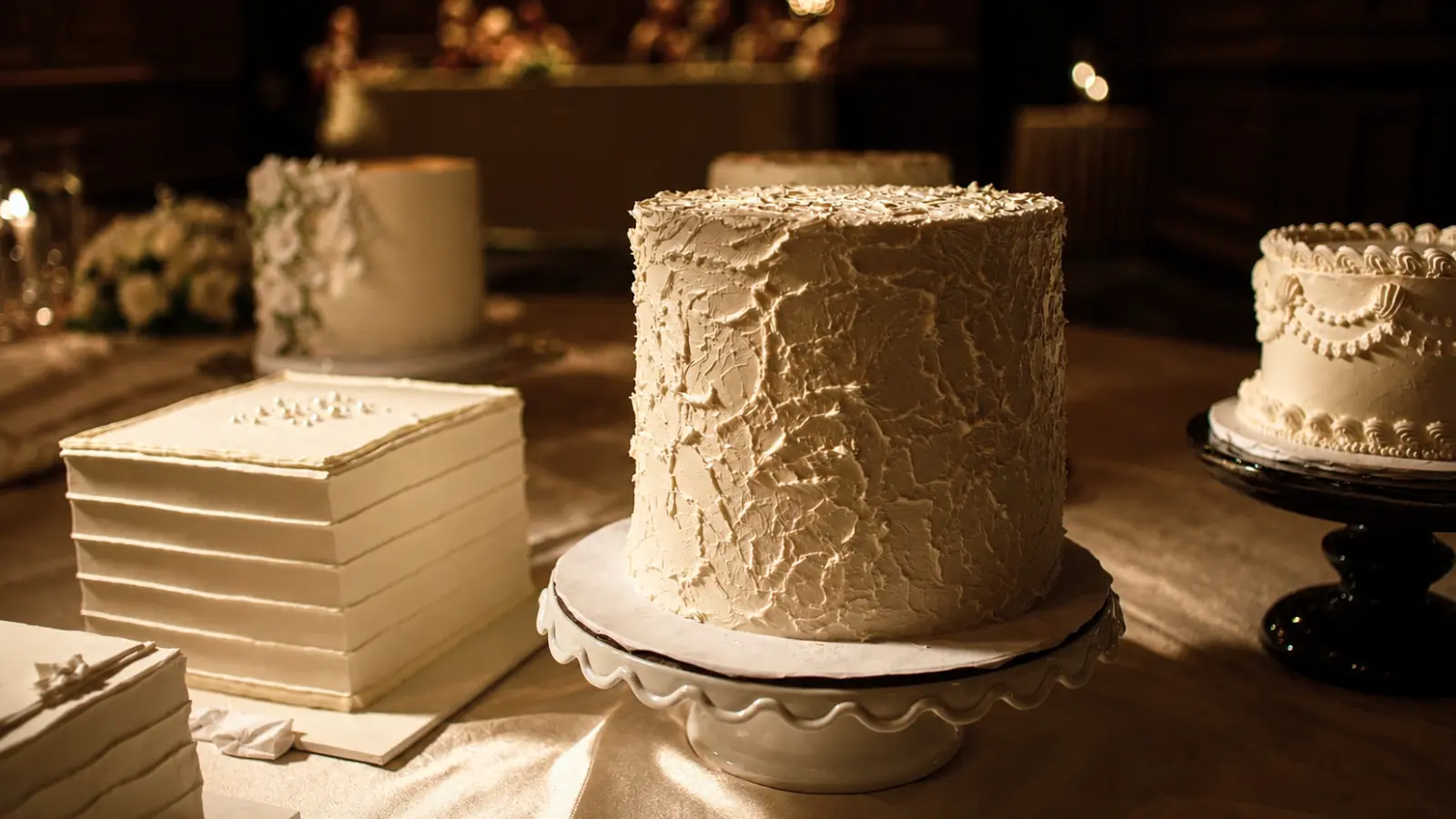
Buttercream vs fondant wedding cakes is one of the most important frosting decisions couples make when choosing the final look, taste, and performance of their wedding cake. Buttercream is known for its rich flavor and natural finish, while fondant is often chosen for smooth designs, detailed decoration, and added stability.
The debate is not as simple as saying one option looks better and the other tastes better. The right choice depends on your wedding style, venue conditions, climate, design expectations, budget, and the skill of your baker. A simple outdoor summer wedding and a formal ballroom reception may require completely different frosting decisions.
In this guide, you’ll compare buttercream and fondant wedding cakes by taste, appearance, cost, customization, heat performance, and guest experience. You’ll also learn the different types of buttercream, when fondant is worth choosing, and how to decide which option makes the most sense for your wedding.
Buttercream Wedding Cakes Explained
Buttercream is a frosting made primarily from butter (or a combination of butter and shortening), sugar, and flavorings. It is applied to the cake in layers — a crumb coat first to seal the surface, then one or more finishing coats — and can be left smooth, textured, or piped into decorative patterns.
What most people think of when they hear “buttercream wedding cake” is actually just one version of buttercream — American buttercream — which is made with butter, powdered sugar, and often a splash of milk or cream. It is the most common, the sweetest, and the easiest to produce. But it is also the least nuanced version of a frosting category that includes three meaningfully different formulas, each of which produces a different taste, texture, and finish.
On the aesthetic side, buttercream is remarkably versatile and can create many different styles of wedding cakes. It can be spread smooth (with enough skill), applied in deliberate textured strokes, piped into rosettes and borders, combed into geometric patterns, or applied thinly for a naked or semi-naked effect. The range of visual outcomes from buttercream is wider than most couples realize — and the best of those outcomes are fully competitive with fondant in photographs.
The limitations of buttercream are real but often overstated. It is less stable in heat and humidity than fondant. It is harder to achieve absolute geometric precision with. It cannot hold very dark, saturated colors as cleanly. But at a quality bakery, using the right formula for the conditions, none of these limitations are deal-breakers for the vast majority of weddings.
Types of Buttercream for Wedding Cakes
This is the section most wedding cake guides skip entirely — which is a problem, because the type of buttercream your baker uses affects the taste, the finish quality, the heat stability, and the cost of the cake significantly. Couples who ask “buttercream or fondant” without knowing which buttercream their baker uses are not getting the full picture.
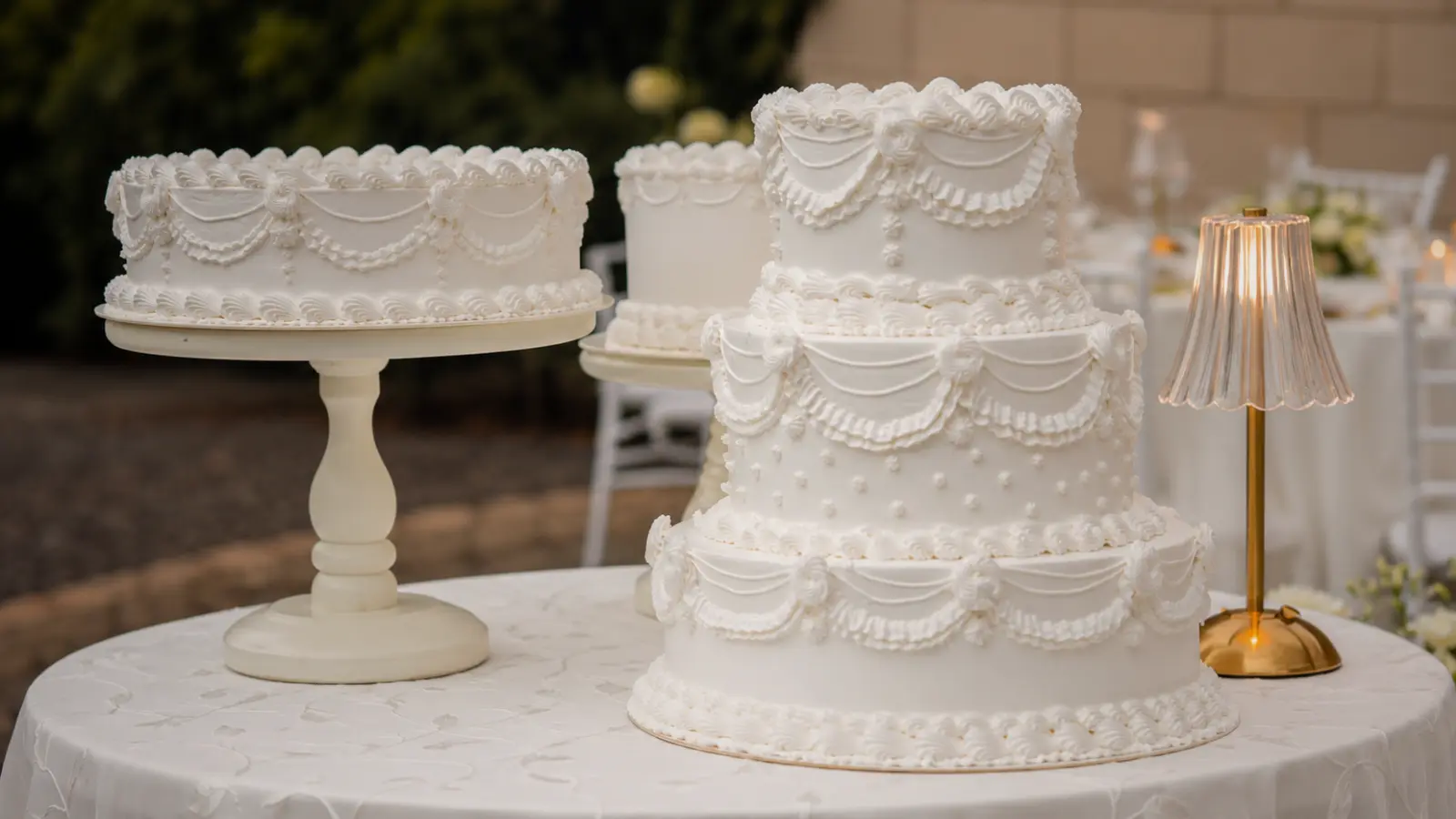
American buttercream
The most common wedding cake frosting in the U.S. Made with butter (or a butter-shortening combination), powdered sugar, and a small amount of liquid. It is the sweetest of the three by a considerable margin — a quality that some guests love and others find overwhelming.
Its heat performance depends heavily on the recipe. American buttercream made with a higher sugar ratio or some shortening can be relatively sturdy, while butter-heavy versions may soften in warm outdoor conditions. For a summer wedding, ask your baker how their specific formula performs in heat and humidity.
The finish quality with American buttercream varies significantly by baker skill. A smooth finish requires real technique; without it, American buttercream shows every scrape mark and tool line. The advantage is that it is inexpensive to produce, takes color readily, and is available at virtually every bakery in the country.
Swiss meringue buttercream
Made by cooking egg whites and sugar together, whipping them to a stiff meringue, then incorporating butter. The result is significantly less sweet than American buttercream, with a silky, satiny texture that melts on the tongue in a way that powdered-sugar-based frosting never does. It is the preferred choice at mid-to-high-end wedding bakeries for good reason.
Swiss meringue buttercream is meaningfully more heat-stable than American buttercream — it can hold up in outdoor conditions up to about 80°F before softening becomes visible. The finish quality is generally higher because the smoother base takes the scraper more evenly. The color range is somewhat narrower than American buttercream (the fat content makes very dark colors harder to achieve), but for the majority of wedding color palettes, it is not a limiting factor.
If your baker does not specify which buttercream they use, ask. If the answer is American buttercream and you are having an outdoor summer wedding, have a specific conversation about heat stability before finalizing the order.
Italian meringue buttercream
The most refined and most expensive of the three. Made by pouring a hot sugar syrup into whipped egg whites and then incorporating butter — a more technically demanding process that can produce an exceptionally silky, refined, and relatively stable result when handled by an experienced baker. Italian meringue buttercream has a satiny finish that photographs with exceptional clarity, takes a smooth bench-scraper application more consistently than either of the other two, and may offer slightly better stability than Swiss meringue depending on the formula and conditions.
The taste is less sweet than American, slightly different in character from Swiss — some describe it as slightly more refined or cleaner. It is often used by pastry-focused custom bakeries and may be reflected in the pricing. When a cake from an excellent baker using Italian meringue buttercream is placed next to a fondant cake in photographs, the two are virtually indistinguishable in surface quality.
Ermine buttercream (flour-based)
Less common but worth mentioning: ermine buttercream is made with a cooked flour-and-milk base rather than meringue. It is less sweet than American buttercream, slightly more stable in warmth, and has a soft, slightly different texture that some bakers prefer for specific applications. Not a standard offering at most bakeries, but if your baker mentions it, it is a legitimate and quality choice.
Fondant Wedding Cakes Explained
Rolled fondant is a pliable sugar dough — made from powdered sugar, water, gelatin or glucose, and glycerin — that is rolled out flat and draped over a crumb-coated cake. Once applied, it is smoothed with a fondant smoother to produce a porcelain-like surface, then trimmed at the base and decorated as desired.
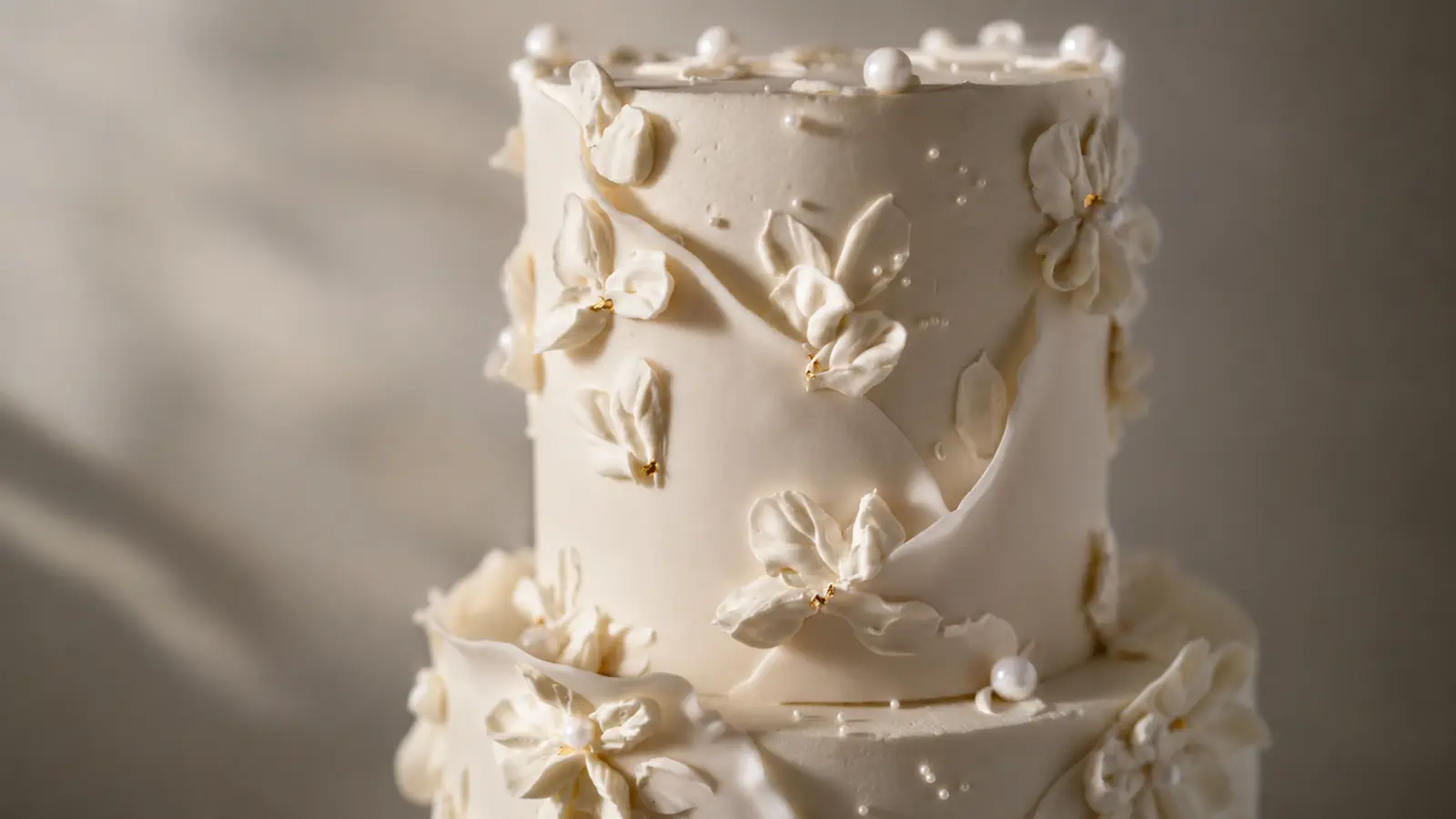
Fondant’s defining quality is consistency. Because it is a physical material rather than a spread frosting, it can produce a uniformly smooth surface when applied by a skilled baker. Every tier comes out the same. Corners are sharp, edges are clean, and the surface has a matte or low-gloss finish that photographs with remarkable precision. For highly decorative wedding cake designs — ones with hand-painted details, sugar flowers, embossed patterns, or printed elements — fondant is often the most practical surface because it provides a stable, dry base for applied decoration.
The well-known limitation of fondant is taste. Fondant is usually quite sweet and slightly chewy, which is why some guests prefer to eat the cake underneath and leave part of the fondant aside. This is such a widely shared experience that “peeling off the fondant” has become a wedding cake cliché. Premium fondant formulas have improved the taste somewhat, but the gap between good fondant and good buttercream in palatability remains significant for most tasters.
What bakers rarely tell couples upfront: the fondant layer is applied over a crumb coat of buttercream, which means the cake underneath is buttercream regardless of which frosting is on the exterior. The choice between fondant and buttercream is specifically a choice about the outer layer — the part that is visible in photographs and the part that guests first encounter when they take a bite.
Buttercream vs Fondant: Key Differences
| Factor | Buttercream | Fondant |
|---|---|---|
| Taste | Rich, buttery, varied by type — broadly preferred | Very sweet, slightly chewy — often peeled off by guests |
| Finish | Smooth to textured — varies significantly by baker skill | Consistently smooth — more forgiving of technique variations |
| Heat stability | Lower (American BC) to moderate (Swiss/Italian BC) | Higher — creates a sealed exterior that resists wilting |
| Color range | Good for pastels and mid-tones; harder for very deep colors | Excellent across the full spectrum, including deep and saturated colors |
| Texture options | Wide — smooth, textured, naked, combed, piped, palette knife | Primarily smooth, with embossed or applied surface decoration |
| Design flexibility | Best for organic, textured, and natural aesthetics | Best for precise, graphic, and highly decorative designs |
| Cost | Generally lower | Typically $1–$3 more per serving |
| Photography | Excellent — especially textured finishes in natural light | Excellent — consistent surface reads cleanly in all conditions |
| Popularity (U.S.) | ~65–70% of couples | Popularity (U.S.) Buttercream is common for natural, floral, and textured styles Fondant remains common for highly decorative, smooth, and precise designs |
Which Tastes Better?
For most guests, buttercream is usually the more enjoyable eating experience.
Fondant is made primarily from sugar — powdered sugar, water, and glucose or gelatin. The result is a layer that is extremely sweet, physically dense, and chewy in a way that is distinctly unlike frosting. What most people experience when they first encounter fondant is the sweetness before anything else — an intensity that can overwhelm the wedding cake flavors underneath. Some guests quietly peel the fondant off and set it on the side of the plate before eating the cake.
This is not a fringe experience. Bakers who work with fondant regularly often know that some guests treat the fondant layer as decorative rather than something they want to eat. It does not ruin the cake — the buttercream crumb coat and the cake layers underneath are still there — but it means the fondant layer is functionally decorative rather than a meaningful part of the eating experience.
A good buttercream, by contrast, is part of the reason people remember a wedding cake fondly. A Swiss or Italian meringue buttercream — rich, smooth, less sweet than the American version — has a flavor complexity that guests actually notice and remember. “The frosting was incredible” is a comment that follows buttercream cakes. “The frosting was fine” is more typical of fondant.
The caveat: if the cake itself is the primary focus and the frosting is incidental to your couple’s decision, the taste difference matters less. Some couples genuinely prioritize the visual impact of the cake above the eating experience, and for those couples, the trade-off is worth it. But for couples who care about what their guests actually taste, buttercream is the clear choice.
Which Looks More Polished?
This is where the conventional wisdom that “fondant looks better” comes from — and it is partially correct but significantly overstated in the current wedding market.
Fondant achieves a consistently smooth finish because of its physical properties. When a skilled baker applies fondant to a well-crumb-coated cake and smooths it with a fondant smoother, the result is a surface that is uniformly flat, matte, and precise. Every tier matches. The corners are sharp. The color is even. This consistency is why fondant has traditionally been associated with formal, elegant wedding cakes — it produces a result that looks the same regardless of how technically demanding the moment of application was.
What has changed is that skilled buttercream technique can now create extremely polished results. When working with an experienced wedding cake baker that specializes in buttercream, a bench-scraped smooth finish using Swiss or Italian meringue buttercream is virtually indistinguishable from fondant in photographs. The surface has a slightly different quality — a bit warmer, a touch less perfectly matte — but in the context of a beautifully designed wedding cake, this difference registers as character rather than imperfection.
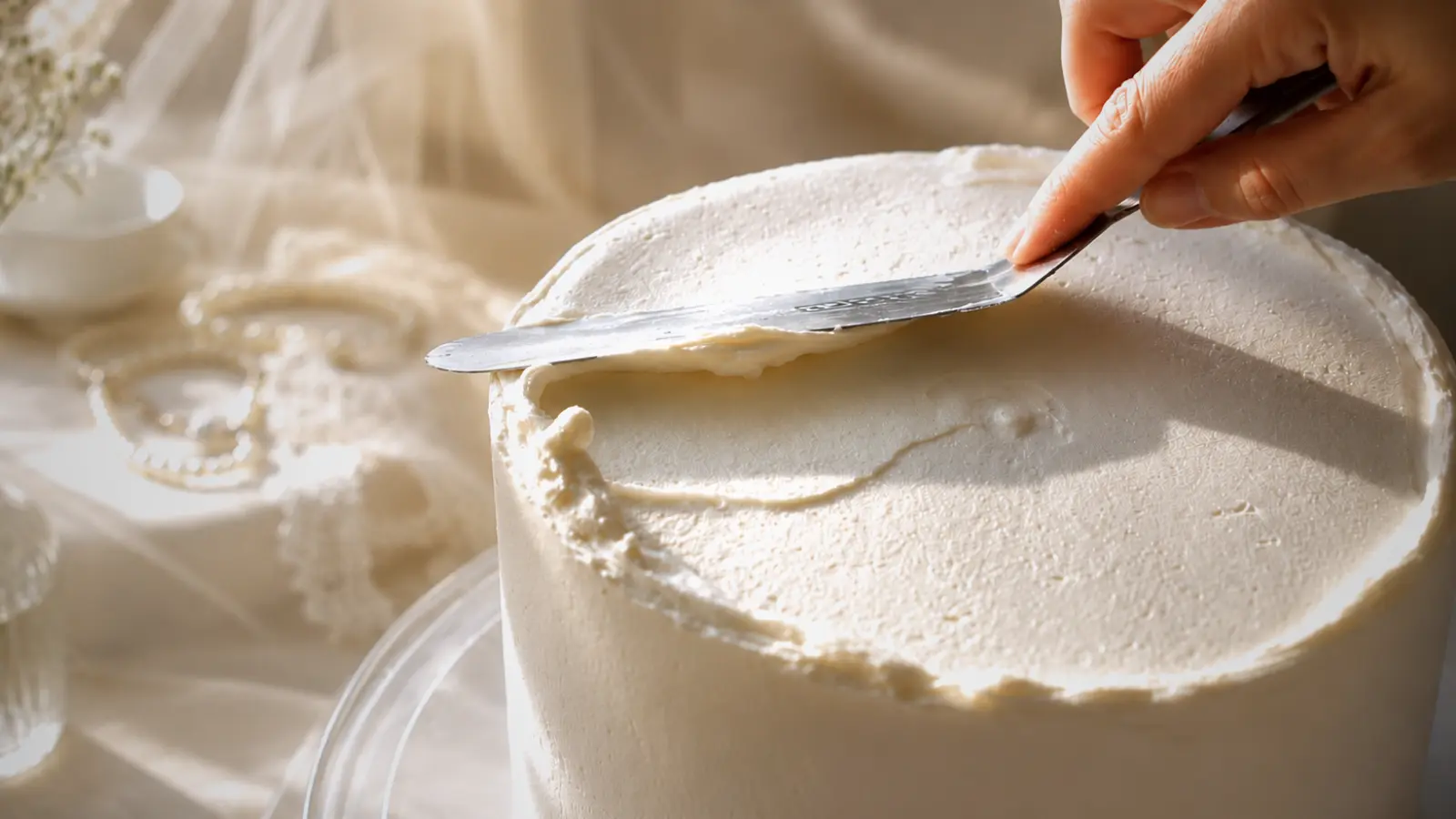
Where fondant still genuinely wins on appearance:
Very precise color matching. If the couple needs a cake in a very specific deep color — navy, burgundy, forest green, black — fondant takes color more cleanly. American buttercream in very deep colors can take on a slightly bitter taste from the food coloring required to achieve them. Fondant does not have this problem.
Structural decoration. Hand-painted designs, embossed patterns, applied sugar flowers, and printed or transferable details all require a dry, stable surface. Fondant provides this. Buttercream does not — it is too soft and moist for many applied decoration techniques.
Geometric precision at scale. For a very large cake — four or five tiers with multiple sharp edges and perfectly matched tiers — fondant’s consistency is a meaningful advantage over buttercream, where technique variations become more visible across a larger surface area.
Where buttercream wins on appearance:
Textured and naturalistic aesthetics. The palette knife stroke, the rustic swirl, the combed finish, the naked or semi-naked exposure of layers — all of these are buttercream-specific effects that are either impossible or significantly more difficult to achieve with fondant. In natural light, a textured buttercream cake photographs with a depth and warmth that fondant simply cannot replicate.
Fresh flowers and organic decoration. Floral wedding cakes often work beautifully with buttercream because fresh blooms sit naturally against textured or smooth frosting surfaces
Which Is Better for Outdoor Weddings?
For outdoor summer weddings, including beach wedding cakes in warm climates, this is one of the most practically important questions in wedding cake planning — and the answer is more nuanced than most guides acknowledge.
The general principle: fondant is more heat-stable than American buttercream. Fondant creates a sealed exterior that resists melting and wilting better than a frosting that is primarily fat and sugar. In direct sunlight or temperatures above 80°F, an American buttercream cake will soften and begin to lose its finish. Fondant will hold its shape for longer.
But the comparison has a missing variable: which buttercream?
American buttercream performance depends on the formula. Some versions made with higher sugar or shortening are sturdier, while butter-heavy versions can soften in warm outdoor conditions. For outdoor summer receptions, the baker’s exact recipe and setup plan matter more than the name of the buttercream alone.
Swiss and Italian meringue buttercreams can work beautifully for outdoor weddings in mild to moderate conditions, especially when the cake is shaded, displayed for a limited time, and handled by a baker who understands the recipe’s limits.
Italian meringue buttercream can be a strong option for polished buttercream cakes, but it is still butter-based and still needs a realistic heat and display plan. At a bakery that uses Italian meringue, an outdoor summer wedding in a shaded setting with reasonable temperature control is feasible.
The practical guidance for outdoor wedding cake planning:
If your outdoor wedding is in a hot, humid climate fondant may be the safer choice for visual stability, especially for smooth or highly decorative designs. Alternatively, choose a Swiss or Italian meringue buttercream and have the cake stored indoors or in a cooled tent until service — no more than 30 minutes before cutting.
If your outdoor wedding is in a mild climate or in spring/fall: Swiss or Italian meringue buttercream is entirely appropriate with reasonable precautions. Keep the cake out of direct sunlight, store it indoors until an hour before cutting, and confirm with your baker what temperature range their buttercream formula can handle.
For any outdoor wedding regardless of climate: Avoid setting up the cake table in direct sunlight. A shaded area — under a tent, beneath a tree, or in a covered portion of the venue — extends the stability window of any frosting significantly.
Which Is Easier to Customize?
The answer here depends on what kind of customization you want — and the two frostings are genuinely better at different things.
Fondant is better for:
Precise color matching, including very deep or saturated colors. Hand-painting and illustrated designs — the fondant surface is stable enough for an artist to paint on it with edible colors in fine detail. Embossed or impressed patterns — fondant can be pressed with molds and tools to create lace effects, geometric patterns, and surface textures that are impossible with buttercream. Applied decoration — sugar flowers, edible gold leaf, printed images, and gum paste sculptures all adhere to and look better against a fondant surface. Printed designs and photo transfers.
Buttercream is better for:
Organic, handcrafted aesthetics — the palette knife stroke, the rustic application, the naturalistic texture. Fresh and dried flower arrangements, which sit and look more natural against the softness of buttercream. Naked and semi-naked designs, which require a specific application technique unique to buttercream. Multiple finish textures within the same cake — different surfaces on different tiers. Natural color palettes and pastel shades, which buttercream renders more softly and naturally than fondant.
Many current American wedding cake styles lean toward the buttercream aesthetic: natural textures, fresh flowers, organic imperfection, and handcrafted quality rather than the graphic precision of fondant. This shift reflects a change in wedding aesthetics overall — toward the intimate and personal rather than the formal and perfect.
Couples who want a highly decorative cake with sugar flowers, hand-painted details, or very precise color work should consider fondant. Couples who want a cake that looks beautiful, natural, and like it was made by human hands should lean toward buttercream.
Which One Costs More?
Fondant wedding cakes generally increase wedding cake cost compared with buttercream cakes of comparable size and design complexity. The cost difference comes from two sources: materials and labor.
Fondant as a material is more expensive than buttercream ingredients. The application process — rolling the fondant to an even thickness, draping it over the cake, smoothing it without tearing — is more time-consuming than applying buttercream. And for highly detailed fondant work (sculpted elements, hand-painting, applied sugar decorations), the labor cost increases significantly.
General cost difference estimates:
Per serving: Fondant often costs more than a comparable buttercream design because it adds material and labor. Across a larger guest count, even a modest per-serving difference can meaningfully increase the total.
By design complexity: A simple fondant cake — smooth white fondant, no elaborate decoration — may add only $1 to $1.50 per serving over a comparable smooth buttercream. A fondant cake with extensive hand-painting, sugar flowers, or sculpted elements can cost significantly more because the design labor becomes more important than the frosting choice alone.
By buttercream type: Within buttercream, there is also a cost difference between types. American buttercream is often less expensive than Swiss or Italian meringue buttercream, while Italian meringue may cost more because it requires more technical skill and labor. Swiss meringue falls in between. For couples who care about a silky texture and polished finish, the premium for Swiss or Italian meringue buttercream may be worth discussing with the baker.
The practical implication: if budget is a meaningful consideration, buttercream is the more cost-effective choice at any given level of design complexity. The difference in per-serving cost is not dramatic for simple designs, but adds up across larger guest counts and scales significantly with design complexity.
What Most Couples Actually Choose and Why
Buttercream has become a very common choice at American weddings, especially for natural, textured, floral, and organic cake styles. This reflects a broader shift in wedding aesthetics, where many couples now prefer natural texture, fresh flowers, and a more handcrafted look.
The shift reflects three changes that happened more or less simultaneously:
Aesthetic changes. The dominant wedding aesthetic in the U.S. moved toward the natural, the organic, and the artisanal — and buttercream fits that aesthetic more naturally than fondant. Textured buttercream, naked cakes, fresh flowers on frosting: all of these are buttercream choices. The highly formal, porcelain-smooth fondant cake is still beautiful, but it belongs to a different aesthetic direction than where the majority of American wedding design has moved.
Buttercream quality improvements. Swiss and Italian meringue buttercream, now standard at mid-to-high-end bakeries, produce a finish quality that was not widely available at all price points a decade ago. Couples no longer have to choose between fondant precision and buttercream flavor — they can have a high-quality buttercream that both tastes excellent and photographs cleanly.
Greater awareness of fondant’s limitations. The widespread experience of peeling fondant off wedding cake slices has made couples more thoughtful about the choice. When couples understand that some guests may set the fondant aside, they can weigh the visual benefits against the eating experience more realistically.
Fondant remains the choice for couples who want highly decorative cakes, very precise color matching, or the specific aesthetic that fondant’s smooth, graphic surface provides. For everything else, buttercream is increasingly the default — and for good reasons.
The Honest Case for Each
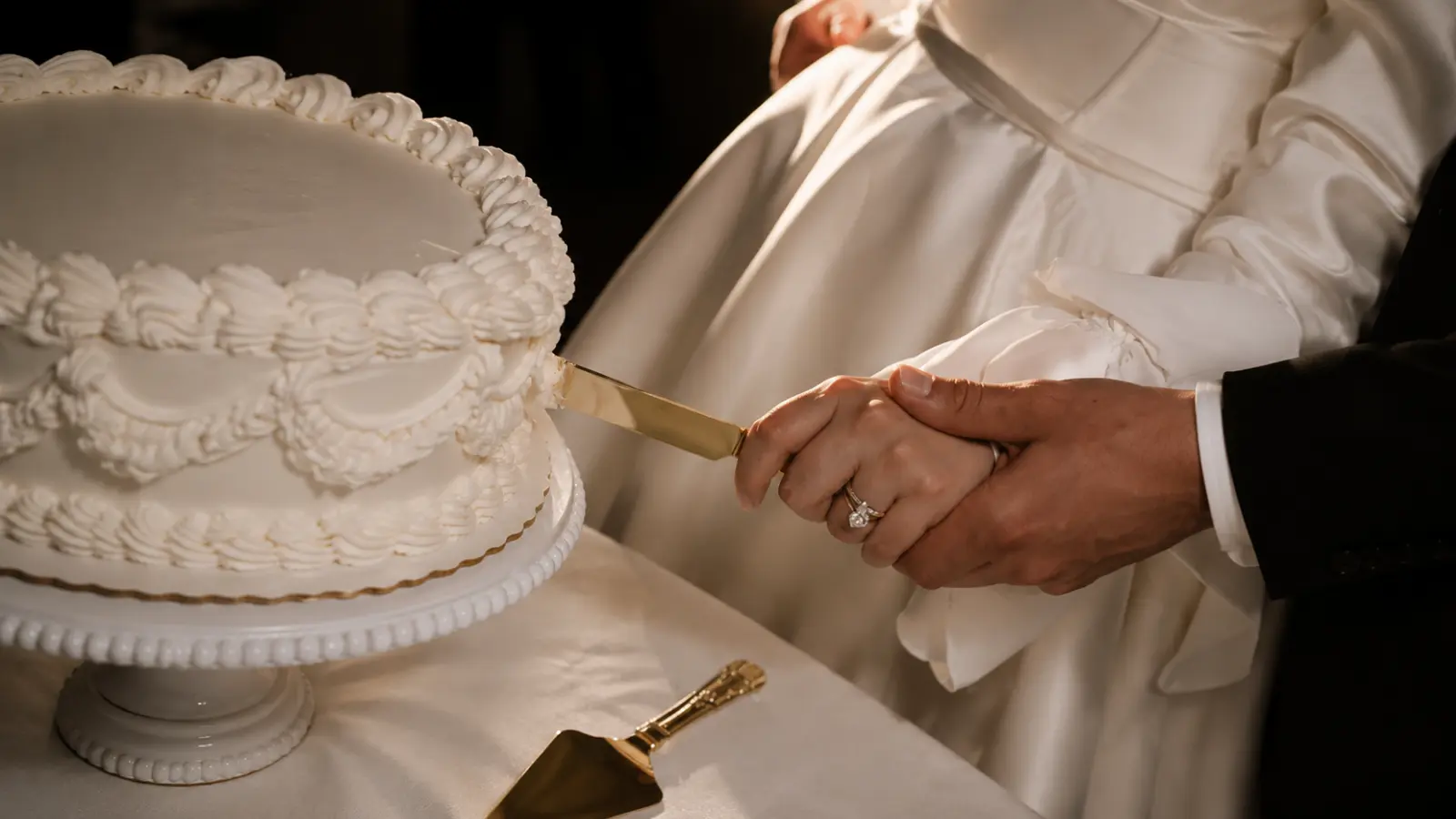
Choose buttercream if:
You want your guests to genuinely enjoy the frosting rather than set it aside. You prefer a natural, organic, or artisanal aesthetic often seen in rustic wedding cakes — textured finishes, fresh flowers, and exposed layers. Your wedding is in a mild climate or indoors with climate control, making heat stability a non-issue. You are working with a mid-to-high-quality baker who can deliver a smooth or textured buttercream finish with confidence. Budget is a consideration and you want to spend the savings on design quality elsewhere.
Choose fondant if:
Your cake design requires precise, deep color matching — navy, burgundy, black, forest green — that buttercream cannot achieve as cleanly. You want hand-painted, embossed, or detailed applied decoration (sugar flowers, printed designs) that requires a dry, stable surface. Your wedding is outdoors in a warm or humid climate and you need the best available heat stability. You want the specific aesthetic that fondant’s smooth, graphic surface provides and you are committed to it as a visual direction rather than just a default.
The combined approach (and when to consider it):
Some couples choose a fondant exterior with the understanding that it will be peeled off — using it purely for the visual surface — and ensure the buttercream beneath the fondant is excellent. Others choose a smooth buttercream exterior with fondant decorative elements (sugar flowers, applied details) that give them the decorative precision they want without covering the entire cake. If your bakery offers it, this hybrid approach can give you the best of both — and it is worth asking about if you find yourself wanting elements from each side of the comparison.
Buttercream vs Fondant Wedding Cake Inspiration Board
Buttercream and fondant wedding cakes create very different visual effects, from textured buttercream finishes and fresh flower designs to smooth fondant tiers, deep colors, and polished decorative details. Explore our buttercream vs fondant wedding cake inspiration board for frosting styles, cake finishes, outdoor wedding ideas, elegant designs, and visual comparisons to help you choose the right look for your celebration.
Final thoughts
For many weddings, buttercream is the stronger choice because it tastes good, photographs beautifully, can cost less, and fits the natural, textured, and floral cake styles many couples love. When made by a skilled baker, buttercream can look polished enough for an elegant reception while still giving guests a frosting they genuinely enjoy.
Fondant still has a clear place when the design requires sharp precision, deep color, hand-painted details, applied decoration, or extra stability in warm outdoor conditions. The best decision is not about which frosting is universally better, but which one supports your cake design, venue, season, budget, and baker’s strongest work.
Frequently asked questions (FAQ)
Will guests care if a wedding cake is buttercream or fondant?
Most guests do not notice the frosting type by name. They notice how the cake looks when they first see it and how it tastes when they eat it. A beautifully executed buttercream cake and a well-designed fondant cake can both create an impressive visual moment — but the eating experience is usually where guests remember the biggest difference.
What is the biggest mistake couples make when choosing between buttercream and fondant?
Choosing based only on photos. A cake needs to survive the actual wedding day: transportation, temperature, display time, cutting, and serving. The best frosting choice is the one that fits your design, venue, season, and baker’s strongest skills.
Why do some luxury wedding cakes still use fondant?
Fondant remains valuable for certain designs. High-end cake artists often use it because it allows precise shapes, dramatic colors, hand-painted details, and complex decoration. Choosing fondant is not automatically outdated — it depends on whether the design actually benefits from it.
Can a buttercream cake still look expensive?
Absolutely. Luxury comes from craftsmanship, not just the frosting material. A flawless buttercream finish with balanced proportions, quality ingredients, and intentional styling can look just as refined as a fondant cake.
Should you prioritize wedding cake appearance or taste?
The strongest wedding cakes balance both. Photos matter because the cake is part of the reception design, but guests experience the cake through flavor. A cake that looks beautiful and tastes memorable usually creates the greatest overall impact.
What do professional cake designers consider before recommending buttercream or fondant?
They look at the complete wedding environment: venue, temperature, design complexity, timeline, guest experience, and the couple’s priorities. Experienced designers are not choosing a “better” frosting — they are choosing the right tool for a specific cake.
Is fondant more expensive than buttercream?
Fondant is often more expensive than buttercream because it adds both material and labor. The final difference depends on the bakery, cake size, design complexity, and whether the fondant is being used only for a smooth surface or for detailed decoration such as hand-painting, embossing, or sculpted elements.
Is buttercream or fondant better for hot weather?
Fondant is often more stable visually in hot or humid conditions, especially for smooth or detailed designs. Buttercream can still work well when the cake is kept shaded, stored properly, and displayed for a limited time, but the result depends heavily on the exact buttercream recipe and the baker’s setup plan.