Wedding cakes are tiered celebration cakes designed for wedding receptions, serving as both a visual centerpiece and a dessert for guests. Beyond being a long-standing wedding tradition, they help define the style of the reception and create one of the most recognizable moments of the entire celebration.
Choosing the right wedding cake can feel more complicated than couples expect because every decision affects something else. The design needs to match the venue, the flavor needs to please guests, the size needs to serve the right number of people, and the cost needs to make sense within the overall wedding budget.
This guide covers everything couples need to know about wedding cakes, including styles, flavors, costs, tiers, sizing, buttercream vs. fondant, flowers, toppers, tastings, cake table ideas, alternatives, and the practical details that make a wedding cake beautiful, memorable, and realistic for the wedding you are actually planning.
Wedding Cake Styles Explained
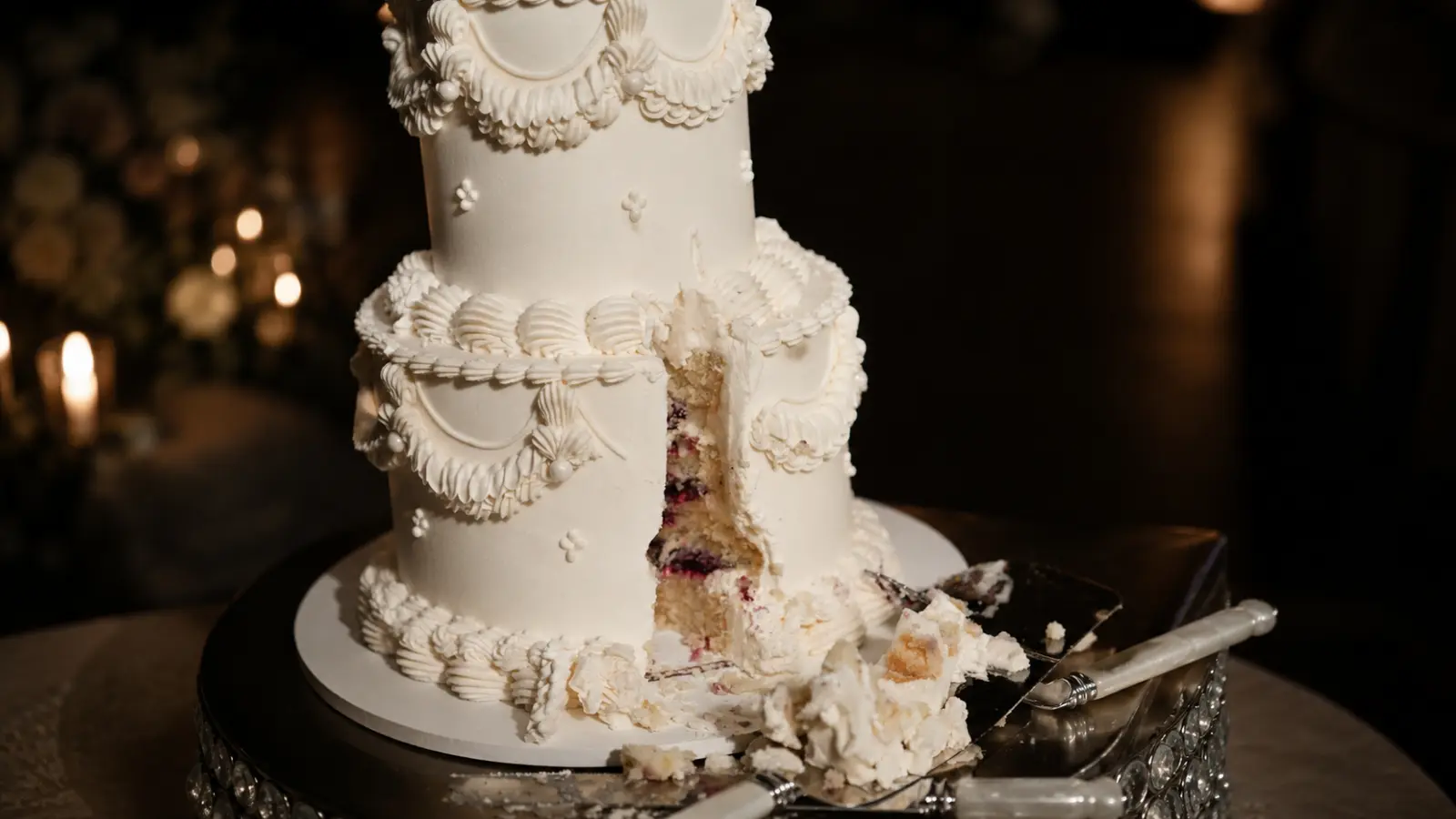
Wedding cake design is the visual language the cake speaks before anyone cuts into it. The style tells the room something about the couple — it should be consistent with the rest of the wedding aesthetic, the venue, the dress, the florals. A beautifully executed rustic cake at a formal ballroom wedding looks like a mistake. The same cake at a barn wedding looks exactly right. Style is context-dependent, and understanding what each style actually is — rather than what Pinterest calls it — is the first step to choosing well.
Buttercream wedding cakes
Buttercream is not a style; it is a medium. But it is worth starting here because it is one of the most widely chosen finishes at American weddings and encompasses many of the styles below. Buttercream vs fondant wedding cakes often comes down to finish, taste, texture, and the level of detail the design needs. Many guests prefer the taste and texture of buttercream over fondant. It photographs beautifully and works in almost every aesthetic context.
The two types couples usually encounter at tastings are American buttercream, which is made with powdered sugar and butter and tends to be sweeter, stiffer, and better for piped detail, and Swiss or Italian meringue buttercream, which is made with egg whites and butter and tends to be silkier, less sweet, and better for smooth finishes. Most high-end cake designers use meringue buttercream. Most supermarket and mid-range bakeries use American buttercream. The difference is noticeable in both taste and texture.
Fondant wedding cakes
Fondant produces the smoothest, most porcelain-like cake surface available. It holds detail exceptionally well — sharp edges, intricate piped patterns, embossed textures — and handles humidity better than buttercream, which matters for outdoor summer weddings. The trade-off is widely acknowledged: many guests find fondant unpleasant to eat and push it to the edge of the plate. If a cake’s visual depends on fondant, the couple is paying for aesthetics a portion of their guests will not consume.
For couples who specifically want the sharp-edge modern look or the porcelain quality of fondant, the best compromise is a fondant-covered cake with a thick, flavorful filling — so guests are eating the cake layers and filling regardless of whether they eat the fondant.
Naked and semi-naked wedding cakes
The naked cake — a stacked tier cake with little or no frosting on the exterior, so the cake layers are deliberately visible — arrived at American weddings around 2015 and has remained a consistent choice for couples who want an organic, unfussy aesthetic. At its best, a naked cake is beautiful: the natural layers of cake and filling create a warm, textured look that pairs perfectly with fresh fruit, herbs, and wildflowers.
What to know before choosing a naked cake: it requires very fresh cake layers (exposed cake dries out faster than frosted cake), it is more temperature-sensitive than covered cakes, and it requires a specific aesthetic context to look intentional rather than unfinished. A naked cake looks right at a garden wedding, a barn reception, a bohemian outdoor venue. It looks out of place at a formal ballroom or a glamorous event.
The semi-naked cake — a thin layer of buttercream applied and partially scraped away, leaving the cake layers visible through a gauze-like frosting — is the more practical version. It protects the cake from drying out, photographs with the same organic texture, and works in a wider range of aesthetic contexts.
Floral wedding cakes
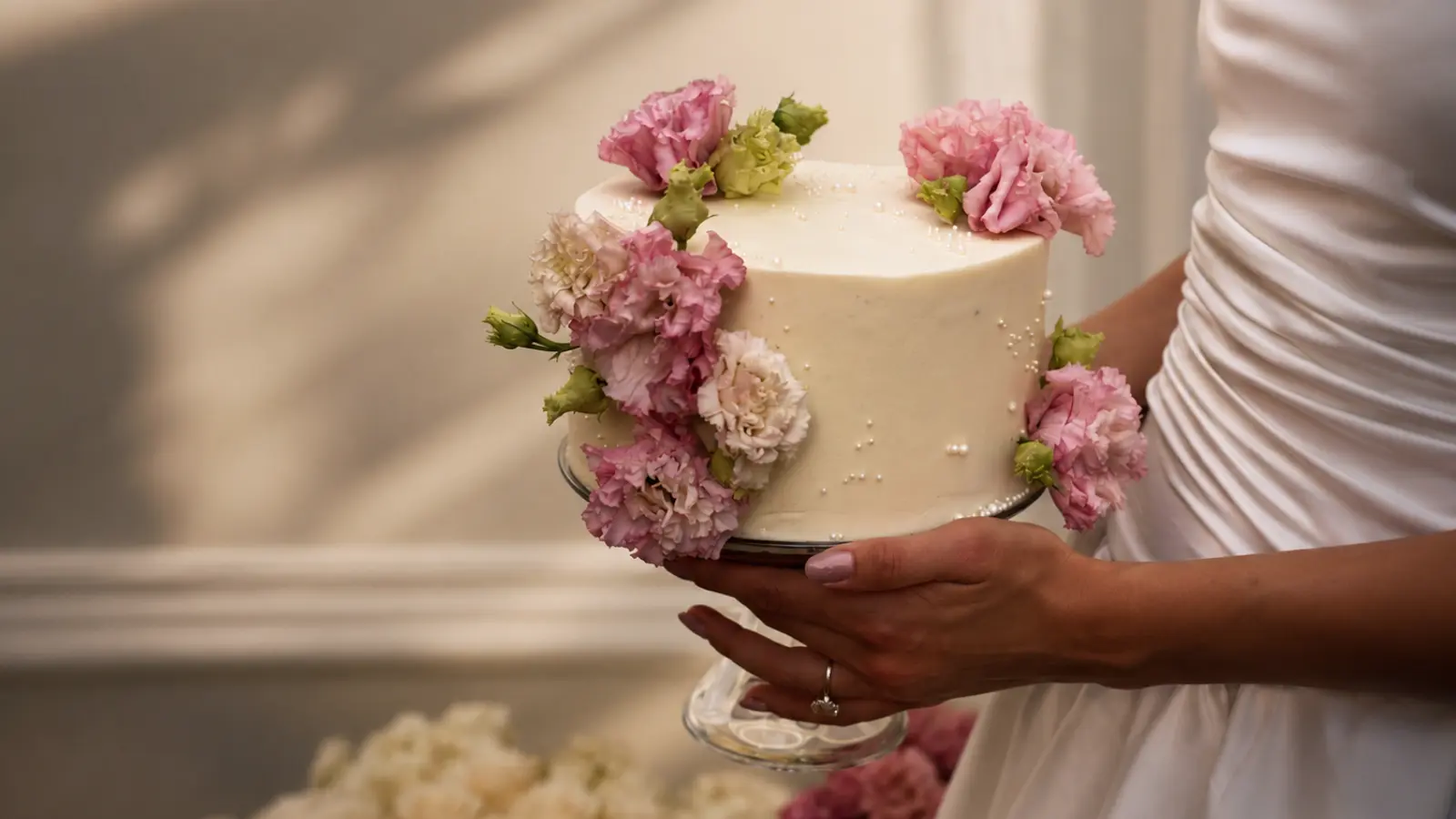
Floral wedding cakes — decorated with fresh flowers, dried flowers, or sugar flowers — are among the most consistently popular cake styles in the U.S. The reason is practical as much as aesthetic: flowers are the most universally understood symbol of a wedding, they are available in every color and variety, and they can be matched directly to the ceremony and reception florals to create visual coherence across the entire wedding.
The execution varies enormously. At one end: a simple two-tier buttercream cake with a handful of fresh garden roses placed loosely at the base and between tiers. At the other: an elaborate sugar flower cascade with hand-crafted blooms requiring 40 or more hours of work at a price that reflects it. Both are “floral cakes.” Understanding where on this spectrum your vision falls — and what it costs — is essential before you fall in love with the most elaborate version.
Rustic wedding cakes
Rustic wedding cakes are characterized by an organic, textured appearance — rough buttercream applied with visible strokes, semi-naked layers, fresh herb accents, fruit, and unrefined florals. The aesthetic is deliberately imperfect, which is both its charm and its challenge: an imperfect cake that was meant to look that way is beautiful; an imperfect cake that was supposed to be smooth looks like a problem.
Rustic cakes work best at outdoor venues, barn receptions, vineyard weddings, and any event where the overall aesthetic favors natural materials and informal elegance. They are significantly less expensive to produce than heavily decorated formal cakes, since the textured finish requires less labor than a smooth one.
Vintage wedding cakes
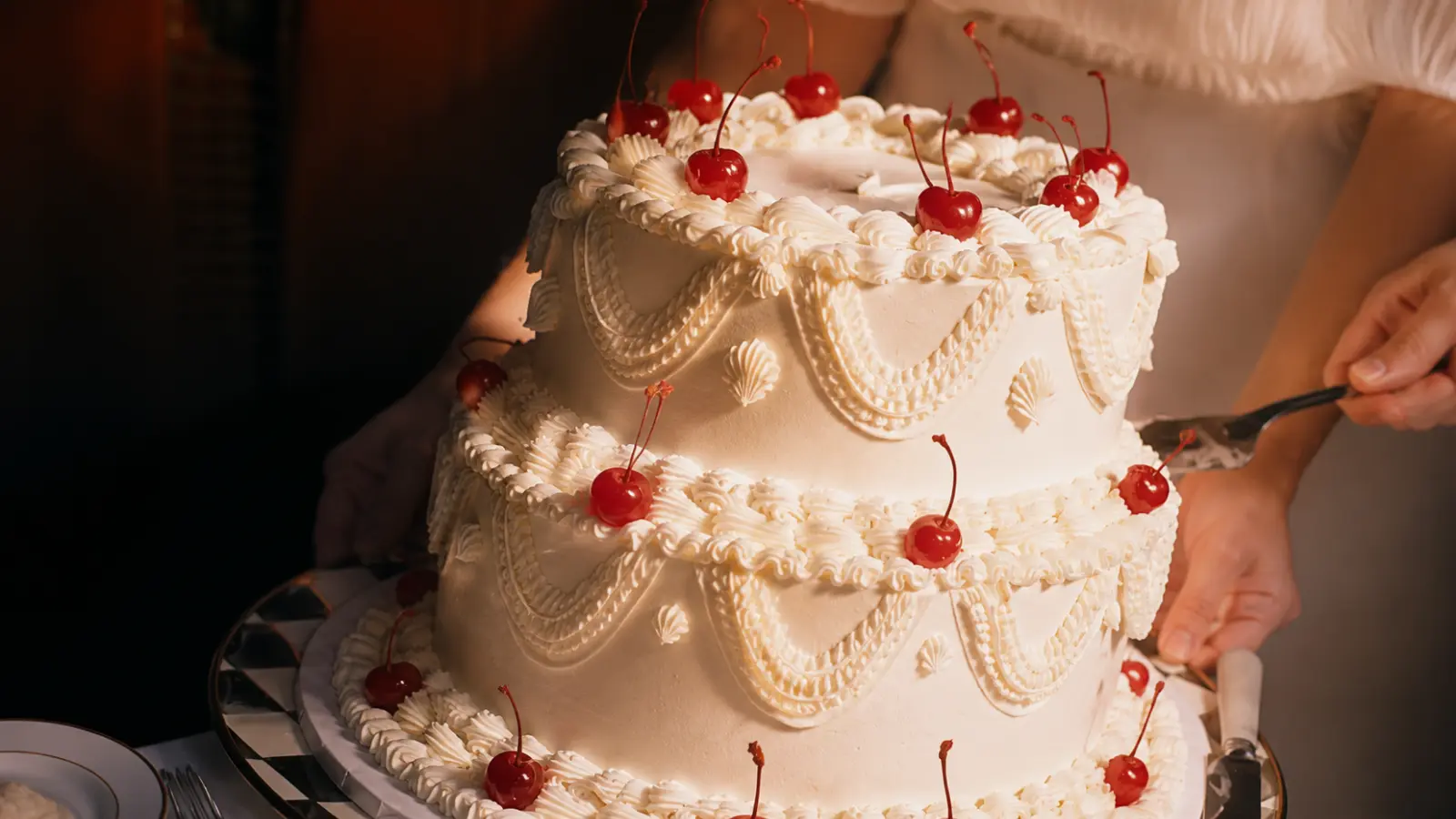
Vintage wedding cakes draw from the decorative traditions of mid-century cake design: piped lace patterns, ruffles, lambeth piping (raised, over-piped borders), pearl details, and monogram accents. They work beautifully at formal weddings with a historical or romantic aesthetic — a European church ceremony, a heritage estate reception, any event where the couple’s visual references are classic rather than contemporary.
The distinguishing quality of a well-executed vintage cake is the precision of the piping. Lambeth piping and lace patterns are technically demanding; not every bakery produces them at the level where they read as intentionally vintage rather than simply old-fashioned. Before booking a baker for a vintage cake, look specifically at their piping work in the portfolio, not just the overall cake shape.
Modern and minimalist wedding cakes
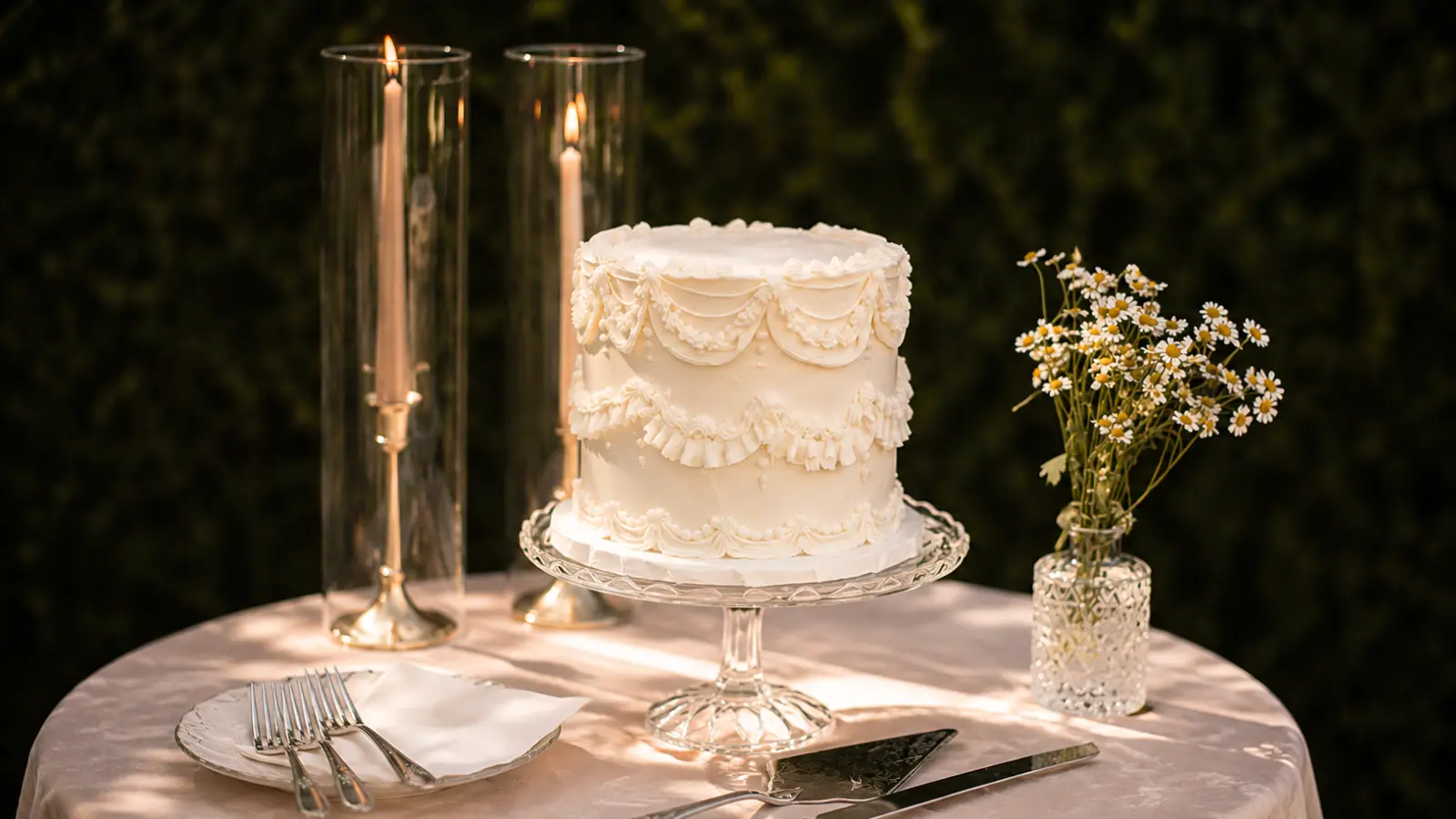
Modern wedding cakes are defined by restraint: clean lines, geometric shapes, monochromatic palettes, and deliberate simplicity. A single-tier white cake with a perfectly smooth surface and one brushstroke of 22K gold leaf. A three-tier gunmetal cake with sharp edges and no decoration. A stark white tiered cake with a structural architectural silhouette. The modern cake says more through what it withholds than through what it adds.
Modern cakes require very high technical skill, particularly in the smooth finish. An imperfect surface reads as a flaw on a minimalist cake in a way it never would on a rustic one. If the visual depends on technical perfection, the baker’s portfolio needs to demonstrate that specific capability.
Painted and artistic wedding cakes
Hand-painted wedding cakes — a buttercream or fondant surface used as a canvas for edible paint, watercolor washes, or detailed illustration — have grown significantly in popularity as a way to personalize the cake with meaningful imagery. A watercolor floral wash in the wedding color palette. A hand-painted landscape of the venue. A botanical illustration of the couple’s home city. These cakes are genuinely one-of-a-kind and are among the most photographed wedding cake styles when executed well.
Hand-painting is an additional labor cost on top of the base cake price, and the final amount depends on the complexity of the artwork, the baker’s skill level, and the amount of painted detail. Budget accordingly and look specifically for a baker whose portfolio includes painted work, not just a baker who says they can do it.
Quick style reference
| Style | Best Venue / Aesthetic | Relative Cost |
|---|---|---|
| Buttercream textured | Any venue; universally flexible | Moderate |
| Floral (fresh flowers) | Garden, estate, outdoor, any romantic setting | Moderate |
| Floral (sugar flowers) | Formal, ballroom, estate, editorial | High |
| Naked / semi-naked | Barn, garden, vineyard, bohemian | Low to moderate |
| Rustic | Barn, outdoor, vineyard, casual elegant | Low to moderate |
| Vintage / piped lace | Church, estate, heritage venue, formal | High |
| Modern / minimalist | Contemporary venue, art gallery, hotel | Moderate to high |
| Hand-painted | Any venue; works best as a statement piece | High |
Wedding Cake Flavors
Wedding cake flavor is where couples consistently make two kinds of mistakes: choosing something that sounds impressive but does not taste good to a broad group, or defaulting to vanilla because it is safe and then feeling underwhelmed at the tasting. The goal is not to pick the most adventurous flavor on the menu. It is to pick the flavor that will make a hundred people — who have just had cocktails, appetizers, and a full dinner — genuinely want a second slice.
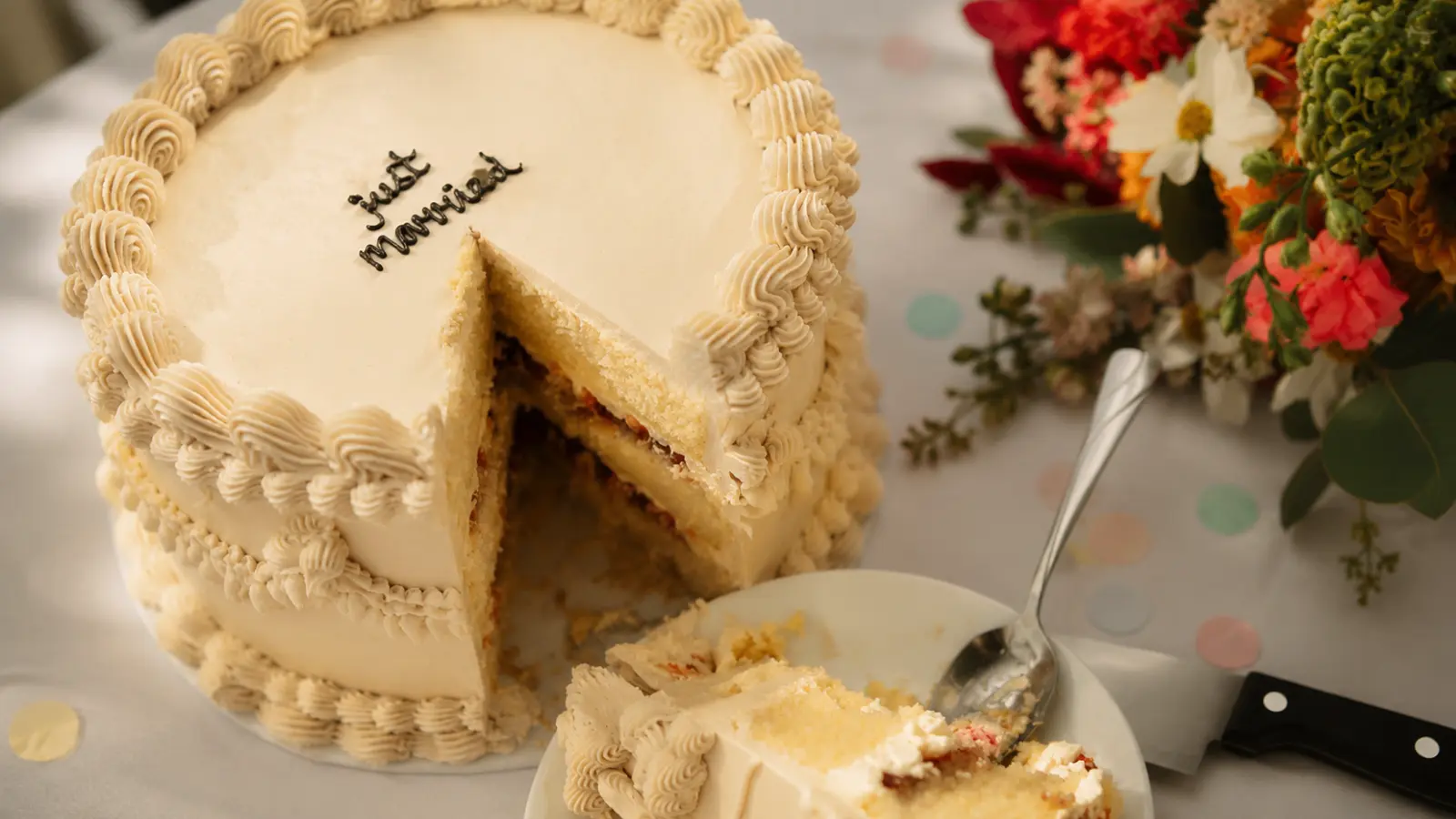
Among the most popular wedding cake flavors in the U.S.
- Vanilla bean. One of the most consistently requested flavors at American weddings, and not without reason. A vanilla bean cake with a quality vanilla bean buttercream or French vanilla pastry cream filling is a genuinely excellent dessert — clean, elegant, and widely liked. “Vanilla” has an unfair reputation for blandness that applies only to vanilla made with poor-quality extract. A good vanilla cake with fresh beans is complex and beautiful.
- Lemon. Among the most popular non-vanilla choices at American weddings. Lemon cake layers with lemon curd filling, finished in either a lemon buttercream or a vanilla buttercream with lemon zest, photographs beautifully and tastes refreshing after a full dinner. Works particularly well at spring and summer weddings.
- Red velvet with cream cheese frosting. A Southern American classic that has become a national wedding staple. The cream cheese frosting is part of the identity — do not attempt red velvet with any other frosting. Particularly appropriate for fall weddings or couples with Southern roots.
- Chocolate. A richer, more divisive choice than vanilla or lemon — most guests love it, a small number actively avoid it. Works best in a mid-tier configuration: one chocolate tier among two vanilla or lemon tiers, so guests who prefer lighter flavors have an option. A dark chocolate cake with salted caramel filling and chocolate ganache is one of the most genuinely delicious wedding cake combinations available.
- Almond. Underused at American weddings and worth more attention. An almond sponge cake with almond buttercream and a raspberry filling is one of the most sophisticated flavor combinations in the wedding cake repertoire. It pairs beautifully with a white or pale aesthetic. Works particularly well for couples who enjoy marzipan or European pastry traditions.
- Carrot cake with cream cheese frosting. A strong choice for autumn weddings — the warm spices feel seasonal and appropriate. Divides opinion slightly more than the other top choices, so better as one tier of a multi-tier cake than as the only flavor.
- Champagne or prosecco cake. Gaining popularity at more celebratory receptions. A champagne-infused sponge with champagne buttercream carries a subtle, sophisticated flavor that reads as appropriately wedding-specific without being overpowering.
Fillings and frosting pairings
Most wedding cake advice focuses on the cake flavor and neglects the filling, which is often the most flavorful element of the entire slice. The combination of cake, filling, and frosting is what a guest actually tastes — not any single element in isolation.
| Cake | Filling | Frosting |
|---|---|---|
| Vanilla bean | Fresh raspberry or strawberry | Vanilla bean buttercream |
| Lemon | Lemon curd | Lemon or vanilla buttercream |
| Almond | Raspberry or apricot jam | Almond buttercream |
| Dark chocolate | Salted caramel | Chocolate ganache or dark chocolate buttercream |
| Red velvet | Cream cheese frosting (as filling) | Cream cheese frosting |
| Carrot | Cream cheese with walnuts | Cream cheese frosting |
| Champagne | Passionfruit curd or peach jam | Champagne buttercream |
Choosing different flavors per tier
For a three-tier wedding cake serving 100 or more guests, different flavors per tier is a popular and practical choice. It gives guests variety, accommodates preferences, and creates a sense of abundance. The most common classic wedding cake flavors combination is vanilla on the top tier, lemon or almond on the middle tier, and chocolate on the bottom tier. The tiers are typically labeled at the table so guests can choose.
If you are planning different flavors per tier, tell the bakery at the initial consultation — not at the tasting. Some flavor and frosting combinations require different structural considerations, and the baker needs to know the full picture from the beginning.
How Much Does a Wedding Cake Cost?
Wedding cake cost in the U.S. is determined by three variables above all others: the number of servings, the complexity of the decoration, and the reputation and location of the bakery. Many couples planning a wedding cake for around 100 guests find themselves in the $700 to $1,000 range at a quality bakery — though that range shifts considerably depending on where you live, who you hire, and how elaborate the design is. Understanding these three main cost drivers makes every pricing conversation with a baker cleaner and less likely to produce sticker shock.
General wedding cake cost ranges
These ranges are general U.S. planning estimates, not fixed prices. Final pricing depends on your bakery, location, design complexity, delivery, setup, and guest count — costs can vary significantly between a major metro area and a smaller market. Use these as a starting framework for your budget conversation with bakers.
| Tier / Guest Count | Average Cost Range | What You Get |
|---|---|---|
| 1-tier / 20–30 guests | $150 – $350 | Simple single tier; minimal decoration; basic flavors |
| 2-tier / 50–75 guests | $350 – $700 | Two tiers; buttercream finish; fresh flowers or simple piping |
| 3-tier / 100–150 guests | $700 – $1,500 | Three tiers; professional decoration; floral or textured finish |
| 3-tier / 100–150 guests (premium) | $1,500 – $3,000 | Three tiers; sugar flowers; hand-painted detail; designer bakery |
| 4-5 tier / 200+ guests | $2,500 – $6,000+ | Four or five tiers; complex decoration; full design consultation |
What drives cost up
- Sugar flowers. Hand-crafted sugar flowers are the single biggest cost driver in wedding cake pricing. A single large sugar peony requires 2 to 4 hours of skilled labor; a cascade of sugar flowers across a three-tier cake can add $500 to $2,000 to the base price.
- Hand-painting. Edible paint applied by hand to the cake surface is a skilled artistic service. Complexity determines cost — a simple watercolor wash is less expensive than a detailed botanical illustration.
- Metallic finishes. Gold leaf, gold drip, and metallic lustre dust are specialty materials with material and labor costs that add up quickly.
- Additional tiers beyond three. Each additional tier adds serving capacity and visual impact — and increases cost proportionally.
- Delivery distance and complexity. Most bakeries charge a delivery fee based on mileage; some charge an additional setup fee for multi-tier cakes that require on-site assembly.
- Bakery reputation and location. A highly sought-after designer bakery in a major metropolitan area will charge significantly more than a quality regional bakery in a smaller market, often for comparable results.
What keeps cost down without sacrificing quality
- Fresh flowers instead of sugar flowers. Fresh flowers coordinated with your florist can achieve a similar visual effect to a sugar flower cake at a fraction of the cost.
- Buttercream texture instead of a smooth finish. A textured palette-knife buttercream finish requires less labor than a smooth finish and produces a warm, contemporary look.
- Sheet cake in the kitchen. The most common money-saving strategy among experienced wedding planners: a smaller display cake for the ceremony, with sheet cakes in the kitchen in the same flavor to supplement the serving count. Guests eat the same cake. The display cake can be as beautiful as the budget allows.
- Fewer tiers, more sheet cake. A two-tier display cake with kitchen sheet cake for the additional servings is indistinguishable from the guest’s perspective and significantly less expensive than a four-tier cake.
- Booking early. Some bakeries offer incentives for early bookings or off-peak wedding dates. Asking about off-season, weekday, or lower-demand pricing may help reduce the total cost, depending on the bakery and market.
Wedding Cake Costs by Region
Wedding cake pricing varies considerably depending on where in the U.S. you live. A three-tier buttercream cake that costs $800 in a mid-size Midwestern city might run $1,500 or more at a comparable bakery in a major coastal metro. Understanding the regional range helps set expectations before the first tasting appointment — and explains why national averages are often misleading as a planning benchmark.
How location affects your cake budget
- Major metro areas (New York, Los Angeles, San Francisco, Chicago, Miami). Wedding cake pricing tends to run significantly higher in these markets — both because labor costs are higher and because demand for top-tier cake designers is concentrated here. A well-reviewed boutique bakery in Manhattan or West Hollywood may charge $12 to $18 or more per serving for a standard decorated cake. Budget accordingly: a 100-guest wedding in these markets may run $1,200 to $2,500 for a quality three-tier cake.
- Secondary cities and regional markets (Nashville, Austin, Denver, Charlotte, Portland). These markets have seen significant growth in high-quality cake designers but pricing tends to be lower than the major metros. A comparable three-tier cake may range from $800 to $1,400. Talented bakers are widely available; availability at popular bakeries may still require booking 6 to 9 months out.
- Smaller markets and rural areas. Pricing can be significantly lower — $500 to $900 for a quality three-tier cake is often achievable — but the range of specialty techniques (sugar flowers, hand-painting, elaborate architectural designs) may be narrower. Couples in smaller markets who want highly specialized work sometimes travel to a nearby city for the cake design and pay the delivery fee accordingly.
- Destination wedding locations. If the wedding is at a destination venue — a mountain resort, a coastal estate, a private property — the nearest quality cake designer may be 60 to 90 minutes away, and delivery fees can add $100 to $400 to the base price. Some destination venues have preferred vendor relationships with specific bakers; ask early in the planning process.
One budget strategy that works in every market
The most consistently effective approach for any budget in any market: tell the baker your exact budget in the first conversation, ask what they can produce beautifully within it, and evaluate the answer. A baker who gives you a clear, detailed answer to that question is a better partner than one who pivots to a design that is 30 percent over budget. The couples who have the least stressful cake experience are the ones who set a real number and stick to it.
Simple and Elegant Wedding Cake Ideas
The most elegant wedding cakes are not always the most elaborate ones. In many cases the opposite is true: a cake with too many competing design elements — flowers and gold leaf and piping and a topper and fresh fruit — often photographs as busy rather than beautiful. The cakes that appear most consistently in editorial wedding photography are the ones that commit to one clear aesthetic statement and execute it with precision.
Simple wedding cakes have a practical advantage alongside the aesthetic one: they are less expensive, faster to produce, and less vulnerable to the things that go wrong with complex designs — sugar flowers that crack in transit, piping that softens in a warm venue, metallic elements that do not survive a long drive. A simple, beautifully executed cake is always the safer technical choice.
Simple wedding cake ideas that never look cheap
- White buttercream with a single fresh floral placement. Three tiers in smooth or lightly textured white buttercream, with flowers placed casually between the tiers and at the base. The entire design is two elements — cake and flowers — and it photographs beautifully at every price point.
- Textured palette-knife buttercream. Buttercream applied with a palette knife in loose, overlapping strokes. Warm, dimensional, and contemporary. Requires almost no additional decoration — the texture is the design. It is one of the most photogenic modern wedding cake styles because the finish adds movement without needing heavy decoration.
- Monochromatic modern cake. A two or three-tier cake in a single color — ivory, dusty rose, sage, warm terracotta — with no additional decoration. The silhouette and the finish do all the work. Looks architectural and intentional in a modern venue.
- Semi-naked with dried botanicals. A semi-naked cake with dried flower accents — dried lavender, pampas grass, dried citrus slices, preserved eucalyptus — lasts longer than fresh flowers, requires no florist coordination, and has a warm, earthy aesthetic that photographs beautifully.
- Smooth white cake with gold details only. A clean white fondant or smooth buttercream surface with gold leaf accents, gold dust on the edges, or a single fine gold line between tiers. The restraint makes the gold look intentional and expensive rather than decorative.
Small Wedding Cakes
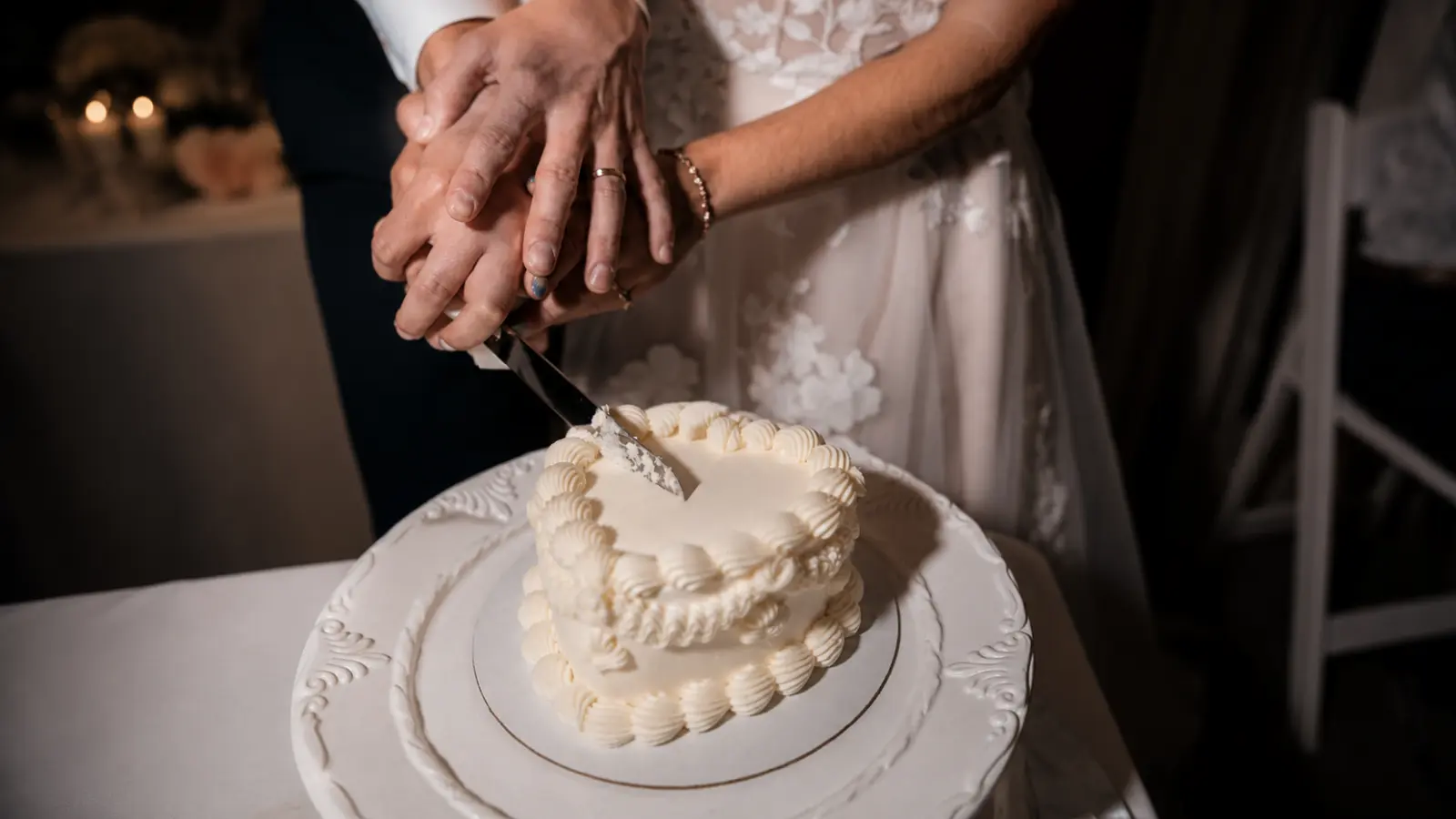
Small wedding cakes — for intimate weddings, elopements, micro-weddings, and couples who simply want a cutting cake alongside another dessert option — are one of the strongest cake value propositions available. A beautifully designed one- or two-tier cake can be just as visually impactful as a large tiered cake when placed in the right setting. The cake does not need to feed 150 people to be a meaningful part of the reception.
When a small wedding cake is the right choice
- Intimate weddings of fewer than 30 guests where a large cake would dwarf the table and produce significant waste
- Micro-weddings and elopements where the cake is for the couple and a small group rather than a full reception
- Couples supplementing the cake with a dessert table, donut wall, cupcake tower, or other sweet option — the cake is for the cutting moment, not for feeding all guests
- Destination weddings where transporting or sourcing a large multi-tier cake is logistically challenging
- Couples whose priority is a very specific, high-quality design that a local bakery can execute beautifully at small scale
Making a small cake look significant
A small cake on a large table looks underwhelming. A small cake on a small, well-styled table can look beautiful. The styling context matters as much as the cake itself. A single-tier cake on the right wedding cake stand, surrounded by scattered petals, a few pillar candles, and a small floral arrangement, reads as intentional and curated. The same cake on a plain table looks like an afterthought.
Height is the other tool. A one-tier cake can be made to appear more visually significant with a tall, statement cake stand — 8 to 12 inches off the table — that gives it presence. A two-tier wedding cake in a tall, narrow configuration reads as more substantial than a wide, squat two-tier cake. Discuss the desired visual impact with your baker and stylist together rather than in separate conversations.
Wedding Cake Tiers and Sizes
Cake tier decisions are simultaneously a visual decision and a math problem. The visual goal — how many tiers creates the presence you want — and the practical goal — how many servings do you need — do not always align at the same size. Understanding the standard serving counts by tier size and configuration makes this conversation with the baker much more productive.
Standard serving counts by configuration
| Configuration | Standard Servings | Best For |
|---|---|---|
| 1-tier (8-inch round) | 24–30 servings | Elopements, micro-weddings, cutting cake only |
| 2-tier (10 + 8 inch) | 50–65 servings | Intimate weddings, 30–60 guests |
| 2-tier (12 + 10 inch) | 80–100 servings | Mid-size weddings with dessert table supplement |
| 3-tier (10 + 8 + 6 inch) | 100–120 servings | Most common configuration; 80–120 guests |
| 3-tier (12 + 10 + 8 inch) | 130–160 servings | Large weddings; generous serving count |
| 4-tier (14 + 12 + 10 + 8 inch) | 200–250 servings | Large receptions; statement centerpiece |
| 5-tier and above | 300+ servings | Grand receptions; maximum visual impact |
A few things many couples do not know about tier sizing:
- Bakery serving sizes vary. Some bakeries cut to a standard 1×2-inch portion; others cut to a 1×1.5-inch portion. The same cake can serve 100 or 120 guests depending on cutting standards. Ask specifically how your bakery measures a serving.
- Not all guests eat cake. Typically 15 to 20 percent of guests at any reception either do not want a slice, are watching their diet, or simply do not make it to the dessert table in time. Ordering at 90 percent of your guest count is usually sufficient unless cake is a centerpiece of your reception.
- The top tier is traditionally saved. Many couples freeze the top tier to eat on their first anniversary. If you plan to follow this tradition, either order a slightly larger overall cake or plan for the top tier not to be served to guests.
- Height variation within a tier adds drama. A standard wedding cake tier is typically 4 to 5 inches tall. Requesting 6-inch-tall tiers adds visual presence without adding width — creating a taller, more dramatic silhouette at the same serving count.
Wedding Cake Decorations and Flowers
Wedding cake decoration is the area of cake planning where the gap between what couples see on Instagram and what is achievable within their budget is widest. Understanding exactly what different decorative techniques require — in time, skill, and cost — makes the design conversation with a baker much more realistic from the first appointment.
Fresh flowers on wedding cakes
Fresh flowers are the most popular wedding cake decoration in the U.S. and have been for years. The advantages are clear: they are widely available, can be matched precisely to the ceremony florals, are less expensive than sugar flowers, and look natural and beautiful in photographs.
What many couples do not know: not all fresh flowers are food-safe. Some popular wedding flowers — lily of the valley, ranunculus, hydrangea, and others — contain compounds that are toxic if ingested, and should not be placed directly on a cake surface. Food-safe fresh flowers for cakes include roses, pansies, lavender, chamomile, marigolds, and violets. For flowers that are visually perfect but not food-safe, a skilled baker can place them on food-safe picks or wrap the stems so they do not contact the cake.
Coordination between the florist and baker is important: decide early who is responsible for providing the flowers for the cake — often the florist includes cake flowers in the overall flower order, but sometimes the baker sources them independently. Always confirm flower safety with both your baker and florist before placing fresh flowers on or near the cake, and get the flower responsibility confirmed in writing to avoid a gap on the wedding day.
Sugar flowers on wedding cakes
Sugar flowers — hand-crafted from gum paste or sugar paste — are the pinnacle of cake decorating artistry. At their best, they are indistinguishable from real flowers in photographs. They last indefinitely, survive any venue temperature, and can be kept as keepsakes after the wedding.
The cost of sugar flowers is the primary reason most couples do not use them: a single large, fully open sugar peony can require 3 to 5 hours of skilled labor and cost $40 to $80 or more as a stand-alone element. A cascade of sugar flowers across a three-tier cake can add $600 to $2,500 to the base cake cost. Sugar flowers are worth the investment for couples who specifically want the photograph that only sugar flowers produce. For couples who are working within a defined budget, high-quality fresh flowers achieve 80 percent of the visual impact at a fraction of the cost.
Other popular cake decoration styles
- Gold and silver leaf. 22K edible gold leaf applied to a cake surface creates a luxurious, editorial look. It can be applied to the entire surface of a tier, used as a drip element, or applied in abstract patches. Gold leaf is a material cost plus labor; less expensive than sugar flowers but more expensive than a plain buttercream finish.
- Ganache drip. A chocolate or colored ganache drip along the top edge of a tier — one of the most popular modern cake details. Can be white chocolate (any color), dark chocolate, or milk chocolate. Adds a dramatic, intentional element to a simple cake.
- Dried botanicals. Dried lavender, dried citrus slices, pampas grass, preserved eucalyptus, and dried roses do not wilt, survive any venue condition, and require no coordination with a florist. Particularly appropriate for bohemian, earthy, and rustic wedding aesthetics.
- Wafer paper flowers. Edible flowers made from rice paper — less expensive than sugar flowers, not as lifelike, but capable of producing a soft, ethereal look, particularly in translucent petals that catch light. Good mid-range option between fresh flowers and sugar flowers.
- Ribbon and trim. A simple satin or grosgrain ribbon in the wedding color palette wrapped at the base of each tier is one of the most underused elegant cake details — and one of the least expensive. It photographs cleanly and creates a finished, intentional look on even a simple cake.
- Fruit. Fresh berries, figs, pomegranate seeds, or stone fruit arranged on and around a naked or semi-naked cake create a seasonal, abundant look. Works best in late summer and autumn when the fruit is at peak quality. More perishable than dried decoration — works best in a temperature-controlled venue.
Wedding Cake Toppers
A wedding cake topper is not required — and many of the most beautiful wedding cakes have nothing on top but the design itself. But for couples who want one, the topper is the detail with the highest potential for personalization and the widest range of aesthetic possibilities.
Types of wedding cake toppers
- Monogram toppers. Laser-cut acrylic or wood initials in the couple’s first letters or last name initial. Clean, readable in photographs, available in every font style from modern to vintage script. One of the most popular toppers at American weddings. Choose a scale that is proportional to the top tier — a too-small monogram looks lost; a too-large one looks heavy.
- Floral topper. A small arrangement of fresh or dried flowers at the top of the cake, extending the cake’s floral decoration to its summit. The simplest and most seamlessly integrated topper — it looks like part of the cake design rather than an addition to it.
- Custom figurines. Hand-crafted or 3D-printed ceramic or clay figurines of the couple — available in endless customizations, from traditional formal poses to illustrations of the couple’s pets to caricatures in their specific outfits. A meaningful keepsake that keeps the cake personal and specific.
- “Mr. and Mrs.” and text toppers. Gold or silver wire toppers in script lettering — “Mr. & Mrs.,” “For Ever,” the wedding year, or any short phrase. Clean, universally understood, widely available, and less expensive than custom figurines. Some couples feel these are generic; others appreciate the directness.
- Celestial and natural toppers. Stars, moons, butterflies, birds, and botanical elements — particularly popular for bohemian and nature-inspired weddings. Available in pressed flowers, wood, acrylic, and metal.
- Heirloom toppers. A topper saved from a parent’s or grandparent’s wedding, restored or used as-is. The most personally meaningful topper choice and the one that generates the most genuine emotional response at the reception when guests notice it.
What to avoid in topper selection
Scale is the most common topper mistake: a topper that is too large for the top tier creates a top-heavy visual that photographs poorly. Before ordering, ask the baker for the exact diameter of the top tier and compare it to the topper’s base dimensions. A topper should occupy roughly one-third of the top tier’s width — enough to be visible and meaningful, not so much that it overwhelms the cake below it.
Weight is the second consideration: heavy ceramic or metal toppers can sink into a soft buttercream top tier over the hours between setup and serving. A good baker will insert dowels or a support structure in the top tier for any topper with significant weight. Ask specifically about this at the final detail meeting before the wedding.
Wedding Cake Tasting
The wedding cake tasting is one of the genuinely enjoyable appointments in the wedding planning process — and one of the most useful, when approached correctly. Many couples treat it as a pleasant afternoon of eating cake. The couples who get the best outcome treat it as a working appointment with clear objectives: choosing a flavor, confirming the baker’s capabilities, establishing a price point, and securing the booking.
When to book the tasting
For popular cake designers and sought-after boutique bakeries, tasting appointments can have a 4 to 8 week lead time during peak wedding season (spring and early fall). Book the tasting 6 to 12 months before the wedding if you are targeting a specific well-reviewed baker. For bakeries with more availability, 3 to 6 months is comfortable. Do not wait until 6 weeks before the wedding — the best bakers fill their calendars far in advance, and the tasting appointment is also when most bakeries take a deposit to hold the wedding date.
What to bring to a tasting
- Inspiration images. Bring 3 to 5 images that reflect what you want, not 30 that reflect everything you have ever liked. The baker needs a clear brief, not a Pinterest board that covers every aesthetic.
- Your guest count and venue name. The baker will ask about the guest count (to determine sizing), the venue (to understand delivery logistics and any temperature/humidity considerations), and the date (to confirm availability).
- Your budget range. Being specific about budget — “we are thinking $800 to $1,200 for the cake” — allows the baker to suggest what is achievable within that range rather than pitching their most elaborate work. Most bakers appreciate directness on budget more than vagueness.
- Your dress photo. Optional but useful — the dress silhouette, color, and any lace or embroidery detail often informs the cake design in ways the couple has not consciously considered until a baker points it out.
Questions to ask at the tasting
- What flavors and fillings do you recommend for our guest count and season?
- What is your pricing structure — per serving, per tier, or per design element?
- What is included in the price — delivery, setup, cake stand rental, stand return?
- Do you handle delivery and setup personally, or do you use contractors?
- Have you worked at our venue before? What do you know about its layout for cake setup?
- What is your policy if something is damaged in transit?
- What do you need from us to confirm the booking today, and what is the deposit amount?
- What is your cancellation and rescheduling policy?
What to taste for — not just what you like
At the tasting, most couples evaluate which flavor they personally enjoy most. This is important but incomplete. The question to ask alongside “which do I like?” is: “which would I want to eat after a full dinner, at the end of a long evening, when I have been drinking champagne?” The best wedding cake flavor is not necessarily the richest or the most interesting one. It is the one that is refreshing, light enough to be enjoyed without appetite, and universally liked by people with different preferences.
Lemon cakes consistently score well at tastings for this reason. Vanilla is the consistent long-term favorite. Heavy chocolate cakes and dense carrot cakes, while delicious in a different context, sometimes feel too rich as a late-evening dessert after a full wedding dinner.
Wedding Cake Table Ideas
Wedding cake table ideas matter because the cake table is a vignette — a composed still-life that will be photographed from multiple angles throughout the reception before the cake is cut. Many couples invest significant effort in choosing the cake and almost none in styling the surface it sits on, which produces photographs where a beautiful cake is undermined by a plain table and a bare tablecloth.
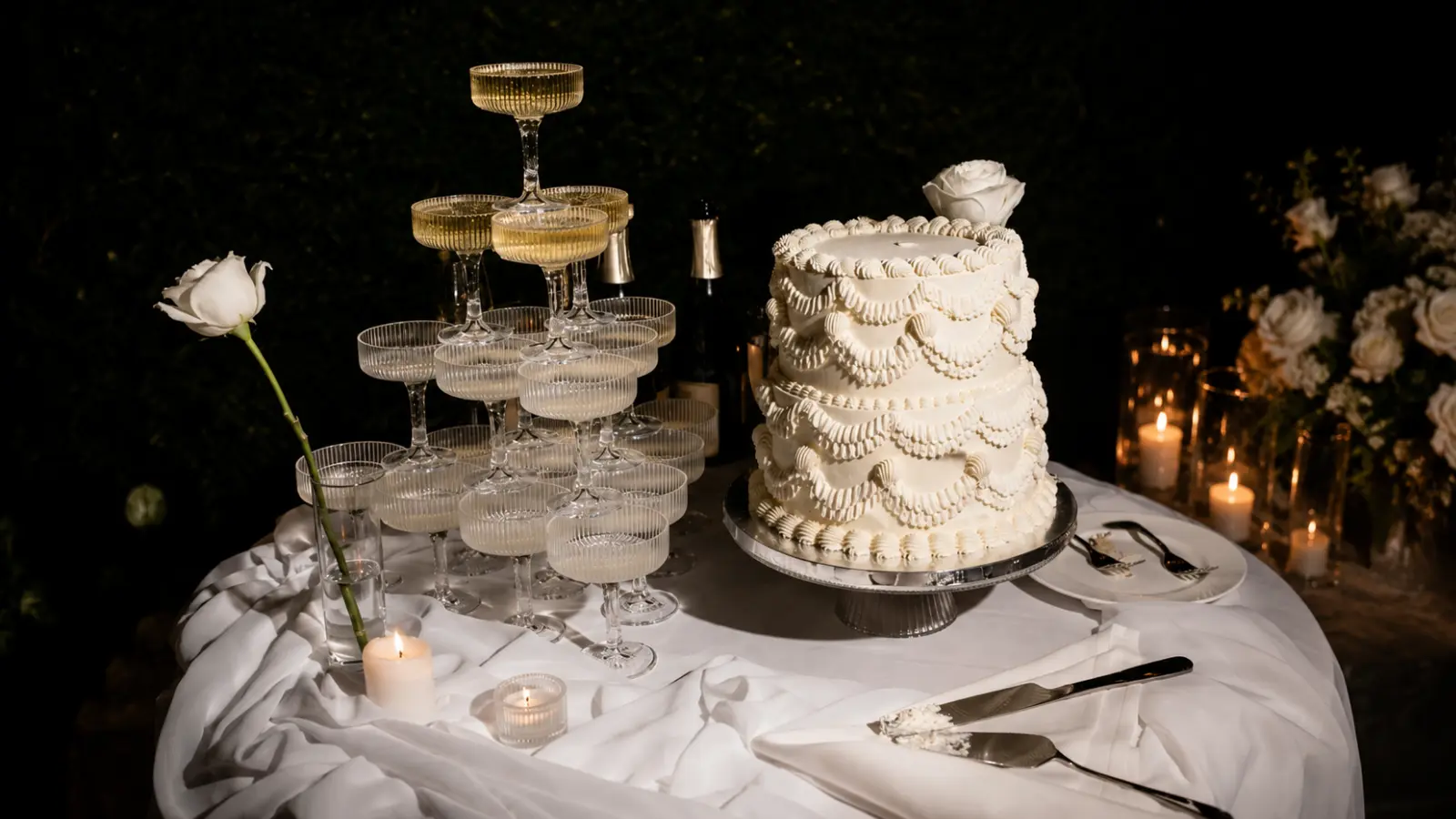
Cake table elements that always work
- A cake stand that adds height. The standard wedding table puts a cake at a relatively low position relative to the room. A cake stand that lifts the cake 6 to 12 inches — marble, brass, rustic wood, white ceramic — immediately gives it more presence and makes it visible from across the reception floor.
- A table covering that complements rather than competes. A plain white tablecloth reads as cafeteria table; a linen tablecloth in a soft ivory, blush, or sage creates a warmth that makes the cake look like it belongs to a styled moment. Alternatively: velvet in deep tones for a glamorous look, or bare wood for a rustic one.
- Scattered florals or petals at the base. Fresh flower heads, scattered petals in the wedding color palette, or small floral clusters around the base of the cake stand create a connection between the cake table and the rest of the reception florals. This detail is inexpensive and dramatically improves cake table photographs.
- Candles. A few pillar candles or taper candles in holders at varying heights create warmth and depth around the cake. They create a beautiful quality of light in evening reception photographs.
- A dessert table context. If the couple is serving multiple dessert options, staging them on the same table creates a visual abundance that photographs as generous and intentional — individual desserts, macarons, or petit fours surrounding the main cake.
- A framed sign or menu card. A small custom card listing the cake flavor(s) is a detail that guests appreciate and that photographs as a considered, personal touch. Particularly important for multi-flavor cakes so guests know what they are choosing.
Cake cutting supplies
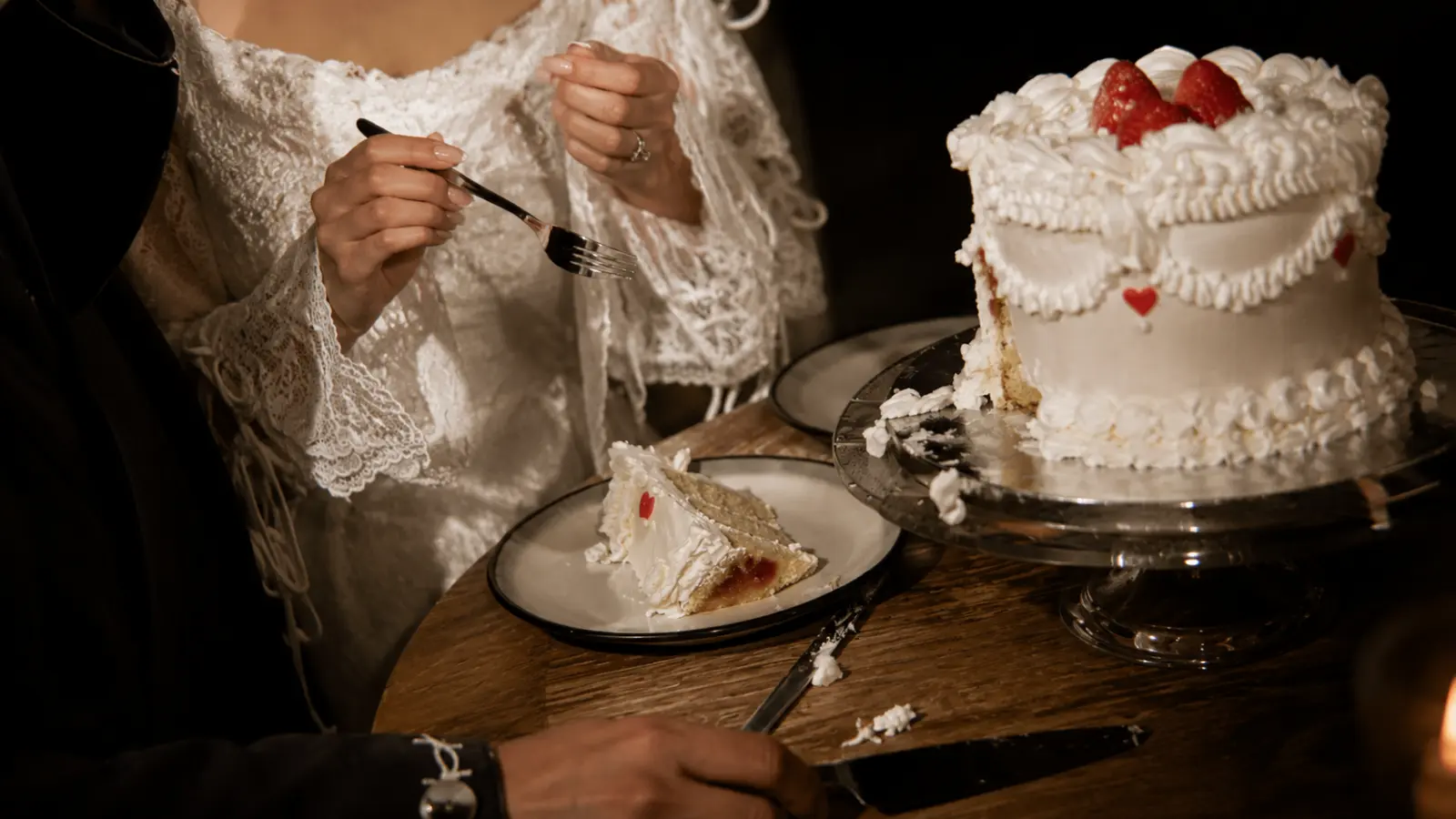
Many couples rent or purchase a custom cake-cutting set — a server and knife with decorated handles, sometimes engraved with the wedding date. The set appears in photographs during the cake-cutting moment and is often kept as a keepsake. Whatever set you choose, confirm with your caterer or venue that they will have a designated person assigned to the cake-cutting — many wedding guests are surprised to learn that someone specific needs to be tasked with this, and that the caterer does not always assume the responsibility automatically.
Wedding Cake Alternatives
The wedding cake is a tradition, not a requirement. An increasing number of American couples are serving something other than a traditional tiered cake at their reception — either because they genuinely prefer another dessert, because their aesthetic does not include a traditional cake, or because their budget is better spent elsewhere. All of the following alternatives are fully acceptable at contemporary American weddings, as long as the couple has a plan for the cake-cutting moment.
One helpful option, regardless of which alternative you choose, is to include a small two-person cutting cake — a single six-inch round that the couple can cut together for photos and tradition. The cake-cutting moment is one of the most photographed moments at any reception, and most photographers consider it an important milestone regardless of what the rest of the guests are eating.
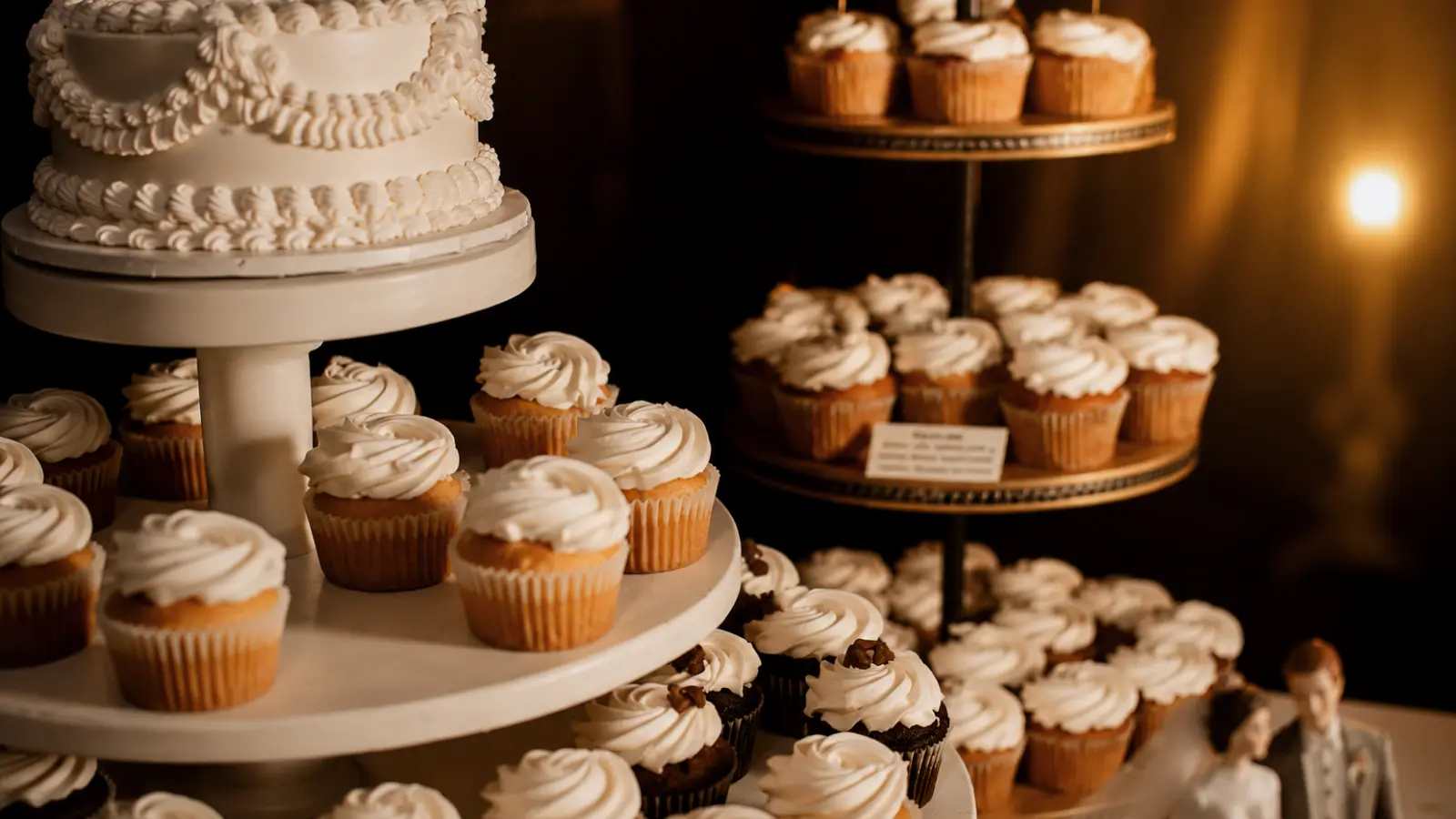
- Cupcake tower. Individual cupcakes displayed on a tiered stand — each one a complete, self-contained serving. No cutting required, no wait for the caterer to slice, no dry corner pieces. A small cutting cake at the top of the tower preserves the ceremonial moment. Particularly popular at casual and outdoor weddings.
- Macaron tower. Macarons stacked in a croquembouche-style tower or mounted on a custom form. Visually distinctive and highly photographed. More expensive per serving than cake; available in every color palette.
- Donut wall or donut tower. A pegboard or foam form with individual donuts displayed — widely popular at casual and bohemian weddings. Highly interactive; guests enjoy choosing their own. Not a formal dessert, so it reads best at casual or outdoor receptions where informality is part of the aesthetic.
- Dessert table. A display of multiple dessert types — brownies, blondies, cookies, small tarts, cake pops, mini cheesecakes — that allows guests to choose what they want. Creates a visual abundance that photographs beautifully. Requires more planning and staffing than a single cake but gives guests more options.
- Cheese wheel tower. Stacked rounds of cheese — typically brie, comté, manchego, and other firm cheeses — decorated with fresh herbs, honeycomb, and fruit. The most popular alternative at European-influenced or food-forward weddings. Serves as both dessert and late-night cheese board.
- Pie display. Individual pies on a rustic table — particularly popular at fall weddings. Brings a warmth and seasonality that cake cannot. Works best with a caterer who can handle cutting and serving efficiently for a large guest count.
- Individual desserts. Cookie boxes, custom cake pops, or individual trifles as part of each place setting — the dessert arrives at the table rather than guests going to the dessert station. Creates a personal, gifts-to-guests feeling that resonates at intimate receptions.
Wedding Cake Cutting: When It Happens and What You Need
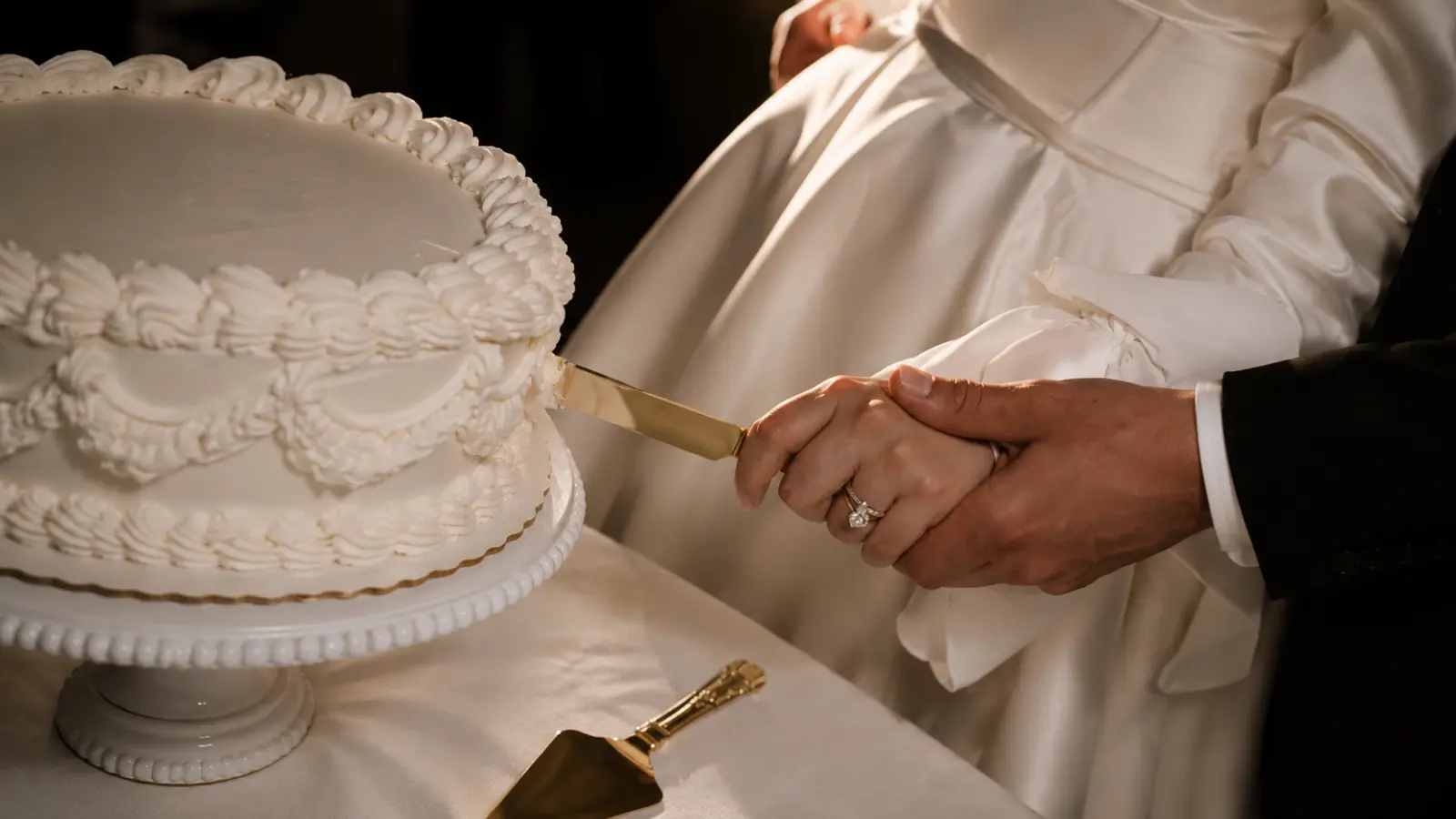
The cake-cutting moment is one of the few times during a reception when the entire room pauses together. Most photographers consider it a must-capture milestone — it typically produces some of the most natural, candid photographs of the day. A little planning around when it happens and what you need makes the moment run cleanly and gives your photographer the best possible setup.
When does the cake cutting typically happen?
Most American receptions schedule the cake cutting between the dinner service and open dancing — usually 45 to 90 minutes after guests are seated. Cutting too early (before dinner) means the cake sits out longer and guests may not want dessert yet. Cutting too late risks losing guests who have drifted to the bar or dance floor. The sweet spot: right after the last course is cleared, when energy is high and the room is still full. Your DJ or band emcee should make a brief announcement to gather attention; most photographers will want 60 to 90 seconds of notice before the couple approaches the cake.
Who handles the actual cutting and serving?
This is one of the most commonly overlooked details in wedding planning. The couple cuts the first slice together for photographs — that is the ceremonial moment. Everything after that is a logistics question that many couples never explicitly assign. Confirm with your caterer or venue coordinator who is responsible for cutting and serving the remainder of the cake to guests. Not all caterers include cake cutting in their standard service; some charge a per-slice cake-cutting fee ($1 to $3 per slice is common). Get this confirmed and in writing before the wedding.
What you need for the cake cutting
- A cake knife and server. Many couples purchase or rent a custom set engraved with the wedding date. Choose one with handles that photograph well — the set will appear in multiple shots. Confirm with your venue whether they provide one or whether you need to bring your own.
- Plates and forks at the table. Someone needs to have plates and forks staged near the cake table before the cutting begins. This sounds obvious and is consistently the detail that gets missed when caterer responsibilities are not clearly assigned.
- A designated person to hand the couple the knife. Often the coordinator or a caterer staff member — but it should be someone with a clear understanding of when and how the moment flows, not a spontaneous decision on the day.
- A heads-up to your photographer. Give your photographer at least 90 seconds of notice before the cutting begins. Most photographers want to reposition for this moment and will ask for it — but a proactive heads-up prevents a rushed setup.
Music for the cake cutting
Many couples choose a short, upbeat song to play during the cake-cutting moment — typically 2 to 3 minutes, timed to cover the ceremonial cutting and the first few slices being served. Popular choices range from a classic jazz standard to a song with personal meaning to the couple. What many couples don’t realize: the DJ or band typically needs the song title confirmed in advance, not chosen on the spot. Add it to your music planning sheet alongside the processional and first dance. For specific song ideas, the wedding processional songs guide covers ceremony music in full; for reception music, your DJ or band can advise based on your overall playlist direction.
The “smash or no smash” question
Whether to smash cake in each other’s faces is one of the more genuinely polarizing wedding decisions. Many couples find it funny and spontaneous; others find it disrespectful to the person who spent months choosing the dress. The only wrong answer is surprising your partner — if one person is expecting a clean, romantic feeding and the other has a smash planned, the photograph captures the surprise rather than the moment. Discuss it in advance and make a deliberate choice, whichever way you go.
How to Choose the Right Wedding Cake
The right wedding cake is the one that looks intentional at your specific venue, tastes good to your specific guests, fits your specific budget without compromise, and produces photographs you will still be happy with in ten years. Those four criteria eliminate most of the decision fatigue.
Step 1: Match the cake to the venue, not the other way around
Start with the venue aesthetic. A formal ballroom calls for a formal cake — smooth finish, structured tiers, floral or piped decoration. A barn or garden venue calls for something organic — textured buttercream, naked layers, fresh florals. A modern gallery space calls for a minimalist cake — clean lines, monochromatic, deliberate restraint. The couples who regret their cake choices almost always chose a cake they loved in isolation without checking whether it made visual sense in their specific space.
Step 2: Set the budget before you taste anything
The most reliable way to avoid wedding cake sticker shock is to establish the budget before the first tasting appointment and communicate it to the baker upfront. A good baker will tell you exactly what is achievable within your budget rather than pitching a design that exceeds it. The couples who walk into a tasting with no stated budget and fall in love with the most elaborate option on the portfolio wall are the ones who end up either overspending or feeling disappointed by what they eventually chose.
Step 3: Taste before you commit to a design
Many couples book a bakery based on portfolio photos and then discover at the tasting that the flavors are mediocre. The design and the flavor are inseparable elements of the wedding cake — a visually beautiful cake that tastes like a grocery store birthday cake will disappoint every guest who eats a slice. Taste first. Then design.
Step 4: Ask to see work at your specific price point
At the tasting, ask to see photographs of cakes the baker has made at a similar budget to yours — not their editorial portfolio work or their best-ever showcase pieces. The question is not “what can this baker do?” It is “what will this baker deliver for what I am paying?” Both are reasonable questions. Only the second one helps you make a decision.
Step 5: Confirm every practical detail in writing
The contract with your baker should include: the specific design (include the reference photos in the contract), the flavor and filling per tier, the serving count, the delivery date, time, and address, the setup requirements (table size, position, any refrigeration needed), the delivery fee, the total cost and payment schedule, and the cancellation/modification policy. A verbal agreement about the design is not a design agreement. Put every detail in writing before the deposit is paid.
Wedding Cake Inspiration Board
Wedding cakes can look dramatically different depending on the venue, floral design, guest count, season, and overall wedding aesthetic. Explore our wedding cake inspiration board for timeless cake styles, modern designs, floral details, tiered wedding cakes, cake table inspiration, and real wedding examples to help you refine your vision before meeting with a baker.
Final thoughts
The best wedding cakes are not always the tallest, most expensive, or most elaborate ones. They are the cakes that make sense for the wedding itself — the venue, the season, the guest count, the budget, the flowers, the dinner, and the atmosphere the couple wants to create.
When the cake fits the wedding naturally, it becomes more than dessert. It becomes part of the celebration’s visual memory — the centerpiece guests notice, the moment couples cut together, and one of the details that still feels meaningful years later.
Frequently asked questions (FAQ)
Is it better to spend more on the cake or on the dessert table?
For most weddings, guests remember variety more than the cake itself. A beautiful cake paired with a small dessert table often creates a better guest experience than spending the entire dessert budget on a larger cake alone.
Can a wedding cake look expensive without a luxury budget?
Yes. Simple buttercream finishes, fresh flowers, and strong cake table styling often create a more elegant result than overly complicated decorations. Many expensive-looking wedding cakes rely on restraint rather than elaborate design.
Do guests actually care about the wedding cake flavor?
More than many couples expect. Guests may not remember the exact design years later, but they often remember whether the cake tasted fresh, dry, rich, or disappointing. Flavor is one of the few parts of the cake every guest directly experiences.
What is the biggest mistake couples make when choosing a wedding cake?
Falling in love with a Pinterest photo before speaking with a bakery. Many designs depend on specific techniques, budgets, climates, or baker skill levels that may not be realistic for every wedding.
Will a larger cake make the wedding feel more luxurious?
Not necessarily. Guests rarely judge luxury by cake size alone. A well-designed three-tier cake displayed beautifully often creates a stronger visual impact than a much larger cake with a weaker design.
How much wedding cake do you need for 100 guests?
A common estimate for 100 guests is a three-tier cake that serves about 100 to 120 people, depending on the bakery’s serving size. If you are also serving a dessert table, you may be able to order slightly fewer cake servings.
Is buttercream or fondant better for a wedding cake?
Buttercream is usually preferred for flavor and a softer, more natural look, while fondant is better for sharp edges, detailed decoration, and a very smooth finish. The best choice depends on the design, weather, venue, and what you want guests to eat.
How far in advance should you order a wedding cake?
Most couples should book their wedding cake 6 to 12 months before the wedding, especially if they want a popular bakery or a custom design. Simpler cakes may have more flexibility, but early booking gives you more choice.