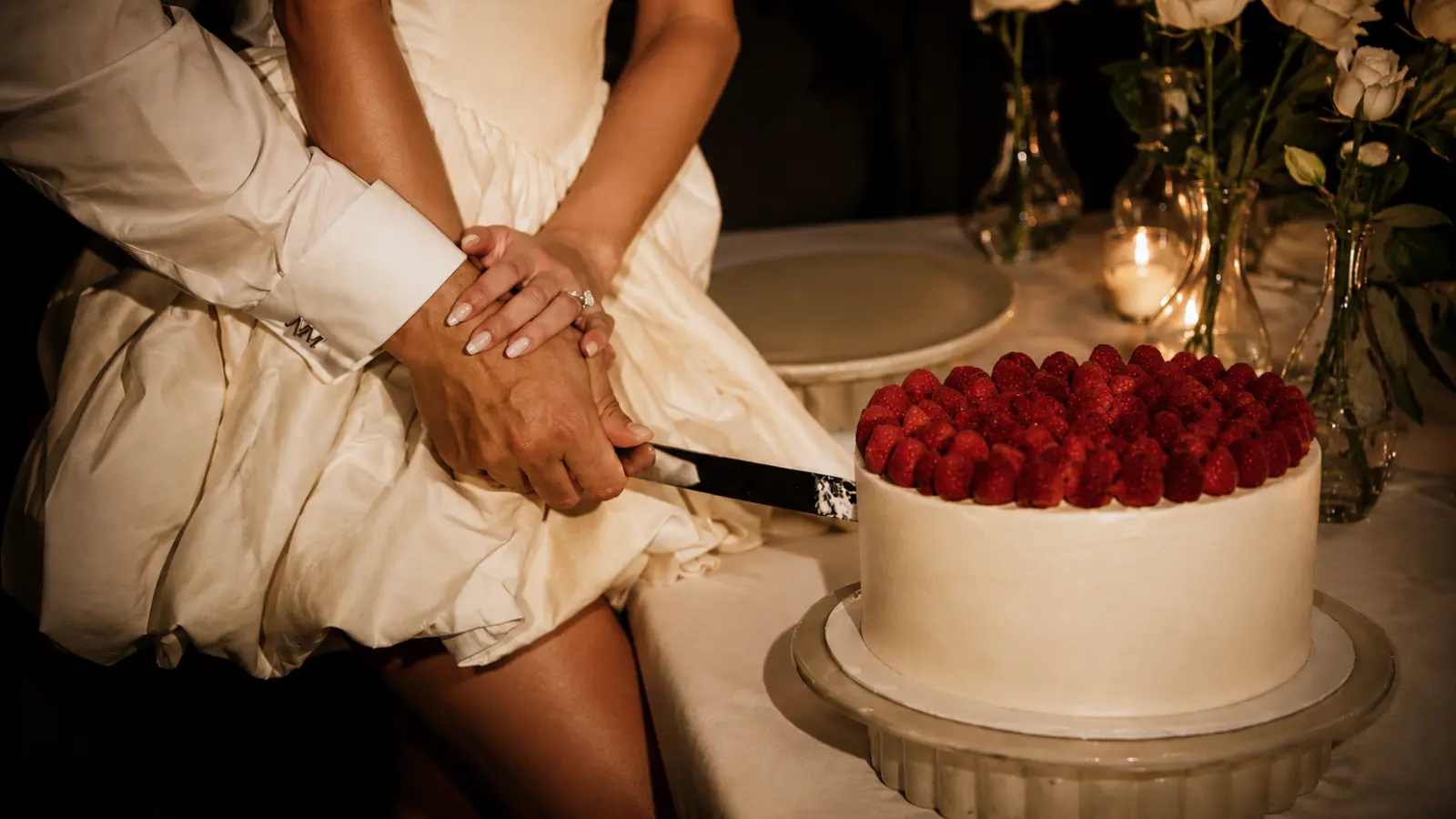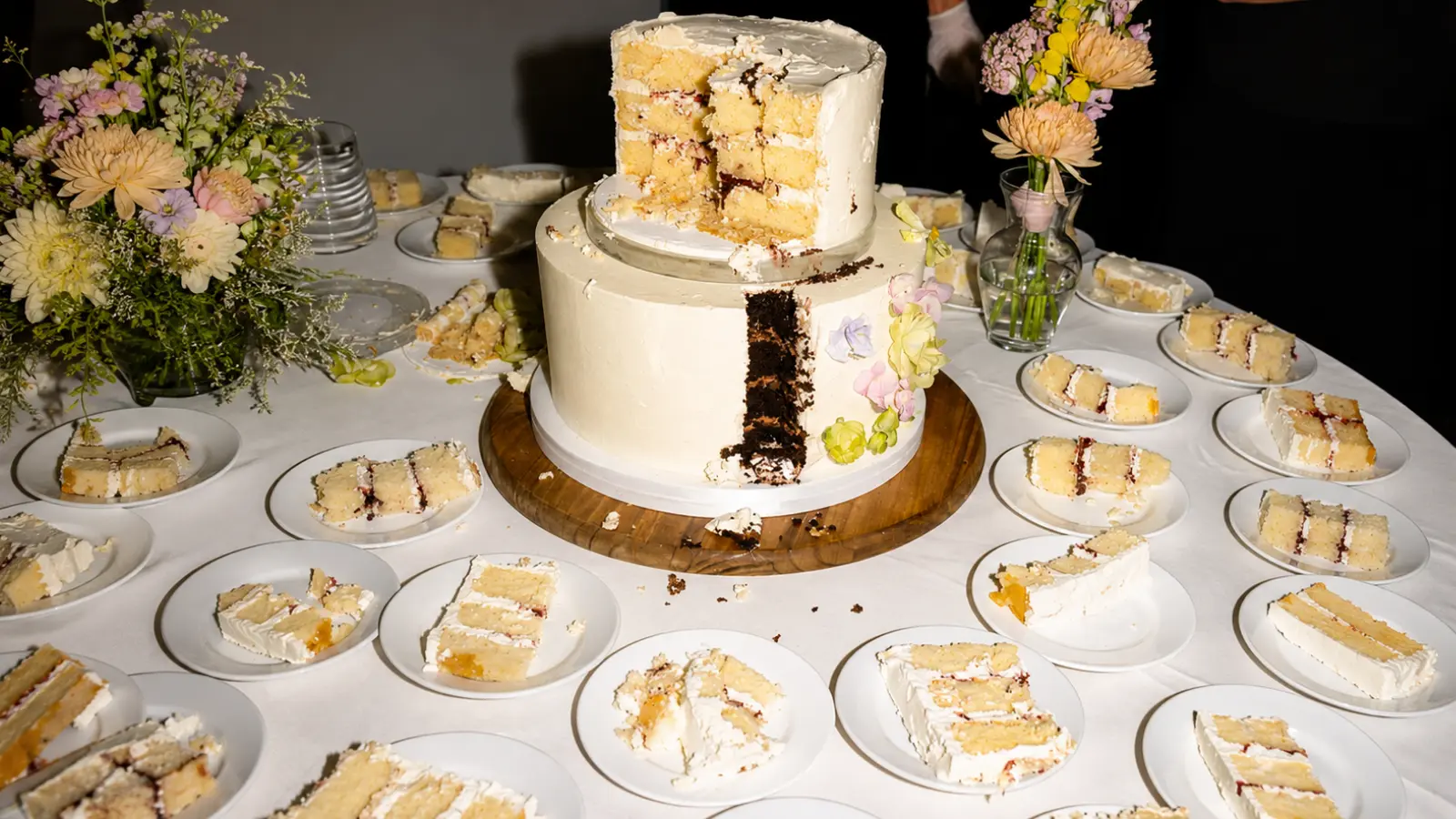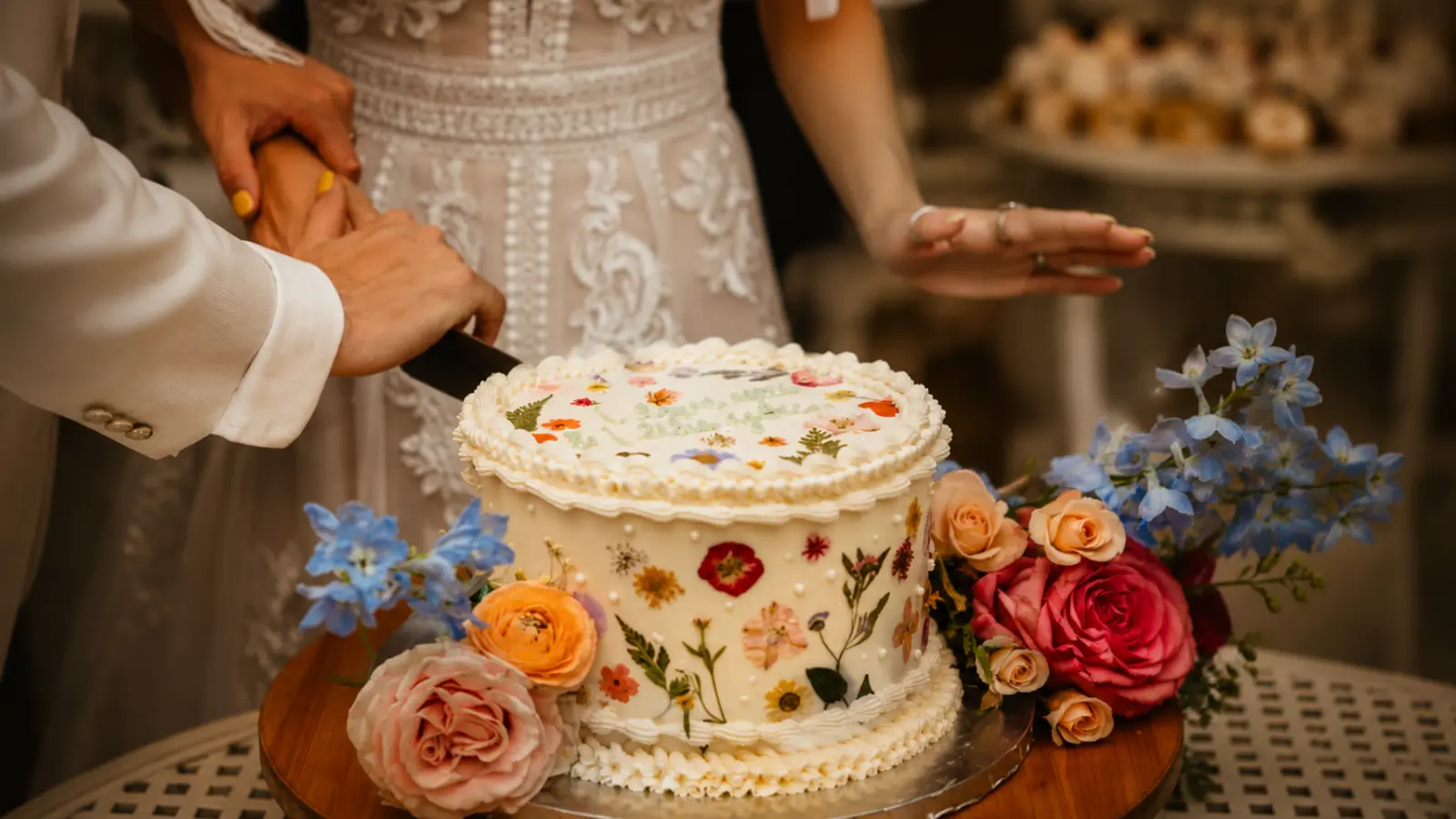
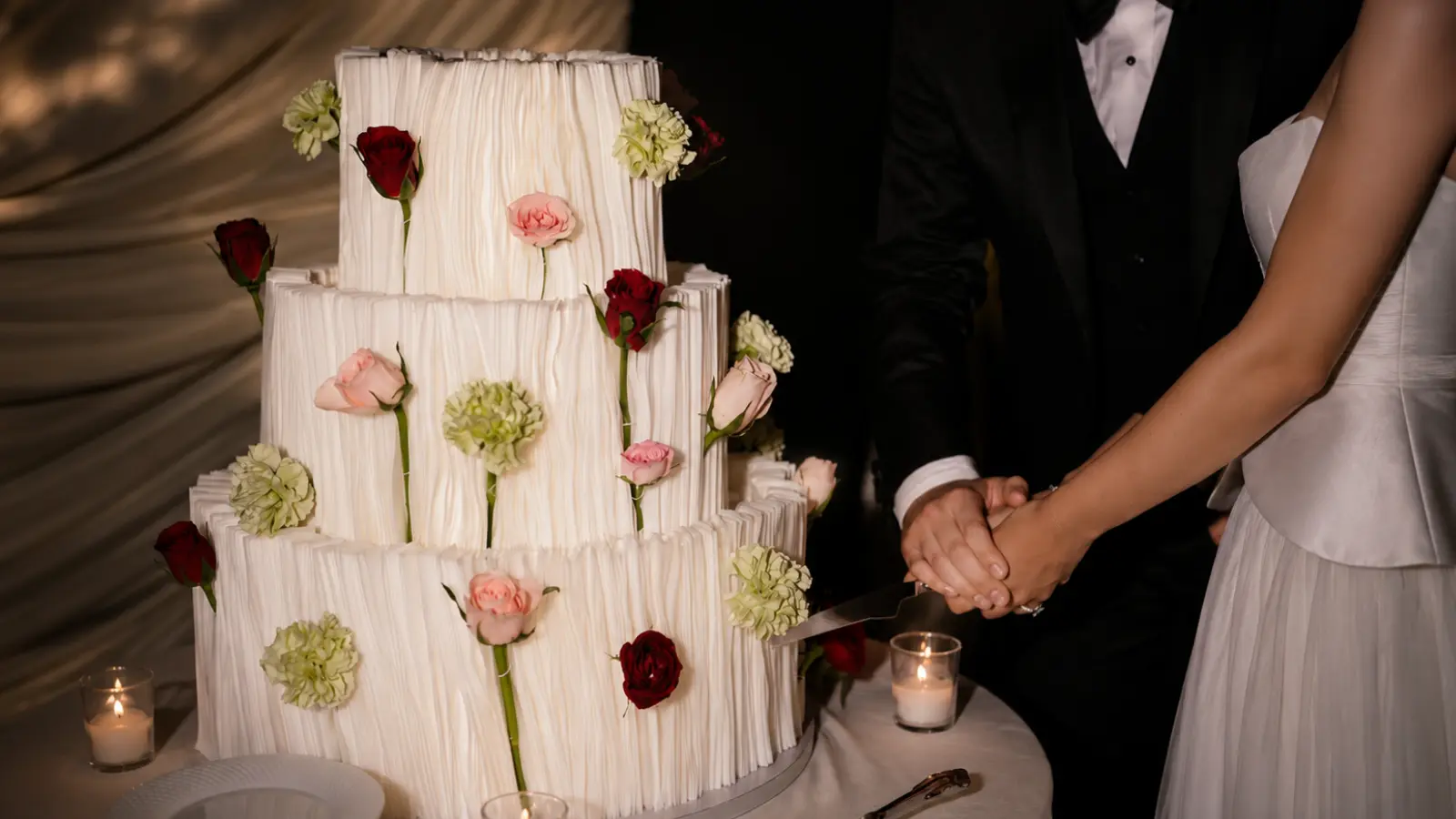
Floral wedding cakes are wedding cakes decorated with fresh flowers, sugar flowers, edible blooms, or botanical-inspired arrangements that bring color, texture, and visual continuity to the celebration. Because flowers already appear throughout most weddings, incorporating them into the cake creates a natural connection between the bouquet, centerpieces, ceremony décor, and reception design.
What makes floral wedding cakes so popular is their versatility. A single garden rose on a smooth white cake can feel timeless and understated, while a dramatic floral cascade can transform the cake into one of the most memorable visual elements of the reception. The style works across nearly every wedding aesthetic, from classic ballroom celebrations and romantic garden weddings to modern minimalist events and rustic outdoor receptions.
In this wedding cakes guide, you’ll discover floral ideas featuring fresh flowers, sugar flowers, edible blooms, pressed flower designs, white cakes with florals, and dramatic cascading arrangements. You’ll also learn which flowers are safe for cakes, how to coordinate floral decorations with your bouquet, and how to choose the right floral style for your season, venue, and budget.
Floral Wedding Cake Ideas
Before narrowing to a specific floral style, it helps to understand the full range of what “floral wedding cake” can look like — because the distance between a single pressed pansy on a minimalist white cake and a full sugar flower cascade on a formal three-tier is enormous, and both are floral wedding cakes. The right choice depends entirely on the wedding’s aesthetic, the venue, the season, and how prominent the cake is meant to be in the overall visual design of the event.
The best way to approach floral wedding cake ideas is by deciding first whether you want the flowers to be the dominant design element or a supporting one. A dominant floral cake design — a full cascade, a complete surface coverage of pressed flowers, an elaborate sugar flower arrangement — makes the cake itself a statement. A supporting floral cake — a single cluster at the base, one bloom on a topper, a few petals scattered between tiers — lets the cake’s shape and finish carry the visual weight while the flowers add warmth and color without competing.
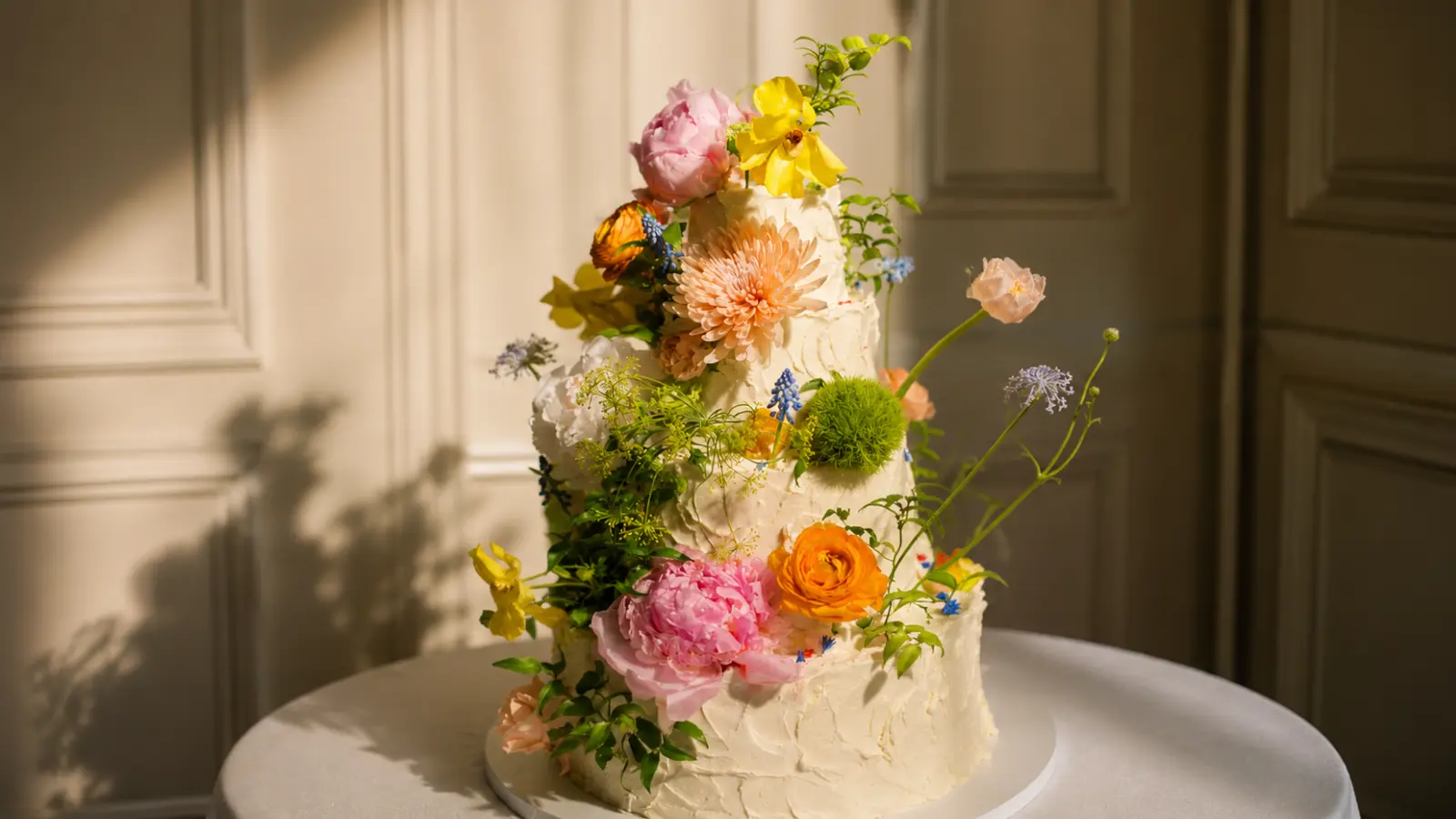
Floral wedding cake ideas by style and occasion
| Floral Cake Idea | What It Looks Like | Best For |
|---|---|---|
| Full sugar flower cascade | Hand-crafted sugar peonies, roses, or ranunculus arranged in a diagonal from the top tier to the base. Each flower individually made; the cascade is designed to read from across the room and hold up in close-up photography. | Formal ballrooms · estate weddings · any reception where the cake is the visual centerpiece · all seasons · couples with a higher decoration budget |
| Fresh garden rose cluster | A smooth white or ivory buttercream base with a single cluster of fresh garden roses — in the wedding bouquet colors — placed at the base of the bottom tier or between tiers. Everything else left plain. | Spring and summer weddings · garden venues · couples who want the simplicity of a plain cake with one organic moment · works when florist and baker coordinate |
| Dried botanical arrangement | Rustic wedding cakes often use dried pampas grass, lunaria, dried citrus, and pressed wildflowers arranged between tiers of a textured or semi-naked cake. Warm, earthy, and temperature-stable. | Fall and winter weddings · barn, vineyard, or rustic outdoor venues · couples with a warm, earthy palette · any wedding where fresh flower wilting is a concern |
| Pressed edible flower surface | Fresh or preserved edible flowers — violas, pansies, rose petals, borage — embedded in a clear glaze or gel applied over the entire cake surface. Botanical specimen quality. Every angle looks different. | Spring garden weddings · couples who want something unexpected and editorial · any venue where a conversation-starting cake is appropriate |
| Herb and wildflower semi-naked | A thin buttercream wash over exposed cake layers, decorated with fresh rosemary, thyme, lavender, and small wildflowers. Organic, farm-adjacent, and deeply suited to the right venue. | Outdoor summer and fall weddings · farm, vineyard, or garden receptions · relaxed bohemian aesthetic |
| Single large bloom topper | One oversized fresh or sugar flower — a garden rose, a dahlia, a peony — placed at the very top of an otherwise simple cake. The scale of the single bloom carries enormous visual weight. | Minimalist couples · any wedding where the cake is meant to be simple but not plain · small weddings where one statement element is more effective than many smaller ones |
| Monochromatic floral cake | A cake where the buttercream, sugar flowers, and any fresh elements are all in the same tonal family — all white, all blush, all terracotta. The tonal coherence creates elegance without requiring complex decoration. | Modern or minimalist venues · couples who want a visually sophisticated result without ornate decoration · works beautifully in photographs for the same reason a monochromatic outfit photographs well |
Fresh Flowers on Wedding Cakes
Fresh flowers on a wedding cake are one of the most popular floral choices at American weddings — and for good reason. They are less expensive than sugar flowers, available in virtually every variety, and can be matched directly to the wedding florals when the florist and baker coordinate in advance. When it works well, a cake decorated with fresh flowers from the same grower as the bouquet has a visual continuity that no other approach can replicate — the colors are identical, the varieties are the same, and the cake looks like a natural extension of the floral design rather than something created separately.
Fresh flowers also introduce a specific set of practical challenges that many couples do not know about until too late. Understanding them before finalizing the design is what separates a beautifully executed floral cake from a last-minute problem on the wedding day.
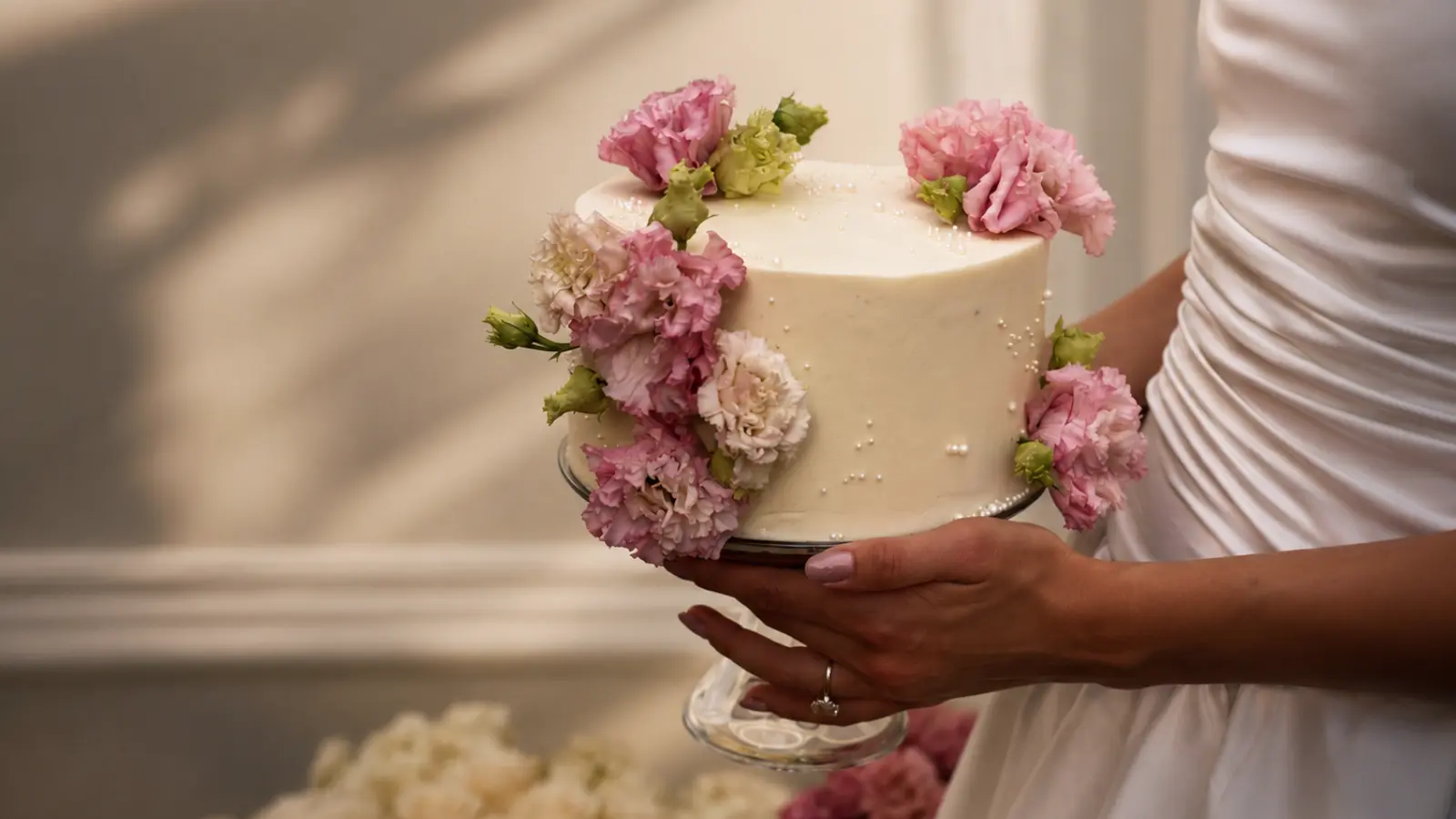
What works well with fresh flowers on cakes
Roses. One of the most versatile fresh flowers for cake decoration. Available year-round, in many colors, and generally sturdy enough to hold their shape well through a reception when handled and placed properly. Garden roses — the fuller, more loosely petaled variety — photograph better than standard hybrid tea roses, which can look stiff in close-up. Their petals also lay more naturally against a cake surface.
Peonies. Extraordinary on a cake in spring and early summer when they are in season. The looseness and layering of peony petals creates a romantic, organic quality that photographs beautifully. The limitation: peonies are seasonal and wilt faster than roses in warm conditions. For outdoor summer weddings, confirm with your baker how they will manage the timing.
Ranunculus. One of the most photographically beautiful fresh flowers for cakes — densely layered petals, an almost-spherical shape, and an extraordinary range of colors. Spring seasonal; requires careful food-safe handling.
Orchids. Temperature-tolerant, long-lasting, and dramatic on a cake surface. White and ivory phalaenopsis orchids on a plain white buttercream cake is one of the most elegant and low-maintenance fresh flower options available.
Lavender sprigs. Edible and food-safe when organic, lavender adds texture, color, and fragrance to a cake without requiring any food-safe barrier preparation. Works especially well on herb-forward rustic cakes and pairs naturally with dried botanical arrangements.
Practical considerations for fresh flowers on cakes
The timing problem. Fresh flowers need to go onto the cake as close to the reception as possible. Most bakers apply fresh flowers on-site at the venue rather than at the bakery, which means your baker needs access to the venue before the reception begins. Confirm the setup logistics before signing contracts — some venues have limited access windows that can complicate last-minute decoration.
The temperature problem. Cut flowers wilt in heat and humidity. An outdoor summer wedding in Georgia or Texas in July presents a real challenge for fresh flower decoration. Discuss temperature management explicitly with your baker — some will recommend dried botanicals, sugar flowers, or refrigeration-tolerant varieties for warm-climate outdoor weddings.
The food-safety problem. This is covered in detail in the food safety section below. The short version: no fresh flower stem should touch the cake surface without a food-safe barrier. Coordinate between your florist and baker before the wedding day to establish exactly how this will be handled.
The coordination problem. When a bride says “I want flowers on my cake that match my bouquet,” the florist and baker need to communicate directly. The florist needs to know what varieties the baker can work with safely. The baker needs to know what the florist will supply and in what condition. This conversation should happen at least 6 weeks before the wedding — not the week before.
Sugar Flowers vs Real Flowers
The choice between sugar flowers and real flowers is the most consequential decision in floral wedding cake planning. It affects the budget significantly, the visual result meaningfully, and the practical experience on the wedding day in ways that are worth understanding completely before committing.
Neither is categorically better. The right choice depends on the couple’s priorities — and different priorities produce different right answers.
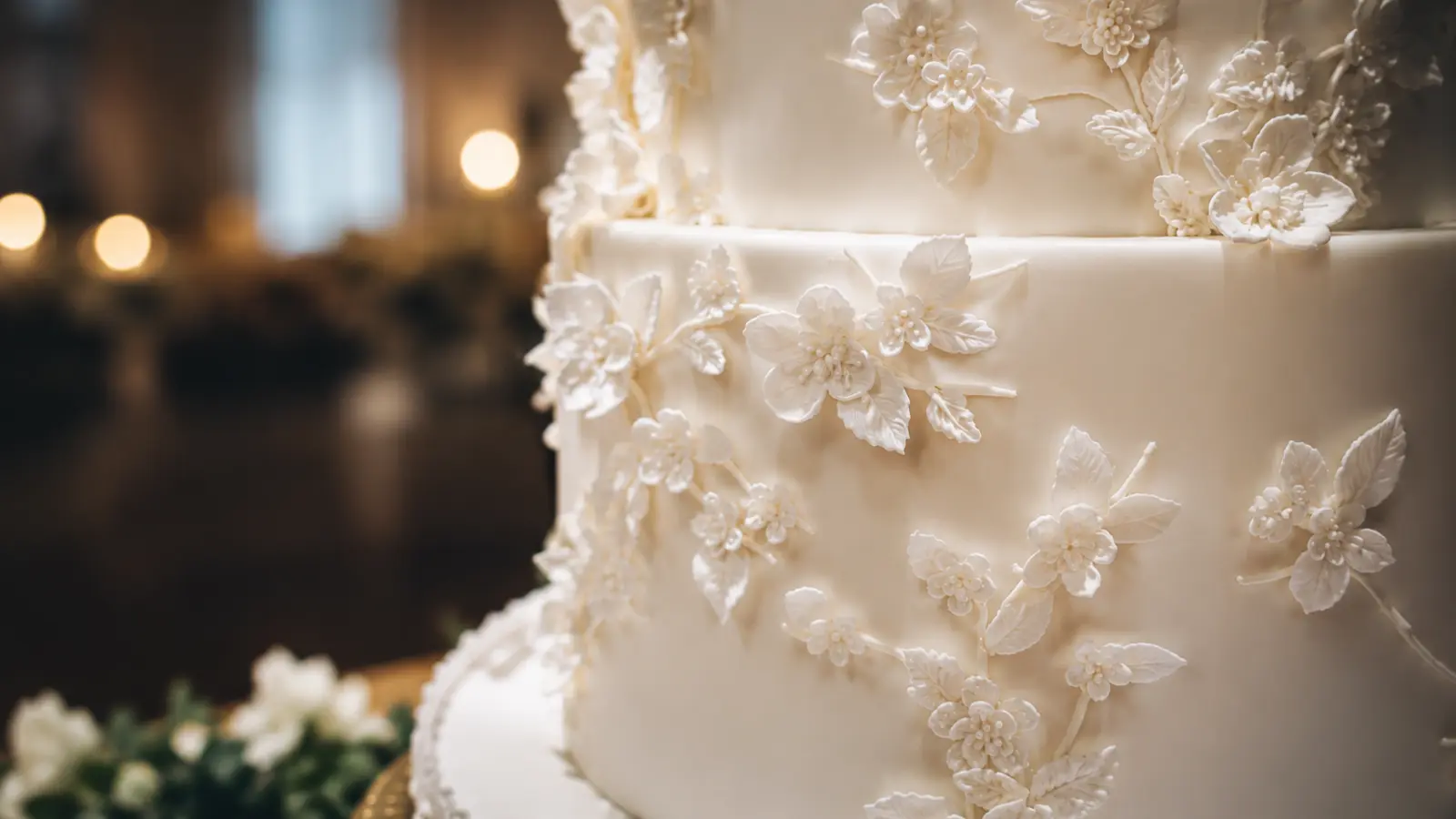
Sugar flowers: what they are and what they cost
Sugar flowers are hand-crafted from gum paste or sugar paste — an edible, pliable medium that can be shaped, textured, and painted to replicate any flower variety with extraordinary detail. A skilled sugar flower artist can create the specific curl of a peony petal, the veining of a garden rose leaf, the color gradation of a ranunculus from deep center to pale outer petal — all from sugar.
The result, in the right baker’s hands, is frequently indistinguishable from fresh flowers in photographs. In skilled hands, sugar flowers can look realistic enough that guests may need to look closely before realizing they are not fresh. And unlike fresh flowers, sugar flowers are entirely food-safe (they are made from edible materials), temperature-stable (they will not wilt in a warm venue), and permanent (they can be preserved as a keepsake).
The cost reflects the labor involved. A single detailed sugar flower can require hours of skilled work, and a full cascade covering several tiers may represent many additional hours of handcrafting. Depending on the flower types, scale, and baker’s level of specialization, a full sugar flower arrangement can add a significant amount to the base cake price. This is not a line item to be surprised by — it is a decision to be made intentionally.
Real flowers: what they offer and what they require
Fresh flowers cost less than sugar flowers in almost every scenario. Your florist can typically supply a small amount of blooms directly to the baker at a fraction of what the equivalent sugar flower work would cost. The visual result — fresh roses that match the bouquet exactly, peonies from the same stem as the ceremony arrangement — has an authenticity that even the best sugar flowers cannot fully replicate, because it actually is the same flower.
The requirements are real, though. Fresh flowers need careful food-safety management. They wilt in warm conditions. They are constrained by seasonal availability. They require the florist and baker to communicate and coordinate in a way that creates a logistical dependency between two separate vendors. And their appearance six hours into the reception may differ from their appearance at the time of the cake cutting.
| Factor | Sugar Flowers | Fresh Flowers |
|---|---|---|
| Cost | Significantly higher — reflects skilled labor per flower | Lower — typically supplied by florist from the wedding flower order |
| Food safety | Entirely food-safe — made from edible materials | Requires food-safe barriers — no stem touches cake surface without preparation |
| Temperature stability | Stable in any condition — will not wilt or change | Will wilt in warm or humid conditions — outdoor summer weddings require planning |
| Seasonal availability | Any flower in any season — the baker works from a reference photo | Constrained by actual flower seasons — some varieties unavailable at certain times |
| Visual result | Extraordinary detail in skilled hands — often indistinguishable from fresh in photographs | The authenticity of real flowers — especially when matched to the bouquet |
| Longevity | Indefinite — can be preserved as a keepsake | Several hours at room temperature, depending on variety, placement, heat, humidity, and handling |
| Vendor coordination | Baker handles everything independently | Florist and baker must communicate — adds a coordination dependency |
| Best for | Formal or high-end weddings · outdoor warm-weather events · any wedding where the cake is the visual centerpiece | Spring and summer indoor weddings · couples who want the cake to feel connected to the bouquet · more moderate decoration budgets |
The honest middle ground: many of the most beautiful floral wedding cakes at American receptions use a combination — a base of sugar flowers for the structural elements of a cascade or arrangement, with a few fresh blooms added on the wedding day for authenticity and color matching. This approach gives the baker control over the major decoration while allowing the florist to tie the cake to the specific flowers of the day. It is worth asking your baker whether they work this way before assuming it has to be one or the other.
Edible Flowers for Wedding Cakes
Edible flowers occupy a specific and often misunderstood category in the floral wedding cake conversation. Many couples assume that any flower can be made “edible” with the right preparation. That is not true. Edible flowers are specific varieties that are safe for consumption — and even within those varieties, the flower must be grown without pesticides, sourced from a culinary grower rather than a florist, and handled in a way that maintains food safety from field to cake.
When edible flowers are done well, the result is one of the most visually distinctive and photographically extraordinary floral cake designs available. A cake surface covered in pressed violas, rose petals, and borage flowers embedded in a clear glaze looks like a botanical illustration brought to life. Every angle is different. In the right light, it looks like the cake is growing.
Commonly used edible flowers at American weddings
| Flower | Color Range | Best Use on Wedding Cakes |
|---|---|---|
| Violas and pansies | Purple, yellow, white, lavender, bi-color | The most widely used edible flower for pressed-surface cakes. Small, flat, and visually precise — they press and dry beautifully and embed into glazes with a jewel-like quality. |
| Nasturtiums | Orange, yellow, red, cream | Warm and vibrant; used on semi-naked and rustic cakes for a burst of color. One of the most genuinely flavorful edible flowers — slightly peppery, which can complement certain cake flavors. |
| Rose petals | Every color | Individual rose petals — not the whole bloom — from organically grown, food-grade roses. Used scattered across the cake surface or pressed into glazes. Must be confirmed food-grade; florist roses are not safe to eat. |
| Lavender | Purple, lilac | Food-safe when organic; adds fragrance as well as visual texture. Works especially well on herb-forward rustic cakes and pairs naturally with lemon or elderflower flavors. |
| Chamomile | White with yellow center | Delicate and daisy-like; used scattered across tiers or clustered at tier bases. Very low-key visually, which makes it effective on minimalist cakes where a stronger flower would compete. |
| Borage | Bright blue, star-shaped | One of the only true-blue edible flowers available — unusual and distinctive. Used in pressed flower surfaces and glaze-embedded designs where the color contrast is the point. |
| Marigolds | Orange, yellow, gold | Warm and bold; works well on fall wedding cakes and earthy-palette designs. The petals separate easily and can be scattered across a cake surface for a painterly effect. |
The sourcing rule — the most important thing about edible flowers
Edible flowers must be sourced from a culinary or food-grade grower — not from a florist, not from a garden center, and not from a flower market. Flowers sold for decoration are treated with pesticides, fertilizers, and preservative chemicals that are not approved for consumption. Even if the variety is technically edible, the growing and handling practices for decorative flowers make them unsafe to eat.
When working with a wedding cake baker on an edible flower cake, ask directly: “Where are you sourcing the edible flowers?” A baker who cannot answer that question clearly has not thought through the food-safety requirements of the design. A baker who can name their specific culinary supplier — or who grows their own — understands what they are doing.
White Wedding Cakes With Flowers
A white wedding cake with flowers is one of the most classic and timeless combinations in American bridal cake design. It works because the visual logic is simple and correct: the white surface is the canvas, and the flowers are the only color or texture introduced. There is no competition between elements, no complexity to resolve — just a clean base and whatever the flowers bring to it.
What many couples do not realize is how much the white itself matters. Understanding buttercream vs fondant wedding cakes matters because white buttercream and white fondant create different floral effects. Matte white and satin white are different. Warm ivory and bright white are different. Each choice changes how the flowers read against the surface, how the cake photographs in different lighting conditions, and how formal or relaxed the overall impression is.
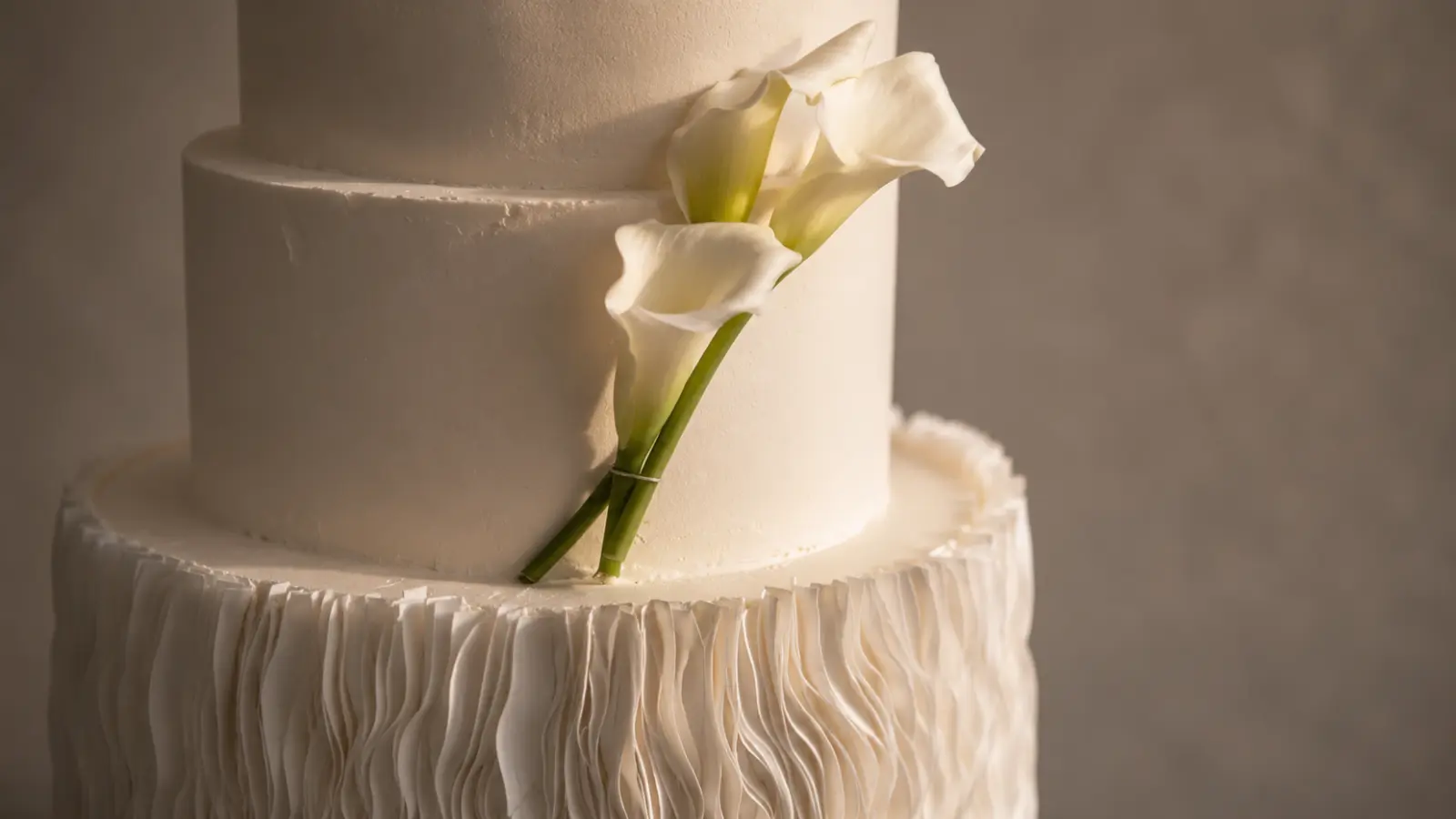
How different whites interact with flowers
Bright white buttercream. High contrast against any colored flower. Makes blush roses look deeply pink, makes lavender appear more vivid. Creates the most dramatic visual impact for a floral arrangement. Works best in natural daylight photography — in artificial light it can look stark.
Warm ivory buttercream. One of the most common choices for floral wedding cakes. The warmth of ivory softens the contrast between cake and flower, creating a result that photographs beautifully in both natural and artificial light. Works especially well with garden roses, peonies, and ranunculus in pink and peach tones.
Matte white. A trend-forward finish that reads as contemporary rather than traditional. The matte surface absorbs light rather than reflecting it, which gives flowers placed on or against it a different visual quality — they appear to sit in front of the cake rather than on it. Striking in photographs.
White fondant. Creates the smoothest surface and the sharpest contrast against decoration. Sugar flowers on white fondant look most dramatic and formal. Works best for structured, architectural floral designs — less suited to organic, loosely arranged fresh flower clusters.
White wedding cake with flowers — the strongest combinations
- White buttercream + garden roses in blush and ivory. The most consistently requested combination at American bakeries. Romantic, warm, and universally flattering in photographs regardless of the time of year.
- White fondant + white sugar peonies. A monochromatic white-on-white arrangement where all the interest comes from texture and form rather than color. Architectural and elegant — especially effective in formal venues.
- Ivory buttercream + dried pampas and eucalyptus. A strong combination for fall and winter floral wedding cakes. Warm, organic, and temperature-stable.
- Matte white + pressed violas and borage. The edible flower version. The matte surface makes the embedded flowers look like they are floating in a medium rather than placed on a surface. Distinctive and editorial.
- White buttercream + single large dahlia topper. For couples who want the simplicity of a white cake with one undeniable floral moment. The scale of a single large flower on top of an otherwise plain cake creates a visual impact disproportionate to the simplicity of the design.
Floral Cascade Wedding Cakes
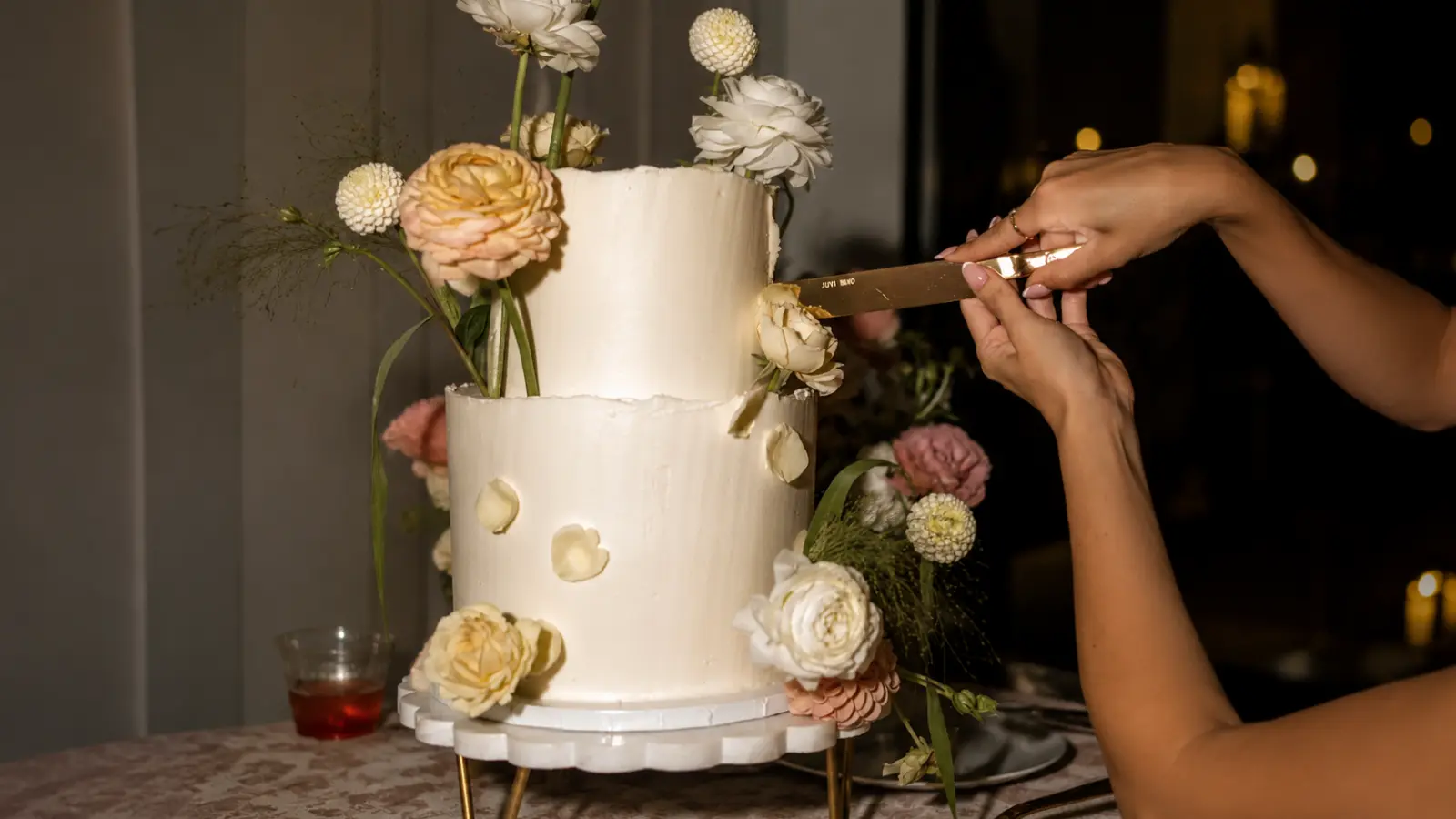
A floral cascade is the most visually dramatic arrangement in the wedding cake floral repertoire — and it is the one that requires the most skill to execute well. The cascade arranges flowers in a diagonal line that descends from the top tier down one side of the cake, often continuing to the base or even to the cake stand or table surface. The result creates movement in a static object: the eye follows the cascade downward, the diagonal creates tension and visual interest, and the overall effect is one of abundance and intention simultaneously.
Many couples do not realize that the cascade’s success depends as much on what is not there as what is. A cascade on a heavily decorated cake disappears into the noise. A cascade on a plain, smooth-surfaced cake becomes the entire visual story. The surface serves the flowers; the flowers do not compete with the surface.
How a cascade should be designed
The anchor point. Every cascade has an origin — typically a cluster of larger blooms at the top tier — and a termination, where the arrangement dissolves into individual stems or small buds at the base. The anchor should have the cake’s largest and most elaborate flowers. The termination should feel like it is trailing off naturally, not cut abruptly.
The diagonal angle. A true cascade is diagonal, not vertical. A vertical arrangement looks like a column; a diagonal creates movement. The standard angle runs from the upper left of the top tier to the lower right of the base tier — though this can be reversed without any visual consequence.
The depth. The best cascades have dimension — larger blooms closer to the cake surface, smaller buds and trailing elements extending outward. A flat cascade, where all flowers are at the same depth, reads as a band of decoration rather than an arrangement.
The negative space. The white or plain surface on the non-cascade side of the cake is not empty space — it is part of the design. The contrast between the decorated side and the plain side creates the visual tension that makes cascades work. Do not add secondary decoration to the back of the cake to “balance” it; the imbalance is intentional.
Cascade styles by flower type
| Cascade Style | Flower Type | Visual Effect |
|---|---|---|
| Sugar peony cascade | Sugar flowers — hand-crafted | The pinnacle of floral cake design. Extraordinary detail, any season, any color. Allows full creative control over the arrangement. Highest cost. |
| Fresh rose cascade | Fresh flowers — food-safe picks required | Natural and romantic. Must be applied on-site close to the reception. Works best in mild-temperature indoor environments. |
| Mixed fresh and sugar cascade | Sugar flower anchors + fresh accents | A practical compromise — the major structural blooms are sugar, the filler and trailing elements are fresh from the florist. Excellent visual result with moderate cost. |
| Dried botanical cascade | Dried flowers and botanicals | Warm, textural, and temperature-stable. Works best on semi-naked or textured buttercream bases. Strong choice for fall and winter. |
| Greenery and bud cascade | Fresh greenery + small fresh buds | More restrained than a full floral cascade — the emphasis is on trailing greenery with small flowers as accents. Works well for couples who want the cascade effect at a lower cost and lower visual intensity. |
One practical consideration for cascades: the weight of sugar flowers in a full cascade is significant. Ask your baker how they structurally support the arrangement within the cake — typically using internal dowels and food-safe anchoring mechanisms. A poorly supported cascade can shift or lean as the cake settles. This is a question worth asking before signing the contract.
What Flowers Are Safe for Wedding Cakes?
Food safety is the most frequently overlooked aspect of floral wedding cake planning — and the stakes are real. Many commonly used wedding flowers contain naturally occurring toxins or have been treated with chemicals that are not safe for consumption. When a flower stem, leaf, or petal contacts a cake surface without proper preparation, it can transfer those substances to the cake itself.
This is not a theoretical concern. It is a documented, well-established food-safety issue that professional bakers take seriously and that couples should understand before finalizing any floral decoration design.
Flowers that are generally safe for cake decoration
The following flowers are typically considered safer for use near or on cakes — but “safer” means with proper handling, food-safe barriers, and a preference for organically grown, unsprayed varieties. No flower should be assumed completely safe without confirming its growing and handling history.
- Roses — food-safe when organic and unsprayed; petals from food-grade roses are edible
- Peonies — generally safe for decoration with food-safe barriers; not recommended for direct consumption
- Orchids — particularly phalaenopsis orchids; one of the safer decorative options
- Lavender — food-safe and edible when organically grown
- Chamomile — food-safe and genuinely edible
- Violas and pansies — edible when food-grade grown
- Nasturtiums — genuinely edible; peppery flavor
- Marigolds (calendula) — food-safe and edible
- Borage — edible; distinctive blue color
Flowers that should never touch a wedding cake
The following flowers are toxic and should not touch the cake or be used in any way that risks contact with food surfaces. If a couple wants these flowers elsewhere in the wedding décor, they should be kept away from the cake table and handled only by the florist. They are commonly used in wedding arrangements, which is why the list is worth knowing specifically:
- Lily of the valley — highly toxic; contains cardiac glycosides
- Sweet peas — toxic if consumed; not safe for food contact
- Hydrangeas — contain cyanogenic glycosides; toxic
- Foxglove (digitalis) — extremely toxic; cardiac effects
- Ranunculus — commonly used decoratively, but not edible; should be handled with food-safe barriers and should not touch the cake surface directly
- Delphiniums — toxic; should not contact food surfaces
- Anemones — toxic; particularly the stems
- Wisteria — toxic
- Azaleas — toxic
- Oleander — extremely toxic
The food-safe barrier rule
For any fresh flower that is used near a cake surface — even varieties that are generally considered safe — the professional standard in the U.S. is to use a food-safe barrier between the flower stem and the cake. The two most common methods:
Food-safe floral picks. Small plastic or food-grade tubes that the flower stem is inserted into before being placed in the cake. The pick seals the stem from the cake interior and prevents any chemical transfer. Standard practice for fresh flowers in cake layers.
Food-grade floral tape. Wraps the stem in a food-safe material before insertion. Less secure than picks for stems that penetrate the cake but appropriate for flowers that rest on the surface rather than inside it.
The most important thing couples can do: confirm with both their baker and their florist how this will be handled before the wedding. Do not assume either vendor will take responsibility for the other’s work. Get the coordination in writing — specifically, who is responsible for preparing the stems, who applies the flowers to the cake, and at what point in the day this happens.
Floral Wedding Cakes by Season
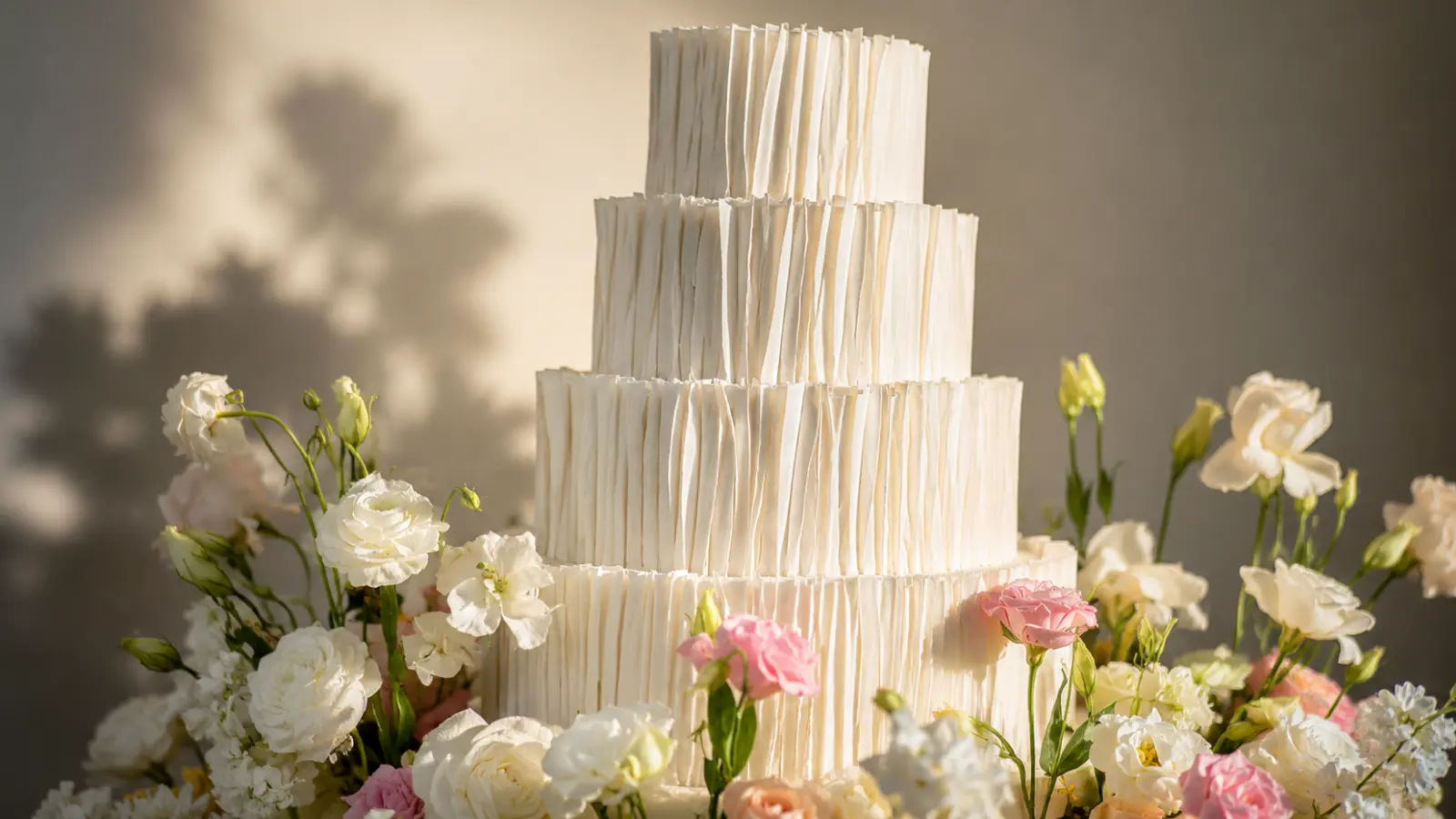
Season is among the most useful filters for floral cake design — not because certain flowers are technically unavailable in the wrong season (most can be sourced year-round from specialty growers), but because the best floral wedding cakes draw from what is naturally present at the time of the wedding. A three-tier wedding cake with seasonal flowers like peonies and garden roses can feel like it belongs to its moment in a way that a winter cake with the same flowers does not. The flower and the season together create a coherence that makes the overall design feel intentional rather than assembled.
| Season | Best Flowers for Cakes | Recommended Cake Styles |
|---|---|---|
| Spring | Peonies · garden roses · ranunculus · tulips · lilac · cherry blossom · anemones (use with food-safe barriers only) | Fresh flower cascade in blush and ivory · pressed edible flower surface · three-tier white buttercream with peony cluster · lace-detail vintage cake with garden roses |
| Summer | Roses · dahlias · lavender · sunflowers · chamomile · nasturtiums · marigolds · sweet William · cosmos | Semi-naked with herbs and wildflowers · naked cake with fresh fruit and lavender · white buttercream with dahlia topper · herb and edible flower rustic cake |
| Fall | Dried pampas grass · dried lunaria · dried citrus slices · dahlias · marigolds · dried wildflowers · rosehips · seasonal berries | Textured buttercream with dried botanical arrangement · semi-naked with fig and berry · deep color monochromatic cake with dried accents · honey drip cake with dried florals |
| Winter | Sugar flowers (any variety, any season) · white orchids · evergreen sprigs · dried botanicals · amaryllis · hellebores (with food-safe barriers) | White fondant with white sugar flower cascade · deep navy or midnight blue with sugar rose accents · Lambeth vintage cake with orchid topper · velvet-textured buttercream with evergreen |
A note on sourcing out-of-season flowers: it is possible to source almost any flower year-round through specialty importers, but the cost is typically higher and the quality is sometimes lower than in-season flowers grown domestically. Sugar flowers eliminate this issue entirely — the baker works from a reference photograph and is not constrained by growing seasons. For couples planning a winter wedding who want peonies on their cake, sugar flowers are almost always the more practical recommendation.
How to Coordinate Cake Flowers With Your Bouquet and Décor
The most visually cohesive wedding receptions are the ones where the cake flowers feel like part of the same conversation as the ceremony florals, the centerpieces, and the overall color palette — not a separate design decision made by a different vendor at a different point in the planning process. Achieving that coherence requires one thing above all else: the florist and baker communicating directly and early.
The coordination conversation — what needs to happen and when
Share the florist’s variety list with your baker at least 6 weeks out. Your florist knows exactly what flowers they are using and in what colors. Your baker needs that information to plan a complementary design. Send the florist’s flower selection document — or ask your florist to email the baker directly. The earlier this happens, the more options both vendors have.
Decide whether the cake flowers need to match exactly or coordinate tonally. Exact matching — the same variety, same color, same stem size as the bouquet — is more demanding logistically and is only achievable with careful planning. Tonal coordination — flowers in the same color family, not necessarily the same variety — is easier to achieve and often looks as intentional in photographs. Decide which approach you want before either vendor finalizes their design.
For fresh flower cakes, confirm who supplies the blooms. In most cases, the florist supplies a small additional amount of the wedding flowers directly to the baker, either the day before or the morning of the wedding. This needs to be explicitly agreed on between all parties — it does not happen automatically. Confirm the logistics: how many stems, in what condition, delivered to whom and when.
For sugar flower cakes, provide reference photographs early. The baker will work from photographs of your bouquet inspiration, your centerpiece design, or your specific flower varieties. The earlier those references are provided, the more time the baker has to develop and refine the sugar flowers before the wedding day. Sugar flower work is not done the week before the wedding — it may be started weeks in advance.
Consider the overall color story. The cake flowers should not introduce a new color that appears nowhere else in the wedding’s visual design. If the entire event is in soft blush, ivory, and sage — and the cake arrives with deep burgundy roses — the cake looks like it came from a different wedding. Wedding cake table ideas work best when the cake flowers draw from the same palette as the ceremony and reception florals, even if they use different varieties.
Floral Wedding Cake Inspiration Board
Floral wedding cakes can range from delicate garden rose clusters and edible pressed flowers to dramatic sugar flower cascades and botanical-inspired statement designs. Explore our floral wedding cake inspiration board for fresh flower arrangements, elegant white cakes with flowers, seasonal floral palettes, romantic garden styles, and creative ideas that connect the cake to the overall wedding aesthetic.
Final thoughts
The most successful floral wedding cakes are not defined by the number of flowers they feature, but by how naturally those flowers connect to the rest of the celebration. When the cake shares the same visual language as the bouquet, centerpieces, ceremony florals, and overall color palette, it feels like an intentional part of the wedding rather than a separate decorative element.
Whether you choose fresh flowers, sugar flowers, edible blooms, or a combination of several approaches, the strongest designs balance beauty with practicality. The right floral wedding cake should feel appropriate to the season, venue, and atmosphere of the day while creating a centerpiece that remains memorable long after the last slice has been served.
Frequently asked questions (FAQ)
Do floral wedding cakes ever look too busy?
Yes. One of the most common design mistakes is treating flowers as decoration rather than composition. When too many flower varieties, colors, and placement styles compete for attention, the cake can feel cluttered instead of elegant. The strongest floral cakes usually have a clear focal point and plenty of visual breathing room.
What makes floral wedding cakes feel luxurious?
It is rarely the number of flowers. Luxury usually comes from thoughtful flower selection, refined placement, and a cake design that allows the florals to stand out. A few perfectly chosen blooms often create a more sophisticated look than an oversized arrangement.
Should cake flowers match the bouquet exactly?
Not necessarily. Exact matching can be beautiful, but many designers prefer coordination rather than duplication. Sharing a color palette, flower family, or overall mood often creates a more natural and cohesive result throughout the wedding.
Why do some floral wedding cakes photograph better than others?
Depth and dimension. Cakes with layered flower placement, varied bloom sizes, and intentional negative space create more visual interest in photographs than arrangements where every flower sits at the same level.
Are sugar flowers worth the extra cost?
For many couples, yes. Sugar flowers offer complete control over color, seasonality, and design while remaining perfect throughout the event. They are often chosen when the cake is expected to serve as a major visual centerpiece.
What do professional cake designers notice first on a floral cake?
Usually the relationship between the flowers and the cake itself. Designers look at proportion, scale, balance, and whether the floral arrangement feels integrated into the design rather than simply attached to it.