Choosing a wedding cake baker means finding a professional who can create a cake that matches your style, tastes as expected, arrives safely, and is handled correctly on your wedding day. A beautiful design matters, but the baker behind the cake shapes everything from flavor quality and structure to communication, delivery, and the final result guests actually see.
Many couples spend weeks choosing wedding cake designs but much less time evaluating the person responsible for making them. The right baker is not only someone with a beautiful portfolio — it is someone with experience, clear communication, reliable processes, proper planning, and a contract that protects both sides. A stunning inspiration photo only matters if the baker has the skill and organization to recreate it successfully.
In this guide, you’ll learn how to choose a wedding cake baker, what questions to ask before booking, how to evaluate a portfolio, what to expect during a tasting, which contract details matter most, and the red flags to watch for before making your final decision.
How to Find a Wedding Cake Baker
The search for a wedding cake baker starts long before the tasting appointment — and where you begin the search determines the quality of the candidates you end up evaluating. Not all referral sources are equally reliable, and not all of them are looking out for your interests in the same way.
Your wedding venue. One of the most reliable starting points. Venues maintain preferred vendor lists based on direct experience with the vendors — not advertising relationships, but actual working history. A bakery that appears consistently on a venue’s preferred list has delivered cakes there before, navigated the setup logistics, understood the venue’s temperature and storage requirements, and done so reliably enough that the venue is willing to stake their reputation on the recommendation. That is meaningful information that online reviews alone rarely provide.
Recently married couples. Ask specifically: would they book the same baker again, and why or why not? The most useful referrals come from couples whose wedding had similar guest count, similar aesthetic, and a similar budget to yours — because the baker who does beautiful small intimate wedding cakes and the baker who executes large formal ballroom tiers fluently are sometimes, but not always, the same person.
Your wedding planner or coordinator. Planners work with vendors repeatedly across many weddings. They know which bakers are reliable under pressure, which ones communicate well, which ones have had delivery problems in the past, and which ones are genuinely exceptional at specific styles. Their referrals come with context that no online search provides.
Instagram and Pinterest. Useful for finding bakers whose aesthetic matches yours — but with an important caveat. Social media shows a baker’s best work, photographed under optimal conditions, often selected from hundreds of cakes. It does not show the average cake, the rushed wedding-weekend delivery, or what happens when something goes wrong. Use social media to create a candidate list, not to make a final decision.
Wedding directories and reviews. The Knot, WeddingWire, Google reviews, and Yelp all provide useful signal — particularly when looking for patterns rather than individual reviews. One negative review among forty positives means something different than five negative reviews about the same specific issue. Look for reviews that mention delivery reliability, communication responsiveness, and whether the final cake matched the agreed design. These operational details tell you more than reviews about flavor.
How many candidates to approach
Book tastings with two to three bakers. More than three is logistically difficult and makes the decision harder rather than easier. Fewer than two means no comparison point. The goal of the tasting process is not to taste the most cake — it is to find one baker you trust enough to sign a contract with, and to have one backup option in case the first choice falls through on availability or budget.
How to Choose a Wedding Cake Baker
Once you have a list of candidates, the evaluation comes down to four things: the quality and relevance of their portfolio, the experience of the tasting, the clarity and completeness of their contract, and the quality of their communication before you have even booked them. That last point is underrated. A baker who responds to inquiries promptly, answers questions specifically rather than vaguely, and volunteers information rather than waiting to be asked is demonstrating exactly the kind of professional reliability you need from someone who is going to be responsible for a significant element of your wedding day.
Skill versus style. The most important distinction in evaluating a wedding cake baker. A baker can be genuinely skilled — excellent technical fundamentals, consistent results, reliable operation — and still not be the right fit for your specific vision. A baker who specializes in rustic naked cakes and produces them beautifully may not have the smooth-finish technique required for modern wedding cakes with a minimalist finish. A baker known for elaborate sugar flower work may not produce the same quality on a simple buttercream texture. Match the baker’s demonstrated expertise to your specific design vision, not just their overall reputation.
Capacity and exclusivity. One of the most important operational questions couples forget to ask: how many weddings does this baker serve per weekend? A high-volume bakery may be delivering several wedding cakes on the same Saturday. The risk is not that they cannot do it — experienced high-volume bakeries have systems for exactly this — but that any problem with one delivery affects the timeline for the next. A boutique baker who takes one or two weddings per weekend offers a different level of focused attention. Neither is inherently better; both require the same question: how many deliveries are you making the day of my wedding?
Licensing and food safety. This is the detail most couples never ask about and almost always should. In many U.S. states, people selling food commercially must operate from a licensed commercial kitchen or qualify under a cottage food exemption with specific rules about what they can sell, where they can sell it, and how the food is handled. An unlicensed baker operating outside these rules may not have the same insurance, inspection, or accountability structure as a properly licensed food business. The question is simple: are you licensed and insured? A professional baker should be able to answer it directly and clearly. A vague or evasive answer is a red flag regardless of how beautiful the portfolio is.
What to Look for in a Cake Portfolio
Looking at a wedding cake portfolio correctly requires a different approach than most couples use. The instinct is to look for beautiful cakes — and the instinct is partially right. But beautiful cakes in a portfolio tell you less than you think, because every portfolio shows the best work, not the average work. What you are looking for is not the best cake in the portfolio. You are looking for the consistent quality across the whole portfolio, and specifically for demonstrated expertise in the style you want.
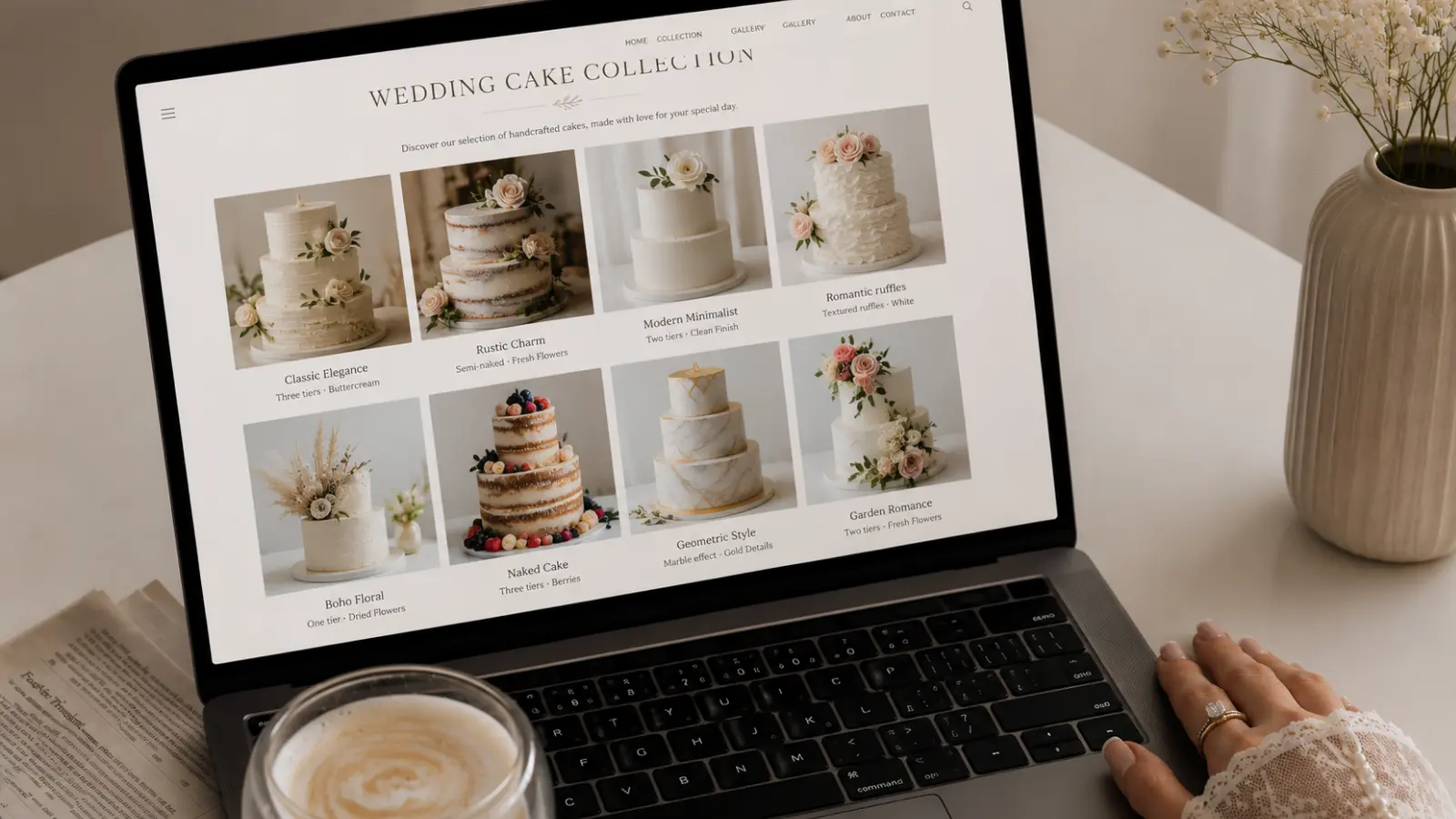
Five things to look for specifically
1. Your style, executed well. If you want a smooth modern buttercream cake, look for smooth modern buttercream cakes in the portfolio — not just the general impression of quality. The skills required for an organic, textured rustic cake are meaningfully different from those required for a sharp-edged, flawless contemporary one. A portfolio full of gorgeous naked cakes does not tell you whether the baker can produce a perfectly smooth fondant-free surface. Look for your specific style, in multiple examples, at a consistent level.
2. Tier alignment and structural integrity. Even in a portfolio photograph, you can assess how well a baker constructs a tiered cake. The tiers should be level — not listing to one side or visibly tilting — and the alignment between tiers should be clean and consistent. A slightly tilted cake in a portfolio photograph is a significantly tilted cake in person. This is a fundamental structural skill; if the portfolio shows problems here, the actual wedding cake will too.
3. Detail work in close-up. Ask to see close-up photographs of piping, flowers, or whatever decorative technique is relevant to your design. Sugar flowers that look beautiful from three feet away should also look beautiful from six inches. Piping work that seems clean in a full-cake shot should remain precise in a detail photograph. A baker whose portfolio does not include detail shots may have a specific reason for that omission.
4. Real wedding photographs alongside studio work. Studio photographs of wedding cakes — taken in controlled lighting, against a clean background, by a photographer who specializes in food — look significantly better than the same cakes photographed at an actual reception. Both are valid, but you want to see both. A portfolio that consists exclusively of studio photography does not tell you how the cakes look in a ballroom at 6pm, in outdoor natural light, or under the fluorescent glow of a barn event space. Real wedding photographs, taken by wedding photographers under real conditions, are more useful data.
5. Consistency across the portfolio. One exceptional cake surrounded by mediocre ones tells a different story than twenty consistently excellent cakes. Look at the range of the portfolio, not just the highlights. A baker with one or two standout cakes but inconsistent work across the rest of the portfolio may not be the safest choice for a wedding cake. The baker you want produces excellent results consistently — across seasons, styles, sizes, and venues.
Portfolio questions worth asking directly
- “Can I see examples of cakes similar to what I have in mind — not just style, but scale and complexity?”
- “Can you show me photographs of cakes from actual wedding venues, not just studio shots?”
- “How recently was this work done?” — Portfolios can include work from years ago that does not represent current skill level in either direction.
- “Which of these did you make personally, versus other decorators in your team?” — Relevant for larger bakeries where a team produces the work; you want to know whose hands will be on your cake.
Questions to Ask a Wedding Cake Baker
The questions you ask before booking a wedding cake baker are one of the most effective ways to protect yourself from common wedding cake problems. Most booking regrets come from questions that were not asked — not from information that was hidden, but from information that was simply never requested.
These questions are organized by each stage of the booking process, from the first conversation to the wedding cake tasting and final contract.
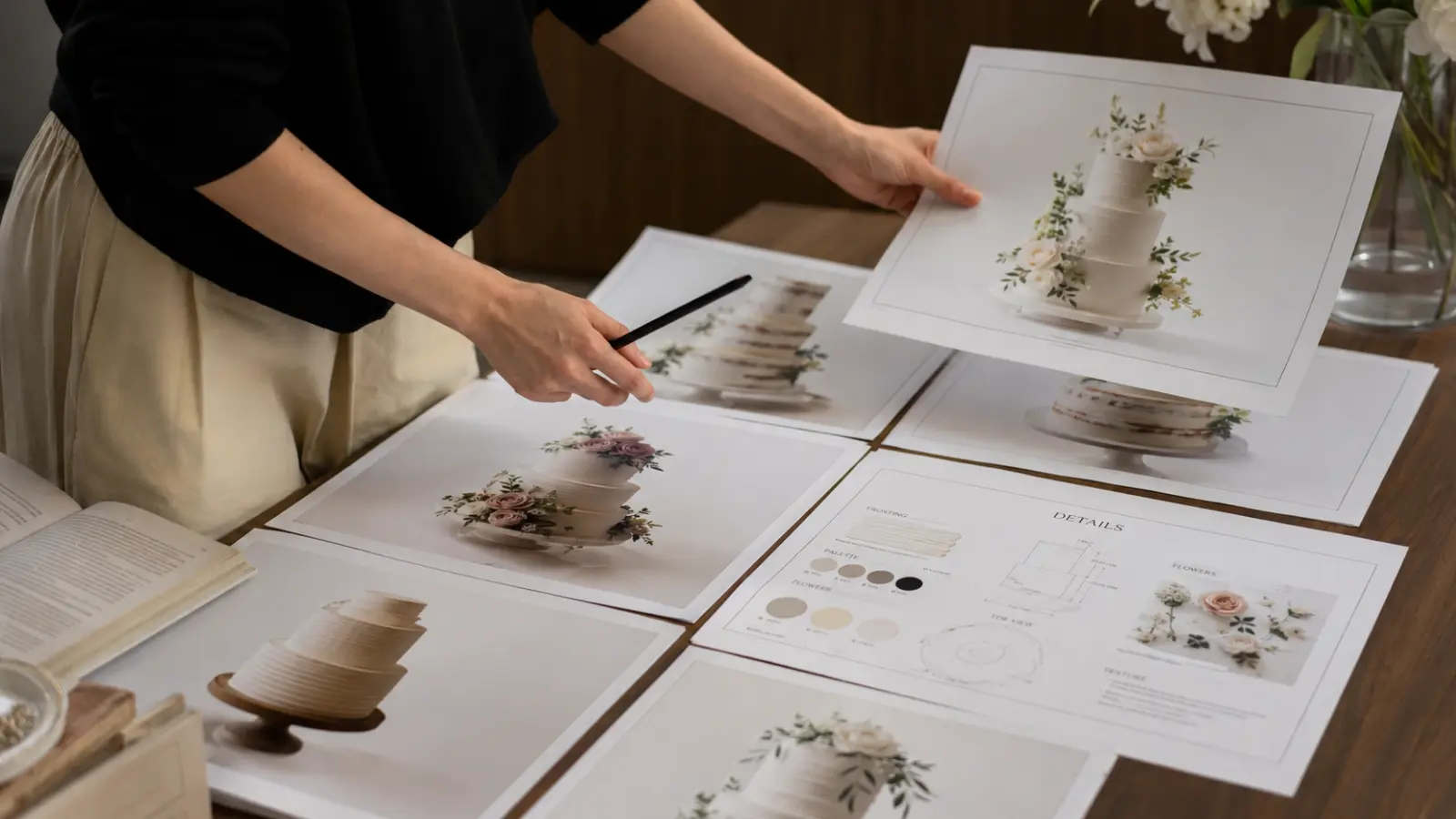
Before the tasting
| Question | Why It Matters |
|---|---|
| Are you available on my wedding date? | Obvious, but ask it first. Some bakeries limit the number of weddings per weekend; availability determines whether the conversation continues. |
| How many weddings do you take per weekend? | Tells you immediately about the attention your order will receive and the delivery-day logistics. One wedding per weekend is a boutique operation. Four or five is a high-volume bakery. Both can be excellent; both require different management. |
| Do you have experience delivering to my venue? | Familiarity with the venue’s loading dock, elevator access, setup space, and temperature conditions reduces delivery risk significantly. |
| Are you licensed and insured? | A non-negotiable question. The answer should be immediate and specific. Anything vague warrants a follow-up. |
| What is your general price range for a cake like mine? | Establishes whether the conversation is financially viable before investing time in a tasting. A baker whose starting price is above your total cake budget is not the right tasting to schedule. |
At the tasting
| Question | Why It Matters |
|---|---|
| Do you bake fresh or from frozen layers? | Both methods can produce excellent results, but the answer tells you about process and quality control. A baker who bakes fresh within 48 hours of delivery has a different workflow than one who freezes layers weeks ahead. Ask what their specific timeline is. |
| Who will make my cake? You personally, or a team member? | At larger bakeries, the person doing the tasting may not be the person who decorates the final cake. If the portfolio work was made by a specific decorator, you want to know if that person will be working on yours. |
| Can you show me an example of this specific style from a real wedding? | Tests whether the portfolio skill translates to actual event conditions. |
| What is your policy if the cake is damaged during delivery? | The most important operational question, and the one most couples never ask. Delivery accidents happen. The question is not whether they can happen — it is what the baker’s response plan looks like when they do. |
| What is included in the delivery fee, and what time will you arrive? | Delivery and setup are typically charged separately from the cake price. Understand exactly what the fee covers: transport only, or transport plus setup and the rental of any cake stand or display items. |
| What changes are allowed after I sign the contract, and what is the deadline for final decisions? | Guest count changes, design adjustments, and flavor substitutions all have practical deadlines for a baker managing multiple orders. Know the window before you sign. |
| What is your cancellation and postponement policy? | Most couples do not expect this to apply to them, but plans can change. Get the terms in detail before signing. |
After the tasting, before signing
| Question | Why It Matters |
|---|---|
| Can I see the full contract before I pay the deposit? | Always review the complete contract before any money changes hands. A baker who pushes to collect the deposit before the contract is ready is not operating with the transparency that this commitment requires. |
| Can you provide references from past wedding clients? | Specifically from couples whose wedding was similar in scale and style to yours. Online reviews are useful; direct references allow specific questions about delivery, setup, and whether the final cake matched the agreement. |
| What is the best way to reach you if I have questions between now and the wedding? | Establishes communication expectations early. Know who to contact, by what method, and what the typical response time is — before you need an urgent answer. |
Cake Tasting: What to Bring, What to Ask, What to Decide
The wedding cake tasting is simultaneously the most enjoyable part of the vendor booking process and the one most couples treat too casually. It can be enjoyable, but it is still a professional evaluation meeting that happens to involve cake. Treating it that way produces better decisions.
Who to bring. Both partners, if possible, and no more than one additional person whose taste preferences are relevant — typically a parent who is contributing financially to the wedding, or a partner who has strong opinions about food. Bringing a large group to a tasting diffuses the decision-making and creates social pressure to reach consensus rather than make the right choice. The tasting decision belongs to the couple.
What to bring. Come with a clear visual reference for the design you want — two or three photographs that represent the style, finish, and scale you have in mind. A screenshot of the wedding’s color palette. Your approximate guest count. A rough sense of the budget for the cake. The baker needs this information to give you an accurate quote and to show you portfolio examples that are relevant to your specific situation rather than their general work.
How to evaluate the flavors. At a tasting, you are evaluating wedding cake flavors, fillings, and frosting choices both separately and together. A filling that tastes excellent on its own may be too sweet against a particular buttercream. A cake layer that is outstanding in texture may be too neutral for a strongly flavored filling. Ask the baker which combinations they recommend and why — they have tasted these combinations many times and know which ones perform best on a wedding timeline (which is different from which ones taste best fresh from the oven).
The question of freshness. Some wedding cake bakers bake layers in advance and freeze them for quality control and structure, while others bake closer to the event date. What matters is understanding that baker’s specific process and how it affects flavor, texture, and freshness. The tasting samples may be baked fresh or may be from a recent batch. Ask which these are. The answer matters because a fresh-baked layer may taste different from a layer that has been frozen and thawed — and the thawed version is what your guests will actually eat.
What to decide at the tasting — and what not to. By the end of the tasting, you should be able to decide on the flavor and filling combination for each tier, confirm that the baker has demonstrated the technical skill for your design in their portfolio, and determine whether you feel confident in their communication and professionalism. You do not need to finalize every design detail at the tasting — most contracts allow for design refinements within a defined window. What you are deciding is whether to book this baker, not the precise position of every flower on the final cake.
For a complete guide to flavor combinations and what works best for each wedding season, see the wedding cake flavors guide.
Wedding Cake Delivery and Setup
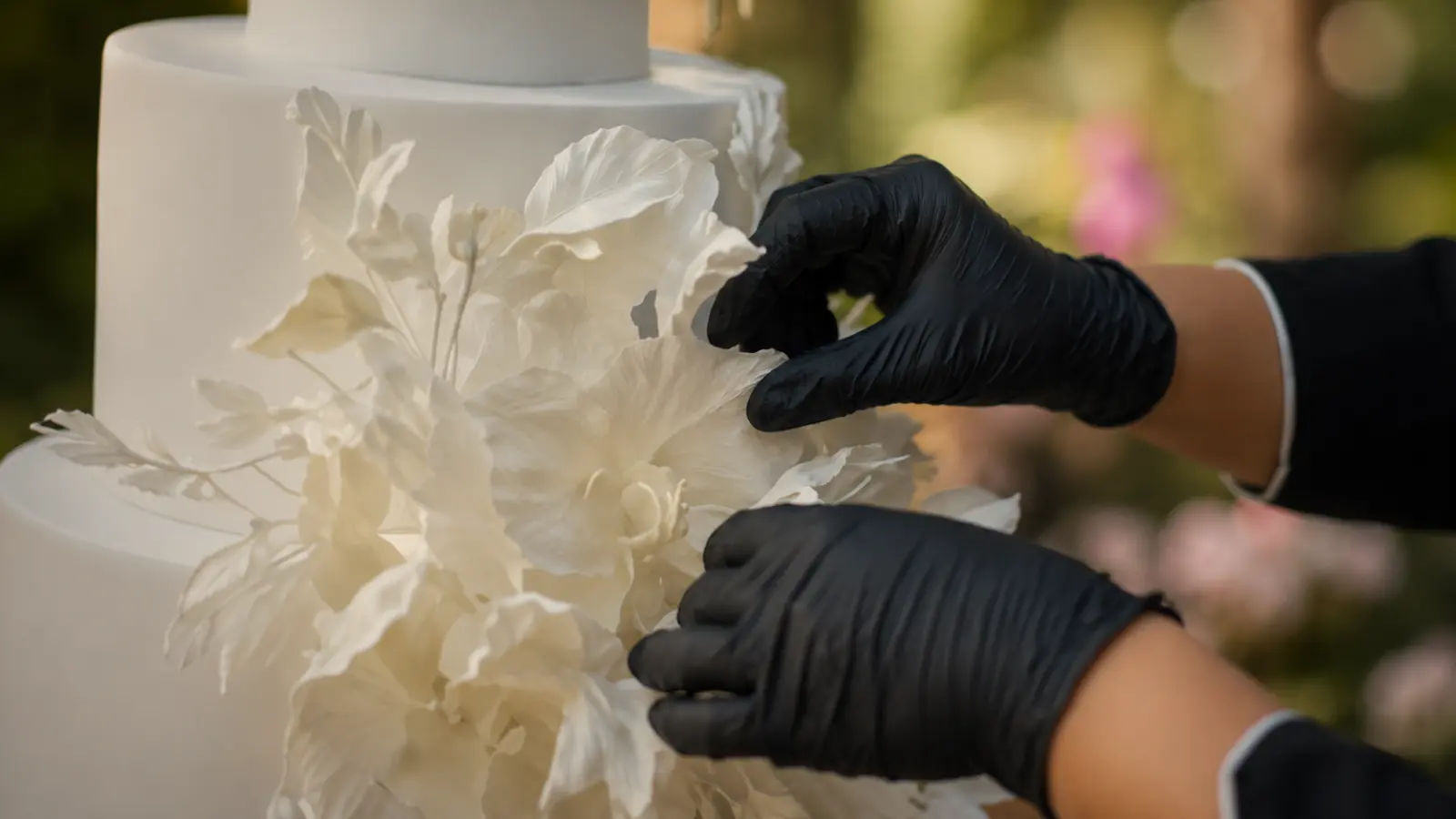
Wedding cake delivery is where the most serious problems occur — and where the most important contractual protections need to be in place. A cake that is perfect in the bakery can be compromised in transit. A delivery that arrives too close to the reception start time can create stress that no amount of beautiful design can fully offset.
Understanding what delivery actually involves — and what can go wrong — is the context that makes the contract questions in the next section make sense.
What professional wedding cake delivery looks like
A professional wedding cake delivery is not one person carrying a box to a reception hall. It is a planned logistical operation. The tiers of a stacked cake are typically transported separately — assembled at the delivery location rather than transported fully assembled — to protect against the vibration and road conditions that make transporting a completed stacked cake risky. The baker arrives at the venue with the tools and materials needed for final assembly and any last-minute touch-ups. They coordinate with the venue’s event staff on where the cake will be displayed, what the temperature conditions are at that location, and how early they can access the space.
A well-run delivery should include enough time for placement, assembly, touch-ups, and coordination with the venue team. A more complex cake — or a venue with difficult access, multiple stairwells, or a specific setup window — may take longer. The delivery time agreed in the contract should account for this realistically, not optimistically.
Delivery details to confirm in writing
| Detail | Why It Needs to Be Written, Not Assumed |
|---|---|
| Delivery date and arrival window | A specific time range, not “morning of.” The venue’s event coordinator needs to know when to expect the baker. A vague delivery window creates scheduling problems for every vendor setup that follows. |
| Delivery address and contact at the venue | The baker needs the specific venue address, the entrance to use for vendor delivery (different from the guest entrance at most venues), and the name and phone number of the venue coordinator they should contact on arrival. |
| Delivery fee and what it covers | Delivery fees vary depending on distance, setup complexity, venue access, and whether rental pickup or on-site assembly is included. The contract should specify exactly what the fee covers — transport only, transport and setup, or transport, setup, and return of any rental equipment. |
| Cake table setup responsibility | Who provides the cake stand, table, and any decorative elements around the cake? The baker, the venue, the florist, or the couple? If the baker is providing any rental items — a stand, a table, a display element — the contract should specify the return arrangement. |
| Temperature requirements | Buttercream cakes, fresh flower decorations, and certain fillings have temperature sensitivities. For outdoor summer weddings, direct sunlight exposure is a real risk. The contract should specify any temperature requirements the couple or venue needs to accommodate. |
| What happens if delivery is delayed or the cake is damaged | The single most important delivery clause. Who is the emergency contact? What is the baker’s response plan? Is there compensation if the cake arrives in a condition different from what was agreed? Get specific answers in writing before you sign. |
Never transport your own wedding cake. This bears saying directly: do not attempt to pick up or transport your own wedding cake in a personal vehicle on the wedding day. Professional bakeries deliver in temperature-controlled vehicles with non-slip cargo surfaces and secure transport systems for a reason. A wedding cake transported in the back seat of a car, or on the floor of an SUV, on the day of the wedding, is a story that ends badly with a frequency that every experienced wedding planner has witnessed. For tiered or delicate cakes, professional bakery delivery is usually worth the cost.
Contract Details That Actually Matter
A wedding cake contract is not a formality. It is the document that defines exactly what was agreed, protects both parties when something goes wrong, and provides the specific terms that govern every interaction from the booking date to the day after the wedding. Many couples sign contracts without reading them carefully — and discover after the fact that the terms were different from what they assumed.
The details that matter most are the ones that govern what happens when circumstances change. Not the description of a perfect-scenario wedding cake delivery, but the specific terms for everything that might not go perfectly.
What every wedding cake contract should include
Full cake description. The number of tiers, the size of each tier, the flavor and filling for each tier, the frosting type and finish, the decoration elements in specific detail, and any special requests or accommodations. “Three-tier buttercream with flowers” is not a sufficient description. “Three-tier Swiss meringue buttercream — 10-inch vanilla almond with raspberry filling (bottom), 8-inch lemon elderflower with lemon curd filling (middle), 6-inch champagne with vanilla bean filling (top) — smooth matte finish inspired by floral wedding cakes, with a cascading arrangement of fresh white garden roses and eucalyptus, coordinated with the florist” is a sufficient description. The level of specificity in the description determines how much protection the contract provides.
Price and payment schedule. Total price, deposit amount and due date, final payment amount and due date, and any circumstances under which the price might change (guest count increase beyond a specific threshold, design changes after a certain deadline, additional delivery distance).
Deposit and refund terms. The deposit amount, whether it is refundable under any circumstances, and the specific conditions under which any partial refund is available. Most wedding cake deposits are non-refundable — the baker has turned away other bookings for your date, which represents a real financial commitment. Understand and accept these terms before signing.
Cancellation and postponement policy. What happens if you cancel: what portion of the total price is owed at different points in the timeline (90 days before, 60 days before, 30 days before, within 14 days). What happens if you need to postpone: can the booking be transferred to a new date, is there a fee, what is the window for rescheduling? These terms should be in the contract in specific language, not described verbally and assumed to be the same as what is written.
Baker’s contingency for non-delivery. What is the baker’s obligation and recourse if they are unable to fulfill the order — due to illness, emergency, equipment failure, or any other circumstance? This clause should specify what compensation or alternative arrangement the baker is responsible for providing. A contract that is silent on this point leaves you with no recourse if the worst happens.
Modification deadline. The date after which no further changes to the design, flavor, or serving count are accepted. This protects the baker from last-minute changes that are operationally impossible to accommodate. Know the deadline before you start making final decisions.
Dispute resolution. How disagreements are handled if the cake does not match the agreed description. Refund? Credit? Partial compensation? A contract that does not address this leaves the resolution entirely to goodwill — which is not the same as a legal commitment.
Red Flags Before Booking
The red flags in wedding cake baker selection are almost always visible before any money changes hands. They appear in the initial inquiry response, in the tasting conversation, in the portfolio, and in the contract review. The challenge is knowing what to look for — because individually, many of these signals can be explained away. Together, they tell a story about what the working relationship will look like.
Communication red flags
- Slow or vague responses to initial inquiries. A baker who takes a week to respond to a booking inquiry, or who answers specific questions with general non-answers, is demonstrating exactly how they will communicate from the contract signing to the wedding day. Communication responsiveness before booking is a reliable predictor of communication responsiveness during the working relationship.
- Reluctance to provide references. A baker with a legitimate track record of successful wedding deliveries has past clients willing to speak to that record. Hesitation or deflection when references are requested is a meaningful signal.
- Verbal commitments with no written follow-through. If a baker confirms details verbally in the tasting meeting and then sends a contract that does not reflect those details, the discrepancy needs to be resolved before signing. The contract is what is enforceable. Verbal agreements are not.
Portfolio red flags
- Inconsistent quality across the portfolio. One or two exceptional cakes surrounded by mediocre work is a sign of inconsistency — which is the exact quality you cannot afford in a wedding vendor.
- Only studio photographs, no real-wedding images. Studio conditions are forgiving. A baker who cannot show you their work in actual wedding conditions may have a reason for that omission.
- No examples of your specific style. Booking a baker to execute a design style they have never demonstrated is accepting unnecessary risk. The baker may be capable of it — but you have no evidence of that, and your wedding is not the right occasion for experimentation.
Pricing red flags
- Significantly below-market pricing without explanation. Wedding cake cost in the U.S. reflects the price of quality ingredients, labor, equipment, and insurance. A baker offering prices dramatically below the market rate in your area is typically absorbing that gap somewhere — in ingredient quality, in unlicensed operation, in inexperience, or in all three. Price below market is not a deal. It is a risk disclosure.
- Requests for full payment upfront. Standard practice is a deposit at booking and the balance due two to four weeks before the wedding. A baker requesting full payment at booking has no financial incentive to prioritize your order over others once the money is received.
- No itemized quote. A total price with no breakdown of what drives it — tier count, serving count, decoration complexity, delivery fee — makes it impossible to adjust the order intelligently if the total is over budget. A professional baker provides an itemized quote.
Contract red flags
- No written contract offered. One of the most significant red flags in the entire booking process. A baker who does not provide a written contract is either inexperienced, operating informally, or both. There is no version of this that protects you.
- Vague cake description in the contract. A contract that describes the cake in general terms — “three-tier white cake with flowers” — rather than specific ones gives the baker latitude to deliver something that does not match your vision and call it compliant with the agreement.
- No contingency clause for baker non-delivery. What happens if the baker is sick, has a family emergency, or has an equipment failure the day of your wedding? A contract that does not address this leaves you with no recourse. A professional baker addresses this clause because they understand it protects both parties.
- Cancellation terms that are verbal rather than written. “Don’t worry, we’re flexible” is not a cancellation policy. The written terms are what apply.
The best wedding cake bakers welcome all of these questions. They have comprehensive contracts because they have been through enough weddings to know exactly what needs to be specified. They provide references because they have clients willing to give them. They discuss delivery contingencies because they have thought through their own response plan. The right baker makes this process straightforward — and that straightforwardness is itself a form of reassurance.
For a complete guide to wedding cake styles, costs, and what to discuss at the tasting, see the complete wedding cake guide.
Wedding Cake Baker Inspiration Board
Before choosing your wedding cake baker, it helps to understand the cake styles, finishes, details, and designs you want for your celebration. Explore our wedding cake baker inspiration board for cake styles, decoration ideas, frosting finishes, floral designs, tiered wedding cakes, and inspiration examples to help you choose a baker who can bring your vision to life.
Final thoughts
The best wedding cake baker is not always the one with the most dramatic designs or the largest portfolio. The right choice is the baker who understands your vision, communicates clearly, creates consistent work, manages the details behind the scenes, and has the experience needed to deliver your cake exactly as planned.
Choosing a baker carefully gives you confidence long before the wedding day arrives. When the style, flavor, budget, contract, and communication all align, your wedding cake becomes more than a beautiful design — it becomes a carefully planned part of the celebration created by someone you trust.
Frequently asked questions (FAQ)
What separates a good cake baker from a great wedding cake baker?
A great wedding cake baker understands more than baking. They understand timelines, transportation, venue conditions, communication, and how a cake needs to perform during an actual event. Beautiful cakes matter, but consistency and reliability are what separate experienced wedding professionals from talented bakers.
Is it better to choose a famous wedding cake bakery or a smaller independent baker?
Neither is automatically better. A larger bakery may have a bigger team, more systems, and experience with high-volume weddings. A smaller baker may offer more personal attention and customization. The better choice is the baker whose experience, communication style, and portfolio match your specific wedding.
Why do some wedding cake bakers cost much more than others?
The price usually reflects more than ingredients. Experienced wedding bakers charge for design skill, structural knowledge, planning time, delivery expertise, insurance, and the ability to solve problems before they affect your wedding day.
What is the biggest mistake couples make when choosing a cake baker?
Choosing based only on photos. A beautiful portfolio shows creativity, but it does not show communication, organization, delivery reliability, or how the baker handles unexpected situations. The process behind the cake matters just as much as the final design.
How do you know if a wedding cake baker understands your vision?
A strong baker asks detailed questions before suggesting solutions. They want to understand your venue, guest count, style, priorities, and budget. A baker who immediately agrees to everything without discussing practical details may not be evaluating what your wedding actually requires.
What do wedding planners notice first about a cake baker?
Usually professionalism before the cake itself. Planners notice response times, organization, contracts, delivery planning, and how prepared the baker is for real wedding conditions. Those behind-the-scenes details are often what determine whether the experience is smooth.
How far in advance should you book a wedding cake baker?
Most couples should start looking for a wedding cake baker after booking the venue and confirming the wedding date. Popular bakers can book far in advance, especially for high-demand wedding seasons, so it is better to schedule tastings early than to wait until only a few options remain.
What should you ask before booking a wedding cake baker?
Before booking a wedding cake baker, ask about availability, licensing, insurance, portfolio examples, tasting options, delivery and setup, pricing, contract terms, cancellation policy, and what happens if the cake is damaged or the baker cannot deliver. The goal is to understand both the cake and the process behind it.