Vintage wedding cakes are wedding cakes inspired by the design traditions of past decades, featuring details such as Lambeth piping, pearl borders, retro toppers, delicate florals, and romantic buttercream finishes. While the style draws inspiration from history, today’s vintage cakes are often reimagined with modern proportions, updated color palettes, and cleaner styling.
What makes vintage wedding cakes so appealing is their visible craftsmanship. In a world filled with sleek minimalist designs, vintage cakes celebrate ornamentation, texture, and decorative techniques that require genuine skill. Every piped scroll, pearl border, and hand-finished detail adds character, creating a centerpiece that feels personal, romantic, and memorable.
In this guide, you’ll discover vintage wedding cake ideas ranging from ornate Lambeth creations and retro-inspired designs to pearl-accented cakes, heirloom toppers, and soft romantic styles. You’ll also learn how to incorporate vintage elements into a modern wedding, how to avoid a themed look, and how to choose a design that feels timeless rather than dated.
Vintage Wedding Cakes Explained
The word “vintage” does almost too much work in the wedding cake world. It is used to describe a fully Lambeth-piped five-tier masterpiece that took a decorator 40 hours to complete, and also a simple white buttercream cake with a single pearl border and an antique topper. Both are vintage — but they are not remotely the same thing, and knowing which version you are drawn to before you sit down with a baker is the difference between getting exactly what you imagined and walking away from the consultation with something that costs twice as much or looks nothing like your inspiration photos.
Vintage wedding cake designs draw from several distinct eras, each with its own specific design vocabulary:
The design eras and what they look like
| Era | Key Visual Elements | Typical Color Palette |
|---|---|---|
| 1920s–1930s (Art Deco) | Geometric piping, angular borders, minimal ornamentation, architectural tiers | White, gold, ivory, black accents |
| 1940s–1950s (Mid-Century Classic) | Shell borders, figurine toppers, white royal icing, ribbon trim, architectural tiers | Stark white, ivory, silver accents |
| 1960s–1970s (Ornate Baroque) | Lambeth piping at its peak, overpiped scrollwork, dimensional flowers, sugar lace | White, pastel pink, pastel yellow, pale mint |
| 1980s (Maximalist) | Fondant bows, ruffles, roses, gum paste florals, multiple tiers | White, blush, pale peach, dusty rose |
| 2020s Vintage Revival | Lambeth-inspired piping, pearl borders, antique toppers, pastel buttercream, deliberate imperfection | Sage, dusty rose, champagne, lavender, warm white |
The current vintage revival draws heavily from the 1960s and 1970s piping tradition while updating the color palette to warmer, more contemporary hues. The Lambeth technique has returned with specific force, driven by social media’s appetite for the kind of intricate, textural, obviously handcrafted work that a smooth fondant cake cannot provide.
Lambeth Wedding Cakes
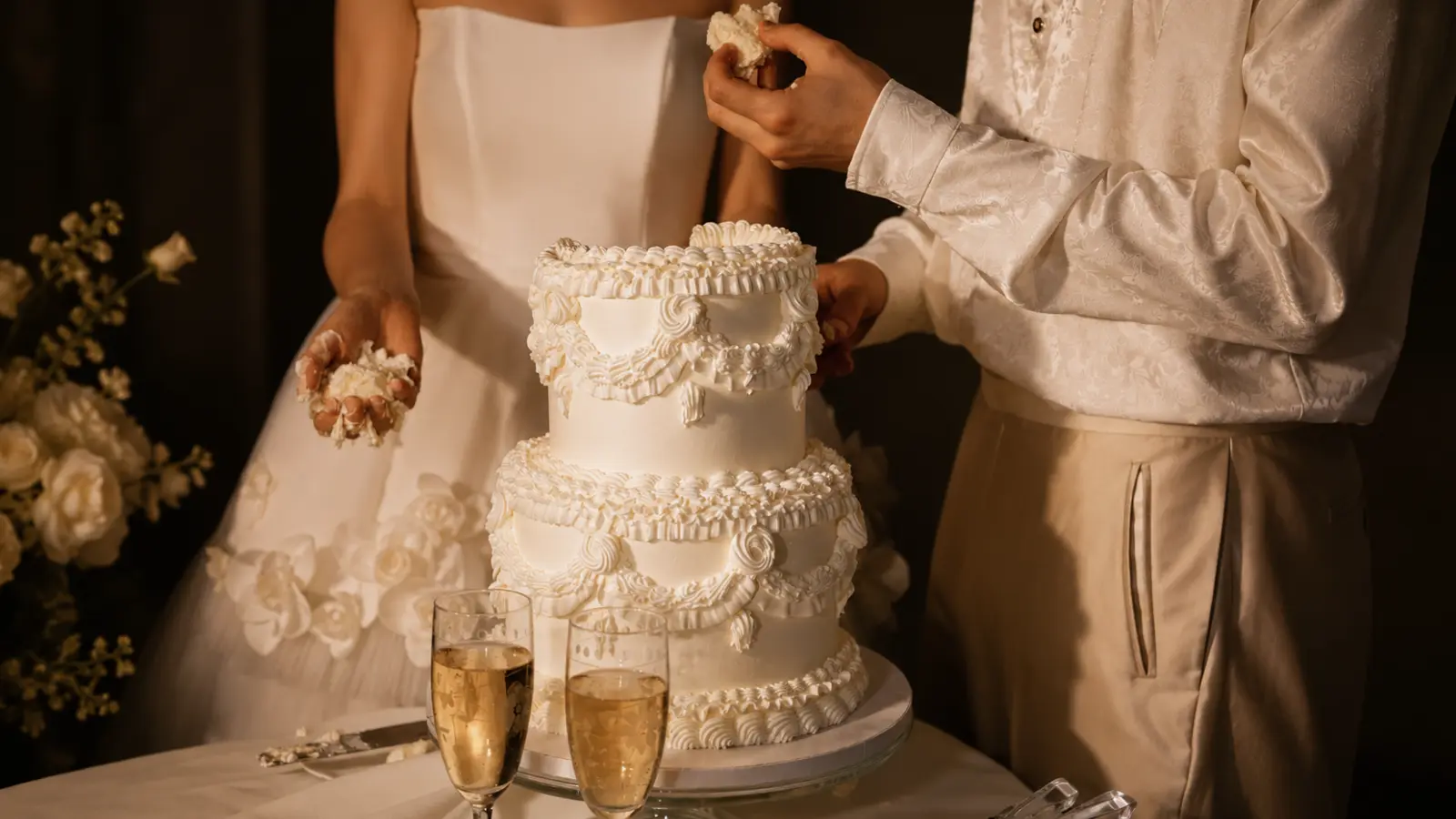
The Lambeth cake is the most technically demanding and visually distinctive style in the vintage cake category — and if you have seen it, you almost certainly remember it. The style is named after Joseph Lambeth, a British confectioner who published a 1934 decorating manual that became the foundational text for a generation of cake decorators. The technique involves building layers of piped royal icing on top of each other in successive passes — a scroll here, a shell there, a border over the border — until the surface of the cake is covered in a three-dimensional relief of decorative elements that looks more like architectural stucco than iced confectionery.
What Lambeth piping does that no other cake technique does is create shadows. Because the decoration is genuinely dimensional — raised well above the surface of the cake — light catches it differently depending on the angle. In wedding photography, a Lambeth cake looks different in every frame, which gives it a visual complexity that a flat fondant cake or a simple buttercream cannot approach.
What a Lambeth cake involves — and what to ask your baker
Not every baker who calls themselves a cake decorator has significant Lambeth experience, and the quality difference between a practiced Lambeth artist and someone attempting it for the first time is immediately visible. Before booking, ask for a portfolio specifically of Lambeth or overpiped work — not just general decorated cakes. A decorator who does this well will have examples they are proud to show. A decorator who has attempted it a few times will show you photographs where the piping is slightly inconsistent or the layers look heavy rather than elegant.
- Traditional Lambeth: White royal icing on white royal icing — maximum contrast in texture with minimal color. The most historically authentic version and the most dramatic in photography.
- Pastel Lambeth: Piping in a soft color — dusty rose, sage, lavender — over a white or cream base. A softer variation that photographs with more warmth than stark white versions.
- Tonal Lambeth: Piping in the same color as the base but a shade darker or lighter — a cream-on-cream or rose-on-blush effect. The most subtle version; reads as texture rather than decoration at a distance.
- Mixed-tier Lambeth: One or two tiers fully Lambeth-piped, the remaining tiers smooth buttercream or minimally decorated. The most practical approach for couples who want the Lambeth look without the full cost of decorating every tier.
Cost note: a fully Lambeth-piped cake for a large guest count can require many additional hours of skilled decorator time beyond baking and assembly. This is not the category to budget-compress. If the full Lambeth is beyond your budget, ask your decorator what is achievable — one heavily decorated tier surrounded by simpler tiers can deliver the visual impact at a fraction of the full cost.
Retro Wedding Cake Designs
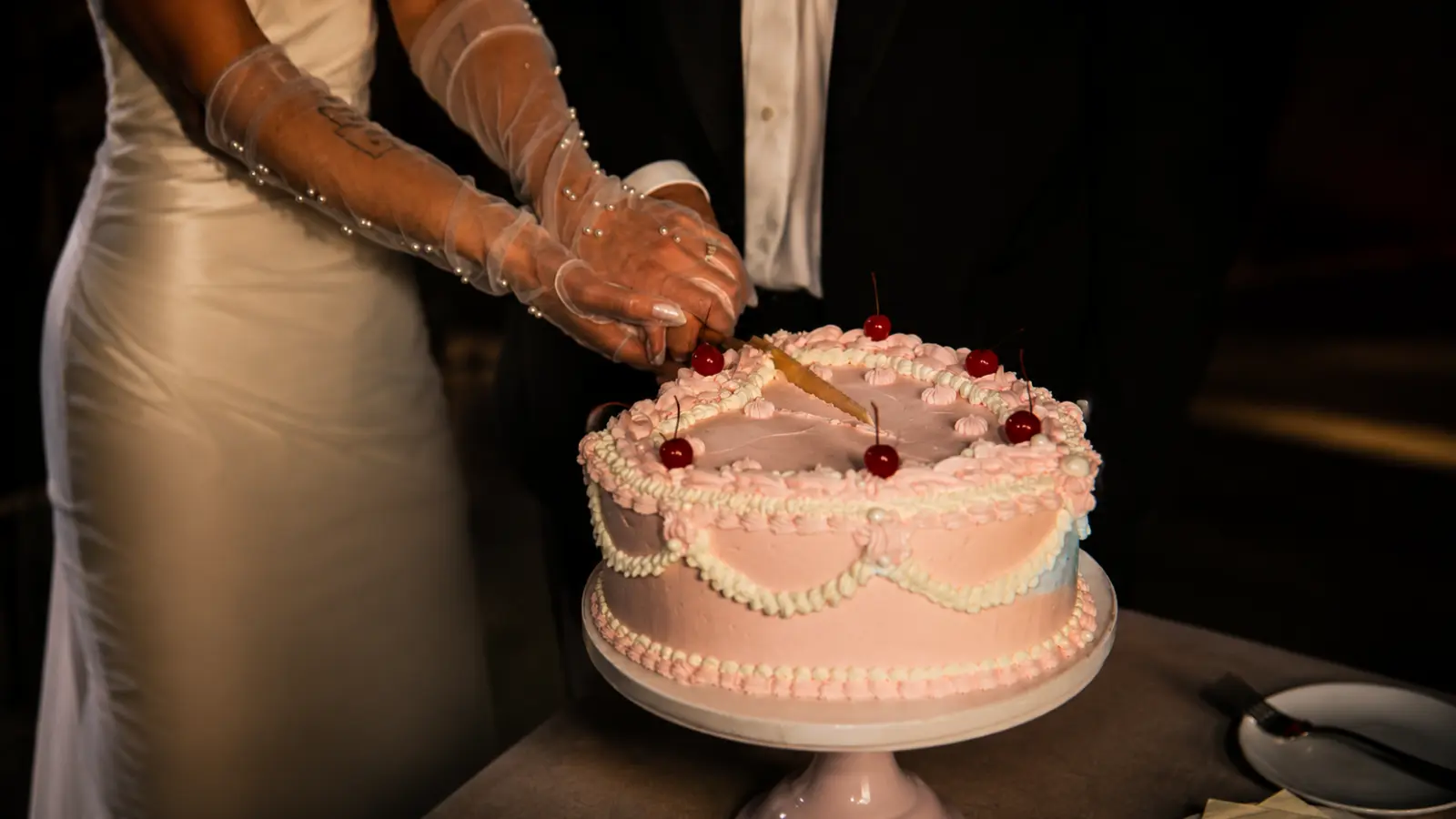
Retro wedding cakes sit slightly differently from vintage ones in the design conversation. Where “vintage” tends to signal romanticism and timelessness — the goal is something that feels of another era but universally beautiful — “retro” implies a more deliberate, sometimes playful reference to a specific decade. A retro wedding cake is not trying to pass as something made in 1962. It is acknowledging the 1962 reference with intention, often with a wink.
Many couples want retro without fully committing to a themed event — they love the visual language of mid-century American wedding cakes without wanting their reception to feel like a sock hop. The way to navigate this is specific: choose retro elements that read as design choices rather than costume choices. A 1950s-style shell border on a beautifully proportioned two-tier wedding cake reads as a considered design choice. A 1950s-style shell border combined with a checkerboard cake board, a diner-style topper, and pastel balloons reads as a theme.
Retro design elements that work without theming
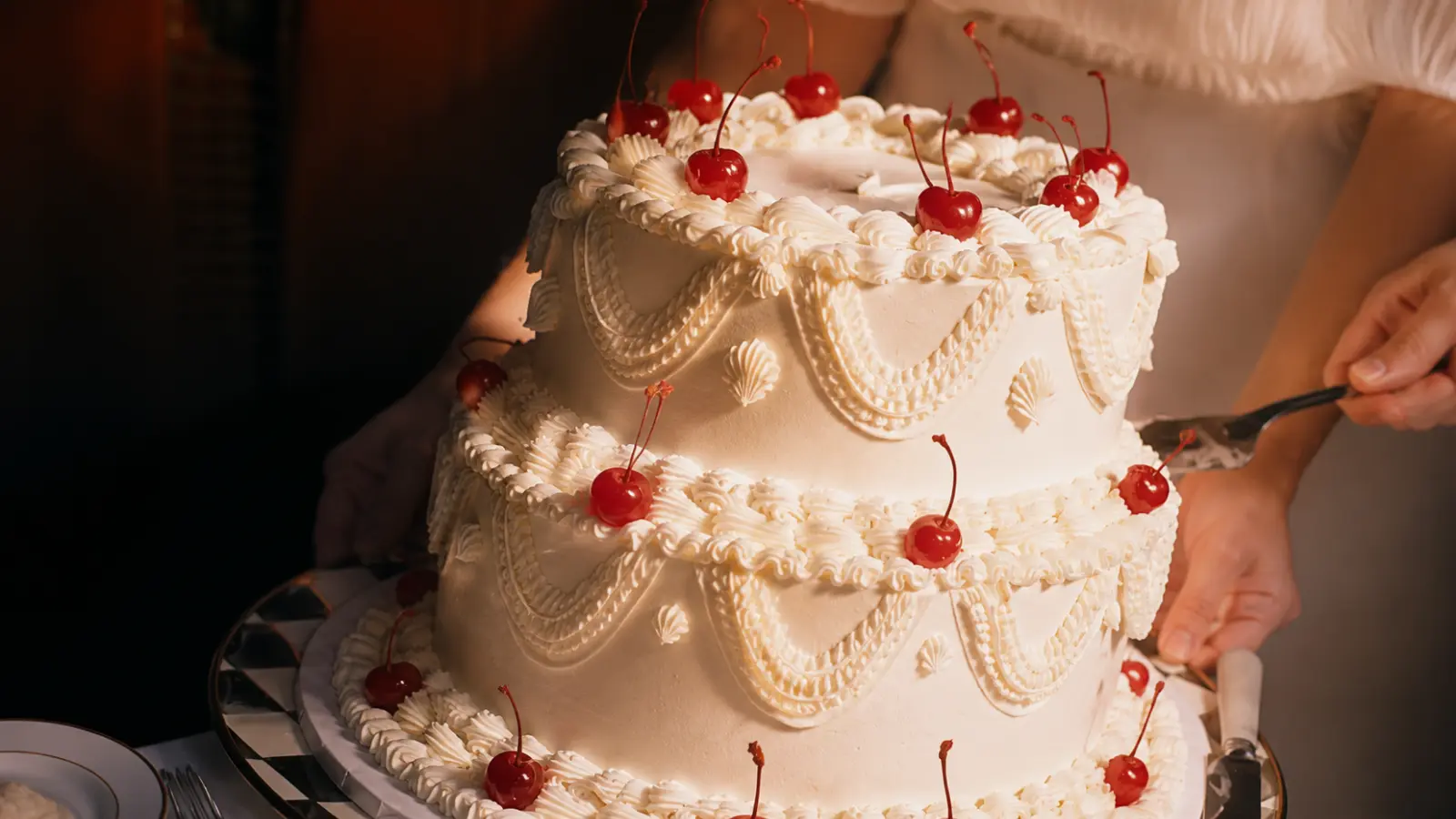
- Shell borders: The scalloped shell border applied around the base and between tiers of a cake is one of the most recognizable mid-century American cake details and one of the most elegant. It requires skilled piping but does not overwhelm the cake’s overall design.
- Stringwork piping: Fine lines of royal icing draped in curved arcs between points on the cake’s surface — a technique common in 1950s and 1960s decorated cakes that reads as delicate and architectural rather than dated.
- Ribbon trim: Actual ribbon or a ribbon-effect in buttercream or fondant applied at the base of each tier. Simple, elegant, and visually associated with mid-century wedding cakes without requiring any specific themed context.
- Stepped pillars: The tiered-pillar construction style used at mid-century weddings — separating tiers with columns to create height and negative space — has returned as a statement structural choice at modern weddings. It is unusual enough now to read as intentional rather than standard.
- Monochromatic white tiers: Multiple tiers in stark white royal icing or fondant, immaculately smooth, the decoration only in the piping rather than in color or embellishment. The 1950s wedding cake look at its most timeless.
Vintage Wedding Cakes with Pearls
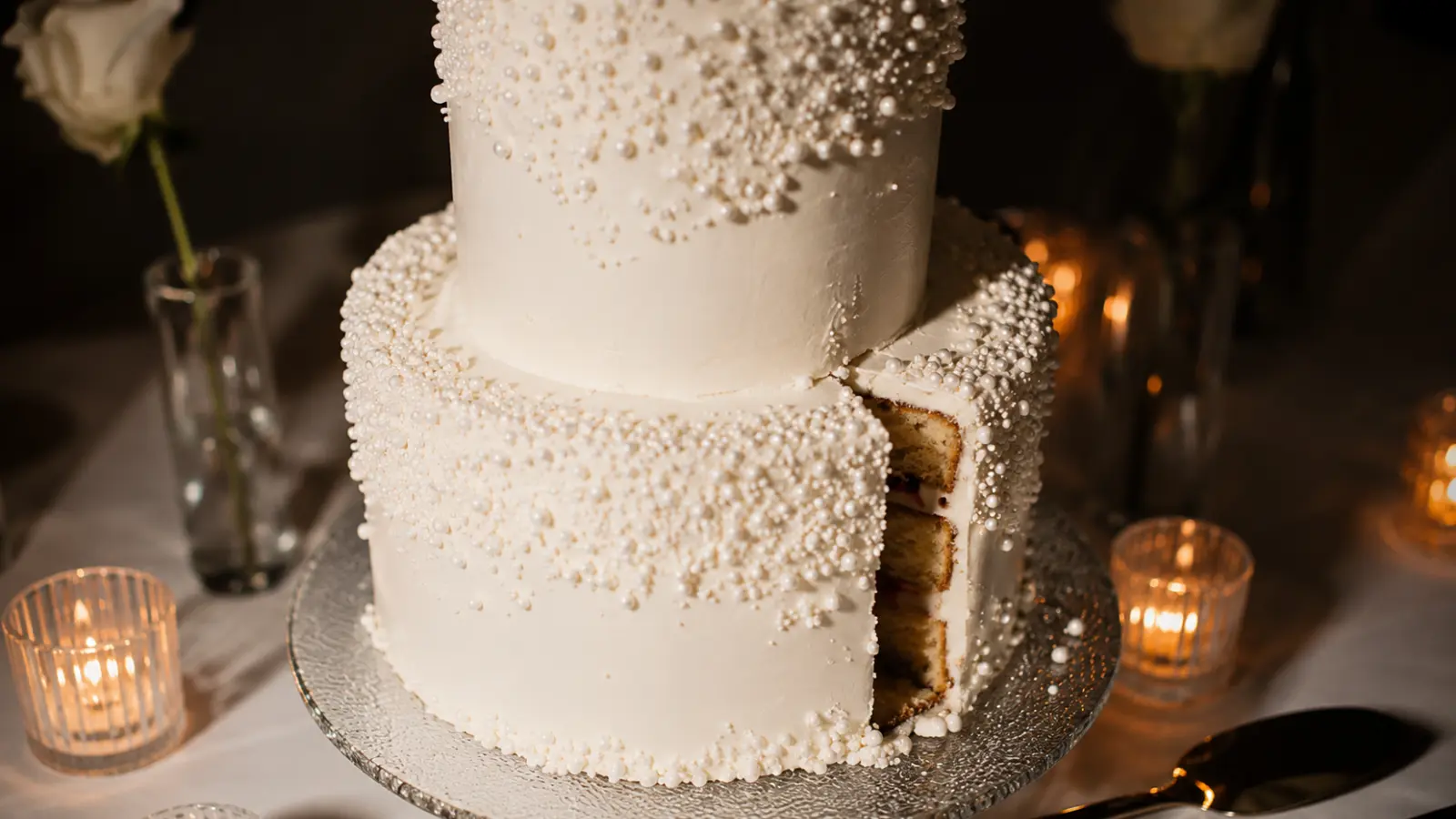
Pearl details on wedding cakes occupy a specific position in the vintage aesthetic: they are the lightest-touch way to achieve a vintage feeling on an otherwise simple cake. Simple wedding cakes with a clean buttercream finish and a border of sugar pearls at the base of each tier can feel vintage-adjacent without committing fully to any specific era’s design language. It is romantic, refined, and specific enough to look intentional in photographs without requiring intricate hand-piping or significant additional cost.
Sugar pearls and edible pearl trim have been available to bakers for decades, but their current use in bridal cakes is more thoughtful than the previous generation’s rather indiscriminate application of pearl-like dragées. The contemporary approach uses pearls as a structural element — a single row of pearls at the tier base, a cluster of pearls at the center of a piped flower, a sparse scattering across an otherwise clean surface — rather than covering every available surface with them.
Pearl applications that work on wedding cakes
| Pearl Technique | Visual Effect | Best Paired With |
|---|---|---|
| Single-row border at tier base | Clean, elegant, quietly vintage | Simple buttercream, any color palette |
| Double or triple row borders | More pronounced vintage reference | White or ivory cakes, formal settings |
| Scattered pearl dusting | Romantic, soft, dimensional | Pastel buttercream, garden and outdoor venues |
| Pearl clusters at flower centers | Detail-forward, visible in close-up photography | Cakes with piped or sugar flowers |
| Pearl-studded Lambeth piping | Maximally ornate, fully vintage | True Lambeth cakes; formal and historic venues |
One thing many couples do not anticipate: the size of the pearl matters enormously in photographs. Small pearls (2mm to 3mm) read as texture and detail in close-up photography — they catch the light without dominating the frame. Large pearls (6mm and above) can look heavy or costume-like, particularly against a simple buttercream base. Unless the overall design is intentionally maximalist, smaller pearls usually produce a more refined result.
Vintage Wedding Cake Toppers
The vintage wedding cake topper is the element that most quickly tips a cake from “vintage-inspired” to “definitively vintage” — in both the best and worst senses. The right topper on a beautifully executed cake makes the whole design feel intentional and specific. The wrong topper on a cake that was otherwise elegantly balanced makes it look like a prop from a reception in 1974 rather than a thoughtful design choice at a contemporary wedding.
The toppers most associated with vintage wedding cakes fall into a few distinct categories, each with different design implications:
Original vintage toppers (1950s–1970s)
The original plastic or porcelain bride-and-groom figurines from the mid-20th century are now collected items found on Etsy, estate sales, and antique markets. They are unmistakably specific — the bride in her full skirt, the groom in his tuxedo, both facing forward with a composure that no contemporary design achieves. Using an actual antique topper communicates a level of intentionality that no reproduction can replicate. It is genuinely old. It came from somewhere. It has a history that your new marriage is now part of.
The main design consideration: these toppers work best on cakes that have a clear vintage visual language — a Lambeth-piped cake, a shell-bordered white royal icing cake — rather than on a modern textured buttercream that does not share the topper’s era. The topper and the cake should look like they belong to the same moment.
Contemporary vintage-inspired toppers
- Porcelain or ceramic figures: Contemporary artisans produce bride-and-groom figurines in the style of mid-century originals with updated proportions and skin tone options. More accessible than antique originals and customizable.
- Ornate metal monogram holders: A laser-cut or cast metal monogram — especially in an ornate serif font — on a vintage-style base reads as wedding cake topper without being a figurine. Bridges vintage and modern effectively.
- Bell arrangements: Small white or gold bells arranged under a glass dome or tied with ribbon were common toppers at mid-century American weddings and have returned at weddings with a deliberate vintage sensibility.
- Dried flower and ribbon compositions: A small arrangement of dried or preserved flowers — pampas grass, dried roses, lavender — tied with a silk ribbon and placed on the top tier. Reads as vintage-romantic rather than dated; works at any venue style.
- Heirloom toppers: Using the topper from a family member’s wedding — a grandmother’s, a mother’s — is one of the most meaningful uses of a vintage element in wedding design. The age of the topper becomes part of the story rather than a styling choice.
Romantic Vintage Wedding Cakes
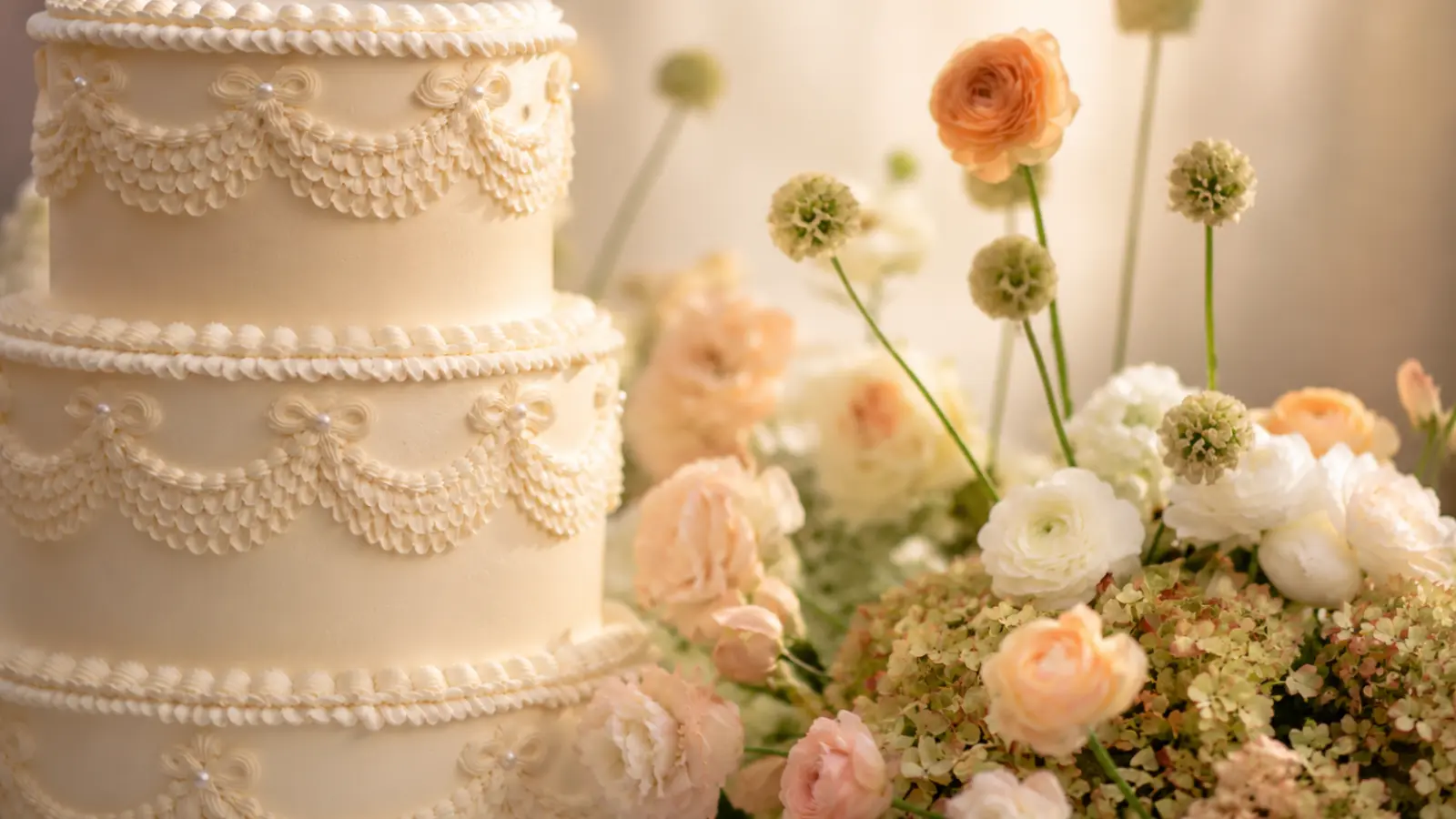
Romantic vintage cakes are often what couples are looking for when they search “vintage wedding cake” — not always a fully Lambeth-piped showpiece that requires a specialist decorator, but something softer. Something that feels like it came from another era’s understanding of romance rather than a specific decade’s decorating conventions. Something that photographs with warmth and beauty without demanding that guests understand its historical references to appreciate it.
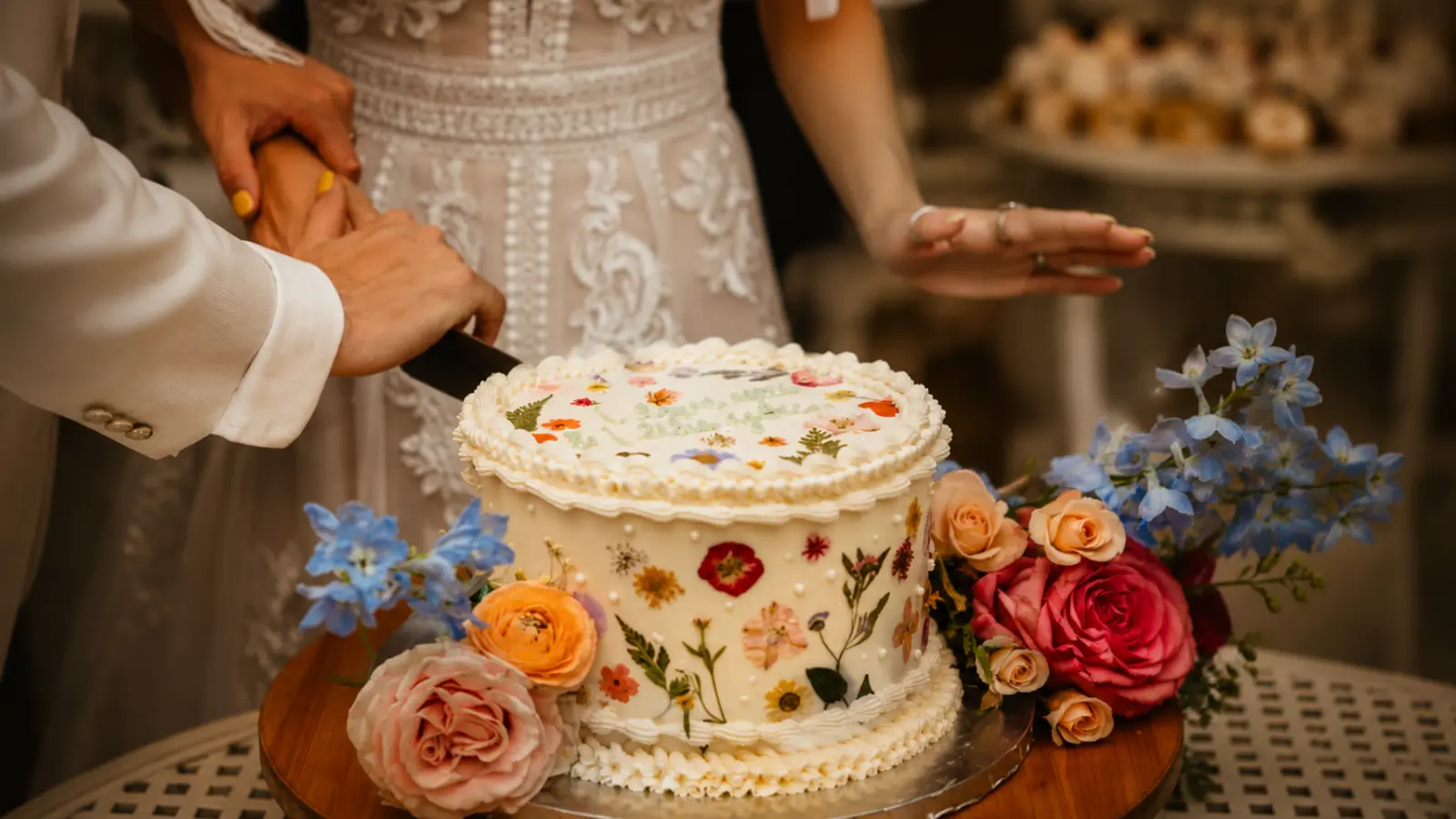
The romantic vintage aesthetic draws inspiration from floral wedding cakes and the delicate end of the vintage spectrum — petal-textured buttercream, sugar rosebuds, trailing fabric elements, soft pastel palettes, and the kind of imperfection that reads as handmade rather than machine-produced. It is the category where vintage and romantic overlap completely, and it is the easiest version of vintage to introduce into a modern wedding without any visual clash.
What makes a cake romantically vintage rather than just vintage
- Petal or ruffle texture: A buttercream technique where overlapping petal shapes are created with a spoon or offset spatula, building a textured surface that catches light softly. Strongly associated with romantic bridal aesthetics across several decades and thoroughly at home at contemporary weddings.
- Piped roses and rosebuds: The classic buttercream rose — applied with a petal tip in a rotating motion — is a technique with a vintage pedigree that reads as specifically romantic rather than specifically dated. A cake covered in soft piped roses in blush and cream is romantic in a way that transcends era.
- Lace-effect decoration: A lace pattern applied to the cake surface in royal icing or fondant — typically on a smooth tier beneath a more textural or floral tier above. The lace references bridal fabric and creates a visual relationship between the cake and the dress.
- Trailing ribbon or bow details: Ribbon elements — whether actual food-safe ribbon or fondant/buttercream replicas — applied at the base of tiers or draped between them. A design element more associated with the romantic vintage aesthetic than any other single detail.
- Pastel color palette: Soft sage, dusty rose, lavender, warm blush, or champagne applied across the tiers in a monochromatic or tone-on-tone arrangement. The pastel palette is one of the clearest signals of vintage romanticism in contemporary cake design.
Many couples do not realize that the romantic vintage category is also the most compatible with seasonal and local florals. A textured petal cake topped with fresh garden roses and a trailing ribbon is one of the most consistently beautiful wedding cake designs across this style — it photographs well in many lighting conditions, works across a wide range of venues, and has a handmade quality that guests respond to without needing to name what they are seeing.
How to Style a Vintage Cake in a Modern Wedding
This is the question most couples are actually asking when they look for vintage cake ideas: how do you use this aesthetic without the whole reception feeling like a period piece? The answer is more specific than “use it in moderation” — it involves understanding exactly which elements carry the most visual weight and making deliberate choices about where that weight lands.
The one-element rule
The most reliable principle for vintage cakes at modern weddings is to choose one vintage element as the design’s anchor and keep everything else clean. One fully Lambeth-piped tier surrounded by smooth, minimal tiers. One row of pearl borders on an otherwise simple buttercream cake. One antique topper on a modern textured base. When you commit to one dominant vintage element and let it be the statement, it reads as a considered design choice. When you add a second and third vintage element — Lambeth piping and pearls and a figurine topper and shell borders — the cake starts to compete with itself and reads as maximalist in the wrong direction.
Cake table styling for vintage cakes
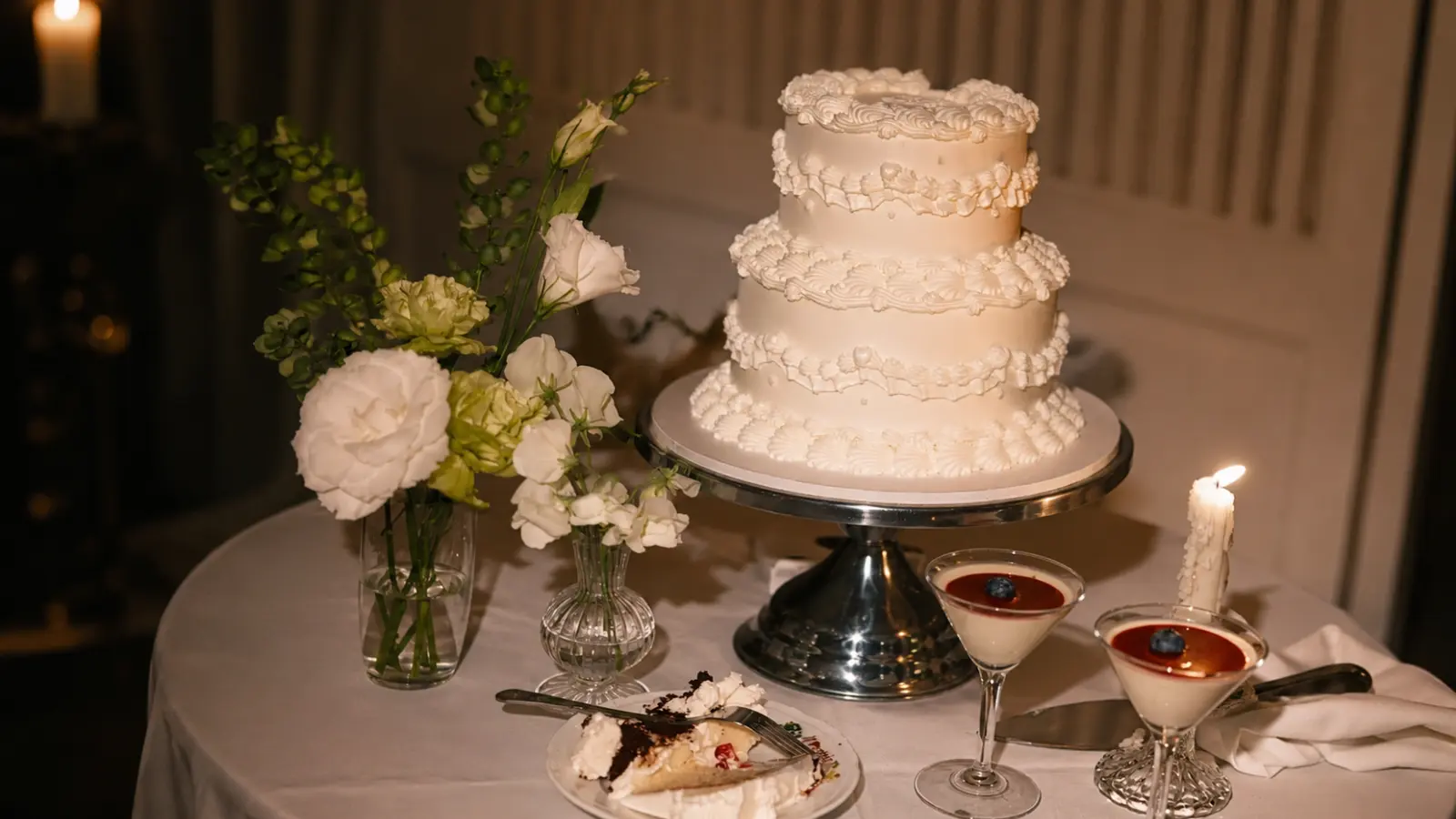
Wedding cake table ideas are where the line between “vintage-inspired” and “vintage-themed” is most clearly drawn. A beautifully simple cake on a table with antique linen, a few loose flowers, and one vintage candleholder reads as an editorial choice. The same cake on a table with a burlap runner, mason jars, multiple vintage items, and string lights reads as a theme. The cake table styling should let the cake be the statement.
Practical suggestions:
- Use a simple white or natural linen tablecloth rather than a patterned or colored one — the cake’s detail reads better against a clean backdrop
- Limit additional styling elements to one or two: a single flower arrangement, a vintage cake server, perhaps one framed photograph or heirloom object
- Let the wedding cake stand do work — a vintage-style pedestal or a marble cake stand elevates the cake physically and visually without adding competing design elements
- Keep the area around the cake clear during the reception — other desserts and signage should be on separate surfaces if possible
Matching the cake to the venue
Vintage cakes work most effortlessly in venues that already carry some historical or architectural character — a Victorian mansion, a garden estate, an older ballroom, a historic church hall. In these spaces, a Lambeth or ornate piped cake feels native rather than imported. In a modern industrial venue or a contemporary hotel ballroom, the same cake requires more thoughtful integration — the surrounding space needs simple, warm styling elements (linen, candles, natural florals) to create a visual bridge between the modern architecture and the vintage cake.
What to avoid
Several combinations reliably push a vintage cake from design choice to costume:
- Multiple figurine toppers combined with heavy Lambeth piping and pearl borders: Each of these elements is individually viable; together they read as a recreation rather than an inspiration
- Matching the cake’s era too precisely to other decor: If the flowers, the linens, the signage, and the cake all reference the same decade, the result is a themed event. Let the cake carry the vintage and let the surrounding elements be more neutral
- Choosing a vintage cake because it is trending rather than because it suits you: Brides who choose a Lambeth cake because they saw it on Pinterest but whose personal aesthetic is minimalist and clean will usually feel their reception looks slightly off without being able to name why. The vintage aesthetic is strong and specific — it should feel like an expression of who you are, not just what is popular
Vintage Wedding Cake Inspiration Board
Vintage wedding cakes can range from ornate Lambeth piping and pearl-trimmed tiers to romantic florals, antique toppers, and pastel buttercream designs inspired by decades past. Explore our vintage wedding cake inspiration board for retro wedding cake ideas, romantic details, heirloom-inspired styling, and timeless designs that bring character and craftsmanship to a modern celebration.
Final thoughts
The best vintage wedding cakes do more than recreate the appearance of another era. They capture the craftsmanship, romance, and sense of occasion that made those designs memorable in the first place. Whether expressed through intricate piping, delicate pearl borders, antique toppers, or soft pastel palettes, the most successful vintage cakes feel intentional rather than nostalgic for nostalgia’s sake.
When vintage elements are chosen thoughtfully and balanced with the overall wedding aesthetic, they create a cake that feels both timeless and personal. The result is not a themed recreation of the past, but a celebration that honors tradition while still feeling entirely relevant to the couple and the wedding they are creating today.
Frequently asked questions (FAQ)
How do you know if a vintage wedding cake is genuinely timeless or just trendy?
A timeless vintage cake feels beautiful even if you remove the word “vintage” from the conversation. Strong proportions, elegant piping, thoughtful color choices, and skilled craftsmanship tend to age well. Cakes chosen only because they are currently popular often lose their appeal once the trend cycle moves on.
What vintage cake detail creates the biggest visual impact?
Usually not the topper or the color, but the piping. Decorative techniques like Lambeth scrollwork, shell borders, and overpiped details immediately signal craftsmanship and history in a way that modern smooth finishes cannot replicate.
Can a vintage wedding cake feel elegant without looking overly traditional?
Absolutely. Many of the most successful vintage-inspired cakes combine one historic element—such as pearl borders or delicate piping—with a cleaner overall silhouette. The balance between old and new is often what makes the design feel sophisticated.
Why do vintage wedding cakes photograph so well?
Vintage cakes create natural depth and shadow through texture. Piping, pearls, lace details, and dimensional decorations catch light from multiple angles, which gives photographers more visual detail than a completely smooth cake surface.
What is the biggest mistake couples make with vintage cake inspiration?
Trying to include every vintage element they love in a single design. Lambeth piping, pearl borders, pastel colors, figurine toppers, lace patterns, and bows can all work beautifully on their own. Combined together, they often compete for attention instead of creating a cohesive look.
Do vintage wedding cakes work in modern venues?
Yes, often surprisingly well. A vintage cake can become a striking focal point inside a modern venue because the contrast highlights the craftsmanship and detail. The key is keeping the surrounding styling simple so the cake feels intentional rather than out of place.