
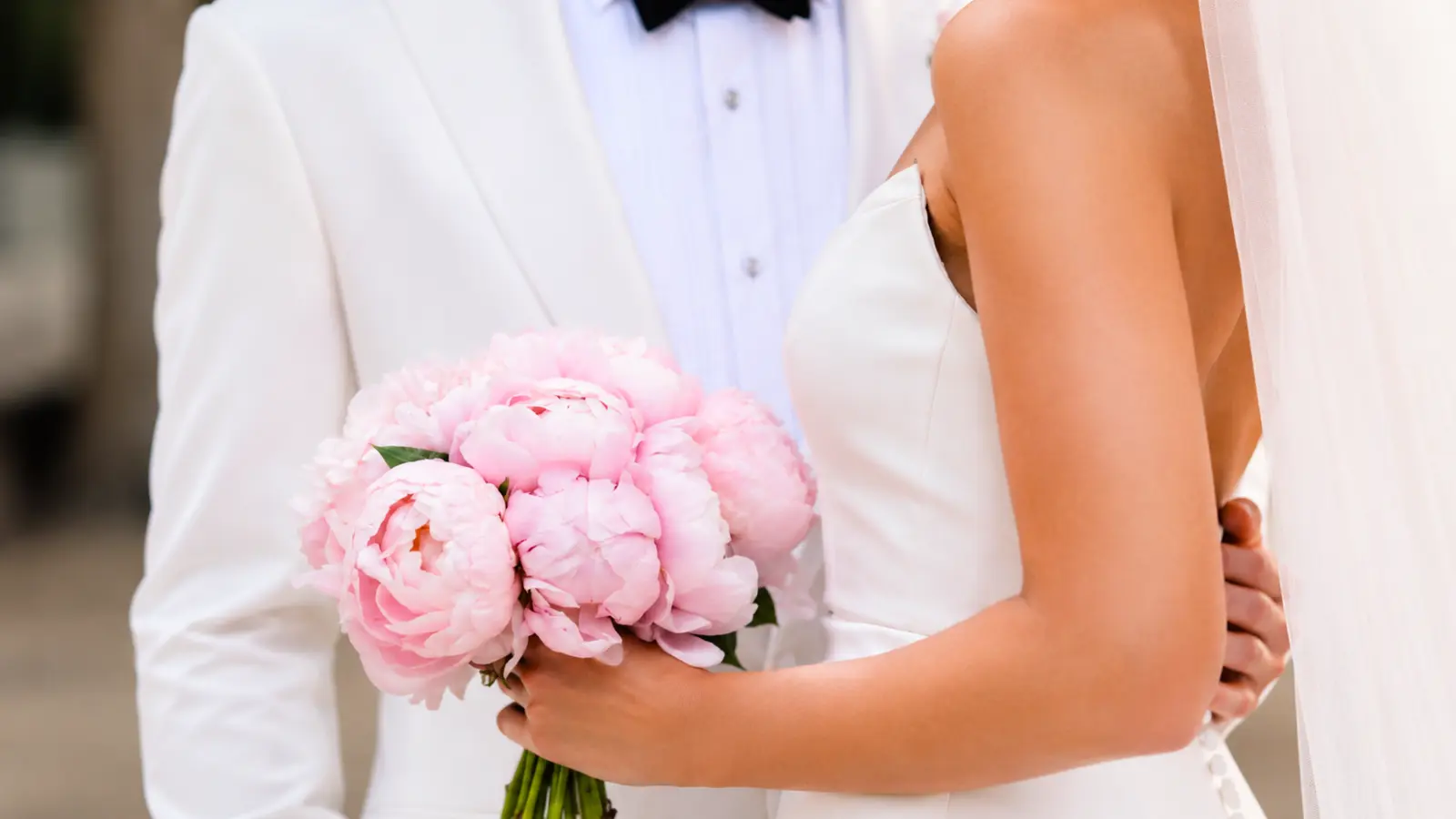
Peony wedding bouquets are one of the most popular choices for brides who want a romantic, elegant, and timeless floral design. Known for their full, layered blooms and soft fragrance, peonies create bouquets with exceptional texture and visual impact, making them a favorite for everything from classic ceremonies to modern garden weddings.
Their beauty, however, comes with practical considerations. Peonies have a relatively short natural season, their availability changes throughout the year, and pricing can vary significantly depending on your wedding date and the varieties your florist can source. Understanding those factors early makes it much easier to decide whether peonies are the right choice for your bouquet.
This guide explores peony wedding bouquets in detail as part of choosing the perfect wedding bouquet, including color options, popular flower pairings, seasonal availability, pricing, styling ideas, and the best alternatives when peonies are out of season or beyond your floral budget.
Why Peonies Are Popular in Wedding Bouquets
The peony’s appeal in bridal florals comes down to a few qualities that are genuinely rare in a single flower. The bloom size is one — a fully open peony is large enough to create visual impact on its own, which means fewer stems are needed to build a full-looking bouquet. The petal structure is another: those layered, ruffled petals catch light differently at every angle, which translates directly into photographs that look rich and dimensional rather than flat.
Fragrance is also part of it, and it is something that photos cannot convey but brides consistently mention. Many peonies have a soft, clean floral scent — present without being overwhelming — that adds something to the experience of carrying the bouquet that flowers like roses and ranunculus do not quite replicate. For brides who want the full sensory experience of their bouquet, not just the visual one, that fragrance matters.
Beyond those qualities, peonies are aesthetically versatile in a way that surprised even their most dedicated fans. They feel romantic and garden-inspired in a loose hand-tied bouquet with eucalyptus and trailing greenery. They feel clean and refined in a tight round arrangement with white blooms and minimal foliage. They work in blush bridal aesthetics and in more saturated, colorful palettes. Very few flowers cross that many aesthetic categories without losing something in translation.
Peony Wedding Bouquet Colors
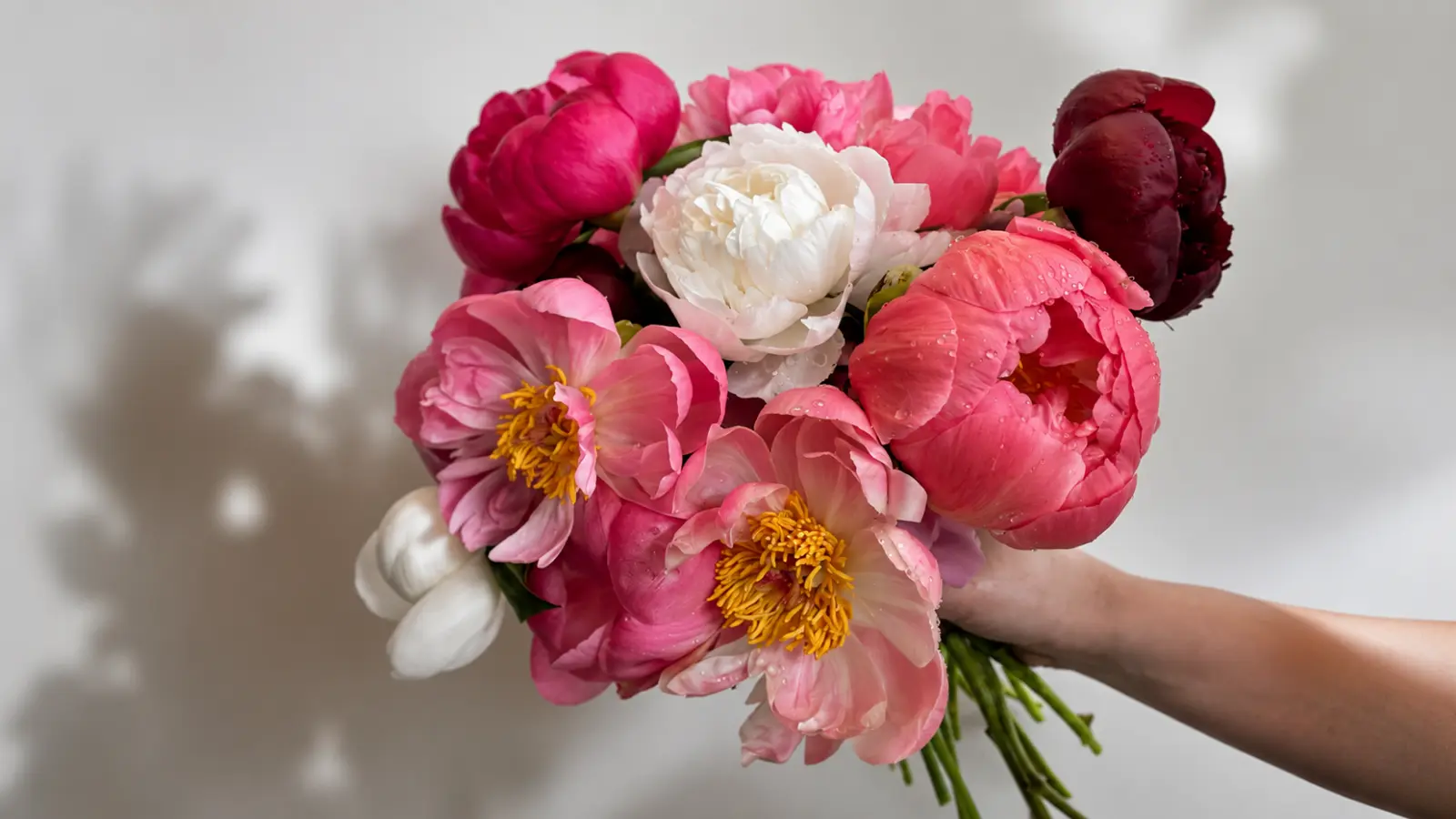
The peony color range is wider than most people realize, and the naming within it can be confusing — a “blush” peony from one grower and a “blush” from another can look meaningfully different in person. Understanding the actual spectrum of wedding bouquet colors before you discuss options with your florist saves time and reduces the chance of a mismatch between expectation and result.
| Color Range | Common Varieties | Best Paired With |
|---|---|---|
| White and cream | Duchesse de Nemours, White Cap, Kelway’s Glorious | Silver eucalyptus, dusty miller, white ranunculus — clean, minimal palettes |
| Blush and soft pink | Sarah Bernhardt, Shirley Temple, Monsieur Jules Elie | Soft roses, sweet peas, cream lisianthus — romantic garden style |
| Coral and peach | Coral Charm, Coral Sunset | Peach garden roses, apricot ranunculus, seeded eucalyptus — warm, earthy palettes |
| Hot pink and magenta | Karl Rosenfield, Felix Crousse | Deep burgundy roses, plum lisianthus, bold greenery — saturated, statement bouquets |
| Deep rose and mauve | Kansas, Raspberry Sundae | Dusty pink roses, burgundy accents, olive or sage greenery |
One practical note on color: peonies open significantly as they bloom, and the color shifts during that process. Coral Charm, one of the most photographed peony varieties in bridal florals, starts as a deep coral-orange bud and softens to a peachy blush as it fully opens. If you have a specific shade in mind, ask your florist to show you photos of the variety at different stages of bloom — not just the closed bud. The flower you receive and the flower in the bouquet on your wedding day may look different from what you saw online if the variety was photographed at a different stage.
Peony and Rose Wedding Bouquets
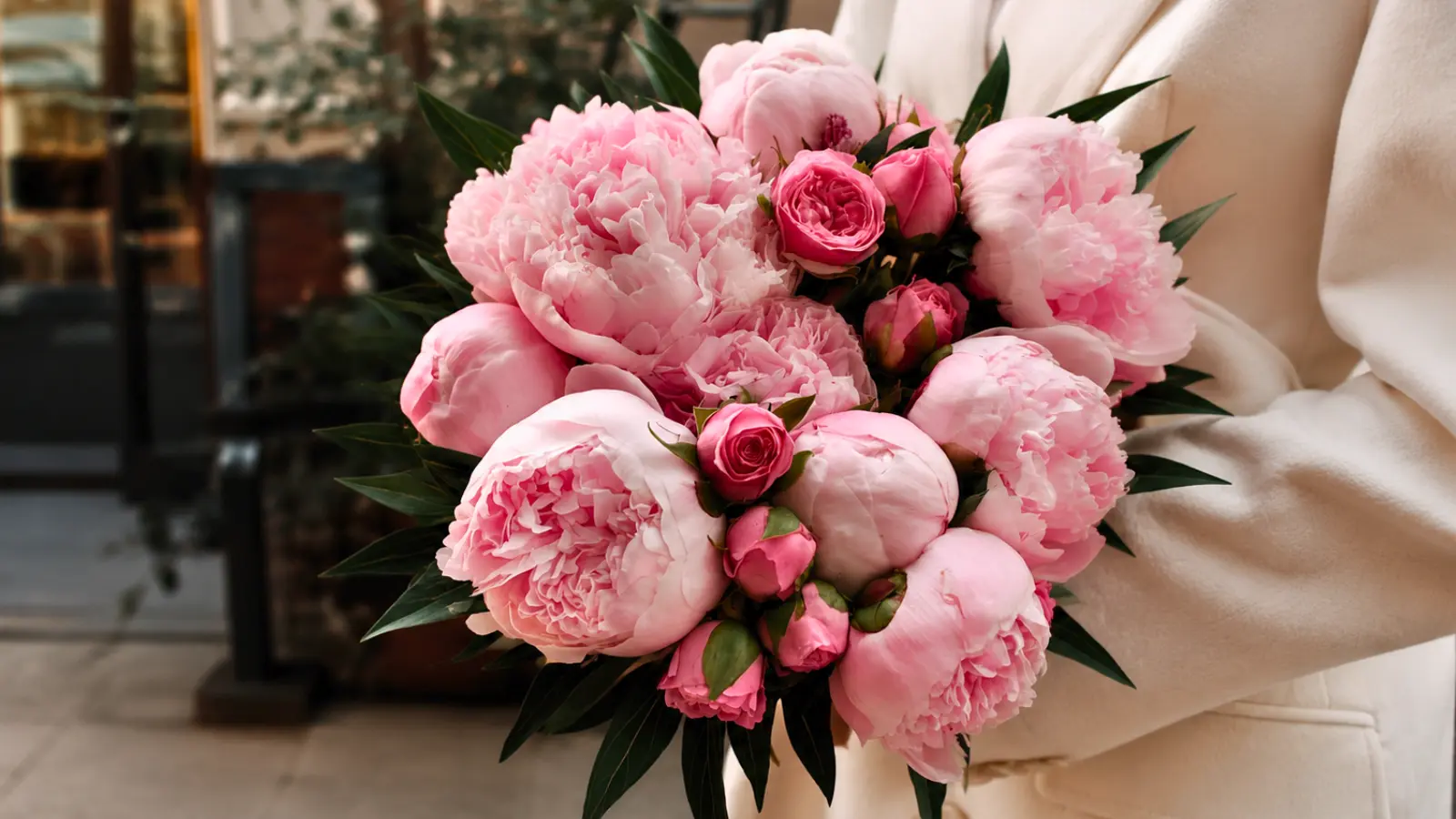
Peonies and roses are probably the most classic pairing in bridal florals, and the reason is practical as much as aesthetic. The two flowers complement each other structurally — the full, domed shape of a peony and the more cupped, layered form of a garden rose sit together naturally without either overpowering the other. In color, they share warm undertones across most of their respective ranges, so blending them rarely creates visual conflict.
The combination also solves a real planning problem. Using peonies as focal flowers alongside garden roses — rather than building the entire bouquet from peonies — reduces the total peony count needed and therefore the cost, while maintaining the softness and fullness that makes peony bouquets so appealing. A bouquet with six peonies and eight garden roses looks just as lush as one built from fourteen peonies, at a meaningfully lower price point.
For a romantic, garden-style aesthetic, blush peonies and soft pink or ivory garden roses with eucalyptus and scattered sweet peas is one of the most requested combinations for a reason — it is genuinely beautiful and holds up across a wide range of venue styles. For something with more contrast, deep coral Coral Charm peonies alongside cream garden roses and seeded eucalyptus creates a warm, slightly unexpected palette that photographs especially well in natural light.
Standard hybrid tea roses tend to look stiff alongside peonies — the tight, high-centered form creates an awkward contrast with the full, open peony bloom. Garden roses (David Austin varieties in particular) are the better pairing because their more relaxed, cupped structure echoes the peony’s fullness without mimicking it. If your florist proposes using standard roses in a peony bouquet, it is worth asking to see examples before agreeing.
Peony and Hydrangea Bouquets
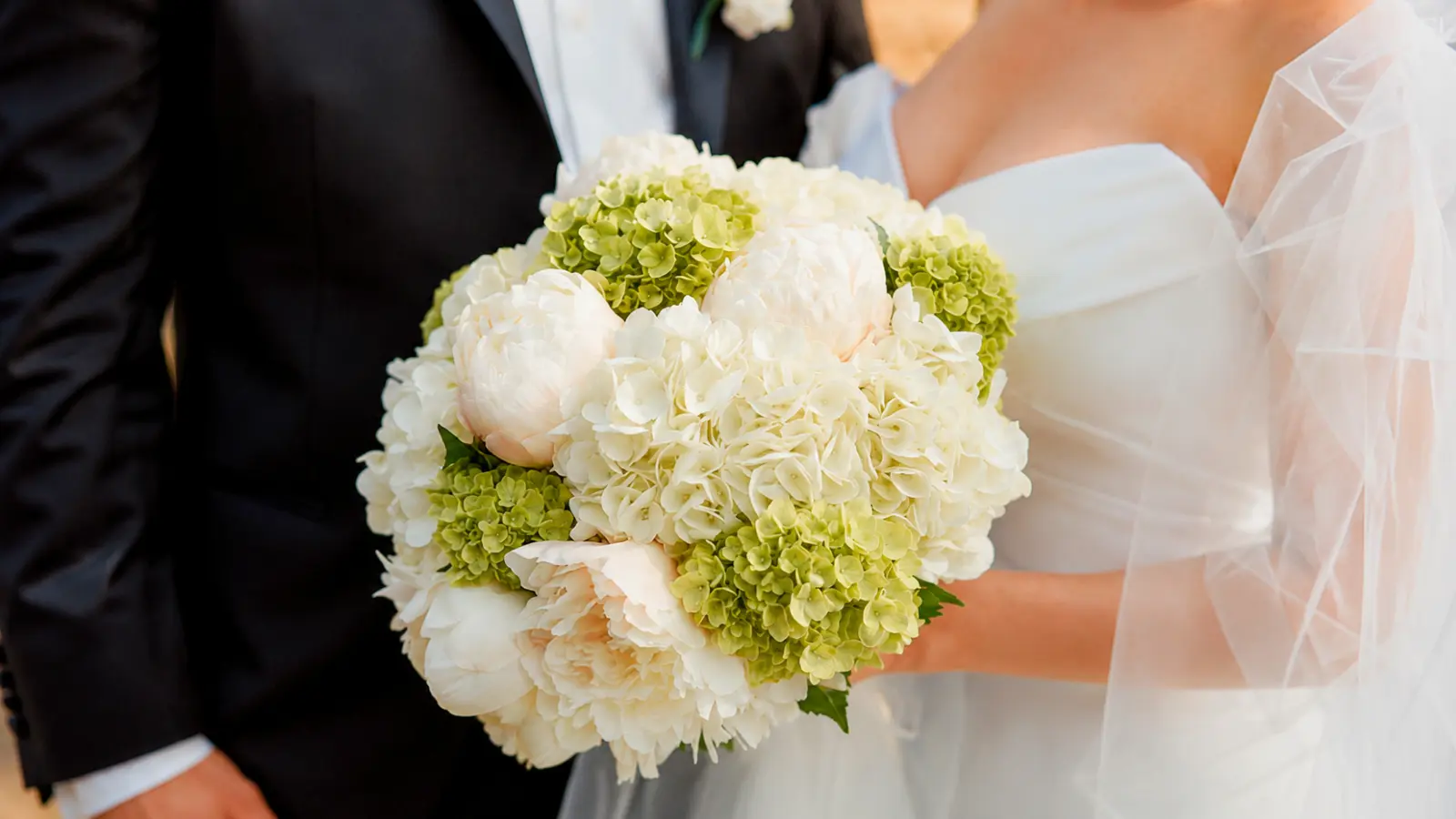
Peonies and hydrangeas together create one of the fullest, most voluminous bouquet combinations in bridal florals — and that volume is both the appeal and the practical consideration. Both flowers are large and moisture-heavy, which means a bouquet built primarily from these two blooms can become heavy to hold and more demanding to keep fresh through a long ceremony and reception.
The combination works best when hydrangeas are used as supporting fill rather than as a co-equal focal flower. A few hydrangea heads tucked between peony blooms add cloud-like texture and volume without creating a bouquet that requires two hands to manage. White or soft blue hydrangeas alongside blush or white peonies produce a particularly soft, romantic effect. Lime green hydrangeas alongside white or cream peonies create something more graphic and fresh — a combination that works well in garden and greenhouse wedding settings.
From a practical standpoint, both peonies and hydrangeas are sensitive to heat and wilting, which concentrates the fragility risk in one bouquet. For outdoor summer ceremonies or warm reception venues, discuss this combination with your florist specifically — they may recommend timing the assembly as close to the ceremony as possible, or suggest using hydrangeas more selectively to reduce the risk. For indoor ceremonies in controlled temperatures, the combination is more forgiving and genuinely stunning.
When Are Peonies in Season?
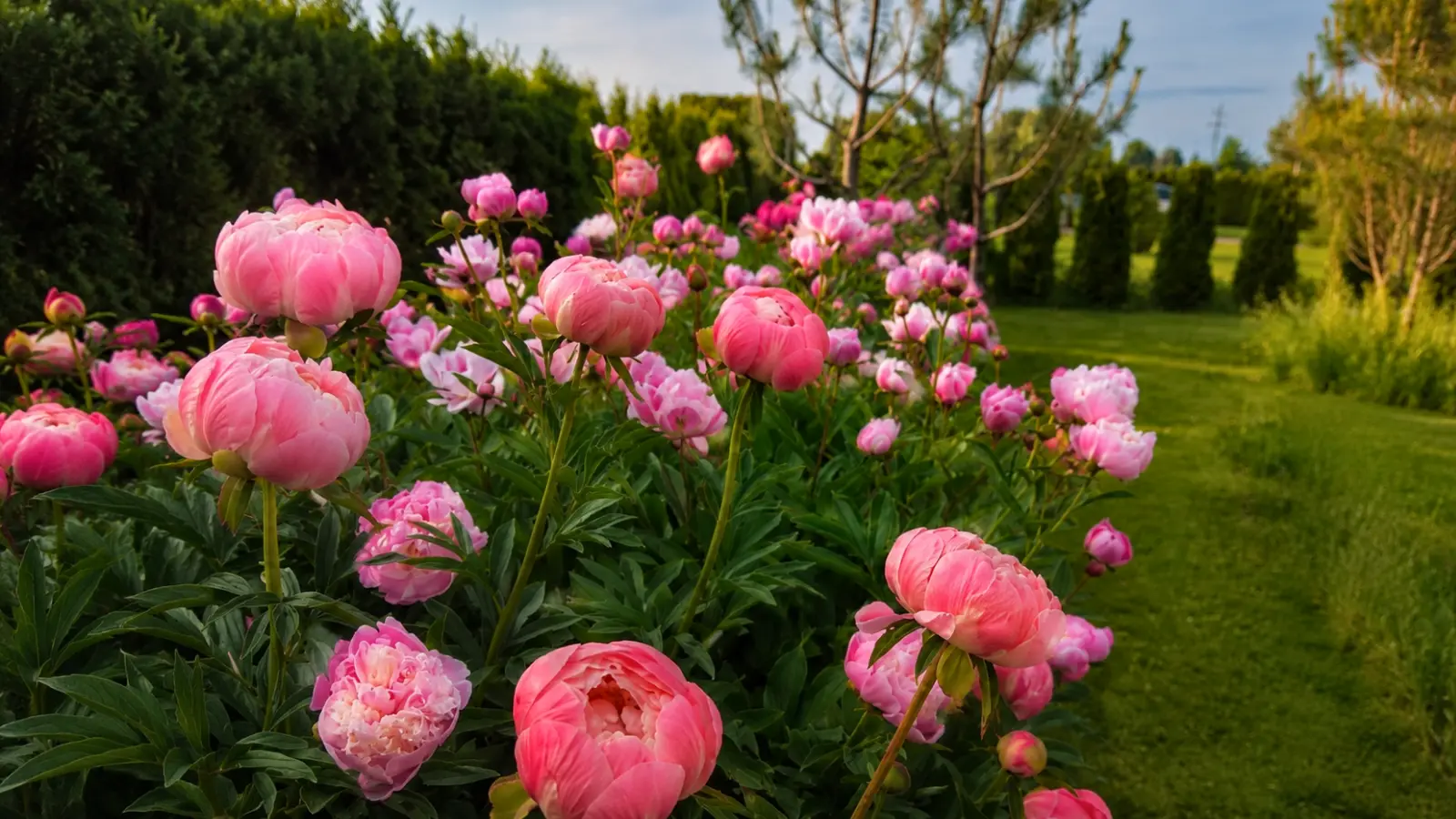
Peony season in the United States runs primarily through the spring wedding bouquet season, from late April through mid-June, with peak availability and best quality in May. That window is fairly narrow compared to year-round staples like roses and lisianthus, which is why wedding date timing matters so much for brides with peonies on their must-have list.
| Wedding Month | Peony Availability | What to Expect |
|---|---|---|
| April – early May | Coming into season | Good availability, building variety — earlier in season, fewer varieties open |
| Mid-May – mid-June | Peak season | Best selection, best quality, most accessible pricing |
| Late June – July | End of domestic season | Availability dropping; some varieties still available from cooler growing regions |
| August – October | Off-season; imported sourcing | Can be sourced from New Zealand or Chile; expect higher cost and less variety |
| November – March | Off-season; limited import | Available through specialty florists with advance planning; premium pricing |
Off-season peonies are not impossible — they are imported from growing regions in the Southern Hemisphere during the North American off-season, primarily from New Zealand and Chile. A skilled florist with established supplier relationships can source them for a fall or winter wedding, but the cost premium is real — often 30 to 60 percent higher per stem than the same variety in May — and the variety selection is narrower. For brides getting married outside the May-June window who want peonies specifically, the most practical approach is to use them selectively as accent flowers in a mixed bouquet rather than building the entire arrangement around them.
It is worth having this conversation with your florist at the first appointment, not after you have already settled on a vision. A good florist will tell you honestly what is realistic for your wedding date and suggest the best path to the aesthetic you want — whether that means timing a peony bouquet to peak season, using alternatives that achieve the same look, or supplementing selectively with imported stems.
Are Peony Wedding Bouquets Expensive?
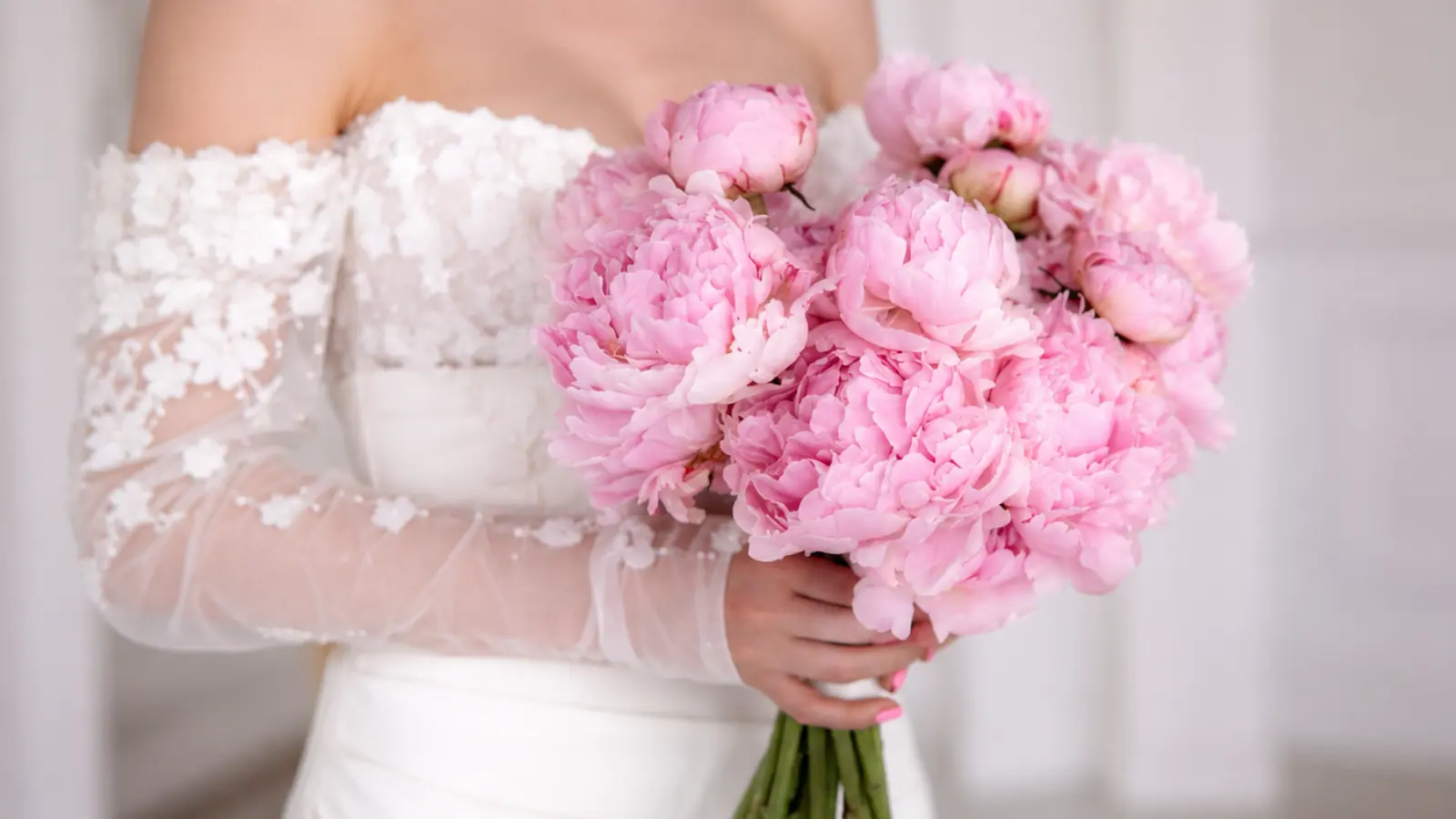
Peonies sit in the upper-mid range of bridal flower pricing — more expensive than standard roses or carnations, less expensive than orchids or specialty blooms. What makes the cost conversation complicated is that peony pricing is not static. The same flower that costs a florist a manageable amount per stem in May can cost substantially more in October, which directly affects what you will be quoted.
A professionally made bridal bouquet built primarily around peonies typically ranges from $280 to $450 in peak season, depending on your overall wedding bouquet cost expectations. Outside of season, that range shifts upward — $350 to $550 or more is reasonable to expect for a similar design when peonies need to be specially sourced. A mixed bouquet using peonies as focal flowers alongside garden roses or ranunculus can bring costs closer to $220 to $320 by reducing the total peony stem count without reducing the visual impact.
A few strategies that genuinely help manage peony bouquet cost without abandoning the aesthetic:
- Get married in May. This is the most effective cost control for peony bouquets — peak season pricing, peak quality, and the widest variety selection all converge in that single month.
- Use peonies as focal flowers, not filler. Five to eight peonies surrounded by complementary garden roses, ranunculus, and greenery can look just as full as fifteen peonies alone, at a fraction of the per-stem premium.
- Be flexible on variety. Some peony varieties are significantly more accessible than others. Asking your florist which varieties will be available and well-priced on your specific date — rather than specifying a particular variety — gives them room to source well within your budget.
- Prioritize peonies for the bridal bouquet only. If bridesmaid bouquets are part of the plan, consider using a peony alternative for those and reserving the actual peonies for the one bouquet that appears in the most photos.
None of these strategies require compromising on the finished look — they just require making intentional decisions about where the flowers go and working with the market rather than against it.
Best Alternatives to Peonies
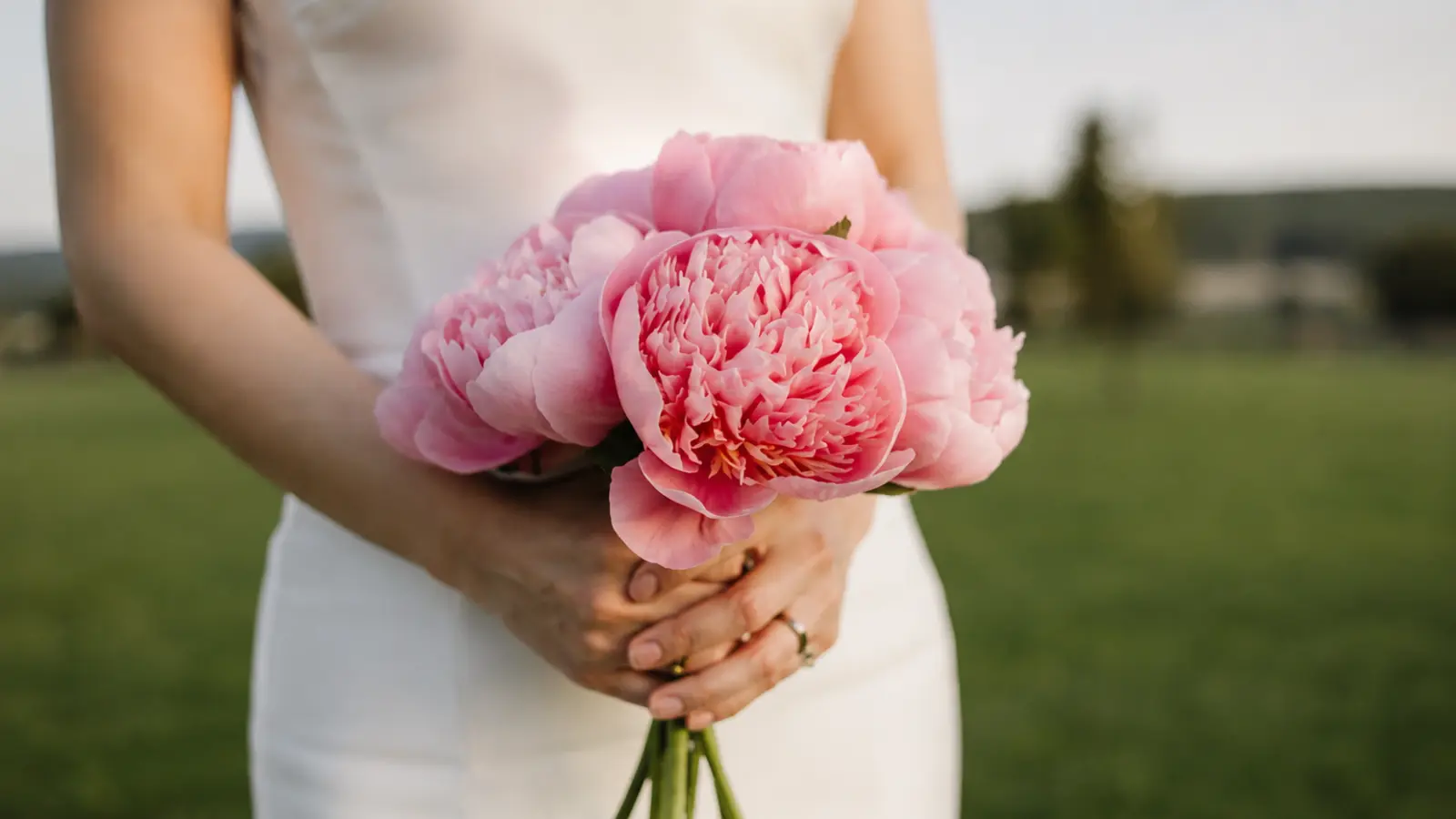
The desire for peonies is almost always really a desire for what peonies do visually: that full, layered, romantic bloom that photographs with depth and softness. Understanding that distinction is useful, because several flowers achieve a very similar effect — sometimes at lower cost, sometimes with better seasonal availability, sometimes with more structural durability.
Ranunculus is the closest overall alternative, and the one most florists reach for when peonies are unavailable or out of budget. The bloom structure — multiple thin, layered petals around a tight center — is remarkably similar to a peony in photographs. Ranunculus comes in a wide color range, holds its shape well, and is available for a longer seasonal window than peonies. The main visual difference is scale: ranunculus blooms are smaller than peonies, which means you need more stems to achieve the same fullness, but the per-stem cost is lower, so it often balances out.
Garden roses (David Austin varieties) are the other primary alternative. The cupped, multi-petaled form of a garden rose — particularly varieties like Juliet, Patience, or Keira — looks genuinely similar to a peony in a finished bouquet, especially in photos. Garden roses are available year-round, which makes them a reliable option for fall and winter weddings where peonies require special sourcing. They are generally less fragrant than peonies but more structurally durable, making them a great option for fresh wedding bouquets, especially for outdoor or summer ceremonies.
Lisianthus is an underused alternative that deserves more attention. Its ruffled, multi-petaled blooms have a similar softness to peonies at smaller scale, and they photograph with a delicate quality that works beautifully in mixed arrangements. Lisianthus is available most of the year and is typically more affordable than either peonies or garden roses, making it a useful anchor for a bouquet that wants peony energy without the peony price tag.
| Alternative | Visual Similarity | Season | Cost vs. Peonies |
|---|---|---|---|
| Ranunculus | Very close — similar layered structure, smaller scale | Late winter through spring | Typically lower |
| Garden roses (David Austin) | Close — cupped form, similar fullness | Year-round | Similar or slightly lower |
| Lisianthus | Moderate — ruffled, delicate, smaller | Most of the year | Lower |
| Camellia | Moderate — smooth petals, very different texture | Winter and early spring | Varies; often specialty pricing |
The best approach when peonies are not feasible is to bring inspiration photos to your florist and ask specifically which flowers in the images are creating the effect you love. Often it is not the peonies themselves but the combination — the way they mix with greenery, the overall softness of the palette, the looseness of the arrangement — and that effect can frequently be recreated with alternatives that are more accessible for your date and budget.
How to Style a Peony Bridal Bouquet
Peonies are one of the more forgiving flowers to style because their bloom does a significant amount of visual work on its own. The main decisions — bouquet shape, supporting flowers, greenery, and palette — all influence different bridal bouquet styles and how the finished piece reads, but none of them require overcomplication. Peonies look best when they are given room to be themselves.
Shape. A loose, hand-tied round or garden-style bouquet is the most natural fit for peonies. Their full, relaxed bloom looks slightly incongruous in a tightly structured arrangement — the flower itself wants to sprawl slightly, and a bouquet style that accommodates that openness looks more natural than one that compresses it. If you love the look of an arm sheaf, peonies work beautifully there too — three or four open blooms cradled with greenery and trailing ivy can be genuinely striking. Cascade bouquets are less common with peonies because the stems are not particularly flexible, but a modified loose cascade with trailing greenery around a peony center is achievable.
Supporting flowers. Peonies pair most naturally with flowers that complement rather than compete. Garden roses are the classic choice. Ranunculus adds a similar layered quality at a different scale. Sweet peas add delicate trailing texture that contrasts beautifully with the density of a peony bloom. Baby’s breath — used with more restraint than it was in previous decades — can add an airy quality without reading as dated when mixed sparingly into a garden-style arrangement.
Greenery. Eucalyptus is the most versatile pairing and is a defining feature of many greenery wedding bouquets, working across almost every peony color. Silver dollar eucalyptus in particular adds soft, rounded leaves that echo the roundness of the peony bloom. For a more structured or modern look, Italian ruscus or olive branches add clean lines without softening the arrangement too much. Dusty miller pairs especially well with white and blush peonies, adding a silvery, slightly vintage quality.
Palette guidance. Peonies have warm undertones across most of their color range, which means they pair most naturally with other warm-toned flowers and greenery. Mixing a warm blush peony with cool lavender blooms can create an uneasy color tension — not impossible, but something to preview in person before committing. For the cleanest results, build the palette within the warm spectrum: blush with peach, cream with coral, deep rose with burgundy. If you want to bring in cooler tones, dusty miller and silver eucalyptus do it more gracefully than cool-toned flowers.
Practical handling. Peonies should be purchased in bud form and allowed to open at room temperature over one to two days before the wedding. A tightly closed bud will not open enough in time; a fully open bloom will be past its best by the end of a long day. Asking your florist to receive the flowers two to three days before the wedding and allow them to open at the right pace is the most reliable way to have peonies at their peak during the ceremony. Keep them away from direct sun and heat, and store in water until as close to the ceremony as possible.
Peony Wedding Bouquet Inspiration
Explore romantic peony wedding bouquets featuring classic white blooms, blush garden arrangements, elegant flower pairings, seasonal color palettes, and timeless bridal bouquet ideas for every wedding style.
Peonies Create Timeless Bridal Bouquets
Peonies have earned their place as one of the most loved wedding flowers because they combine beauty, texture, fragrance, and versatility in a way that few blooms can match. Whether you choose an all-peony bouquet or mix them with garden roses, ranunculus, or seasonal greenery, they bring a romantic quality that photographs beautifully and suits a wide range of wedding styles.
The key to getting the best results is planning around the flowers rather than expecting the flowers to adapt to every season. Work closely with your florist, stay flexible with varieties when needed, and let seasonal availability guide your choices. With thoughtful planning, a peony bouquet can become one of the most memorable details of your wedding day.
Frequently asked questions (FAQ)
Are peonies a good choice for a wedding bouquet?
Yes. Peonies are one of the most sought-after wedding flowers because of their large, layered blooms, soft fragrance, and timeless romantic look. They work beautifully in classic, garden, modern, and luxury weddings. Their biggest limitations are seasonality, cost outside peak bloom, and sensitivity to heat, making early planning especially important.
When are peonies in season for weddings?
Peonies are naturally in season from late April through June, with the best availability, quality, and pricing usually found during May. Outside this period, they can still be sourced through specialty growers and imports, but prices increase and fewer varieties may be available.
How much do peony wedding bouquets cost?
A professionally designed peony bridal bouquet generally costs between $280 and $450 during peak season. Weddings outside the natural peony season often require imported flowers, increasing prices to $350–$550 or more. Using peonies as focal flowers alongside roses or ranunculus is a common way to reduce costs while maintaining the same romantic look.
What flowers look similar to peonies?
Garden roses, ranunculus, and lisianthus are the closest alternatives. Garden roses offer a similarly full, cupped bloom and are available year-round, while ranunculus creates the same layered texture at a smaller scale. These flowers can often recreate the soft, romantic appearance of peonies when seasonal availability or budget is a concern.
Can peonies survive an outdoor summer wedding?
Yes, but they require extra care. Peonies are more delicate than many other wedding flowers and can wilt or bruise in high temperatures. Keeping the bouquet hydrated, limiting direct sun exposure, and working with an experienced florist helps them stay beautiful throughout the ceremony and portraits.
How do you style a peony wedding bouquet?
Peonies pair beautifully with garden roses, ranunculus, sweet peas, eucalyptus, Italian ruscus, and dusty miller. Loose garden-style and hand-tied bouquets are the most popular because they allow the large blooms to open naturally and create the soft, romantic look that makes peonies so distinctive.
Do peonies last all day in a wedding bouquet?
Yes, when properly conditioned and kept hydrated, peonies can last throughout the wedding day. Because they are sensitive to heat and direct sunlight, experienced florists usually prepare them carefully and recommend keeping the bouquet in water until shortly before the ceremony whenever possible.