
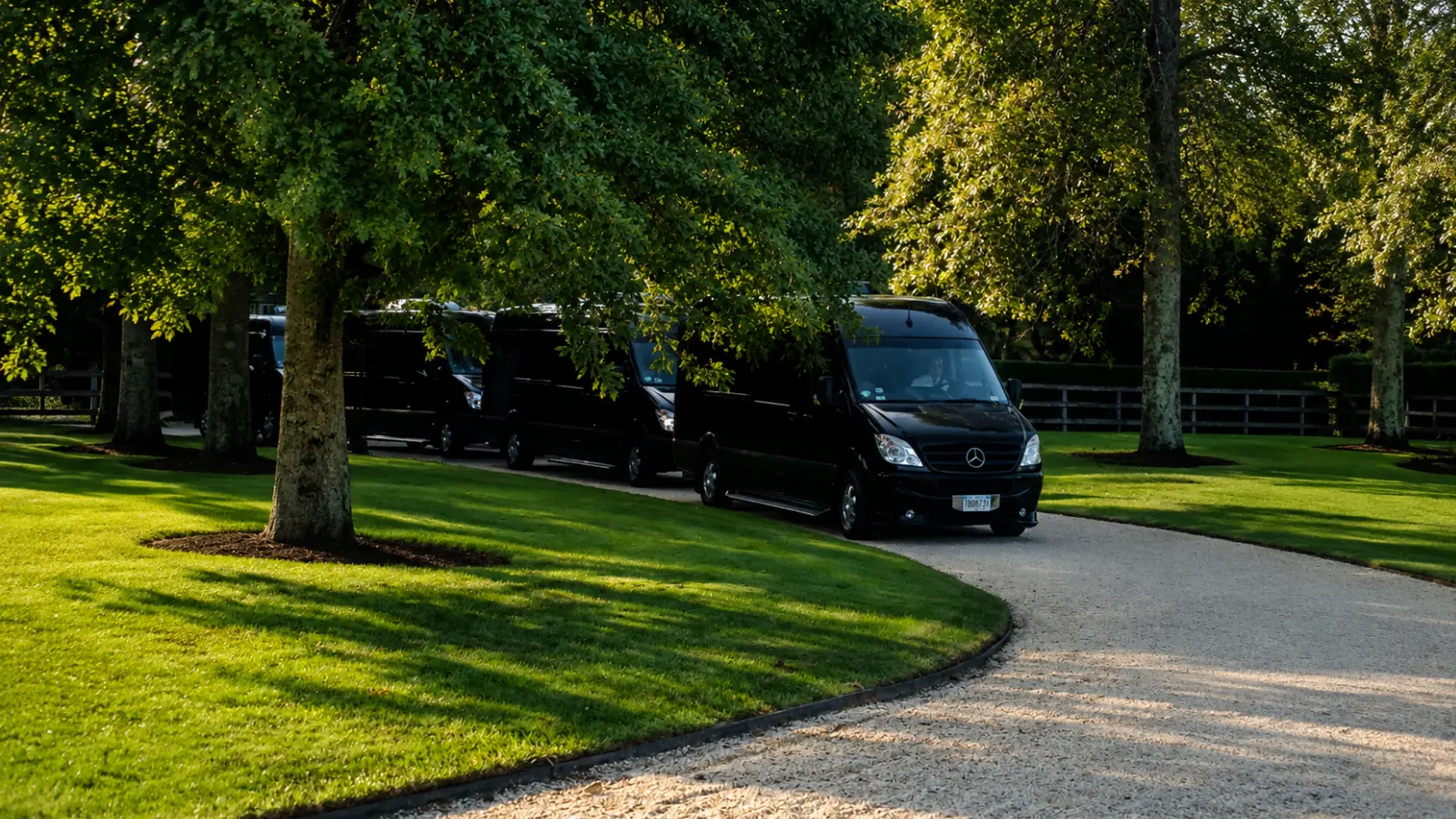
A wedding transportation plan is not simply a list of vehicles. It is a map of every group that needs to move on the wedding day: where they start, where they need to be, when they should leave, and how much buffer protects the schedule if loading, traffic, or another small delay takes longer than expected.
The most reliable way to build that plan is to work backward from each group’s required arrival time. The couple, wedding party, hotel guests, ceremony guests, and anyone moving between venues may all need different pickup points, vehicles, departure times, and accessibility arrangements. A route that looks simple on a map can become a problem when loading time, parking, multiple stops, and vehicle access are added.
This guide shows how to build a wedding transportation plan around those movements, including the couple, wedding party, guests, shuttles, routes, parking, accessibility, vendor transport, the couple’s exit, and backup options. The goal is not to manage the entire wedding-day timeline here, but to make sure every movement fits cleanly into it.
Why Buffer Time Is the Real Job of a Transportation Plan
The core function of a wedding transportation plan isn’t booking vehicles — it’s deciding how much time sits between each movement so a small delay doesn’t become a big one. A route that takes fifteen minutes on a map rarely takes exactly fifteen minutes on the actual day, once loading, unloading, and a few late arrivals are factored in.
A reasonable planning habit is to work backward from the moment each group truly needs to be in place — ceremony start, portrait time, reception entrance — and build the departure time from there, not the other way around. Guests are typically asked to arrive somewhere in the neighborhood of twenty to thirty minutes before a ceremony or reception begins, which means the transportation departure has to account for that arrival window, not just the drive time itself. Every group and every route below follows this same backward-planning logic.
The Wedding Transportation Plan at a Glance
Rather than organizing this by vendor or by vehicle type, the clearest way to plan wedding transportation is by group: who’s moving, where they start, where they’re headed, when they leave, and how much cushion sits around that departure. Build this table out with real times once your ceremony and reception times are locked, and share it with your coordinator and drivers well before the wedding.
| Group | Pickup | Destination | Departure | Buffer |
|---|---|---|---|---|
| Couple | Getting-ready location | Ceremony site | Set from ceremony start, working backward | 10-15 min |
| Wedding party | Getting-ready location(s) | Ceremony site, then portrait location | Ahead of the couple’s departure | 10-15 min |
| Guests (hotel block) | Host hotel(s) | Ceremony site | Set from guest arrival time, working backward | 10-15 min per leg |
| Guests (ceremony to reception) | Ceremony site | Reception venue | Right after ceremony ends | 10-15 min |
| Vendors requiring transport | Vendor’s own location | Ceremony or reception site | Confirmed directly with vendor | Vendor-specific |
| Couple’s exit | Reception venue | Hotel, home, or send-off point | Set at planning, confirmed day-of | 5-10 min |
| Guests (end of night) | Reception venue | Hotel(s) or home | Reception end, often in waves | Ongoing through last call |
Seven rows cover nearly every wedding, though smaller or single-venue weddings may only need two or three of them filled in. The couples who avoid transportation stress are usually the ones who filled this out with real names, times, and vehicles weeks before the wedding, not the morning of.
The Couple
The couple’s own transportation is usually the simplest leg to plan and the easiest to get wrong by under-buffering it, since it’s tempting to assume the couple will simply be ready on time. Build in the same ten-to-fifteen-minute cushion used elsewhere, since hair, makeup, and photos routinely run a few minutes past schedule even in well-organized mornings.
If the couple is traveling separately to the ceremony — a common choice for couples who want to preserve a first-look reveal or keep pre-ceremony traditions — confirm both routes independently rather than assuming they’ll naturally sync up. A getaway car or exit vehicle at the end of the night is a separate booking from the ceremony-day transportation and deserves its own confirmed departure time.
Wedding Party
The wedding party typically moves in a tighter window than guests do, since they’re usually needed on-site earlier for photos before the ceremony begins. If the wedding party is getting ready at a different location than the couple, plan their departure to land them at the ceremony site with enough time for portraits, not just enough time to arrive as guests start seating.
Vehicle capacity matters more here than for most other groups — a wedding party of eight or ten people plus the couple can outgrow a single vehicle quickly, and a second trip adds real time that needs its own buffer. Confirm capacity against your actual headcount before the day, not against an estimate made months earlier.
Guests
Guest transportation is where a plan earns its keep, mainly because guests move in groups and on their own schedule in a way the wedding party and couple don’t. A common guideline is to have guests arrive at the ceremony roughly twenty to thirty minutes before the published start time, which gives people time to park, find seats, and settle in without pressure on the ceremony schedule itself.
For hotel-to-ceremony transportation, work backward from that arrival window rather than the ceremony start time directly. A practical approach allocates around fifteen minutes at each pickup stop for loading and unloading, then adds the actual drive time on top of that. If guests are staying at more than one hotel, either run separate routes or plan a single loop with enough total time for every stop — a route that looks fine on a map can run long once multiple pickups are added.
How Many Shuttles You Actually Need
The right number of shuttles comes down to guest count, vehicle capacity, and how far apart your venues are, not a fixed rule that applies to every wedding. Shuttle capacities commonly range from around fifteen to fifty passengers, so a guest list of 80 people might need one larger shuttle running two loops or two smaller vehicles running simultaneously, depending on your timeline.
If your ceremony and reception are close together and parking is available at both, a shuttle may be a convenience rather than a necessity. It becomes closer to essential when parking is limited at either venue, when a meaningful share of your guest list is unfamiliar with the area, or when older guests or those with mobility needs would otherwise be navigating an unfamiliar drive alone.
Routes
Mapping a route on the wedding day itself is different from mapping it in advance, mainly because typical drive-time estimates don’t account for a bus or shuttle’s turning radius, loading time, or how a route behaves at the exact hour your wedding is happening. Drive the actual route, or have your transportation vendor do so, rather than relying on a mapping app’s estimate alone.
Pay particular attention to venue access for larger vehicles. Narrow driveways, gravel paths, or tight turnarounds can rule out a full-size bus even when the venue itself has plenty of room, and discovering that on the wedding day rather than during planning creates a problem nobody has time to solve well.
Parking
Parking deserves its own line in the plan because it affects nearly every group differently: guests driving themselves need clear direction on where to park and how far that is from the entrance, while a shuttle or bus needs its own designated space to load and unload without blocking other traffic.
If either venue has limited on-site parking, decide early whether guests will be directed to an off-site lot with shuttle service, or whether transportation becomes the primary way guests get there at all. Either approach works, but it needs to be decided and communicated well before the wedding, not discovered by guests circling a full lot on the day.
Accessibility
Accessibility needs are easy to overlook in a transportation plan built around the average guest, but they matter enough to plan for directly rather than assuming someone will manage on their own. If any guests use a wheelchair or have mobility needs, confirm with your transportation vendor that at least one vehicle in rotation can accommodate that, since not every shuttle or bus is built for it.
The same applies to lower-step vehicles for guests who have difficulty with a standard shuttle’s boarding height, and to drop-off points that are genuinely close to an accessible entrance rather than the nearest general parking area. Asking about this specifically on your invitation RSVP, rather than waiting for someone to raise it, tends to catch needs that would otherwise surface as a problem on the day itself.
Vendor Transport
Most vendors handle their own transportation and don’t need to appear in your plan at all, but a few situations are worth confirming directly. If a vendor needs to move between the ceremony and reception sites — a band or DJ transporting equipment, a photographer covering a first look at a third location — ask about that leg specifically. A general arrival time doesn’t automatically cover a mid-day move.
This is also where your vendor contact sheet earns its place again: a coordinator who knows each vendor’s arrival window can catch a transportation gap before it turns into a delay. For what happens if a vendor’s own transportation actually falls through, the wedding contingency plan covers that scenario directly.
Exit

The couple’s exit at the end of the night is its own booking, separate from anything used earlier in the day, and it’s one of the more commonly forgotten pieces of a transportation plan. Confirm the vehicle, driver, and pickup time for the exit specifically — the driver who handled the morning isn’t necessarily the same one available late at night.
If the exit includes a specific moment — a sparkler send-off, a classic car, a horse-drawn departure — confirm timing with your photographer as well, since that moment usually needs coordinated lighting or positioning that a driver alone won’t manage.
Backup
Even a well-built transportation plan needs a fallback, mainly because transportation is one of the more common places for a small delay to appear on a wedding day. Know in advance who has a backup driver’s contact, whether rideshare is a realistic fallback for your venue and guest count, and who’s authorized to make that call if a shuttle runs seriously behind.
This piece of the plan overlaps directly with wedding-day contingency planning, and rather than duplicating that guidance here, the wedding contingency plan walks through exactly how to handle a transportation delay once it happens, including who owns the decision and when to act.
Make Every Movement Part of the Plan
A wedding transportation plan works best when every group has a clear starting point, destination, departure time, vehicle, and enough buffer to absorb the small delays that happen on real wedding days. The goal is not to move everyone as fast as possible; it is to get each group where they need to be before the next part of the day depends on them.
Fill in the real routes, names, vehicles, accessibility needs, and pickup times before the wedding week, then give the plan to the people responsible for executing it. When transportation works well, guests barely notice it — they simply arrive where they are supposed to be, when they are supposed to be there.
Frequently asked questions (FAQ)
How do you create a wedding transportation plan?
List every group that needs to move on the wedding day, then give each one a pickup point, destination, departure time, vehicle, and buffer. Work backward from when that group truly needs to arrive rather than starting with the drive time alone. Include loading, unloading, traffic, accessibility needs, multiple stops, and any separate return or end-of-night transportation.
How far in advance should you book wedding transportation?
Begin once your venues, date, approximate guest count, and major transportation routes are clear. High-demand dates and larger or specialized vehicles may require earlier booking, while simpler local transportation can allow more flexibility. The important point is to confirm capacity and routing before the remaining options become too limited for your actual plan.
Do all wedding guests need shuttle transportation?
No. A shuttle is most useful when parking is limited, guests are staying together at hotels, venues are difficult to reach, alcohol service makes group transportation practical, or many guests are unfamiliar with the area. If parking is easy and guests can comfortably drive themselves, transportation can be optional rather than universal.
How much buffer time should a wedding transportation plan include?
Build extra time on top of the expected drive and loading time rather than scheduling each movement at its fastest possible pace. A short local route may only need a modest cushion, while multiple hotel stops, heavy traffic, large groups, or difficult venue access require more. The correct buffer is the amount that keeps one ordinary delay from affecting the next fixed event.
How do you plan wedding transportation for guests staying at multiple hotels?
Treat each hotel as a separate pickup point and calculate the full route, including loading time at every stop. Depending on the guest count and distance between properties, it may be more reliable to use separate vehicles or routes rather than one long loop. Give guests exact pickup locations and departure times so the transportation schedule does not depend on everyone finding the shuttle at the last minute.
What is the difference between a wedding transportation plan and a wedding day timeline?
A wedding transportation plan covers only movement: who is traveling, where they start, where they need to go, when they depart, and how much buffer the route needs. A wedding day timeline connects those transportation segments with the rest of the event, including preparation, photography, ceremony, meal service, entertainment, and other scheduled moments.