
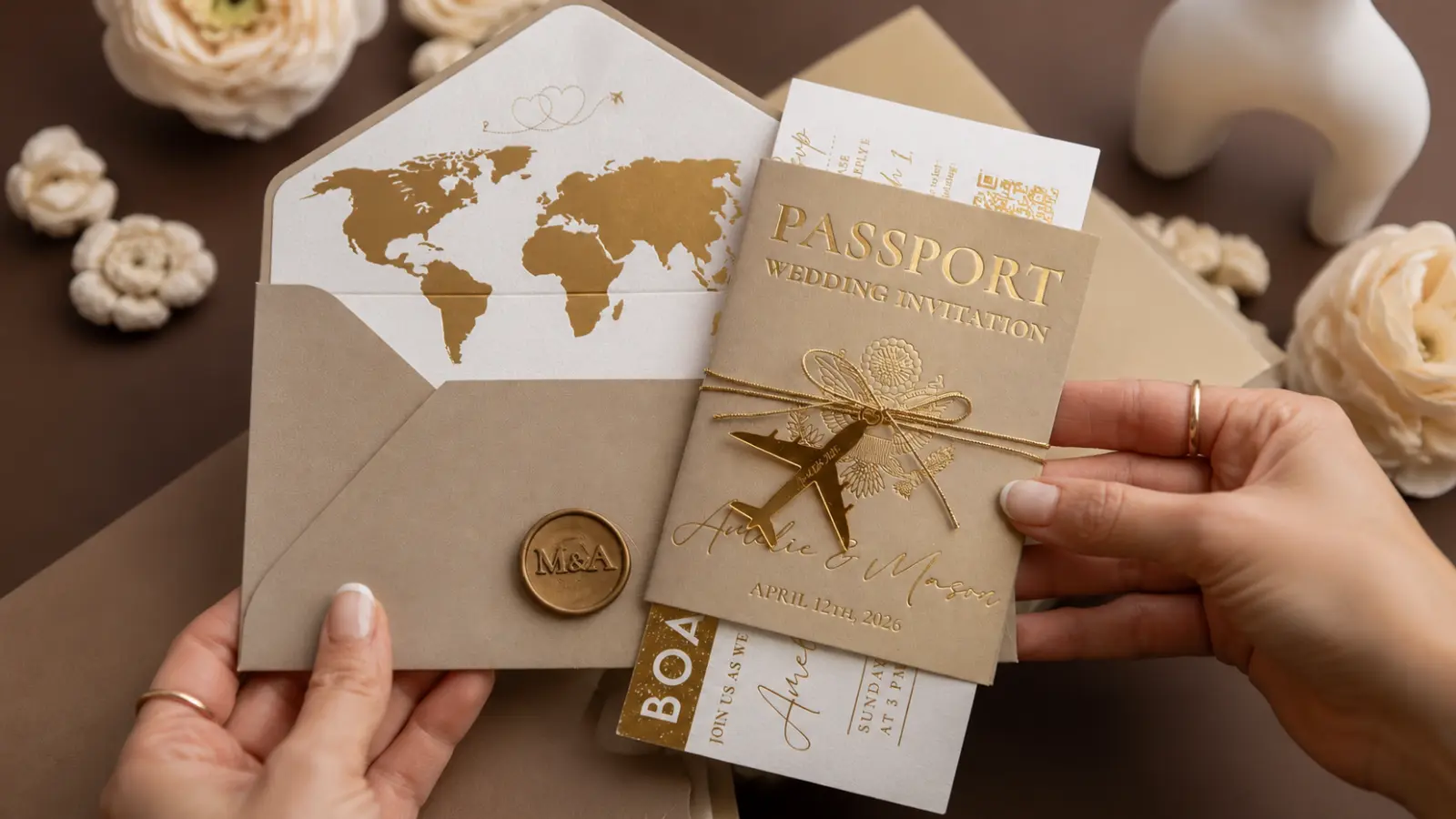
A Destination Wedding Invitation Timeline should give guests enough time to make travel decisions before you need their final attendance decision. That means communication usually begins well before the formal invitation, with an early heads-up for essential guests when appropriate, followed by the save-the-date, wedding website, invitation, RSVP deadline, hotel reminders, and final travel updates.
The exact timing depends on the trip. An international wedding involving passports, multiple flights, several hotel nights, and significant time away from work may require more lead time than a destination guests can reach easily with a short domestic trip. Venue deadlines, hotel cutoffs, transportation contracts, catering counts, and other operational commitments also affect when you need responses.
This Destination Wedding Invitation Timeline explains when to send save-the-dates and invitations, how to set an RSVP deadline, how hotel booking deadlines fit into the sequence, what information guests need at each stage, and how to work backward from real planning dependencies instead of following one rigid stationery calendar.
Think of Destination Wedding Communication as a Sequence
Destination communication works best when each message has one job. The save-the-date should not try to become the invitation, and the invitation should not become a travel manual.
Think of the sequence this way:
- Heads-up: privately test feasibility with essential guests when needed.
- Save-the-date: establish the destination and date early enough for travel planning.
- Wedding website: become the living source for lodging, transportation, and updates.
- Invitation: formally invite the guest and confirm the event details.
- RSVP: convert interest into an attendance decision by a useful deadline.
- Final updates: provide the logistics guests need once travel is already booked.
The result is less repetition and less pressure on any one piece of communication to explain the entire weekend.
Destination Wedding Invitation Timeline at a Glance
Use these windows as planning ranges, then adjust them based on travel complexity and the deadlines your venue, hotel, caterer, transportation provider, or planner actually gives you.
| Communication | Lead Time | Include | Dependency |
|---|---|---|---|
| VIP Heads-Up | Before major booking when attendance is essential | Possible destination, date range, expected travel burden | Destination feasibility |
| Save-the-Date | Often about 8–12 months; earlier for unusually complex travel | Names, date, destination, website | Destination and date sufficiently firm |
| Travel Page / Website | Live by or soon after save-the-date | Airport, lodging, booking details, travel framework | Reliable hotel and travel information |
| Formal Invitation | Commonly about 8–12+ weeks depending on trip and prior notice | Ceremony details, RSVP instructions, website | Event details and RSVP deadline confirmed |
| RSVP Deadline | Often 6–10+ weeks before, or earlier if operational deadlines require it | Clear response deadline and requested guest information | Venue, catering, hotel, transportation, seating deadlines |
| Hotel Reminder | Before room-block or preferred-rate cutoff | Deadline, booking link, consequences of waiting | Hotel contract or room-release date |
| Final Travel Update | Final weeks | Transfers, pickup times, event schedule, contact | Final itinerary and transportation plan |
The correct sequence protects both sides: guests get time to plan, and you get the information required to finalize the wedding.
Give VIP Guests an Early Heads-Up When It Helps
An informal heads-up can be useful before the save-the-date when the attendance of a few people is essential to the destination decision. This is not an early invitation; it is a feasibility conversation.
You might tell parents, siblings, grandparents, wedding-party members, or another small circle that you are considering a particular destination and date range. The goal is to identify obvious barriers such as school calendars, inflexible work dates, mobility issues, passport timing, or an unusually difficult trip.
Do not poll the entire potential guest list before booking. That can create confusion about who will eventually be invited and can turn a planning decision into a group vote.
Use the heads-up only where a person’s realistic ability to attend could change whether you choose the destination at all.
When to Send Destination Wedding Save-the-Dates
If you are wondering when to send destination wedding save the dates, a useful planning range is often around 8–12 months before the wedding. More complicated international travel, peak-season trips, or unusually high guest planning burdens can justify sending them earlier once the date and location are firm.
The save-the-date should give guests enough to begin evaluating the trip without pretending every detail is already finished. Include the couple’s names, wedding date, destination or city, and wedding website if it is ready.
You do not necessarily need to include a finalized venue if the destination itself is confirmed and guests do not need the exact property to begin planning. But avoid sending a save-the-date while the date or destination is still likely to change.
The best save-the-date creates useful certainty: this is where, this is when, and this is where future travel information will live.
Launch the Travel Page Early Enough to Be Useful
The wedding website should become useful at the same moment guests begin thinking about travel. For many destination weddings, that means having at least a basic travel page live by the time save-the-dates arrive or shortly afterward.
You do not need a completed itinerary. Start with confirmed information:
- Destination and dates: include the general wedding-weekend window.
- Recommended airport: explain meaningful alternatives only when they are actually useful.
- Lodging: provide the hotel block or recommended area once confirmed.
- Booking instructions: include links, codes, deadlines, and minimum-stay terms where relevant.
- Transportation framework: explain what is confirmed and what guests should arrange independently.
Label details that are still being finalized rather than leaving old information online after plans change. A travel page earns trust by being current, not by appearing complete months too early.
When to Send Destination Wedding Invitations
The destination wedding invitations timeline usually gives guests more room than a purely local event, but the right mailing date depends on how much reliable information they already received through the save-the-date and website.
For many destination weddings, sending formal invitations around 8–12 weeks before the wedding can provide enough time when guests have already received a save-the-date and reliable travel information, while more complex trips may justify additional lead time. The important point is that a formal invitation should not be the first moment guests learn they need to take a flight.
The formal invitation should confirm what the save-the-date only introduced:
- Ceremony date, time, and location.
- Reception information, as appropriate.
- RSVP method and deadline.
- The wedding website, for travel details.
Additional-event invitations should make it clear exactly who is invited to what. Do not push the formal invitation dramatically earlier just to solve a travel-planning problem that should already have been handled by the save-the-date and website.
Set the RSVP Deadline from Your Real Deadlines
Your destination wedding rsvp deadline should be set by the earliest firm deadline that depends on attendance. That may be catering, room allocations, venue capacity, transportation, rentals, seating, welcome-event counts, or another contracted requirement.
Work backward. If the hotel needs room allocations by a certain date and your shuttle company needs passenger counts shortly afterward, your RSVP deadline must leave enough time to follow up with non-responders and turn responses into usable numbers. Destination guidance often puts RSVP deadlines roughly 6–10 weeks before the wedding, with earlier cutoffs when the event or property requires more advance planning—but there is no advantage in choosing an earlier deadline unless you can explain what operational decision it unlocks.
An RSVP deadline is not just etiquette copy. It is a production deadline disguised as a guest-facing date.
Coordinate the RSVP and Hotel Deadlines
The hotel deadline and RSVP deadline should know about each other. When they are planned independently, guests may be asked to decide whether they are attending after the preferred room rate has already disappeared.
Review your room-block agreement for the terms that will shape guest communication:
- Booking cutoff and room-release date.
- Minimum-stay conditions, if the property requires them.
- Deposits and cancellation terms.
- Any financial obligation attached to unbooked inventory.
If the hotel deadline comes before the RSVP date, communicate that clearly. Guests may need to reserve lodging before formally responding, particularly where inventory is limited. If reservations are refundable within certain terms, share those terms accurately rather than simplifying them into a promise.
The guest should understand the order of decisions before spending money: secure the room by this date, formally RSVP by this later date, if that is how your actual plan works.
Send Updates Only When Guests Need Them
A destination wedding creates more information, but more messages do not automatically create more clarity. Use the website as the source of truth and send direct updates when a guest needs to act.
Good reasons for an update include:
- A hotel booking deadline approaching.
- Transportation registration opening.
- A meaningful itinerary change.
- A new arrival recommendation.
- A confirmed shuttle schedule.
Avoid sending every minor planning development. Guests do not need to know that the florist changed setup time or that the couple selected a different dinner linen.
Every travel update should answer three questions: What changed? Who does it affect? What does the guest need to do now?
Handle Late Travel Changes Without Re-Sending Everything
When a late change affects travel, update the central travel page first and then contact only the people who need the new information.
A few examples of how that plays out:
- Shuttle pickup time changes: send the revised time to riders.
- Hotel block sells out: update lodging guidance and contact guests who have not booked.
- Event changes location: notify attendees directly rather than assuming they will notice the website edit.
Keep older versions from circulating when possible. A clear message such as “The Saturday shuttle now departs at 4:15 p.m.; the website has been updated” is more useful than sending a completely new weekend itinerary with no explanation.
Late-stage communication should reduce cognitive load. Guests are already managing travel; they should not need to compare documents to discover what changed.
Send Each Message Before the Decision It Needs to Support
A Destination Wedding Invitation Timeline works best when communication is scheduled around the decisions guests and vendors actually need to make. Give guests the destination and date early enough to evaluate travel, provide lodging information before booking deadlines matter, send the formal invitation with a usable RSVP process, and set the response deadline far enough ahead to satisfy your real operational commitments.
Use the wedding website as the current source for evolving travel information and reserve direct updates for changes that require guest action. The goal is not to communicate constantly — it is to make sure every message arrives before the decision it is supposed to support.
Frequently asked questions (FAQ)
What is the ideal destination wedding invitation timeline?
For many destination weddings, save-the-dates are sent around 8–12 months before the wedding, with earlier notice when international travel, peak-season demand, passports, or significant PTO make planning more complex. Formal invitations commonly follow around 8–12 weeks before the wedding, while the RSVP deadline is often set roughly 6–10 weeks before—or earlier when venue, hotel, transportation, or catering deadlines require it. Use these as planning ranges and work backward from your actual operational deadlines.
Can you send destination wedding save-the-dates more than a year early?
Yes, when the destination and date are genuinely firm and guests need substantial lead time. Very early notice can be useful for international travel, expensive or limited flights, peak tourism periods, significant PTO, or guests who need extra time to prepare. Make the wedding year unmistakably clear and keep the travel information updated as plans develop.
Should guests RSVP on the destination wedding save-the-date?
Usually not. A save-the-date is primarily advance notice that gives invited guests time to evaluate and begin planning the trip. You can privately collect preliminary travel interest when useful, but make it clear that an informal response is not the final RSVP unless you intentionally structure your process that way.
Should the hotel booking deadline come before the RSVP deadline?
It can. Hotel room-block cutoffs and wedding RSVP deadlines are created by different operational needs, so the hotel deadline may occur first. If guests need to reserve lodging before formally RSVPing, explain that sequence clearly, including the booking deadline, applicable cancellation terms, and what happens if they wait.
What if guests book flights before the formal invitation arrives?
That can be completely normal for a destination wedding when they have already received a save-the-date confirming the destination and date. The formal invitation later provides the ceremony details and final RSVP process. For that reason, send save-the-dates only to people you genuinely intend to invite.
When should you send the final destination wedding itinerary?
Send the guest-facing itinerary once event times, locations, and transportation are reliable, usually during the final weeks rather than many months ahead. Keep it concise and focused on where guests need to be, when they need to be there, how transportation works, and whom to contact. If a later change affects those logistics, update the central travel page and notify the affected guests directly.

About the Author
Débora Justo
Founder and editor of EVORÉ, creating practical wedding planning resources, thoughtful inspiration and useful tools for the decisions that shape a celebration.
Read more about the author →