
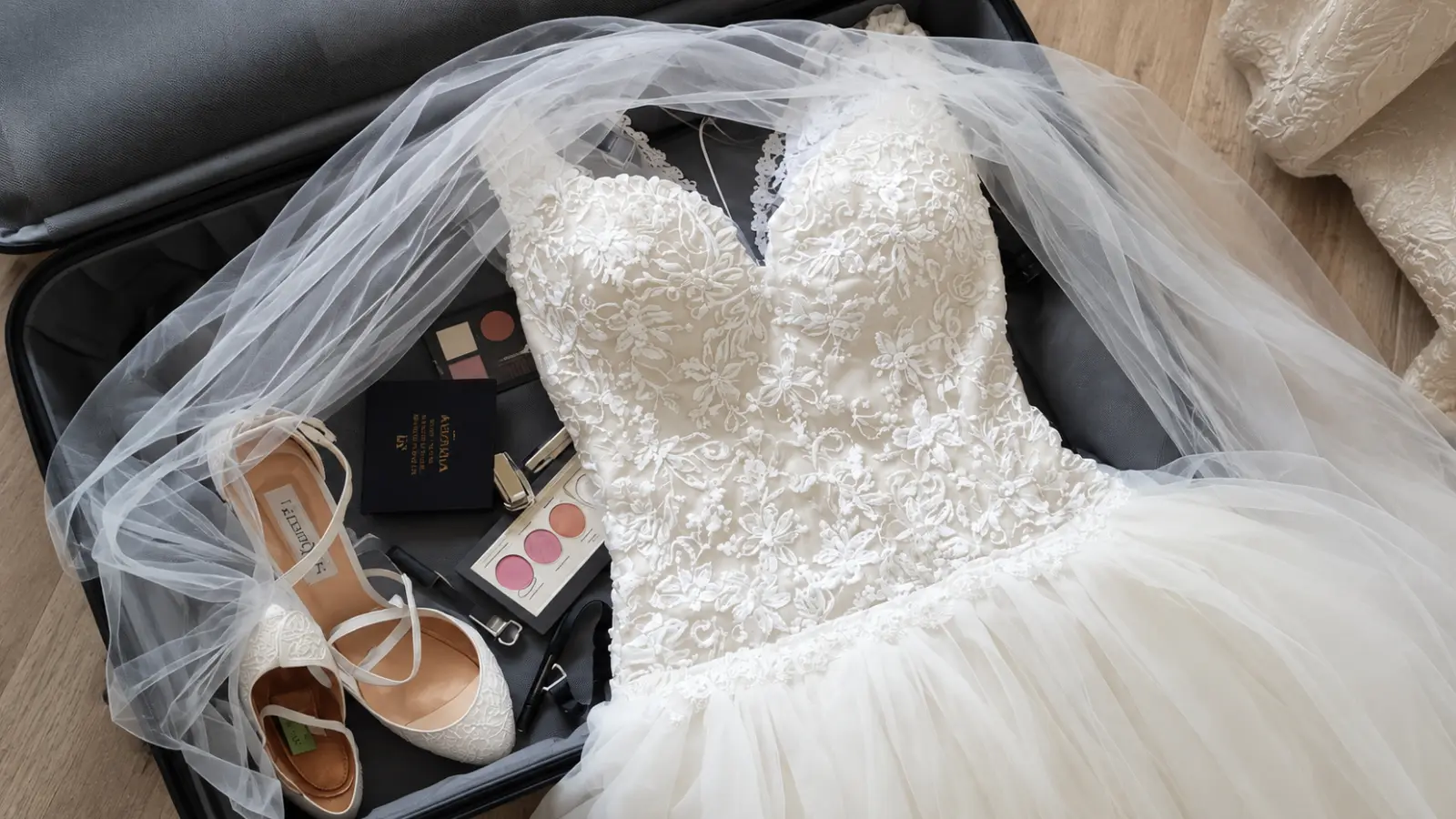
A Destination Wedding Packing Checklist should begin with risk, not with toiletries. Before deciding what goes into each suitcase, ask one question: what would be hardest to replace if a bag, shipment, or travel connection failed?
That changes the packing strategy. Rings, critical documents, primary wedding attire, vows, medication, and sentimental items deserve more protection than backup shoes, replaceable stationery, beauty extras, or bulk décor. Some items should remain under direct control, some can travel in checked baggage, some may be better shipped in advance, and others are easier to source locally.
This Destination Wedding Packing Checklist organizes the couple’s wedding items by consequence and travel method, including documents, rings, attire, shoes, accessories, beauty items, ceremony pieces, stationery, décor, shipping, local backups, and a small emergency kit.
Pack by Consequence, Not Category
A useful wedding travel packing list separates items by what happens if they do not arrive. That is more valuable than packing every category together and hoping the baggage system treats them equally.
Use four levels:
- Carry-On / Direct Control: items whose loss would immediately affect the wedding and that are permitted under current airline and security rules.
- Checked: bulky or lower-risk items that can be replaced, borrowed, or sourced locally if necessary.
- Ship: noncritical items that are too bulky to fly efficiently and can arrive well before the event.
- Local Backup: a destination source or substitute you identify before travel for anything vulnerable to delay.
This turns packing from a storage problem into a continuity plan.
Destination Wedding Packing Checklist at a Glance
The table below is a risk-based starting point, not a substitute for current TSA, airline, customs, courier, or destination rules. Always verify restrictions that apply to your exact route and item.
| Item | Carry-On | Checked | Ship | Backup |
|---|---|---|---|---|
| Passport / ID / Critical Travel Documents | Yes | No | No | Secure digital/copy set where appropriate |
| Wedding Rings | Yes | Avoid | Avoid | Know who carries them and where they stay |
| Wedding Dress / Primary Attire | Preferred when practical and airline allows | Possible but higher consequence | Usually avoid | Local steaming / minor alteration contact |
| Suit / Tuxedo | Preferred when practical | Possible | Usually avoid | Local pressing / emergency formalwear option |
| Wedding Shoes | Primary pair if space allows | Backup pair | No | Pack alternate neutral footwear |
| Vows / Ring Box / Sentimental Ceremony Items | Yes | Avoid | Avoid | Digital vows / simple substitute if appropriate |
| Printed Stationery | Small critical quantity | Possible | Yes, if early | Printable files / local print shop |
| Bulk Décor | Rarely | If manageable | Often | Rent or source locally |
| Beauty Products | Essential, compliant sizes | Bulk / full-size extras | Rarely | Know local pharmacy/beauty options |
| Emergency Kit | Core items | Larger extras | No | Local pharmacy / convenience store |
The safest plan avoids concentrating every ceremony-critical item in the same bag, person, or shipment.
Documents and Travel Essentials
Travel documents should remain accessible throughout the journey. For international travel, the U.S. Department of State recommends checking passport expiration early, organizing required travel documents, and keeping copies separate from the originals.
Depending on your trip, your direct-control document pouch may include:
- Passport or government-issued identification: according to your itinerary and destination requirements.
- Flight and lodging confirmations: preferably accessible offline as well as in email or an app.
- Ground-transfer information: driver, shuttle, rail, ferry, rental-car, or other arrival details.
- Insurance information: if you purchased relevant travel or event coverage.
- Wedding paperwork: only the documents you have verified are required for your specific wedding circumstances.
- Copies of key travel documents: stored separately from the originals where appropriate.
Do not use a generic packing list as legal-document advice. For international trips, verify entry and passport requirements with official sources before departure.
Wedding Rings and Other Irreplaceable Jewelry
Wedding rings are small, valuable, and difficult to replace meaningfully on short notice. Give them a specific owner and a specific travel location.
Do not casually move the rings between purse, hotel safe, garment bag, planner tote, and wedding-party pockets. Decide who carries them during travel, where they stay at the destination, and when responsibility transfers for the ceremony.
The same logic applies to heirloom jewelry, sentimental accessories, or pieces borrowed from family. If the emotional consequence of losing an item is high, treat it like a critical asset rather than an accessory.
A tiny item can carry the largest replacement risk in the entire suitcase.
Wedding Attire
Primary wedding attire deserves a higher level of travel protection than ordinary clothing. The TSA currently permits wedding dresses through the security checkpoint and recommends packing them securely in a garment-style bag or other protective packaging. It also advises travelers to contact the airline about onboard storage and carry-on limits.
Wedding Dress
If practical for your route and airline, keeping the dress with you reduces the risk of separation from checked baggage. Contact the airline before departure to understand garment policies, overhead-bin limitations, closet availability if any, and whether the dress counts toward your carry-on allowance.
Suit or Tuxedo
Use the same risk logic. If the primary suit can travel under direct control, that may be preferable. Pack shirt, tie or bow tie, belt or suspenders, cuff links, socks, and other ceremony-critical pieces together rather than scattering them across bags.
At the destination, know where pressing, steaming, or minor alterations could be handled if needed. That local backup is often more useful than packing a large amount of garment-care equipment.
Shoes and Backup Footwear
Shoes are replaceable in theory but difficult to replace well at the last minute. Pack the primary wedding pair early and test it before travel.
A useful destination wedding packing checklist for either partner should also consider the venue surface. Sand, grass, cobblestones, steep paths, heat, or rain may make a second pair more than a comfort item.
Pack backup footwear in a separate bag when practical so one baggage problem does not remove every usable option. A neutral pair that works with the outfit is more valuable than a highly specific second pair that creates the same vulnerability.
The backup does not need to be glamorous. It needs to keep the day moving.
Accessories and Personal Details
Small accessories create disproportionate wedding-day frustration because couples often assume they are too minor to forget.
Keep ceremony-specific accessories together in one labeled pouch or case:
- Jewelry and watches: especially heirloom or high-value pieces.
- Veil, headpiece, or hair accessories: protected from crushing.
- Cuff links, tie, bow tie, pocket square, belt, or suspenders: packed with the outfit they belong to.
- Undergarments and shapewear: including any pieces required for the fit of the wedding attire.
- Personal fragrance or sentimental detail: packed according to liquid and airline rules if traveling by air.
One accessory pouch is easier to audit than six small items hidden in different luggage pockets.
Beauty and Getting-Ready Items
Pack beauty items according to consequence and current travel restrictions. Put essential, difficult-to-substitute products in compliant carry-on quantities when possible, then place larger or replaceable products in checked baggage.
If a professional hair or makeup team is working with you, confirm what they provide before duplicating an entire kit. Beyond that, the couple typically still wants their own skin-care routine, contact lenses and supplies, dental items, fragrance, touch-up makeup, hair accessories, and any prescribed medication they normally travel with.
For international travel, verify destination rules for medications through official guidance where necessary. Do not assume that every product or prescription permitted at home can automatically travel everywhere.
Beauty packing should support the getting-ready plan, not recreate your bathroom counter abroad.
Ceremony Items
Ceremony items are often small enough to travel easily, which is exactly why they are easy to lose. Create one ceremony pouch or box under a named person’s control.
Depending on your wedding, it may contain:
- Vow books or printed vows: with a secure digital backup of the text.
- Ring box: separate from the decision about who physically carries the rings.
- Personal ceremony objects: cultural, religious, sentimental, or family pieces that are part of the ceremony.
- Marriage paperwork: only if you have verified that particular documents must physically travel with you.
- Small ceremony accessories: handkerchiefs, reserved-seat tokens, or another nonreplaceable detail.
The ceremony box should contain what cannot simply be borrowed from the venue five minutes before the processional.
Stationery and Paper Goods
Printed items sit in the middle of the packing hierarchy: some are critical in small quantities, while bulk paper is usually replaceable.
Carry a small quantity of anything essential for immediate use, such as ceremony programs or escort materials if there is no digital or local backup. Larger quantities may travel in checked luggage or ship ahead if receiving and storage are reliable.
Keep print-ready digital files accessible. A local print shop may be able to reproduce menus, signs, place cards, schedules, or basic paper goods faster than a delayed shipment can be recovered.
The best stationery backup is often not another suitcase. It is a clean PDF and a known place that can print it.
Décor: Carry, Check, Ship, or Source Locally?
Décor should earn its place in the luggage. Bulky, fragile, inexpensive, or easy-to-rent items can cost more to move than they are worth.
Use this decision filter:
- Carry: small sentimental pieces that are difficult to replace.
- Check: compact, sturdy items that would be inconvenient but not disastrous to lose temporarily.
- Ship: noncritical bulk items that can arrive early and have a confirmed receiver.
- Source Locally: candles, simple vessels, large signage structures, linens, furniture, glassware, props, or other pieces whose shipping burden exceeds their value.
Before shipping anything international, verify current courier, customs, import, tax, and destination restrictions rather than assuming a domestic shipping process applies.
Destination design is often strongest when it travels lightly.
Build a Small Destination Wedding Emergency Kit
An emergency kit should solve likely, small problems—not become a mobile supply closet.
Useful categories may include:
- Attire care: fashion tape, stain-treatment product, sewing basics, safety pins, lint roller, or another garment-specific item.
- Comfort: blister care, bandages, tissues, wipes, and weather-appropriate comfort items.
- Beauty touch-ups: the products actually needed for your look.
- Practical tools: small scissors or other tools only where permitted by current travel-security rules, chargers, portable battery, and spare fasteners.
- Personal medication: managed according to your normal medical instructions and destination travel requirements.
Keep the kit proportional to the wedding. The better your local sourcing plan, the less you need to carry for rare scenarios.
How to Ship Wedding Items Without Losing Control
Shipping is useful only when someone is responsible for the package after the courier marks it delivered.
Before sending wedding items, confirm:
- Receiver: the exact person, venue department, planner, or hotel contact authorized to accept the shipment.
- Address format: including guest name, event name, reservation number, department, or reference required by the property.
- Arrival window: early enough to recover from delays without arriving so early that the property cannot store it.
- Tracking and inventory: know what is inside each box and whether every box physically arrived.
- Storage: determine where packages remain before setup.
- Return plan: decide what happens to reusable items after the wedding.
Never put something irreplaceable into a shipment simply because shipping is convenient.
The 24-Hour Packing Check
The day before departure, stop adding items and audit the plan by consequence.
Confirm these five things:
- Documents: the people traveling have the identification and verified documents they need.
- Rings and valuables: one named person knows exactly where they are.
- Primary attire: every ceremony-critical component is accounted for.
- Shipments: anything sent ahead has a tracking status and a confirmed receiver.
- Backups: you know what can be replaced locally if a checked bag is delayed.
If those five systems are secure, forgotten extras become inconveniences rather than wedding-threatening problems.
Protect the Things the Wedding Cannot Easily Replace
A Destination Wedding Packing Checklist works best when the most important items receive the strongest travel plan. Keep irreplaceable documents, rings, sentimental pieces, primary attire, medication, and ceremony-critical items under direct control whenever practical and permitted, then use checked luggage, shipping, or local sourcing for items with lower replacement consequences.
The goal is not to pack everything yourself. It is to avoid creating one suitcase, shipment, or person as a single point of failure. When every important item has a transport method and a backup strategy, forgotten or delayed extras become inconveniences rather than wedding-threatening problems.
Frequently asked questions (FAQ)
What should be on a destination wedding packing checklist?
Prioritize travel documents, wedding rings, primary attire, ceremony-critical accessories, vows, medication, sentimental items, shoes, beauty essentials, stationery, décor, and a small emergency kit. Then assign every item to one of four travel strategies: carry-on or direct control, checked baggage, shipping, or local backup. The most important items are not necessarily the largest—they are the ones that would be hardest to replace if something were delayed or lost.
Can a wedding dress go through TSA security?
Yes. Current TSA guidance allows wedding dresses through the security checkpoint when packed securely in protective garment-style packaging. Contact the airline separately before travel to understand carry-on limits, onboard storage options, and how the garment will be handled once you board.
Should wedding rings go in checked luggage?
From a continuity standpoint, it is safer to keep small, irreplaceable wedding rings under direct control rather than placing them in checked baggage. Assign one person to carry them, decide where they will be stored at the destination, and establish when responsibility transfers for the ceremony.
How early should you ship destination wedding décor?
There is no universal shipping window. Timing depends on the destination, courier, customs when applicable, venue receiving rules, storage, and how easily the items could be replaced. Ship early enough to recover from delays, use tracking, and confirm that a specific person or department can physically receive and inspect the shipment.
What should the couple keep in carry-on baggage for a destination wedding?
Prioritize permitted items that are time-critical, valuable, or difficult to replace, such as identification and travel documents, wedding rings, prescribed medication, vows, sentimental ceremony pieces, important accessories, and primary wedding attire when practical within the airline’s rules. Verify current security and carrier policies before departure.
Should you pack all destination wedding décor yourself?
Usually not. Carry small sentimental pieces that are difficult to replace, but compare the transportation burden of bulky or fragile décor against renting, sourcing locally, or shipping it in advance. Large signage, glassware, linens, vessels, props, and similar items are often easier to manage locally when the destination has suitable vendors.

About the Author
Débora Justo
Founder and editor of EVORÉ, creating practical wedding planning resources, thoughtful inspiration and useful tools for the decisions that shape a celebration.
Read more about the author →