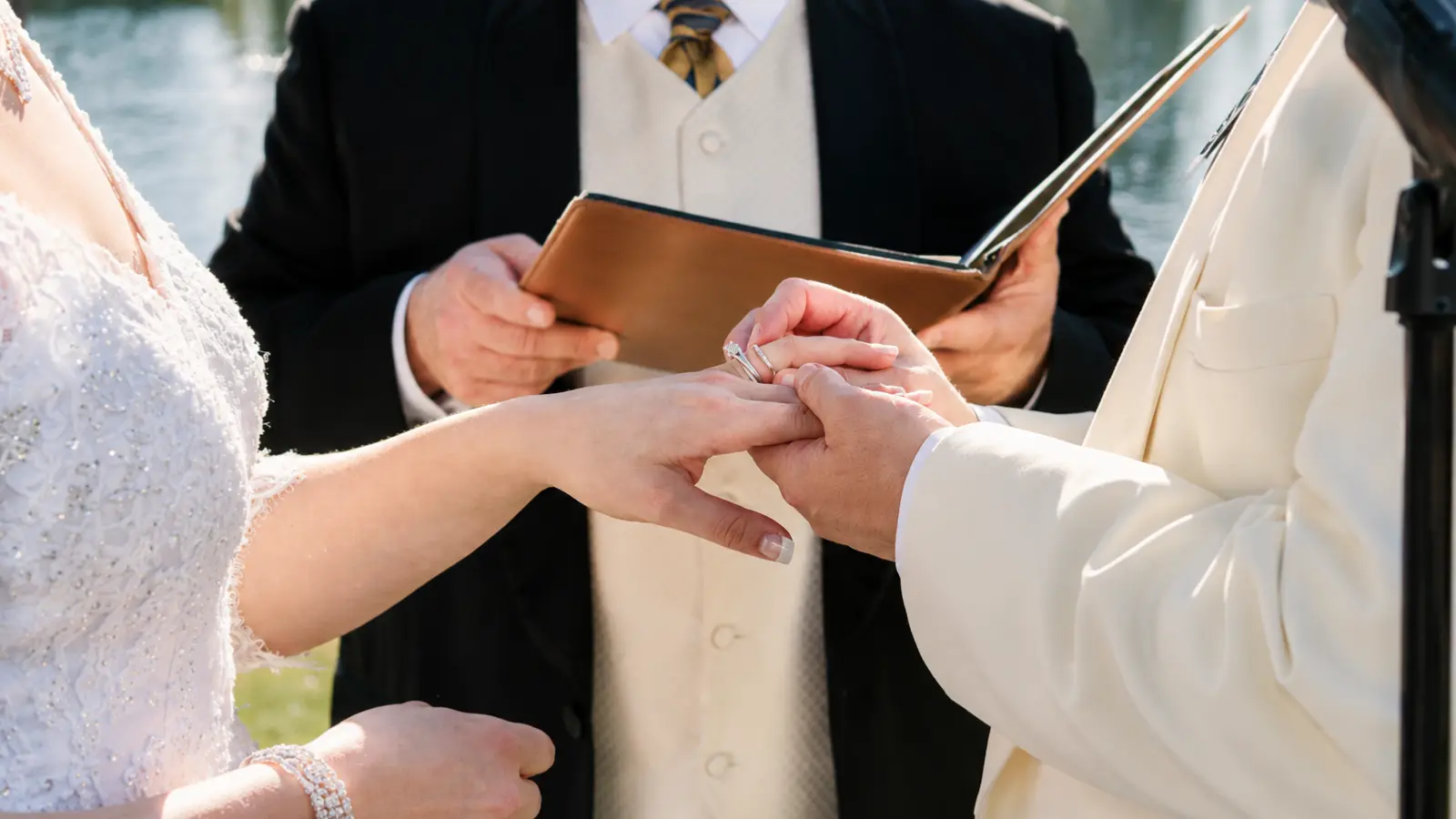

A wedding officiant script gives the ceremony a clear structure while helping the officiant move naturally between welcome, storytelling, consent, vows, rings, rituals, pronouncement, and closing. The strongest scripts are not simply generic templates with the couple’s names inserted. They separate spoken language from stage directions, reflect the couple’s real voice, and make every section serve a specific purpose.
A good script also keeps legal requirements distinct from optional ceremonial elements. The declaration of intent or other form of present consent may have legal significance, while personal vows, readings, rings, unity rituals, and most storytelling are typically customizable. Because ceremony requirements vary by jurisdiction, any legal wording should be verified locally rather than copied from an unrelated sample.
This wedding officiant script guide explains how each ceremony section works, what the officiant can say, how to write stage directions, welcome guests, tell the couple’s story, introduce readings, lead the declaration, vows and ring exchange, make the pronouncement, personalize the ceremony, and adapt complete civil, nonreligious, and traditional structures.
How a Wedding Officiant Script Works
A script has three layers. The first is legal: the consent or declaration required for the marriage, along with any ceremony conditions imposed by the jurisdiction. The second is ceremonial: the welcome, reflection, vows, rings, readings, rituals, and closing. The third is operational: processional cues, movement, microphone instructions, ring handoffs, pauses, and the transition to license signing.
Keeping those layers visible helps the officiant edit safely. A couple can remove a reading or shorten their story without affecting the legal core. They should not delete a required declaration because it sounds repetitive beside personal vows.
The operational guide on how to officiate a wedding covers authority, registration, rehearsal, license signatures, filing, and deadlines. This article assumes those responsibilities are being handled and concentrates on preparing words that can be delivered naturally.
Before drafting, decide:
- the target ceremony length;
- the desired tone and degree of formality;
- whether religious or cultural language is appropriate;
- which relationship details are public;
- whether personal vows will be shared;
- whether readings, music, or a unity ritual will be included;
- the exact legal element confirmed for the ceremony location.
Read every draft aloud. A page that looks concise can sound dense, while a conversational paragraph may need added pauses or shorter sentences. Spoken clarity matters more than literary complexity.
Wedding Ceremony Script Sections
Not every section of a script carries the same weight. Some are legally sensitive, some are ceremonial and fully optional, and some exist only to keep the room organized. Mapping each part to its purpose makes it easier to edit the script without accidentally cutting something that matters.
| Section | Purpose | Usually Required? | Personalization |
|---|---|---|---|
| Processional notes | Coordinate entrances, positions, music, and the start cue | Operational, not usually spoken | Order, music, escorts, standing arrangement |
| Announcement | Give guest instructions before the ceremony | No | Phones, photography, seating, participation |
| Welcome | Identify the occasion and include the guests | Ceremonially expected | Formality, family acknowledgment, setting |
| Opening | Frame the meaning of marriage and the ceremony | No | Values, faith, culture, tone |
| Couple story | Connect the ceremony to this relationship | No | Shared history, qualities, future |
| Reading | Add another voice or perspective | No | Reader, source, placement, introduction |
| Declaration | Express the couple’s present consent to marry | Often legally significant; verify locally | Limited by legal requirements |
| Personal vows | State chosen promises for the marriage | Usually optional | Original, repeated, private, or omitted |
| Ring exchange | Give a physical symbol to the promises | Usually optional | One ring, two rings, wording, or omitted |
| Unity ritual | Represent joining, family, heritage, or shared purpose | Usually optional | Ritual, participants, explanation, music |
| Pronouncement | Declare the marriage after required elements | Common; legal role may vary | Accurate authority phrase and couple’s terms |
| Closing | End the ceremony and cue the recessional | No | Blessing, wish, presentation, next-step note |
Treat this table as a checklist, not a fixed running order. A couple can reverse the story and the reading, drop the unity ritual entirely, or fold the declaration and vows into a single moment — the sequence can flex as long as every legally required element survives the edit.
Processional Notes: Write Directions That Are Not Spoken
Processional notes belong in the working script even though guests never hear them. Use brackets, italics, highlighting, or another unmistakable format to distinguish directions from spoken text.
A practical opening page might contain:
[Confirm the couple and wedding party are ready. Check that the required witnesses are present. Wait for the coordinator’s signal. Processional music begins. Wedding party enters. Couple reaches position. Music fades. Pause, smile, and begin.]
Name the person responsible for each cue rather than writing “music starts” with no owner. Identify who closes doors, signals musicians, carries the rings, moves a chair, hands over vow cards, or adjusts a microphone.
The script can also mark physical actions:
[Ask guests to be seated.] [Invite the couple to face each other.] [Step aside for the first kiss.] [Pause for applause.]
Directions should be short enough to recognize at a glance. A stage note is a safety rail, not a paragraph the officiant must study while everyone waits.
Guest Announcement Before the Ceremony
An announcement is different from the welcome. It is delivered before the formal ceremony to address phones, photography, seating, participation, or an unusual transition. The planner, venue, or officiant may deliver it.
For an unplugged ceremony:
“The couple invites you to be fully present with them. Please silence and put away phones and cameras until the ceremony has ended. Their photographer will preserve the moment, and they look forward to sharing those images with you.”
For a brief safety or venue instruction:
“Before we begin, please keep the center aisle clear and remain seated during the processional. At the end of the ceremony, the wedding party will lead everyone to the reception area.”
Only announce a request the couple and venue have approved. Avoid scolding guests or opening the occasion with a list of prohibitions.
Welcome and Opening Remarks
The welcome answers three questions quickly: Why are we here? Whose marriage are we witnessing? How should the moment feel?
A search for “what does officiant say at wedding” can make the role sound like one uninterrupted speech. In practice, the officiant alternates between addressing the guests, speaking to the couple, asking for responses, introducing other participants, and giving quiet operational cues.
The Welcome
A warm neutral welcome:
“Welcome, everyone. We are gathered to witness and celebrate the marriage of [Name] and [Name]. Your presence reflects the community of family and friends that has supported them and will continue to share in the life they build together.”
A concise formal welcome:
“Family and friends, welcome. Today, in your presence, [Name] and [Name] will declare their intention to marry and make promises for the life ahead.”
The Opening
The opening then gives the ceremony meaning. It should reflect the couple rather than deliver a universal lecture on marriage.
“Marriage is both a commitment made today and a practice renewed in ordinary life. It is built through attention, honesty, patience, shared responsibility, and the decision to meet change as partners. [Name] and [Name] come here ready to make that decision openly.”
People searching “officiant speech wedding” generally need language that is specific, restrained, and easy to follow. Two focused paragraphs often carry more weight than a long meditation assembled from quotations.
The Couple Story
The couple story connects a familiar ceremony structure to two particular people. Its purpose is not to document every date. Select a few details that reveal how the relationship works.
A useful story arc has three parts:
- how the relationship began or when it became meaningful;
- what the couple has learned or built together;
- what qualities they bring into marriage.
Example:
“When [Name] and [Name] first met, neither could have predicted the exact path that would bring them here. What became clear over time was how naturally they made room for one another: for different ideas, changing plans, difficult days, and ambitious dreams. Their relationship grew not from one dramatic moment, but from a series of dependable choices—to listen, to show up, to laugh, and to begin again when necessary.”
“They admire different qualities in each other, but they describe the same foundation: trust. Today does not create that foundation. It gives them the opportunity to name it, honor it, and carry it deliberately into marriage.”
Ask both partners to approve the facts and emotional boundaries. Do not reveal medical history, grief, estrangement, fertility, finances, former relationships, or private conflict merely because the material makes a dramatic story.
Introducing a Reading
A reading can add a family voice, cultural reference, spiritual idea, or literary perspective. It should earn its place by reinforcing the couple’s values rather than filling time.
Introduce the reader and explain the selection in one sentence:
“The couple has invited [Reader’s Name] to share a passage they chose for its reflection on patience and partnership.”
After the reading, use a short transition:
“Thank you, [Reader’s Name]. [Name] and [Name], the values expressed in that reading lead us to the promises you will make now.”
Do not paste an entire poem, book passage, song lyric, film speech, or published ceremony into an officiant wedding script without checking copyright status and permission. A title, author credit, and lawful source can be listed in the private working document when appropriate. Public-domain status should also be verified instead of assumed from the age or popularity of the work.
Declaration of Intent: Protect the Legal Core
The declaration of intent is where each person expresses present consent to marry. It may resemble traditional “I do” wording, but its legal treatment depends on the jurisdiction. This section should be labeled clearly in the script and confirmed before decorative language is added around it.
A neutral example is:
“[Name], do you freely choose [Name] as your spouse and enter this marriage with the intention of sharing your life together?”
Response: “I do.”
Repeat the question for the other partner. This is only an adaptable example. Do not assume that its wording, witnesses, or format satisfies a particular state or local rule.
The couple should already have obtained a valid marriage license where one is required. The license and official instructions may identify the jurisdiction, effective dates, witnesses, officiant fields, and return process, but they do not always provide a complete ceremony script.
Personal and Repeat-After-Me Vows
Personal vows express promises chosen by the couple. They can be original, repeated after the officiant, read from cards, or shared privately before the public ceremony.
A brief repeat-after-me form:
“I, [Name], choose you, [Name], as my partner in marriage. I promise to speak honestly, listen generously, share responsibility, celebrate your growth, and stand beside you through the changes life brings.”
If the couple writes personal vows, the officiant needs only a transition:
“You have declared your intention to marry. You will now share the promises you have written for one another.”
Balance matters. Ask each person to aim for a similar length without forcing matching content. Two to three minutes each is often enough for meaningful public vows. Keep printed backups and decide in advance who speaks first.
Personal vows should not be treated automatically as a replacement for the declaration. Maintain both sections when local requirements or the couple’s ceremony plan call for both.
Ring Exchange Wording
The ring exchange uses a physical object to represent the promises already made. It is usually optional from a civil legal perspective, although a religious tradition may assign it a different importance.
Transition:
“The rings are small enough to be carried each day, but they represent a commitment larger than any single moment. May they remind you of the promises made here and the care through which those promises will be kept.”
Short ring words:
“[Name], I give you this ring as a sign of my love and commitment.”
The couple may exchange two rings, one ring, another object, or no object. Write the actual choice into the script so the officiant does not announce a ring that is not present.
Unity Ritual
A unity ritual can represent partnership, family, culture, faith, or a shared future. Examples include lighting candles, blending sand, sharing a cup, tying cords, planting, assembling an object, or involving children and relatives.
The officiant should explain only what guests need to understand:
“[Name] and [Name] will now combine these two vessels of sand. The colors remain visible as parts of one design, representing two individual lives joined without losing the qualities each person brings.”
Keep the explanation accurate to the couple’s reason for choosing the ritual. If it belongs to a living religious or cultural tradition, work with a knowledgeable practitioner rather than reducing it to decoration.
Rehearse the physical action. Check wind, flame restrictions, table height, containers, music length, clothing, mobility, cleanup, and who moves each item. A ritual should not be inserted only because a wedding ceremony officiant script template includes a blank space for one.
Pronouncement
The pronouncement comes after the required consent and any vows or rings. It declares the marriage to the couple and those present. The wording should use an accurate description of the officiant’s authority and the terms the couple prefers.
Neutral example:
“[Name] and [Name], you have declared your intention to marry and made your promises in the presence of those gathered here. Having completed these commitments, I now pronounce you married.”
If a kiss follows:
“You may celebrate with a kiss.”
Step aside before giving that cue so the officiant is not centered in the photograph. Pause long enough for the moment, then return for the presentation.
The courthouse wedding ceremony guide explains how a brief government ceremony may handle consent, rings, signatures, and what follows immediately afterward. A civil wedding can also include personal language while remaining nonreligious and legally authorized.
Closing and Presentation
The closing should not introduce a new theme after the emotional conclusion has already arrived. Offer one final wish, provide a necessary instruction, and present the couple.
“May the promises made today be reflected in the life you build: in the decisions you share, the home you create, the people you welcome, and the care you offer one another. It is my honor to present [the couple’s chosen names or form of introduction].”
Use the couple’s approved names. Never assume that either person is changing a surname or that they want to be introduced with a gendered or traditional title.
Add a private stage direction after the presentation:
[Recessional music begins. Couple exits. Wedding party follows. Officiant retrieves ceremony materials and proceeds to the planned signing location.]
Short Civil Wedding Officiant Script
A short civil structure removes extended storytelling, readings, and rituals while preserving a respectful welcome, present consent, optional vows or rings, and a clear pronouncement. It may be appropriate for an elopement, office ceremony, private home, or other authorized civil setting.
1. Welcome
“Welcome. We are here to witness the marriage of [Name] and [Name] and to support the commitment they make today.”
2. Brief Opening
“Marriage is a partnership entered freely and sustained through trust, honesty, respect, and shared responsibility. [Name] and [Name] come here ready to make that commitment to each other.”
3. Declaration
“[Name], do you choose [Name] as your spouse and enter this marriage freely?”
Response: “I do.”
[Repeat for the other partner using locally confirmed language.]
4. Optional Rings
“Please place the ring and repeat: I give you this ring as a sign of my love and commitment.”
5. Pronouncement and Closing
“You have declared your intention to marry in the presence of those gathered here. I now pronounce you married. It is my honor to present [chosen form of introduction].”
This structure is intentionally brief, but “brief” does not waive legal requirements. Confirm authority, declaration, witnesses, signatures, and license procedures separately.
Nonreligious Wedding Ceremony Structure
A nonreligious ceremony can be reflective, emotional, formal, or traditional in shape without invoking a deity, sacred text, or religious authority. Its source of meaning is the couple’s relationship, values, community, and chosen commitments.
1. Processional and Welcome
Welcome the guests and acknowledge the role they have played in the couple’s lives.
2. Reflection on Partnership
Describe marriage through the couple’s stated values—perhaps curiosity, loyalty, humor, steadiness, independence, or shared purpose.
3. Couple Story
Share a concise account of how the relationship developed and what the partners appreciate in each other.
4. Optional Reading
Invite a reader to share a properly licensed, public-domain, or original selection that fits the ceremony’s central idea.
5. Declaration and Personal Vows
Lead the locally confirmed consent first, then invite each person to read the promises they wrote.
6. Rings or Unity Ritual
Introduce the symbol briefly and allow the physical action to carry the moment.
7. Pronouncement, Kiss, and Presentation
Pronounce the marriage, move aside, cue the kiss if desired, and introduce the couple using their approved names.
A nonreligious script does not need to avoid seriousness or tradition. It needs to avoid falsely speaking for beliefs the couple does not hold.
Traditional Wedding Ceremony Structure
“Traditional” can refer to a familiar Western ceremony order, a particular faith, a cultural practice, or a family’s customs. Define the term with the couple before writing. The structure below uses familiar elements without reproducing a complete religious liturgy.
1. Processional
The officiant and wedding party enter according to the couple’s chosen order.
2. Welcome and Invocation or Opening Reflection
The officiant welcomes the community and, when appropriate, offers faith-based language approved by the couple and institution.
3. Reading or Family Acknowledgment
A selected passage, prayer, blessing, or statement acknowledges the tradition and community surrounding the marriage.
4. Address to the Couple
The officiant reflects on commitment, mutual responsibilities, and the meaning of marriage within the couple’s tradition.
5. Declaration, Vows, and Rings
The couple expresses consent, makes prescribed or chosen vows, and exchanges rings if included.
6. Blessing or Approved Ritual
The officiant or designated participant leads the tradition’s authorized closing element.
7. Pronouncement and Recessional
The officiant pronounces the marriage, offers the approved presentation, and cues the recessional.
When a house of worship or faith leader controls the liturgy, use its approved service rather than combining internet fragments. The officiant and couple should ask what may be personalized, what must remain unchanged, and whether another civil step is necessary.
How to Personalize a Wedding Officiant Script Template
Personalization is not measured by the number of private details added. A ceremony feels personal when its language, rhythm, stories, and promises accurately reflect the couple.
Start With an Interview, Not Adjectives
Ask for specific moments: a decision they made well together, a routine they value, a challenge that revealed character, something they have learned, or what they want their home to feel like. Concrete answers produce better writing than asking only for three words that describe the relationship.
Choose One Central Idea
A script becomes scattered when every section introduces a new metaphor. Select a theme—partnership, home, growth, adventure, steadiness, community—and allow different sections to develop it without repeating the same sentence.
Match the Couple’s Natural Voice
Humor should sound like their humor. Formal language should be a deliberate choice, not an attempt to make the wedding feel important. Avoid jokes at one partner’s expense, stereotypes, forced sentiment, and statements the couple would never say.
Use Names and Pronouns Carefully
Confirm legal names for documents and preferred names for the ceremony. Check pronunciation, pronouns, relationship terms, titles, and the final presentation. Do not write a surname change into the script unless the couple requested it.
Edit for Speaking
Shorten sentences, mark pauses, place page breaks between complete sections, and avoid ending a page in the middle of a declaration or vow. Print in a readable size with generous spacing. Number pages and remove editing comments from the final copy.
Time the Actual Ceremony
Include entrances, responses, vow delivery, ring movement, readings, rituals, laughter, applause, and the kiss. A 1,500-word script is not the same length in every officiant’s voice.
Extensive custom writing may be included in a professional package or priced separately. The wedding officiant cost guide explains how script customization, revisions, rehearsal, travel, and license handling can affect the service scope.
Legal Wording Warning: Never Treat a Sample as Universal
A wedding ceremony officiant script can organize the service, but it cannot establish the officiant’s authority or override local law. The person performing the marriage should verify both eligibility and ceremony requirements before using any template.
Official statutes demonstrate why wording cannot be universal. Washington law says no particular form is required, but the parties must assent or declare before the authorized officiant and two attending witnesses that they take each other as spouses. New York law also rejects one required ceremony form while specifying a solemn declaration and at least one attending witness. Those are examples from two jurisdictions, not a national standard.
California’s official marriage-officiant guidance directs officiants to know the laws governing performance of the marriage and completion of the license. The correct source for another ceremony may be a state statute, county clerk, city clerk, probate court, vital-records office, or another designated authority.
Check:
- whether the officiant is authorized in the ceremony location;
- whether registration or documentation is required;
- what present consent or declaration the parties must make;
- how many witnesses must attend and sign;
- whether any remote, proxy, or location restriction applies;
- who signs, returns, and records the license;
- which deadline and correction method apply.
The guides on who can officiate a wedding and the meaning of a wedding officiant license address authority separately. Someone preparing for the role can also review how to become a wedding officiant without confusing training or credentials with the words spoken during the ceremony.
Final Script Review
Before printing the final version, confirm:
- the couple approved the tone, story, names, pronouns, and presentation;
- stage directions are visually different from spoken words;
- the processional, reader, music, ring, ritual, kiss, and recessional cues have owners;
- the declaration is clearly marked and locally verified;
- personal vows do not accidentally replace required consent;
- every reading has an accurate source and lawful use;
- religious or cultural elements are authorized and respectfully represented;
- the script has been timed aloud;
- a clean printed copy and backup are ready;
- the ceremony order matches the rehearsal and vendor timeline.
The best script gives the officiant enough support to lead confidently without making the ceremony feel read at the couple. Clear structure creates room for eye contact, pauses, emotion, and an unplanned laugh while protecting the words that cannot be missed.
Build the Script Around Purpose, Not Tradition Alone
A wedding officiant script works best when every section has a clear reason to be there. Stage directions keep the ceremony organized, the welcome establishes the tone, stories and readings make it personal, the declaration protects the legal core, vows and rings express chosen promises, and the pronouncement and closing bring the ceremony to a natural conclusion.
Start with the couple’s actual values and voice, remove anything that feels generic or unnecessary, and read the entire ceremony aloud before the wedding day. Keep legal wording clearly identified and locally verified, then rehearse every transition involving another person, object, cue, or movement. The result should feel personal and effortless to the guests because the structure behind it is deliberate and precise.
Frequently asked questions (FAQ)
What does a wedding officiant say at a wedding?
A wedding officiant typically welcomes the guests, introduces the meaning of the ceremony, shares brief remarks about the couple, leads the legally required declaration of consent, guides any vows, rings, readings, or rituals, pronounces the marriage, and closes the ceremony. The exact legal wording should always be confirmed for the jurisdiction where the marriage takes place.
What should a wedding officiant script include?
A wedding officiant script may include processional notes, a welcome, opening remarks, a short couple story, optional readings or rituals, the required declaration of intent or consent, personal or repeat-after-me vows, an optional ring exchange, the pronouncement, and a closing presentation. Stage directions should be clearly separated from words the officiant will actually speak.
How long should a wedding officiant script be?
A brief civil ceremony may take only a few minutes, while a personalized wedding ceremony can run approximately 15 to 25 minutes or longer when readings, rituals, personal vows, or other elements are included. The most reliable method is to read the complete script aloud and time it with pauses, responses, movement, and ceremonial elements included.
Is the declaration of intent the same as wedding vows?
Not necessarily. The declaration of intent expresses the couple’s present consent to marry and may have legal significance under the applicable jurisdiction. Personal vows are promises the couple chooses to make to one another. A ceremony can contain both, and personal vows should not automatically be assumed to replace any legally required declaration.
Are wedding rings required in a wedding ceremony script?
Usually not. A ring exchange is generally a ceremonial choice rather than what legally creates the marriage. Couples may exchange two rings, one ring, another symbolic object, or no rings at all, provided the ceremony still satisfies every legal requirement that applies where the marriage takes place.
Can you use a wedding officiant script template word for word?
A template can provide a useful structure, but it should not automatically be used word for word. The officiant should adapt the tone, names, pronouns, story, transitions, vows, and ceremony elements to the couple, verify all legally required language locally, and confirm that any readings or other copyrighted material may be lawfully used.
About the Author
Débora Justo
Founder and editor of EVORÉ, creating practical wedding planning resources, thoughtful inspiration and useful tools for the decisions that shape a celebration.
Read more about the author →