
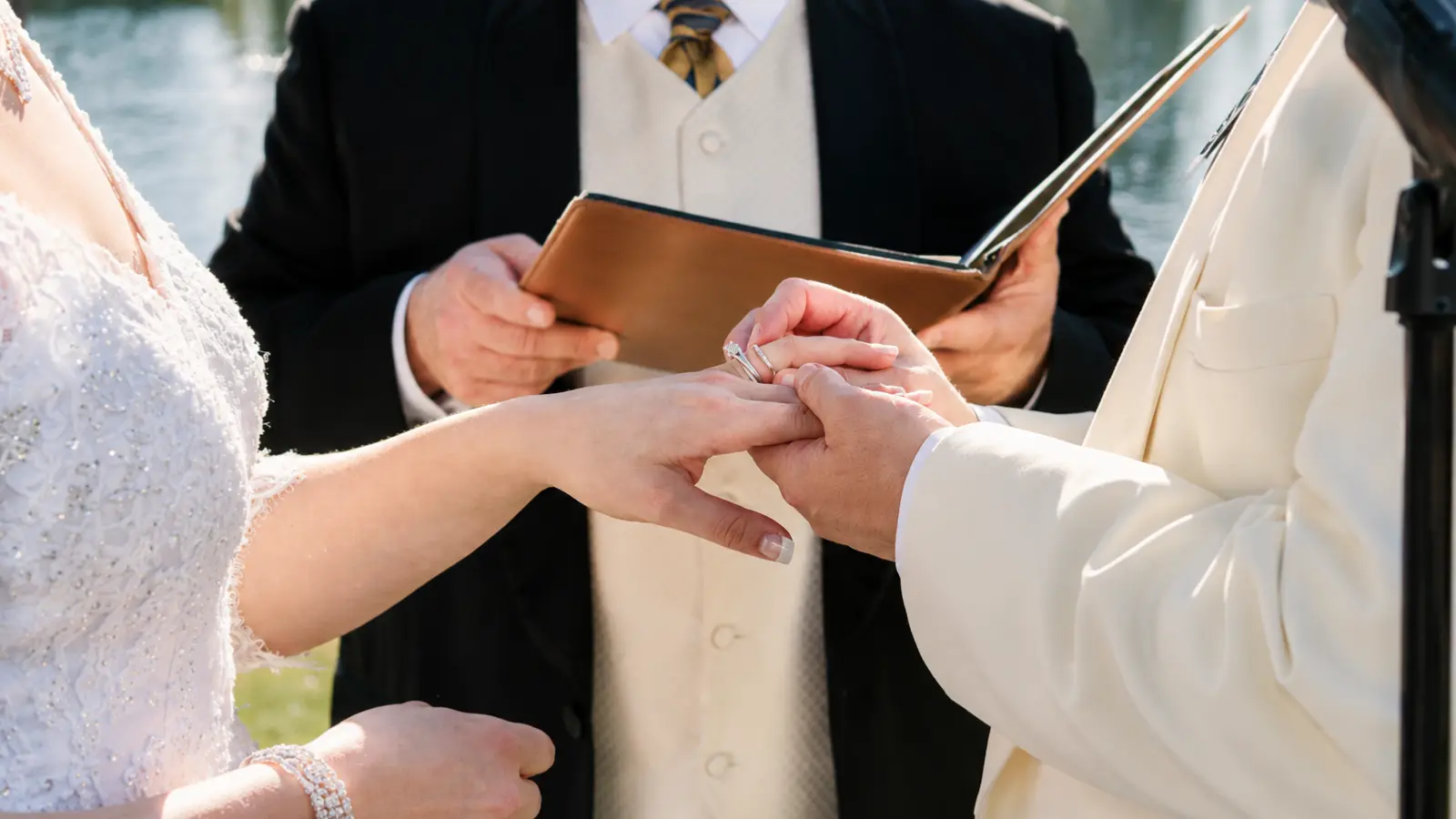
Who can officiate a wedding depends on the law governing the place where the ceremony takes place. Depending on the jurisdiction, authorized officiants may include religious leaders, judges, magistrates, civil celebrants, certain government officials, retired officials, notaries where specifically permitted, or people who receive temporary authority for a particular marriage.
A person’s relationship to the couple does not create legal authority on its own. A friend, relative, online-ordained minister, retired judge, public official, or notary may still need to fit a recognized legal category and complete any required registration, appointment, credential filing, residency requirement, or temporary designation before performing the ceremony.
This guide explains who can officiate a wedding, how legal authority works, which officiant roles may qualify, when friends and family members can perform a marriage, how online ordination and notary authority differ by jurisdiction, what registration may be required, how couples can verify an officiant, and what to do if the person who performed the ceremony may not have been properly authorized.
How Legal Authority to Officiate Works
Marriage law usually names categories rather than issuing the same credential to everyone. One person may be authorized because of religious office, another because of judicial service, and another because a court or clerk granted a one-day designation.
People searching “who can officiate wedding ceremony” often expect one national list. The related question “can anyone officiate wedding” has the same limitation: almost any type of person might qualify through an available legal path, but no one qualifies merely by agreeing to lead the ceremony.
Washington’s official list of authorized people, for example, includes specified active or retired judicial officers and officials of religious organizations. California’s Family Code Section 400 identifies religious representatives, judges, retired judges, commissioners, magistrates, legislators, and other defined officials. The lists are not identical.
Four questions should be asked about any candidate:
- Does current law name or encompass this role?
- Does the individual actually hold the required status?
- Is an appointment, registration, credential filing, bond, or temporary designation required?
- Does the authority cover the ceremony date and location?
The wedding officiant license guide explains how authority differs from ordination papers, course certificates, registration confirmations, court orders, and the couple’s marriage license.
Who May Be Authorized to Officiate?
The four questions above apply to every role, but seeing them answered side by side makes the pattern easier to spot: almost every category on this list is a “sometimes,” never an automatic “yes.”
| Role | May Be Authorized | Registration Possible | Verify |
|---|---|---|---|
| Religious leader | Yes, when the recognized legal category and status apply | State or local filing may apply | Statute, clerk, religious organization |
| Judge or magistrate | Frequently, but category and status matter | Possible depending on jurisdiction | Statute, court, clerk |
| Government official | Only when the particular office is authorized | Possible | Statute and office rules |
| Civil celebrant or commissioner | Yes where appointed or authorized | Often part of approval | Court, clerk, appointing authority |
| Online-ordained person | Depends on recognition of the status | May be required | Statute, clerk, credentialing organization |
| Friend or relative | Only through a separate qualifying path | Possible or ceremony-specific | Temporary-designation office, statute, clerk |
| Retired official | In jurisdictions that expressly include the former role | Possible | Current statute and relevant office |
| Notary public | Only where notarial commission includes marriage authority | Commission and local rules may apply | State notary and marriage law |
| Nonresident officiant | Depends on residency and recognition rules | Temporary or local filing possible | Ceremony jurisdiction |
The “Verify” column is the real takeaway: whichever role applies, the current statute or the office that administers it settles the question, not the general reputation of that category.
Religious Leaders
Priests, ministers, rabbis, imams, and comparable officials of religious organizations are commonly included in marriage statutes. The exact legal language may refer to ordination, licensing, authorization, good standing, religious office, or another relationship with the organization.
A title alone is not conclusive. The person should know:
- which organization grants the status;
- whether the status is current;
- which credentials document it;
- whether the ceremony jurisdiction recognizes the category;
- whether credentials must be filed or registration completed.
Religious law and civil law are separate. A religious organization may approve or refuse a ceremony under its own rules, while government law determines whether the civil marriage is validly solemnized.
The ordained wedding officiant guide examines ordination, online credentials, good standing, registration, and legal recognition without turning this page into an ordination tutorial.
Judges and Magistrates
Judges and magistrates are frequently authorized, but the relevant law may distinguish between state, federal, tribal, active, retired, resigned, resident, and nonresident judicial officers.
California, for example, names several categories of active and retired judges, commissioners, and magistrates. Washington names state, federal, and tribal judicial roles and expressly includes active or retired persons within stated categories.
Legal authority does not guarantee availability. A judge may not offer private ceremonies, may perform them only under an office policy, or may limit location and scheduling. Couples should confirm both eligibility and willingness.
A government ceremony may also be performed by a different authorized official. The courthouse wedding ceremony guide explains appointments, ceremony elements, rings, witnesses, guests, signing, and what happens afterward.
Clerks, Mayors and Other Government Officials
Some statutes authorize specific elected, appointed, or administrative officials. Possible examples include city clerks, mayors, commissioners, legislators, or officers named by state law.
The office must be identified precisely. Being a government employee does not create marriage authority, and a title that is authorized in one state may be absent from another state’s statute.
Check whether authority applies:
- only while the person holds office;
- after retirement or resignation;
- only within a geographic territory;
- only without compensation;
- only after designation or registration;
- only for ceremonies arranged through the office.
A civil ceremony describes legal rather than religious authority. The civil wedding guide explains why civil weddings can occur in several authorized locations and are not limited to one government building.
Civil Celebrants and Marriage Commissioners
A civil celebrant, marriage commissioner, or comparable officer may receive authority through a court, clerk, state office, county, or other appointing body. The title is not nationally standardized.
Authorization may be continuing, renewable, territory-specific, or limited to one ceremony. An application can involve residency, identification, a background declaration, court order, fee, bond, oath, training, or another condition.
Read the appointment itself. It should indicate the legal title, effective date, geographic scope, expiration, conditions, and any marriage-license duties. A professional celebrant trained in ceremony design is not legally authorized merely because the person uses the title “celebrant.”
Online-Ordained Officiants
An online-ordained person may be authorized when the jurisdiction recognizes the resulting religious status and every additional administrative requirement has been completed. Online ordination is not a federal license.
Evaluate three layers:
- Does the organization consider the person ordained or otherwise authorized?
- Does the ceremony jurisdiction recognize that category and status?
- Must the person register, file credentials, present good standing, or obtain approval?
California’s official officiant guidance says the state does not require people performing marriages to file credentials with the court clerk or another office. New York City has a registration requirement. These contrasting examples show why a provider’s national map should not replace current government guidance.
The search “who can be wedding officiant” is therefore incomplete without a location. The same credential can encounter different documentation and recognition rules in another state, county, or city.
Friends and Family Members
A friendship or family relationship gives the ceremony emotional meaning, not legal authority. The answer to “can friend officiate wedding” or “can family member officiate wedding” depends on whether that individual uses a qualifying path available in the ceremony jurisdiction.
Possible paths include:
- recognized religious ordination or appointment;
- one-day or temporary designation;
- court authorization as a civil celebrant;
- an existing judicial, public, or other authorized office.
Massachusetts offers an official One-Day Marriage Designation for a friend or family member to perform a ceremony in Massachusetts. The designation is ceremony-specific and the official guidance states that the applicant need not be a Massachusetts resident.
That procedure does not exist everywhere and should not be recreated with a homemade letter. If temporary authority is unavailable, the person needs another recognized route or the couple should use a legally authorized officiant for the civil ceremony.
The guide on how to become a wedding officiant covers the chronological path from choosing authority through registration, practical preparation, and the first wedding.
Retired and Former Officials
Some laws expressly authorize retired judges, commissioners, magistrates, or other former officials. Others limit authority to a current officeholder or impose additional conditions.
Washington’s statute includes active or retired persons within its stated judicial categories. California separately names several retired or former judicial and public offices. Neither example proves that every retired official may officiate throughout the country.
Confirm:
- the exact former office;
- whether retirement, resignation, or expiration is treated differently;
- residency and geographic scope;
- required proof of prior service;
- registration or appointment requirements;
- compensation restrictions.
A former official should enter only a title accepted by the jurisdiction on the marriage license.
Notaries Where Authorized
A notary public can perform a marriage only when applicable law grants that authority. The power to acknowledge signatures, administer oaths, or perform other notarial acts does not automatically include solemnizing marriage.
Florida provides a clear official example. Florida Statutes Section 117.045 authorizes a notary public to solemnize marriage. A notary commissioned by another state should not use that rule as authority for a ceremony elsewhere.
Verify whether the notary must hold an active commission issued by the ceremony state, whether residency matters, which ceremony steps are required, and how the marriage license should identify the officiant’s capacity.
Nonresident and Out-of-State Officiants
Residency rules vary by authority source and jurisdiction. A state may recognize a nonresident religious officiant, judge, or temporary designee, require local registration, limit a civil appointment to residents, or offer a ceremony-specific application.
Do not confuse three locations:
- where the officiant lives;
- where credentials or a commission were issued;
- where the ceremony physically occurs.
The ceremony location generally drives the authority analysis. Massachusetts explicitly states that its one-day designation has no residency requirement, but that does not remove the requirement to obtain the designation or allow the ceremony to occur outside Massachusetts.
When an officiant crosses a state line, confirm recognition, local registration, document filing, title, and marriage-license return before travel is booked.
Registration Can Be Required Even When the Role Qualifies
Legal eligibility and administrative registration are related but separate. A person may fit a category named in state law and still need to register with a city, county, clerk, or court before performing the ceremony.
New York City’s Marriage Officiant Registration guidance says an officiant must register with the Office of the City Clerk before performing a ceremony in the city. The current process includes an application, notarized signature, identification, supporting documents, and a fee.
Registration may also have effective dates, renewal requirements, territorial limits, and a public verification system. Save the approval and use the exact title or number requested on the marriage license.
How to Verify an Officiant
Use official sources in this order:
- Identify the exact ceremony address and jurisdiction.
- Read the current statute or official authorized-person list.
- Ask the officiant which legal category applies.
- Confirm appointment, ordination, office, designation, or commission status.
- Check local registration, residency, bond, and credential-filing rules.
- Verify that authority is effective on the wedding date.
- Review the issued marriage license and officiant fields.
Couples should ask to see relevant current documentation without collecting unnecessary personal information. A credential title alone is not enough; note the issuer, date, status, jurisdiction, and geographic scope.
The couple’s marriage license authorizes the marriage under its own terms but does not transform an ineligible person into an authorized officiant. The marriage license requirements guide covers documents, age, witnesses, waiting periods, prior marriages, and other applicant issues separately.
Authority Is Only the Beginning
An authorized person still needs to follow the ceremony and document rules. Depending on the jurisdiction, those duties can include obtaining present consent, conducting the ceremony during the license-validity period, coordinating witnesses, completing officiant fields, signing, and returning the license.
The operational guide on how to officiate a wedding explains the sequence from authority and license review through the ceremony, signatures, filing, and recording confirmation.
Authority also does not guarantee that a particular religious leader, judge, or official is obligated or available to perform the couple’s ceremony. Agreement, scheduling, venue rules, service scope, and any institutional requirements remain separate.
What If the Officiant Was Not Authorized?
The consequences vary too much for a national yes-or-no answer. A jurisdiction may distinguish between missing authority, incomplete registration, a document error, the parties’ good-faith belief, and other facts.
Washington’s unauthorized-cleric provision, for example, contains a specific good-faith protection under its stated conditions. Another state may use a different rule or remedy. Do not treat Washington’s statute as a nationwide cure.
If authority is questioned:
- Preserve the marriage license, credentials, approval, correspondence, and delivery evidence.
- Do not erase, backdate, overwrite, or submit false information.
- Contact the office that issued or records the license.
- Ask whether the record was accepted, rejected, held, or returned.
- Follow official correction or new-ceremony instructions.
- Seek qualified local legal advice if marital status may affect benefits, taxes, property, immigration, inheritance, or parentage.
None of these steps fix the problem on their own — they exist to protect the record while the correct office determines what, if anything, needs to be corrected.
Final Eligibility Checklist
Before relying on an officiant, confirm:
- Exact ceremony location identified
- Current authorized-person rule reviewed
- Officiant’s legal category clearly identified
- Current status or office verified
- Residency and nonresident rules checked
- Retired or former status accepted where relevant
- Ordination recognition checked where applicable
- Civil appointment or one-day designation approved
- Notary authority expressly confirmed where claimed
- State and local registration checked separately
- Effective date and geographic scope confirmed
- Marriage-license duties assigned
A couple who works through this list before the wedding rarely needs the remediation steps above — most eligibility problems surface early enough to fix with one verification call.
Verify the Person’s Legal Role Before the Ceremony
Who can officiate a wedding is ultimately determined by the combination of the person’s legal status and the jurisdiction where the marriage takes place. A familiar title such as minister, judge, celebrant, friend, notary, or retired official does not automatically prove that the person is authorized for every ceremony.
Before the wedding, identify the exact ceremony location, determine which legal category applies to the officiant, verify current credentials or appointment, and check any registration, residency, designation, or filing requirements. Confirming those details in advance protects the marriage process and avoids relying on assumptions that may be valid in one jurisdiction but not another.
Frequently asked questions (FAQ)
Who can officiate a wedding?
Who can legally officiate a wedding depends on the jurisdiction where the ceremony takes place. Authorized people may include religious leaders, judges, magistrates, clerks, civil celebrants, specified government officials, certain retired officials, notaries where expressly authorized, and people who receive temporary or one-day authority.
Can a friend or family member officiate a wedding?
Possibly, but being a friend or relative does not itself create legal authority. The person may need recognized religious status, civil appointment, a temporary or one-day designation, local registration, or another qualification accepted by the jurisdiction where the ceremony occurs.
Can an online-ordained minister officiate a wedding?
It depends on the ceremony jurisdiction. Online ordination may establish religious status within the organization that issued it, but that does not create one nationwide authorization to perform marriages. The officiant should confirm whether that status is legally recognized and whether registration, credential filing, good-standing documentation, or another step is required.
Can a notary officiate a wedding?
Only where the applicable law specifically authorizes notaries to solemnize marriages. Florida is one example, but a notary commission from another state should not automatically be assumed to include marriage authority. The current law for the ceremony location should always be checked.
Can an out-of-state officiant perform a wedding?
Sometimes. Residency and nonresident-officiant rules vary by jurisdiction and by the source of the officiant’s authority. A nonresident religious officiant, judge, civil celebrant, or temporary designee may be allowed in some locations but may need additional registration, approval, or documentation before the ceremony.
Does a wedding officiant have to register before performing the ceremony?
Not everywhere. Some jurisdictions allow an otherwise authorized officiant to perform marriages without separate registration, while others require credential filing, registration with a city or county, court approval, or another administrative step. Legal eligibility and registration should be checked separately for the exact ceremony location.

About the Author
Débora Justo
Founder and editor of EVORÉ, creating practical wedding planning resources, thoughtful inspiration and useful tools for the decisions that shape a celebration.
Read more about the author →