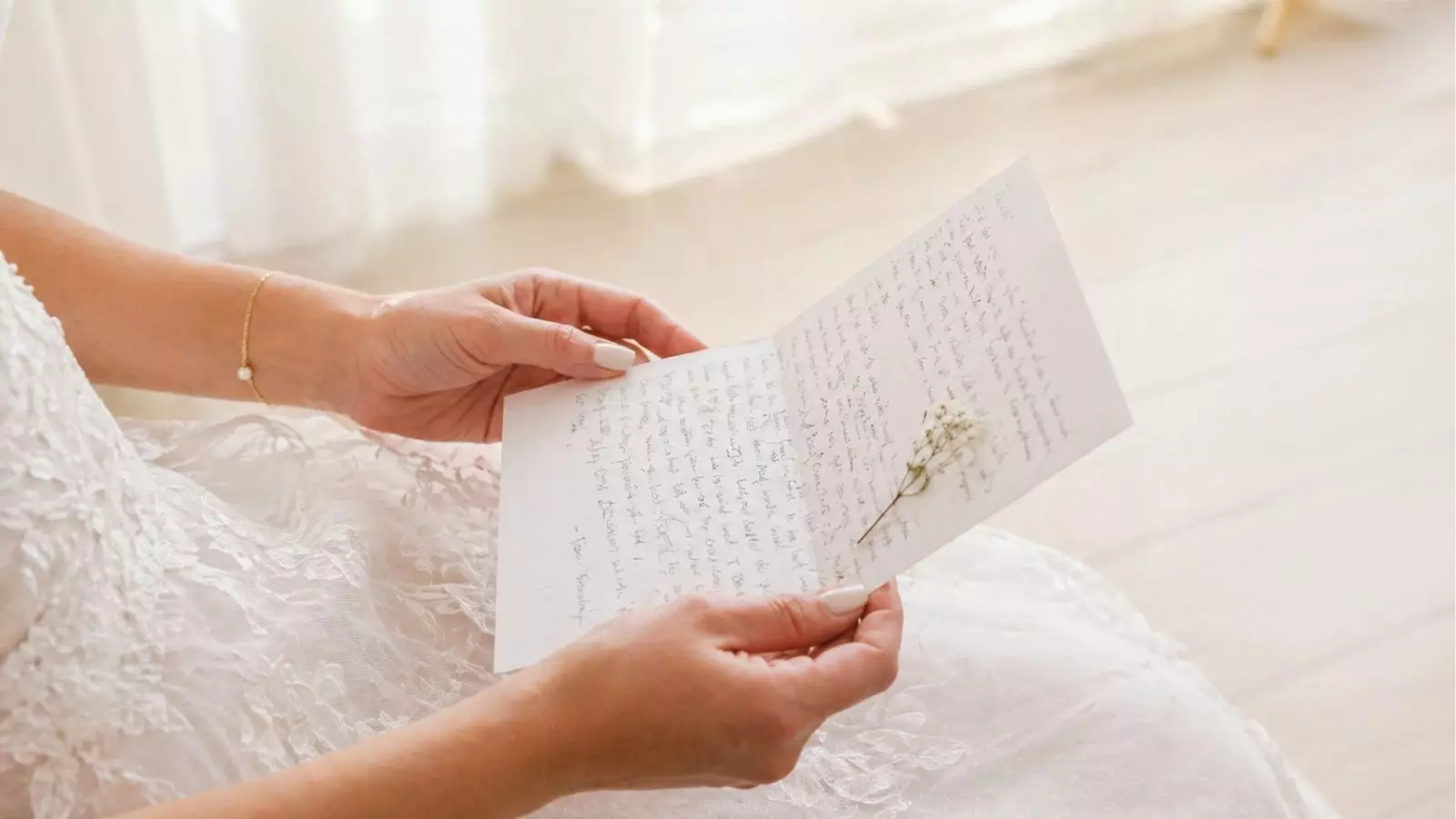
A wedding vows template is not about giving you the right words. It is about giving you a structure so you can find your own.
Couples who are still exploring styles, formats, and examples before writing their vows often benefit from reading a complete wedding vows guide first.
Most people struggle to write their vows for the same reason: they are trying to start from nothing. When you are faced with a blank page and a moment that feels important, the pressure to say something meaningful can make it surprisingly difficult to say anything at all.
A clear structure changes that completely. Instead of wondering where to begin, you move step by step through a framework that guides what to say next. This guide gives you that structure, a complete fill-in template, real examples applied within it, and everything you need to turn your thoughts into something you can confidently say at the altar.
Why Vows Need a Structure — And Why That’s a Good Thing
The reason most people freeze when they sit down to write their vows is not a lack of love or feeling. It is the absence of a framework. You open a blank document, stare at the cursor, think about how much this person means to you, and then feel the pressure of that magnitude so completely that nothing comes out.
For many couples, following a step-by-step process for how to write wedding vows makes the entire experience feel far less overwhelming.
A template does not make your vows less personal. It does the opposite. By giving you a scaffold, it frees you from the anxiety of structure so you can focus entirely on what you actually want to say. The template handles the architecture. You provide the truth.
Think of it this way: a house has a foundation, walls, and a roof — a structure. What makes a house a home is everything that goes inside it. Your vow template is the structure. The specific memories, the real promises, the things only you could say — those are what make it yours.
Every memorable wedding vow — whether it sounded spontaneous or polished — followed some version of the four-part structure below. The couples who wrote the best vows did not have more talent. They had more specificity. This guide gives you both the structure and the method for filling it with something real.
The Four Parts of a Great Wedding Vow
Every great personal wedding vow moves through four distinct phases. They do not have to be labeled or announced — they flow naturally from one to the next. But understanding them before you write means you always know what comes next, which eliminates the blank-page panic completely.
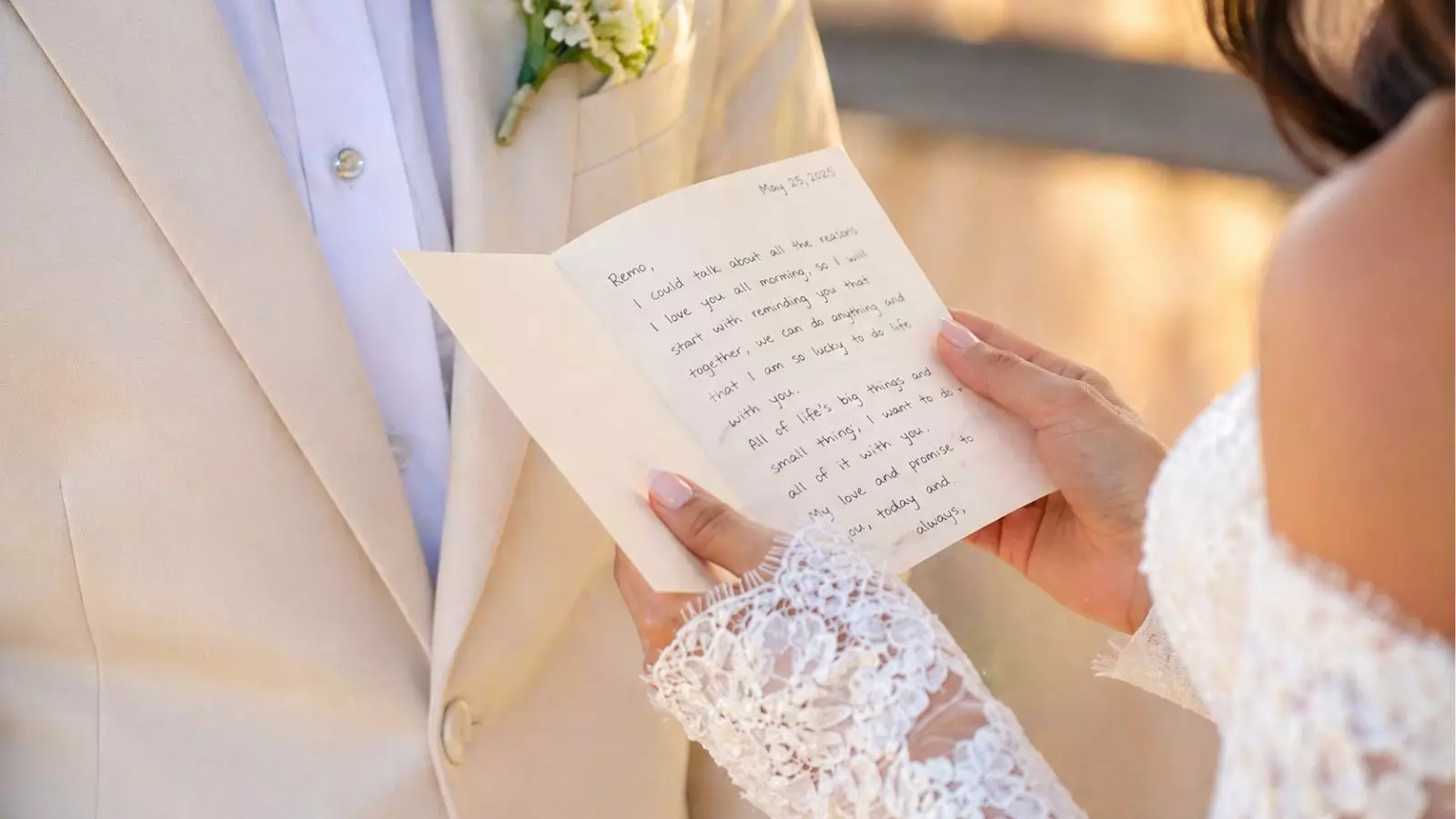
Part 1: The Opening (The Past)
You begin with a specific moment — one scene from your relationship that represents everything about why you are standing there. Not a general statement about when you met. A specific memory. A particular day. Something that was unmistakably yours.
This is the part that signals to your partner — and everyone watching — that these vows were written for one specific person, not borrowed from the internet. It takes about 2 to 4 sentences.
The strongest unique wedding vows are usually built around details and memories that could only belong to one relationship.
Part 2: The Story (The Person)
You move from that specific moment to describing who this person is to you right now. Not generic qualities like “kind” or “patient” — but the specific version of those qualities that exists in your relationship. The way they show up. The things only you have seen. The qualities they do not even know you have noticed.
This is usually the part that makes people cry — the partner hears themselves described in a way they did not expect. It takes about 3 to 5 sentences.
Part 3: The Promises
This is the actual vow. Three to five specific, forward-looking commitments that could only come from your relationship. Not “I will always be there for you” — but the concrete version of that in your specific life together. What does “being there” actually look like for you two?
If you are unsure what promises or ideas actually belong inside a vow, using a complete checklist for what to include in wedding vows can help organize your thoughts.
This section gives the vow its weight. Declarations of love are beautiful. Promises are what a vow technically is.
Part 4: The Close
One or two sentences that land. A callback to your opening, a declaration, or a forward-looking statement that makes the room hold its breath for a second. This is the line people will repeat afterward. Make it count.
Many couples spend the most time trying to figure out how to start and end wedding vows in a way that sounds natural instead of scripted.
The Complete Fill-In Wedding Vows Template
This is the core of this guide. Use it directly, or treat it as a scaffold you build from. Fill in every bracket with something specific to your relationship. The more specific, the better the vow.
✍️ Complete Wedding Vow Template — Fill In Every Bracket
PART 1 — THE OPENING
I remember [a specific moment — a day, a scene, a sentence you said or they said].
That was the moment I knew [what you realized — not “you were the one” but the specific thing you understood].
PART 2 — THE PERSON
You are the person who [something specific they do that shows you who they are].
What I love most — the thing I am not sure you even know I notice — is [a quiet, specific quality].
You have taught me [what being with them has changed or shown you].
PART 3 — THE PROMISES
I promise to [specific promise 1 — not generic, make it yours].
I promise to [specific promise 2].
I promise to [specific promise 3 — include “even when” to make it feel real].
I promise to [optional 4th promise].
PART 4 — THE CLOSE
Today, I choose you. [One final sentence — a declaration, a callback, or a forward-looking commitment that lands.]
Once you have filled this in, read it out loud. Time it. Cut anything that could have been written by someone else about someone else. What remains is your actual vow.
How to Write Each Part — The Real Method
Knowing the structure is half the battle. Knowing how to actually write each part is the other half. Here is the specific method for each section.
How to write the Opening
Do not start here when you sit down to write. Go to Part 2 first — figure out who this person is to you — then come back to the opening. The best openings are found, not invented.
Ask yourself: what is one moment that, if I described it to a stranger, they would understand immediately why I am marrying this person? Not your first date (unless something specific and real happened). Not “when I knew I was in love” as a general statement. A scene. A detail. Something you can describe in two sentences and have it feel like a photograph.
If you cannot think of one, try answering this: what is the first memory of them that comes to mind when you are somewhere and you suddenly miss them? That is usually the right one.
How to write the Person section
This is the hardest part to write and the most important. The failure mode is generic compliments. “You are kind, you are patient, you make me laugh” — these could describe anyone. The standard to aim for is: could this sentence have been written by someone else, about someone else? If yes, cut it.
Instead of “you are kind,” write the specific version of their kindness. How does it show up? When did you see it in a way you will never forget? Instead of “you make me laugh,” write the thing they do that makes you laugh even when you are angry, or the specific laugh you can pick out across a crowded room.
A useful prompt: What do you love about them that they probably don’t know you’ve noticed? Write that. That is the line that makes people cry.
How to write the Promises
Start with the generic promise, then replace it. Here is the method:
Write “I promise to always be there for you.” Then cross it out and ask: what does “being there” actually look like in our relationship? What is the specific version of that? Maybe it is: “I promise to be the person who picks up the phone, even when I am tired, because you have never once made me feel like a burden when I needed you.” That is a promise. That is a vow.
Write 6 to 8 promises in your first draft. Keep the 3 to 5 that are most real and most specific. Cut the rest.
How to write the Close
The close should feel like you just took a breath. Not a performance — a landing. The simplest closes are often the strongest: “I love you. I choose you. That is not changing.” Or a callback to the opening: if you opened with a specific memory, the close can return to it — “And every day I wake up beside you, I get to keep making the choice I made that day.”
Wedding Vow Template for Him — From Her
This wedding vow template for him is written from the bride’s perspective. The brackets guide you toward the most powerful content — replace every one with something specific to your relationship.
Reading complete wedding vows for him can also help brides understand emotional tone, pacing, and structure before writing their final version.
I remember [specific moment — a day or scene that changed things for you].
That was when I understood [what you realized about him or about yourself].
You are the person who [something specific he does — not a general quality, an action].
What I love most — the thing I doubt you know I notice — is [a quiet, real detail about him].
You have made me [what being loved by him has changed in you].
I promise to [specific promise 1 — something that reflects how you want to show up for him].
I promise to [specific promise 2 — something about your marriage specifically].
I promise to [specific promise 3 — include “even when” to make it unconditional].
I choose you. [Final line — make it yours.]
Filled-in example — from her to him
I remember the night you drove an hour in the wrong direction because I was crying on the phone and you did not want me to be alone. You did not make a big deal of it. You just came.
That was when I understood what kind of man you are.
You show up in the quiet ways — the ones no one ever sees. You check in after hard conversations. You remember the things I mention once and never bring up again. What I love most, and I am not sure you know this, is the way you look at me when you think I am not paying attention. Like you are still figuring out what you did to deserve this. You have no idea.
I promise to be your safe place — the person you never have to perform for. I promise to fight for us before I ever fight against you. I promise to love you on the hard days, not just the easy ones.
I choose you. Today and every day after this one. I am so glad you came.
Wedding Vow Template for Her — From Him
This template is written from the groom’s perspective. The same principle applies: replace every bracket with something real. The more specific, the more powerful.
Many grooms also read complete wedding vows for her examples before adapting the template into their own words.
I remember [specific moment or scene — when you first saw her clearly, not just beautifully].
That was the moment I knew [what you realized — be specific, not poetic].
You are the kind of person who [something specific about how she loves or shows up].
I notice [something quiet and real that she probably does not know you see].
Being loved by you has [what it has changed or taught you — be honest].
I promise to [promise 1 — something that reflects the husband you want to be].
I promise to [promise 2 — something specific to your relationship].
I promise to [promise 3 — make it unconditional with “even when”].
You are it for me. [Final line — land it.]
Filled-in example — from him to her
I remember the first time I watched you with your family — the way you made everyone in the room feel like the most important person there. You did it without thinking. That was when I knew this was different.
You carry more than most people see. You give more than you take. And the thing I notice — the thing I have never told you — is how hard you are on yourself in private, and how little of that you let anyone else see. I want to be the person who sees it. I want to be the person who helps carry it.
I promise to protect you — not from difficulty, but from ever facing it alone. I promise to listen before I react, even when that is hard. I promise to love you completely, including the parts you are still learning to love yourself.
You are it for me. I am proud to stand here and say that in front of everyone we love.
Short Wedding Vow Template — Under 90 Seconds
Short vows are not lesser vows. They are compressed vows — every sentence carrying full weight because there are very few of them. The short template removes Part 2 (the Person section) and tightens everything else to its essential core.
[One sentence — a specific truth about them or your relationship].
I promise to [promise 1].
I promise to [promise 2].
I promise to [promise 3].
[One closing line — the most important thing.]
Short vow — filled-in example
You are the person who made me believe that love is supposed to feel like coming home.
I promise to show up for you without being asked. I promise to choose us before I choose being right. I promise to love you — completely and on purpose — for the rest of my life.
You are it for me. That is not changing.
Long Wedding Vow Template — 2 to 3 Minutes
The long template is for couples who want more room — more story, more promises, more emotional depth. Be careful: longer is not automatically better. Every sentence in a long vow must still earn its place. The failure mode of long vows is padding — sentences that feel like content but carry no emotional weight.
If you are unsure whether your vows are becoming too long or too short, understanding how long wedding vows should be can help you find the right balance.
Opening (2–3 sentences):
I remember [specific moment 1].
And then [a second moment or detail that deepened it].
That was when I knew [what you understood].
The Person (4–6 sentences):
You are the kind of person who [specific quality — show it, don’t label it].
I have watched you [something specific you have observed].
What I love most — the thing you probably do not know I notice — is [quiet, real detail].
You have changed the way I [what their love has changed in you].
I did not know [something you did not know before them] until I met you.
The Promises (4–6):
I promise to [promise 1].
I promise to [promise 2].
I promise to [promise 3 — “even when” version].
I promise to [promise 4].
I promise to [promise 5 — something small and specific that matters in your relationship].
The Close (2 sentences):
[Callback to opening or final declaration].
[The most important thing — one sentence.]
Real Examples Applied to the Template
The following complete vow shows each template section working together. The annotations in brackets show which part you are reading — they would not appear in the actual vow.
[OPENING — specific moment]
The third time we got coffee, you ordered the same strange thing I had always thought only I liked. I did not say anything. But I went home that night and thought about it for an hour.[PERSON — specific qualities]
You are the person who checks in after hard conversations, not to revisit them, but just to make sure I am okay. You laugh the loudest in quiet rooms and somehow make that feel right. What I love most — the thing I have never told you — is how you get nervous before anything that matters to you, and how you do it anyway. Every single time.[PROMISES]
I promise to be the person who listens before they react — especially when everything in me wants to react. I promise to fight for us before I fight against you. I promise to celebrate your wins louder than anyone in the room. I promise to love you on the ordinary days, not just the ones worth photographing.[CLOSE]
Today I choose you. And I will keep choosing you — every single day — for the rest of my life.
How to Adapt a Template Without Sounding Generic
The most common failure when using a wedding vows template is leaving the generic parts in. People fill in a few brackets, feel good about the structure, and do not push hard enough on the specificity. The result is a vow that sounds like it could have been written by anyone — because parts of it were.
Reading realistic wedding vows examples can help couples understand the difference between generic language and vows that genuinely sound personal.
The test for every sentence
Before you finalize your vow, read each sentence and ask: could this have been written by a stranger, about a stranger? If the answer is yes — even slightly — replace it with the specific version.
The rule is not that every sentence must be hyper-personal. It is that no sentence should be able to move seamlessly into someone else’s vow. The difference between “you make me laugh” and “you do this thing with your face right before you make a joke where you try not to smile and completely fail” is not just detail — it is proof. Proof that these vows were written for one specific person.
How to make generic promises specific
| Generic Version | Specific Version |
|---|---|
| “I promise to always be there for you.” | “I promise to pick up the phone, even at midnight, even when I have work in the morning.” |
| “I promise to support your dreams.” | “I promise to be the person who reads your first drafts, even the bad ones, and finds something real to say.” |
| “I promise to love you in sickness and in health.” | “I promise to show up on the hard days — not with solutions, but with presence.” |
| “You are my best friend.” | “You are the person I want to call immediately after anything happens — good or bad — and that has been true since the first week I knew you.” |
| “I never knew love like this before.” | “Before you, I thought love was supposed to feel like a performance. You made it feel like exhaling.” |
How to Present Your Vows at the Altar
Writing great vows is half the equation. Delivering them well — with the right physical format, pacing, and presence — is what makes them land in the room. This section covers everything about the physical presentation of your vows that most guides skip entirely.
Couples planning a full ceremony often also review complete wedding vows script examples to understand pacing, officiant transitions, and vow placement.
Paper card vs. vow book vs. phone — what to use
- Paper card (recommended for most): A simple index card or folded cardstock with your vows written or printed in a font large enough to read under emotional stress. Easy to hold in one hand, easy to glance at without losing eye contact for long. Does not reflect light or require a screen to wake up. If your venue is outdoors, a card will not glare in sun the way a phone screen might.
- Vow book: A small, elegant booklet — sold at paper goods stores and on Etsy — that holds your vows in a format you can keep afterward as a keepsake. Photographs beautifully and feels ceremonial. Slightly more unwieldy to hold than a single card, but many couples love having the physical artifact. Coordinate with your partner ahead of time if you both plan to use one, so the photos look cohesive.
- Phone: Not recommended if avoidable. Screens can glare in outdoor light, require you to wake them if they dim, and read as casual in photos. If you use a phone, put it in airplane mode, keep it at maximum brightness, and test it at the venue beforehand. Some officiants strongly prefer couples not use phones during the ceremony — confirm in advance.
Memorized vs. read — what actually works
Memorizing your vows sounds ideal and reads terribly in execution about half the time. The combination of adrenaline, emotion, and the sight of your partner’s face makes the altar a very different environment than your bathroom mirror. Couples who memorize without a backup card frequently freeze, rush, or deliver flatly because they are focused on remembering rather than feeling.
The professional recommendation — from most officiants — is to know your vows well enough that reading feels natural, but always have the card. Glance at it to find your place, then look up to deliver each sentence. This produces the best combination of connection and accuracy.
Pacing — slower than you think
Emotion makes people speak faster. The instinct at the altar is to get through the vulnerability quickly and reach the safety of the other side. Resist this. Slow down by at least 30% from your practice pace. Let the silence between sentences exist — that space is where the emotion lives for the people watching. If you feel tears rising, take a breath, look slightly upward for a moment, and continue. The room will wait. They want to feel this with you.
Eye contact — the most important thing
The card is a tool, not the destination. Glance at it to find your line, then deliver it directly to your partner’s eyes. The moments of eye contact during vows are what photographs and memories are made of. Practice looking up from the card during your rehearsals at home — it needs to feel natural before it can look natural.
Common Mistakes When Using a Wedding Vows Template
Mistake 1: Not replacing the generic parts
The most universal error. A template gives you structure; it does not give you content. If you fill in the brackets with the first thing that comes to mind and do not push for specificity, you will end up with a vow that sounds like it was written from a template — because it was. Every bracket must be replaced with something real.
Mistake 2: Copying the example vow directly
The filled-in examples in this guide — and in every vow guide — are illustrations, not scripts to steal. Your partner’s family will notice if your vow describes a moment that did not happen. Write your own. Use the examples to understand the level of specificity to aim for, then produce that level of specificity about your actual relationship.
Mistake 3: Making promises you cannot keep
Vows written for emotional impact sometimes contain promises that are genuinely unsustainable. “I promise to always make you feel like the most important person in every room” — do you? Every room? A vow is a commitment you will be held to by yourself, by your partner, and implicitly by everyone who witnessed it. Write promises you intend to keep because they are true, not because they sound good.
Mistake 4: Not reading it out loud before the wedding
A vow that looks perfect on paper often sounds wrong spoken aloud. Sentences that are too long to say in one breath. Words that feel unnatural in your mouth. Pacing that runs too fast. You cannot discover these things silently. Read your vows out loud — at least ten times before the wedding. Time them. The version you read aloud at the altar should feel as natural as a conversation.
Mistake 5: Coordinating too much (or not at all)
You should not share the content of your vows with your partner before the ceremony — the surprise is part of what makes the moment. But you should coordinate on approximate length and general tone. If one partner delivers a three-minute heartfelt essay and the other gives four sentences, the contrast is jarring for everyone. Agree on the parameters. Keep the words private.
Final thoughts
A wedding vows template does not make your vows less personal. It gives your words a place to exist.
The structure is there so you do not have to think about what comes next. It removes the pressure of organizing everything perfectly and lets you focus on what actually matters — saying something real to the person in front of you.
In the end, no one remembers whether your vows followed a template. They remember whether they felt true. If what you wrote reflects your relationship, your voice, and your intention, then it is already exactly what it needs to be.
Frequently asked questions (FAQ)
What is a wedding vows template used for?
A wedding vows template is used to guide you through writing your vows step by step. It removes the pressure of starting from scratch by giving you a clear structure to follow, making the process easier and more organized.
Is it better to use a wedding vows template or write from scratch?
Using a template is usually more effective because it provides structure. Most people write better vows when they follow a framework and then personalize it with specific details instead of starting with a blank page.
How do you make a wedding vows template sound personal?
You make a template personal by replacing every generic phrase with something specific from your relationship. Real memories, small details, and honest promises are what transform a template into something meaningful.
How long should vows written from a template be?
Vows written from a template are typically between 150 and 280 words, which equals about one and a half to two minutes when spoken. This length keeps the vows meaningful without becoming too long.
Can both partners use the same wedding vows template?
Yes, both partners can use the same template structure. What matters is that each person fills it with different personal details, so the vows feel unique even if the format is similar.