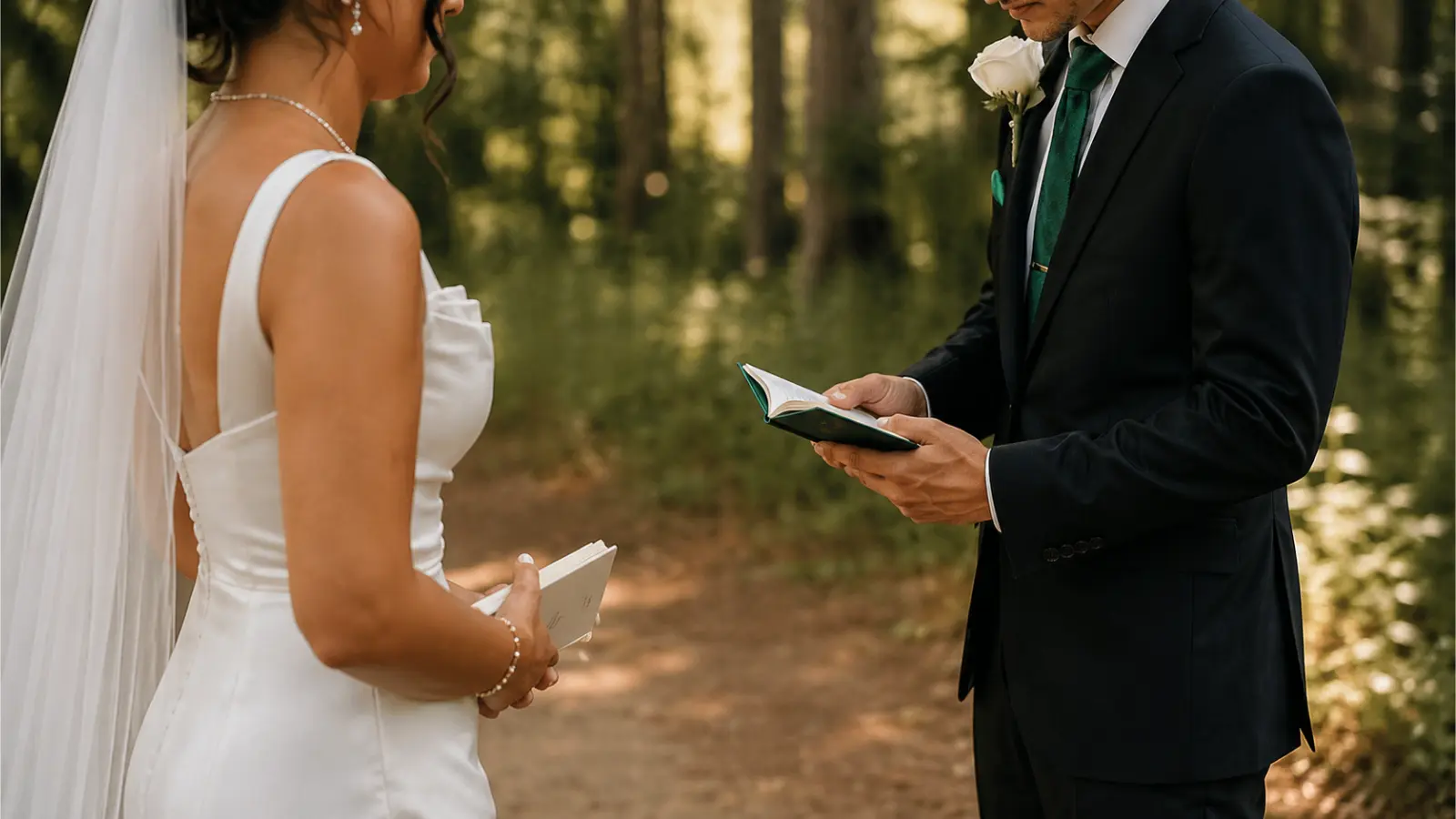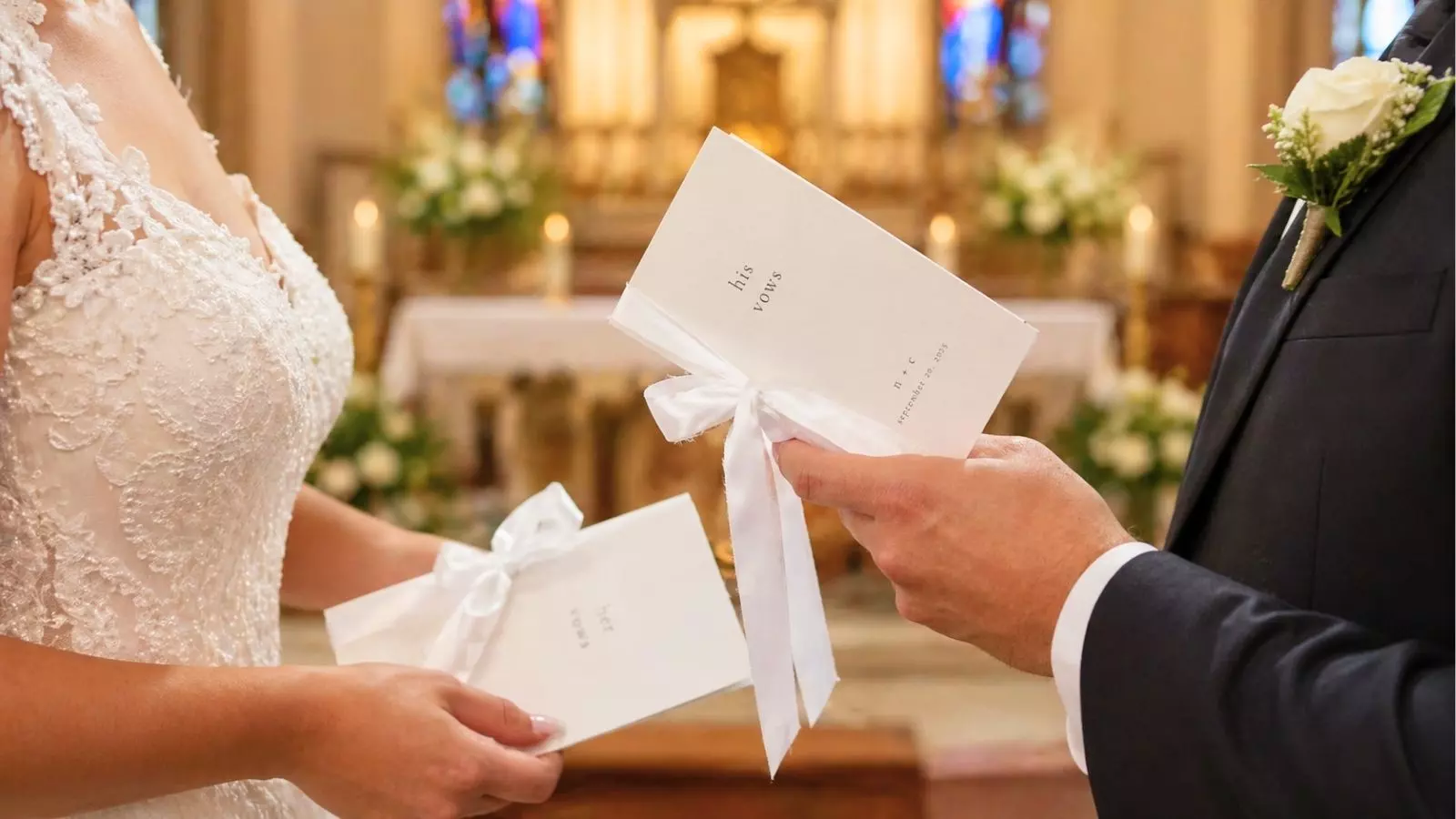
Who says wedding vows first depends on the ceremony, but traditionally, the groom goes first in most weddings. That is the order most people have seen, and it remains common in many ceremonies today.
At the same time, it is not a rule. Modern weddings — whether religious, non-religious, or fully personalized — often change the order without any issue, and in many cases, the decision comes down to what feels right for the couple rather than what tradition suggests.
Understanding where this tradition comes from, how the vow exchange actually works, and how it fits into a complete wedding vows guide makes the decision much easier, and what the emotional difference is between going first or second makes the decision much easier. This guide breaks down the traditional order, the most common modern variations, and how to choose what works best for your ceremony.
The Traditional Order — and Where It Comes From
The convention of the groom speaking first comes from the 1549 Book of Common Prayer, which is also central to where wedding vows come from historically, the foundational text of Anglican and many Protestant liturgical traditions. In the original ceremony order, the priest addresses the man first — “Wilt thou have this woman to thy wedded wife?” — and after the man’s response, turns to the woman with the same question. The man then recites his vow first, followed by the woman.
This order was not arbitrary. It reflected the theological and social structure of 16th-century marriage, in which the groom was understood to be the primary party making the covenant — the one extending the commitment, with the bride receiving and reciprocating it. That framing has shifted substantially in contemporary Christian theology and almost entirely in secular practice, but the order itself has persisted by inertia. Most officiants follow it simply because it is what they were taught through traditional wedding vows ceremony structures, not because it carries doctrinal weight.
In Catholic ceremonies, the priest typically addresses and elicits responses from the groom first as well, though this varies by diocese and celebrant. In Jewish ceremonies, the order depends on the tradition: in Orthodox practice, the groom places the ring and makes his declaration first; Reform and Conservative ceremonies vary.
How the Vow Exchange Actually Works
Understanding the mechanics of the vow exchange makes the order question easier to think about. There are two primary wedding vows script formats, and the order plays out slightly differently in each.
Format 1: The “I Do” / Question-and-Answer Form
The officiant asks each partner a version of: “Do you take [Name] to be your wedded spouse, to have and to hold, in sickness and in health…?” Each partner responds “I do” or “I will.” In this format, the officiant controls the order — they simply address one partner first, then the other. The groom is typically addressed first by convention.
Format 2: The Repeat-After-Me Form
The officiant prompts each partner to repeat the vow phrase by phrase. Again, one partner goes first while the other stands listening. In traditional ceremonies, this is the groom. The partner who goes second has the unusual experience of having heard their own vow spoken back to them before they say it — which some people find grounding and others find slightly deflating.
Format 3: Personal Vows (Prepared and Spoken)
In modern personalized ceremonies, especially non-religious wedding vows ceremonies, each partner has prepared their own vows using many of the same principles discussed in how to write wedding vows naturally and speaks them directly to the other — no prompting from the officiant. This is where the order question is most open. The officiant usually says something like “Please face each other and share your vows” and then nods to whoever is going first. Without a directive from the couple, most officiants default to the groom (or, in same-sex ceremonies, whichever partner was designated in the rehearsal).
Modern Variations
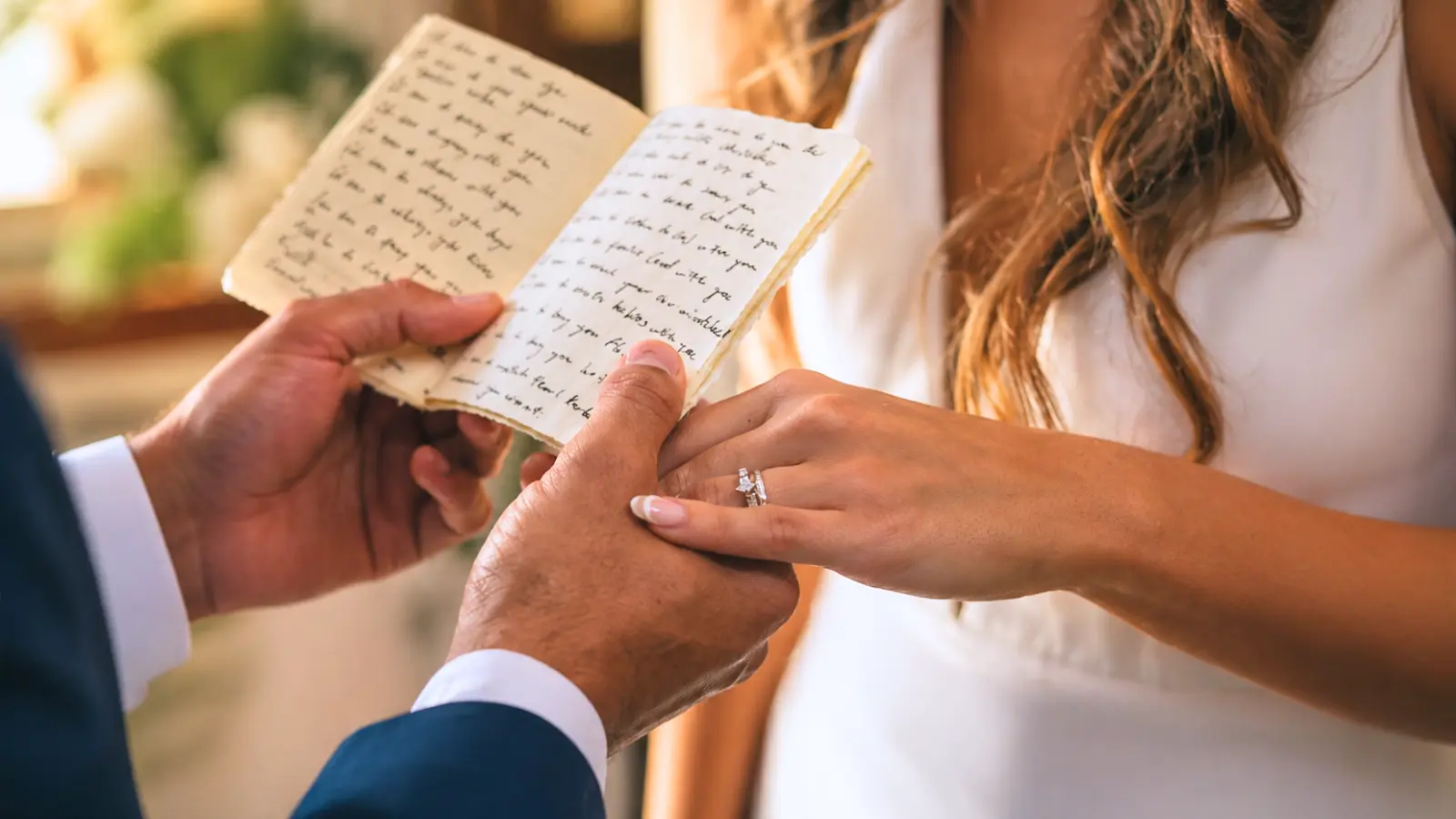
Contemporary ceremonies have loosened the traditional order considerably, and several alternatives have become common.
Bride first. Some couples prefer the bride to speak first, especially in ceremonies built around funny wedding vows or highly personalized exchanges — particularly if the groom is more naturally expressive or if the couple wants to subvert the traditional framing. There is nothing unusual about this choice; most guests will not notice unless they were specifically expecting the traditional order.
Simultaneous vows. A small but growing number of couples choose to speak their vows at the same time — face to face, voices overlapping. This is less common because it makes the content of each vow harder to follow, but it carries a symbolic weight that some couples find meaningful: neither goes first, neither goes second, both commit in the same moment.
Alternating lines. Some ceremonies structure the vow exchange as a call-and-response, with each partner alternating lines or promises. “I promise to love you faithfully” from one partner, then “I promise to love you faithfully” from the other, before moving to the next promise together. This keeps both voices active throughout the exchange rather than front-loading one partner’s commitment.
Whoever is more nervous goes second. This is the most practical modern approach and worth considering seriously. The partner who is more anxious about public speaking gets extra time to compose while their partner speaks. By the time it is their turn, the emotional atmosphere in the room is already established and the pressure has eased slightly. Many officiants quietly suggest this to couples at the rehearsal.
Same-Sex and Non-Binary Ceremonies
In same-sex weddings, there is no traditional default — neither partner is “the groom” in the conventional sense — so the order is entirely decided by the couple. Most same-sex couples either go alphabetically by first name, flip a coin, or simply ask themselves who wants to go first. The partner who is more expressive or more comfortable speaking publicly sometimes volunteers to go first to set the emotional tone. The partner who is more private or more nervous often prefers to go second.
For non-binary or gender-nonconforming partners, the question is the same: convention offers no guidance, so the decision is entirely personal. Some couples find this liberating — the absence of a default means the choice is genuinely theirs. Others find it adds a small logistical question to an already full planning process. Either way, it is a five-minute conversation with your officiant that resolves cleanly.
The Officiant’s Role in the Vow Exchange
Your officiant is the person who actually manages the moment — who cues each partner, sets the pace, and ensures the exchange flows naturally. Their role in the vow order is more significant than most couples realize.
A good officiant will discuss vow order with you during your ceremony planning meeting or rehearsal. They will confirm who goes first, whether vows are personal or scripted, whether they are prompting or the couple is speaking independently, and what the cue looks like. “I’ll nod to you, [Name], when it is your turn” is a small thing that prevents a disorienting pause in front of everyone you know.
If your officiant has not raised the question of vow order, raise it yourself — ideally at the rehearsal, not on the wedding day. It takes two minutes to settle and eliminates one potential awkward moment during the ceremony.
The Emotional Impact of Going First vs. Second
Most couples give vow order no thought and suffer no consequences. For some, though, the emotional logic of the order is worth considering.
Going first means speaking into silence — your partner has not yet said their words, the emotional temperature of the room is still building, and you are the one setting the tone. Some people find this energizing: you are not reacting, you are initiating. Others find it exposing, particularly if they are more private or prone to tears, because there is no warmth in the room yet to lean into.
Going second means receiving your partner’s vow before you speak your own. You have just heard them commit to you — which is, in most cases, the most emotionally intense moment in the ceremony. Then you are asked to speak. Some people find this grounding: the love in the room is already palpable and they feel held by it. Others find it nearly impossible — they are still processing their partner’s words and their own composure is at its lowest point exactly when they need to perform.
Neither position is easier for everyone. Know yourself. If you cry easily and recover slowly, going first — before your partner’s vow breaks you open — may be kinder to you. If you are a nervous speaker who steadies once the emotional atmosphere is established, going second may be better.
How to Choose Your Order
If your ceremony has a prescribed order — Catholic, Orthodox Jewish, or a denomination with a set liturgy — the order is already decided and the question does not apply. Follow the form.
If your ceremony is flexible, here is a simple framework for the conversation with your partner:
Who is more nervous about speaking publicly? That person probably goes second — they get the benefit of the room already being warm and emotionally open when their turn arrives.
Who cries more easily? If one partner is certain to cry and the other is steadier, consider having the steadier partner go first. Their composed delivery raises the emotional bar; the more expressive partner’s tears, when they come, feel earned rather than premature.
Is there a symbolic reason to choose one order over the other? Some couples have a meaningful reason — one partner did not expect to be loved the way they have been and wants to go second so they can respond to what they have just heard. Some couples want the partner who proposed to go first, continuing the gesture of initiation. These are valid and real reasons. Follow them if they resonate.
If there is no reason either way: default to tradition (groom first, or whoever was designated at the rehearsal) and put your energy into what you are going to say rather than when. The order will matter to no one in the room as much as the words do.
Final thoughts
The order of wedding vows is one of the smallest decisions you will make in your ceremony, but for some couples, it carries more meaning than expected.
Going first or second does not change what is being promised, but it can change how the moment feels — whether you are setting the tone or responding to it, whether you are speaking into silence or into something that has already been created.
In the end, there is no right order beyond the one that feels natural to both of you. Once that decision is made, it quickly fades into the background, and what remains is what actually matters — the words themselves.
Frequently asked questions (FAQ)
Who usually says wedding vows first?
Traditionally, the groom says his vows first. This order comes from historical ceremony structures, but in modern weddings, couples often choose whichever order feels most comfortable.
Does it matter who says wedding vows first?
For most couples, it does not matter. The emotional impact comes from the vows themselves, not the order. The only important factor is that both partners know the sequence in advance.
Can the bride say her vows first?
Yes, the bride can absolutely say her vows first. There is no rule requiring the traditional order, and many modern ceremonies choose the sequence based on preference.
Who should go first if one partner is nervous?
The more confident speaker should usually go first. This helps create a relaxed atmosphere, making it easier for the more nervous partner to speak second.
Do same-sex couples follow a specific vow order?
No, same-sex couples do not follow a traditional order. The sequence is completely flexible and usually based on personal preference or what feels most natural for the couple.