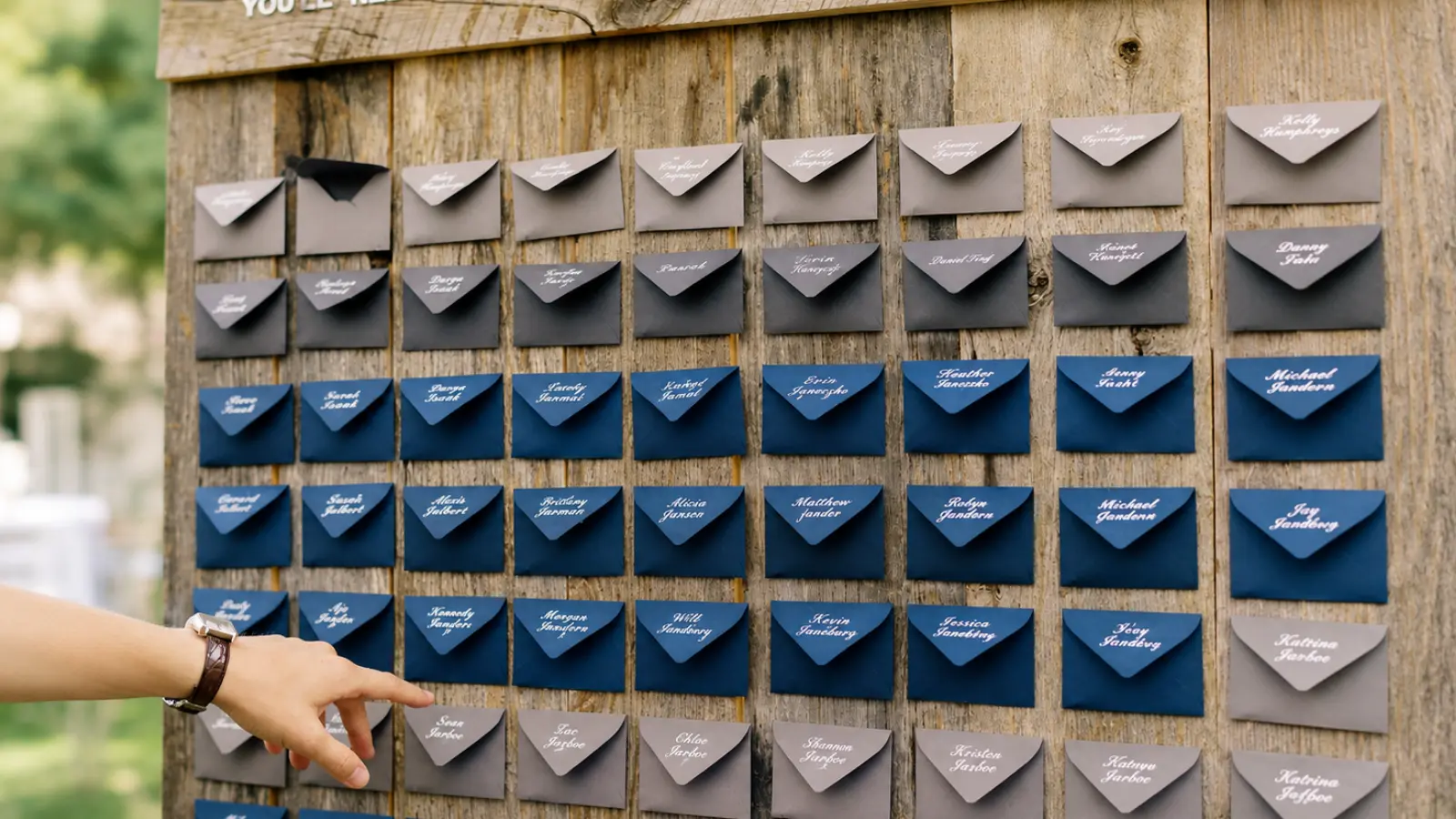
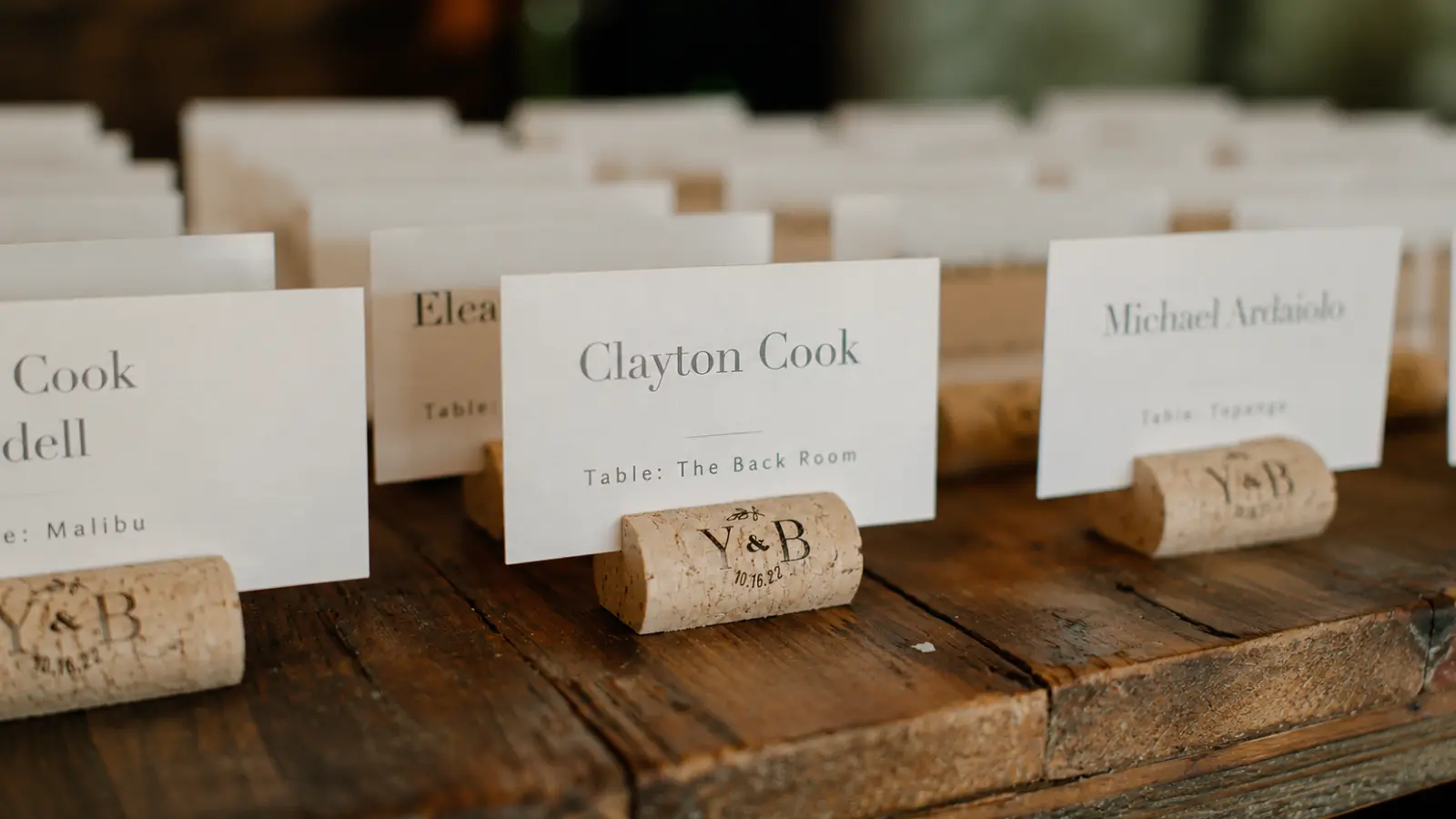
Escort Cards vs Place Cards can be confusing because both use guest names, but they do completely different jobs. An escort card tells a guest which table to go to, while a place card identifies the exact seat they should use once they arrive there. A seating chart handles table assignments differently by displaying many guests and table numbers in one shared location.
The right system depends on how precise your seating plan is. If you are assigning tables only, a seating chart or escort cards may be enough. If every guest has an assigned chair, place cards add the final step from table assignment to exact seat.
This guide compares Escort Cards vs Place Cards vs seating charts, including when each one is needed, how they work with assigned tables and assigned seats, where meal indicators fit, and when combining systems makes the guest experience clearer rather than more complicated.
The Three Terms in One Minute
The easiest way to understand the terminology is to ask one question: What does this item tell the guest?
A seating chart gives table assignments in one shared display. An escort card gives one guest or household a table assignment. A place card sits at the table and identifies a specific seat.
Because these items can all contain a guest name and table number, the terms are often used interchangeably even when the functions are different.
The function matters more than the format.
Escort Cards, Place Cards, and Seating Charts Compared
The table below shows what each item communicates, where the guest encounters it, and when it is actually needed.
| Item | Tells Guest | Location | Needed When |
|---|---|---|---|
| Seating Chart | Which table to find | Reception entrance or transition area | Tables are assigned |
| Escort Card | Which table to find | Picked up before entering seating area | Tables are assigned and individual cards are preferred |
| Place Card | Which exact seat to use | At the assigned place setting | Individual seats are assigned |
If two items communicate the same information, you may not need both. The most useful system is the one that reduces guest uncertainty without adding duplicate steps.
If You Are Assigning Tables Only
If guests are assigned to tables but choose their own chair, you usually need either a seating chart or escort cards.
A seating chart keeps all assignments in one place. Guests find their names, note the table number, and walk directly to that table.
Escort cards perform the same table-assignment job but as individual pieces. Each guest or household locates and takes the card that carries their table number.
You generally do not need place cards when seats within the table are open.
If You Are Assigning Individual Seats
If every guest has a specific chair, a table assignment alone is not enough.
You still need a way to get the guest to the correct table, such as a seating chart or escort card. Then place cards at the table identify the exact seat.
This two-step system separates navigation from final placement: first “go to Table 8,” then “this is your chair.”
Assigned seats make the role of place cards much clearer because the place card is no longer decorative; it completes the seating instruction.
Where Meal Indicators Belong
Meal indicators belong wherever the catering team can use them reliably without confusing the guest-facing seating system.
If individual meal choices need to be visible at service, the place card is often the most logical location because it stays at the guest’s actual seat. An escort card may also carry meal information when the event workflow requires it, but that card can move once the guest picks it up.
The exact setup depends on how the caterer or venue wants meal information presented, so confirm their preferred service method before finalizing the cards.
Do not let the meal marker interfere with the primary job of telling guests where to go.
When to Combine Systems
Combining systems makes sense when each item handles a different step.
Examples include:
- Seating chart + place cards: the chart directs guests to the table; place cards assign individual seats.
- Escort cards + place cards: guests pick up their table assignment, then find a labeled seat at that table.
- Seating chart only: enough when tables are assigned and seats are open.
- Escort cards only: enough when table assignments are individual but exact seats are not assigned.
The cleanest combination is the one where each layer adds new information instead of repeating the same instruction twice.
How an Escort Card Display Functions
An escort card display is a pickup system, not simply a decorative installation.
Guests need to locate their own card quickly, read the table number, and take the card without disrupting the order for everyone else. Alphabetical organization is often the clearest approach when there are many names.
Because the cards are removable, the display can also make it visually obvious which guests have already passed through the area.
This article does not cover the styling of the display; the priority here is lookup speed and accurate table assignment.
Household vs. Individual Names
Escort-card systems also need one practical decision: whether one card represents a household or each person receives an individual card.
A household card can work when everyone in the household shares the same table assignment and no person-level meal or seating instruction needs to travel with the card. Individual cards are cleaner when guests in the same household have different table assignments, meal indicators, or other person-specific information.
Place cards are inherently individual because they identify one exact seat. A seating chart can list guests individually or by household as long as the structure stays consistent and nobody has to guess who is included.
The naming structure should follow the information each guest actually needs — a useful filter to keep in mind when browsing seating card ideas for wedding stationery, since the prettiest option is not always the clearest one.
Common Terminology Mistakes
The most common mistake is calling any named card a “place card.”
If the card is picked up at the entrance and tells the guest to go to Table 12, it is functioning as an escort card. If the card is already waiting at one chair at Table 12, it is functioning as a place card.
Likewise, a large board listing names and table numbers is a seating chart, even if the design resembles individual seating cards wedding inspiration.
Once you classify the item by its job, the terminology becomes much easier.
Give Every Seating Tool One Clear Job
Escort Cards vs Place Cards becomes much easier to understand when each item is defined by the information it gives the guest. A seating chart directs many guests to their tables from one display, an escort card gives an individual guest or household a table assignment, and a place card identifies one exact seat.
Use the fewest layers necessary for the seating plan you actually have. Assigned tables usually need one table-navigation system; assigned seats need that first step plus a place card at the table. When every piece communicates something new instead of repeating the same instruction, guests can move from arrival to their seats without confusion.
Frequently asked questions (FAQ)
Should you use escort cards, place cards, or a seating chart?
Use a seating chart or escort cards when guests only need to know which table to join. Use place cards when each guest has a specific seat. If you assign exact seats, combine a seating chart or escort cards for table navigation with place cards at the table. Avoid using multiple systems that repeat the same information without serving a separate purpose.
What is the difference between escort cards and place cards?
An escort card tells a guest which table to go to and is usually picked up before entering the seating area. A place card is already positioned at the table and identifies the guest’s exact seat. The distinction is based on what the card tells the guest, not simply what the card looks like.
Do you need escort cards if you already have a seating chart?
Usually not if both provide only the same table assignment. A seating chart lets guests find their table from one shared display, while escort cards provide that information individually. Use both only when the escort card serves another operational purpose that the seating chart does not.
Do you need place cards if guests only have assigned tables?
No. If guests are assigned to a table but can choose any available chair at that table, a seating chart or escort card is generally enough. Place cards become necessary when you want to assign individual seats or need person-specific information to remain at each place setting.
Can meal choices go on escort cards?
They can, but the correct location depends on how the catering team plans to identify meals during service. If the indicator needs to remain with the guest’s exact seat, a place card may be more reliable. Confirm the service workflow with the caterer before choosing where meal information will appear.
Can you use a seating chart and place cards together?
Yes. This is a practical combination when individual seats are assigned. The seating chart directs each guest to the correct table, while the place card identifies the exact chair once they arrive. Each item performs a different step, so the system adds clarity rather than duplicating information.

About the Author
Débora Justo
Founder and editor of EVORÉ, creating practical wedding planning resources, thoughtful inspiration and useful tools for the decisions that shape a celebration.
Read more about the author →