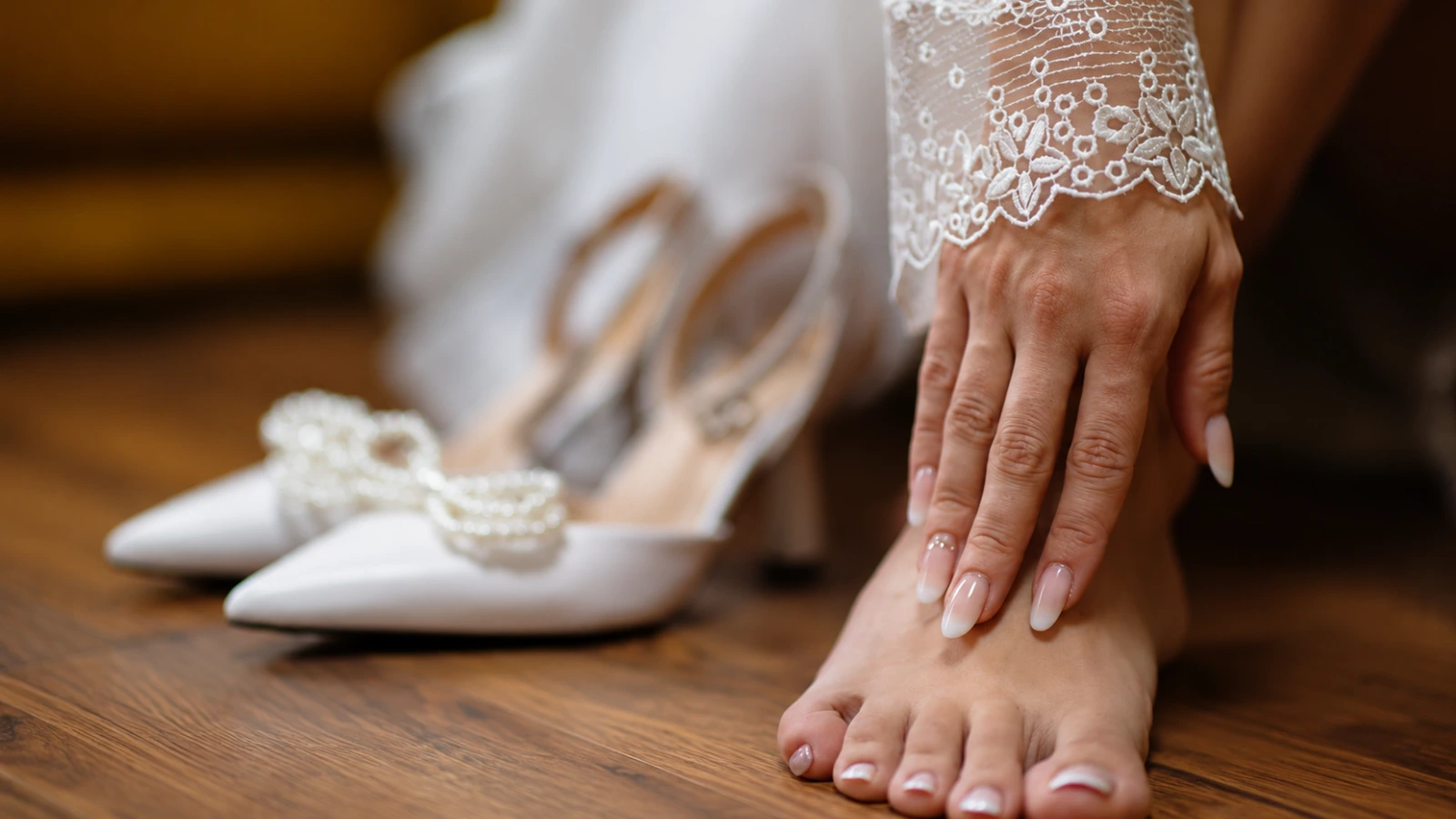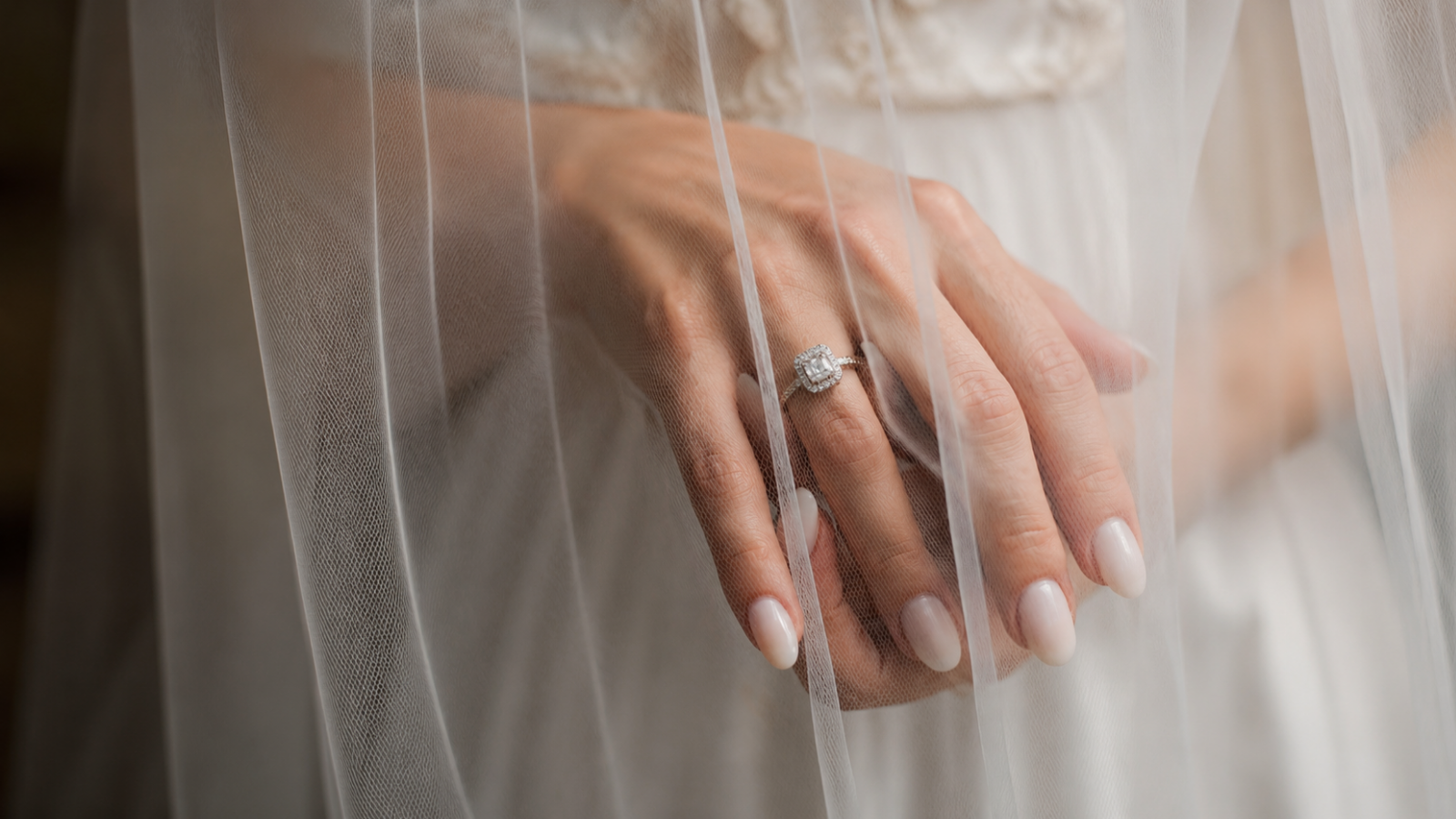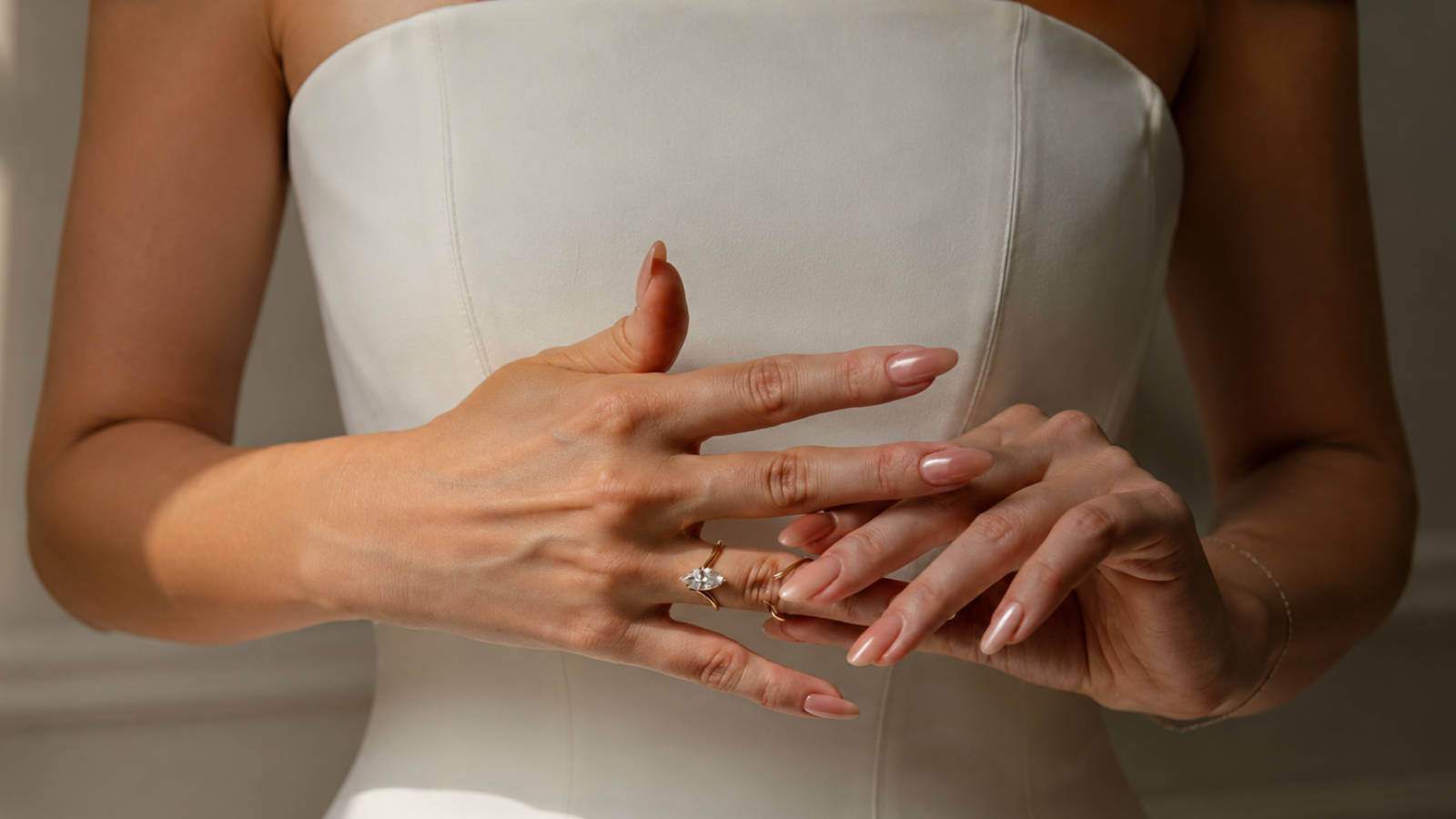
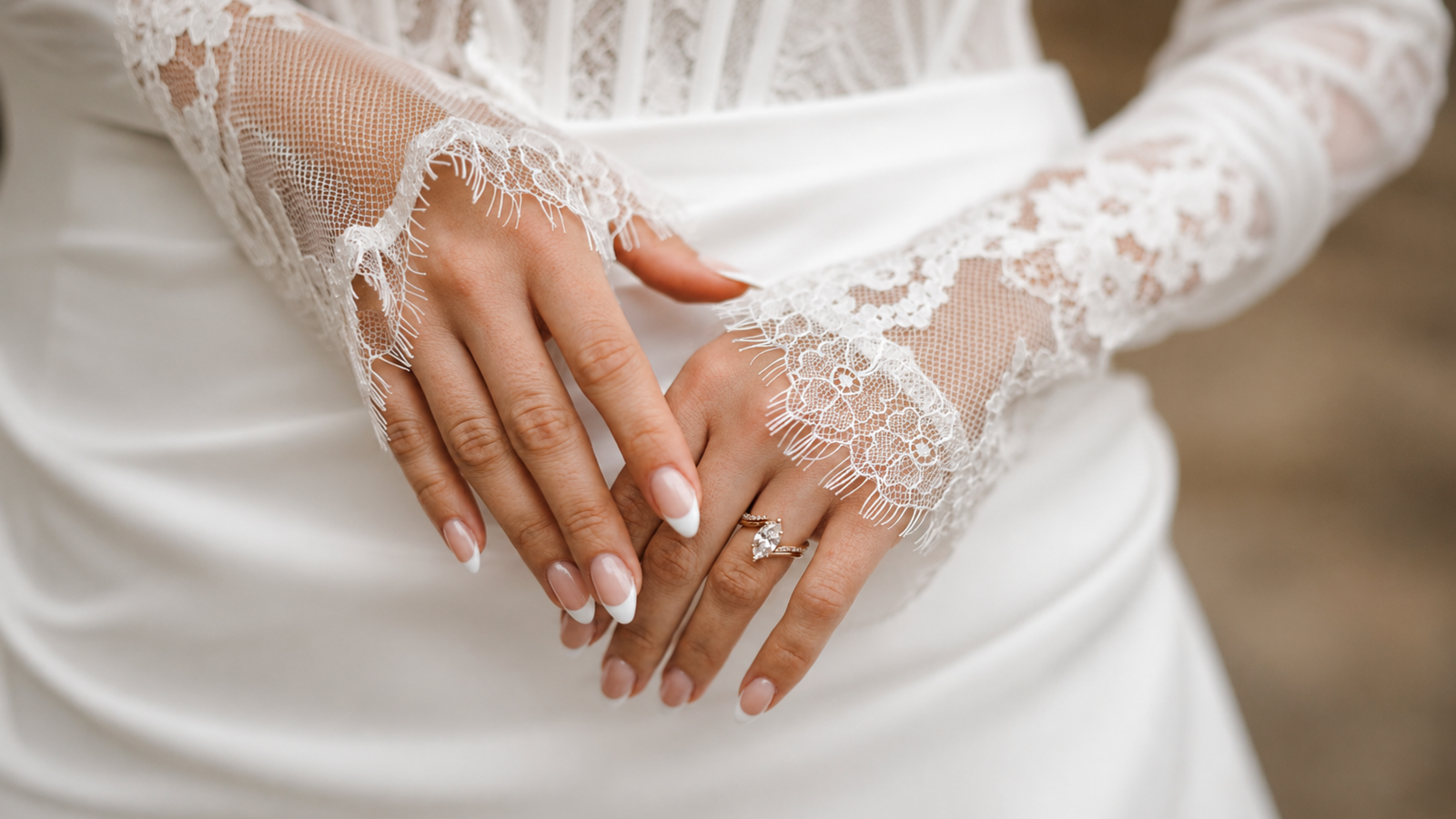
French tip wedding nails remain one of the most timeless bridal nail choices because they do exactly what a wedding manicure should do: look polished in close-up photos without competing with the ring, the dress, or the moment itself.
French tip wedding nails are bridal manicures with a nude, pink, sheer, or milky base and a defined or softly blended tip, designed to look elegant, refined, and timeless in wedding photography. A clean nude base with a delicate white tip can complement almost every dress style, soften the hands in ring shots, and still feel beautiful years later when more trend-driven bridal beauty choices may already look dated.
This guide covers the best French tip wedding nails for brides, including micro French nails, milky French styles, French ombré nails, pearl and chrome finishes, almond French tips, short wedding nails, and modern French manicure variations that feel refined instead of dated.
Classic French Tip Wedding Nails
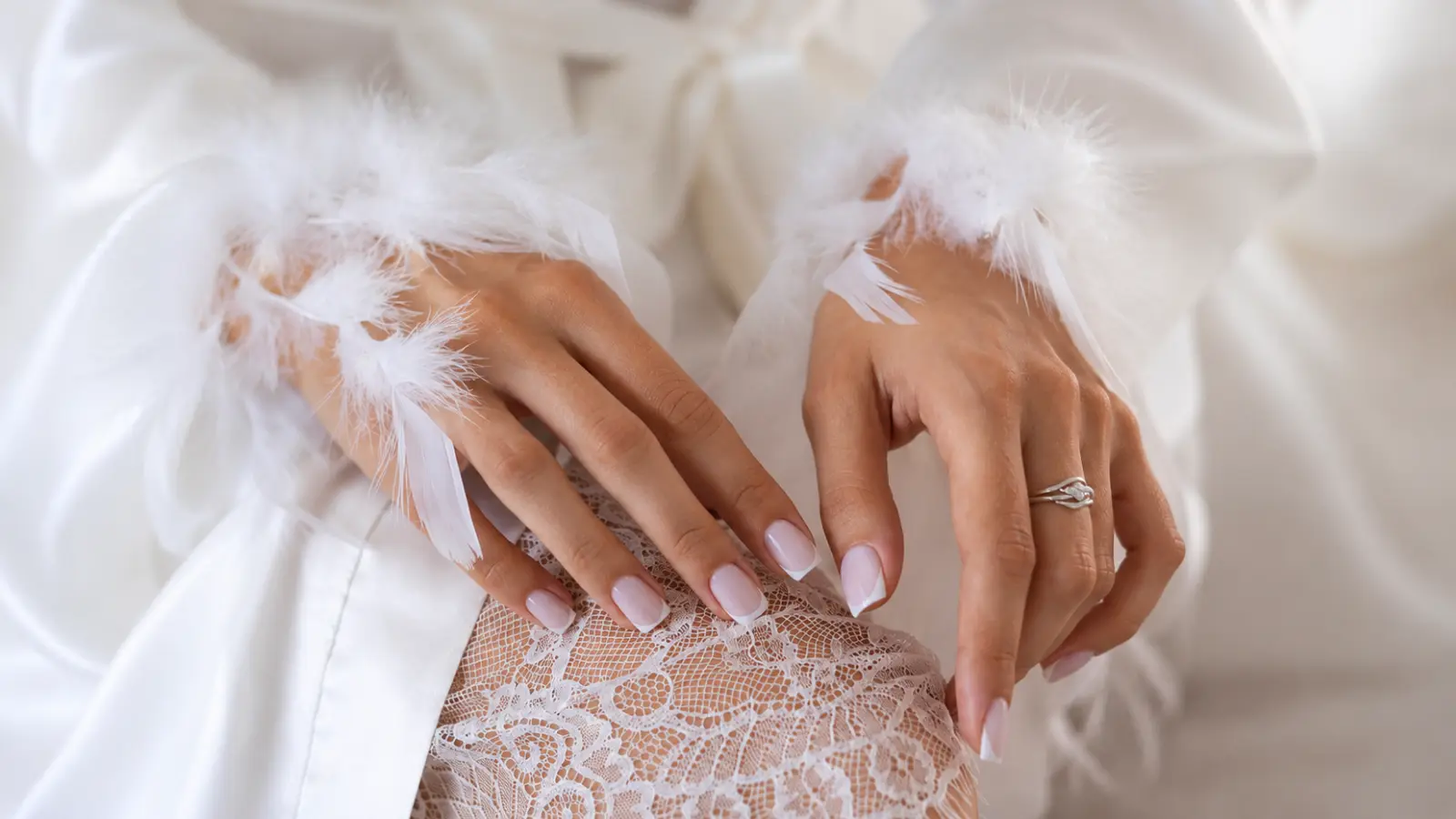
The classic French manicure — a nude or pale pink base with a precisely defined white tip — has been one of the most timeless wedding nails at American salons for longer than most current brides have been alive. That longevity is not nostalgia. It is because the design solves the core problem of wedding nails with unusual efficiency: it is polished enough to look intentional, neutral enough to disappear into the overall look without demanding attention, and clean enough to photograph at any magnification without looking busy.
The traditional version uses a nude or sheer pink as the base and a semi-opaque white applied in a clean arc following the tip of the nail. The arc width — typically 3 to 5 millimeters — is what defines the look as “classic” rather than one of its modern variations. At its best, a classic French tip is immaculate: every arc precisely the same width, every cuticle pushed back cleanly, the base color matching the exact undertone of the skin so the nail appears to extend the finger rather than sit on top of it.
Where classic French tips lose brides today is in the execution rather than the concept. A thick, flat white arc with a sharp defined edge can look dated in photographs compared to the softer, more nuanced versions now available. If you want a classic French for your wedding, the difference between one that looks timeless and one that looks dated is almost entirely in the tip width and the white formula. Ask for a slightly thinner arc than you think you want, and choose a white with a subtle cream or shimmer quality rather than a stark opaque.
| Classic French Variation | Tip Width | Best For |
|---|---|---|
| Traditional thick French | 4–6mm | Formal weddings, classic aesthetic; nail should be medium-long to carry the proportion |
| Refined classic French | 3–4mm | The most versatile and timeless version; works on any length or shape |
| Micro French | 1–2mm | Modern, contemporary aesthetic; best on shorter nails or almond/oval shapes |
| Milky French | Blended / no defined edge | Romantic, soft; works on all lengths; photographs with a luminous quality |
Modern French Wedding Nails
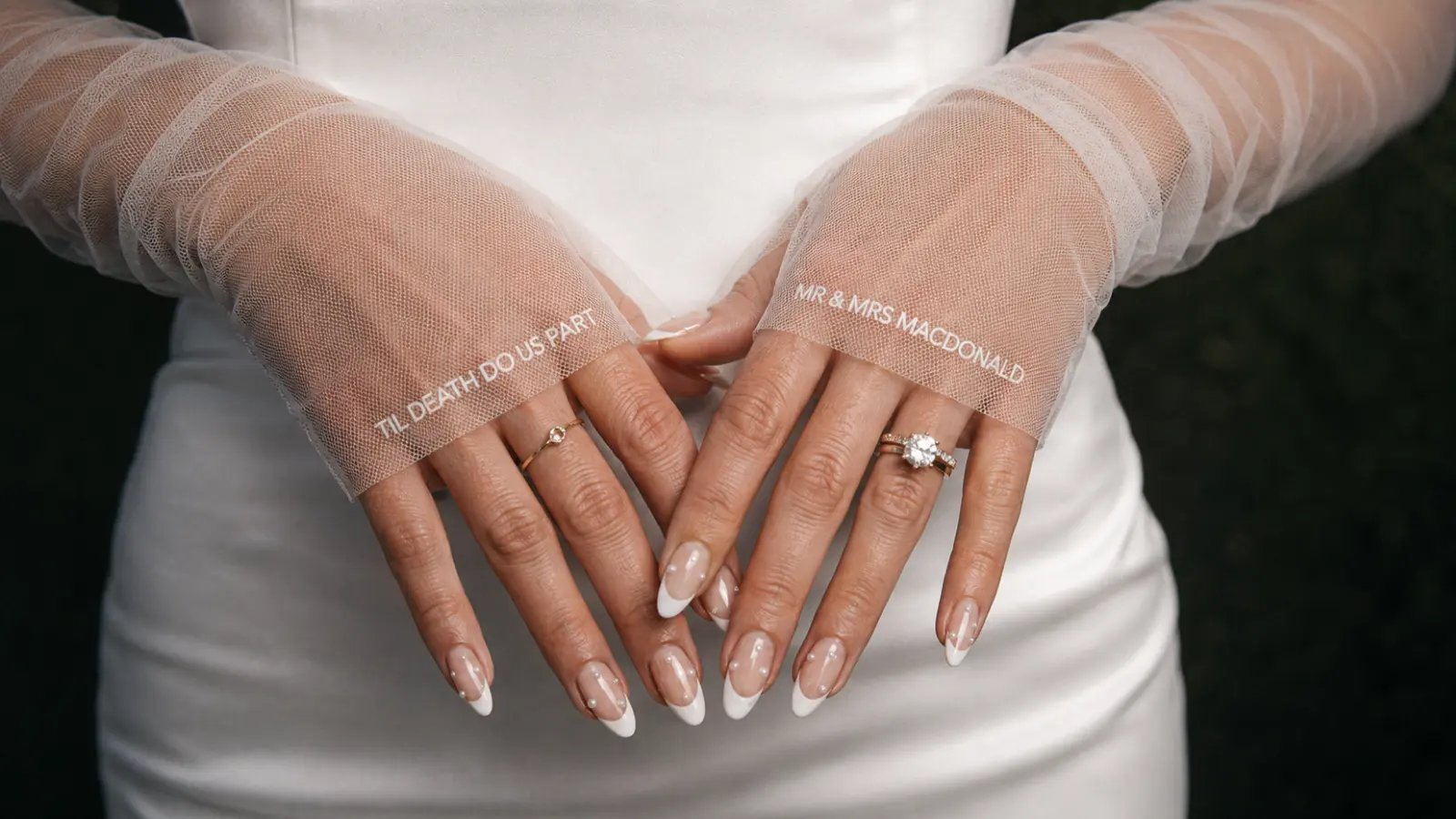
Modern French wedding nails are still unmistakably French in concept — there is a lighter base and a defined or gradient tip — but they have moved considerably from the specific execution of the 1990s original. What separates a modern French from a classic one is usually one or more of these factors: a softer transition at the tip, a more luminous or textured white, a more delicate tip width, or the addition of a subtle finish (pearl, chrome, shimmer) that gives the nail dimensionality a flat French tip cannot achieve.
Many couples do not realize how different two French manicures can look from each other until they sit down with a nail technician and look at reference images side by side. A thick arc in stark opaque white reads as a completely different design from a barely-there micro line in a creamy white shimmer — even though both are technically “a French tip.” Knowing which version you want before the appointment is the single most useful thing you can do to get results you are happy with.
Choosing the design early also makes it easier to plan when to get your nails done before the wedding so your final manicure looks fresh on the day.
The modern French variations worth knowing
- Micro French: A hair-thin line of white — often 1 to 2mm — along the nail’s edge. Reads as barely-there detail in person; shows up beautifully in close-up ring photography. One of the most contemporary versions of the French tip and a popular choice at current U.S. bridal appointments.
- Milky French: A translucent, creamy white base with a slightly more opaque tip — the two blend into each other rather than creating a sharp line. Luminous and soft. More romantic than a traditional French and more interesting than a plain sheer.
- French ombré (baby boomer): A gradient from nude or pink at the base to white at the tip, with no line at all — the transition is seamless. One of the most popular wedding nail styles at American salons.
- Pearl French: A classic or micro French with an iridescent pearl or chrome overlay on the tip, the base, or the full nail. The pearl quality adds dimension and luminosity that photographs particularly well in ring shots.
- Color-tipped French: The white tip replaced by a soft color — blush pink, dusty lavender, the palest gold — over a nude base. Reads as elevated and editorial rather than traditional. Works best at modern, non-traditional ceremonies.
- Gold-line French: A classic French with a thin gold line applied at the boundary between tip and base. One of the subtlest ways to add a metallic element to a French manicure without making it look embellished.
Micro French Wedding Nails
Micro French is the version of the French manicure that most consistently surprises brides who see it in person for the first time. The tip is so thin — often just a sliver of white at the very edge of the nail — that it barely reads as a French at all in casual lighting. In close-up photography, it becomes visible as a precise, intentional detail that gives the nail an elegance a plain nude cannot achieve.
The technique requires more precision than a traditional French, not less. Because the line is so narrow, any wobble or unevenness is immediately visible. A nail technician who regularly does bridal work will often prefer micro French for this reason — it photographs with a clean, refined quality that is difficult to replicate with a thicker arc. If you are booking a micro French for your wedding, show your technician reference images and ask specifically whether they are comfortable with the narrow line. Not every technician executes micro French with the same consistency.
Why micro French photographs so well at weddings
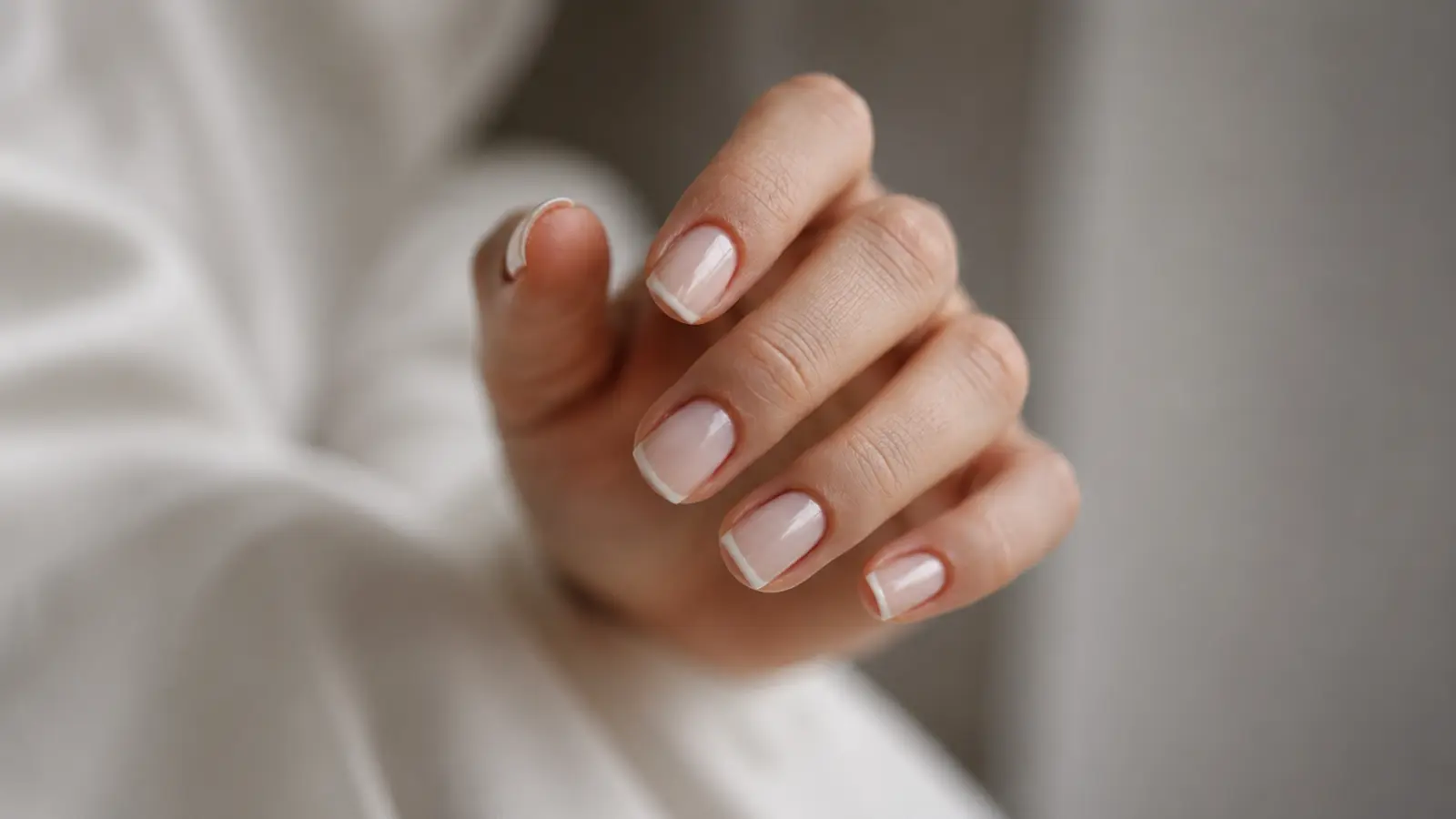
In a ring shot, the camera is typically 12 to 18 inches from the hand, focused on the engagement ring with the nail as a secondary element in the frame. A thick French tip at that distance competes visually with the ring — the eye moves between the white arc and the diamond without settling. A micro French sits quietly in the background, adding a clean finish that says “this nail was intentionally done” without saying anything else. The ring gets the full attention, and the nail serves as a polished frame.
That supporting role is exactly what most bridal nail choices should be doing. A micro French executes it better than almost any other design.
Milky French Nails
Milky French and white wedding nails have had a significant cultural moment in the past two years, accelerated by the glazed donut nail trend and the broader shift toward luminous, soft nail finishes in bridal design. The milky French is not a traditional French with a different color — it is a fundamentally different approach to the French concept.
In a traditional French, there is a clear distinction between base and tip: one color stops and another begins. In a milky French, both the base and the tip are versions of the same creamy, translucent white. The base is sheer and luminous, slightly translucent like a frosted glass quality. The tip is the same color but more opaque, creating a gradient rather than a line. The result photographs with a softness and glow that is specific to this finish — it catches light in a way that reads as luminous rather than white.
Several things make milky French particularly effective for weddings. It works on short nails without looking proportionally heavy. It complements both ivory and white dresses without competing. It is flattering on a wide range of skin tones because the translucency means the nail’s actual appearance shifts slightly based on the skin beneath. And it has a contemporary feel without being trendy in a way that will date in wedding photographs.
French Ombré Wedding Nails (Baby Boomer)
The French ombré — one of the most popular ombré wedding nails styles — is the version of French tip nails that has most comprehensively replaced the traditional version at American bridal salons over the past decade. The sponge-blended gradient from nude or pink at the base to white at the tip eliminates the sharp line that makes classic French nails look dated, replacing it with a seamless fade that photographs with a softness no other French variation achieves.
Executing a baby boomer well requires a specific sponging technique that not every nail technician has practiced consistently. Unlike a micro French (where precision is the skill) or a milky French (where the formula does most of the work), the ombré French requires repeated, controlled sponge application to create a gradient that looks seamless rather than streaky. Ask to see the technician’s previous ombré work before booking if this is your chosen style — the quality range is wider than almost any other French variation.
Baby boomer variations worth knowing
- Classic baby boomer: Nude pink to white gradient, the transition happening in the top third of the nail. The most natural-looking version; works on any length.
- Milky baby boomer: Both base and tip are versions of creamy white rather than nude-to-white. The effect is cloudlike and luminous. Very popular for brides who want a specifically soft, romantic finish.
- Pink baby boomer: A soft pink base — slightly more saturated than nude — to a white tip. More visible and romantic than the nude version; works particularly well for warm skin tones.
- Peach or blush ombré: A peachy or blush base with a white tip. Less frequently seen than traditional baby boomer but extremely flattering; works well in natural light photography.
French Tips for Short Wedding Nails
Many couples assume French tips only look good on longer nails — that short nails cannot carry the design. This is almost entirely wrong, and the misunderstanding comes from imagining the thick traditional French tip on a short nail, which does look proportionally heavy. A micro French or baby boomer ombré on well-shaped short wedding nails is one of the most elegant bridal nail choices available.
The key is proportionality. The tip width and the nail length should relate — a thin micro line on a short nail creates a clean, refined finish without visual weight. The shape matters equally: round and oval shapes on short nails look soft and sophisticated, allowing the French tip to follow the nail’s natural curve cleanly rather than creating a harsh line across a squared edge.
What works and what does not on short French nails
| French Style | Works on Short Nails? | Notes |
|---|---|---|
| Micro French | ✓ Excellent | Best choice for short nails — proportionally perfect |
| Baby boomer ombré | ✓ Excellent | The seamless gradient is particularly flattering at shorter lengths |
| Milky French | ✓ Very good | Soft and luminous regardless of length |
| Refined classic French (3–4mm) | ✓ Good | Works on oval shape; avoid square edges |
| Traditional thick French (5mm+) | ✗ Avoid | Looks disproportionate; tip visually overwhelms the nail |
| Stiletto/dramatic shape French | ✗ Avoid | Extreme shapes on short nails read as nail extensions at an early stage |
One advantage of short French nails in wedding photography that most brides do not consider: shorter nails let the ring take center stage in ring shots without visual competition. A bare, perfectly shaped short nail with a micro French tip is often more striking in ring photography than a long, elaborate nail — because the eye goes directly to the diamond without detours.
Pearl and Chrome French Nails
Pearl and chrome finishes applied to a French manicure are where modern bridal nail design is most specifically current. Both finishes work by adding a reflective or iridescent quality to the nail that flat gel cannot replicate — and in the context of a French tip, they do that without abandoning the fundamental elegance that makes French nails the perennial bridal choice.
Pearl French nails
A pearl overlay on a French manicure can be applied to the tip, the base, or the full nail. The most popular version for weddings applies a subtle pearl or iridescent chrome powder over the entire nail on top of a sheer or milky French base, creating a luminosity that the eye reads as dimensional rather than simply shiny. The pearl quality means the nail looks different from each angle — in natural light, in flash photography, in candlelight — which gives wedding photographs a dynamism that flat color cannot achieve.
Pearl French nails are particularly effective for brides who want something more interesting than a plain nude or white but do not want embellishments or art. The pearl quality is the detail — it is visible on close inspection and in photographs, but it does not announce itself from across the room.
Chrome French nails
Chrome powder applied specifically to the white tip of a French manicure — rather than the whole nail — creates a metallic or mirror-quality tip that reads as dramatic against a soft nude base. This is not the same as the glazed donut chrome, which is applied over the full nail — a chrome-tipped French is more graphic and more editorial, and works best for brides who want a deliberate statement within the French category.
The most bridal versions of chrome French use gold or rose gold chrome on a nude base — the metallic tip against the natural nail creates warmth and glamour without the harshness of silver chrome on pale nail. Silver chrome tips over a white or milky base lean more editorial and work best at modern, urban, or fashion-forward weddings.
Glitter French Tip Wedding Nails
A glitter French tip — replacing the white with a fine silver, gold, or iridescent glitter — is one of the most underrated options in the bridal nail category. It sits at the intersection of the French’s structural elegance and the celebratory quality that glitter brings to a wedding occasion, and when it is executed with a fine glitter rather than chunky sequins, the result photographs with a sparkle that is specifically festive without being garish.
The execution detail that makes the difference: the glitter should be fine enough that it reads as shimmer or sparkle rather than visible individual pieces. A micro glitter or iridescent sugar glitter applied in the tip position of a classic French creates a subtle gleam that is more interesting than a white tip without overpowering the nude base. Chunky glitter in the French tip position tends to look unfinished — the large particles sit on top of the nail rather than creating a smooth surface.
Glitter French variations that work at weddings
- Fine silver glitter tip on nude base: The most versatile glitter French for weddings — the silver catches light in photographs without dominating the design. Works for winter, evening, and ballroom ceremonies.
- Fine gold glitter tip on nude base: Warmer and slightly more unexpected than silver. Works particularly well for autumn weddings, warm-toned skin, and ceremonies with gold accents in the decor or jewelry.
- Iridescent glitter tip: A glitter that shifts between pink, silver, and champagne tones depending on light. The most feminine version of the glitter French and the one that photographs most consistently across different lighting conditions.
- Glitter French with pearl base: A fine glitter tip over a pearl or shimmer base — both elements are subtle, but together they create a nail that is entirely luminous. Specifically beautiful for candlelit evening receptions.
Almond French Nails for the Bride
Almond-shaped nails and French tips have a natural aesthetic relationship: the curved, tapered edge of the almond shape allows the white tip to follow a more graceful arc than a square or straight edge, creating a result that looks specifically elegant rather than graphic. In ring photography, the almond shape elongates the finger and creates a softer frame around the ring than a square or coffin shape which is why it has become one of the most popular nail shapes at bridal appointments across the U.S.
For French tips specifically, the almond shape makes every version of the design look more refined. The micro French on an almond nail reads as a delicate, tapered detail. The baby boomer ombré on an almond nail photographs with a softness that the same gradient on a square nail does not achieve. If you are undecided between nail shapes for your wedding French tip and your natural nail length allows for it, almond is the recommendation that will satisfy you in photographs.
Almond French nail length guide
- Short almond: A rounded tip on a nail that extends just slightly beyond the fingertip. Achievable on natural nails. The micro French or milky French reads best at this length — the minimal tip detail suits the compact shape.
- Medium almond: The most common bridal length. Extends 3 to 5mm beyond the fingertip with a clear taper. Works with every French variation, including the classic French with a standard arc width.
- Long almond: A pronounced taper extending 6mm or more. More editorial and fashion-forward. Works for brides who are comfortable with longer nails and whose aesthetic is specifically glamorous.
When French Nails Are the Best Choice for a Wedding
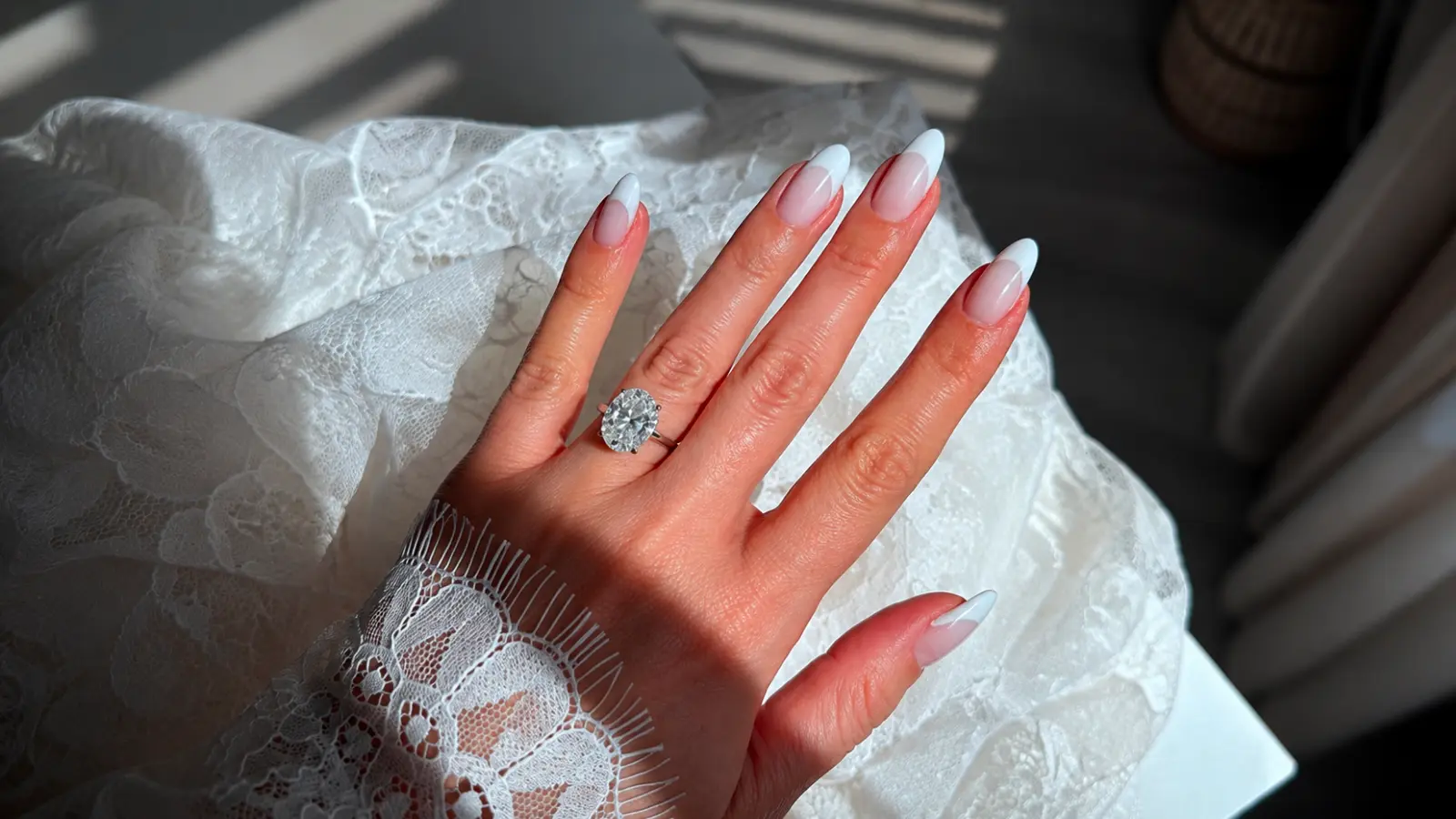
French tip nails are not automatically the right call for every bride — but they are right more often than any other single nail category, and the specific situations where they are the strongest choice are worth knowing.
When you want timelessness above trend. French nails will not read as dated in wedding photographs in five years, ten years, or twenty. Nail trends move quickly; the French concept does not. If your priority is a nail that looks as intentional in your album’s future viewings as it does today, French — in any of its modern variations — is the most reliable choice.
When the ring is the visual priority. In ring photography, a French tip frames the ring without competing with it. The neutral base and clean white tip create a polished backdrop that says “this person takes care of their appearance” without pulling attention from the diamond. If your ring is significant and you want it to be the dominant element in close-up photographs, a French tip gives it the best frame.
When the dress and the nails need to coexist. Choosing the right wedding nail colors matters because some nail designs compete with a wedding dress for attention — particularly very bold colors or very intricate art on a simple gown. A French tip integrates with the overall look rather than adding a separate visual element. It is the nail equivalent of a shoe that works with the dress rather than challenging it.
When you are uncertain. If you are genuinely unsure what nail to choose for your wedding, a well-executed modern French tip — micro or milky or ombré rather than thick and traditional — is the lowest-risk, highest-return option available. It is the choice you will not regret.
When it might not be the right call: French nails are the strongest choice for most brides, but they are not the only choice. If your personal style is specifically maximalist, if you love nail art and always wear it, if your wedding has a bold color palette and you want the nail to reflect it — a French tip might feel too quiet for who you are. The best wedding nail is always the one that looks unmistakably like you. A French tip is the right call when that happens to be its direction.
French Tip Wedding Nails Inspiration Board
Before choosing your final French manicure, it helps to see different versions of the style across nail shapes, lengths, finishes, and wedding aesthetics. Explore our French tip wedding nails inspiration board for micro French tips, milky French nails, French ombré styles, pearl French finishes, almond French nails, short French wedding nails, and elegant bridal ideas to save for your appointment.
Final thoughts
The reason French tip wedding nails continue to last while trends constantly change is simple: they understand their role perfectly.
A bridal manicure should elevate the overall look without competing with the dress, the jewelry, or the moment itself — and few nail styles do that more naturally than a well-executed French tip.
Whether it is a micro French, a soft milky finish, a baby boomer ombré, or a pearl overlay, the strongest versions always share the same quality: restraint. The details are precise, the proportions are intentional, and the result feels polished rather than overdesigned.
And years later, when the wedding album is opened again, that quiet elegance is exactly what keeps the nails looking timeless instead of tied to a trend.
Frequently asked questions (FAQ)
Are French tip nails good for a wedding?
Yes. French tip nails are one of the most timeless and elegant bridal nail styles because they photograph beautifully and work with every dress style.
What is the most popular French tip style for weddings?
Micro French tips and milky French nails are currently the most requested bridal French manicure styles because they look softer and more modern than traditional thick French tips.
Do French tip nails work on short wedding nails?
Yes. A thin micro French on short oval or round nails looks extremely elegant and keeps the focus on the engagement ring in close-up photos.
What nail shape looks best with French tips for weddings?
Almond and oval nail shapes are the most flattering because they create a softer and more elegant French tip line.
What is the difference between classic French and milky French nails?
Classic French nails have a clear white tip with a nude base, while milky French nails use softer translucent whites that blend together for a more modern and luminous effect.