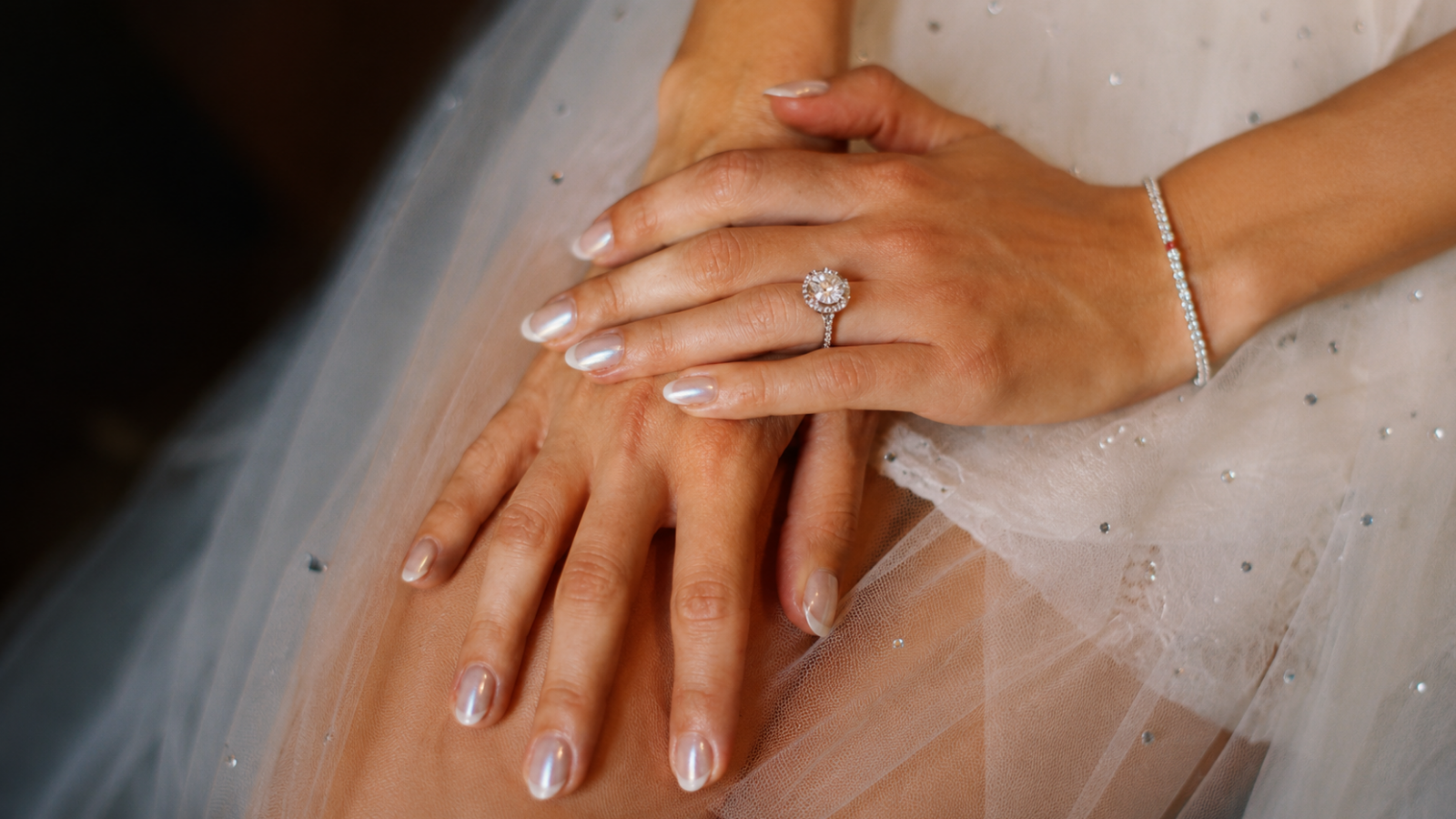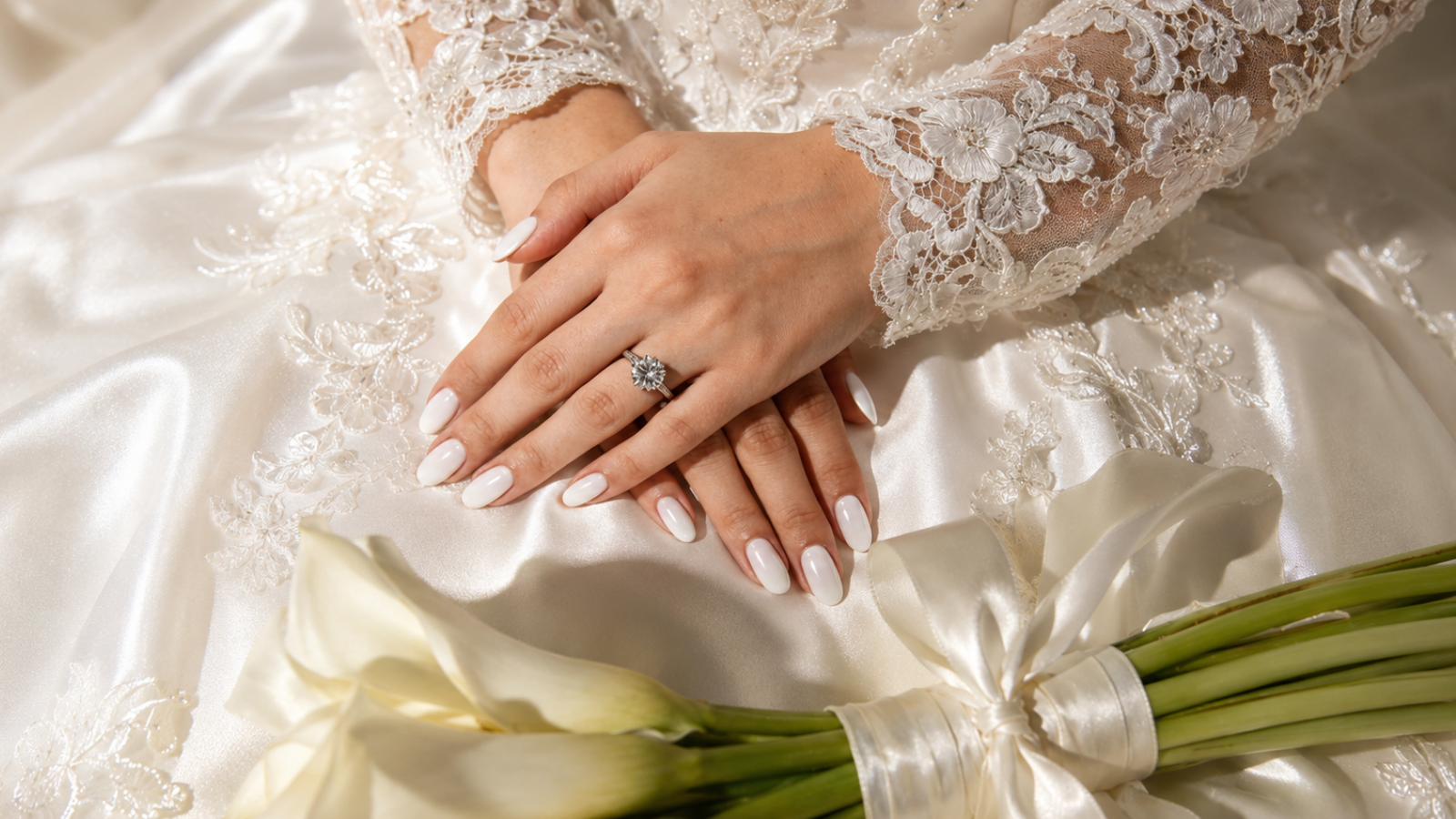
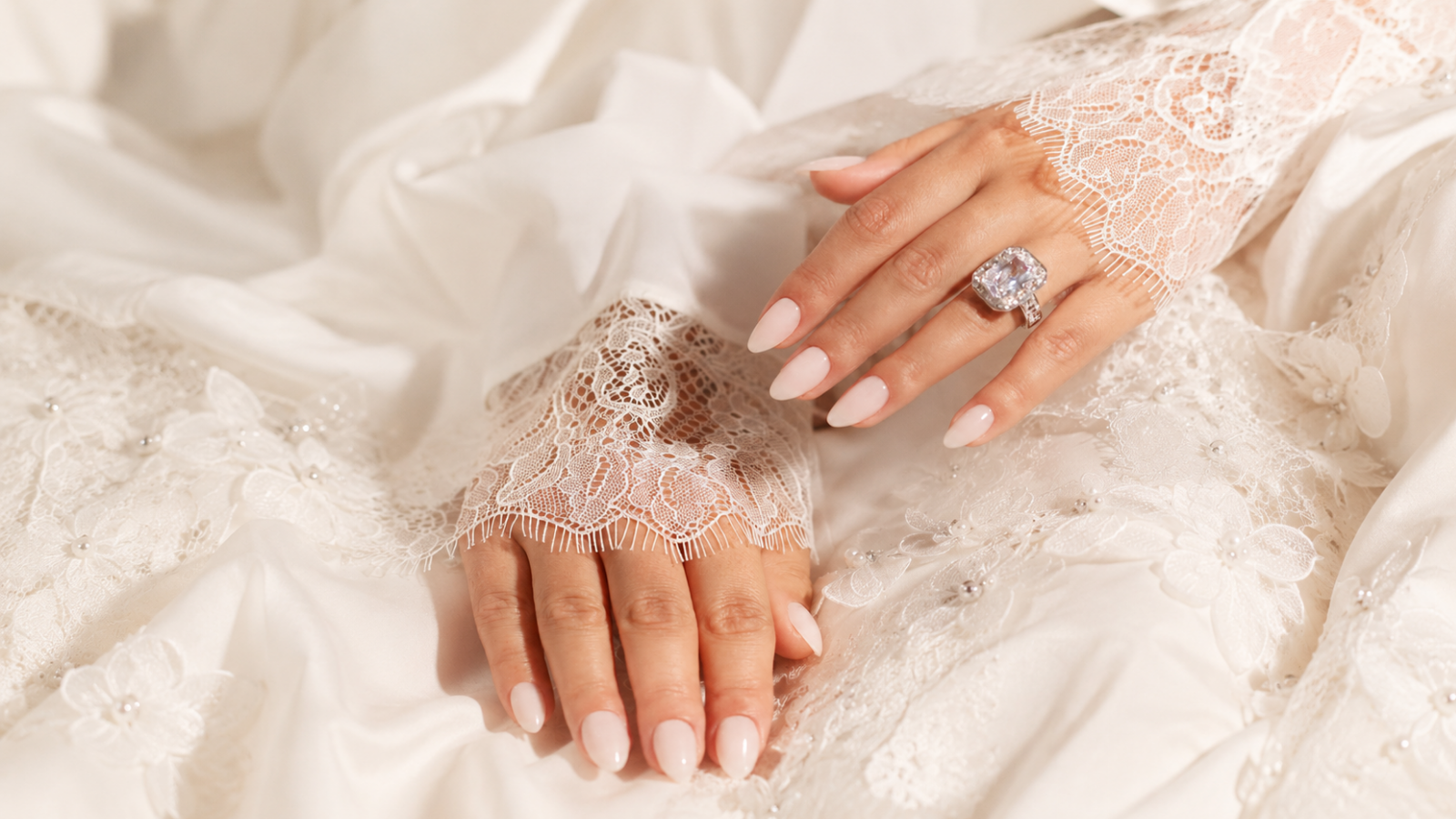
Wedding nails appear in almost every important photograph of the day — the ring shot, the bouquet hold, the dress detail photos, the champagne toast, the close-up moments during the ceremony, and the candid reception images that couples end up loving most years later.
Wedding nails are manicures chosen specifically to complement the bride’s dress, rings, bouquet, wedding style, and photography while lasting through the ceremony, reception, and often the honeymoon.
And yet, despite how visible they are, most brides choose their wedding nails at the very last minute, often based on a random Pinterest save instead of considering what actually works with their dress, their rings, their wedding style, their skin tone, and the way certain nail finishes photograph under real wedding lighting.
This guide brings together the best wedding nail ideas for brides, bridesmaids, and guests, including French tip wedding nails, nude and white bridal nails, pearl and chrome finishes, short wedding nails, elegant minimalist designs, acrylic vs gel comparisons, wedding nails and toes coordination, and the exact nail styles that continue to look timeless long after wedding trends begin to fade.
Best Wedding Nail Ideas
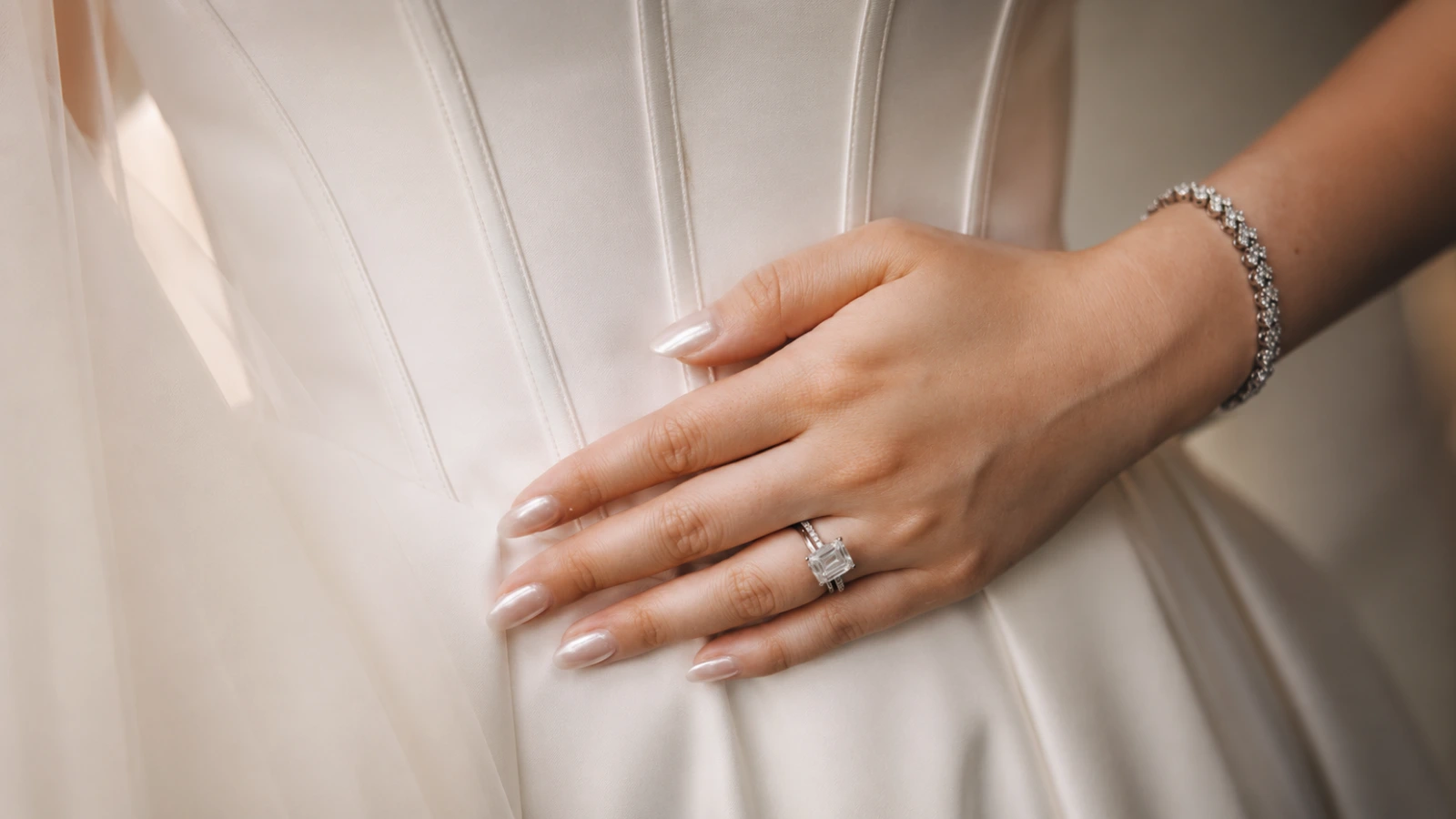
Wedding nail trends move faster than most brides expect — what dominated Pinterest three years ago can read as dated in wedding photographs today. The best wedding nails balance what is genuinely current with what will still look beautiful in a decade of anniversary revisits through your photo album.
The direction is overwhelmingly toward refinement over maximalism. The heavily embellished, jewel-encrusted, 3D-element nails of the mid-2020s have given way to quieter statements: sheer overlays with a single pearl accent, milky whites with the faintest shimmer, chrome powders applied with restraint over nude bases. The aesthetic is specifically bridal — elevated, intentional, and unmistakably appropriate for a wedding without being so obvious it becomes boring.
The nail ideas defining bridal season
- Glazed donut nails — The Hailey Bieber-influenced finish that has completely taken over bridal appointments. A sheer pink base with a chrome or pearl overlay that creates a soft, luminous glow. Photographs beautifully in natural and studio light. The most-requested bridal finish of the current season.
- Milky white nails — Not stark white — a creamy, translucent white that allows some of the natural nail to show through. More sophisticated than opaque white, softer than sheer. Works on any skin tone and any nail length.
- Soft pink with pearl accents — A sheer or semi-sheer pink as the base, with one or two delicate pearl nail charms on the ring finger or accent nail. Dimensional without being busy.
- Minimal French with a twist — The classic French tip updated with a softer, thinner white tip, sometimes with a micro-detail: a thin gold line where tip meets base, a tiny rhinestone at the corner, or a barely-there shimmer in the white itself.
- Soft chrome over nude — A chrome powder applied over a nude or blush base creates a subtle metallic quality that looks different in each light. Less aggressive than a full mirror chrome finish; more interesting than a plain nude.
- Clean single-color gel — Sometimes the most confident choice is the simplest: one immaculate color, applied in gel, with perfect cuticles and a shape that suits the hand. No art, no accents, no texture. The sophistication is entirely in the execution.
Wedding Nail Ideas by Bridal Style
The best wedding nails usually depend on the overall style of the wedding, not just the manicure itself. A nail design that looks perfect for a black-tie ballroom wedding may feel too formal for a beach ceremony, while a playful shimmer finish may look beautiful at a summer celebration but too bold for a classic church wedding.
For a classic bride: French tips, soft pink gel, oval nails, and sheer nude polish are the safest and most timeless choices. They photograph beautifully with rings, lace, satin, and traditional bridal gowns.
For a modern bride: Milky white nails, soft chrome, nude square nails, and minimal French tips feel clean, current, and polished without looking overly trendy.
For a romantic bride: Pearl accents, pink ombré, almond nails, soft shimmer, and blush tones create a delicate look that works especially well with lace, tulle, garden venues, and floral details.
For a minimalist bride: Short oval nails, sheer nude gel, soft white polish, and clean single-color manicures usually look more elevated than detailed nail art. The sophistication is entirely in the execution.
For a glam bride: Rose gold chrome, shimmer French tips, pearl finishes, or one delicate glitter accent nail can add light and dimension without overwhelming the bridal look.
For a fall or winter bride: For fall wedding nails, dusty mauve, warm nude, terracotta, champagne shimmer, soft brown-pink, and deep neutral tones feel seasonal while still looking elegant in wedding photos — and they photograph beautifully in the warm, low light typical of fall and winter ceremonies.
Wedding Nails for the Bride
Wedding nails for the bride require a different decision-making process than everyday manicures, and most brides do not fully understand why until they are sitting in the nail chair the day before the wedding with an idea they have never actually tested on their own hands.
The most important rule: your wedding is not the day to try something new. If you have never worn almond nails and you book them for your wedding day, you will spend the entire day noticing how unfamiliar they feel. If you have never worn a bright red manicure and you book one because it photographs beautifully, you may hate how it looks against your dress in person. Test drive your wedding nail design at least once — ideally at your bridal trial or your final dress fitting — before committing.
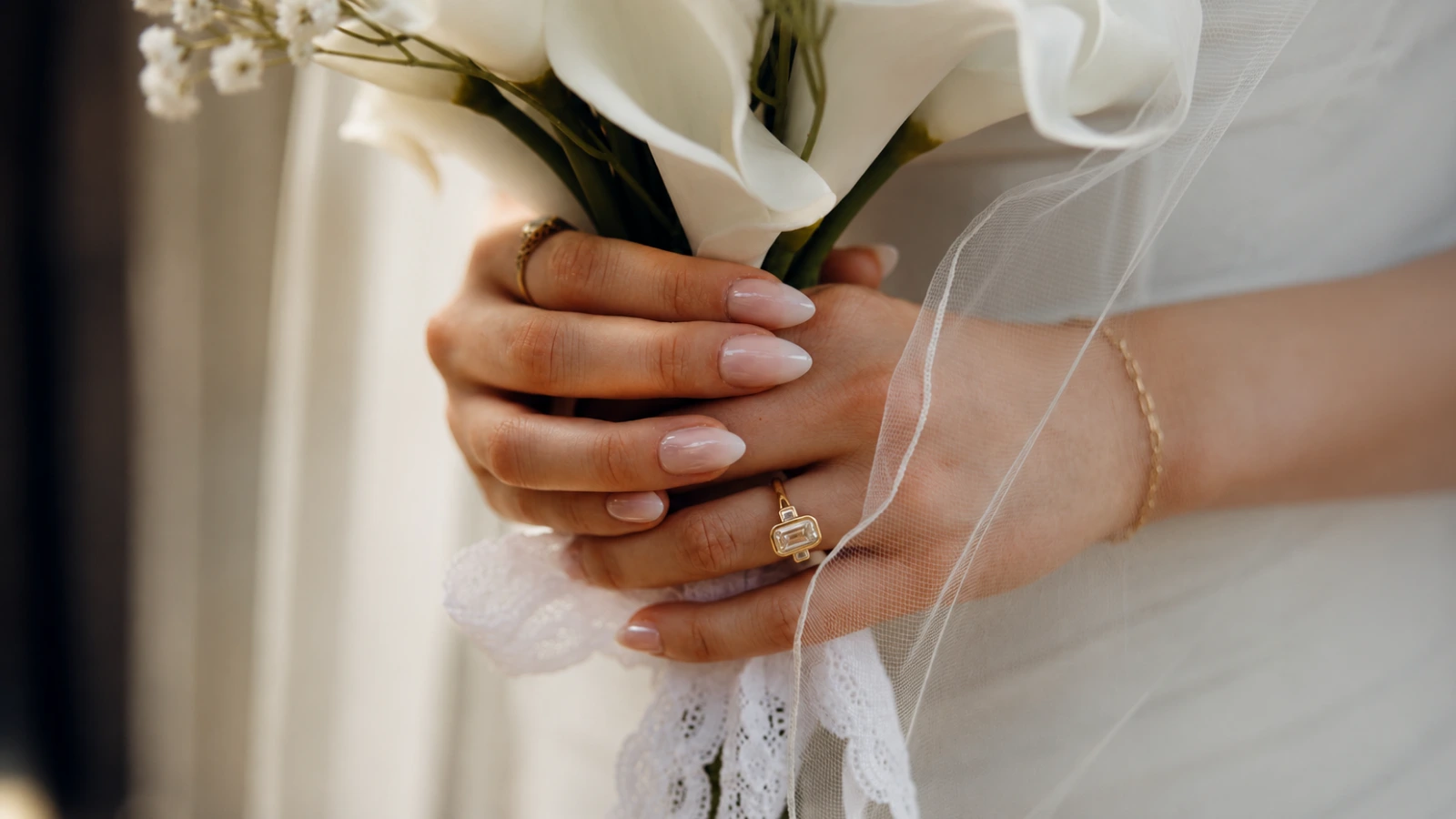
What brides actually need from their nails
Bridal nails need to do four specific things that everyday nails do not:
- Photograph well in close-up. Your ring finger will be photographed in extreme close-up. Any chip, uneven edge, or clumpy cuticle will be visible. Gel is the minimum standard for wedding day nails; hard gel or acrylic if longevity is a concern.
- Work with the ring. An engagement ring and wedding band are on your finger for most of the day. Certain nail shapes — very long stiletto, very wide coffin — can clash with rings in ways that bother brides throughout the day. Try on your rings with your planned nail shape before committing.
- Last through the honeymoon. The wedding is one day; the honeymoon is typically a week or two. A manicure done 48 hours before the wedding should still look beautiful two weeks later. Gel and hard gel hold up; regular polish does not.
- Not distract from the dress. This is a matter of personal style, but it is worth considering: your nails and your dress exist in photographs together. A very maximalist nail design on a minimalist dress, or a very bold nail color against an ivory gown, can create visual competition rather than harmony.
The most popular bridal nail styles right now
| Style | Best For | Photography Result |
|---|---|---|
| Glazed donut / chrome pearl | Modern brides who want current without trendy | Luminous and dimensional in all lighting |
| Milky white gel | Minimalist brides, ivory gowns | Clean and soft; pairs with any dress color |
| Soft pink sheer | Traditional and romantic brides | Universally flattering; timeless in photographs |
| Classic French tip | Any style, any venue, any season | Crisp and clean; the most photographed nail style in bridal history |
| Nude with pearl accent | Brides who want minimal art without being plain | Subtle detail visible in close-up ring shots |
| Soft ombré (pink to white) | Romantic, garden, and beach weddings | Gradient photographs beautifully at any angle |
Nails for the bridal trial appointment
If your salon offers a bridal trial appointment — and most good salons do — use it. Book a trial manicure in your planned wedding nail style 4 to 6 weeks before the wedding. This serves three purposes: you can see exactly how the design looks on your actual hands, your nail technician can refine the design before the real appointment, and you have time to change course entirely if the design does not look the way you imagined.
At the trial, bring your engagement ring and, if possible, a photo of your dress neckline and any significant jewelry you plan to wear. These context elements change how a nail design reads in the full picture of your wedding day look.
Wedding Nails for Guests
Wedding guest nails are less restrictive than most guests assume — and more thoughtful than most guests apply. The basic principle: your nails should not visually compete with the bride or the wedding party in photographs you will both appear in together.
This does not mean guests must wear neutral nails. It means the nail choice should be made with the wedding context in mind rather than in isolation. A bold cranberry manicure that looks stunning at a winter formal wedding photographs differently than the same manicure at a white-themed beach wedding where it reads as a distraction in every group shot.
What works for wedding guests
- Classic neutrals — always appropriate: Nude, soft pink, beige, blush, taupe. These complement virtually every outfit and photograph beautifully without drawing attention. The guest who wears an elegant nude nail is never the wrong choice.
- Clean white or off-white: A soft white or ivory nail looks polished and is particularly appropriate at spring and summer weddings. Avoid stark bright white if the bride is wearing white — the competition in photographs is subtle but real.
- A single accent color matched to the outfit: If you are wearing a specific color, a nail that coordinates (not matches exactly) with the outfit creates a put-together look that photographs as intentional.
- Deep tones for fall and winter: Burgundy, mauve, deep taupe, warm terracotta — these read as season-appropriate and sophisticated at fall and winter weddings.
- French tips: Always appropriate for guests. The French tip reads as elegant and complete without making a statement that competes with the wedding party.
What to avoid as a wedding guest
- The same shade as the bridesmaids: If you know the wedding color palette, avoid the exact bridesmaid nail color — it creates confusion in photographs and can read as intentionally mimicking the wedding party.
- Maximalist nail art: Heavy 3D elements, bold graphic designs, and statement nail art tend to draw the eye in group photos in ways that pull focus from the couple. Save your most editorial nail designs for occasions where you are the focus.
- Neon or very bright colors at formal weddings: Context matters. A bold coral that looks perfect at a casual summer beach wedding reads as jarring at a formal black-tie evening celebration.
Simple and Elegant Wedding Nails
The argument for simple wedding nails is stronger than most brides initially believe. Nail art is a category where the most restrained choices almost always age the best — and when you are looking at your wedding photographs in twenty years, a clean, elegant, simple nail will look as intentional then as it does now, while a heavily trended nail art design will have a timestamp.
Simple does not mean boring. The difference between a plain nude nail and an elegant simple nail is entirely in the execution: the quality of the gel, the precision of the cuticle work, the evenness of the application, and the nail shape. A perfectly executed round nail in a single sheer pink is more sophisticated than badly executed elaborate nail art.
Simple elegant nail ideas for brides and guests
- Single-color gel in a soft neutral: One shade, applied immaculately. The sophistication is in the quality of the finish and the precision of the nail work.
- Sheer overlay with a high-shine top coat: A barely-there sheer color applied over natural nails — nude, pink, or white — gives polish with a natural look. Perfect for brides who want their nails to look beautiful without looking done.
- Minimal French with a thin, precise tip: The French tip is thinner and more precise than its predecessors. The white line is subtle, the transition is soft, the result is clean and unmistakably elegant.
- Single delicate accent: A solid nude or soft pink nail on every finger, with one ring-finger accent — a single tiny rhinestone, a hair-thin gold line, or a single pearl charm. The restraint of the rest makes the one accent feel intentional rather than busy.
- Negative space nail art: A design that uses the natural nail as part of the composition. Thin geometric lines, a subtle half-moon at the base, or a fine diagonal stripe — all read as contemporary and sophisticated without being maximalist.
French Tip Wedding Nails
French tip wedding nails have been a dominant bridal nail style for decades, and they remain popular not because brides lack imagination, but because they genuinely work. It photographs cleanly, complements every skin tone, works with every dress style, and does not date. The argument against French tips — that they are overdone — is the argument against choosing something because it is reliable, which is not actually an argument against the choice.
What has changed is how the French tip looks. The thick, stark-white arc of the original nail salon standard has been replaced by something more refined: a thinner white line, a softer transition, sometimes a sheer rather than opaque white, often with a subtle shimmer or gold detail at the smile line. The French tip is not the same as it was — it has been updated, and the updated version is genuinely beautiful.
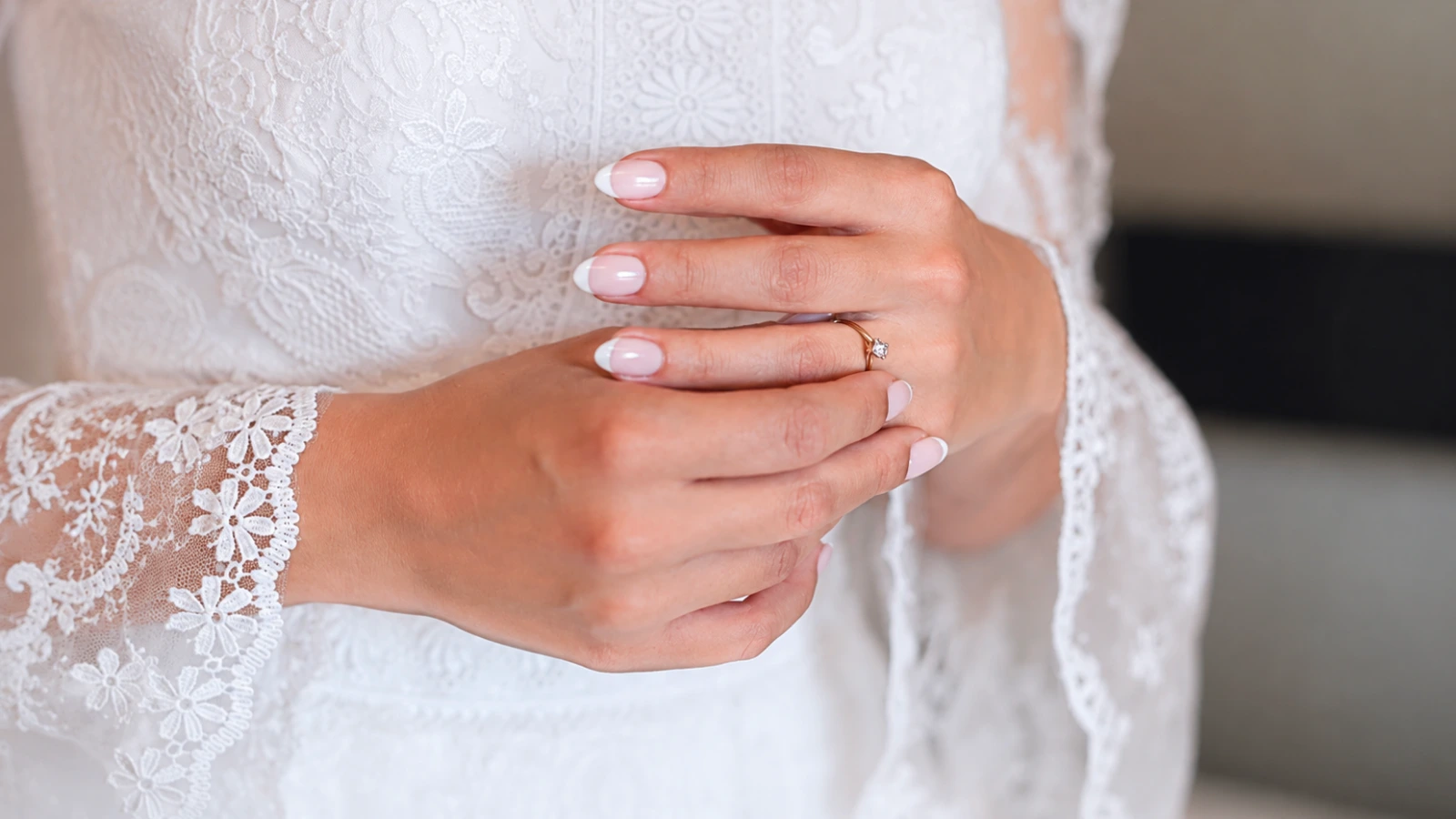
French tip styles for weddings
- Classic French — refined: The original, executed with precision. A thin, clean white arc, a soft pink or natural base, and a high-shine gel top coat. The sophistication is entirely in the execution. Find a nail technician who can draw a precise, even smile line — this is where classic French tips fail, and where they succeed.
- Micro French / thin-line French: An ultra-thin white line at the tip — barely there, but visible. The thinnest, most delicate version of the French tip. Popular for brides who want the French tip effect without the obviousness of a traditional arc.
- Sheer French: A translucent rather than opaque white tip. The nail shows through the tip slightly, creating a softer, more natural version of the French look. Particularly beautiful on natural nails without extensions.
- Colored French tip: The trend that updated the French for a new generation. Instead of white, the tip is a soft lavender, a barely-there pink, a warm taupe, or a muted sage. The base is nude or clear; the tip introduces a single quiet color. At weddings, the most appropriate versions are those where the tip color is subtle — a slightly pink-tinted white, a barely-there lavender — rather than a bold statement.
- Gold-detail French: A classic white French tip with a thin gold line painted precisely where the tip meets the base. Adds warmth and a hint of luxury without moving away from the essential elegance of the French manicure.
- V-French / chevron French: The smile line cut into a V-shape rather than a U. More graphic and modern than the traditional arc. Works for brides who want something slightly more editorial within the French tip category.
One practical note: French tips, particularly white ones, show chips and edge wear more visibly than other nail styles. For a wedding, this makes the choice of nail medium more important — a French tip in regular polish will begin to show wear within a day or two. A French tip in gel will hold its edge for two to three weeks.
White, Nude, Pink, and Neutral Wedding Nails
Wedding nail colors in the neutral family — white, nude, pink, blush, ivory, beige — dominate bridal choices for a reason that is not simply conservative taste. Neutral nails disappear into the overall look in the best possible way: they never compete with the dress, the flowers, or the jewelry, and they photograph without calling attention to themselves as a specific design choice. In wedding photography, a nail that looks beautiful without drawing the eye is often more sophisticated than one that demands to be noticed.
White wedding nails
White wedding nails have had a significant moment in recent years and show no signs of retreating. For brides specifically, white nails are a natural choice — the connection between white nails and a white gown feels intentional and cohesive in photographs. But not all white nails are the same, and the specific version of white matters considerably.
- Stark opaque white: Bold, graphic, and modern. Works best for minimalist brides with a contemporary aesthetic and high-contrast looks. Can read as too strong against softer, more romantic dresses.
- Milky white / sheer white: The most popular bridal white. A creamy, translucent white that softens the look significantly compared to opaque white. More versatile across skin tones and dress styles. The glazed donut effect — a milky white with a pearl or chrome overlay — falls into this category.
- Off-white / ivory: The subtlest white option. Almost nude but with a white quality. Works beautifully on warm-toned skin and pairs particularly well with ivory or champagne gowns.
- White with shimmer: A white base with a subtle iridescent shimmer or pearl finish. Catches light beautifully in ceremony and reception photography without looking glittery or over-the-top.
Nude wedding nails
Nude nails are the most reliably sophisticated bridal choice. The important qualification: “nude” is not one color — it is a family of colors that reads as a natural extension of the hand, and the right nude for any person depends on their specific skin tone. A nude that photographs beautifully on fair skin can read as muddy or gray on deeper skin tones. Finding the right nude requires actually trying it against your hand, not choosing based on a swatch.
- Fair to light skin: Peachy nudes, light pinks, soft beige. Avoid nudes that are too white — they can look chalky. OPI’s “Bubble Bath,” Essie’s “Ballet Slippers,” and similar soft pinks are reliable choices.
- Medium skin: Warm beige, caramel nude, warm pink. Nudes in the warm-brown family look most natural. Avoid cool-toned nudes that can look gray.
- Deep and dark skin: Warm caramel, terracotta nude, rich brown-pink. The “nude” that reads as natural is deeper and richer. Trusting the salon to match rather than bringing in a specific shade is often the better approach for deep skin tones.
Pink wedding nails
Pink is the most consistently requested wedding nail color at U.S. salons and has been for decades. The variation within pink is enormous — from the palest sheer blush to a bright bubblegum — and the appropriate pink for a wedding depends on the tone of the overall look.
- Sheer baby pink: The most delicate option. Almost translucent. Looks barely-there in person but photographs with a softness that is distinctly romantic.
- Soft blush pink: A step more saturated than sheer. The most popular single bridal nail color in the current market. Universally flattering, pairs with every dress color, photographs beautifully in both warm and cool light.
- Dusty mauve pink: A pink with a grayish or brownish undertone. Sophisticated and slightly more editorial than straight pink. Works particularly well for fall and winter weddings and for brides who find pure pink too sweet.
- Bright pink: Bold and joyful. Works for summer beach weddings, colorful celebrations, and brides whose personal style is specifically vibrant. Not the obvious bridal choice — but for the right couple at the right wedding, an unexpected and memorable one.
Pearl, Chrome, Glitter, and Ombré Wedding Nails
The finish category — the texture and light quality of the nail rather than just the color is where bridal nail design lives most distinctly. Solid color gel remains the most common choice, but the finishing techniques available at modern salons have created options that photographs with a dimension and luminosity that flat color cannot replicate.
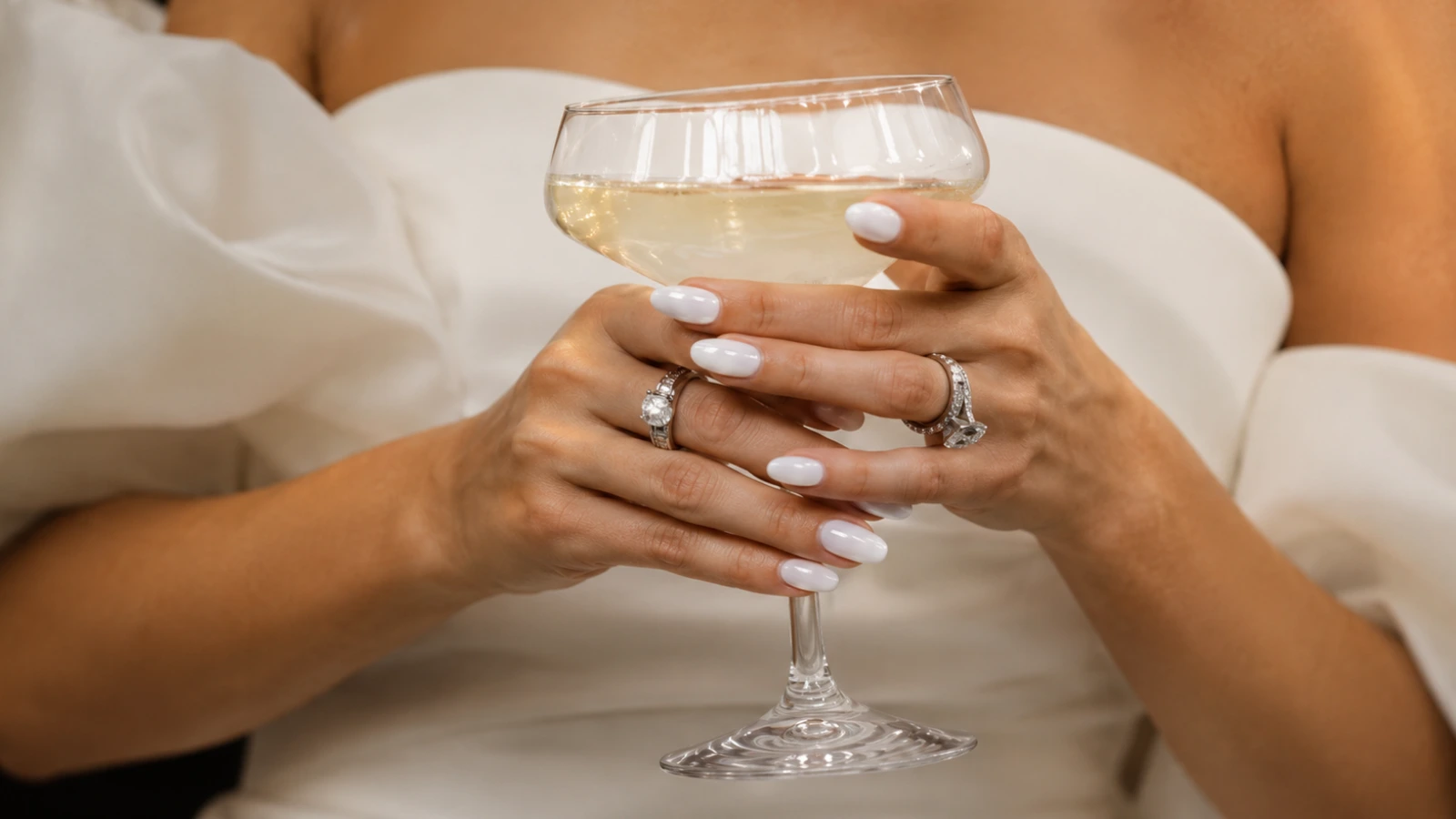
Pearl wedding nails
Pearl nails are having a prolonged moment in bridal design, and the reason is specifically photographic: a pearl finish catches light differently from every angle, which means the nail never looks the same in two consecutive photographs. In a ring shot, the pearl quality gives the nail an almost three-dimensional luminosity that flat color cannot achieve.
Pearl nails range from a barely-there iridescent shimmer over a nude base to a fully white-pearl finish that is visibly luminous at first glance. The most versatile version for brides is the subtle pearl overlay — a light iridescent powder or chrome applied over a sheer pink or nude base. It reads as elegant and intentional without being obvious.
Chrome wedding nails
Chrome nails — created by rubbing a chrome powder over a cured gel base — create a mirror-like or metallic effect that is more muted and sophisticated than traditional glitter. For weddings, the most appropriate chrome finishes are the softer ones: rose gold chrome over a nude base, silver-white chrome over a milky white, or the barely-there chrome that creates the glazed donut effect rather than a full mirror surface.
A full mirror chrome in silver or gold reads as a statement rather than a bridal choice — it works for brides with a specifically editorial or modern aesthetic, but can compete with jewelry in photographs. The trend is toward chrome used as a finishing touch (15 to 20% of the nail’s visual impact) rather than as the dominant element.
Glitter wedding nails
Glitter nails at weddings require more calibration than almost any other finish — they are simultaneously one of the most popular requests and one of the choices most likely to look overdone in photographs. The difference is in the scale and placement of the glitter.
- Fine shimmer / micro glitter: A glitter that reads as shimmer rather than sparkle — the particles are small enough to catch light without visibly reading as individual pieces. This is the most appropriate version for wedding nails. It adds dimension and luminosity without dominating.
- Single glitter accent nail: One ring finger in a fine glitter or sequin finish while the remaining nails are solid — nude, pink, or white. The accent nail draws the eye in ring photographs without making the overall manicure look heavy.
- Glitter tip French: A French tip where the white is replaced by a fine silver or gold glitter. More sparkle than a traditional French, less overwhelming than fully glitter nails. Popular for New Year’s Eve weddings, evening ceremonies, and brides who want a touch of glamour.
- Chunky glitter: Large-particle glitter that reads as confetti or sequins on the nail. This is the version most likely to look overdone in wedding photographs, where the nail is photographed in close-up. Reserved for brides whose wedding aesthetic is specifically maximalist and glam.
Ombré wedding nails
Ombré wedding nails — a gradient that blends one color into another across the nail — are among the most consistently beautiful bridal nail designs for one simple reason: a gradient photographs without a hard edge. Every close-up image shows the transition, which creates a depth and softness that flat color cannot achieve.
- Pink to white ombré: The most popular bridal ombré. A soft pink at the base transitions to white at the tip. More sophisticated than a traditional French tip because the transition is gradual rather than defined. Photographs beautifully in any lighting condition.
- Nude to white ombré (baby boomer): Known as the “baby boomer” nail in the industry. A warm nude at the base transitions to a soft white at the tip. Reads as extremely natural and skin-like — beautiful in close-up photographs without announcing itself as a specific design.
- Sheer to shimmer ombré: A transparent base at the cuticle that transitions to a pearl or shimmer finish at the tip. Creates a luminous, almost ethereal quality that photographs with particular beauty in ceremony and outdoor light.
- Rose gold ombré: A deeper, metallic ombré — nude or pink at the base transitioning to a rose gold chrome at the tip. More editorial and statement-making than the classic pink-to-white. Works for styled celebrations and brides with a modern aesthetic.
Short Wedding Nails
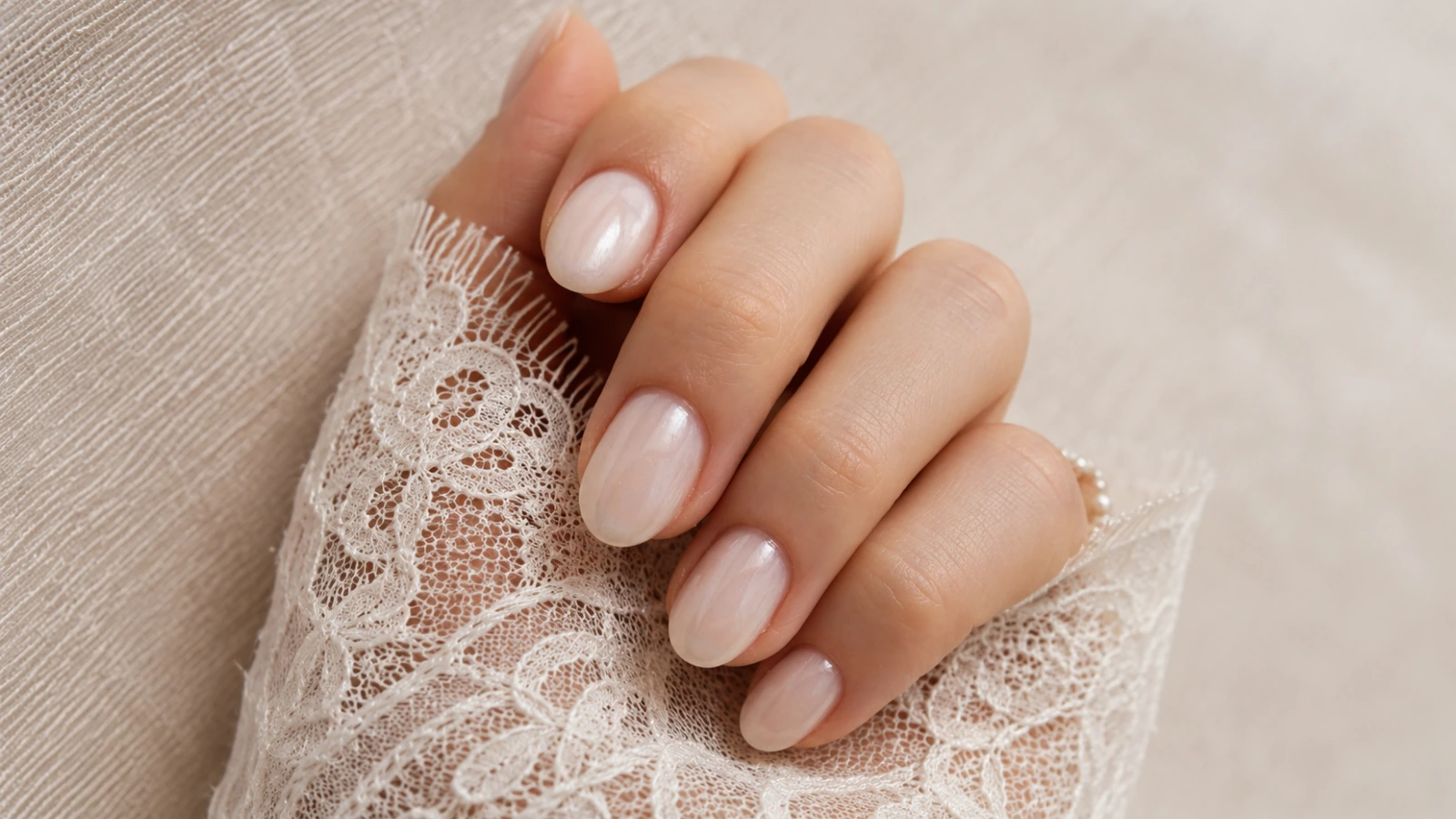
Short wedding nails are not a compromise — they are a choice, and for many brides, the right one. Many women find that longer nails are simply incompatible with their daily life, their work, their comfort, or their sense of themselves. A short, perfectly manicured nail in a beautiful finish is more elegant than a long nail that feels wrong on your hand.
The specific advantage of short nails in wedding photography is that they allow the ring to be the clear focal point of every close-up shot. Long nails divide the visual attention in a ring photograph between the jewelry and the nail itself; short nails direct the eye entirely to the ring.
What works best on short nails
- Round or oval shape: Square and squared-off shapes can make short nails look stubby. A round or soft oval shape on a short nail looks intentionally manicured and elegant.
- Nude and soft pink polish: Lighter colors on short nails create the illusion of length. A sheer or semi-sheer nude allows the entire nail to appear longer than it is.
- Thin French tip: A minimal, thin white line at the tip of a short nail creates length without adding artificial length. The precision matters more on short nails — a thick arc on a short nail can look like it is trying too hard.
- Negative space designs: Design elements that incorporate the natural nail as part of the composition — a thin crescent at the base, a simple geometric line, a barely-there stripe — work beautifully on short nails. The restraint is the point.
- Pearl and shimmer finishes: A shimmer or pearl finish on a short nail adds dimension without adding length. The light-catching quality creates visual interest that flat color on a short nail sometimes lacks.
What to avoid on short nails
- Very dark colors: Deep colors on very short nails can make the finger look shorter. This is not a strict rule — some women carry dark polish on short nails beautifully — but it is worth considering for wedding photography specifically.
- Elaborate nail art across the full nail: On a small canvas, detailed nail art can look crowded. One accent nail with a delicate design works better than art on every finger.
- A French tip arc that is too thick: The classic round arc of a French tip is proportionally more visible on a shorter nail. A thin-line French tip is more flattering on short nails.
Wedding Nail Shapes
Nail shape is one of the most consequential decisions in the bridal nail process, and it is one that many brides make without fully understanding what each shape does to the hand in photographs. The shape is not just an aesthetic preference — it changes how the ring looks, how the finger photographs, and how the nail design reads.
| Shape | Best For | Photography Notes |
|---|---|---|
| Oval | Most hand shapes; universally flattering; any length | The most flattering wedding nail shape in close-up photography; elongates fingers naturally |
| Almond | Narrow hands; medium to long lengths; editorial looks | Extremely elegant in ring shots; the pointed tip directs the eye toward the ring |
| Round | Short nails; practical lifestyle; soft romantic looks | Natural and clean; the most understated shape — the nail becomes background rather than foreground |
| Square | Modern minimalist aesthetic; longer nail beds; confident style | Clean and graphic; can look slightly wider than other shapes on shorter fingers |
| Soft square / squoval | Between square and oval; practical and polished | The most practical elegant shape; has the clean edge of square with the softness of oval |
| Coffin / ballerina | Long nails; editorial and maximalist looks; bold brides | Statement shape that reads as intentional and editorial; requires length to work |
| Stiletto | Very editorial; maximum drama; runway aesthetic | Striking in photographs but can compete with the ring; practical concerns with ceremony activities |
Many brides do not realize that nail shape interacts with ring style in photographs. A wide, pavé-set band looks different against an oval nail than against a square one. A solitaire on a fine band photographs differently against a stiletto nail than against a round one. If you have a distinctive ring and you care about how the ring photographs with the nail, bring your ring to the nail trial and look at the combination.
Acrylic, Gel, and Press-On Nails for Weddings
The medium matters as much as the design. A beautiful nail design applied in regular polish will not survive a full wedding day without at least one chip. Understanding the difference between your options — and which one is right for your specific situation — is as important as choosing the color or shape.
Gel nails for weddings
Gel is the most popular choice for wedding nails and for good reason. It is applied over natural nails, cured under UV light in layers, and produces a smooth, glossy finish that lasts two to three weeks without chipping. It looks natural because it is built on the natural nail rather than an extension. It is the most common medium at bridal appointments at U.S. salons.
The two types of gel brides encounter at salons are soft gel and hard gel. Soft gel (the most common) is flexible and soaks off with acetone. Hard gel is more durable, cannot be soaked off (must be filed), and can be used to add slight length extensions. For a bride who wants to add a small amount of length to natural nails — 2 to 4mm — hard gel is a natural-looking option that does not require the full acrylic process.
Gel builder — sometimes called builder gel or BIAB (Builder in a Bottle) — has become one of the most popular bridal nail treatments. Applied like gel but thicker, it strengthens natural nails while adding a small amount of structure. For brides who have brittle or damaged nails from daily life, BIAB applied 4 to 6 weeks before the wedding can dramatically improve nail health in time for the wedding appointment.
Acrylic nails for weddings
Acrylic nails are created by combining a liquid monomer with a powder polymer, which is applied to the natural nail or a nail tip and sculpted into the desired shape. Acrylics allow for the most dramatic length and shape customization — coffin, almond, and stiletto shapes at longer lengths are typically done in acrylic. They are harder and more durable than soft gel but require professional removal.
For brides who want a significant change in nail length or a very specific shape that their natural nails cannot achieve, acrylic is the most reliable option. The concern for some brides is that acrylic nails look artificial — which is entirely dependent on the technician’s skill. In the hands of a skilled nail artist, acrylics can look completely natural. The standard of work varies dramatically between salons, and this is a case where seeing the technician’s portfolio specifically for natural-looking acrylics before booking is essential.
Press-on nails for weddings
Press-on nails have undergone a complete reputation rehabilitation in recent years, and the version of a high-quality press-on nail looks nothing like the drugstore press-ons of the past. Modern press-ons from brands like KISS, Static Nails, Aprés Gel-X, and Clutch Nails are made with professional-quality materials and are genuinely indistinguishable from salon nails in photographs — which is the only place that matters for a wedding.
Press-ons are particularly practical for:
- Destination wedding guests who are traveling and cannot guarantee a quality salon appointment at the destination
- Brides who want a very specific design that is difficult to execute locally — many independent nail artists sell custom hand-painted press-ons that are works of art
- Bridesmaids on a budget who want coordinated nails without a salon appointment for every member of the party
- Brides with nail damage from previous nail work — press-ons give the nail bed a break while still looking beautiful on the wedding day
For maximum durability, apply press-ons with nail glue rather than the adhesive tabs that come in the package. Prepared correctly — nails dehydrated, cuticle pushed back, glue applied precisely — press-ons applied with nail glue can last one to two weeks without lifting.
Which medium to choose
| Medium | Longevity | Best For | Removal |
|---|---|---|---|
| Regular polish | 2–5 days | Guests only; not recommended for brides | Acetone or remover |
| Soft gel | 2–3 weeks | Most brides; natural look, natural length | Soak-off with acetone |
| Hard gel / BIAB | 3–4 weeks | Brides wanting small extensions or stronger nails | File off (no soaking) |
| Acrylic | 3–4 weeks | Significant length/shape changes; maximum durability | Professional removal recommended |
| Press-on (with nail glue) | 1–2 weeks | Guests, destination travelers, specific designs | Warm water soak |
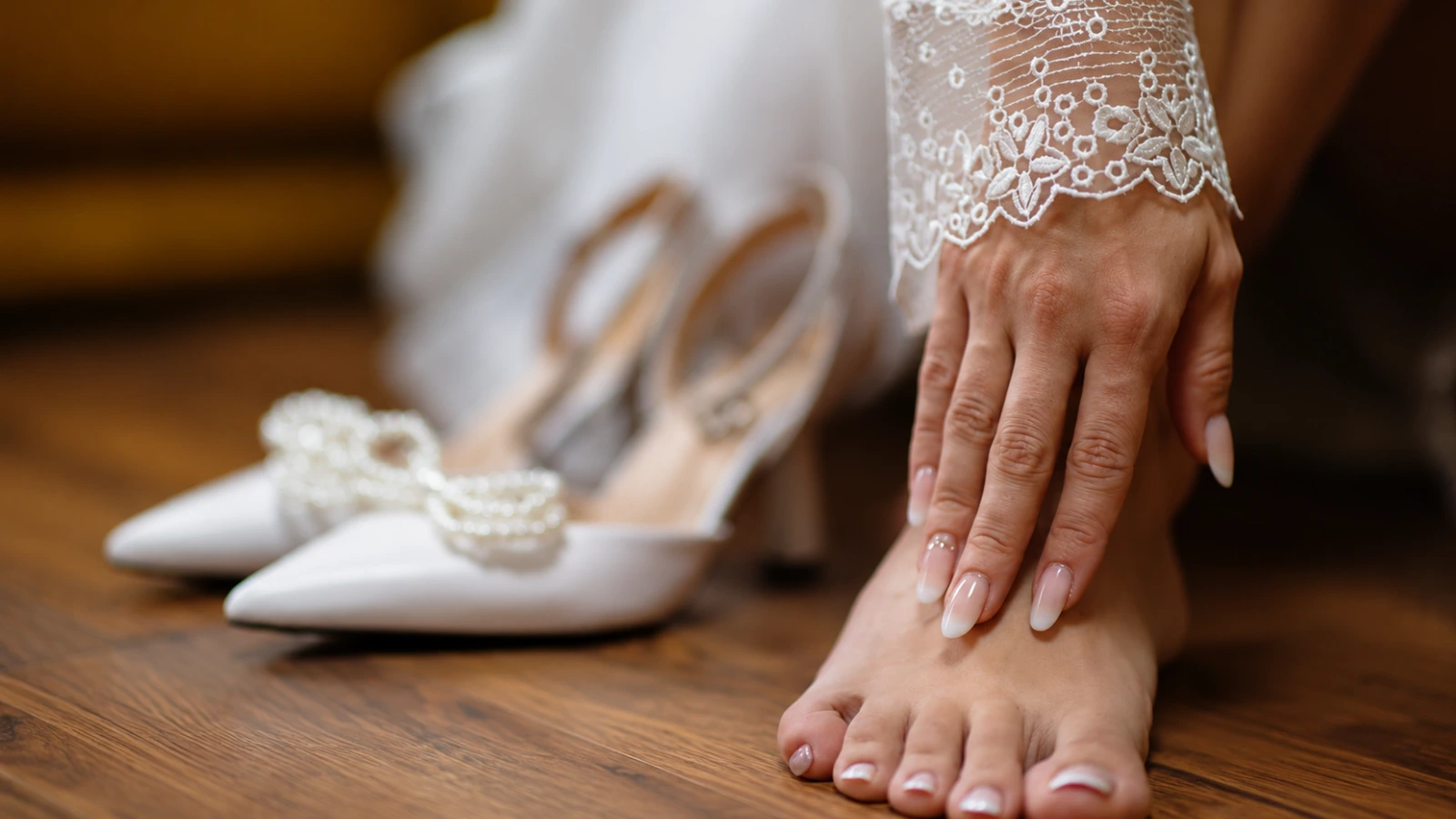
Wedding Nails and Toes
Wedding nails and toes are often an afterthought — which is exactly when they become a problem. A bride in open-toe shoes or sandals is photographed from the feet up multiple times: at the altar, during the first look, at the reception. Toenails that are chipped, bare, or visually inconsistent with the overall look are one of those details that nobody mentions during the wedding but that the bride notices in every photograph afterward.
Do toenails need to match fingernails?
They do not need to match exactly — but they should coordinate. The most common and effective approach is to use the same color family in the same or a closely related finish. If the fingernails are a soft pink gel, the toenails in the same soft pink or a slightly deeper version of it feels intentional. Matching the exact shade produces the most put-together look in photographs; coordinating rather than matching is perfectly acceptable and often more comfortable.
What looks obviously uncoordinated in wedding photographs: bright red toenails with nude fingernails; dark toenails with pale fingernails; or bare toenails with elaborately done fingernails. The contrast can look like an oversight rather than a deliberate choice.
Nail designs that work on toenails
- Single color gel: The most practical and polished option for toenails. A solid nude, soft pink, white, or whatever coordinates with the fingernails. Clean and deliberately done.
- French tip toenails: A French tip on toenails is more unusual than on fingernails but photographs beautifully, particularly against a natural skin tone in sandals or open-toe shoes.
- Accent nail on the big toe: A pearl or shimmer accent on the big toenail while the remaining toes are solid. Adds a detail that reads in close-up photographs without being obvious.
- Matching the wedding shoes: Some brides choose a toenail color that specifically coordinates with their shoes — a warm champagne to complement metallic sandals, a soft blue to complement embroidered shoes. This works particularly well when the shoes are a statement piece.
When to schedule the pedicure
Schedule your pedicure the day before or the morning of the wedding — not the same day as the manicure appointment, which is typically already scheduled close to the wedding date. Booking both on the same day at the same salon is convenient but can make the appointment feel rushed. Many nail salons offer a bridal mani-pedi package that sequences both services properly.
When to Get Your Nails Done Before the Wedding
Knowing when to get your nails done before the wedding is one of the most misunderstood parts of the bridal nail process. Many brides book their nail appointment too early (nails begin to show wear before the wedding), too close to other getting-ready activities (not enough drying time), or without accounting for touch-up needs.
The ideal timing schedule
- 6 to 8 weeks before the wedding: Start the BIAB or nail strengthening process if your natural nails need conditioning. Begin growing nails to your target length. This window is also when many brides book their nail trial appointment.
- 4 to 6 weeks before: Bridal nail trial appointment. Test the exact design, shape, and color you plan to wear. Make changes now, not the week of the wedding.
- 1 to 2 weeks before: If you are getting acrylics or hard gel extensions, book this appointment here. Extensions need to be applied early enough to allow adjustment — a nail that lifts or feels wrong has time to be corrected.
- 1 to 2 days before the wedding: The ideal window for the wedding manicure. Gel nails applied two days before will be fully set, chip-free, and looking their best on the wedding day. They will also still look beautiful for the honeymoon photographs.
- Morning of the wedding: Only if necessary and only for touch-ups. Scheduling a full manicure the morning of the wedding creates logistical stress during an already full getting-ready schedule.
What to tell the nail salon
When booking your bridal appointment, tell the salon specifically that it is for a wedding. This triggers a different level of attention at most salons — more time allocated, more precision applied, and often a senior technician assigned to the appointment. Bring reference photos of the specific design you want and, if possible, bring your engagement ring so the technician can see how the nail looks against the ring.
A few things many brides do not think to ask about at the appointment:
- Ask the technician to check the cuticle work under a bright light — cuticle preparation is the single most important factor in how a professional manicure looks in close-up photographs
- Ask specifically whether the top coat they use is photographically safe — some high-shine top coats produce a glare in certain lighting conditions that reads oddly in flash photography
- Ask whether they have the specific shade you want, or whether you should bring your own — for a very specific reference shade, some brides purchase their own bottle and bring it to the appointment
How long before the wedding is too early for gel nails?
Gel nails applied more than 4 days before the wedding are technically fine — gel does not chip the way regular polish does — but the cuticle will have grown slightly by the wedding day, creating a small gap between the cuticle and the gel that is visible in close-up photographs. Most nail professionals recommend 1 to 2 days before as the sweet spot: fresh enough to look pristine, early enough not to cause morning-of scheduling stress.
Wedding Nails Inspiration Board
Before choosing your final manicure, it helps to see wedding nail ideas across different styles, colors, shapes, finishes, and dress codes.. Explore our wedding nails inspiration board for bridal nails, guest nails, French tips, milky white manicures, soft pink designs, pearl finishes, chrome details, short wedding nails, and elegant nail ideas to save for your appointment.
Final thoughts
The best wedding nails are rarely the ones trying hardest to stand out.
They are the ones that feel naturally connected to the entire wedding the dress, the rings, the flowers, the lighting, the season, and the atmosphere surrounding the day itself. The manicure should complete the bridal look, not compete with it.
That is why the most timeless wedding nails continue to be the softest and most intentional ones: elegant French tips, sheer pinks, milky whites, refined nude shades, subtle pearl finishes, and shapes that flatter the hand naturally instead of chasing trends that may feel dated a few years later.
And when the color, shape, and finish are chosen carefully, wedding nails stop feeling like a small beauty detail and become part of the visual memory of the entire day appearing quietly and beautifully in photographs couples will keep forever.
Frequently asked questions (FAQ)
What nail style is most popular for weddings?
French tip nails, soft pink gel, milky white nails, and glazed pearl finishes are the most popular wedding nail styles.
When should you get your wedding nails done?
Most brides get their nails done 1 to 2 days before the wedding to keep them looking fresh in close-up photos.
What nail shape looks best for weddings?
Oval and almond nail shapes are the most flattering for wedding photos because they elongate the fingers and look elegant with rings.
Are short nails good for weddings?
Yes. Short nails with soft pink, nude, pearl, or French tip designs can look extremely elegant and photograph beautifully.
Should wedding guest nails match the wedding colors?
Not exactly. Guests should choose nails that complement the wedding style and outfit without competing with the bridal party.