Your wedding nails will appear in almost every important photograph from the day — the ring shot, the bouquet hold, the ceremony close-ups, the champagne toast, and the moments couples end up revisiting for years afterward.
Bridal nails are wedding-day manicures designed to complement the dress, engagement ring, bouquet, photography style, and overall bridal aesthetic.
But bridal nails and wedding nails are not only about choosing a pretty design. The shape, finish, color, and texture of a manicure all photograph differently in real wedding lighting, and the best bridal nails are usually the ones that still feel elegant long after trends change.
This guide covers the best wedding nails for brides, including French tips, milky white nails, nude and soft pink bridal styles, pearl chrome finishes, short wedding nails, bridal nail shapes, gel vs acrylic, and the nail designs that actually look timeless in real wedding photography.
How to choose bridal nails for your wedding look
Choosing bridal nails is not just about finding the prettiest manicure online. The best choice should work with the full bridal look: the dress fabric, ring metal, bouquet colors, venue, season, photography style, and the bride’s usual comfort with nail length.
A lace gown may pair beautifully with sheer pink, pearl accents, or a refined French tip. A minimalist satin gown can handle milky white, soft chrome, or a clean nude manicure. A romantic garden wedding may suit blush, ombré, or delicate floral details, while a modern city wedding can make a short square nude or subtle chrome finish feel intentional and polished.
The best bridal nails should feel like part of the styling, not a separate beauty trend added at the last minute.
Elegant Wedding Nails for Brides
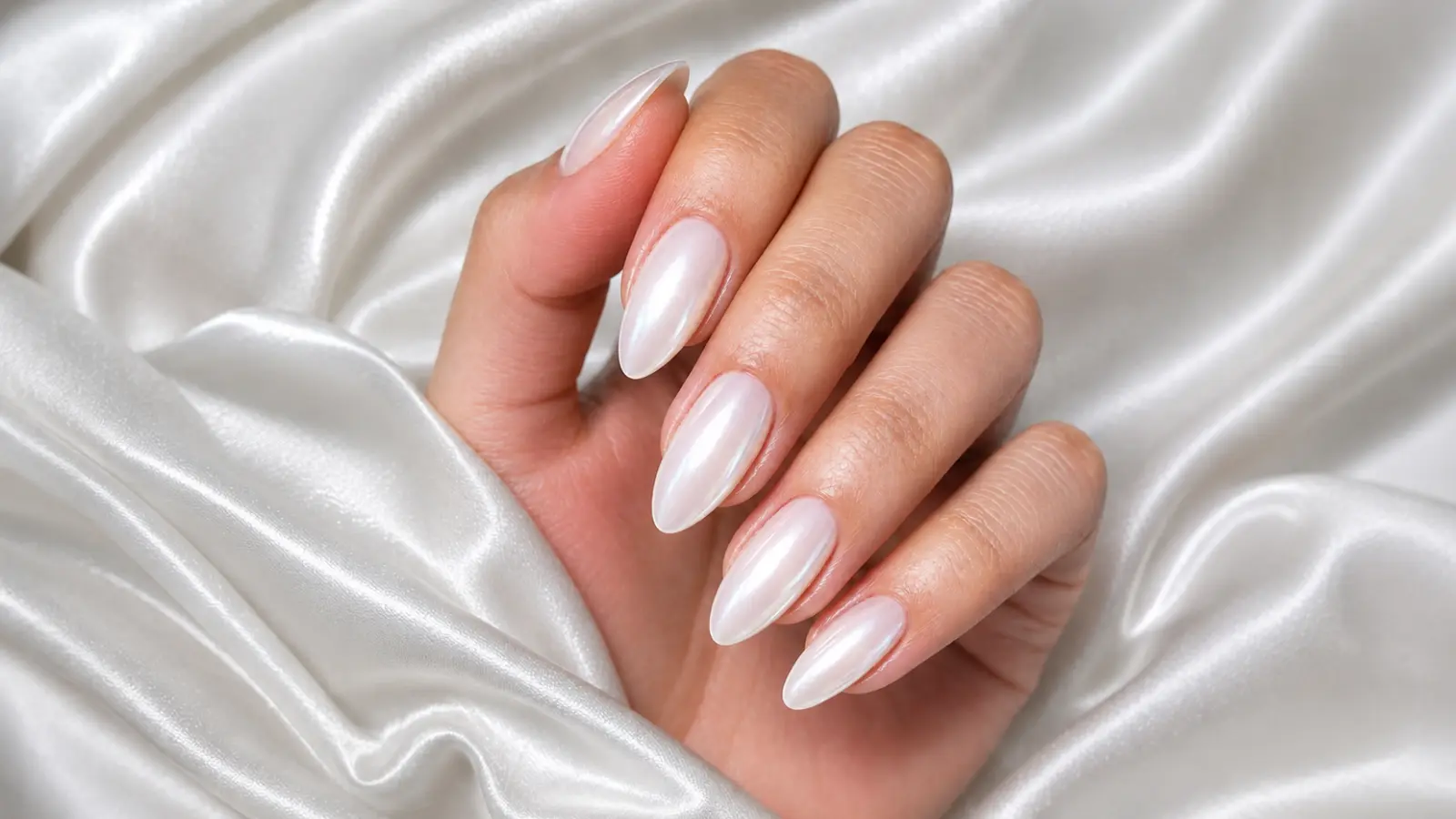
Elegance in bridal nails is not about complexity. The most elegant wedding manicures at American weddings share a different quality: restraint executed with precision. A single immaculate color in a perfect shape, with cuticles that look like they were tended to by someone who genuinely cared. That is what photographs as elegant — not the number of elements on the nail, but the quality of everything that is there.
What many brides do not realize until they see their ring shots is that nail art competes with the ring in close-up photographs. A heavily detailed nail pulls the eye in multiple directions; a clean, luminous nail directs the eye toward the stone. Elegant bridal nails are almost always the ones that make the ring look better, not the ones that look interesting on their own.
The five most elegant bridal nail styles
- Glazed donut / pearl chrome. One of the most popular bridal nail finishes. A sheer or semi-sheer base — nude, blush, or milky pink — finished with a pearl chrome powder that creates a soft, luminous glow. Not metallic in a statement way. More like the nail is lit from within. Photographs with a dimensional quality that flat color cannot achieve and looks unmistakably intentional without being obvious about it.
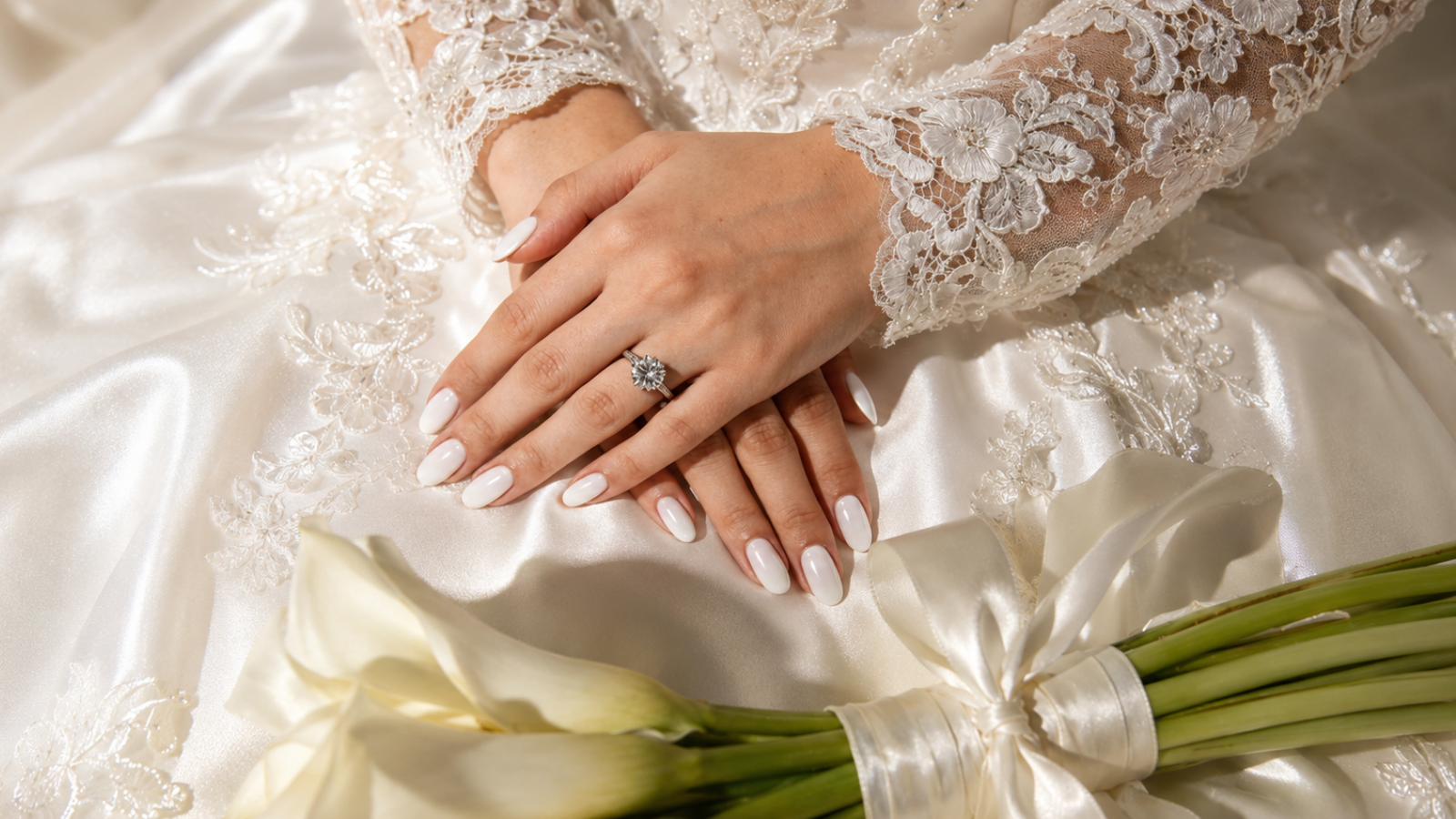
- Milky white gel. A creamy, translucent white that lets the natural nail show through slightly. Not stark white — softer, more organic. It reads as modern and clean without being cold. It tends to work well across many skin tones and nail lengths, and pairs beautifully with dress colors from pure white to champagne to blush.
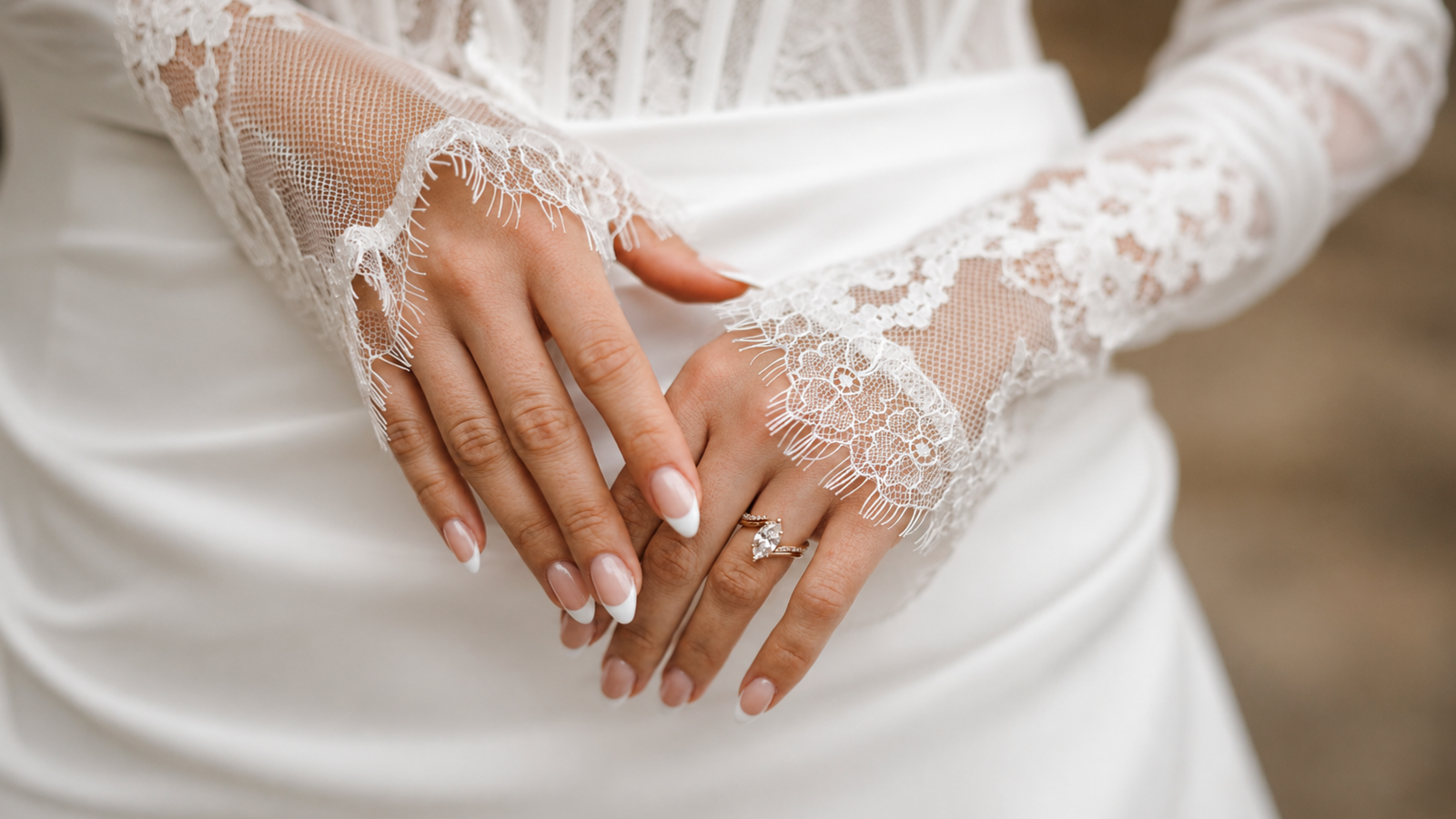
- Refined French tip. The classic, updated: a thinner white tip with a softer transition, sometimes with a barely-there detail at the smile line — a thin gold stroke, a micro rhinestone, a whisper of shimmer in the white. A design that has remained one of the most reliable bridal choices for decades because it works with so many dresses, rings, bouquets, and wedding styles.
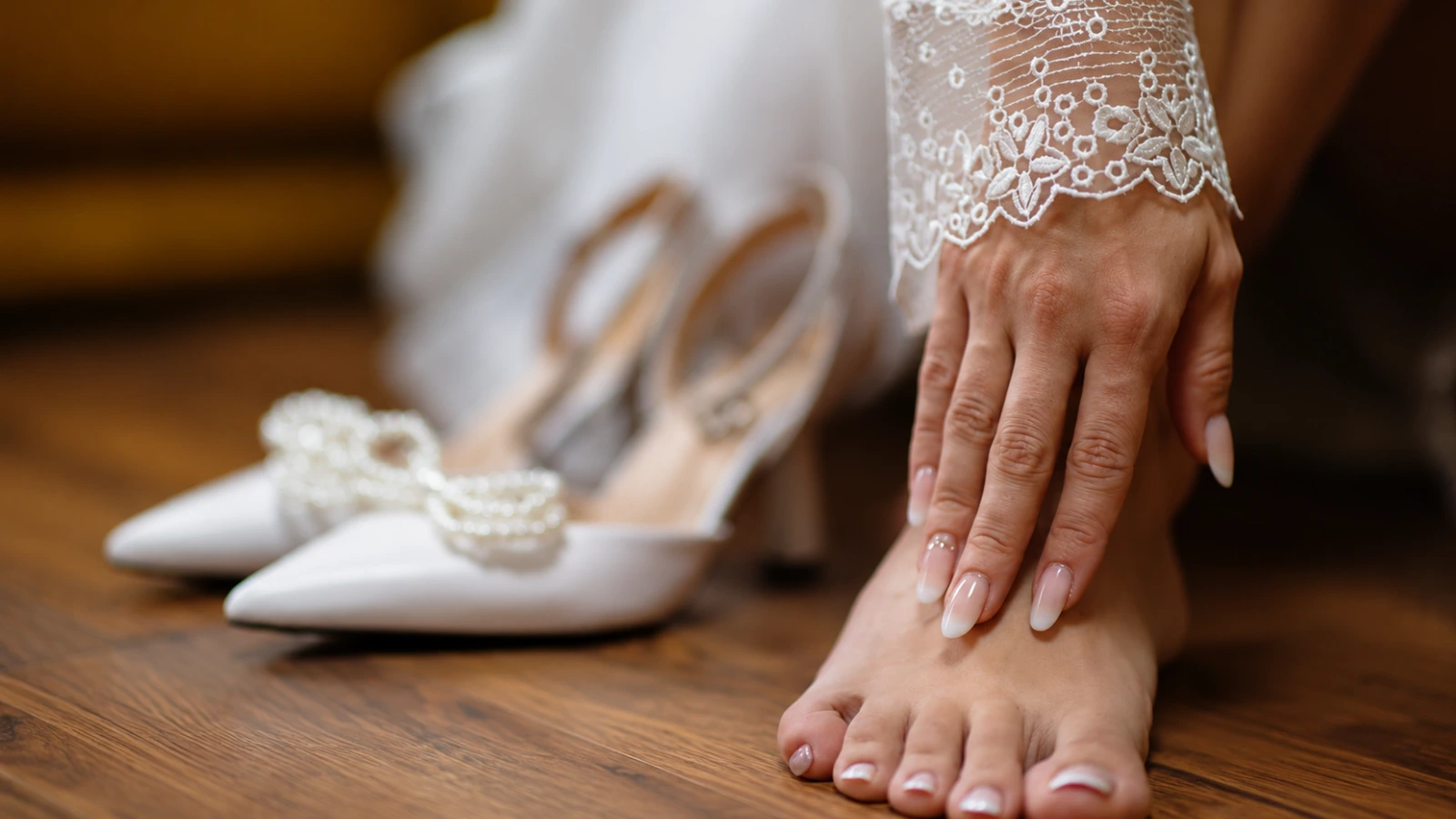
- Sheer pink with pearl accent. A sheer or semi-sheer pink base — barely there in person, beautifully warm in photographs — with a single pearl nail charm on the ring finger or accent nail. Dimensional without being busy. The right choice for brides who want the faintest gesture toward nail art without committing to a full design.
- Perfect nude, nothing else. Sometimes the most confident choice is the most minimal one. One immaculate nude in gel, matched precisely to the skin tone, with a shape that suits the hand and cuticles prepared with genuine care. No art, no accents, no shimmer. The sophistication is entirely in the execution.
Simple Bridal Nail Ideas
Simple wedding nails are not a fallback. They are a deliberate aesthetic choice — and for many brides, the right one. A simple manicure done well ages better in photographs than a complex one done to a standard that was just good enough for the day.
Simple also has a practical advantage: a simpler design is faster to execute at the salon, faster to correct if something goes wrong, and less likely to look overdone against a dress that already has its own texture and detail.
Simple bridal nail ideas that never fail
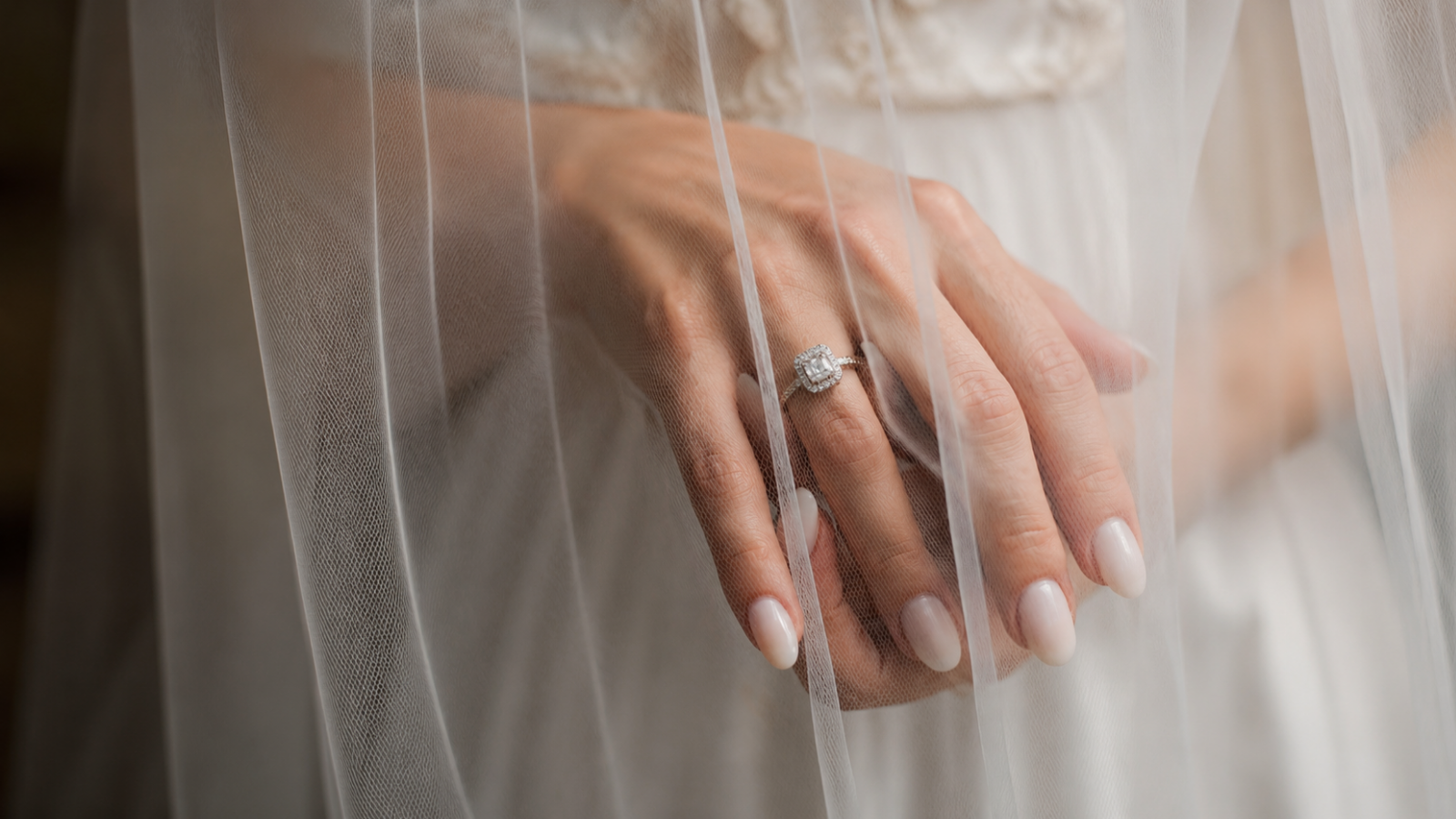
- One clean color in gel, no art. Choose the color that makes your hands look most like themselves — warm nude, sheer pink, soft blush — and let the shape and the finish do the work. This is the simplest and most consistently elegant option for brides who do not feel strongly about nail design.
- Thin-line French tip. A French tip with a thinner-than-classic white line. No thick arc, no chunky smile line. The minimal version looks modern and sophisticated on any nail length.
- Bare shimmer. A clear or near-clear base with a fine iridescent shimmer. Looks almost like bare nails in casual light; catches the light beautifully in photographs. Ideal for brides who rarely wear nail color and want their hands to look like themselves.
- Single accent nail. Nine nails in a clean nude or pink, one ring finger nail in a pearl finish or with a tiny rhinestone at the base. The minimum possible gesture toward bridal nail art — enough to photograph as intentional without dominating the look.
- Sheer pink, any length. A sheer pink that reads as barely-there in person but adds warmth to the skin in photographs. The simplest and most consistently flattering bridal choice for brides who genuinely cannot decide.
Many brides underestimate the simple option because they feel pressure to match the effort they have put into every other wedding detail. The nail does not need to be elaborate to be beautiful. What it needs to do is look exactly right on your hand, in your ring shot, on your specific wedding day.
French Tip Wedding Nails for Brides
French tip wedding nails have remained one of the most requested wedding nail styles at U.S. salons for decades, and the reason is not a lack of imagination. It is that the French tip solves several bridal nail concerns at once: it works with most dress colors, most ring metals, many bouquet styles, and a wide range of skin tones. It reads as elegant without reading as trendy. It photographs cleanly in close-up and does not compete with the ring.
The French tip is not the same as the one from ten years ago. The thick, rounded white arc of the traditional French has given way to a thinner, more refined line with softer transitions. The new versions have more nuance — and more options for brides who want to personalize without abandoning the classic.
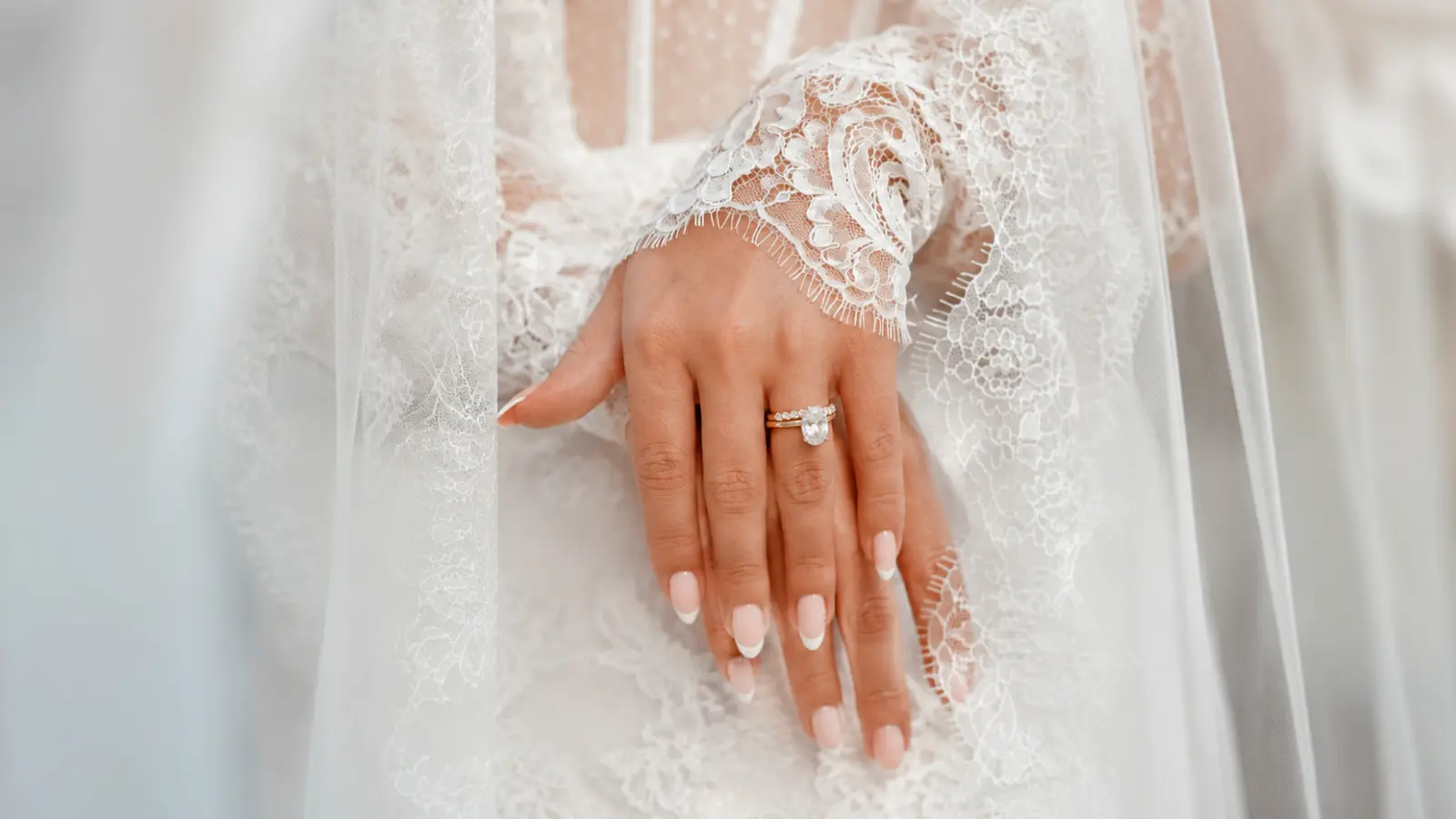
French tip variations for brides
- Classic thin-line French. The white tip, refined. Thinner than the traditional arc, with a transition line that blurs rather than defines. More modern, still unmistakably French, and especially strong for brides who want a classic manicure with a softer finish.
- Gold-line French. The classic French tip with a thin gold line where the white meets the base — at the smile line. Adds a quiet luxury to the design without making it complex. Works particularly well with yellow gold or rose gold engagement rings.
- Shimmer French. The white tip contains a fine shimmer or pearl finish rather than being flat white. Photographs with more dimension than a traditional French. Slightly more bridal than the classic; still entirely appropriate for any style of wedding.
- Micro rhinestone French. A single micro rhinestone or crystal placed at the corner of the smile line. Visible in close-up ring photographs; invisible at normal viewing distance. The right amount of sparkle for brides who want a detail without a statement.
- Baby boomer. Ombré wedding Nails create a soft gradient from nude at the base to white at the tip, without a defined smile line. The most sophisticated French tip variation — it reads as a natural nail extension rather than a painted design. Photographs with particular beauty because the gradient has no hard edge to catch or compete with the ring.
- Colored tip French. The white replaced with a soft champagne, a warm ivory, or a barely-there blush. Dresses the design down slightly from the classic, adds warmth against warmer skin tones. Particularly effective on brides wearing champagne or blush gowns.
One thing many brides do not realize about French tips: the quality of the smile line — the precision of that curved edge where white meets base — is what separates a professional French from one that looks like it was done at home. At your bridal appointment, this is worth checking in bright light before you leave the salon.
White and Milky Wedding Nails
White wedding nails have been building for several seasons and they are now fully established as a bridal choice — not a trend, a classic in progress. The key distinction that most brides do not know before they book: there are at least four different kinds of “white,” and they look dramatically different on the hand and in photographs.
The four whites — and what each does
- Stark opaque white. The most visible white — no natural nail showing through, fully saturated. Makes a statement. Works for brides who specifically want the contrast between a clean white nail and a classic ivory or white gown. Can feel cold on very fair skin tones if the undertone is not matched carefully.
- Milky white. The most popular bridal white. A creamy, semi-translucent white that allows the natural nail to show through slightly. Softer and more organic than opaque white; warmer and more sophisticated. Photographs as intentional without being stark. Works on every skin tone because the translucency adjusts to each person’s natural nail color.
- Sheer white / white jelly. Nearly transparent — the faintest wash of white over the natural nail. Looks almost bare in person; adds a clean luminosity in photographs. The right choice for brides who want white nails but are not sure they can commit to the full version.
- White with pearl overlay. A white base finished with a pearl chrome powder — the most dimensional of the white options. The pearl overlay creates an iridescent quality that shifts between white and soft lavender or blush depending on the light. The glazed donut effect in white. The most photographically interesting of all the white options.
What white nails work best with
White nails are unusually versatile with dress color — counterintuitively, they work as well with a white dress as with a colored one. Against an ivory or champagne gown, a milky white nail reads as an intentional tonal match. Against a blush or dusty rose gown, white nails create a clean contrast that photographs beautifully. Against a classic white gown, white nails read as part of a coherent monochromatic look.
White nails photograph best with platinum, white gold, and silver ring metals. They create more visual competition with yellow gold than nude or pink nails do — not a dealbreaker, but worth knowing before you commit.
Nude and Soft Pink Bridal Nails
Nude and soft pink bridal nails have been the foundation of American bridal nail culture for decades, and the reason is not a lack of creativity. It is that these colors solve the central bridal nail challenge better than any other: they look beautiful on the hands without competing with anything else in the frame. The dress, the ring, the bouquet — nude and pink nails let all of it be seen without adding visual noise.
Choosing the right nude for your skin tone
Many brides choose a nude that does not match their skin tone and spend the wedding day feeling like their hands look washed out or, in the other direction, like the nail color is clearly visible as a separate element. The right nude is the one that looks like a slightly elevated version of your own hand — present enough to be clearly manicured, invisible enough to direct the eye to the ring.
- Fair to light skin tones: Peachy pinks, light blush, soft shell pink. Avoid nudes that are too white on fair skin — they can read as chalky. OPI “Bubble Bath” and Essie “Ballet Slippers” are the most consistently requested options in this category for a reason.
- Medium skin tones: Warm beige, caramel nude, warm dusty pink. Nudes in the warm-brown family look most natural and create the most convincing length illusion. Avoid cool-toned nudes that can look gray on medium complexions.
- Deep and dark skin tones: Rich warm caramel, terracotta nude, mocha pink. The “nude” that reads as natural is deeper and richer. Consulting with the nail technician and showing a reference on a similar skin tone is often more reliable than bringing in a specific bottle.
Soft pink bridal nails — finding the right shade
Pink is the most consistently requested bridal nail color at American salons, and the range within “pink” is wider than most brides expect. The version that is right for a wedding is almost never the most saturated version — it is the one with enough depth to photograph beautifully but enough restraint to pair with the dress.
- Sheer baby pink: Almost translucent. Barely-there in person, softly romantic in photographs. The most delicate bridal option in the pink family.
- Soft blush pink: The most popular single bridal nail color in the current market. A step more saturated than sheer, universally flattering, pairs with every dress color, photographs beautifully in both warm and cool light.
- Dusty mauve pink: A pink with a grayish or brownish undertone. More sophisticated and slightly editorial — particularly effective for fall and winter weddings and for brides whose personal aesthetic runs toward understated rather than sweet.
- Warm rose pink: A pink with enough warmth to read as a color but enough softness to remain bridal. Works particularly well with warm-toned gowns — champagne, blush, antique white — and with rose gold engagement rings.
Pearl and Chrome Wedding Nails
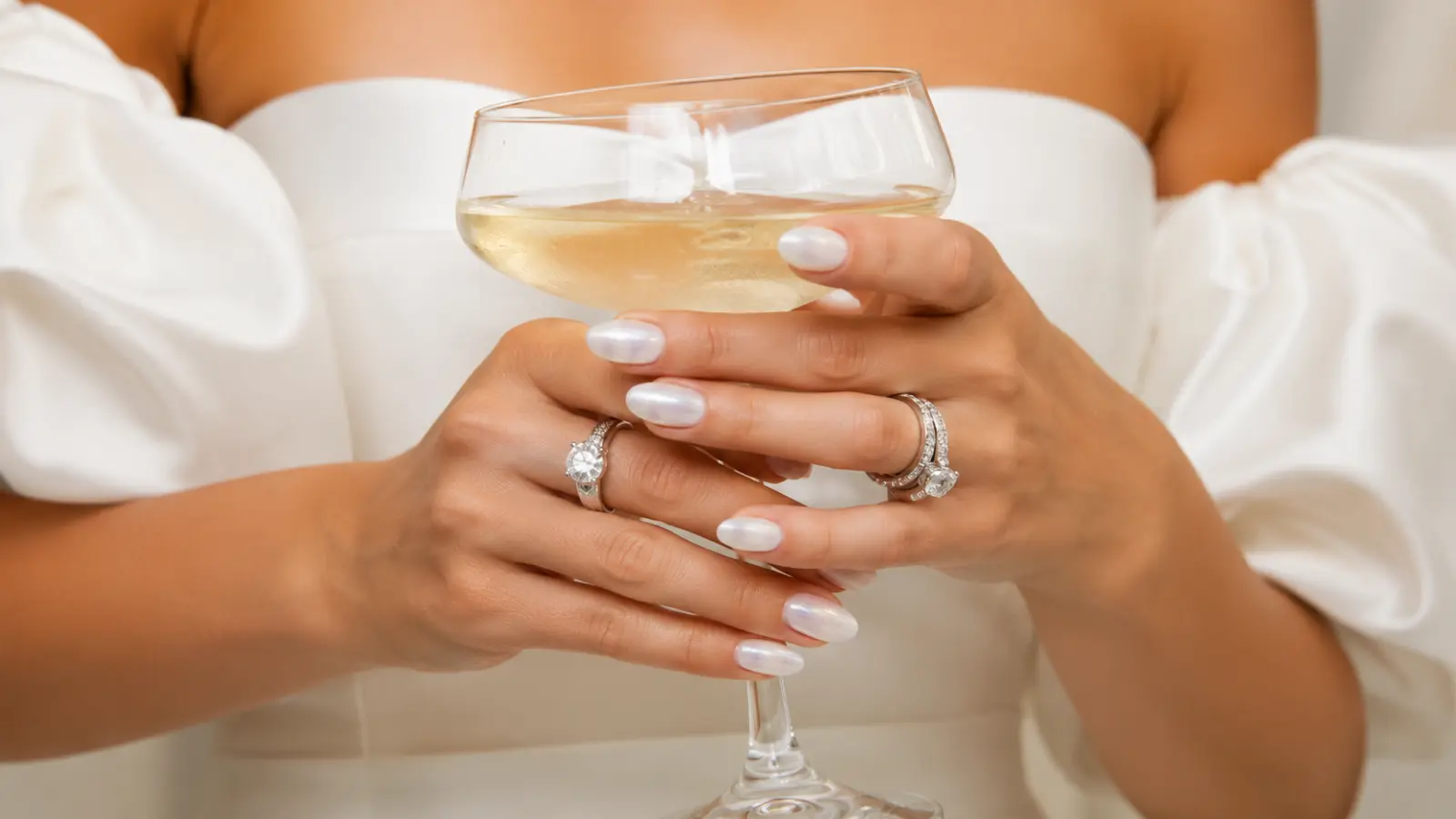
Pearl and chrome finishes have moved from trend to standard at bridal appointments because they solve a specific photographic problem that flat color cannot: dimension. A pearl or chrome nail looks different from every angle — in natural light, in flash photography, in the ceremony candlelight. That variability is not a flaw. It is what makes the nail look alive in photographs rather than flat.
Pearl wedding nails
Pearl nails are not the thick, opaque pearl of a decade ago. They are a finish — an iridescent powder or overlay applied over a base color that creates a soft, shifting luminosity. The most bridal version is the subtle pearl: barely perceptible in person, unmistakably beautiful in a photograph.
The pearl finish works particularly well over a sheer pink or nude base. The combination — a natural-looking base with a pearl overlay — reads as refined and intentional without being decorative. In a ring shot, the pearl quality catches the same light the diamond does, which creates a visual harmony between the nail and the ring that flat color rarely achieves.
Pearl also ages exceptionally well in wedding photographs. Unlike chrome in a specific metallic color or nail art in a current style, a pearl finish is not dateable to a particular moment. It looks bridal and will look bridal.
Chrome wedding nails
Chrome nails — created by rubbing a chrome powder over a fully cured gel base — produce a mirror-like or metallic effect. For bridal purposes, the version that works best is the soft chrome, not the full mirror. The difference matters: a full mirror chrome in silver or gold competes with jewelry in photographs. A soft chrome over a nude or blush base creates a subtle metallic luminosity that adds dimension without announcing itself as a statement.
The most bridal chrome options:
- Pearl chrome over nude: The glazed donut effect — the dominant bridal finish. Reads as luminous skin rather than chrome. The most universally flattering version for weddings.
- Rose gold chrome over blush: A warm metallic quality that pairs particularly well with rose gold engagement rings and warm-toned gowns. More visible than the pearl chrome; still within the range of bridal appropriateness.
- Silver chrome over milky white: For brides who want a clearly visible metallic element. More editorial than the pearl chrome; works for modern, minimalist weddings where a graphic, clean aesthetic is intentional.
What to avoid: a full-coverage mirror chrome in a saturated color — deep blue, electric silver, bold gold. These are statement nails designed to be the focal point of the hand. At a wedding, the ring is the focal point. A chrome that competes with it creates visual tension rather than harmony.
Short Wedding Nails for Brides
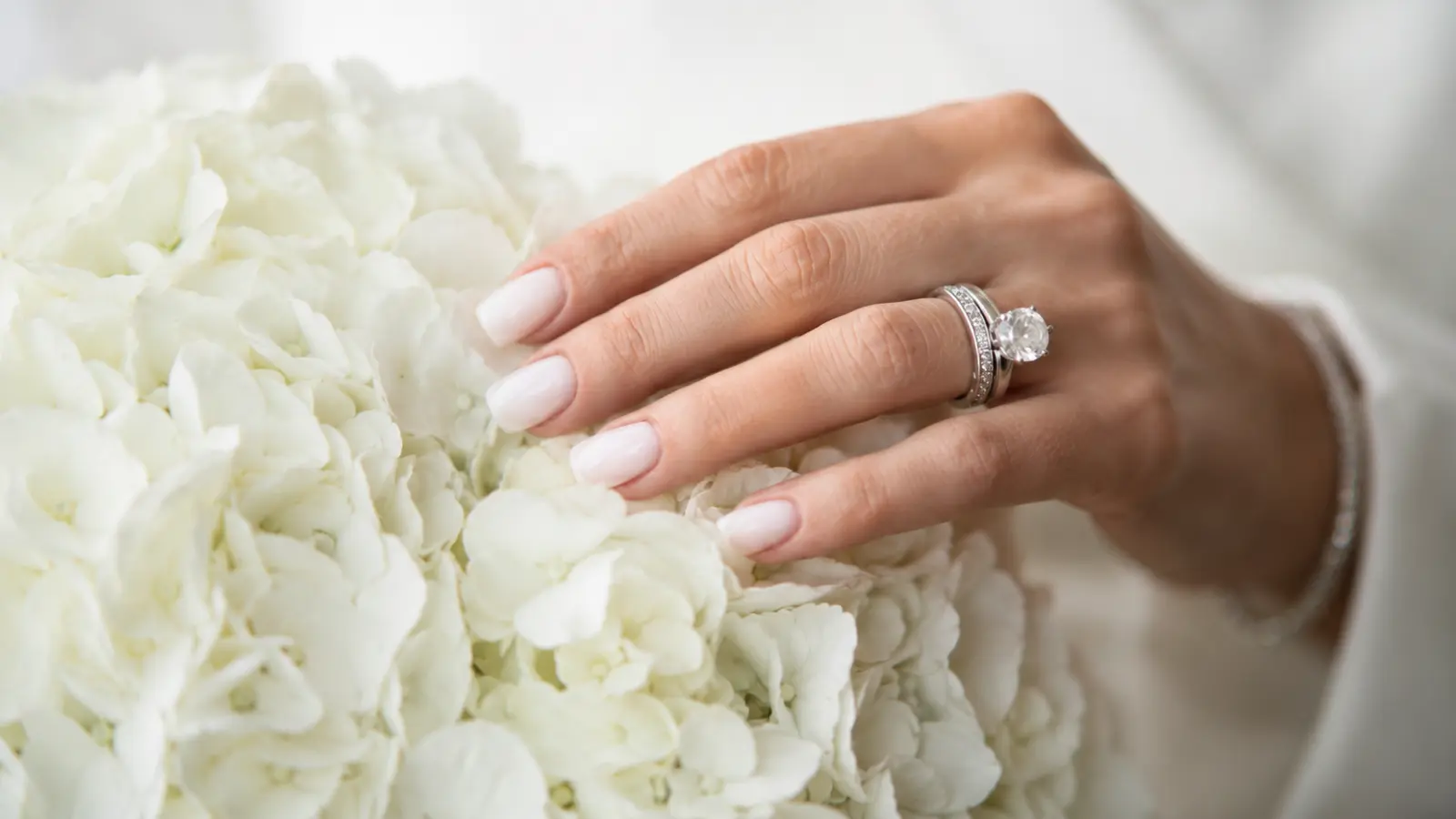
Short wedding nails are not a compromise or a consolation choice for brides. They are a legitimate aesthetic decision — and for many brides, the most honest one. Many women simply do not wear long nails in their daily lives. Choosing dramatically different nail length for the wedding means spending the day aware of how different your hands feel, which is the opposite of how a bride should spend her wedding day.
Short nails also have a specific photographic advantage that longer nails do not: in a ring shot, short nails allow the ring to be the sole focal point. There is no competing length, no dramatic shape, nothing to pull the eye away from the jewelry. A beautifully manicured short nail in a quality finish is a confident, sophisticated bridal choice.
What works best on short bridal nails
- Round or oval shape. Square and squared-off shapes can look disproportionate on a shorter nail. Round softens the edge naturally; oval adds the suggestion of length without requiring it. Either is more flattering than square on a short nail at a wedding.
- Nude or sheer pink. Lighter colors on short nails create the optical illusion of length. A sheer nude allows the whole finger to appear longer than it is — the nail becomes an extension of the skin rather than a separate element.
- Thin-line French tip. A minimal white line at the tip of a short nail creates length without fake extensions. The precision matters more on short nails than long: a thick, rounded arc on a short nail can look heavy and proportionally wrong. The thinner the line, the more elegant the result.
- Pearl and shimmer finishes. A shimmer or pearl overlay adds dimension and catches light on a short nail in a way that flat matte color cannot. It creates visual interest without adding bulk, which is exactly what a short nail needs.
- Negative space detail. A thin line at the base, a delicate crescent at the cuticle, a barely-there geometric element. These designs use the small canvas of a short nail deliberately — the restraint is the design.
What to avoid on short bridal nails
- Very dark or saturated colors: Deep colors on very short nails can make the nail look shorter and the finger look wider. This is not a strict rule — some women carry dark polish on short nails with confidence — but for wedding photography specifically, lighter and more neutral tends to photograph better.
- Elaborate nail art across all fingers: On a small canvas, a full-nail detailed design can look crowded and busy. One accent nail with a delicate element works far better than art on every finger.
- A French tip arc that is too thick: The rounded arc of a traditional French tip is proportionally more visible on a shorter nail. If the arc covers more than a quarter of the nail surface, it reads as heavy. A thin smile line is more flattering on any nail under medium length.
Best Nail Shapes for Brides
Nail shape is one of the most consequential decisions in bridal nail planning — and one that most brides make last, if they make it consciously at all. Shape affects how the ring looks in photographs. It affects how the finger reads at length. It affects whether the nail design works as intended or looks slightly off in a way that is hard to identify.
| Shape | Best For | In Ring Photographs |
|---|---|---|
| Oval | Most hand shapes; any length; universally flattering | The most flattering bridal shape in close-up — elongates naturally and frames the ring without competing |
| Almond | Narrow hands; medium to long lengths; romantic, elongated look | The pointed tip directs the eye toward the ring — one of the most ring-flattering shapes in bridal photography |
| Round | Short nails; practical brides; soft romantic aesthetic | Natural and clean; the nail recedes and lets the ring carry the photograph |
| Soft square / squoval | Brides who want a clean edge without the pointed tip of almond | The most practical elegant shape — clean like square, soft like oval |
| Square | Modern minimalist aesthetic; longer nail beds; graphic looks | Graphic and clean; can make shorter fingers look slightly wider — works best on longer nail beds |
| Coffin / ballerina | Long nails; editorial aesthetic; brides with a maximalist personal style | Statement shape — it reads as intentional and editorial; requires significant length to work proportionally |
| Stiletto | Very editorial; maximum drama; brides whose wedding aesthetic is specifically avant-garde | Striking in photographs but can dominate the ring shot — the nail becomes the focal point rather than the ring |
One thing many brides do not think to do before choosing a shape: try on the ring with the intended shape during the nail trial. A wide pavé band looks different against an oval nail than against a square one. A delicate solitaire on a fine band reads differently next to a coffin nail than next to a round one. The ring-plus-nail combination is what photographs — look at the combination, not each element separately.
How to Choose Bridal Nails That Photograph Well
Most bridal nail guides talk about what looks beautiful. This section talks about what photographs well — which is a related but distinct question. A nail that looks stunning in person can photograph as flat or harsh. A nail that seems almost invisible in person can photograph with a luminosity that elevates every image it appears in.
Understanding how nails photograph is not a minor concern for a bride. Your ring shot will likely be one of the most shared images from your wedding. It will appear on social media, in thank-you cards, in your album, on your wall. Getting the nail right in that specific context matters more than getting it right in the mirror at the salon.
The qualities that photograph well
- Precision at the cuticle. This is the single most important factor in how a bridal manicure looks in a close-up photograph. A slightly uneven cuticle line, a tiny bit of polish over the skin, any imprecision at the nail’s edge — all of it is visible in extreme close-up. Ask your technician to check the cuticle work under a bright light before you leave the salon. This is not nitpicking. This is exactly what makes the difference between a professional result and a good amateur one.
- Finishes that catch light dimensionally. Pearl, shimmer, and soft chrome finishes catch light from multiple angles, which means they look different in every photograph. This creates a sense of life and dimension in images that flat matte color cannot achieve. If you are choosing between two designs and one of them has any kind of light-catching finish, the photographically correct choice is usually the one with the finish.
- Shapes that frame rather than compete. Oval and almond shapes draw the eye toward the ring without competing with it. Square and squoval create a graphic frame that works in certain compositions. Stiletto and coffin direct the eye toward the nail itself, which can pull attention away from the ring in close-up shots.
- Colors that do not create hard contrast with the ring metal. A very dark nail against a white gold ring creates a high-contrast image where both elements compete. A nude or soft pink nail against the same ring creates a harmonious image where the ring is the clear focal point. For brides with platinum or white gold rings: soft, light nail colors. For yellow gold rings: warm nudes, blush, champagne — any warm tone that creates a tonal bridge between the nail and the metal.
What to tell your photographer
Many brides do not realize they can discuss nail photography with their photographer before the wedding. A good wedding photographer will have specific preferences about ring shots — the light direction, the angle, the framing — and knowing your nail design in advance allows them to plan accordingly. Some photographers prefer natural light for ring shots; others prefer flash. The same nail can look completely different in each. If your photographer is willing to discuss it, share your nail design before the wedding day and ask which light they plan to use for the ring shots.
Gel vs. Acrylic: Which Is Right for Your Wedding?
The medium question — gel, acrylic, or press-on — is one that many brides defer to the salon, which is fine, but understanding the distinction helps you arrive at the appointment with a clear brief rather than relying entirely on the technician’s default recommendation.
| Medium | Best For | Longevity |
|---|---|---|
| Soft gel | Most brides — natural look, easy removal, wide color range | 2 to 3 weeks without chipping |
| Hard gel / BIAB | Brides with brittle nails; brides wanting slight length addition without acrylic | 3 to 4 weeks; must be filed off |
| Acrylic | Brides who want significant length or a specific dramatic shape (coffin, long almond) | 3 to 4+ weeks; requires fills |
| Press-on (quality brand) | Destination weddings; brides wanting a specific design; guests without salon access | 1 to 2 weeks with nail glue |
For most brides, soft gel is the right answer. It looks natural because it is applied over the natural nail, not an extension. It lasts long enough to cover the wedding and the honeymoon. It is the fastest to apply, the easiest to adjust if something goes wrong, and the most widely available at quality salons in the U.S.
Acrylic is the right answer when a bride wants a specific length or shape that her natural nails cannot achieve — a very long almond, a coffin shape, a dramatic stiletto. The acrylic process is more involved, requires a skilled technician to look convincing in close-up photographs, and takes longer to remove. It is not the default bridal choice; it is the right choice for a specific aesthetic goal.
Builder gel and BIAB are worth knowing about if your natural nails are brittle or damaged. Starting BIAB treatments 6 to 8 weeks before the wedding can strengthen and condition natural nails in time for the wedding appointment, so the final gel manicure is applied to a healthy nail rather than a compromised one. Ask your technician about this option at the booking call — not on the day of the appointment.
When to Get Your Nails Done
Timing is one of the most consistently mismanaged parts of bridal nail preparation. The answer most brides have heard — “get them done the day before” — is close but incomplete. Here is what actually matters.
- 6 to 8 weeks before: Start BIAB or nail strengthening if your nails need conditioning. This window is also when you should book the trial appointment — not the week before the wedding.
- 4 to 6 weeks before: The nail trial. Test the exact design, shape, and color you plan to wear. Bring your ring and a dress photo. Make changes now while there is time.
- 1 to 2 weeks before: If you are getting acrylic extensions or hard gel, book this appointment now. Extensions need time for any adjustment — a nail that lifts or feels wrong at this stage can be corrected. A nail that lifts the morning of the wedding cannot.
- 1 to 2 days before: The ideal window for the wedding manicure. Gel applied two days before will be fully cured, pristine on the wedding day, and still beautiful for honeymoon photographs. This is the sweet spot — fresh enough to look perfect, early enough to avoid morning-of stress.
- Morning of the wedding: Only if absolutely unavoidable, only for touch-ups, never for a full manicure. Scheduling a full nail appointment on the morning of the wedding adds logistical pressure to an already full schedule and creates a scenario where any problem — a chip, a smudge, a shade that looks wrong against the dress — has no solution.
Bridal Nails Inspiration Board
Before choosing your final bridal manicure, it helps to see nail ideas across different dress styles, ring metals, nail shapes, skin tones, and wedding photography settings. Explore our bridal nails inspiration board for soft pink nails, milky white manicures, refined French tips, pearl chrome finishes, short bridal nails, and elegant wedding nail ideas to save for your appointment.
Final thoughts
The best bridal nails are rarely the ones that try the hardest.
They are the ones that feel intentional — the shape that naturally flatters the hand, the finish that catches light beautifully in photographs, and the color that still looks elegant years later when trends around it have already changed.
That is why the strongest bridal nail choices are usually built around refinement rather than excess. A soft nude gel, a milky white finish, a refined French tip, or a subtle pearl chrome often photographs more beautifully than the most elaborate nail art in the salon.
And when the manicure truly fits the bride, the nails stop feeling like a trend and start feeling like part of the wedding itself.
Frequently asked questions (FAQ)
What nail style is best for a bride?
Soft pink gel, milky white nails, glazed pearl chrome, nude polish, and refined French tips are among the most timeless bridal nail styles because they photograph well and complement most wedding dresses.
What nail shape looks most elegant for weddings?
Oval and almond nail shapes are considered the most elegant because they elongate the fingers and photograph beautifully with engagement rings.
Should bridal nails be long or short?
Both can look beautiful. Short nails create a cleaner ring-focused look, while longer almond nails create a more romantic and editorial effect.
When should a bride get her nails done?
Most brides schedule their manicure 1 to 2 days before the wedding for the freshest result in close-up photos.
Are French tip nails still popular for brides?
Yes. French tip nails remain one of the most requested bridal nail styles because they look timeless, elegant, and work with every dress style.