Choosing the perfect wedding dress with veil is about creating one beautiful, cohesive bridal look—not selecting two beautiful pieces separately. The right veil should enhance your dress, highlight its best features, and feel like a natural extension of your overall style.
Your dress silhouette, neckline, fabric, embellishments, train, and even your venue all influence which veil will create the most balanced result. That’s why the same veil can look breathtaking with one gown and completely out of place with another.
This guide explains exactly how to match your wedding dress with the perfect wedding veil, helping you confidently choose the right style, length, fabric, and finishing details for your bridal look.
Does the Veil Have to Match the Dress?
This is one of the most commonly searched questions in bridal veil shopping, and the answer is clear: no, the veil does not need to match the dress exactly. But that answer needs context to actually be useful.
Exact shade matching is not necessary and, practically speaking, is often impossible. Ivory tulle and ivory satin read differently under the same light because of the way different fabrics absorb and reflect light. A veil that is technically the same color as the dress can look noticeably off once both are together in a bright salon or outdoor setting. What actually matters is that the veil is in the same tonal family as the dress — warm with warm, cool with cool — and that any difference between the two is small enough to read as intentional, not accidental.
On the detail side, exact matching also works against you. A veil with the same lace pattern as the dress, or pearl beading that precisely mirrors the dress’s embellishment, tends to flatten both elements. The eye needs some variation to read the two pieces as complementary rather than redundant. The goal is harmony, not duplication. Exact matching of color, fabric, and detail in the same look often makes the whole thing read as over-coordinated in photos in a way that a slight tonal variation would not.
Veil Color and Undertone: What to Know
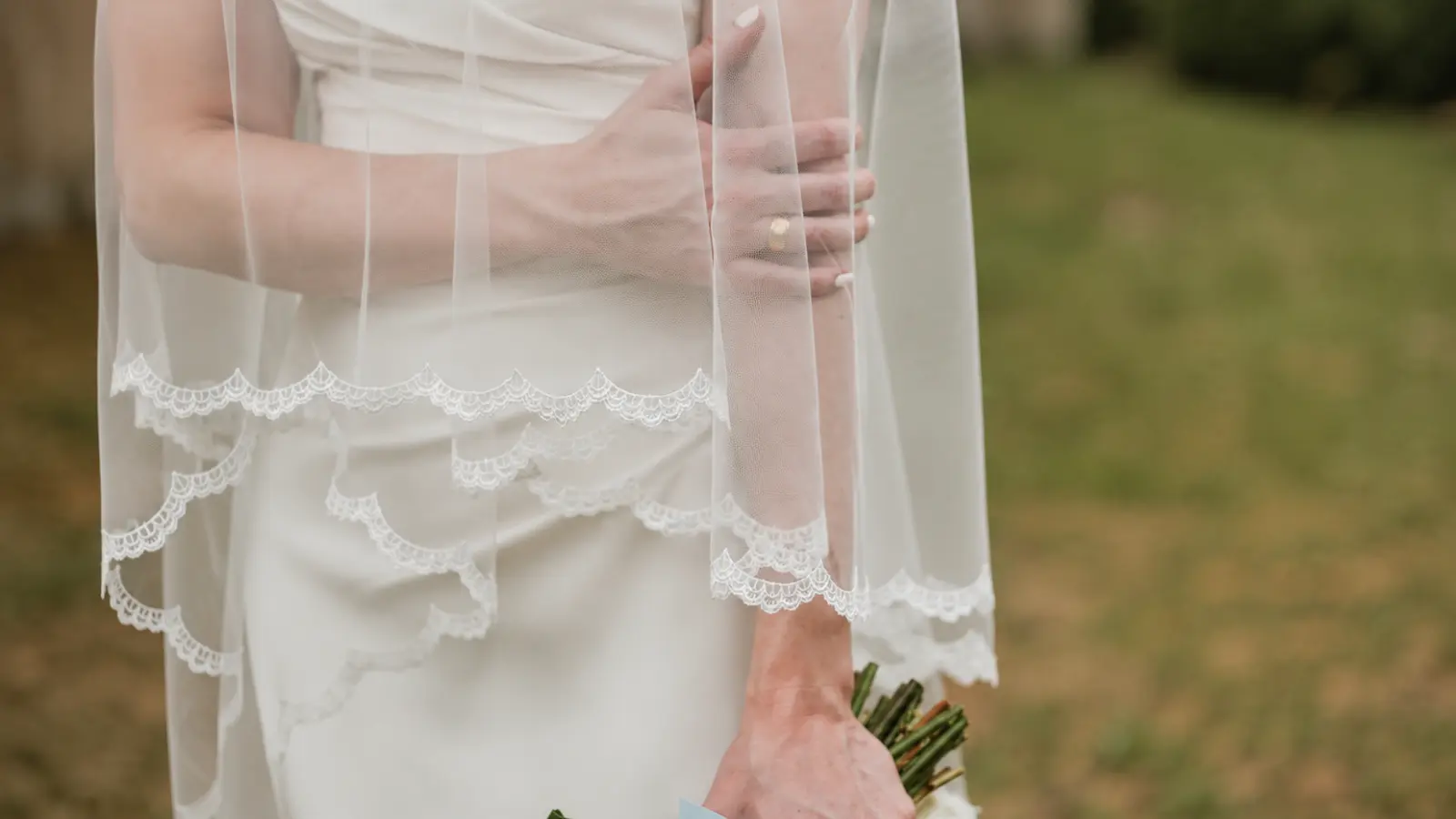
Wedding veils come in a range of whites and off-whites that are easy to blur together in a catalog but read very differently in person and in photos. Understanding the basic spectrum before your appointment saves a lot of back-and-forth when you’re holding samples up to your dress.
The main options in American bridal retail are bright white (a pure, cool white), soft white or diamond white (a slightly warmer white with no yellow tones), ivory (a creamy, warm off-white), and champagne (a warm beige-gold tone). Some veils are also available in blush, which reads as a very soft pink-ivory. Lace veils can introduce their own undertone depending on how the lace was treated.
The practical rule: match the undertone of the dress, not the shade. A warm ivory dress with a cool bright-white veil will look mismatched even from a few feet away. An ivory dress with an ivory veil in a slightly different weight or fabric reads harmoniously. When you go to the salon, bring a swatch or a photo of the dress in good natural light — the showroom lighting at most bridal salons is warm-toned and will make everything look closer together than it actually is.
One common worry is unnecessary: a small tonal difference between the dress and veil, when both are in the same warm-ivory family, typically reads as intentional layering rather than a mistake. Brides who spend months anxious about a half-shade difference often can’t identify it in their own wedding photos. What the camera and the eye register is the overall composition, not the precise Pantone match.
Matching by Dress Silhouette
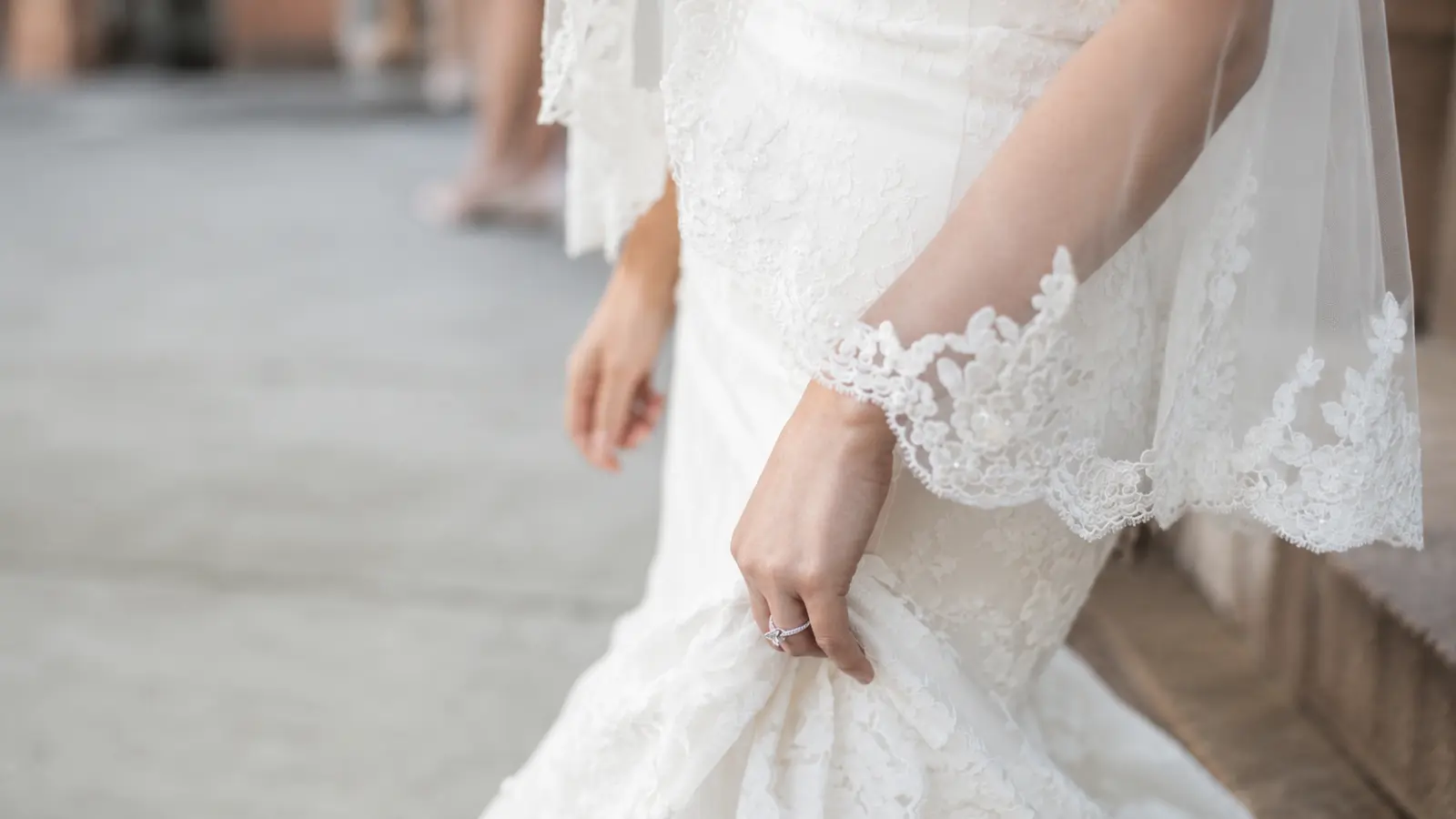
Silhouette is the starting point for most pairing decisions because it determines proportion — how much visual volume the dress occupies, and therefore how much the veil needs to hold its own without overwhelming or disappearing against it. Here’s how each major silhouette interacts with veil length and different wedding veil styles.
Ballgown and Full-Skirt Dresses
A ballgown has significant volume at the skirt, and veils need to be proportionate to that scale to avoid looking small against the dress. Fingertip, chapel, and cathedral lengths are the natural territory here. A veil that falls well above the skirt’s fullest point tends to read as an afterthought on a ballgown, while longer options — particularly chapel through cathedral — create the proportional balance the silhouette demands. Two-tier veils with a blusher pair naturally with ballgowns for formal ceremonies, reinforcing the traditional bridal vocabulary the silhouette already carries.
A-line Dresses
The A-line is the most veil-forgiving silhouette. It doesn’t have the extreme volume of a ballgown or the fitted drama of a mermaid, which means almost any veil length reads proportionately against it. Elbow through cathedral all work. The primary decision with an A-line shifts to the dress’s embellishment level and neckline rather than silhouette — those variables carry more weight here than the shape itself.
Mermaid and Trumpet Dresses
Mermaid and trumpet gowns are fitted through the body and flare dramatically at the hem. The visual vocabulary is elongated and high-drama, and the veil choices that work best either echo that drama or provide a deliberate counterpoint. Cathedral or chapel length in a single-tier or flat drop style emphasizes the vertical line. A short birdcage veil, by contrast, can read as intentional modern contrast. Mid-length veils — waltz or elbow — often look unresolved against a very fitted skirt because they interrupt the elongated line without providing enough length to balance it. See our veil lengths for measurements on each of these options.
Sheath, Slip, and Column Dresses
Minimalist and architecturally clean dresses have a quieter visual profile, and veils pair best when they don’t add volume or competing texture at the hip and thigh. A flat drop veil at fingertip or chapel length works beautifully — it adds presence without disrupting the clean line. A gathered full veil in a style with significant volume can compete with the sleekness the dress creates. The cape veil, which attaches at the shoulders rather than the crown, is also an effective choice here because it creates drama at the back without adding side-body volume.
How Neckline Changes the Equation
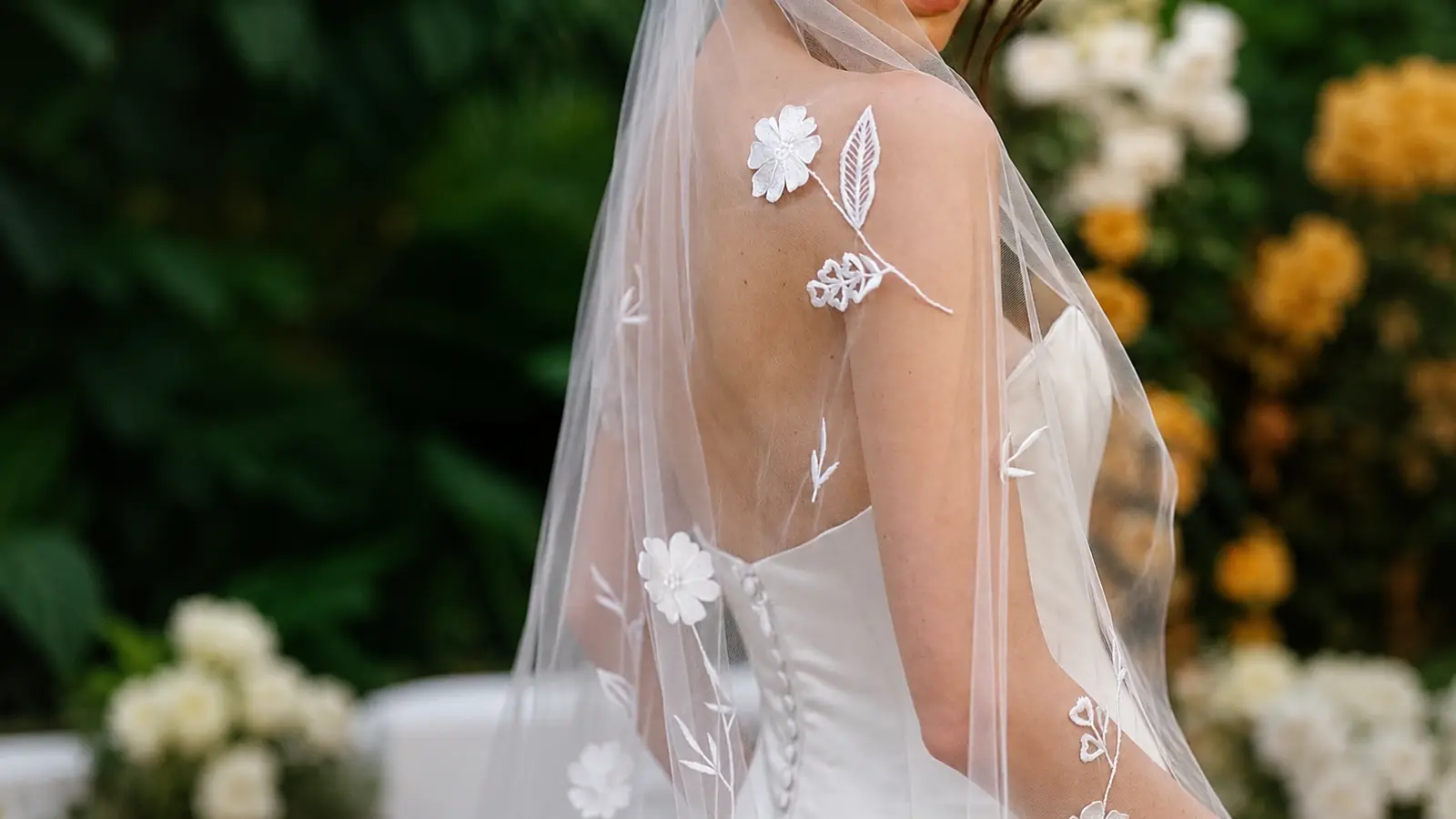
Neckline is one of the most underrated variables in dress-veil pairing — and one of the most practically consequential. The veil falls past the head, which means it passes directly through the neckline zone before reaching its final length. That relationship affects what gets emphasized, what gets obscured, and where the eye travels on a dressed bride.
Open Back Dresses
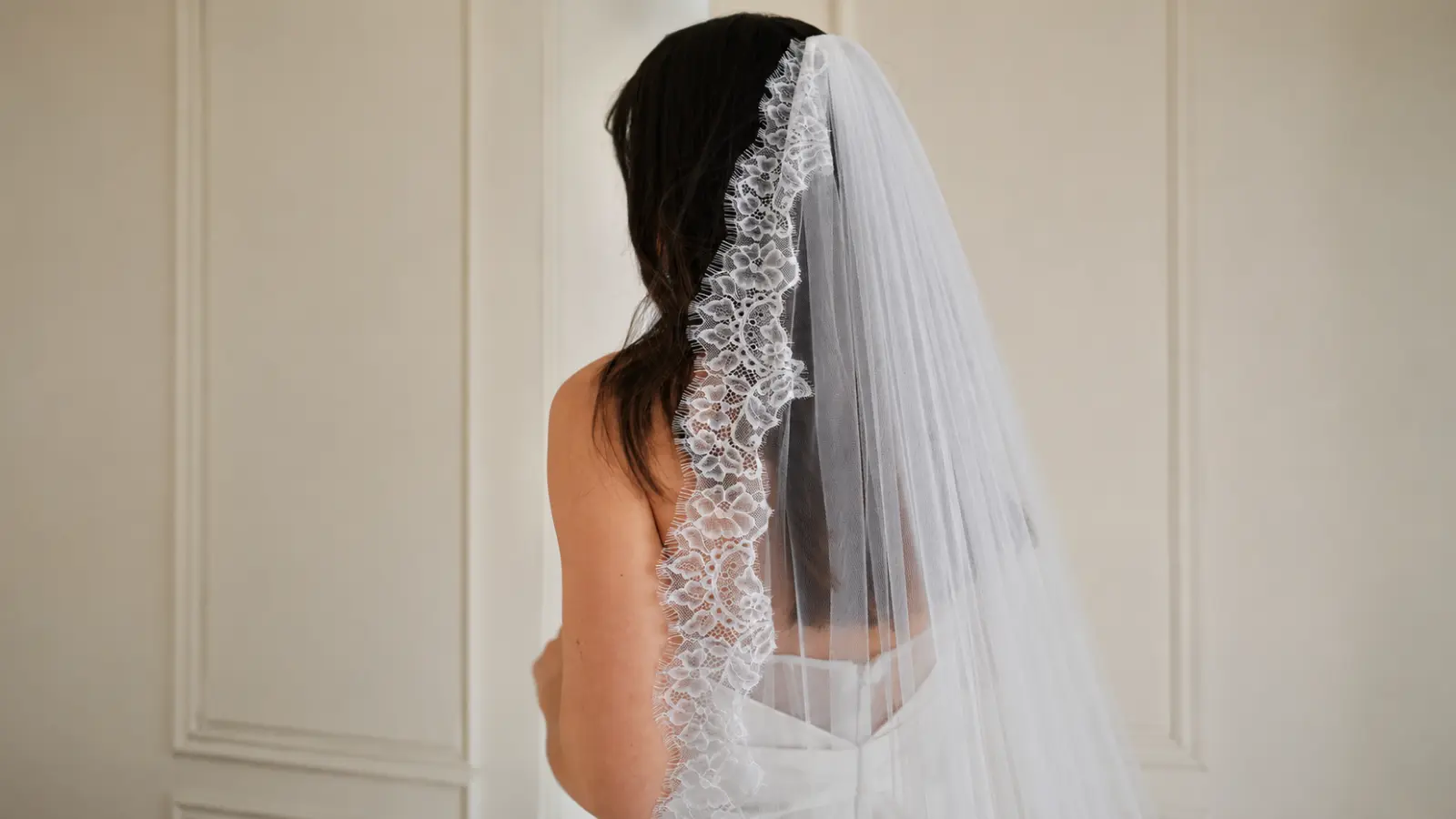
An open back is a focal point — often the primary design moment of the dress. The veil’s attachment point and its fall determine whether that detail is visible, partially covered, or obscured entirely. A single-tier veil attached at the crown allows the back to show as the fabric falls to either side. A two-tier gathered veil, particularly at chapel or cathedral length, can sit squarely over the back opening when the bride is standing still. If the open back is the visual center of your dress, test the veil from behind during the appointment: walk away from the mirror, have someone photograph your back, and see how much coverage the veil creates in motion versus standing. Attaching the comb slightly lower, toward the nape, is a technique that helps the veil fall in a way that clears the back more cleanly.
High-Neck and Illusion-Neck Dresses
A high neckline — whether a true high collar, an illusion lace neck, or a Sabrina neckline — often means the dress’s detail is concentrated at the top of the body. A veil placed close to this zone needs careful consideration: too much competing detail near the face and neck (a lace-edged veil against an illusion lace neckline, for example) can create visual noise. A simple, plain-edge veil placed cleanly at the crown tends to work better here, letting the neckline detail read without interruption.
Off-Shoulder, Strapless, and Sweetheart Necklines
These necklines place the visual interest at the chest and décolleté. They are open necklines, which means there’s no structural detail competing with the veil in the neck zone. This gives you more flexibility with edge details and embellished veils — a lace edge or pearl trim registers clearly and harmoniously against an unembellished strapless or off-shoulder bodice. The veil falls cleanly past bare skin rather than competing with fabric detail near the face.
V-neck and Plunge Necklines
Deep V-necks direct the eye downward along the center front of the dress. The veil falls behind, which means there’s less direct interaction at the front than with a high or illusion neckline. The primary consideration is the back attachment: a veil placed at the crown with a deep plunge will fall cleanly away from the front detail. A two-tier veil can be particularly elegant here — the blusher frames the face and the back layer falls independently.
Matching by Dress Embellishment Level
Embellishment level is one of the clearest signals for how much detail the veil should carry. The principle is straightforward: a heavily decorated dress typically needs a quieter veil, and a plain dress gives the veil room to carry more interest. When both elements are highly decorated, they tend to compete rather than complement.
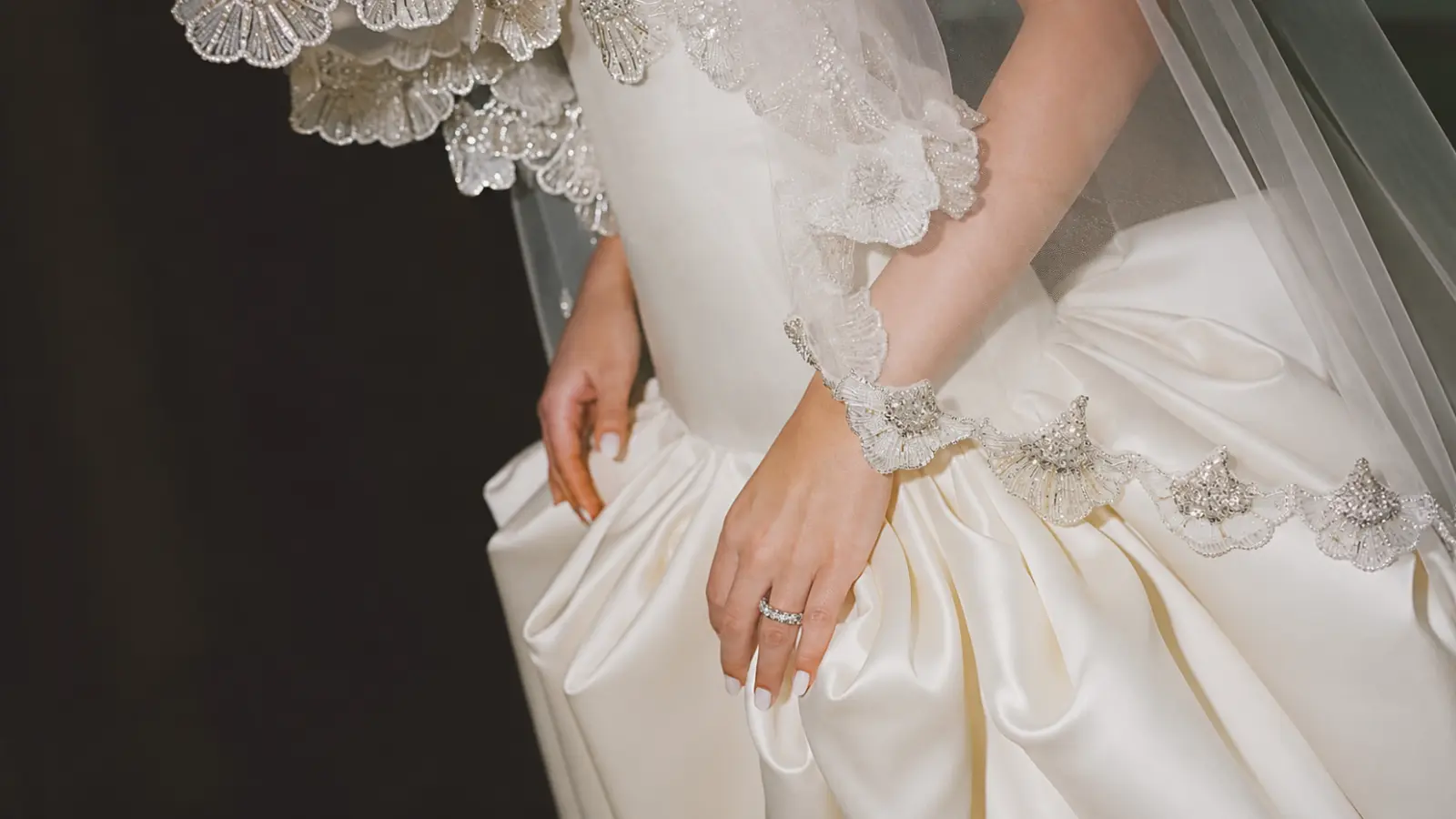
A heavily embellished dress — dense beading, heavy lace, intricate embroidery, or 3D floral appliqués — has already claimed the visual space. A simple wedding veil with a raw edge, rolled edge, or thin horsehair trim keeps the attention where the dress has earned it. A heavily decorated veil against a heavily decorated dress risks creating a look where no single element reads clearly in photos.
A moderately embellished dress — some beading or lace trim, but not all-over — gives you more flexibility. A lace-edged veil, a pearl trim, or a scattered embellishment can complement without overwhelming. The key is ensuring the veil’s detail is at a different scale than the dress’s — delicate veil trim against a more prominent dress motif, for example.
A minimalist or plain dress opens up the most options for the veil. This is where a mantilla, a heavily lace-edged veil, a pearl-scattered veil, or an embroidered style can carry real visual weight without fighting anything. The dress becomes the canvas; the veil provides the interest. For brides with plain gowns who want a significant veil statement, this is the combination that works best.
Dress Fabric and Veil Fabric: The Harmony Principle
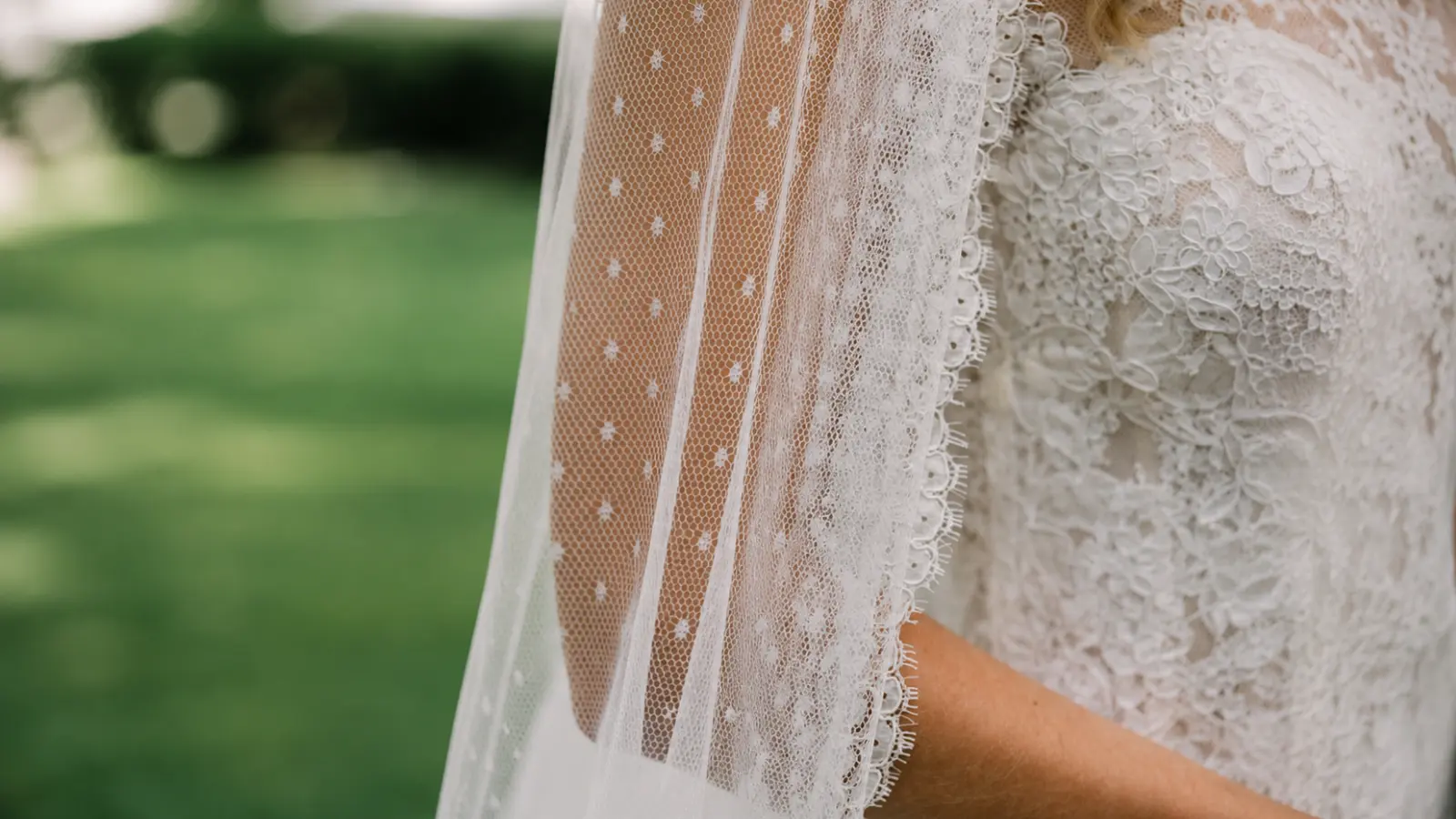
Fabric texture is a variable most brides overlook, but it has a real effect on how the overall look reads. The principle is tonal harmony between materials: fabrics with similar weights and drape qualities tend to look cohesive together, while mismatched weights can create a visual discontinuity even when the color and detail are well-matched.
A satin dress has a smooth, reflective surface. It pairs naturally with a veil that has some weight and drape — standard bridal tulle works well, but silk tulle reads even better alongside satin because its softer fall and luminosity are in the same weight class as the fabric. A very stiff, structured veil against fluid satin can look incongruous.
A lace dress — particularly an all-over or primarily lace gown — has textural complexity built into the fabric. A simple plain veil in standard tulle keeps the focus on the lace and doesn’t create additional texture competition. If the veil has lace, the scale and weight of that lace should differ meaningfully from the dress’s lace to avoid looking like the same element repeated twice.
A crepe or georgette dress has a matte, soft drape. Silk tulle or lightweight chiffon in the veil reads harmoniously with these matte fabrics. Standard bridal tulle — slightly stiffer and shinier — can sometimes contrast more than flatters against a crepe gown. Worth checking in the salon with samples side by side.
A tulle ballgown has volume and softness built into the skirt. A veil in the same or similar tulle weight creates a unified, continuous bridal silhouette. A very stiff organza veil against a soft tulle skirt can look like two different visual languages.
For a full breakdown of veil fabric options and their properties, see our wedding veil materials.
Specific Dress Types, Answered
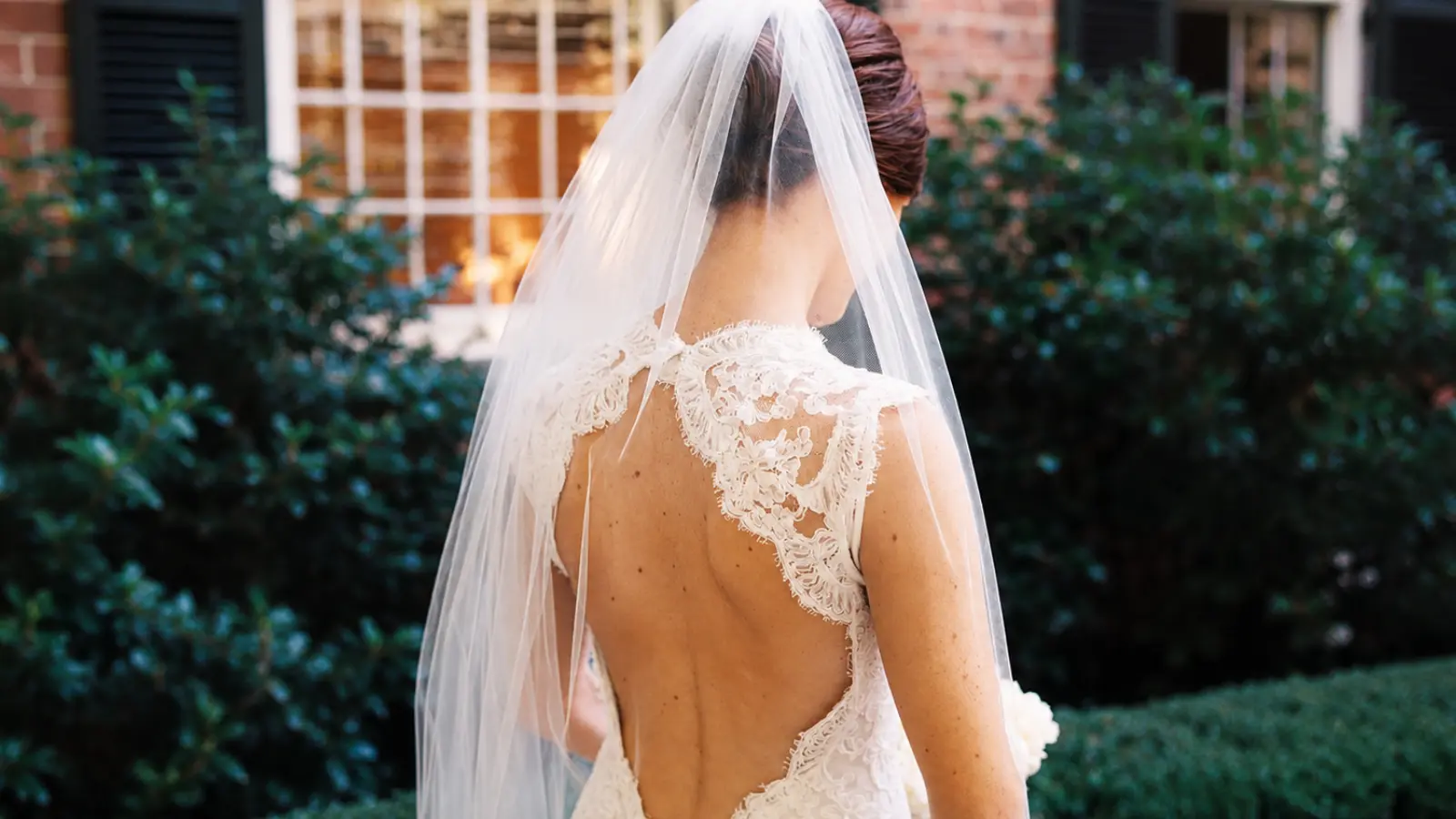
Beyond silhouette, certain dress types come with their own specific pairing logic. Here’s what to know about the dress types brides most often search for veil guidance on.
Lace Wedding Dress
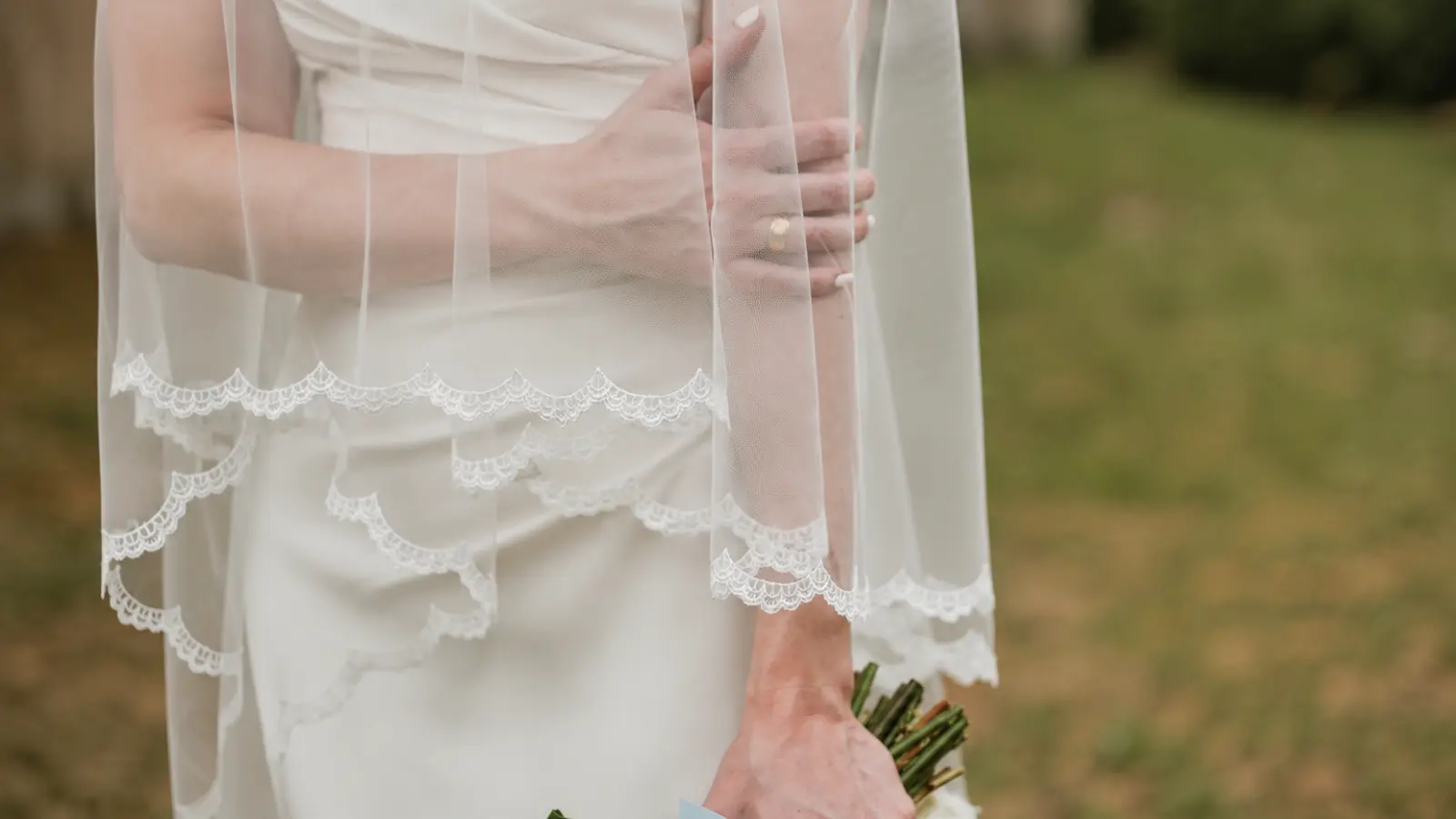
The primary risk with a lace dress and a lace veil is that both read as the same visual element used twice. A mantilla veil is the one exception — the all-over lace of a mantilla works with a lace gown when the lace types are noticeably different in pattern, weight, or construction. For any other veil style with lace edge or lace trim, choose a lace that contrasts in scale with the dress’s lace: a small scallop against a dense Chantilly, or a bold floral Alençon edge against a light eyelash lace gown. A simple plain veil is the safest choice and often the most elegant with a lace gown. Our lace wedding veil covers this pairing in detail.
Beaded or Crystal-Embellished Dress
A beaded dress catches light actively — sequins, crystals, and embroidery all have visual weight and surface interest. The veil’s job alongside a beaded gown is to add movement and presence without adding competing light-catching elements. A simple tulle veil at a length that moves when the bride walks creates the necessary contrast: light and fluid against structured and textured. If any veil detail is used, keep it minimal — a thin horsehair edge or a barely-there rolled finish. Pearl or crystal veil edges against an already-beaded gown can look chaotic in photos.
Simple Satin or Crepe Dress
A clean satin or crepe dress is one of the most flexible canvases for a veil. The lack of surface texture or embellishment means the veil can carry more without competing. A mantilla at chapel length, a two-tier veil at cathedral, a lace-edged fingertip veil, or a pearl-trimmed style all work here. The choice shifts to aesthetic preference and venue formality rather than dress compatibility. One consideration: the veil’s weight and drape should feel consistent with the dress — a very stiff, structural veil alongside a soft fluid crepe can look mismatched in its movement even if the color is right.
High-Neck or Long-Sleeve Dress
High-neck and long-sleeve dresses have a quieter, more refined visual vocabulary. They tend to read most cohesively with simpler, less embellished veils that don’t clutter the neck and face area. A single-tier plain veil at fingertip or chapel length, or a flat drop veil in a slightly longer length, tends to be the most harmonious pairing. Very heavy or wide lace edges near the face can compete with illusion lace detailing at the neckline.
Short and Tea-Length Dresses With a Veil
Short dresses and veils is a pairing that makes some brides hesitant — the instinct is that a veil belongs with a full-length gown. That instinct is worth examining, because it’s not accurate. Short dresses and veils can work beautifully, and the rules are fewer than most brides expect.
The proportional principle that matters most: avoid lengths that split the difference awkwardly. For a tea-length dress, short wedding veils such as shoulder or elbow styles read proportionately and keep the visual weight near the top of the look. A very short birdcage veil on a cocktail-length dress creates a complete, polished look that doesn’t try to do too much. What tends to look unresolved is a mid-length veil — waltz or knee — on a short dress, because the veil’s hem and the dress’s hem end up competing in the same visual zone.
The case for a long veil on a short dress is different: it’s a deliberate, high-contrast choice that can look intentional and striking, particularly from behind. A cathedral-length veil on a tea-length gown creates an interesting juxtaposition. The key is committing to the contrast rather than landing somewhere in the middle. When it works, it reads as a considered fashion statement rather than an accident of scale — but it benefits from deliberate coordination with the rest of the styling.
Dress and Veil Pairing Quick-Reference Table
This table pulls together the main pairing recommendations by dress type, covering recommended veil length, detail level, and what to avoid. It’s a starting point before the appointment, not a final answer — trying veils on with your actual dress is the only way to confirm what works.
| Dress Type | Best Veil Length | Best Veil Detail | Avoid |
|---|---|---|---|
| Ballgown, unembellished | Fingertip to cathedral | Lace edge, pearl trim, or simple plain | Very short veils that disappear against the skirt volume |
| Ballgown, heavily beaded | Fingertip to chapel | Simple, plain edge | Crystal or heavily embellished veils that compete with the beading |
| A-line, any embellishment | Elbow to cathedral | Flexible — follow embellishment rule | Nothing excluded; use detail rule based on dress embellishment level |
| Mermaid or trumpet | Chapel or cathedral; or very short | Simple or plain; or bold lace on plain dress | Mid-length veils that interrupt the elongated silhouette |
| Sheath or slip dress | Fingertip to chapel; drop style | Simple or delicate edge; cape veil also works | Very gathered or full-volume veils that add unwanted side bulk |
| Lace dress, all-over lace | Any length | Simple plain edge; mantilla if lace types differ clearly | Matching lace types on both veil and dress |
| Simple satin or crepe dress | Any length | Lace edge, pearl, mantilla, two-tier — high flexibility | Very stiff or structural veil fabrics against soft, fluid dress |
| High-neck or long-sleeve dress | Fingertip to chapel | Simple or plain edge; minimal near the face | Heavy lace edge that competes with illusion neckline detail |
| Short or tea-length dress | Shoulder, elbow, or very long for contrast | Simple or birdcage style; veil should feel proportionate | Waltz or ballet length — awkward mid-point between dress and floor |
| Open-back dress | Any length — test from behind in salon | Simple or sleek; consider comb placement carefully | Very full gathered veil that obscures the back detail when standing |
One thing no table can fully capture: the interaction between a specific veil and a specific dress in a specific light. These recommendations will narrow the field substantially, but the appointment is where the final call gets made.
Common Pairing Mistakes to Avoid
Most dress-veil pairing mistakes come down to making decisions in isolation — choosing the veil without the dress information, or choosing based on the veil alone without thinking about how the two interact. Here are the most common ones worth knowing before you shop.
- Choosing the veil before the dress is confirmed. The veil has to work with the actual dress you’re wearing, not an approximation. If your dress isn’t finalized, hold off on committing to a veil. Even a small change in dress embellishment or neckline can make a previously chosen veil work less well.
- Ignoring the train interaction. A veil that ends mid-train creates a visual stutter — two layers of fabric at competing lengths rather than one unified composition behind the bride. If your dress has a train, know its length and bring that measurement to the appointment. The veil should extend past the train or fall at a clearly shorter point.
- Matching lace identically. The same lace type used in both dress and veil tends to flatten both. Choose different scale, different weight, or different pattern. A plain veil alongside a lace dress is almost always more elegant than a same-lace combination.
- Testing the veil standing still. The relationship between a veil and an open back, or a gathered veil and a fitted mermaid silhouette, changes in motion. Walk in the veil, turn, and have someone photograph your back before deciding. What looks one way in a mirror can read very differently when you’re moving.
- Letting the tonal anxiety take over. A small tonal difference between veil and dress — both in the ivory family, but slightly different shades — is normal and typically registers as intentional layering in photographs rather than a mistake. The condition to avoid is a warm-toned dress with a cool-white veil, or vice versa. Within the same undertone family, slight variations are fine.
Most of these come back to the same preparation: know your dress details — silhouette, embellishment level, neckline, train length, and fabric — before the veil appointment. That information is what makes the decision faster and more confident.
Wedding Dress With Veil Inspiration
Discover beautiful wedding dress with veil inspiration for every bridal style, from timeless cathedral veils and romantic lace designs to modern minimalist looks. Explore elegant pairings, stunning bridal combinations, and expert styling ideas to help you find the perfect veil for your wedding dress, silhouette, and overall bridal vision.
Create a Bridal Look That Feels Complete
The perfect wedding dress and veil don’t need to match exactly—they simply need to belong together. When the silhouette, proportions, fabrics, and details work in harmony, the entire bridal look feels effortless, elegant, and uniquely yours.
Now that you understand how different veils interact with various dress styles, you’ll be able to approach your bridal appointment with confidence and focus on creating a look that feels balanced from every angle. The right veil doesn’t compete with your dress—it completes it.
Frequently asked questions (FAQ)
How do you match a wedding veil to your dress?
Start with the dress silhouette, train, neckline, fabric, color undertone, and level of embellishment. The veil should feel proportional to the gown and balance its visual detail rather than duplicate it. Heavily embellished dresses usually work best with simpler veils, while minimalist gowns can support lace, pearls, embroidery, or a dramatic mantilla. The veil does not need to match perfectly, but it should look as though it was chosen with the dress in mind.
Does the veil have to match the wedding dress exactly?
No. The veil should coordinate with the dress, but it does not need to be made from the same fabric or match the shade precisely. Focus on keeping both pieces in the same undertone family, such as warm ivory with warm ivory or cool white with cool white. Slight tonal differences are normal because tulle, satin, lace, and crepe reflect light differently.
What veil looks best with a lace wedding dress?
A plain or lightly finished veil is often the safest and most elegant choice because it allows the gown’s lace to remain the focal point. If you want a lace-edged veil, choose a pattern that differs clearly from the dress in scale, weight, or motif. A mantilla can also work when its lace is complementary rather than identical.
What veil goes with a simple wedding dress?
A minimalist wedding dress gives you considerable freedom. Lace-edged, pearl, floral, embroidered, mantilla, cape, and two-tier veils can all add interest without competing with the gown. A plain veil also works beautifully when you want the entire bridal look to remain restrained and modern.
What veil works with an open-back wedding dress?
Choose a veil that allows the back detail to remain visible in both stillness and movement. A single-tier veil with lighter fullness usually reveals more of the back than a heavily gathered two-tier style. Comb placement also matters: positioning it higher or lower can change how the fabric falls. Test the veil from behind and take photos during the fitting before deciding.
What veil goes with a mermaid wedding dress?
Mermaid and trumpet gowns usually work best with veils that preserve or deliberately contrast with their elongated silhouette. Chapel or cathedral veils in a flat drop or simple single-tier style extend the drama cleanly. A short birdcage veil can create intentional contrast. Mid-length options often interrupt the line without adding enough visual balance.
Can you wear a long veil with a short wedding dress?
Yes. A long veil with a short or tea-length dress can create a striking fashion contrast when the pairing is clearly intentional. Cathedral or chapel length can work better than an uncertain mid-length option. For a more proportional look, birdcage, shoulder, and elbow veils are the easiest choices.