Wedding veil with tiara is one of the most timeless bridal combinations, creating a look that feels elegant, regal, and beautifully balanced when each piece is positioned correctly. While many brides worry that a tiara and veil might compete for attention, the right placement allows both accessories to complement each other perfectly.
The challenge isn’t whether you can wear them together—it’s understanding where the veil should attach, how different hairstyles affect the placement, and which headpieces work best with different veil lengths. From delicate tiaras to crowns, headbands, and floral accessories, each combination creates a slightly different bridal style.
This guide explains everything you need to know about wearing a wedding veil with a tiara or other bridal headpieces, including placement techniques, hairstyle recommendations, compatibility with different veil styles, and practical styling tips to create a polished, harmonious bridal look.
Can You Wear a Tiara and Veil Together?
Yes, and it is one of the more enduring combinations in American bridal styling. A tiara and veil worn together creates the most recognizably traditional bridal silhouette: the tiara frames the face and hairline, the veil flows behind, and the two pieces read as a single cohesive look rather than two separate accessories competing for attention.
The reason this pairing works so reliably is structural. A tiara sits near the front of the crown — above the forehead, oriented toward the face — while a veil comb sits at the back of that same zone and falls behind. Because they occupy slightly different points on the head and serve different visual directions (one faces forward, one flows back), they do not naturally overlap or compete the way two accessories positioned identically would.
The combination does require one decision up front: whether the veil comb goes above the tiara, below it, or directly behind it. In most cases, the comb sits just behind the tiara’s back edge, with the veil fabric flowing from that point downward. This keeps the tiara visible from the front and ensures the veil has a clean, unobstructed fall from the back. The section below on tiara placement covers this in more detail.
The Visual Weight Problem (and How to Solve It)
The most useful way to think about veil and headpiece combinations is not as a matching exercise but as a balance problem. Every element you add to your bridal look has visual weight — the amount of visual attention it draws. A full crown is heavy; a delicate headband is light. A cathedral veil with a lace edge is heavy; a simple fingertip veil in plain tulle is relatively light.
When two heavy elements occupy the same area of your look — the head and upper body — they compete. The eye doesn’t know where to land, and the overall effect can read as busy rather than elevated. When you balance a heavier element with a lighter one, each gets its own moment.
This is the practical framework behind most of the pairing guidance in this article. It is not about rules; it is about what the eye actually does when it takes in a bridal look. A few questions worth asking before you finalize any combination:
- Which piece do you want to be the focal point? If it’s the headpiece, choose a simpler veil. If the veil is the hero, keep the headpiece delicate.
- How much detail is already on your dress? A heavily embellished bodice reduces how much the head can carry before the overall look becomes visually loud.
- How does the pairing photograph? Some combinations that look beautiful in a mirror become difficult to read in photos because the camera flattens the spatial separation between pieces. This is worth thinking about, especially if editorial-quality photos matter to you.
With that framework in mind, here is how each major headpiece type interacts with a veil.
Tiara With Veil: Placement and Styling
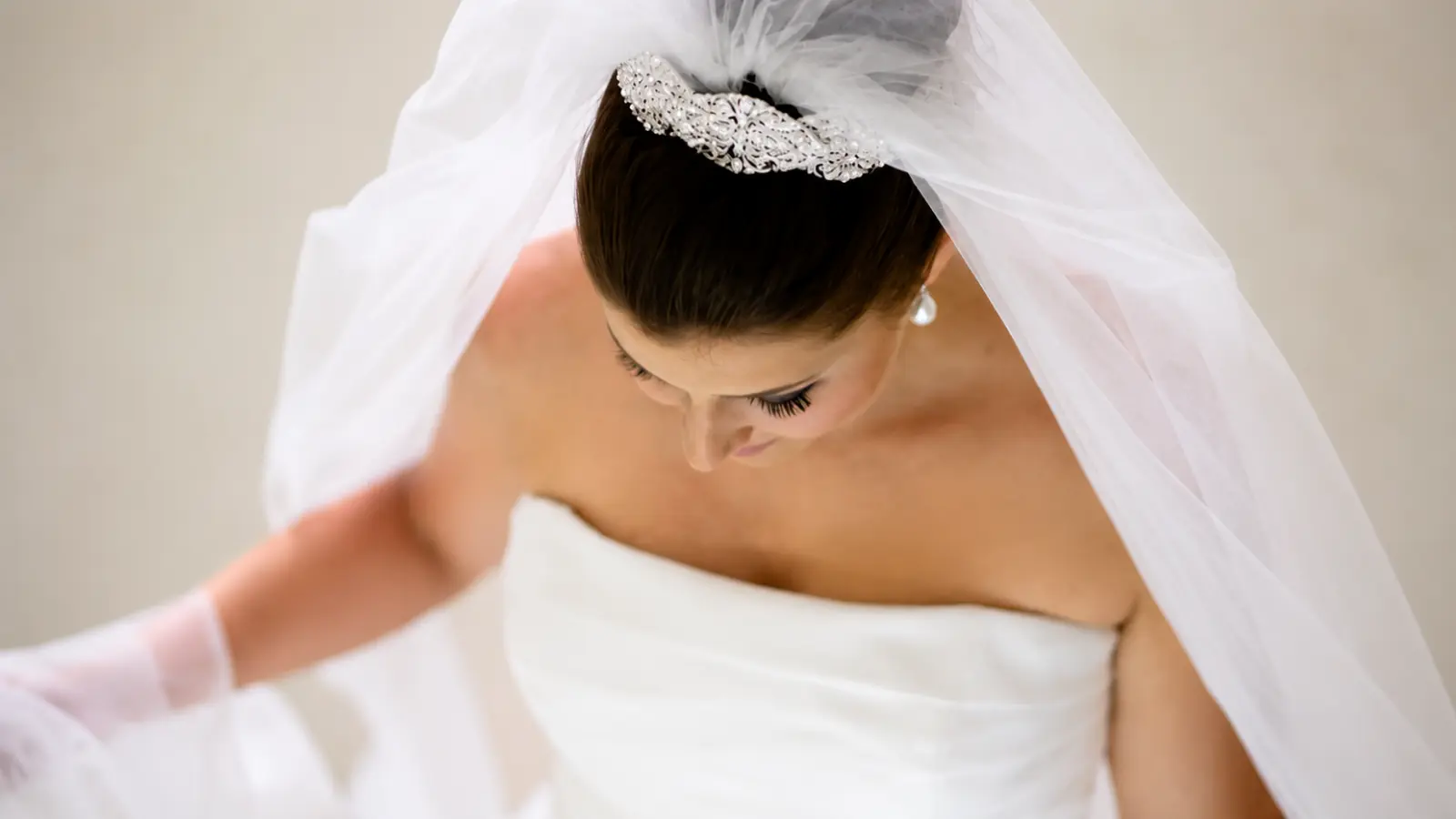
A tiara is an open-backed headpiece that curves across the front of the crown, sitting above the hairline and facing forward. Because it does not encircle the head, it leaves the back of the crown open — which is exactly where the veil comb typically attaches. This is why the tiara-and-veil pairing is so straightforward compared to other headpiece combinations.
Standard Placement
Place the tiara first, positioned across the crown where it naturally rests. Then position the veil comb directly behind the tiara’s back edge, slightly beneath it. The veil fabric will fall from that point, flowing behind and below the tiara without obscuring it. From the front, the tiara is fully visible. From the back and sides, the veil frames the tiara’s silhouette and creates continuity between the headpiece and the flowing fabric below.
Above or Below the Updo
With an updo, the tiara typically sits at the top of the pinned hair, with the veil comb positioned just below or behind the updo’s base. This creates a clean separation: the tiara crowns the style, and the veil emerges from just beneath it. With hair worn partially down, the tiara still anchors at the crown, but the veil comb may need to be set slightly lower to avoid getting lost in the hair texture. Your stylist should test both positions during the trial to find where the veil falls most cleanly.
Choosing the Right Tiara Weight
A delicate, thin-band tiara works with almost any veil length and style. A taller, more ornate tiara — particularly one with significant height above the hairline — pairs best with a longer, simpler veil where the veil’s visual weight comes from length rather than embellishment. Pairing a tall, elaborate tiara with a heavily embellished cathedral veil can create an overworked top that pulls visual attention away from the rest of the look.
Crown With Veil: Placement and Styling
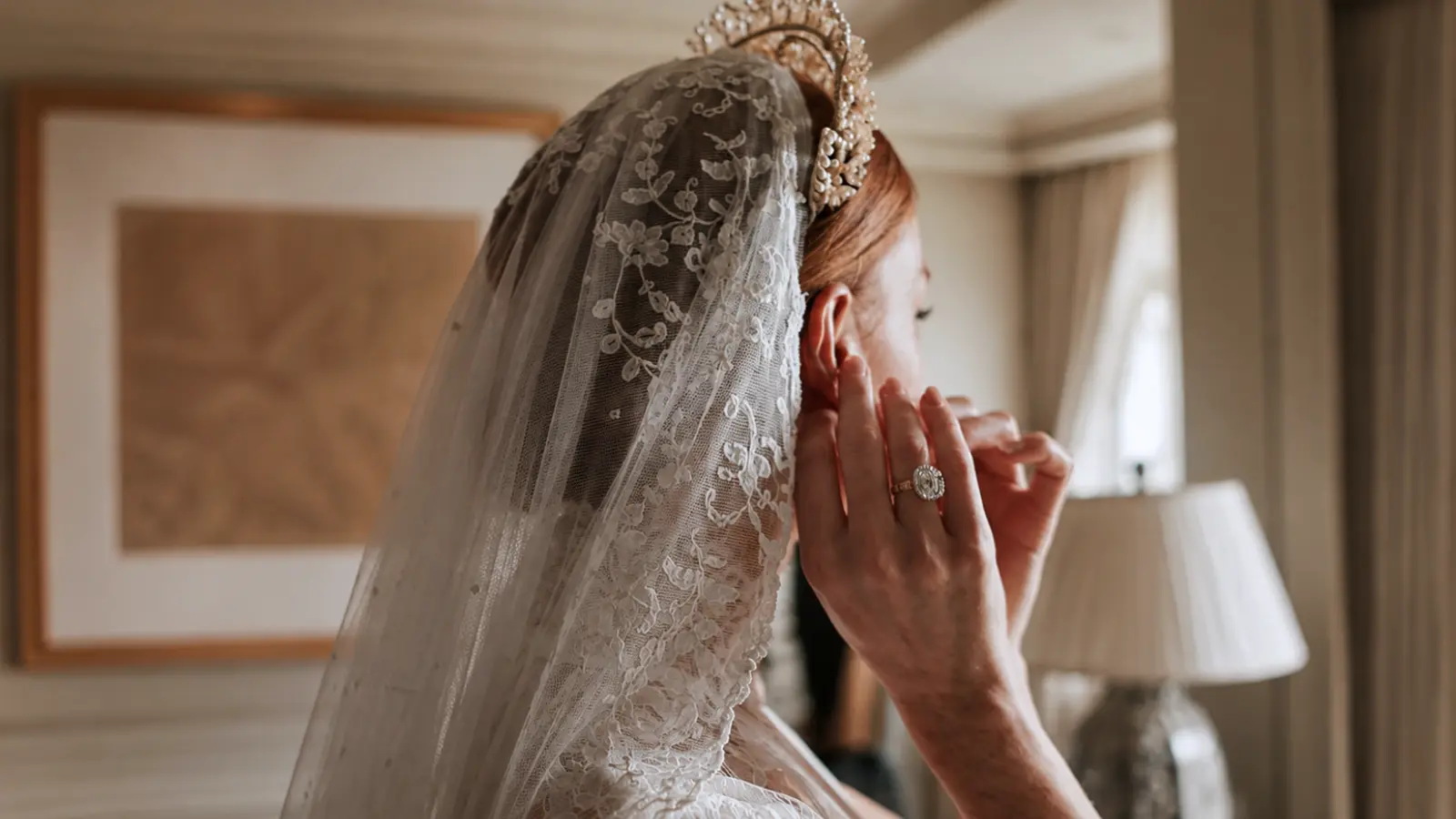
A full crown encircles the entire head, which means it occupies the full perimeter of the crown area. This creates a different styling challenge than a tiara: there is no obvious open-backed zone where a veil comb can sit without either hiding behind the crown or interfering with how the crown rests.
The practical solution is to position the veil comb at the back of the head, below the crown’s lower edge, so the fabric emerges from beneath the crown and falls down the back. This approach keeps the crown fully visible from all angles and gives the veil a clean starting point. The visual result is regal and deliberate — the crown floats above the hairline, and the veil cascades from below it.
This placement does require the crown to be stable on its own, which means an updo or closely pinned hairstyle is almost always necessary. A full crown on loose, flowing hair has a tendency to shift, and once the veil is attached behind it, any movement in the crown affects the veil’s position as well. If you are planning to wear your hair down, a tiara or headband will be far easier to manage than a full crown.
In terms of veil pairing, a full crown carries enough visual weight that a simpler veil is usually the stronger choice. A clean, unembellished chapel or cathedral veil in plain tulle lets the crown be the focal point. A heavily trimmed or embellished veil at the same scale as the crown can leave the look feeling unresolved at the top.
Headband With Veil: Placement and Styling
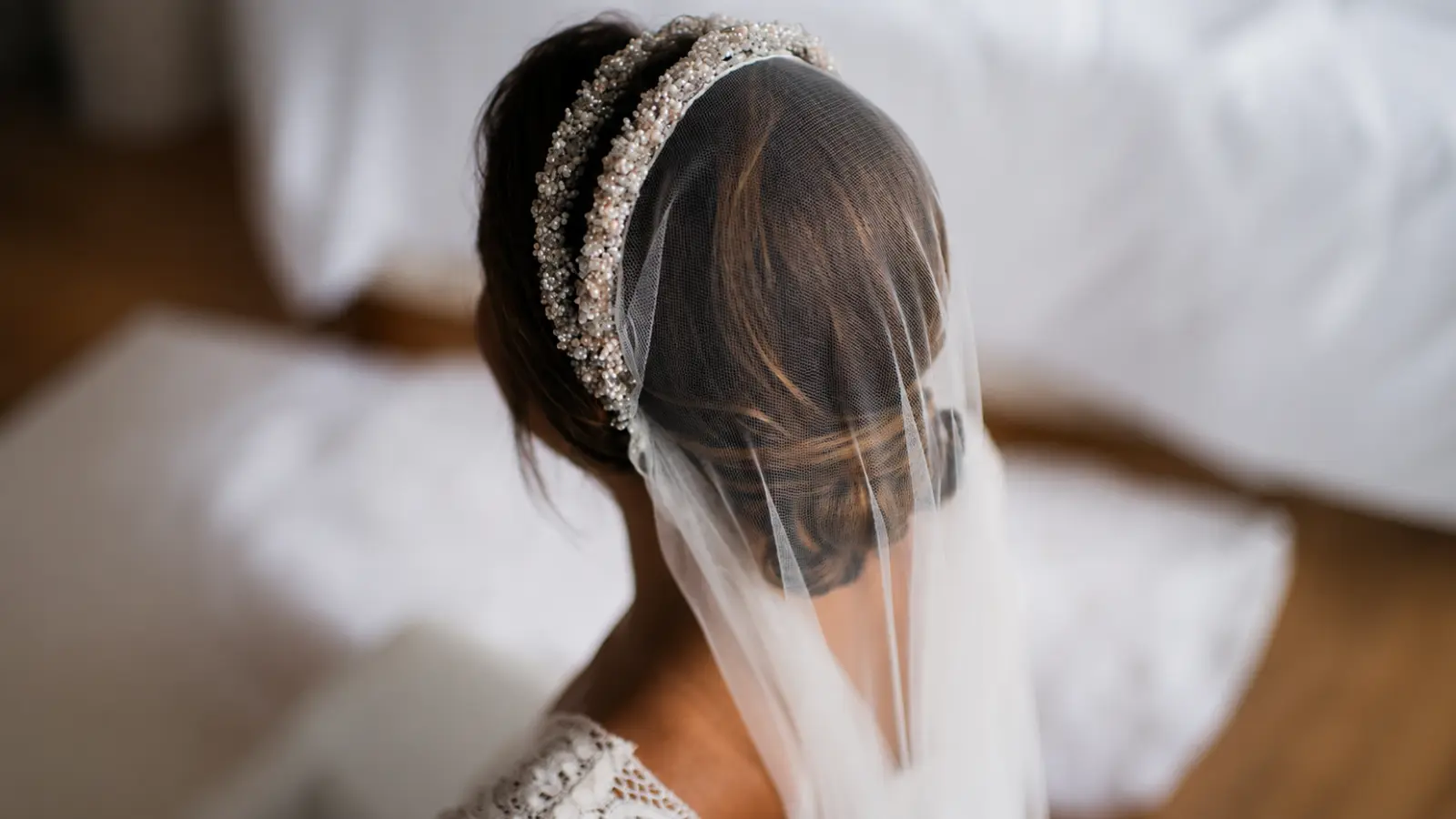
A bridal headband — whether embellished with pearls, crystals, or simple metal — sits like a tiara but typically lies flatter against the head, following the hairline rather than rising above it. This lower profile makes the headband one of the most versatile headpieces to pair with a veil because it adds structure and detail without adding significant height.
Placement follows the same basic logic as a tiara: the headband goes on first, and the veil comb attaches just behind it. Because headbands sit closer to the head than most tiaras, the veil tends to emerge from a slightly lower point, which can create a softer, more relaxed overall silhouette than the classic tiara-and-veil combination.
Headbands work particularly well with veils at most lengths. A fingertip or chapel veil paired with a delicate headband is one of the more wearable and modern interpretations of the headpiece-plus-veil look. A cathedral veil with a thin embellished headband is also a strong combination — the headband adds a focal point at the front without competing with the dramatic scale of the veil.
The one situation where headbands require more thought is hair worn completely down. A headband on loose hair needs to be secured with pins on both sides to prevent it from sliding back during the ceremony, and the veil comb must also be pinned securely into the hair beneath the band. Do a full-movement test during your hair trial — including walking, turning, and light dancing — before committing to this configuration.
Flower Crown With Veil: Placement and Styling
A flower crown sits differently than a structured headpiece. Because it is made of organic, soft material — fresh or dried flowers, greenery, ribbon — it rests on the head rather than gripping it, which means it relies almost entirely on pinning to stay in place. This changes how the veil attaches and how both pieces are managed through the day.
The standard approach is to place the flower crown first, pinning it securely at multiple points around the head. The veil comb then goes in at the back of the head, below the crown’s back edge, so the fabric falls from beneath the floral arrangement. The flowers should be clearly visible from the front; the veil should emerge cleanly from behind them without pushing the crown forward or distorting its shape.
Wedding veil lengths are especially important when pairing a veil with a flower crown. A very long veil — cathedral or royal length — can visually overpower a floral crown and shift the emphasis almost entirely to the back of the look. A fingertip or elbow-length veil keeps the proportion more balanced, allowing the flower crown to remain a genuine focal point rather than a small detail buried under a dramatic train of fabric. For outdoor and garden ceremonies especially, the fingertip-to-chapel range tends to be the most photographically coherent pairing with floral headpieces.
If you are wearing fresh flowers, brief your florist and your hair stylist in advance. Fresh flower crowns need to be placed as late as possible before the ceremony, and the veil comb should be inserted with the crown already in position so the stylist can find the correct angle without disturbing the arrangement.
Decorative Comb and Fascinator With Veil
A decorative hair comb is the most straightforward addition to a veil because it uses the same attachment mechanism. A single ornamental comb — with pearl clusters, crystals, or a simple metal design — can be placed adjacent to the veil comb, slightly off to one side, creating a styled focal point without adding significant height or volume. This is a particularly clean approach for brides who want a detail element without the formality of a tiara or the scale of a crown.
The key is physical separation: the decorative comb and the veil comb should not be positioned so close together that they function as a single piece. A few inches of visible separation, with hair between them, lets each element read distinctly. On the other hand, placing them too far apart — the decorative comb at the temple and the veil comb at the crown — can create an unbalanced, asymmetric effect that does not always translate well in ceremony photos.
A fascinator is a more structured accessory — often featuring a base, feathers, flowers, or netting — that typically clips or pins to one side of the head. Fascinators are strongly associated with British and Australian formal dress and have a particular vintage, editorial quality in American bridal contexts. Pairing a fascinator with a full-length veil is an advanced styling choice: the fascinator’s asymmetric, side-positioned placement can look intentionally fashion-forward alongside a short or mid-length veil, but it can also read as mismatched or confused if the overall aesthetic doesn’t support it. Different wedding veil styles create very different pairings with a fascinator: a birdcage veil is a more natural companion than a traditional single-tier veil.
Headpiece and Veil Compatibility at a Glance
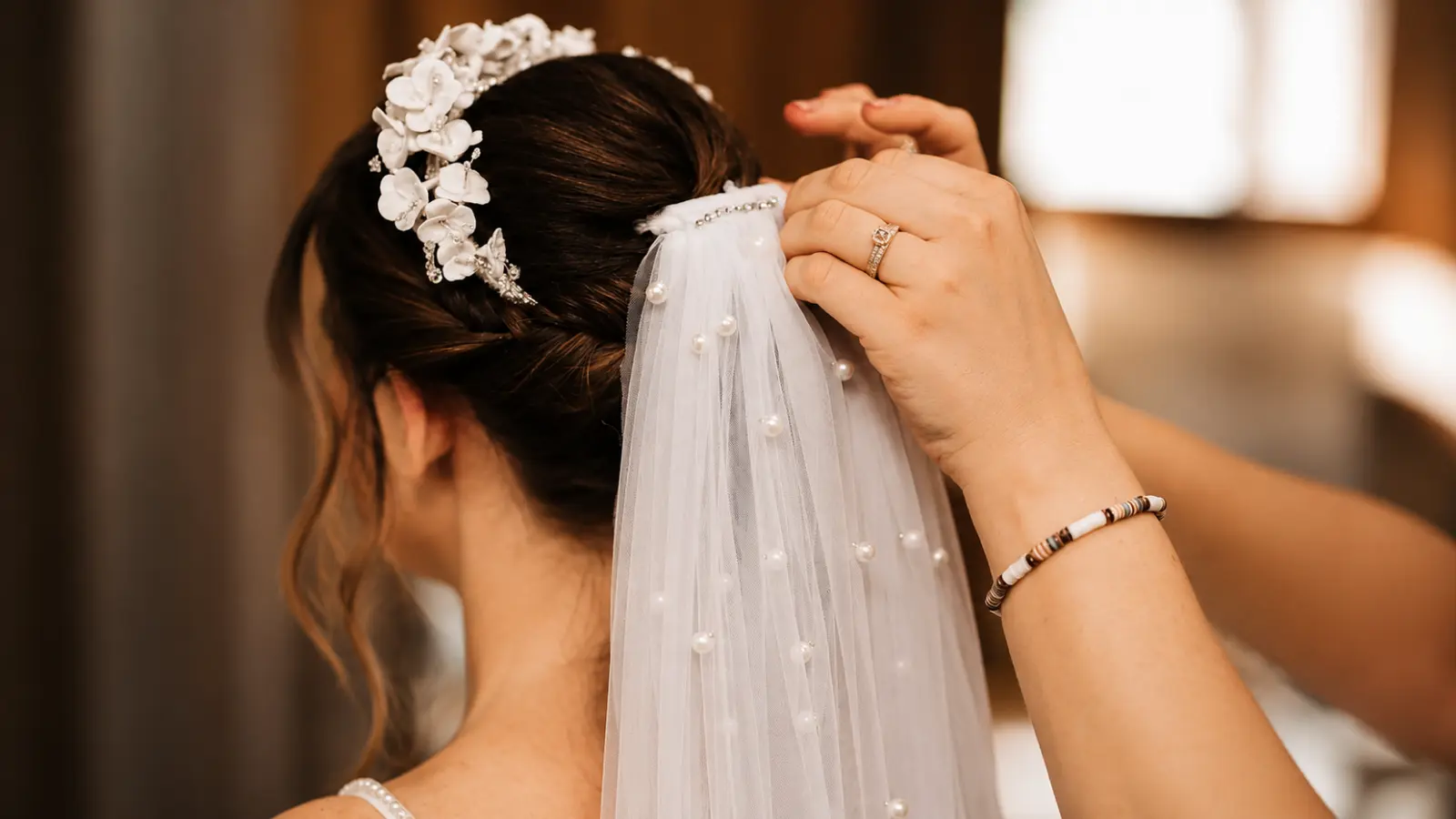
This table summarizes how each major headpiece type pairs with different veil styles and hairstyles. Use it as a starting point — not a ceiling — since individual pieces vary significantly in scale, weight, and detail level.
| Headpiece | Best Veil Placement | Best Veil Length | Best Hairstyle |
|---|---|---|---|
| Delicate tiara | Veil comb just behind tiara’s back edge | Any length | Updo or half-up; works with hair down |
| Tall or ornate tiara | Veil comb behind tiara, lower placement | Chapel to cathedral; simple edge | Updo recommended for stability |
| Full crown | Veil comb below crown’s back edge | Fingertip to cathedral; plain fabric | Updo or closely pinned hair; not loose |
| Embellished headband | Veil comb just behind headband | Fingertip to cathedral | Updo, half-up, or down with pins |
| Flower crown | Veil comb below crown’s back edge | Elbow to fingertip; avoid cathedral | Down, half-up, or loose updo |
| Decorative hair comb | Side-positioned, separate from veil comb | Any length | Updo or half-up |
| Fascinator | Side-mounted; veil comb at back crown | Short to mid-length; birdcage | Updo or sleek half-up |
| Mantilla veil | No headpiece recommended | Mantilla is a full style on its own | Down, half-up, or simple updo |
The mantilla row warrants a note. A mantilla veil lies flat against the head and is pinned directly into the hair, leaving little visible space for a separate headpiece. Most stylists recommend treating the mantilla as a complete look on its own rather than layering it with a tiara or crown. For everything about the mantilla specifically, see our mantilla wedding veil.
Hair Up vs. Hair Down: How It Changes the Equation
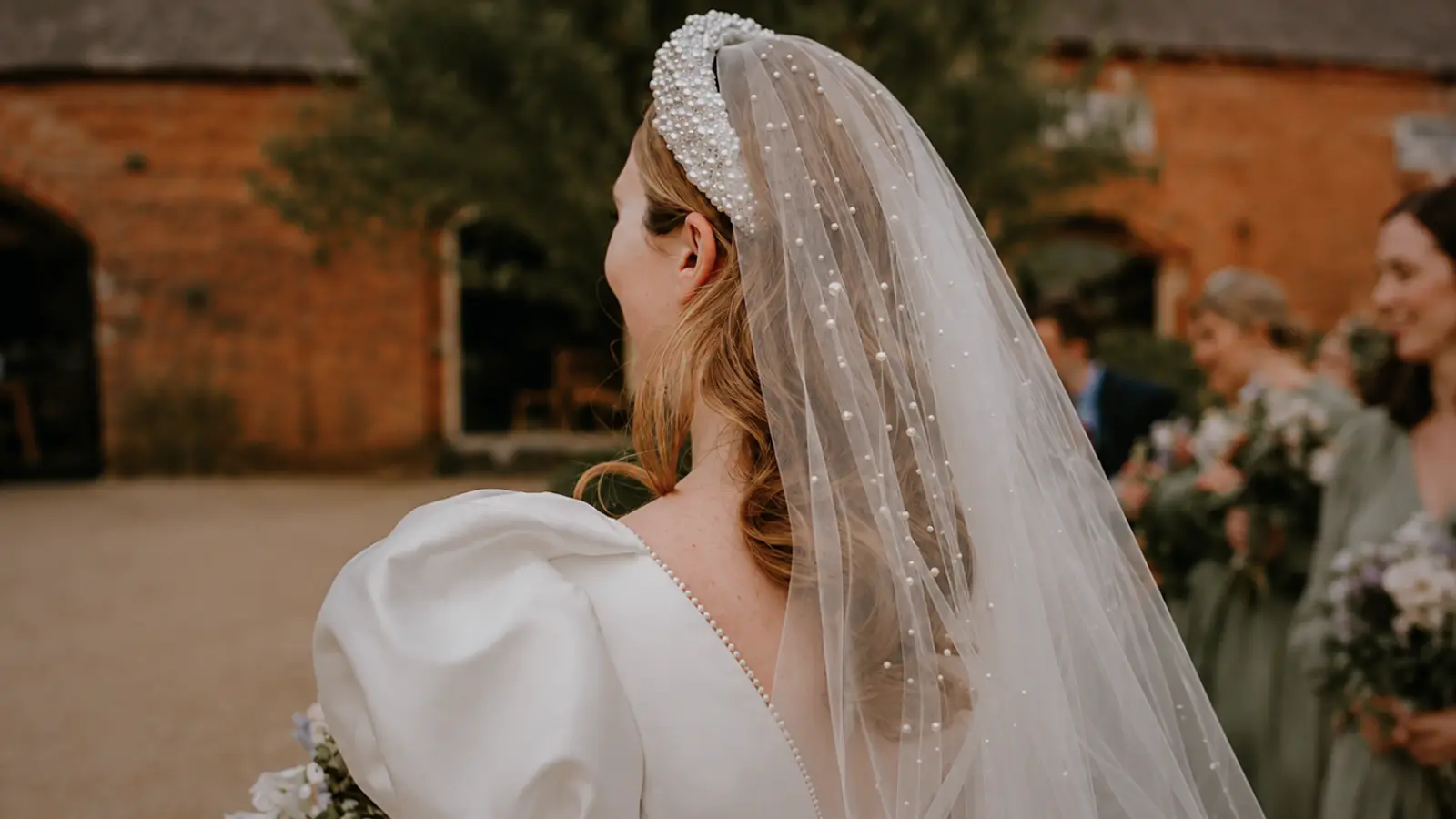
Hairstyle affects the veil and headpiece pairing more than most brides anticipate — not just aesthetically, but practically. An updo creates a defined, stable attachment point for both pieces. Hair down or in loose waves creates a more fluid situation where grip, pin placement, and the weight of each accessory all need more attention.
With an Updo
An updo gives you the most flexibility. The veil comb can anchor into the pinned hair below the headpiece, and both pieces stay in place with minimal reinforcement. This is the most reliable configuration for long veils, heavy headpieces, and outdoor ceremonies where movement and wind are factors. If you are planning to wear a crown, a tiara with height, or any headpiece that requires significant stability, an updo is the strongest foundation.
With Hair Down or Half-Up
Wearing a veil and headpiece with hair partially or fully down requires more advance planning. Both pieces need to be pinned into a stable section of hair — usually a portion that is gathered or twisted rather than fully loose — because accessories placed into purely loose strands have a tendency to slip, especially with movement. The visual effect can be beautiful, but the technical execution is less forgiving. This is a case where doing the hair trial specifically with both pieces in place, and then moving and shaking your head deliberately, is not optional. For specific pairing ideas by hairstyle, see our wedding hairstyles with veil.
Cathedral and Mantilla Veils: Special Considerations
Cathedral veils and mantilla veils both come with specific constraints when headpieces are involved, and it is worth addressing them separately since they come up often in this search context.
Cathedral Veil With a Headpiece
A cathedral veil carries significant visual weight on its own — the length, the fabric movement, and the train effect behind the bride all command attention. Adding a headpiece means adding something at the top of that silhouette that can either anchor the look or overload it. The guidance from the visual weight framework applies here clearly: a cathedral veil pairs best with a restrained headpiece. A thin, delicate tiara. A simple embellished headband. A small decorative comb. Any of these can coexist with the cathedral scale without fighting it. A large crown or a heavily embellished tiara at that same length can push the overall look past the point of balance. For more on styling a cathedral veil day-to-day, see our cathedral wedding veil.
Mantilla Veil With a Headpiece
A mantilla veil is a complete look in itself. The lace lies directly against the head, frames the face entirely, and is pinned into the hair at multiple points. There is no clean surface — no open zone of the crown — where a tiara or headband can sit without either resting on top of the lace or being obscured by it. A tiara placed over a mantilla tends to look awkward at the edges where the metal meets the lace. A headband placed beneath the mantilla can cause the lace to sit unevenly and lose its clean line. Most experienced stylists approach the mantilla as the headpiece itself and build the rest of the look around it rather than adding another accessory on top. If you are drawn to both the mantilla look and the tiara moment, this is a situation where seeing both options on your head — separately — will tell you more than any description can.
What to Avoid
A few patterns show up consistently when brides run into trouble with this combination. Most of them come down to the same underlying issue: not seeing both pieces together before the wedding day.
- Buying the headpiece and the veil separately without trying them together. Two pieces that each look beautiful on their own do not automatically work together. Scale, height, color tone, and the way each one attaches to the hair all need to be tested as a pair. If at all possible, bring your veil to the headpiece appointment, or bring the headpiece to the veil appointment, so you can see them in the same mirror at the same time.
- Choosing a headpiece after the hair trial but before the veil appointment. The order matters. Your hair trial is the moment to test the full look — veil, headpiece, and hairstyle together. Deciding on a headpiece in isolation, or testing the headpiece at the trial without the veil in place, means you are making decisions without complete information.
- Pairing two high-detail pieces without a moderating element. A heavily embellished cathedral veil paired with a tall ornate tiara can produce a look where nothing stands out because everything is competing. When both elements are highly detailed, the look tends to need one of them to be scaled back. This is not about being less — it is about giving each piece enough visual space to register.
- Assuming the veil color will match the headpiece metal or stones exactly. Veil fabric in warm ivory and a headpiece with silver or gold tones will almost always have some variation. This is normal and usually reads beautifully rather than mismatched, but it is worth evaluating under actual lighting conditions — specifically, the kind of light in your ceremony space — rather than only in a bright salon.
- Skipping the movement test. A veil and headpiece that feel secure standing still may shift, slide, or separate during the processional. At your hair trial, walk the length of the room, turn your head, and if you are comfortable, shake it gently. What holds through that test will hold through the ceremony.
The common thread in all of these is timing. The brides who are happiest with their veil and headpiece combination are almost always the ones who tested them together, early enough to make adjustments if something did not work.
Wedding Veil With Tiara Inspiration
Discover elegant wedding veil with tiara inspiration featuring classic bridal tiaras, delicate headbands, regal crowns, floral headpieces, and timeless veil styling ideas. Explore beautiful combinations for cathedral, chapel, fingertip, and minimalist veils to create a balanced and sophisticated bridal look.
Is a Wedding Veil With a Tiara Right for You?
A wedding veil with a tiara creates one of the most iconic bridal looks because it combines the softness of a flowing veil with the elegance of a carefully chosen headpiece. Whether you prefer a delicate tiara, a romantic headband, or a statement crown, the key is balancing each element so they enhance rather than compete with one another.
The most successful combinations are planned as a complete bridal look rather than as separate accessories. By trying your veil, headpiece, and hairstyle together during your hair trial, you’ll find the ideal placement and create a timeless bridal style that looks beautiful from every angle throughout your wedding day.
Frequently asked questions (FAQ)
How do you choose the right headpiece to wear with a wedding veil?
Start by deciding which element should be the visual focal point. If your veil is dramatic, such as a cathedral style, choose a lighter headpiece. If your headpiece is large or ornate, pair it with a simpler veil. The most balanced bridal looks allow one accessory to lead while the other supports it.
Can you wear a tiara and veil together?
Yes. A tiara and veil are one of the most traditional bridal combinations. The tiara normally sits at the front of the crown while the veil comb attaches just behind it, allowing both pieces to remain visible without competing for the same space.
Does the veil go over or under the tiara?
Most stylists place the veil comb behind the tiara so the fabric falls beneath and behind it. This keeps the tiara fully visible while allowing the veil to flow naturally from the back of the hairstyle.
Can you wear a crown with a veil?
Yes, but a full crown requires more planning because it surrounds the entire head. The veil usually attaches below the crown at the back of the hairstyle, making an updo or securely pinned hairstyle the best foundation.
Can you wear a mantilla veil with a tiara?
Usually not. A mantilla already frames the head and face with lace, leaving little room for another headpiece. Most stylists recommend treating the mantilla as the primary headpiece instead of layering a tiara over it.
How do you wear a flower crown with a veil?
Secure the flower crown first, then attach the veil underneath it at the back of the head. Fingertip and elbow-length veils generally create the most balanced proportions because they complement the softness of the flowers without overpowering them.
Does your hairstyle affect how a veil and headpiece work together?
Absolutely. Updos provide the strongest support for heavier veils and structured headpieces, while loose hairstyles often require additional pins and careful placement to prevent slipping. Every combination should be tested during the hair trial with both accessories in place.