
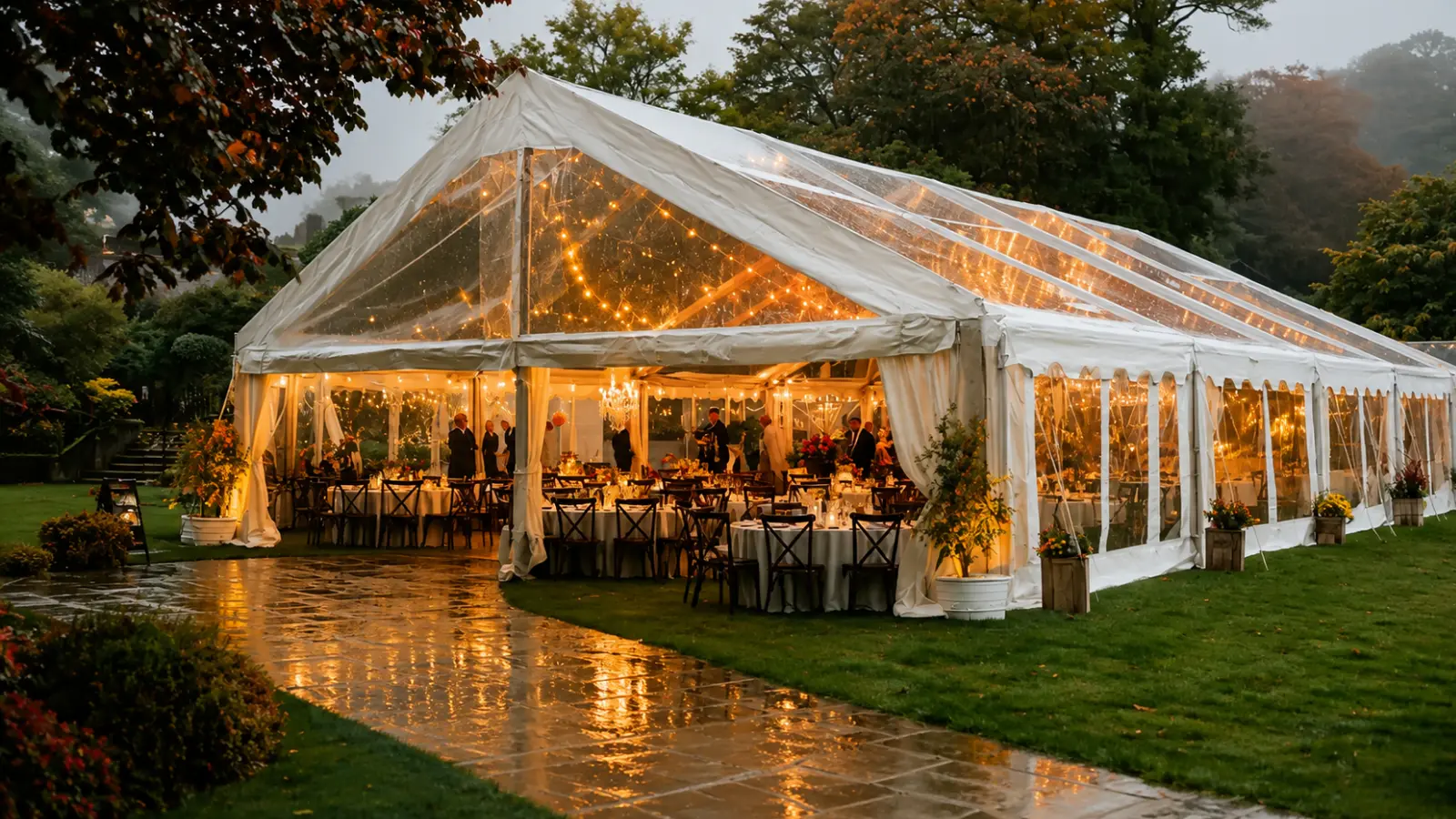
A wedding weather backup plan should exist long before the forecast matters. An outdoor wedding does not need perfect weather to work; it needs the tent, indoor space, flooring, power, and other backup infrastructure secured early enough that the final forecast only determines whether the plan gets activated.
The most reliable approach is to separate preparation from the weather call itself. Decide what happens if rain, heat, cold, or wind affects the event, set a clear trigger for each condition, name the person who has authority to make the call, and establish the deadline by which vendors need that decision. That removes the need for a stressful debate while setup is already underway.
This guide shows how to build a wedding weather backup plan around rain, lightning, heat, cold, and wind, including tents, flooring, power, indoor backup space, vendor impact, ceremony moves, decision deadlines, and guest communication. Non-weather problems such as vendor delays, transportation failures, and missing items belong in the separate wedding contingency plan.
Decide the Infrastructure Before You Decide the Weather
The single biggest mistake in weather planning is treating it as a day-of decision. Tents, flooring, and indoor backup space all have their own booking timelines, and most of them close long before you’ll have a reliable forecast. Tent companies may require several days’ notice to activate a reserved tent, so confirm the exact decision deadline when you book. That means the infrastructure decision has to happen at the planning stage, not the week of the wedding.
The practical version of this: book a tent “on hold” months in advance if your ceremony or reception is outdoors, and confirm your venue’s own indoor alternative in writing during the walkthrough. A venue that can’t give a clear, specific answer about their weather backup is worth a second look before you sign.
The Weather Backup Plan at a Glance
Each condition below works the same way: a trigger that tells you the backup plan is needed, what that backup plan actually is, how it affects your vendors, and what guests need to hear. Fill this out with your coordinator or venue once your ceremony and reception locations are set, not during the week of the wedding.
| Risk | Trigger | Backup | Vendor Impact | Guest Message |
|---|---|---|---|---|
| Rain | Meaningful rain chance at the agreed decision deadline, or active rain | Tented ceremony/reception or move to indoor backup space | Florist, rentals, and photographer re-brief on new location and light | Signage, text, or a stationed helper redirecting guests to the new spot |
| Lightning | Thunder heard or lightning detected nearby | Immediate move indoors, ceremony paused if already underway | All outdoor vendors relocate equipment immediately | Coordinator or officiant directs guests indoors in real time |
| Heat | Forecast high temperature that makes prolonged outdoor time genuinely uncomfortable | Shade structures, water stations, shortened outdoor segments | Florist adjusts for wilting risk; catering adjusts service timing | Note on program or signage pointing to water and shaded seating |
| Cold | Evening or shoulder-season temperature likely to push guests indoors early | Heat lamps, blankets, indoor space for cocktail hour | Rental company adds heaters; bar/catering setup adjusts | Note in invitation suite or day-of signage suggesting layers |
| Wind | Sustained wind strong enough to affect a tent, décor, or an unsecured arch | Sidewalls, secured or ground-weighted décor, simplified florals | Tent and rental company confirm weighting; florist adjusts arrangements | Rarely needs guest communication unless the venue itself changes |
Every row above depends on the same two things: infrastructure that was already booked, and a trigger specific enough that nobody has to debate it in the moment. The sections that follow walk through each condition, plus the decision-making pieces that tie the whole plan together: who decides, by when, and how guests find out.
Rain
Rain is the condition most couples plan for, and the one with the clearest infrastructure answer: a tent, an indoor backup space, or both. Most planners suggest setting the final decision deadline at least four to six hours before the ceremony starts, which gives vendors enough time to execute the change without rushing. A tent that needs to be installed rather than simply opened up may need considerably more lead time than that.
The trigger matters more than the exact forecast number. Some planners use a rule of thumb tied to rain probability at a set number of hours out; others simply watch radar and commit once rain is realistically unavoidable. Either approach works, as long as it’s agreed on in advance and the person watching the forecast has the authority to activate the plan without checking with the couple first.
Lightning Is Its Own Trigger
Lightning deserves a separate, non-negotiable rule from ordinary rain, because it’s the one weather condition that genuinely isn’t safe to wait out. If thunder is heard, move everyone to a substantial building or other appropriate enclosed shelter immediately, following the venue’s severe-weather procedures, ceremony in progress or not. This isn’t a judgment call to soften for the sake of the moment. It’s the one trigger on this page that should never be delayed for photos, guest comfort, or finishing a toast.
Heat
Heat rarely cancels a wedding, but it does change how comfortable guests are and how long they’ll tolerate being outside. The real risk isn’t the temperature number itself; it’s how long guests are asked to stand or sit in direct sun during a ceremony or cocktail hour, and that’s exactly what the backup plan should target.
Shade structures, water stations, and a shortened outdoor segment of the timeline handle most heat scenarios without needing to move the whole event. If your ceremony or cocktail hour runs during peak afternoon sun, ask your venue or planner about shade options during the same walkthrough where you confirm rain infrastructure, since both conversations tend to happen at the same stage of planning.
Cold
Cold weather causes more quiet problems than dramatic ones: guests who leave a reception early, a cocktail hour that empties out faster than planned, photos that get rushed because everyone’s uncomfortable. Shoulder-season and evening weddings are the most common setting for this, even in regions that don’t typically read as “cold weather” destinations.
Heat lamps, blankets set out for guests, and an indoor option for any outdoor cocktail hour or lounge space cover most of what cold weather requires. If part of your day depends on guests being outside for more than a few minutes, build a warm alternative into the plan rather than hoping everyone bundles up on their own.
Wind
Wind is the condition most likely to be underestimated, since a clear, sunny, windy day doesn’t read as bad weather the way rain does. Sustained wind can still take down an unsecured arch, scatter lightweight décor, or make a tent without sidewalls far less useful than it looks. If your ceremony or reception depends on a tent, confirm with the rental company specifically how it’s weighted or staked, not just that a tent is being delivered.
Florists and stylists can usually adjust for wind with sturdier arrangements and secured installations, but that adjustment needs to happen before the day, based on a known wind forecast, not as an improvised fix once petals are already blowing across the aisle.
Tent, Flooring, and Power
A tent solves the rain problem, but flooring and power are what make that solution actually work rather than create a new set of problems. Grass under a tent turns to mud within an hour of real rain, and a tent without a confirmed power source for lighting, climate control, or entertainment can leave you with a dry, dark, uncomfortable space instead of a real Plan B.
- Flooring protects against mud and uneven ground, and it’s worth pricing at the same time you price the tent itself, since it’s easy to underestimate the cost and lead time separately.
- Sidewalls are what actually keep wind-driven rain out; a tent without them offers far less protection than most couples expect.
- Power needs its own confirmation with the tent company or venue, especially if the tent is a standalone structure rather than an extension of an already-wired building.
Treat these three as one package rather than three separate decisions, since a tent booked without flooring or power is a tent that solves only part of the problem it was meant to solve.
Naming the Indoor Backup
Every outdoor wedding needs one specific answer to a simple question: if the weather plan activates, where does everything actually go? A vague answer — “we’ll figure it out” — is the single most common gap in weather planning, and it’s the one that creates real chaos on the day itself.
Ask your venue directly whether they have a dedicated indoor space with matching capacity, or whether the backup means converting the reception room for the ceremony and resetting it afterward. Both are workable plans; an unclear or undersized answer is not. Confirm this during your venue walkthrough, get it in writing if it isn’t already in your contract, and treat it as settled rather than something to revisit closer to the date.
Vendor Impact
A weather change doesn’t affect every vendor the same way, and the ones who need the most notice are usually florists and rental companies, since their work is physically built around a specific space. Photographers generally adapt fastest, since most have experience shooting in changed conditions and often welcome the different light.
Whoever owns the decision should notify every affected vendor directly and immediately once the call is made, rather than assuming word travels on its own. This is where a written vendor contact sheet, already covered in the broader wedding contingency plan, does double duty: the same list that handles a vendor delay is exactly what you need to loop everyone in on a weather change fast.
Moving the Ceremony
Physically moving a ceremony takes real time, and that time needs to be built into the plan rather than assumed away. Flipping an outdoor setup to an indoor space commonly takes something in the range of thirty minutes to an hour, depending on how much needs to be moved and how far the new location is from the original one.
Build that window into your timeline as a named buffer, not an unplanned delay everyone absorbs on the fly. If your coordinator needs to activate the move while the couple is still getting ready or finishing photos, that’s exactly the kind of handoff a day-of point person exists for. The couple should hear that the plan changed, not manage the changeover themselves.
Decision Deadline
Every weather trigger above only works if one person has the authority to activate it by an agreed deadline, without needing the couple’s sign-off in the moment. Set that deadline when you book your vendors, since tent companies in particular need more advance notice than most couples realize.
A reasonable structure: infrastructure decisions (tent, flooring) locked in weeks or months ahead; the activation decision made within a defined window before the ceremony, commonly several hours out; and lightning as the one trigger that overrides every deadline and activates immediately. Put this in writing, share it with your coordinator and key vendors, and treat the deadline as final once it’s made. Revisiting a weather call after vendors have already started moving tends to create more disruption than the weather itself.
Guest Communication
Guests handle a weather change well when they hear about it clearly and don’t have to guess. For a same-day shift, a stationed helper redirecting arrivals, clear signage at the original location, and a text to anyone on a group list cover most situations. The goal is that no guest arrives at an empty outdoor site wondering where everyone went.
For a change decided further in advance, a simple note through your wedding website or a day-before text is usually enough, and it removes any need for real-time redirection. Whichever method you use, name it in the plan itself so your coordinator isn’t inventing a communication method on the spot.
Plan the Backup Before You Need It
A wedding weather backup plan cannot control what the forecast does, but it can control how prepared everyone is when conditions change. Secure the infrastructure early, define the trigger for activating it, give one person authority to make the call, and make sure vendors and guests already have a communication path when the plan changes.
The goal is not to spend the final days trying to predict the weather perfectly. It is to reach that point knowing that rain, heat, cold, or wind already has an answer. When the backup is real before the forecast arrives, weather becomes a decision to activate — not a problem the couple has to invent a solution for.
Frequently asked questions (FAQ)
What should a wedding weather backup plan include?
A strong weather backup plan should identify the conditions that could disrupt the event, the trigger that activates each backup, the indoor or covered alternative, any tent, flooring, power, heating, cooling, or other infrastructure required, the person authorized to make the final call, and how vendors and guests will be informed. Those decisions should be made well before the final forecast.
How far in advance should you book a rain plan tent?
Secure tent availability well before the wedding, especially during high-demand seasons or in areas with limited rental inventory. Some companies allow couples to reserve or hold a tent and make the final activation decision closer to the event. Confirm the company’s exact deadline, cancellation terms, installation requirements, and whether flooring, sidewalls, or power need to be reserved at the same time.
Who decides if the wedding weather backup plan gets activated?
Ideally, a planner, coordinator, venue lead, or another specifically named point person should make the call using criteria agreed on in advance. The couple can establish the priorities and boundaries beforehand, but the final decision should not become a live debate while vendors are waiting to move equipment or reset the space.
Does every outdoor wedding need a weather backup plan?
Yes, if any important part of the celebration depends on outdoor conditions. The relevant risk may be rain, heat, cold, wind, or a combination of them depending on the location and season. Even when severe weather is unlikely, the plan should still identify where guests and vendors go if the original outdoor setup becomes impractical or unsafe.
What is the difference between a wedding weather backup plan and a wedding contingency plan?
A wedding weather backup plan deals specifically with weather-related conditions such as rain, heat, cold, and wind, including the infrastructure and activation triggers those conditions require. A broader wedding contingency plan addresses non-weather operational problems such as vendor delays, transportation failures, missing items, power issues, or timeline disruptions.
What if the weather forecast keeps changing before the wedding?
Do not let a changing forecast reopen infrastructure decisions that should already be settled. Your tent, indoor space, flooring, power, and other backup resources should be secured in advance. The changing forecast should affect only the final activation decision, which should be made at the pre-agreed deadline by the person authorized to make that call.

About the Author
Débora Justo
Founder and editor of EVORÉ, creating practical wedding planning resources, thoughtful inspiration and useful tools for the decisions that shape a celebration.
Read more about the author →