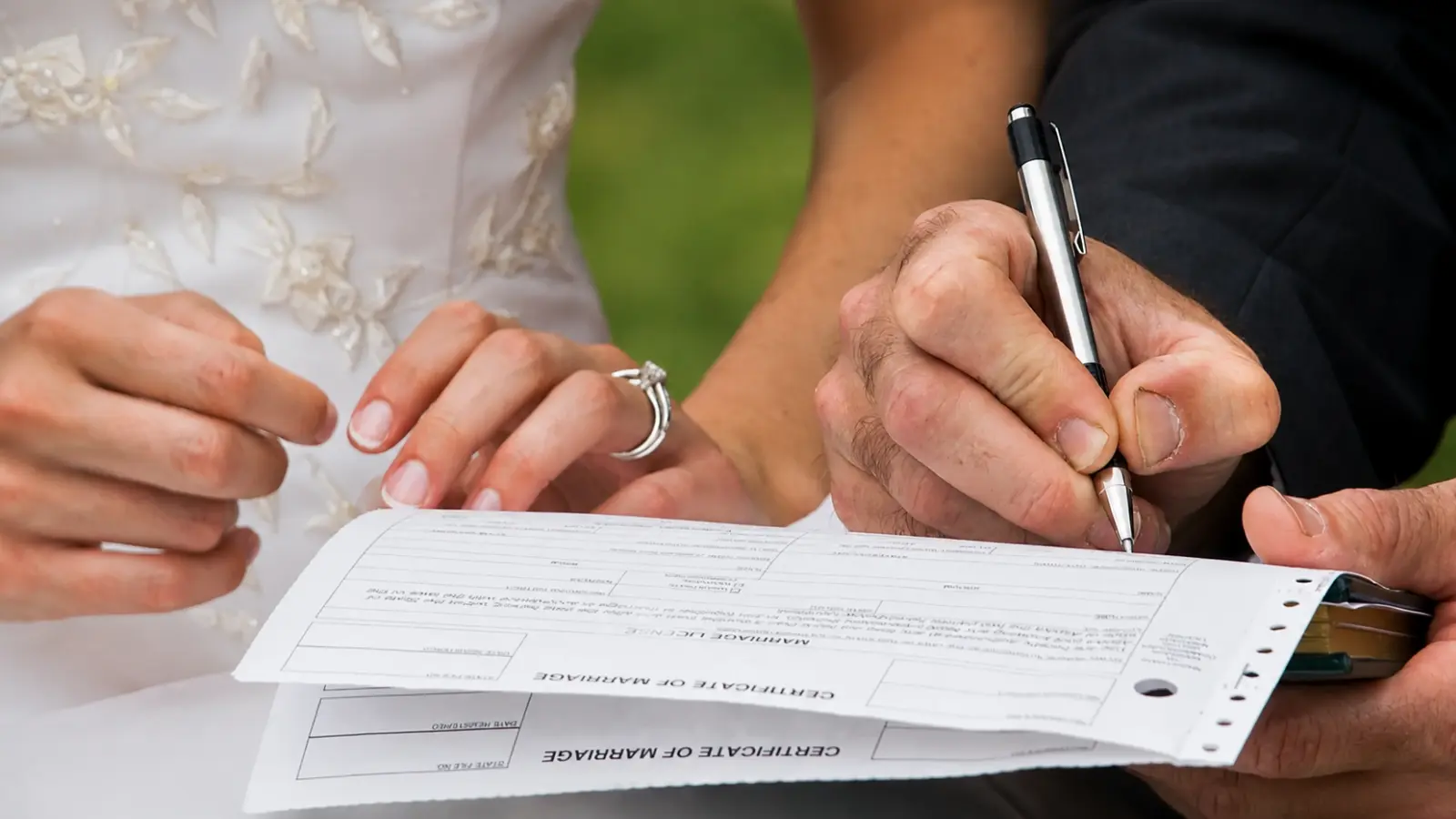

Marriage Records can include marriage-license applications, issued licenses, completed marriage documents, registration entries, searchable indexes, government verifications, and certified copies. These records may relate to the same marriage, but they do not necessarily contain the same information or carry the same evidentiary value.
Public access also varies. Some jurisdictions publish searchable indexes or historical images online, while others restrict recent, confidential, or full records. A name appearing in an online database can help identify a likely marriage record, but it does not automatically prove that the marriage was completed or provide the certified document another organization may require.
This Marriage Records guide explains what marriage records can include, where they are held, which records may be public or restricted, how online indexes work, how to conduct a search, why recent and historical records may behave differently, and when you need official verification or a certified copy instead of a search result.
What Are Marriage Records?
“Marriage record” is an umbrella term. Depending on the office and stage of the process, it can refer to:
- A marriage-license application.
- An issued but not yet completed license.
- The license or certificate completed after the ceremony.
- The registration entry created when the marriage is recorded.
- An index listing selected information about the record.
- A verification or abstract issued from the database.
- A certified copy of the full or summarized record.
The National Archives explains that vital records such as marriage licenses are created by local authorities and generally are not federal records held by NARA. State, county, city, town, court, or other local offices normally control them.
This decentralized structure explains why a nationwide search website cannot establish one access rule or guarantee complete coverage. The controlling source is the government custodian for the jurisdiction and time period.
Marriage License Lookup vs Marriage Certificate Lookup
A marriage license lookup may return an application, an issued license, a license number, or a completed record, depending on how the local office labels its database. A marriage certificate lookup usually aims to find the recorded post-ceremony event, but the search result may still be only an index entry.
The legal sequence matters:
- The couple applies for and receives authorization to marry.
- The legal marriage process is completed.
- The required people sign the document.
- The document is returned and recorded.
- The recorded marriage becomes available for searches, verifications, or copies under local rules.
The pre-ceremony document is explained in EVORÉ’s marriage license guide. The license vs certificate comparison shows why finding an issued license does not necessarily prove that the ceremony occurred and the marriage was recorded.
Read the search portal’s record description. A database titled “Marriage Licenses” may include completed marriages, while another may list only applications or issue dates. The name of the database is not enough to determine its evidentiary meaning.
Are Marriage Records Public?
Some are, some are restricted, and some provide public index information while limiting access to the full record. The answer can depend on:
- State and local public-record law.
- Whether the license was public or confidential.
- The record’s age.
- Whether either or both spouses are deceased.
- The requester’s relationship or legal purpose.
- Whether the request is for an index, plain copy, informational copy, or authorized certified copy.
- Whether sensitive fields are withheld or redacted.
Public marriage records do not necessarily make every application detail open to everyone. An office may disclose names, date, location, and record number while withholding addresses, identification numbers, signatures, health information, or other protected fields.
New York City illustrates an age-based access rule. Its official marriage-record page states that records older than 50 years are considered historic and available to the general public, while more recent records have eligibility requirements. That is a New York City rule, not a national waiting period.
Are Marriage Licenses Public Record?
Marriage licenses can be public records, but not every jurisdiction exposes the same document or fields. Some offices allow anyone to request a public license record. Others limit recent records, applications, confidential licenses, or personally identifying information.
California provides a useful example of the distinction. California’s Department of Public Health explains that copies of a public marriage license may be requested from the county recorder, while confidential marriage records follow different access rules.
Public access also does not mean free access. Search, retrieval, certification, and copy fees can apply even when the record itself is public.
Are Marriage Certificates Public Record?
A recorded marriage certificate may be public under local law while an authorized certified version remains subject to eligibility and identification rules. Another jurisdiction may restrict the entire recent record or release only an informational copy.
The question should therefore be divided into three parts:
- Can the public confirm that the marriage record exists?
- Can the public view or obtain the record’s information?
- Who can order the certificate version accepted for official use?
Those answers can differ within the same office. A searchable name and date do not automatically authorize access to a full certified certificate.
Confidential, Sealed, and Restricted Marriage Records
A confidential marriage record is created under a jurisdiction-specific process that restricts access. It is not merely a public record hidden from an online search engine. Eligibility and ordering are controlled by the law and office responsible for that record type.
California, for example, directs confidential marriage-record requests to the county clerk in the county where the license was issued. The state vital records office handles specified public marriage records but does not replace the county’s role for confidential licenses.
Other restrictions can arise from a court order, identity-protection program, sealed proceeding, adoption-related matter, or protected personal information. Do not attempt to bypass a restricted portal, impersonate an eligible requester, or use another person’s credentials.
The information collected during licensing is covered in EVORÉ’s marriage license requirements guide. Collection of information does not mean every field later appears in a public index.
Where Marriage Records Are Held
There is no universal “marriage records department” name. Possible custodians include county clerks, recorders, registers of deeds, probate offices, city or town clerks, courts, marriage bureaus, state vital records offices, and archives.
The best source can depend on the purpose:
| Source | Information Available | Public? | Certified Copy? | Best Use |
|---|---|---|---|---|
| County, city, or town office | Local index, license, completed record, or certificate | Depends on local law and record type | Often, for records it maintains | Recent local records and full copies |
| State or territorial vital records office | Statewide index, verification, abstract, or certificate for covered years | Varies by jurisdiction | Sometimes; full local copies may be elsewhere | Locating the responsible system and ordering available state records |
| Court or marriage bureau | Applications, licenses, registrations, or court-maintained records | Depends on court and record rules | Where authorized | Jurisdictions where the court or bureau is the custodian |
| Government online index | Names, date, place, record number, or image where published | Only the published fields | Usually a separate order | Finding the likely record and its identifier |
| Government archive | Older indexes, images, registers, or archived files | Often broader for historical records | May be available under archive procedures | Historical records outside the active vital-record system |
| Private search database | Aggregated index entries or transcriptions | Based on licensed or public-source coverage | Generally no government certification | Finding clues to verify with the official custodian |
The CDC’s Where to Write for Vital Records directory provides state and territory starting points. Use it to locate the relevant records system, then follow the current state or local instructions rather than treating the directory as a national record search.
What an Online Marriage Index Shows, and What It Misses
An online index is a finding tool. Depending on the database, it may show:
- One or both spouses’ names.
- The marriage, license, filing, or recording date.
- The county, city, town, or other jurisdiction.
- A record, license, certificate, book, page, or image number.
- The officiant or ceremony location where publicly indexed.
- A link to a scanned image or certificate-order page.
It may not show recent records, confidential records, corrected names, every indexed field, or a complete image. Some systems cover only selected years or digitized collections. Spelling and transcription errors can prevent an exact-name match.
An index result is not automatically a certified document. Even an image hosted by a government archive may be intended for reference unless the office separately certifies the ordered copy.
How to Conduct a Marriage Record Search
Use a location-first process:
- Identify the state and likely county, city, or town connected to the license or recording.
- Estimate the marriage date and determine whether the record is recent or historical.
- Locate the official state or local custodian.
- Review its date coverage, record types, access restrictions, and fees.
- Search using the names as they appeared at the time of marriage.
- Try permitted alternate spellings, prior surnames, initials, and a wider date range.
- Record the file number and custodian shown in a likely result.
- Request verification or a certified copy if formal proof is needed.
If you are trying to start a new license application rather than find an existing event, use EVORÉ’s marriage license application guide. A record lookup does not create authorization to marry.
Information That Improves the Search
Gather both spouses’ names at the time of marriage, approximate date, license location, ceremony location, and any record number. A prior copy, officiant paperwork, wedding announcement, or administrative file may provide the missing jurisdiction.
A marriage records search can fail when the user enters a current surname that was adopted only after the event. Search with the names likely used on the application or recorded certificate.
Do not submit Social Security numbers, identity documents, or payment data to a general index unless the official ordering process requires them. Basic public searches usually need less information than certified-copy applications.
Marriage Records Search Results Are Not All Equivalent
A search result can indicate:
- A possible name match.
- An issued license.
- A completed and recorded marriage.
- A verification entry created from selected facts.
- A historical image.
- A private transcription copied from another source.
Read the database description and field labels before drawing a conclusion. “License date” is not necessarily the ceremony date. “Application” is not necessarily proof of issuance. “Certificate number” can identify the record without providing a certified certificate.
If accuracy matters, confirm the result with the listed government custodian. Private databases can be useful discovery tools, but their coverage, updates, transcriptions, and identity matching may be incomplete.
Historical Marriage Records
Older records may leave the active clerk or vital records system and move to a municipal archive, state archive, court archive, records department, or another historical repository. Access often becomes broader with age, but the threshold and available copy types vary.
New York City’s Historical Vital Records service, for example, provides online access to millions of digitized birth, death, and marriage records from specified historical periods and also describes how to order certified archive copies.
A historical image found online may be valuable for research but still require a separately issued certified copy for a current legal use. Ask the receiving organization whether an archive-certified document is acceptable.
This article does not provide genealogical research strategies. Its purpose is to distinguish historical search access from official documentary proof.
Recently Filed Marriage Records
A recent marriage may not appear immediately. The document must first be returned after the ceremony, reviewed for completion, accepted, recorded, indexed, and sometimes transferred between local and state systems.
A missing online result can therefore reflect processing rather than an invalid marriage. Ask the office that received the completed document:
- Whether it received the signed marriage document.
- Whether the document was accepted or returned for correction.
- When recent records become searchable.
- When certified copies become available.
- Whether a record number or receipt can be used to check status.
Do not rely on a search engine’s cached page or a third-party index to monitor a new filing. Contact the responsible office using information from its official website.
Search Result vs Certified Copy
A searchable record helps answer “Does a likely record exist, and where is it held?” A certified copy answers “Can the custodian provide official documentary evidence of the recorded marriage?”
A certified copy includes certification by the authorized records office. It can be a full image, transcript, or abstract depending on the jurisdiction. The certified marriage certificate guide explains seals, security features, informational versions, scans, and receiving-agency requirements.
Finding public index information does not remove eligibility rules for an authorized copy. Conversely, a person eligible for a certified copy may be able to request it even when the record is not visible in a public online index.
To place the actual order, follow EVORÉ’s marriage certificate copy request guide. Search and ordering are related but separate steps.
Official Verification
Some state or local offices provide a marriage verification rather than a full certificate. A verification may confirm selected facts such as names, date, and location. It can be useful when the receiving organization accepts it, but it may not substitute for a certified full record.
Before requesting verification, ask the receiving organization:
- Does it accept a government verification or require a certified certificate?
- Which marriage facts must appear?
- Does the document need a seal, signature, issue date, or direct electronic response?
- Can the applicant submit it, or must the records office send it directly?
An unofficial screenshot of an online search is not direct verification merely because it came from a government website. Follow the office’s formal verification procedure.
Privacy and Safe Record Searching
Marriage indexes can expose names, dates, locations, and record numbers. Full records may contain signatures, addresses, birth information, prior-marriage information, and other personal details depending on the form and era.
Use public information responsibly:
- Search only for a legitimate personal, administrative, historical, or legal purpose.
- Do not publish certificate images or personal identifiers unnecessarily.
- Use official government portals before entering identity or payment information.
- Do not evade confidential-record or eligibility restrictions.
- Store downloaded images and certified copies securely.
- Verify unexpected results before making personal or legal claims.
This article does not support private investigations, background checks, locating individuals, or drawing conclusions about a specific person’s relationship status. A marriage search also does not establish that no later divorce, annulment, correction, or other legal event occurred.
Wrong Names, Dates, or Duplicate Results
Index errors can come from transcription, scanning, name variations, data migration, or incomplete search fields. The underlying official record may be correct even when the public index is not.
If the certificate itself contains incorrect information, do not alter a downloaded image or certified paper. The marriage certificate correction guide explains how to distinguish a copy problem, an index problem, and an error in the official record.
Duplicate-looking entries may represent an application and a completed certificate, separate indexing systems, corrected records, or different couples with similar names. Compare dates, jurisdictions, record numbers, and document descriptions before assuming duplication.
Marriage Record Search Checklist
- Identify the likely state and local jurisdiction.
- Determine whether you need a search result, verification, or certified copy.
- Check the official office’s record types and date coverage.
- Search names as recorded at the time of marriage.
- Use alternate spellings and a reasonable date range if permitted.
- Read what the database entry actually represents.
- Confirm access rules for public, confidential, recent, or historical records.
- Save the record number and custodian information.
- Request official evidence separately when needed.
The key is to match the source to the purpose. An index is excellent for locating a record; it should not be presented as a certified certificate when formal proof is required.
Use an Index to Find the Record, Not Replace It
Marriage Records are most useful when you know what type of result you are looking at. An online index may identify names, dates, locations, or a record number, while a government verification or certified copy serves a different purpose and may have separate eligibility and ordering requirements.
Start with the jurisdiction connected to the marriage, confirm which office holds records for the relevant date and record type, and read the database description before drawing conclusions from a result. Use indexes for discovery and official records procedures for proof when formal documentation is required.
Frequently asked questions (FAQ)
How do you search for a marriage record?
Start by identifying the state and likely county, city, town, court, or other jurisdiction connected to the marriage. Then locate the official government office or archive that maintains records for that location and time period. Search using the names as recorded at the time of marriage, the approximate date, and the location, and check the database’s record type and date coverage before interpreting the result.
Are marriage records public?
Some marriage records are public, while others are restricted or provide only limited public information. Access can depend on the jurisdiction, record age, license type, confidentiality rules, and the version requested. A public index may show names, dates, or record numbers even when the full record or an authorized certified copy is available only to eligible requesters.
Can you search marriage records online for free?
Sometimes. Government indexes and historical collections may provide free searches, while other offices charge for searches, retrieval, verification, or copies, and some records are not available online at all. A free online result is generally a finding tool rather than certified proof of marriage.
Is an online marriage-record result legal proof of marriage?
Usually not by itself. An online index can help show that a likely record exists and identify its date, location, record number, or custodian, but it does not automatically carry government certification. Formal transactions may require an official verification or a certified copy accepted by the receiving organization.
Why is a recent marriage record missing from an online search?
A recent marriage may not appear immediately because the completed document can still be awaiting return, review, recording, indexing, transfer between government systems, or publication in the search database. Also check whether the search covers the correct years and record type before assuming the marriage record does not exist.
Can you order a certified marriage certificate from a public-record search?
Sometimes an official government search portal provides a direct path to ordering, but searching and ordering are still separate processes. Eligibility, identification, certificate type, fees, and delivery requirements continue to apply. A private or third-party search result does not automatically authorize that service to issue the official certified certificate.

About the Author
Débora Justo
Founder and editor of EVORÉ, creating practical wedding planning resources, thoughtful inspiration and useful tools for the decisions that shape a celebration.
Read more about the author →