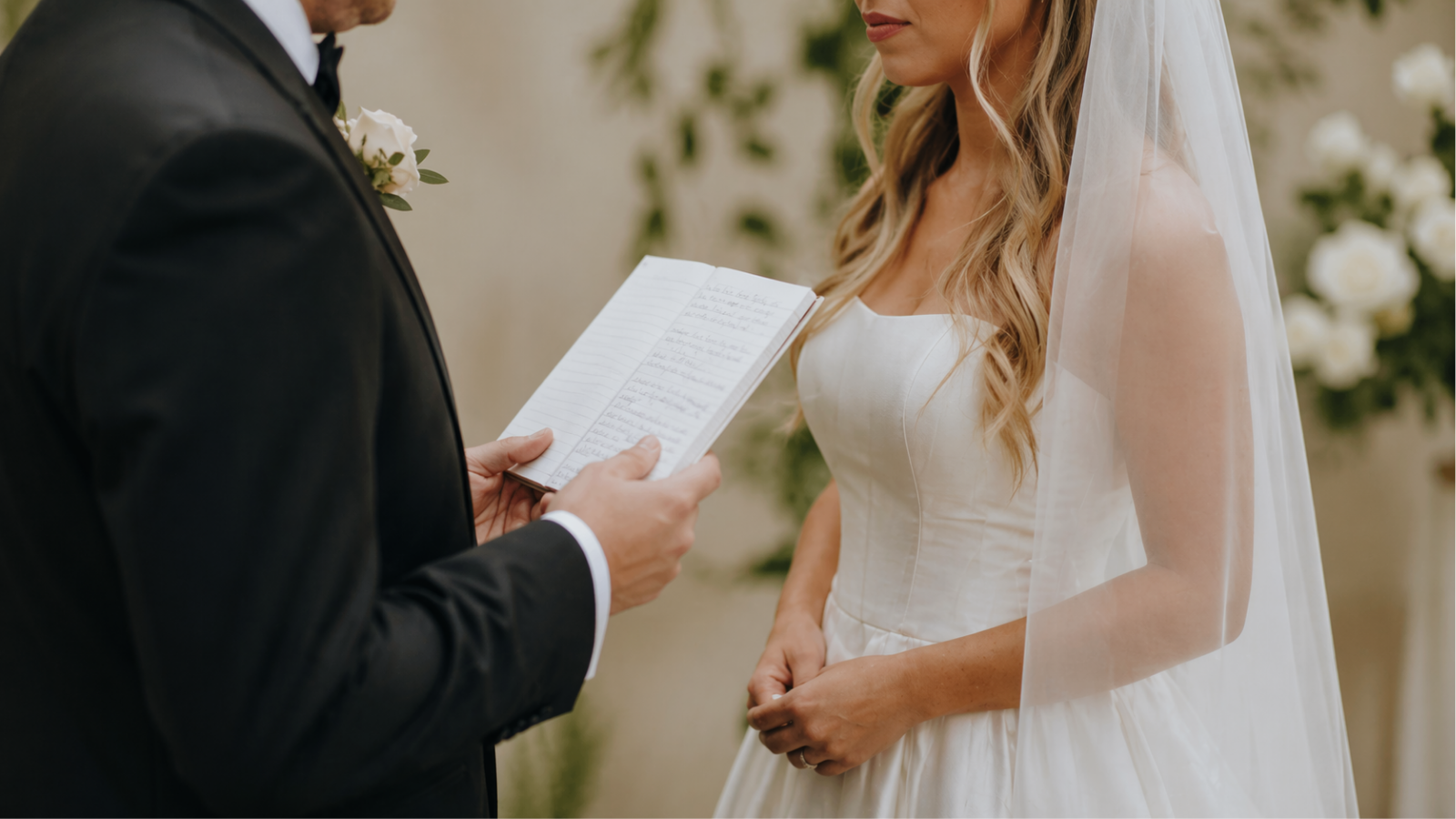
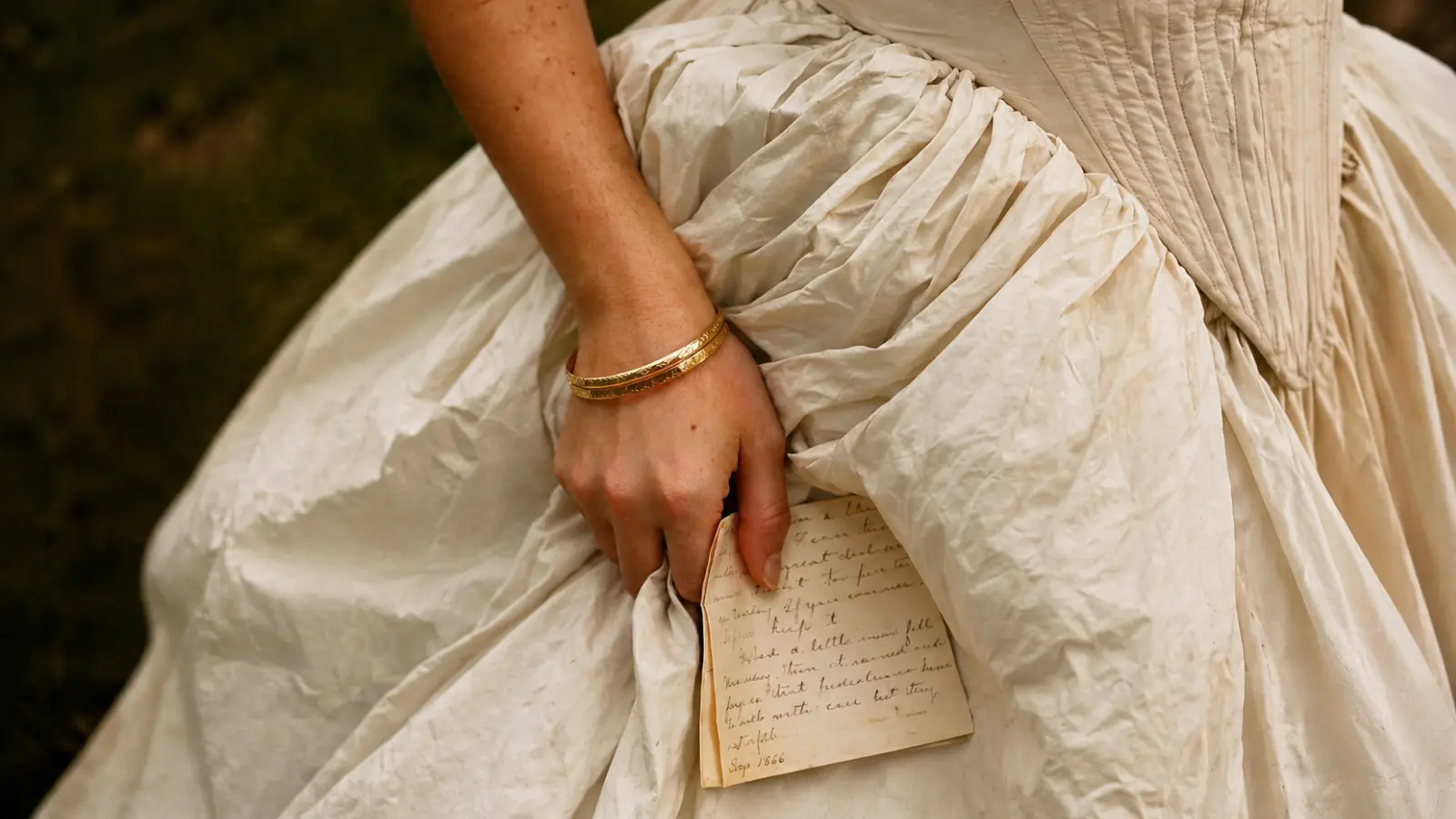
Where do wedding vows come from? Wedding vows come from the 1549 Book of Common Prayer, written by Thomas Cranmer during the English Reformation. This is where the traditional phrases like “to have and to hold,” “for better or worse,” and “till death do us part” were first formalized in English and spoken by the couple themselves.
Before that, marriage ceremonies were conducted in Latin and controlled by the Church, meaning most couples did not fully understand the words being spoken at their own wedding. The shift to English transformed the ceremony from something performed for the couple into something spoken by them, which is why those same phrases are still used today across the United States.
The phrases you will hear at a wedding today have survived for nearly 500 years. They have been repeated across generations, adapted across cultures, and carried through major changes in how marriage is understood. This guide explains where wedding vows come from, what the traditional phrases actually mean, and how they shaped the modern complete wedding vows guide couples still follow today.
Before Wedding Vows Existed
Marriage is older than recorded history. What we would recognize as a wedding vow — a spoken promise made publicly between two people — is not. For most of human history, marriage was less a romantic covenant and more a legal and economic transaction, documented in contracts, witnessed by families, and enforced by social and financial consequence rather than by the weight of the words spoken.
Ancient Rome
Roman marriage ceremonies included a confarreatio — a religious rite involving shared bread, sacred objects, and witnesses — but the spoken words at these ceremonies were less a personal declaration and more a legal formula. Roman marriage was fundamentally a change of legal status, formalized through documents and family agreement. The concept of a personal spoken promise as the emotional and moral center of the ceremony was largely absent.
What Roman tradition did establish was the idea of public witnessing — that the marriage needed an audience, that the community’s presence gave the union its legitimacy. This principle survived every subsequent civilization and is still the reason we invite people to weddings at all.
Ancient Jewish Tradition
Jewish marriage contracts — the ketubah — are among the oldest documented marriage instruments in the world, dating back over two thousand years. The ketubah is a written document detailing the husband’s obligations to the wife: food, clothing, conjugal rights, and financial protection in the event of divorce or the husband’s death. It was read aloud at the ceremony and signed by witnesses.
What is striking about the ketubah is that it is largely a document of promises — specific, enforceable, addressed to the wife rather than about her. This structure anticipates what we now call wedding vows by centuries. Some couples today incorporate a modern ketubah as part of their ceremony, bridging ancient tradition and contemporary language.
Medieval Europe — The Church Takes Control
Through the early medieval period, marriage in Europe gradually moved from a purely civil and family matter to an ecclesiastical one. The Catholic Church began asserting authority over marriage ceremonies around the 9th and 10th centuries. By the 13th century, the Fourth Lateran Council (1215) had formalized church control — requiring public announcement of intent to marry (the banns), clerical oversight, and witnesses.
The ceremonies of this period were conducted in Latin, using the Sarum Rite — a regional variation of the Roman Rite originating in Salisbury Cathedral that became the dominant form in England. The emotional commitments embedded in these ceremonies — fidelity, companionship through hardship, permanence — are recognizable ancestors of what we say today. But they were spoken in a language ordinary people did not understand, by priests to couples who could not fully participate in their own ceremony.
The Problem Cranmer Solved
Before 1549, English couples were married in ceremonies they could not understand — conducted in Latin, by clergy, while they stood as passive participants in their own most significant moment. The modern wedding vow was invented, in part, to fix this. Thomas Cranmer’s radical act was to write a ceremony in plain English that the couple could actually speak and mean.
The Moment Everything Changed: 1549
The wedding vow as we know it was born on June 9, 1549, when King Edward VI’s government published the first Book of Common Prayer — the foundational liturgical text of the Church of England, written primarily by Thomas Cranmer, Archbishop of Canterbury.
Cranmer’s achievement was remarkable. He took the Latin ceremonial tradition of the medieval church, stripped it of its exclusivity, and rewrote it in English that ordinary people could speak, understand, and mean. The ceremony he produced was not just translated — it was transformed. The vow was no longer a formula recited at the couple; it was a promise spoken by the couple, in their own language, to each other.
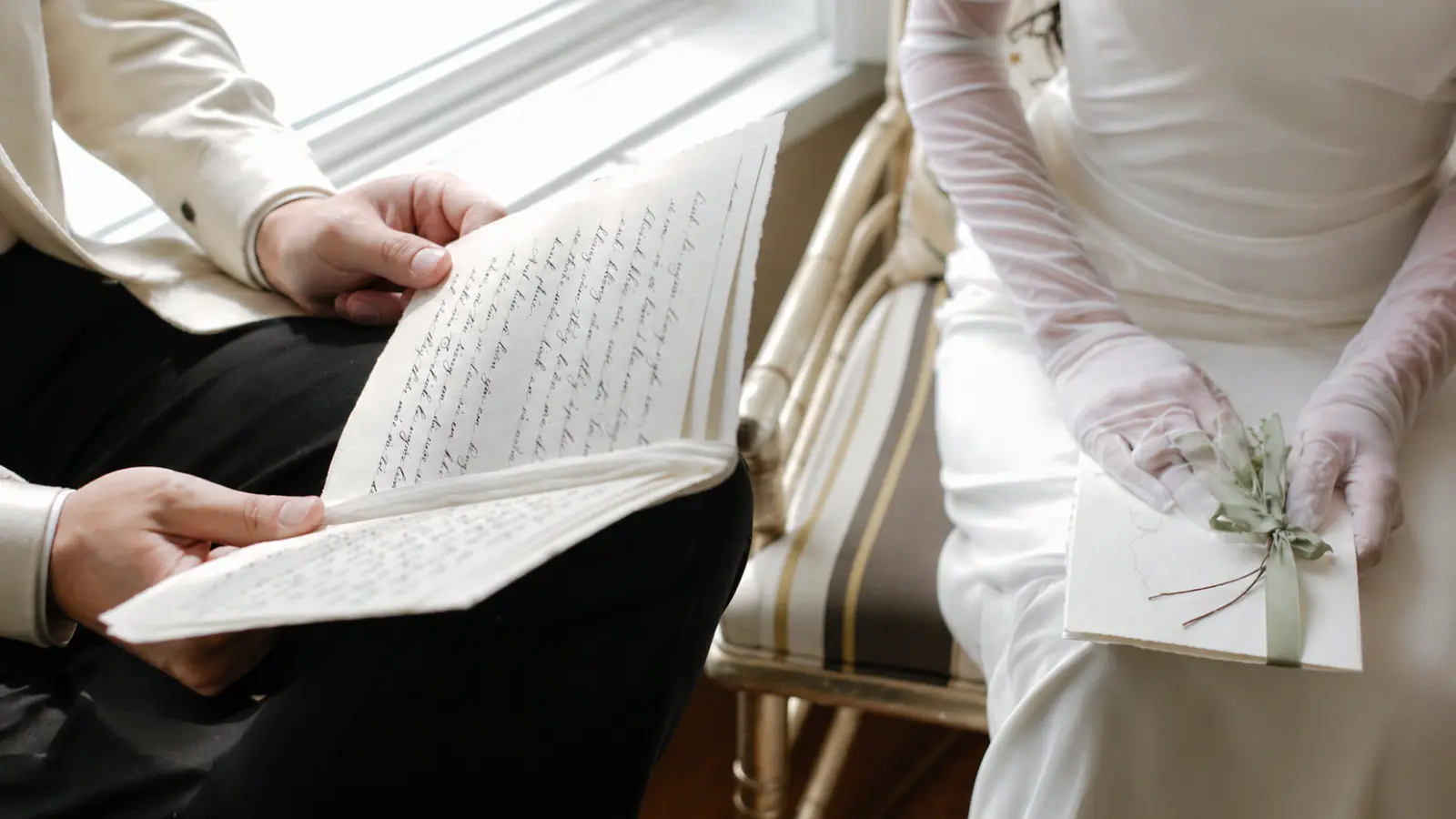
The 1549 Vow — Original Text
The man’s vow — Book of Common Prayer, 1549
I [Name] take thee [Name] to my wedded wife, to have and to holde from this day forwarde, for better for wurse, for richer for poorer, in sickenes and in health, to love and to cherishe, tyll death us departe: accordynge to Goddes holy ordynaunce: And therto I plight thee my trouth.
The woman’s vow — Book of Common Prayer, 1549
I [Name] take thee [Name] to my wedded husbande, to have and to holde from this day forwarde, for better for wurse, for richer for poorer, in sickenes and in health, to be bonny and buxome in bed and at borde, tyll death us departe: accordynge to Goddes holy ordynaunce: And therto I plight thee my trouth.
Several things stand out in this original text. First, the core phrases are already fully formed — “to have and to hold,” “for better for worse,” “for richer for poorer,” “in sickness and in health,” “till death us depart” — nearly identical to what millions of people say today. Cranmer’s language was so carefully constructed that 475 years of revision and reform have not materially improved it.
Second, the woman’s vow includes a phrase that vanished from the record within a few decades: “to be bonny and buxome in bed and at borde” — meaning to be pleasant and accommodating both in the bedroom and at the table. This phrase was already archaic by the 1662 revision of the Prayer Book and is absent from virtually all modern scripts.
Third, the phrase “I plight thee my trouth” — from the Middle English word troth, meaning faithfulness or fidelity — survives in some traditional scripts today, though most modern ceremonies replace it with “This is my solemn vow” or simply close without it.
The 1662 Revision
The Book of Common Prayer was revised in 1662, producing the version that shaped Anglican and subsequently Protestant ceremonies for the next three centuries. The language is almost identical to 1549, with modernized spelling and slight adjustments. This is the version most people picture when they say traditional wedding vows today — and it is the version that arrived in America with English settlers.
What the Classic Phrases Actually Mean
The phrases in the traditional wedding vow were not decorative. Cranmer chose each one deliberately, and each carries a specific meaning that rewards close reading. Most people who say these words — or hear them — do not know their full weight.
“To have and to hold”
What it means: This phrase is a legal doublet — a pair of words used in English law to cover the full range of a concept. “To have” refers to legal possession and partnership; “to hold” refers to physical presence, closeness, and the ongoing act of keeping. Together they promise both the legal reality of marriage and the physical, embodied presence that makes it real day to day.
In a 16th-century legal context, “to have and to hold” was used in property law — “to have and to hold a piece of land” meant to own it completely and to actively maintain possession of it. Cranmer’s use of this phrase at the opening of the vow elevated the partner — this person you are promising to “have and to hold” — to the status of your most important earthly possession and responsibility. Not a possession in the diminishing sense, but in the sense of the thing you value most and commit to keeping close.
“For better or for worse”
What it means: This is the unconditional clause — the promise that is not contingent on circumstances. It explicitly names the possibility of “worse” as something the vow covers. The phrase does not pretend that marriage will always be good. It acknowledges that it will not be, and says: even then, I am here.
In Cranmer’s time, “worse” was not an abstraction. Life expectancy was short, poverty was common, and hardship was not exceptional but expected. The vow was not promising to love someone when everything was fine; it was promising to stay when everything was not. That is still what it means.
“For richer, for poorer”
What it means: A promise that is explicitly not conditional on financial circumstance. In an era when marriages were largely economic arrangements — unions between families as much as between individuals — this phrase was radical. It stated that the commitment was not dependent on material status. The marriage stood regardless of what happened to the money.
Today, research consistently identifies financial stress as one of the leading causes of marital conflict and divorce. The 16th century did not need research to know this. The people who wrote this phrase understood it from experience, which is why they named it specifically, placed it next to “for better or for worse,” and made it a direct promise rather than an assumption.
“In sickness and in health”
What it means: This is the physical commitment — the promise that extends through the body’s decline. In a period before modern medicine, sickness was common, prolonged, and often fatal. The vow was promising to stay through the hardest physical realities of human life — not just illness but aging, disability, and the slow diminishment of the body over decades.
The phrase pairs “sickness” with “health” rather than “sickness and recovery” — because recovery was not guaranteed. You were not promising to stay through a temporary setback. You were promising to stay through whatever the body brought, including the worst of it, including the end.
“To love and to cherish”
What it means: Two distinct promises in a single phrase. “To love” is the active commitment — the ongoing choice to prioritize this person, to act in their interest, to sustain the emotional reality of the marriage. “To cherish” goes further — it is the promise to hold the person in high esteem, to treat them as precious, to honor what they are rather than merely tolerate who they are.
Cranmer’s original man’s vow used “to worship” in the place of “to cherish” for the woman — a word that carried extraordinary weight. To worship a person in 16th-century English meant to hold them in the highest honor. The woman was later asked “to cherish” while the man was asked “to worship,” an asymmetry that later revisions corrected but that reveals how seriously Cranmer’s original text took the man’s obligation to the woman.
“Till death do us part”
What it means: The duration clause — the promise that names its own limit. Cranmer’s original was “till death us depart” (with “depart” meaning “separate”), which later became “till death do us part.” The phrase is both comforting and stark. It says the marriage is permanent — but it also acknowledges mortality directly, in the middle of a ceremony that is fundamentally about hope and beginning.
This directness is deliberate. The vow is not promising something vague like “forever.” It is promising the full length of a specific human life — yours — and acknowledging that the only thing that ends this promise is death. That specificity is what gives the phrase its weight. It is not a romantic flourish. It is a precise commitment.
“I plight thee my troth”
What it means: The closing line of the 1549 vow, now mostly absent from modern ceremonies. “Troth” comes from the same Old English root as “truth” — it means faithfulness, fidelity, and sworn word. “To plight” means to solemnly pledge. The phrase translates directly to: “I give you my faithfulness as a solemn pledge.” In an era when a person’s word was their bond and breaking it carried serious social and spiritual consequences, this was not a ceremonial flourish. It was the legal and moral core of the entire vow.
The History of “Obey”
No single word in the history of wedding vow language has generated more debate, more revision, and more internet searches than “obey.” Its history is a compressed version of the history of women’s rights — and understanding where it came from explains both why it was there and why it left.
Why It Was There
In 1549, when Cranmer wrote the bride’s vow to include “obey,” this was not a theological statement about the relative worth of women. It was a legal description of the reality of married life in 16th-century England. Upon marriage, a woman’s legal identity was entirely subsumed into her husband’s — she could not own property, sign contracts, or appear in court independently. She was, legally, his dependent. The vow language encoded this social and legal reality.
The groom’s corresponding word was not “obey” but “worship” — to hold in the highest honor. In the original framing, the asymmetry cut both ways: she obeyed, he honored. This did not make the arrangement equal, but it placed a significant obligation on the man that later revisions sometimes obscured by simply removing “obey” without addressing the rest.
How It Left
| Era | What changed |
|---|---|
| 1920s–1930s | Women’s suffrage shifts public consciousness; some mainline Protestant denominations begin offering vow scripts without “obey” |
| 1960s | Second-wave feminism accelerates revision; “obey” becomes a point of active contestation in mainstream Protestant ceremonies |
| 1970s | The Episcopal Church revises its Prayer Book (1979), removing gendered asymmetry from both vow scripts; most mainline denominations follow |
| Today | Absent from nearly all mainstream U.S. ceremonies; retained in some conservative evangelical traditions, sometimes reframed as mutual submission (Ephesians 5:21) |
Today, some couples choose to include “obey” or “honor and submit” language in their vows deliberately — not as a statement of hierarchy but as an expression of the theological concept of mutual submission in marriage, drawn from Ephesians 5:21: “Submit to one another out of reverence for Christ.” In ceremonies where this interpretation is used, both partners sometimes include the language as an equal, reciprocal commitment. This is a minority practice, chosen with intention and theological conviction.
How Wedding Vows Came to America
The 1549 Book of Common Prayer arrived in America with the first English settlers in the early 1600s. The Virginia Colony used Anglican ceremony forms from the beginning; the Puritan settlers of Massachusetts brought their own Reformed tradition, which had a more ambivalent relationship with fixed liturgy but still relied on similar foundational language.
As American religious life diversified through the 17th and 18th centuries — with the arrival of Quakers, Catholics, German Reformed churches, Dutch Reformed churches, and eventually a vast array of Protestant denominations — wedding vow traditions multiplied. But the core English Protestant language remained the dominant form, embedded deeply enough in the culture that even denominations that modified it preserved its essential structure.
Civil Marriage in America
Civil marriage — conducted by a justice of the peace or other government official rather than a religious figure — became legally recognized across American states through the 18th and 19th centuries. Civil ceremonies and non-religious wedding vows often used stripped-down versions of the traditional language, removing explicitly religious framing while keeping the core structure of the vow.
This produced what became the standard American wedding vows script — the “I do” format — which replaced the full recitation of the vow with a question-and-answer structure. Rather than each partner speaking the full vow, the officiant asks: “Do you take this person…” and the partner responds: “I do.” This format is now the most commonly used in American weddings of all types, religious and secular.
How Vow Language Evolved Through the 20th Century
The 20th century transformed wedding vows more than any period since 1549. The changes were driven not by theology but by social change — and they tell the story of how Americans’ understanding of marriage itself shifted across a hundred years.
1900s–1920s
Standard ceremonies use the 1662 Book of Common Prayer language or close American adaptations. “Obey” is nearly universal in the bride’s vow. Catholic ceremonies follow the Rite of Marriage in Latin.
1920s–1930s
Women’s suffrage (19th Amendment, 1920) begins reshaping public attitudes toward vow language. Some Progressive-era Protestant ministers begin offering brides the option to omit “obey.” The practice is considered unconventional but is no longer shocking.
1940s–1950s
Post-war romanticism intensifies the cultural emphasis on marriage as a personal, emotional bond rather than primarily a legal or economic arrangement. The “love match” ideal — choosing a partner for romantic reasons — becomes mainstream. This shifts emphasis from duty-language toward love-language in vows.
1960s
Second-wave feminism produces direct challenges to “obey” language. Clergy in mainline denominations begin routinely offering vow scripts without the word. The first personal-vow weddings appear in mainstream American culture — counterculture couples writing their own language, outside the prescribed forms.
1970s
The Episcopal Church produces a revised Book of Common Prayer (1979) with gender-equal language. Most mainline Protestant denominations follow. Personal vows move from countercultural to increasingly mainstream. Catholic ceremonies transition to English following the Second Vatican Council reforms.
1980s–1990s
Personal vows become a common option offered by most non-Catholic officiants. Wedding media — magazines, books, early internet resources — begin publishing personal vow guides. The market for wedding vow writing assistance emerges.
2000s–present
Personal vows become the majority choice for American couples, increasing interest in how to write wedding vows naturally, LGBTQ+ marriage equality (Obergefell v. Hodges, 2015) produces a generation of couples writing vows without the gender-specific language of traditional scripts. The traditional script remains deeply meaningful — particularly in religious ceremonies — but is now one option among many rather than the default.
Wedding Vow Traditions Around the World
The English-language wedding vow tradition is one of dozens of distinct forms that exist across cultures. Each reflects the society that produced it — its understanding of what marriage is, what it demands, and what it means to promise something in public.
Jewish — The Ketubah and the Seven Blessings
Traditional Jewish marriage centers on the ketubah (marriage contract) and the Sheva Brachot (Seven Blessings). The ketubah is a written document specifying the husband’s obligations to his wife — not a mutual vow but a one-directional promise from groom to bride, read aloud at the ceremony and signed by witnesses. The Seven Blessings are prayers rather than personal promises, invoking joy and holiness over the couple.
Modern Jewish ceremonies often supplement these with personal vows in English, but the ketubah remains central — and many couples today commission a ketubah as an illuminated artwork, displayed in the home as a permanent record of the ceremony’s promises.
Hindu — The Saptapadi (Seven Steps)
The heart of the traditional Hindu wedding ceremony is the Saptapadi — seven steps taken together around a sacred fire, with a spoken or implied vow accompanying each step. The seven promises are: nourishment, strength, prosperity, wisdom, children, health and longevity, and friendship. Together, they cover the full practical and spiritual scope of a shared life.
The Saptapadi is considered legally binding in India upon completion of the seventh step. It is one of the oldest documented marriage ritual forms in the world, with roots in the Rigveda. The structure — a series of specific, forward-looking promises rather than a single omnibus commitment — is strikingly similar to what modern personal vow writers arrive at after extensive deliberation.
Islamic — The Mahr and the Ijab-Qabul
Islamic marriage (the Nikah) centers on the ijab-qabul — the offer and acceptance — in which the bride’s guardian (or the bride herself in many modern ceremonies) and the groom formally state their agreement to the marriage in the presence of witnesses. This is followed by the mahr — a mandatory gift from the groom to the bride, which is her property alone and a form of financial protection.
Islamic marriage ceremonies do not traditionally include the extended personal vow exchange that characterizes Protestant weddings. The legal and sacred aspects of the marriage are established through the ijab-qabul, with the mahr providing the material dimension. Many Muslim couples in the U.S. today supplement this with personal vow exchanges, combining the traditional Islamic structure with the Protestant American convention.
Celtic / Irish — Handfasting and the Pledge
The Celtic tradition of handfasting — binding the couple’s hands together with a cord while vows are spoken — is one of the most visually distinctive wedding rites in the Western tradition. Historically practiced in Scotland and Ireland, handfasting was at various times a formal betrothal rite, a temporary marriage trial, and a full marriage ceremony, depending on period and location.
Modern handfasting ceremonies draw on this tradition for its powerful symbolism: the binding of hands makes the abstract promise physically literal. The cord, often made in significant colors, is tied in a knot during the vows — creating the idiom “tying the knot.” This tradition has experienced a significant revival in the U.S. among couples seeking ceremonies with historical depth and elemental imagery.
Japanese — San-san-kudo
Traditional Shinto wedding ceremonies in Japan center on san-san-kudo — literally “three-three-nine-times” — in which the couple takes three sips each from three cups of sake, for a total of nine sips. There are no spoken vows in the Western sense; the ritual act itself is the marriage pledge. The ceremony emphasizes harmony and sacred union over personal declaration.
Modern Japanese weddings frequently blend Shinto tradition with Western-style ceremonies, including personal vow exchanges in English or Japanese. The fusion reflects a broader pattern: wedding vow traditions across cultures increasingly borrow and blend, producing ceremonies that draw on multiple heritages simultaneously.
What the Bible Actually Says About Wedding Vows
One of the most common questions people ask when researching wedding vow history is: where in the Bible does it say what to promise? The honest answer is that no wedding vow script appears in the Bible. There is no prescribed ceremony, no required language, no passage that functions as a liturgical template for what a couple should say.
What the Bible does contain is a rich and varied theological framework for marriage — and it is this framework, interpreted and reinterpreted across centuries of Christian tradition, that produced the wedding vow language we know today.
The Passages That Shaped Vow Language
Genesis 2:24 — “Therefore a man shall leave his father and his mother and hold fast to his wife, and they shall become one flesh.” This passage, quoted by Jesus in Matthew 19:5 and by Paul in Ephesians 5:31, established the theological foundation of Christian marriage: a new primary bond, above the bond of origin. The leaving and the holding fast — the choice and the permanence — are both here.
Ruth 1:16–17 — “Where you go I will go, and where you stay I will stay. Your people will be my people and your God my God.” Spoken by Ruth to her mother-in-law Naomi rather than to a spouse, this passage has nonetheless become the most-used scripture at American weddings because its language of unconditional accompanying — wherever you go, I go — captures the emotional core of marriage in words that no vow writer has improved upon.
1 Corinthians 13:4–8 — “Love is patient, love is kind…” The most-read passage at American weddings, used in ceremonies across every denomination and in secular ceremonies as well. Its list of what love does and does not do has been adapted into personal vow language by thousands of couples: “I promise to be patient with you. I promise to be kind. I promise to keep no record of wrongs.”
Song of Solomon 6:3 — “I am my beloved’s and my beloved is mine.” Brief, bilateral, and mutual — this line from the Song of Songs is often used as a closing line for biblically-grounded personal vows because it says everything in eight words and cannot be improved upon.
Why No Biblical Vow Script Exists
The absence of a prescribed vow script in scripture is theologically significant. The New Testament describes marriage as a covenant, draws on it as a metaphor for Christ’s relationship with the church, and gives substantial guidance about how spouses should treat each other — but it does not prescribe a ceremony. This left the church free to develop ceremonial forms according to cultural context and pastoral need, which is exactly what it did.
The result is that the wedding vow tradition is entirely ecclesiastical — a human creation, developed by the church to embody theological commitments in a form that people could speak, remember, and hold each other to. The tradition is not less meaningful for being human-made. It is arguably more so: it represents centuries of accumulated wisdom about what a marriage promise actually needs to say.
The Rise of the Personal Vow
The personal wedding vow — in which each partner writes their own promises rather than using a prescribed script — is sometimes presented as a modern invention, a product of contemporary individualism and the desire for personalization in consumer culture. This characterization is partly true and mostly misleading.
Personal vow elements have existed in various forms throughout wedding history. Medieval English couples supplemented formal ceremony language with personal declarations. Quaker meetings in the 17th century required couples to speak their own promises before the congregation rather than repeating after a minister. What changed in the late 20th century was not the idea of personal vows but their prevalence — the shift from an exception to a near-majority practice.
What Drove the Shift
Several forces converged to produce the current dominance of personal vows in American weddings. The feminist critique of traditional vow language in the 1960s and 1970s created an opening: if the traditional script was not acceptable as-is, couples needed an alternative. The decline of denominational religious affiliation meant that fewer couples were bound by prescribed liturgical forms. And the rise of wedding media — magazines, websites, social platforms — created a culture in which the personal vow became not just an option but a performance expectation.
The result is that today roughly 74% of American couples write their own vows. The traditional script is chosen by approximately 26% — predominantly in religious ceremonies where it carries denominational and theological weight — and it remains, by any measure, the most-recognized marriage language in the English-speaking world.
What Personal Vows Gave Up and Gained
The traditional vow carries something that no personal vow can replicate: the accumulated weight of millions of promises made over centuries. When you say “for better or for worse, in sickness and in health,” you are using language that your grandparents said, and their grandparents before them, going back to a ceremony in 1549. The continuity is itself meaningful — it places your promise in a lineage.
What personal vows offer instead is specificity: the particular voice of a particular person, speaking to a particular partner, in language that could not have been written by anyone else. The most powerful wedding vows examples do something the traditional script cannot — they name the actual relationship, the real moments, and the specificity found in strong unique wedding vows. Both forms have their place. The choice between them is not about quality. It is about what kind of weight you want your words to carry.
How to Give Your Vows Meaning Today
Whether you choose the traditional script, write your own, or blend the two, the history of wedding vows offers clear guidance about what makes them work — what separates the promises that stay in a room from the ones that fade.
The Principle That Has Held for 475 Years
Cranmer’s 1549 vow has survived because it was specific. Not abstractly specific — specifically specific. It named the circumstances that would test the marriage: better and worse, richer and poorer, sickness and health. It did not promise that everything would be fine. It promised to stay when it was not.
This is the principle that every effective vow — traditional or personal — follows: it names the reality of what you are promising, which is also the foundation of what to include in wedding vows today, including the hard parts. A vow that only promises joy is a promise about good circumstances. A vow that promises to stay through sickness, poverty, and the worst is a promise about commitment. The first is easy to say. The second is the actual thing.
What “Meaning” Requires
A vow means something when the person saying it means it — which sounds obvious but is the hardest part. The ceremony, the witnesses, the formality, the rings — all of these create conditions for meaning. But the meaning itself comes from the person speaking, and from the specificity of what they say.
If you are using the traditional script: say it slowly. Do not rush through phrases you have heard a hundred times. Let “in sickness and in health” land on your partner as if it were being said for the first time — because for the two of you, it is.
If you are writing personal vows: find the specific thing that is true about your relationship and name it. Not what love is in general but what loving this person has been like. Not what you hope for in the abstract but what you are actually promising, with real shape and real stakes.
The goal in either case is the same as it was in 1549: a promise spoken in plain language, much like the strongest advice found in how to start and end wedding vows naturally, by the person who means it, to the person it is for. That is what a wedding vow is. That is what it has always been.
Final thoughts
Wedding vows have lasted for centuries because they were built on something simple and difficult at the same time — saying clearly what you are promising, even when those promises include things most people would rather not think about.
The phrases have not survived because they are traditional. They have survived because they describe the reality of commitment in a way that still holds true, no matter how much the idea of marriage changes around them.
Whether you choose to use those exact words or write your own, the purpose remains the same as it was in 1549: to say something that is clear, intentional, and real enough to stand over time.
Frequently asked questions (FAQ)
Where do wedding vows come from historically?
Wedding vows as we know them today come from the 1549 Book of Common Prayer, written by Thomas Cranmer in England. Before that, marriage ceremonies were conducted in Latin, and couples often did not understand the words being spoken.
Are traditional wedding vows based on the Bible?
No, traditional wedding vows are not directly from the Bible. They were created by the Church based on biblical ideas about marriage, but the actual wording comes from religious tradition, not scripture.
Why have wedding vows stayed the same for so long?
Wedding vows have remained similar for centuries because they address fundamental aspects of marriage that do not change, such as commitment, hardship, loyalty, and permanence. Their simplicity and clarity make them timeless.
What is the meaning behind traditional wedding vow phrases?
Each phrase represents a specific commitment. For example, “for better or worse” refers to emotional challenges, while “in sickness and in health” refers to physical ones. Together, they cover the full reality of a long-term relationship.
Do modern couples still use traditional wedding vows?
Yes, many couples still use traditional vows, especially in religious ceremonies. However, a majority now choose to write personal vows or combine traditional structure with their own words.