
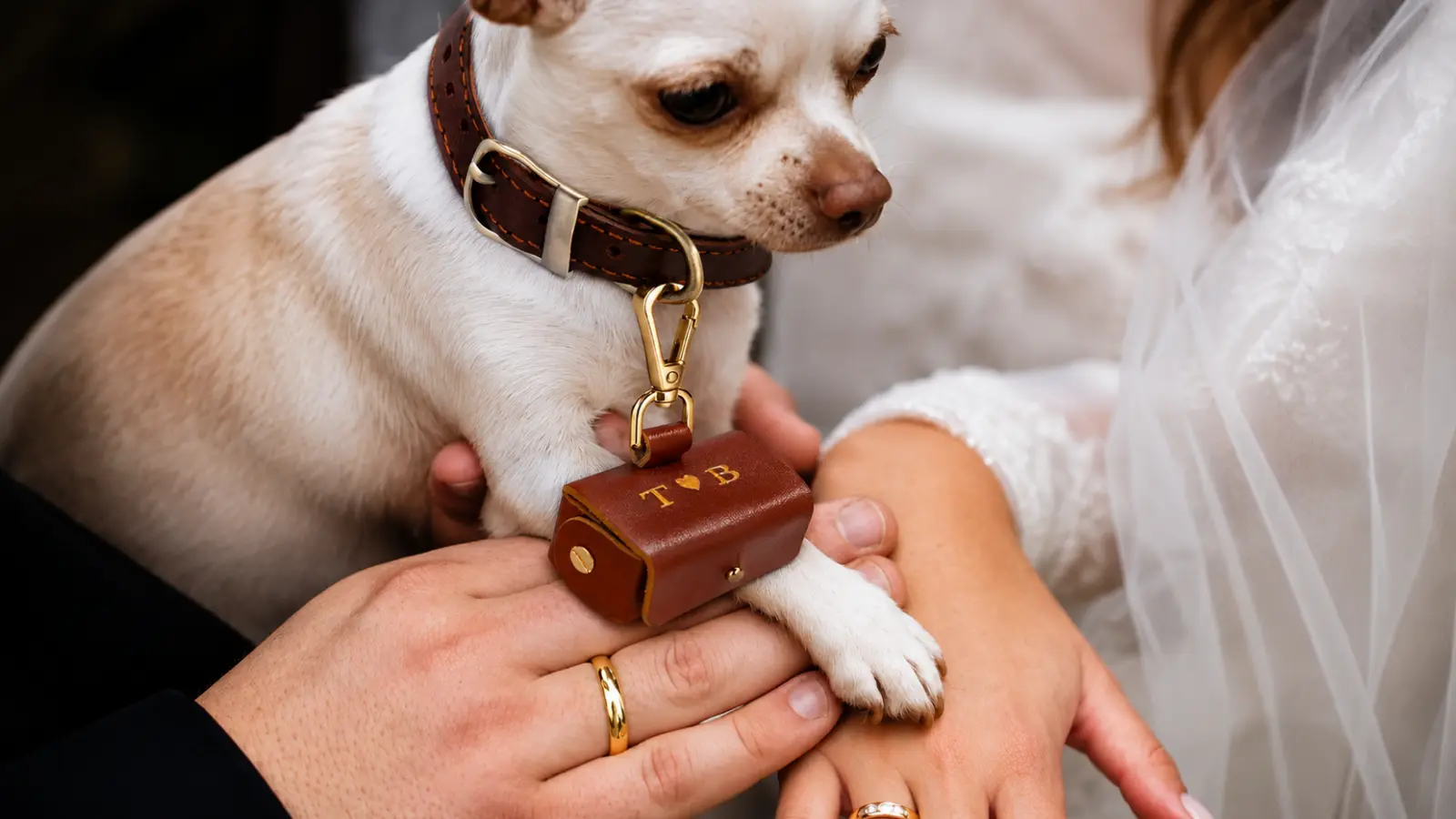
A dog ring bearer can become one of the most memorable moments of a wedding ceremony when the role is planned carefully. A calm, well-prepared dog walking down the aisle creates beautiful photographs and unforgettable memories, but success depends much more on preparation than on luck.
Not every dog enjoys busy wedding environments, and not every ceremony is suitable for a canine ring bearer. Choosing the right handler, practicing the aisle walk, using safe accessories, and preparing a backup plan all make the experience more comfortable for the dog and more enjoyable for everyone attending the wedding.
This guide explains everything you need to know about having a dog ring bearer and how to include your pet in your wedding, including training, ceremony preparation, ring safety, accessories, practice sessions, common mistakes, and what to do if your dog does not follow the ceremony plan.
Dog Ring Bearer at a Glance
Before getting into the details, here’s a quick reference for the most common questions couples ask when they start planning a dog ring bearer moment.
| Question | Simple Answer |
|---|---|
| Can a dog be a ring bearer? | Yes, if the venue allows it and the dog is calm and leash-trained |
| Can another pet fill this role? | Sometimes symbolically, but dogs are the most realistic option |
| Should the dog carry real rings? | Only with secure attachment and a clear backup plan |
| Who walks the dog? | A dedicated handler — not a guest, not a wedding party member with other duties |
| What if the dog refuses to walk? | Use a pre-planned backup and keep the real rings elsewhere |
The sections below cover every one of these in enough depth to make the actual decision — and pull it off on the day.
Can Your Dog Be the Ring Bearer?
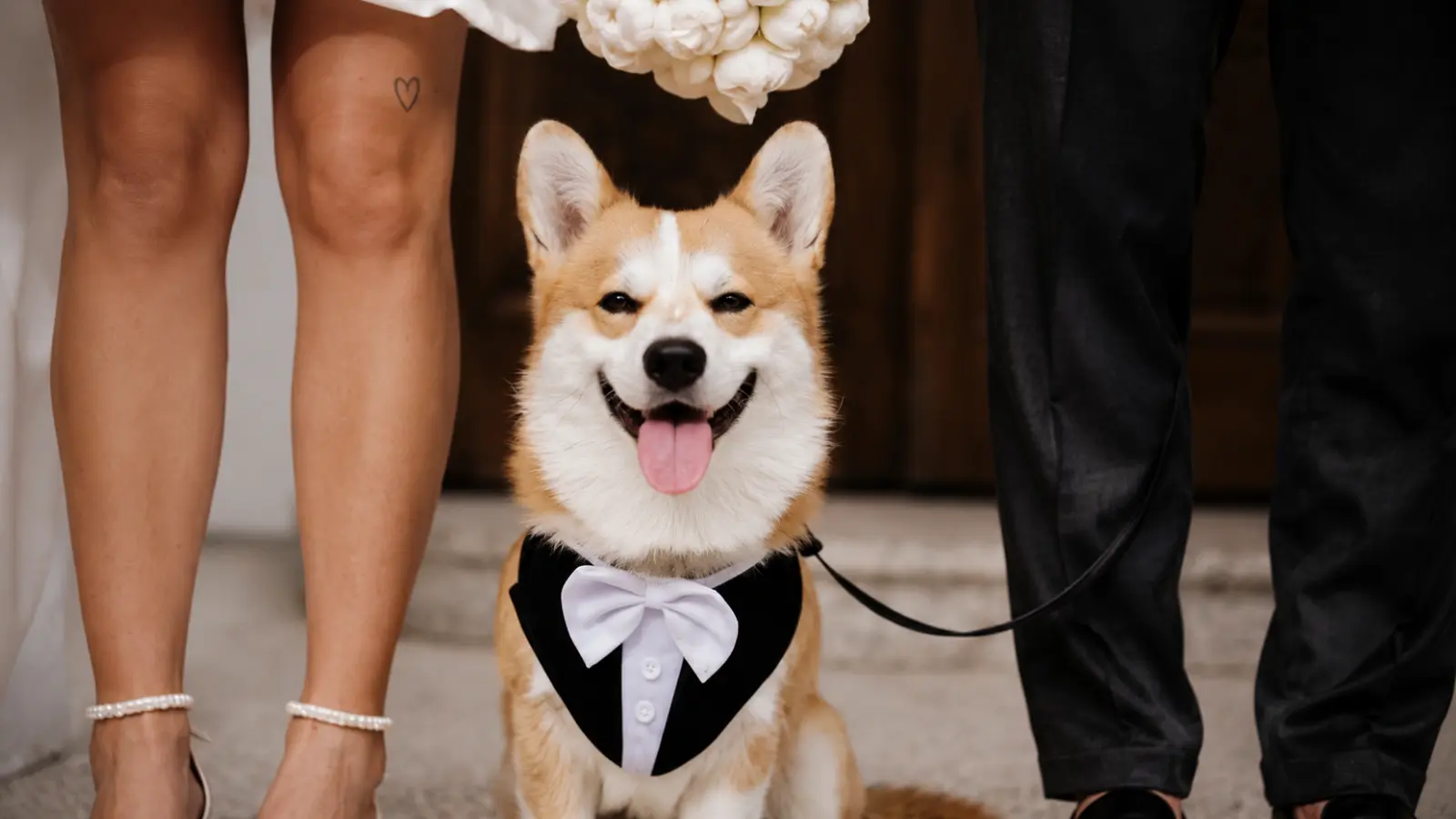
The short answer is yes — with the right dog, the right preparation, and the right setup. But “the right dog” is doing a lot of work in that sentence, and it’s worth being specific about what it actually means.
A dog who can realistically serve as a ring bearer is one who walks calmly on a leash with a handler who isn’t their primary owner, doesn’t react strongly to crowds or applause, isn’t easily spooked by unfamiliar environments, and can complete a short, focused walk without getting distracted or anxious. That’s a meaningful threshold, and not every dog — no matter how beloved or well-behaved at home — clears it in a wedding setting.
A wedding ceremony involves a lot of things that don’t happen on a regular walk: rows of people in formal clothes all looking in the same direction, music, a camera crew moving around, floral arrangements at nose level, the emotional energy of a couple who is visibly different from their usual selves. Some dogs move through all of that without breaking stride. Others find one element of it genuinely overwhelming. Knowing which type of dog you have is the starting point for everything else in this guide.
Is Your Dog a Good Fit for This Role?
Before committing to the ring bearer plan, run your dog through these questions honestly. This isn’t about whether your dog is well-trained in general — it’s about whether they’re suited to this specific environment.
Does your dog walk calmly on a leash with someone other than you? The handler will likely not be the dog’s primary owner, since that person is usually the one getting married. If your dog becomes anxious or distracted when their main person isn’t holding the leash, that’s a real concern for a ceremony walk.
Has your dog been in spaces with many strangers before — and handled it without barking, pulling, or shutting down? A dog who is friendly one-on-one but overwhelmed by groups will read the ceremony differently than you expect.
How does your dog respond to applause? Many guests will clap or react audibly when the dog appears. A dog who startles at sudden noise in the middle of an aisle walk is a problem that’s hard to recover from gracefully.
Can your dog complete a focused task — walk from point A to point B — without stopping to investigate every smell along the way? Ceremony aisles often have flowers, food-adjacent smells from the reception setup, and unfamiliar scents from hundreds of guests. A nose-driven dog can easily turn a fifteen-second walk into a two-minute detour.
If the honest answers give you pause on more than one of these, it doesn’t mean the dog can’t be part of the wedding — it may mean the ceremony walk isn’t the right role. A portrait session, a getting-ready photo, or a symbolic detail may serve everyone better, including the dog. There are many thoughtful ways to honor your pet at your wedding without bringing them to the ceremony if staying home is the kinder choice.
Can Another Pet Be a Ring Bearer?
Dogs are the most realistic option for a true ring bearer walk, but other pets occasionally take on a version of this role. The key word is version — because what works for a dog in a ceremony setting rarely translates directly to other animals.
Cats as Ring Bearers: Is It Realistic?
Cats can be carried down the aisle, and some unusually social cats do tolerate a brief ceremony appearance. But a cat walking independently down an aisle toward a crowd of strangers, on cue, in an unfamiliar space that scenario is far more difficult in a real wedding ceremony than it may appear in a short video or photo.
Most cats are territorial, noise-sensitive, and not inclined to follow directional cues from a handler in an unfamiliar environment. A cat who is relaxed at home may become a completely different animal the moment they are transported to a venue and handed to someone they barely know in front of 100 guests. If your heart is set on including your cat in the ceremony, a symbolic role — carried briefly for a single photo moment, or honored through a detail on the program — is usually the more respectful and realistic path. The main pets at weddings guide covers the full picture on cat inclusion.
Other Small Pets
Rabbits, birds, and other small animals occasionally appear in ceremony photos taken before the event begins, in a calm and controlled setting. A true aisle walk is rarely appropriate for these animals — the combination of noise, strangers, and an unfamiliar environment creates real stress risk. If you want a small pet involved, plan a brief pre-ceremony portrait session in a quiet space and let that be their moment. Short, calm, and on the animal’s terms.
Venue Rules and Ceremony Restrictions
Choosing pet-friendly wedding venues comes before any other planning, because even the best-prepared dog cannot be a ring bearer at a venue that doesn’t allow animals. A dog who is perfectly suited for the role cannot be a ring bearer at a venue that doesn’t allow pets — and finding that out after you’ve built the ceremony around the moment is a painful surprise.
When you speak to your venue coordinator, ask specifically about pets in the ceremony space, not just on the property. Some venues allow animals on the grounds but not inside the main ceremony hall. Others require a signed pet waiver or proof of vaccination. Some have breed or size restrictions. Get the specific terms in writing — including which areas of the venue the dog may access, whether there is a quiet holding space for the animal before and after their moment, and what the cleanup expectations are.
Also check with your officiant. Some officiants are completely comfortable incorporating a dog into the ceremony flow; others have concerns about managing a live animal during the vows. A brief conversation before the wedding day will surface any friction early enough to address it.
Who Should Walk the Dog Down the Aisle?
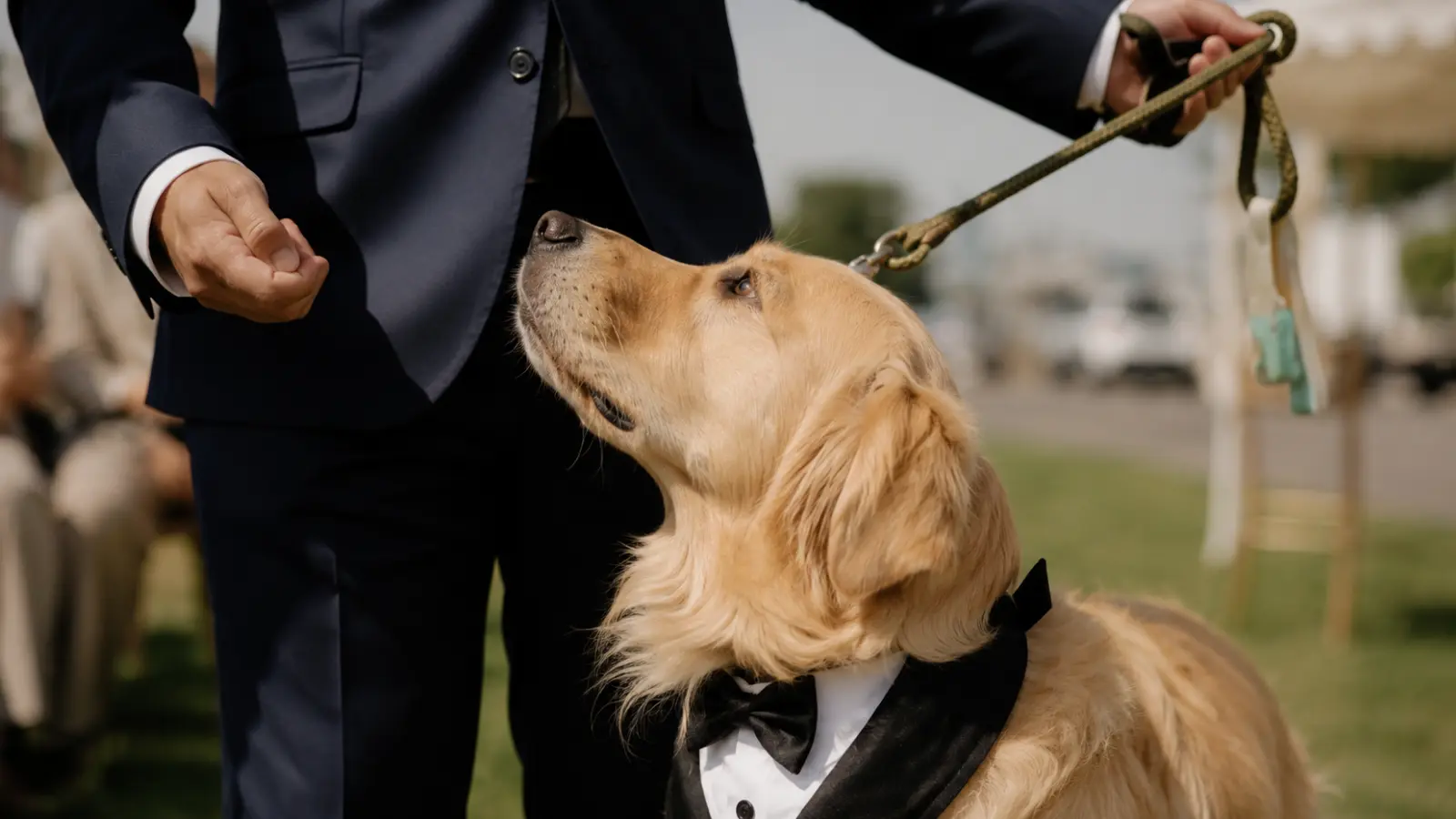
The handler is the most important logistical decision in this entire plan, and it’s the one most couples underestimate. The person walking the dog needs to be fully focused on that animal from the moment the dog enters the ceremony space until the moment they exit. That means they cannot also be a bridesmaid, a groomsman, a parent walking in the processional, a photographer’s assistant, or a guest trying to watch the ceremony.
The handler’s job is not just to hold the leash. They need to keep the dog calm in the moments before the walk, execute the aisle entrance on cue, manage whatever the dog actually does during the walk (which may not match what you rehearsed), retrieve the rings at the front if real rings are used, and remove the dog from the ceremony space immediately and quietly after their moment is done. That is a full, focused role.
A trusted friend or family member who knows the dog well and has no other ceremony responsibilities is a good option. A professional pet attendant who specializes in weddings is an even better one, particularly if your dog is less familiar with strangers handling them. The wedding pet attendant guide covers how to find and brief the right person for this role.
Should Your Dog Carry the Real Wedding Rings?
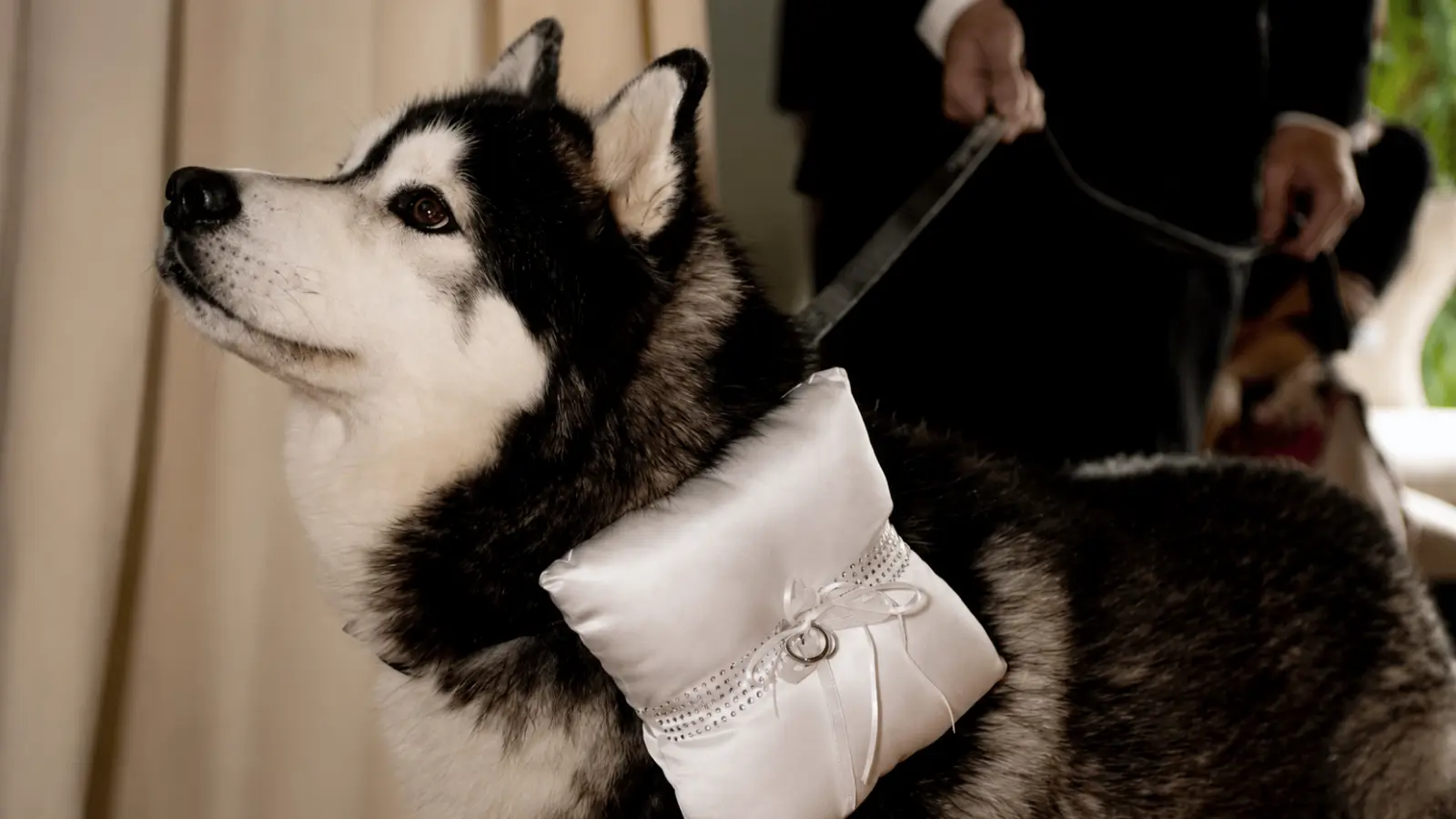
This is where the romance of the idea meets the reality of the logistics, and it’s worth thinking through carefully rather than assuming it will work out.
Real wedding rings attached to a dog moving down an aisle introduce several genuine risks: the rings fall off mid-walk, the dog shakes and dislodges them, someone reaches out to pet the dog and inadvertently displaces the attachment, or the officiant fumbles with an unfamiliar knot or clip under the pressure of the ceremony moment. None of these scenarios are catastrophic, but all of them interrupt the flow of a ceremony that you’ve spent months planning.
Fake Rings vs. Real Rings
For most couples, decorative placeholder rings — inexpensive bands tied to the pillow or pouch — are the practical choice. The real rings stay with the best man, the maid of honor, or the officiant. The dog carries the symbolic version, the moment happens, and nobody is managing real anxiety about a lost ring on top of everything else the ceremony involves.
If you are set on the dog carrying the actual rings, secure attachment is non-negotiable. The rings should be tied through the pillow with a knot that requires deliberate effort to undo — not a decorative bow that a shake of the dog’s head could loosen. A small carabiner or clip through a ring loop is even more secure. Test the attachment at home before the wedding, put it on the dog, and watch what happens when the dog moves, shakes, and sniffs the ground. If anything shifts during a home test, it will shift on the wedding day too.
Regardless of which option you choose, designate a specific person to retrieve the rings at the front of the aisle — and make sure that person knows exactly what they’re doing and where the rings are attached. Fumbling with an unfamiliar pillow knot in front of 150 guests is avoidable with thirty seconds of briefing beforehand.
Ring Bearer Accessories: Collar, Harness, Pouch, and Sign
The accessory the dog wears for their ring bearer moment is partly aesthetic and partly functional. Here’s how to think through each option.
Dog Ring Bearer Collar
A decorative collar — floral, ribbon-wrapped, or customized with the wedding date or the couple’s initials — is a clean, lightweight option that works well for dogs who are sensitive to anything on their body. The collar can be worn throughout the ceremony without restricting movement or causing discomfort. The limitation is attachment: securing a ring pillow or pouch to a collar is less stable than a harness, so this option works better with decorative rings than real ones.
Dog Ring Bearer Harness
A harness gives you a more secure attachment point for a pillow or pouch, distributes any weight more evenly across the dog’s body, and gives the handler better control during the walk. A harness dressed up with ribbon, satin, or a small floral detail can look genuinely elegant in photos. Introduce the harness several weeks before the wedding so the dog is completely comfortable wearing it before the ceremony day.
Dog Ring Bearer Pouch or Pillow
A small pillow clipped or tied to the harness is the classic visual, and it works well when the attachment is secure and the pillow is sized proportionally to the dog. A miniature pouch — a small fabric bag that closes securely — is a more practical alternative, especially for real rings, because it encloses rather than displays them. Either option should be tested at home with the dog wearing the full setup and moving naturally. If the dog immediately tries to remove it or seems distressed by the weight or feel, that’s information worth having before the wedding day.
Dog Ring Bearer Sign
A small sign hung from the collar or harness — “Here come the rings,” “Last chance to run,” or simply the couple’s names and date — has become a popular alternative to the traditional pillow, particularly for dogs who are carrying decorative rings or no rings at all. The sign format is lighter, less bulky, and easier for the dog to wear comfortably. It also photographs well, especially from a distance.
For any accessory, the comfort rule applies without exception: if the dog shows signs of distress wearing it — panting, trying to remove it, freezing up — the accessory is the wrong choice regardless of how it looks. For a deeper look at attire and accessory options across the full spectrum, the pet wedding attire guide covers every category.
Practice Before the Wedding
A dog who has never practiced the ring bearer walk is an unpredictable variable in the middle of your ceremony. Practice removes most of that unpredictability — not all of it, but enough to make a meaningful difference.
Start at least four to six weeks before the wedding. Work on leash walking with the handler specifically — not just with you, but with the person who will actually be holding the leash on the wedding day. Practice the specific distance of the aisle walk, starting short and building up. Introduce the ring bearer accessory during walks so the dog has time to get used to wearing it before it matters.
If it’s possible to visit the venue before the wedding day, do it. You can also use that visit to plan wedding photos with pets in the same locations where your dog will walk during the ceremony. Even a single walkthrough of the actual aisle — with the handler, wearing the accessory, during a quiet moment — gives the dog a reference point for the space. A dog who has been in that room before will carry themselves differently than one encountering it for the first time while 150 people watch.
Practice the exit too. The handler should run through the full sequence: enter, walk the aisle, reach the front, hand off the rings or step aside, and remove the dog calmly. The exit is just as important as the entrance, because a dog who lingers at the front or tries to reach the couple becomes a distraction during the vows.
What Happens After the Dog Reaches the Front?
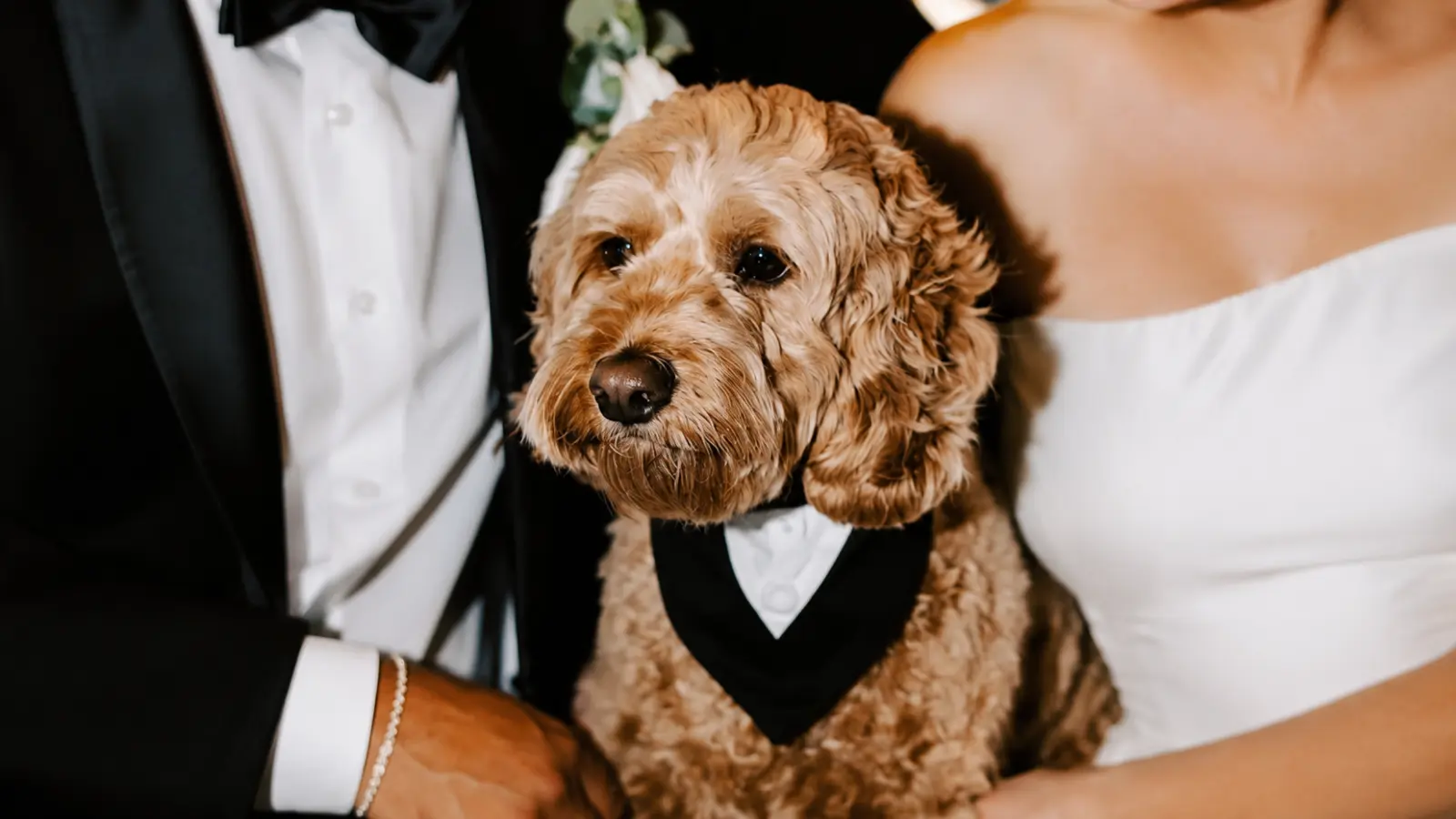
This is the part that doesn’t get enough attention in most ring bearer planning conversations, and it’s where a lot of ceremony disruptions actually happen. The dog has walked the aisle, reached the front, the moment has happened — and now what?
The handler needs to remove the dog from the immediate ceremony area before the vows begin. Not after a few minutes. Not when it feels like the right moment. Immediately, as soon as the ring exchange or greeting at the front is complete. A dog who stands at the altar while the couple recites their vows is a dog who is going to get bored, distracted, or anxious — and will find ways to make that known.
Plan where the dog goes after the exit: a quiet room, a shaded outdoor space, a safe, climate-controlled place arranged in advance. The handler stays with the dog for the duration of the ceremony. The dog does not return to the ceremony space until it is completely over. These aren’t harsh restrictions — they’re what keeps the animal comfortable and the ceremony uninterrupted.
Backup Plan
A backup plan is not pessimism. It is the mark of a couple who has thought this through seriously enough to protect both their dog and their ceremony.
Decide in advance: if the dog refuses to walk, what happens? The most practical answer is a human ring bearer — a child, a sibling, a junior attendant — who can step in without anyone needing to make an announcement or improvise on the spot. Brief the officiant on the backup plan before the wedding day so they know how to keep the ceremony moving if the dog portion doesn’t go as planned.
Keep the real rings with a person, not with the dog, unless you have tested the attachment extensively and have full confidence in the setup. That way, even if the dog sits down in the middle of the aisle and refuses to take another step, the ceremony is not delayed by a lost ring situation.
Let the backup plan exist quietly in the background. Most couples who prepare it never use it. But the ones who don’t prepare it and need it are the ones telling the story differently the next day.
Mistakes to Avoid
Most dog ring bearer problems are foreseeable. Here are the ones that come up most often — and how to avoid them.
Assuming a well-behaved dog is automatically a good ring bearer. A dog who listens well at home, on walks, and at the park has not been tested in a ceremony setting. Those are different environments with different stimuli. Know the difference.
Not briefing the handler in detail. The handler needs to know the full sequence: where to wait before the entrance cue, where to go after the walk, what to do if the dog resists, and exactly how the rings are attached. A vague “just walk him down and hand off the rings” briefing is not enough.
Introducing the accessory on the wedding day. A dog encountering a harness, pillow, or sign for the first time on the morning of the wedding is a dog who may spend the entire ceremony trying to remove it. Introduce every piece of the outfit weeks in advance.
Not having a backup plan for the rings. Even with excellent preparation, dogs are unpredictable. Keep a real set of rings with a person, always.
Letting the dog stay at the front during the vows. The moment the ring bearer role is complete, the dog needs to exit. A dog stationed at the altar during a twenty-minute ceremony is almost certain to create a distraction.
Skipping the practice walk with the actual handler. The dog practicing with you is not the same as the dog practicing with the person who will be holding the leash on the day. That specific combination needs rehearsal time.
Dog Ring Bearer Ideas
Planning a dog ring bearer for your wedding? Explore training tips, ceremony ideas, ring bearer collars, harnesses, signs, safe ways to carry the rings, and practical advice to help your dog enjoy one of the most memorable moments of the day.
A Great Ring Bearer Starts With Good Preparation
A dog ring bearer creates unforgettable wedding memories when the experience is planned around the dog’s comfort rather than the photograph alone. Careful training, a trusted handler, realistic expectations, and a well-rehearsed ceremony make the difference between a stressful moment and one that feels effortless for everyone involved.
Whether your dog carries decorative rings, wears a simple sign, or simply walks proudly down the aisle, the most successful role is the one that matches your pet’s personality. A confident, happy dog will always create more meaningful memories than a perfectly staged moment.
Frequently asked questions (FAQ)
Can a dog really be a ring bearer at a wedding?
Yes. A dog can be a wonderful ring bearer if they are calm, leash-trained, comfortable around crowds, and familiar with following a handler. The role should be brief and carefully planned, with the dog walking down the aisle, reaching the front, and leaving the ceremony before the vows begin. Success depends much more on preparation than on the dog’s breed or age.
Should a dog carry the real wedding rings?
Usually, decorative rings are the safer choice. Most couples keep the real wedding rings with the best man, maid of honor, or officiant while the dog carries symbolic rings for the ceremony. If you decide to use the real rings, they should be attached securely to a harness or pouch that has been thoroughly tested before the wedding day.
What makes a dog a good ring bearer?
A good dog ring bearer stays calm in unfamiliar environments, walks confidently on a leash with someone other than their owner, and is not easily distracted by crowds, music, or applause. The best candidate is not necessarily the most obedient dog at home, but the one who can stay relaxed during a busy wedding ceremony.
Who should walk the dog down the aisle?
A dedicated handler is always the best choice. This person should have no other responsibilities during the ceremony and should focus entirely on guiding the dog, managing unexpected situations, retrieving the rings if necessary, and leading the dog out immediately after the entrance. Professional wedding pet attendants are also an excellent option.
What if the dog refuses to walk down the aisle?
Every couple should prepare a backup plan before the wedding day. A child, family member, or member of the wedding party can step in as the ring bearer while the real rings remain safely with a designated person. Planning for this possibility allows the ceremony to continue naturally without creating stress or delays.
How should you prepare a dog for the ring bearer role?
Begin practicing several weeks before the wedding using the same handler, leash, harness, and accessories planned for the ceremony. Practice walking a similar distance, reward calm behavior, and, if possible, visit the venue before the wedding day. Familiarity with the routine helps the dog feel more confident when the ceremony begins.