A Wedding Photography Timeline should fit inside the wedding day, not force the wedding day to bend around photography. The goal is to give the photographer enough time to create the images that matter while still protecting ceremony staging, guest movement, dinner service, transportation, and the couple’s actual experience of the day.
The most useful way to build the schedule is to treat photography as several separate blocks instead of one long “photos” section. Details, getting ready, first look, couple portraits, wedding-party photos, family photos, golden hour, reception details, and travel all have different dependencies and different windows where they work best.
This Wedding Photography Timeline shows how to place those photo blocks into the day without creating hidden delays, including the people each block requires, the transitions around it, and the travel or gathering time that is easy to underestimate. The goal is not to maximize photography minutes — it is to protect the photographs you value without quietly sacrificing the wedding moments around them.
Photography Timeline at a Glance
This table is a planning framework rather than a universal shot schedule. Actual time should be set with the photographer based on group size, locations, travel, priorities, light, and how much direction each block requires.
| Photo Block | Time | Best Window | Required People |
|---|---|---|---|
| Details | Photographer-dependent | Before dressing or while beauty is underway | Photographer; couple only if needed for handoff |
| Getting ready | Coverage-dependent | Final hair/makeup, dressing, finishing moments | Couple, selected attendants/family |
| First look | Short focal block plus transition | After both partners are fully ready | Couple, photographer, video if applicable |
| Couple portraits | Priority- and location-dependent | After first look, post-ceremony, golden hour, or split | Couple, photographer/video |
| Wedding party | Group-size dependent | Before ceremony when practical or immediately after | Couple, wedding party |
| Family | Combination-dependent | Before ceremony for some groups or immediately after | Couple, named family groups |
| Golden hour | Brief dedicated window | Based on local light conditions | Couple, photographer/video |
| Reception details | Room-size dependent | After setup is complete and before guests enter | Photographer; coordination/vendor access |
| Travel | Route-dependent | Between any off-site photo blocks | Everyone required at the next location |
The most useful wedding photo timeline makes the hidden transitions visible. A 20-minute portrait session can consume much more than 20 minutes if gathering people, walking, or travel is omitted.
Details: Photograph Them Before They Disappear Into the Day
Detail photos fit best before the objects become operational. Once rings are handed off, invitations are packed away, shoes are being worn, or vows are needed for the ceremony, the photographer has less control over access.
Gather the items the photographer requested in one place before coverage begins. That may include stationery, rings, jewelry, shoes, fragrance, heirlooms, vow books, or other meaningful objects.
The timing advantage is significant: the photographer can work while hair and makeup or other preparation continues, rather than stopping the couple repeatedly to locate pieces. Once photographed, essential objects should return to the correct owner immediately so the block does not create a later handoff problem.
Getting Ready: Protect the Final Preparation Window
Getting-ready coverage should focus on the part of preparation that is visually and emotionally useful, not necessarily every hour of hair and makeup.
Coordinate the photography arrival time with the wedding morning timeline. The photographer may want time for details, final hair or makeup touches, candid interactions, dressing, and a few completed portraits before the next transition.
Leave room between “beauty finished” and “photo-ready.” Dressing, accessories, touch-ups, room cleanup, and gathering personal items can all happen in that gap. If photography coverage is limited, protect this final preparation window first rather than filling the schedule with hours of repetitive early-morning coverage.
First Look: Use It to Move Portraits Earlier
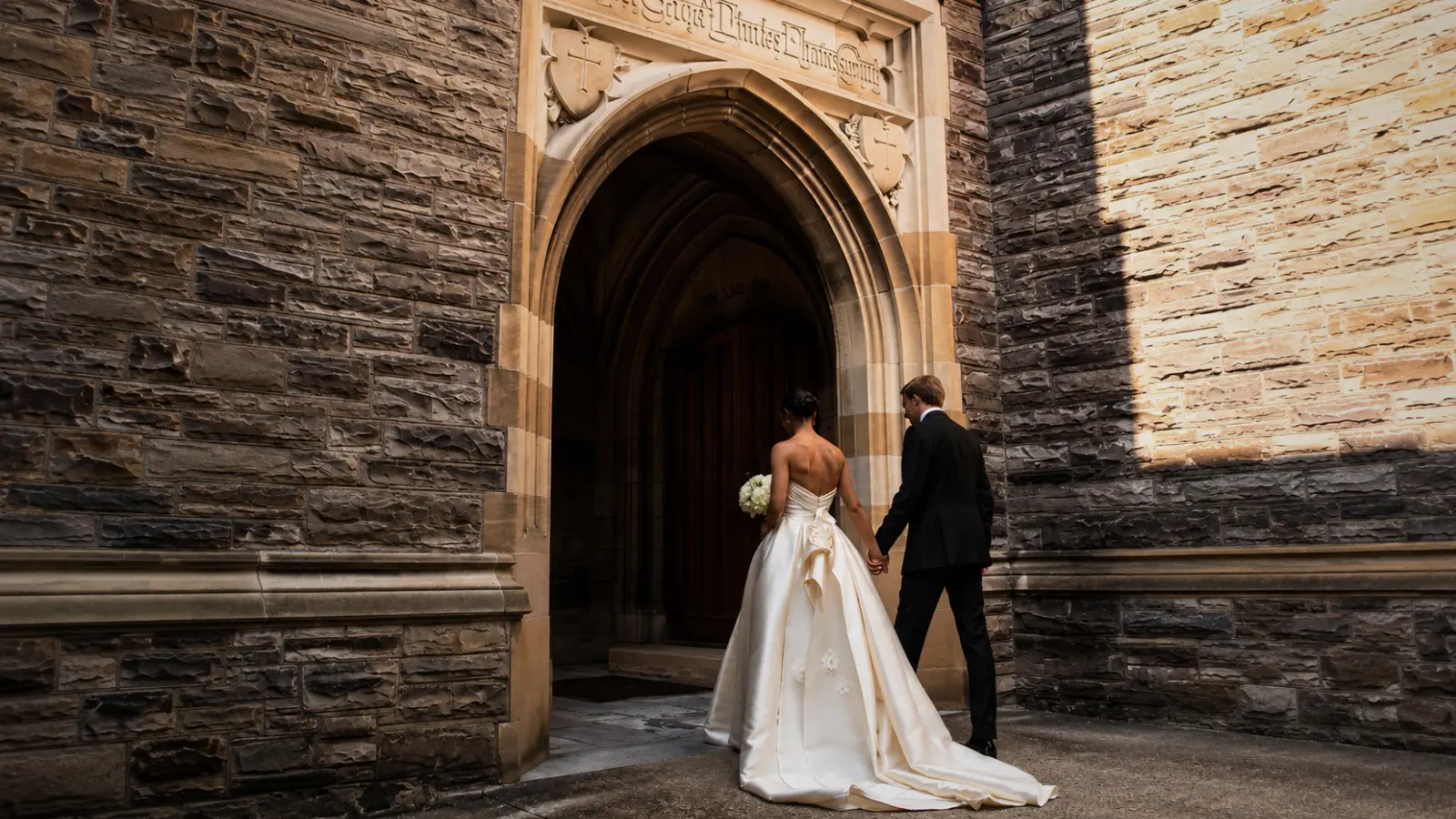
A first look earns its place in the photography schedule when it unlocks useful portrait time before the ceremony.
After the first look, the couple may be able to complete couple portraits, wedding-party photos, and selected family combinations before guests arrive. That can preserve more of cocktail hour and reduce the number of people who need to remain behind after the ceremony.
But the first look itself needs staging time. Both partners must be ready, positioned, and protected from guest traffic, and the photographer or video team may need a few minutes to set up the moment. If the first look does not materially move other portrait blocks, its timing benefit is smaller, so include it because the couple wants it, not because it is automatically more efficient.
Couple Portraits: Split the Time if Needed
Couple portraits do not have to happen in one long block. Splitting them can protect the wedding-day flow and give the photographer different light or settings without forcing the couple away from guests for an extended period.
One portion may happen after the first look, another immediately after the ceremony, and a brief final set around golden hour if that light matters to the couple.
The right amount of time depends on photography priorities, walking distance, location variety, travel, and the photographer’s working style. Avoid a generic duration without asking what the planned locations actually require; the scheduling goal is enough room for good work, not a continuous portrait session.
Wedding Party Photos: Group Strategically
Wedding-party photos become faster when the required people are already assembled, dressed, and informed about where to go next.
If a first look is happening, completing the majority of wedding-party portraits before the ceremony can remove a large group from the post-ceremony photo block. If there is no first look, stage the wedding party for photos immediately after the ceremony before people scatter into cocktail hour.
Keep the shot list realistic. Every subgroup, individual combination, and location change adds movement even when the actual photograph takes only moments, and a clear call time protects both photography and ceremony staging because the group is not being gathered at the last possible minute.
Family Photos: Build a Real People-Gathering Plan
A family photo wedding timeline needs more than a list of combinations. It needs a plan for locating the people in those combinations.
Create the family-photo list before the wedding and identify which groups genuinely matter. Then decide where each person should wait and who can help the photographer gather relatives quickly.
Family portraits often work well immediately after the ceremony because many relatives are already in one place, but that only helps if the necessary people know not to leave for cocktail hour. For larger or more complex family structures, order the combinations so people can be released efficiently; the logistics, not the poses, are what determine whether this block stays controlled.
Golden Hour: Treat Light as a Moving Constraint
Golden-hour portraits should be scheduled only after the photographer identifies the useful light window for the date and location. It is a moving constraint, not a fixed reception tradition.
If golden-hour photos are a high priority, decide what part of the reception the couple is willing to step away from. The cleanest placement is usually during a lower-impact window rather than in the middle of a meal course, important toast, or a newly active dance floor.
Keep the block focused. A brief portrait window can deliver a different quality of light without requiring the couple to disappear for a large portion of the reception, and if weather or light does not cooperate, the schedule should still work without forcing the rest of the event to wait.
Reception Details: Photograph the Room Before Guests Change It
Reception-detail photos need a narrow window: after setup is complete, before guests fill the space, move chairs, place bags, touch place settings, or begin service.
That makes this block a vendor-dependency problem. Rentals, florals, stationery, lighting, catering setup, and venue styling may all need to be finished before the photographer can document the room as intended.
If the photographer is also covering cocktail-hour portraits, coordination is especially important; the schedule may need another photographer, a short room-access window, or a different portrait order to make both things possible. Do not assume reception details “fit somewhere.” Give the room a real ready time and protect a short photography window after it.
Travel: Count Door-to-Door Time, Not Drive Time
Travel is one of the easiest ways for a wedding photography schedule to become unrealistic. Map time is only the center of the block.
Add time to gather people, load attire or personal items, board vehicles, park, unload, walk to the photography location, and reposition on arrival. If several vehicles are involved, the group may not arrive at exactly the same moment.
Off-site portrait locations should earn the time they consume. A scenic stop may be worthwhile, but the schedule should show the true cost in travel and transition time rather than hiding it inside the portrait block; when time is tight, staying on-site can preserve more actual shooting time than adding another location.
How to Build the Photography Schedule Into the Day
The photography plan should be built inside the master wedding-day schedule, not created separately and merged at the end.
Use this sequence:
- Identify fixed anchors. Ceremony start, venue access, dinner service, reception end, transportation, and any light-dependent priority.
- Choose whether there is a first look. That determines how much portrait work can move before the ceremony.
- List required photo blocks. Details, getting ready, couple, wedding party, family, golden hour if desired, and reception details.
- Assign people to each block. This exposes where someone is expected in two places at once.
- Add travel and gathering time. Do not hide transitions inside the photo duration.
- Protect ceremony staging and dinner. Portraits should not push directly against the two strongest guest-facing anchors.
- Have the photographer review the final version. The planned shot scope and locations should match the actual time available.
Once those pieces align, photography becomes part of the day’s rhythm instead of a competing schedule running beside it.
Protect the Photos Without Losing the Wedding
A Wedding Photography Timeline works best when each photo block has enough space to succeed without quietly taking time from another part of the day. Schedule the people, locations, gathering time, travel, and transitions around every portrait block instead of treating the photography duration as the entire commitment.
Protect the images that matter most, but also protect ceremony staging, dinner, guest interaction, and the couple’s time inside the celebration. When photography is integrated into the master schedule instead of competing with it, the day can produce meaningful photographs without making the wedding feel like one continuous photo session.
Frequently asked questions (FAQ)
What should a wedding photography timeline include?
A wedding photography timeline should include the photo blocks that matter to the couple, such as details, getting ready, first look if planned, couple portraits, wedding-party photos, family photos, golden-hour portraits, and reception details. It should also include the people required for each block, travel, walking, gathering time, staging, and transitions so the photography schedule fits realistically inside the wedding day.
How much time should you allow for wedding photos?
There is no universal total. The right amount depends on the number of photo blocks, group sizes, locations, travel, whether there is a first look, how much portrait variety the couple wants, and the photographer’s working style. Build each block individually rather than assigning one generic amount of time to all photography.
How long do family photos take at a wedding?
Family-photo timing depends mainly on the number of combinations and how efficiently relatives can be gathered. A short, organized list in one location can move quickly, while a long list with people scattered across cocktail hour takes much longer. Prepare the combinations in advance and assign someone who knows the families to help gather people.
When should reception detail photos happen?
Photograph the reception space after setup is complete and before guests enter whenever possible. This requires coordination with the venue, florist, rentals, catering, and other setup teams because the usable window may be brief. The room should have a defined ready time rather than assuming the photographer can fit detail photos in later.
Is golden hour worth adding to a wedding photography timeline?
It can be if that light is a meaningful photography priority and the reception can absorb a short portrait break. Schedule it around the actual light conditions for the date and location, and avoid placing it in the middle of dinner, important toasts, or another high-priority moment unless the couple has intentionally chosen that tradeoff.
What is the biggest wedding photography timeline mistake?
The biggest mistake is treating the stated portrait duration as the full time the block requires. Gathering people, moving between locations, walking, loading vehicles, staging groups, and transitioning back into the wedding can take as much time as the photographs themselves. Those hidden transitions need to appear in the schedule explicitly.
About the Author
Débora Justo
Founder and editor of EVORÉ, creating practical wedding planning resources, thoughtful inspiration and useful tools for the decisions that shape a celebration.
Read more about the author →