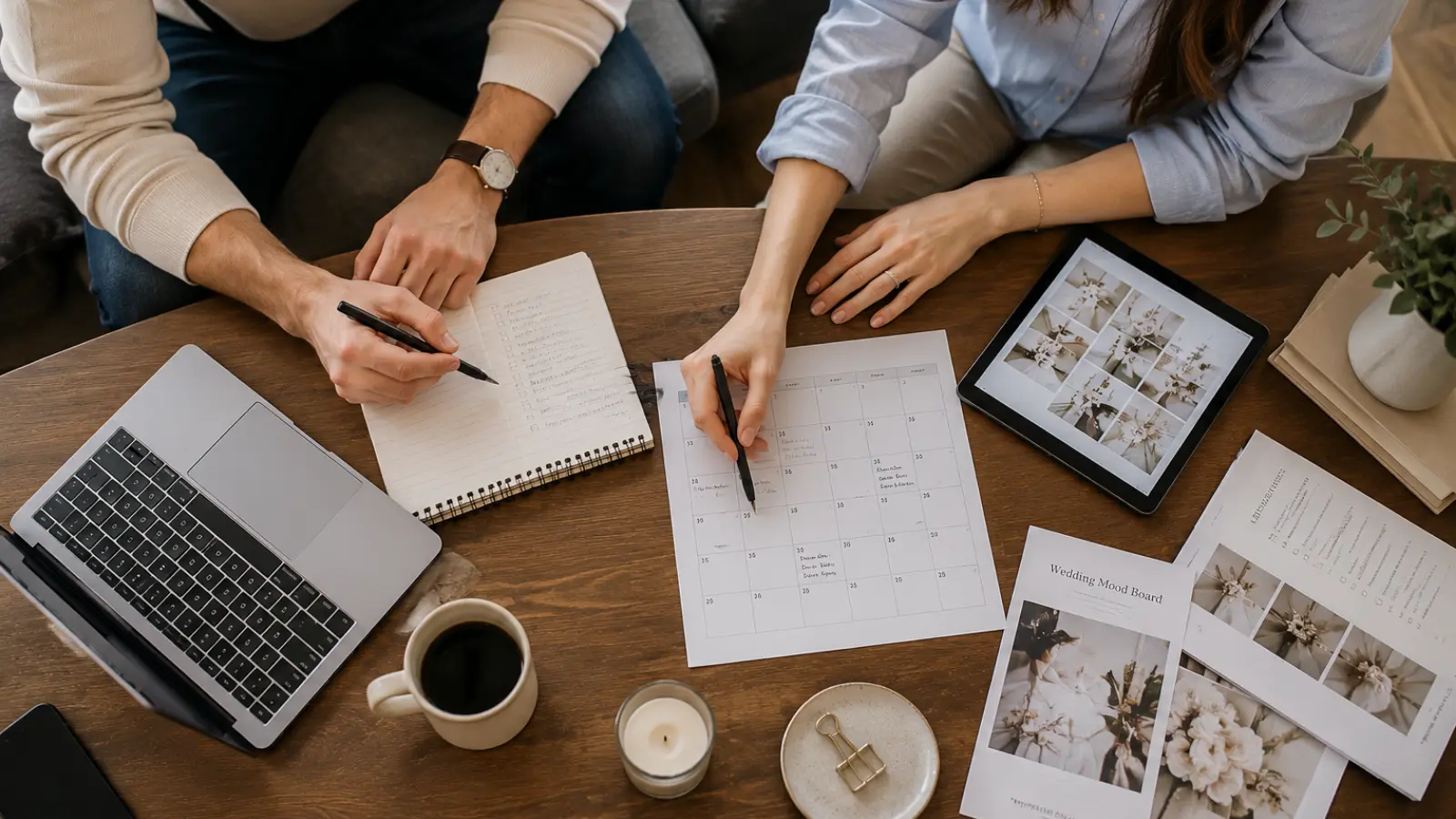
Wedding planning meetings give couples a simple way to turn scattered conversations into decisions that actually move the plan forward. Instead of discussing the wedding in passing and trying to remember later what was decided, a short recurring meeting creates one place to review open questions, make decisions, assign ownership, and record deadlines.
The value is not in making wedding planning feel formal. It is in creating enough structure that important topics do not disappear behind whatever feels most urgent that week. A consistent agenda also makes it easier to catch budget drift, vendor follow-ups, guest changes, and unfinished tasks before they become larger problems.
This guide shows how to run wedding planning meetings with a practical agenda, a realistic meeting cadence, and a simple decision log that records what was decided, who owns the next step, and when it needs to be done. The goal is to leave each session with fewer open loops, not just more conversation.
Why an Agenda Beats an Open-Ended Conversation
An open-ended conversation about the wedding tends to circle the same two or three topics — usually whatever feels most urgent or most exciting that week — while other decisions quietly get pushed back without either partner noticing. An agenda fixes this by making sure every session touches the things that actually need attention, not just whatever happens to be top of mind.
The other problem an agenda solves is memory. A decision made in passing conversation is easy to misremember or disagree about later — “I thought we said the caterer was handling that” is a common source of friction that has nothing to do with the decision itself and everything to do with nobody writing it down. A short written record at the end of each meeting removes that entire category of problem.
How Often to Meet
There’s no single right frequency, but a short, regular cadence works better than long, infrequent sessions for most couples. A meeting every two to four weeks is a common rhythm early in planning, shifting to weekly as the wedding gets closer and there’s simply more to track — vendor confirmations, final counts, timeline details that only firm up in the last few months.
What matters more than the exact interval is consistency: a meeting that happens reliably, even briefly, beats one that gets scheduled ambitiously and then skipped half the time. Twenty focused minutes every two weeks accomplishes more than an occasional two-hour session that only happens when stress finally forces the conversation.
Building the Agenda
A useful wedding planning agenda covers the same handful of categories every time, so both partners know what to expect walking in and can come prepared rather than improvising. The specific items will shift as planning progresses, but the categories themselves stay fairly constant from the first meeting to the last.
- Open decisions — anything still unresolved from a previous meeting, reviewed first so nothing quietly falls off the list.
- Budget review — a quick check on spending against the plan, not a full audit every time, just enough to catch drift early.
- Vendors — any vendor conversations, contracts, or follow-ups that need a decision or a next step.
- Guests — guest list changes, RSVPs, seating questions, or anything guest-related that’s come up since the last meeting.
- Tasks and owners — what needs to happen before the next meeting, and specifically who’s doing it.
Five categories is enough structure to keep a meeting focused without making it feel like a formal business review. The goal is coverage, not exhaustiveness — a meeting that tries to deeply discuss every category every time will run long and lose momentum fast.
The Decision Log at a Glance
The single most valuable habit in a wedding planning meeting isn’t the conversation itself — it’s the record that comes out of it. A decision log is short: what got decided, who’s responsible for acting on it, and when it needs to be done by. Without this, even a productive conversation tends to evaporate by the next meeting.
| Agenda Item | Decision | Owner | Deadline |
|---|---|---|---|
| Open decision: florist | Book Vendor A, decline Vendor B | Partner 1 | This week |
| Budget review | Catering is running over; trim floral budget to offset | Both | Revisit next meeting |
| Vendors: photographer | Send signed contract and deposit | Partner 2 | By Friday |
| Guests: plus-ones | Finalize plus-one policy before invitations go out | Both | Before stationery order |
| Task: save-the-dates | Confirm final guest address list | Partner 1 | Two weeks out |
This is one meeting’s worth of decisions, not a template to fill out mechanically every time — some sessions will only produce two or three real entries, and that’s a sign the meeting is focused, not that it failed to accomplish enough. What matters is that every row has an owner and a real deadline, not a vague “soon.”
Starting with Open Decisions
Every meeting should open by reviewing whatever didn’t get resolved last time, before adding anything new to the agenda. This single habit prevents the most common failure mode of recurring planning conversations: new topics constantly crowding out old ones, so a decision that felt urgent two weeks ago is still sitting unresolved a month later.
If an open decision has been carried over more than once or twice, that’s worth naming directly at the meeting — either it’s missing information needed to actually decide, or it’s too big to resolve in one sitting and needs to be broken into a smaller next step. Either way, leaving it on the list without addressing why is worse than resolving it or explicitly deciding to set it aside for now.
Keeping the Budget Review Short
A budget review doesn’t need to be a full reconciliation every meeting — a quick check on whether spending is tracking to plan is usually enough, with a deeper look reserved for whenever a category runs noticeably over or under. The goal is catching drift early, while it’s still a small adjustment, rather than discovering a significant overage close to the wedding when there’s less room to correct it.
This is also where the priorities decided earlier in planning actually get used, not just referenced once and forgotten. If catering is running over and something has to give, the priorities list is what tells you whether to trim florals or guest count first — the wedding planning priorities guide covers how to build that list if it doesn’t exist yet.
Vendors and Guests: The Two Categories That Change Most
Vendor and guest updates tend to generate more agenda items than any other category, simply because they involve the most back-and-forth with people outside the relationship — a vendor’s response to a question, a family member’s RSVP, a guest’s dietary request. Giving each its own dedicated agenda slot, rather than letting them surface randomly mid-conversation, keeps this steady stream of small updates from taking over the entire meeting.
For vendors specifically, the agenda item doesn’t need to be the full decision — it can simply be “follow up with the caterer about the final menu tasting,” with the actual decision landing in a future meeting once the information exists. Treating “follow up” as a legitimate agenda outcome, not just a stalled decision, keeps momentum without forcing choices before they’re ready to be made.
Tasks, Owners, and Deadlines
A task without an owner tends not to get done, and a task without a deadline tends to drift indefinitely — which is exactly why every action item leaving a planning meeting needs both attached, not just a general sense that “we’ll handle it.” Splitting tasks by owner also does something less obvious but just as useful: it keeps the workload visibly balanced between partners, rather than one person accumulating most of the mental load without either person noticing it happening.
A reasonable habit is assigning tasks based on who’s already in conversation with a given vendor or handling a given category, rather than splitting everything down the middle artificially. What matters isn’t a perfectly even split every single meeting — it’s that ownership is clear enough that neither partner is left wondering whether something got handled.
End Every Meeting With a Clear Next Step
Wedding planning meetings work when something concrete leaves the conversation. Record the decisions that were made, assign each follow-up to one person, and give every action item a real deadline so the next session begins with facts instead of trying to reconstruct what happened last time.
The meeting itself can stay short. What matters is consistency and a written record that both partners can return to later. When each session closes open loops instead of simply creating more discussion, the planning process becomes much easier to keep moving.
Frequently asked questions (FAQ)
What should be on a wedding planning meeting agenda?
A useful agenda should cover unresolved decisions first, followed by a quick budget review, vendor updates, guest-related changes, and the tasks that need to happen before the next meeting. End by writing down every decision, assigning one owner to each action item, and setting a real deadline so nothing leaves the meeting as a vague “we’ll handle it.”
How often should couples have wedding planning meetings?
There is no single schedule that works for every couple. Early in planning, meeting every two to four weeks may be enough, while weekly check-ins often become more useful as the wedding gets closer and deadlines increase. Consistency matters more than frequency, so choose a cadence you can realistically maintain.
How long should a wedding planning meeting last?
Regular meetings usually work best when they are short and focused. Around twenty to thirty minutes can be enough to review open decisions, current priorities, vendor or guest updates, and next steps. Save longer sessions for decisions that genuinely require more time, such as reviewing major contracts or restructuring the budget.
Should family or the wedding party join wedding planning meetings?
Usually not. These meetings are most efficient when they remain focused on the couple’s decisions and responsibilities. Family or wedding-party input can be gathered separately and brought into the meeting as information when needed, rather than adding more people to every planning discussion.
Do you need special software for wedding planning meetings?
No. A shared document, spreadsheet, notes app, or simple decision log can work well as long as both partners can access it and it stays current. The important part is consistently recording what was decided, who owns the next action, and when it needs to be completed.
What is the difference between a wedding planning meeting and simply talking about the wedding?
A planning meeting has a defined agenda and produces a written outcome. Casual wedding conversations can be useful, but they often end without a confirmed decision, clear owner, or deadline. A structured meeting turns discussion into an actionable record that both partners can refer back to later.