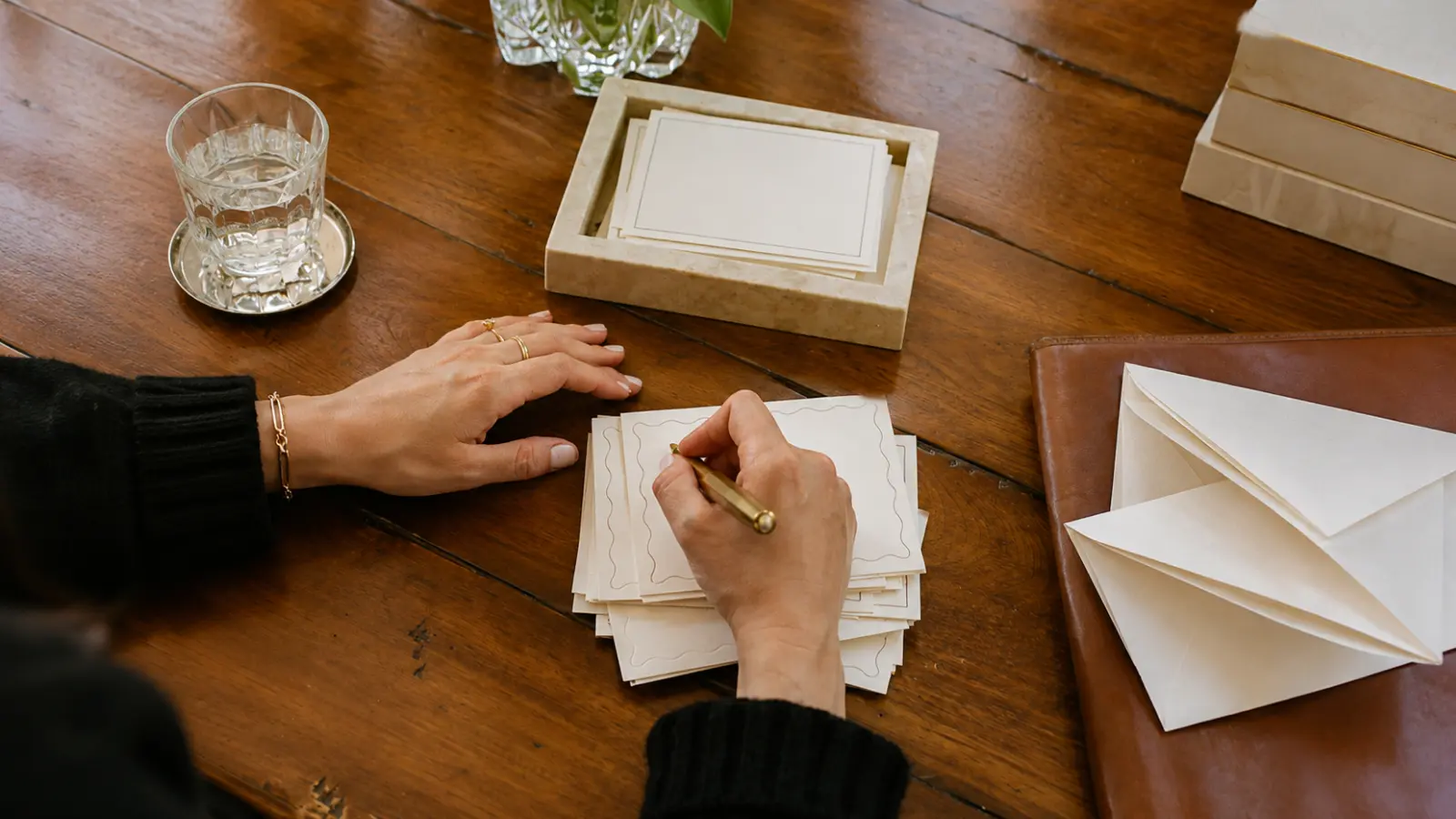
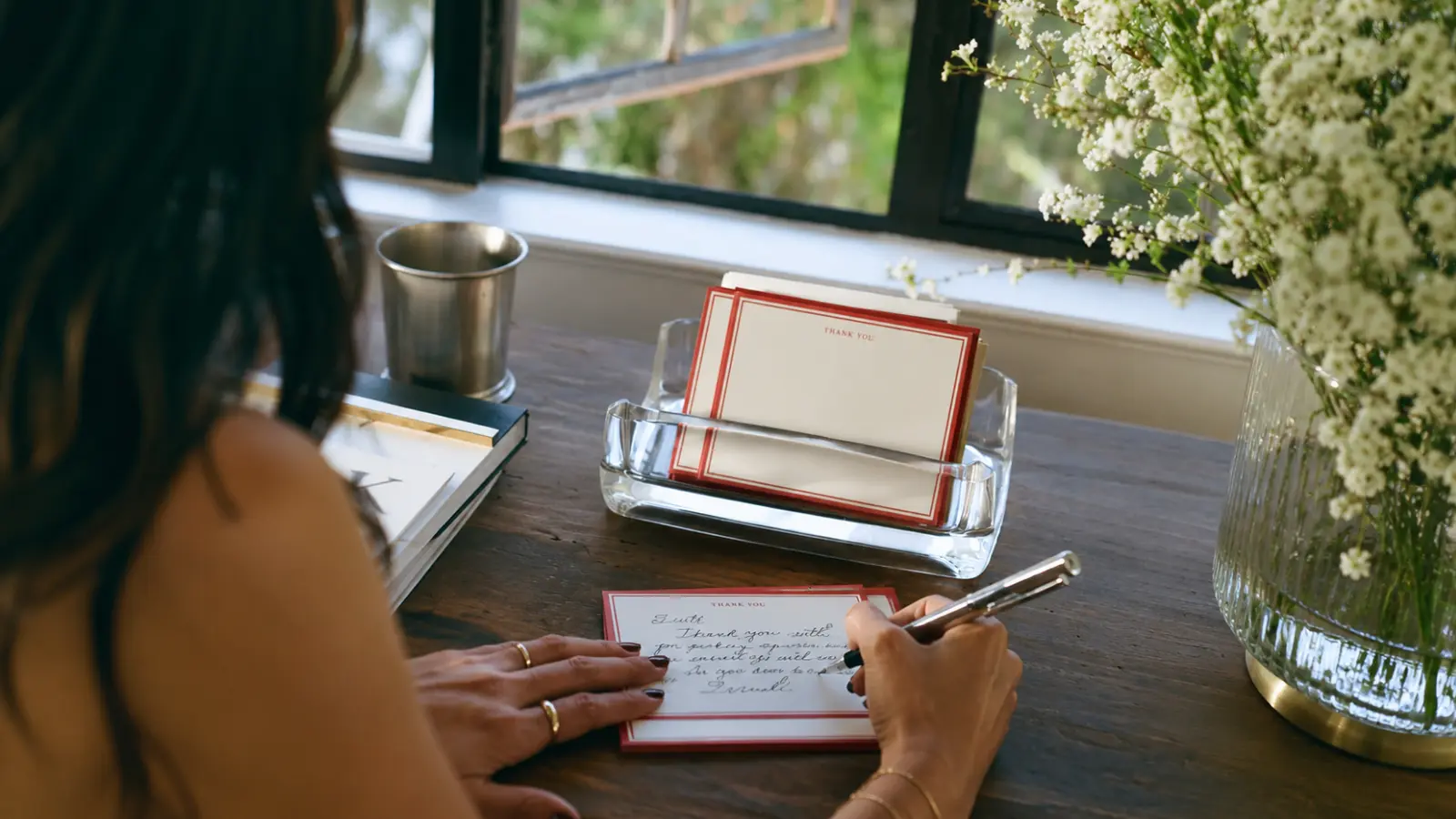
Wedding thank you card templates make writing dozens of personal notes much easier when the words start to blur together. After thanking fifteen, forty, or even a hundred guests, the challenge usually isn’t a lack of gratitude—it’s the mental fatigue of reinventing the same message again and again while still trying to make every card feel thoughtful.
A good template solves that problem by giving you a reliable structure without taking away the personal details that make a thank you meaningful. Instead of starting from a blank card each time, you can choose the template that matches the situation, fill in the guest’s name, gift, shared memory, and closing, then adjust the tone to fit your relationship.
This guide includes ready-to-use wedding thank you card templates for guests who attended, guests who couldn’t attend, couples and families, close friends, coworkers, group gifts, gifts received before or after the wedding, and other tricky situations. You’ll also find short, formal, and casual variations, personalization tips, and a simple writing system to help you work through your entire guest list without making every message sound the same.
How to Use a Wedding Thank You Card Template
A template is scaffolding, not a finished card. The value of a good wedding thank you card template is that it removes the blank-page problem: you’re never staring at empty space wondering how to begin. Instead, you’re filling in two or three specific details inside a structure that already works.
The templates below use bracketed placeholders, like [Guest Name] or [the gift], that you swap out for each card. Read through a template once, notice which parts stay the same and which parts change, and then write your own version rather than transcribing it directly. If you need help turning that structure into a natural message, wedding thank you card wording examples can show how the finished note should sound.
The Basic Fill-In-the-Blank Formula
Nearly every wedding thank you card template on this page is a variation of the same four-part structure. Once it’s memorized, you can adapt it on the fly for situations that don’t fit neatly into a category.
The Universal Template
Dear [Guest Name],
Thank you so much for [the gift or for celebrating with us]. [One specific sentence: how you’re using it, or a moment from the day]. [Closing line that fits your relationship],
[Your Names]
Everything else in this guide is this same shape, adjusted for who’s receiving the card and what they gave. Once that structure feels automatic, writing a stack of cards in one sitting takes far less mental effort than starting fresh each time.
Fill-In Templates for Every Situation
The following templates cover the guest situations that come up on nearly every wedding list. Swap the bracketed sections for the specifics that apply to each card, and adjust the tone up or down depending on the relationship.
Template for a Guest Who Attended and Gave a Gift
Dear [Name], Thank you for [the gift] and for celebrating with us at the wedding. [One sentence: how you’ll use it, or a moment you shared]. [Closing], [Your Names]
Template for a Guest Who Attended Without a Gift
Dear [Name], Having you there meant so much to us. Thank you for [making the trip / celebrating with us all night / a specific moment]. [Closing], [Your Names]
Template for Someone Who Sent a Gift but Could Not Attend
Dear [Name], Thank you so much for [the gift]. We wish you could have celebrated with us, but we felt your love all the same. [Closing], [Your Names]
Template for a Couple or Family
Dear [Household Names], Thank you for [the gift] and for being part of our celebration. [One sentence acknowledging the household or a shared memory]. [Closing], [Your Names]
Template for a Close Friend
Dear [Name], Seriously, thank you for [the gift] — [a genuine, slightly informal reaction]. So glad you were there for [a specific moment or inside joke]. [Casual closing], [Your Names]
Template for an Extended Family Member
Dear [Name], Thank you for your generous gift toward [the gift or purpose]. We’re so grateful, and [one warm, specific sentence about your relationship]. [Closing], [Your Names]
When the gift is money or a check, wedding thank you card wording for money can be adapted to acknowledge the generosity without making the exact amount the focus of the note.
Template for a Coworker
Dear [Name], Thank you so much for [the gift] and for celebrating with us. It was wonderful having you there. [Slightly more composed closing], [Your Names]
Template for a Group Gift
Dear [Individual Name], Thank you for being part of the group gift of [the item] — it means a lot that you and [the group] thought of us together. [One personal sentence to this individual]. [Closing], [Your Names]
Each person who contributed to a group gift still gets their own card. For broader wedding thank you card etiquette about who should receive a note and how different gift situations are handled, the rules can vary beyond the wording itself.
Templates for Tricky Gift Situations
A few situations don’t fit the standard categories, and not having a plan for them is a common reason thank you cards get delayed. These templates handle the cases that trip couples up most often.
Template for a Gift Received Before the Wedding
Dear [Name], Thank you so much for [the gift], which arrived before the big day. We’re already looking forward to using it once we’re settled in as a married couple. [Closing], [Your Names]
Gifts that arrive before the wedding, including ones from a shower, are best acknowledged close to when they’re received rather than held until after the wedding. Shower gifts specifically have their own timing and etiquette, covered in our wedding shower thank you cards guide.
Template for a Gift Received After the Wedding
Dear [Name], Thank you for [the gift], which arrived after the wedding — we were so happy to find it waiting for us. [One sentence about using or enjoying it]. [Closing], [Your Names]
Template for a Gift Without a Clear Sender
Dear [Name], Thank you so much for your generous gift and for celebrating with us. [One warm, general sentence]. [Closing], [Your Names]
Use this version when a card was separated from a physical gift at the reception and you genuinely can’t confirm who sent it. Referencing “your generous gift” without naming the item is gracious and doesn’t draw attention to the mix-up.
Template for a Duplicate Gift
Dear [Name], Thank you so much for [the gift] — we truly appreciate you thinking of us. [One genuine sentence, without mentioning the duplicate]. [Closing], [Your Names]
A duplicate gift is never mentioned in the card itself. The giver doesn’t need to know their gift matched someone else’s, and the thank you should read exactly as warmly as any other note.
Template for a Gift That Will Be Returned or Exchanged
Dear [Name], Thank you so much for [the gift]. Your thoughtfulness means a lot to us, [and we’ll be putting the gift card / store credit toward something for our new home]. [Closing], [Your Names]
If a specific item is being exchanged, there’s no need to say so directly. Focusing on the gesture, or on what the exchange will go toward if it’s store credit, keeps the note gracious without drawing attention to the swap.
Templates by Length and Tone
The same fill-in structure can flex shorter, longer, more formal, or more casual, depending on the card and the relationship. These variations are useful when a guest doesn’t fit neatly into a category above.
Short Wedding Thank You Card Templates
Dear [Name], Thank you for [the gift] and for celebrating with us. It meant the world. [Closing], [Your Names]
Formal Wedding Thank You Card Templates
Dear [Mr./Mrs. Last Name], Thank you for your generous gift and for joining us in celebrating our marriage. Your presence and kindness meant a great deal to us both. Sincerely, [Your Names]
Casual Wedding Thank You Card Templates
Hey [Name], Thank you for [the gift], we’re already obsessed. So glad you were there for [a specific memory]. Love you, [Your Names]
How to Personalize Each Template
Every template on this page uses the same three swap points: the greeting, the specific detail, and the closing. Everything between them can stay consistent without any card reading as a duplicate of another, because the guest reading their card has no reason to compare it to anyone else’s.
The table below summarizes which template fits which situation, what needs to change each time, and roughly how the tone should land.
| Situation | Fill-In Template | Details to Personalize | Tone |
|---|---|---|---|
| Guest attended with a gift | Universal template | Gift, one shared moment | Warm, standard |
| Guest attended, no gift | Attended without a gift | Specific reason you’re glad they came | Warm, presence-focused |
| Gift sent, couldn’t attend | Gift, no attendance | Gift, brief mention they were missed | Warm, slightly wistful |
| Close friend or sibling | Close friend template | Inside reference, informal phrasing | Casual, personal |
| Extended family or older relative | Extended family template | Gift, relationship detail | Warm, slightly more formal |
| Coworker or acquaintance | Coworker template | Gift, brief warmth | Composed, friendly |
| Group or household gift | Group gift template | One line specific to that household | Warm, individualized |
| Gift with an unclear sender | No clear sender template | General but genuine phrasing | Warm, unspecific by design |
Once you’ve matched a guest to the right row, filling in the two or three details takes less time than deciding how to phrase the whole card from scratch.
Printable Wedding Thank You Writing Worksheet
A simple worksheet makes the templates above genuinely usable across a full guest list rather than something you reference once and abandon. The idea is to separate the thinking (who gave what, and what to say about it) from the writing itself, so the actual card-writing sessions move quickly.
What to include on your worksheet: for each guest, note the name, the gift (or “attended, no gift”), which template fits, one personal detail to add, whether the card has been written, and whether it’s been mailed. Working through the list one column at a time, rather than one full card at a time, is often faster.
A basic version of this can live in a notebook, a spreadsheet, or even the notes app on your phone. What matters is having somewhere to record the small details, like a shared memory or a specific comment a guest made, before they’re forgotten in the weeks after the wedding.
Template Mistakes to Avoid
Templates are meant to save time, not replace thought entirely. A few patterns are worth watching for as you work through your list.
- Leaving the brackets unfilled in spirit, even if not literally. Swapping in a name but keeping every other sentence generic defeats the purpose of the personal detail slot.
- Using one template for every guest, regardless of relationship. A formal template sent to a close friend, or a casual one sent to a parent’s colleague, reads as slightly off no matter how warm the words are.
- Skipping the personal detail to save time. The structure can repeat; the one specific sentence per card is what actually makes the note feel considered.
- Writing the whole batch in one sitting without breaks. Templates make repetition easier, but fatigue still shows in the writing. Short sessions across several days tend to produce warmer notes than one long marathon.
None of these are difficult fixes, but they’re the difference between a template that speeds up genuine gratitude and one that starts to feel like an assembly line.
A Good Template Saves Time Without Losing the Personal Touch
Wedding thank you card templates aren’t meant to write the entire message for you—they’re meant to remove the hardest part: starting from a blank card dozens of times. Once you have a reliable structure for each common situation, you can spend less energy deciding how to begin and more time adding the details that make each note feel genuine.
Choose a few templates that match most of your guest list, keep the structure consistent, and personalize the gift, memory, tone, or relationship in every card. The words don’t need to be completely different each time. When the details are specific to the person receiving them, a repeatable template can still create a thank you that feels warm, thoughtful, and entirely personal.
Frequently asked questions (FAQ)
What should a wedding thank you card template include?
A useful wedding thank you card template should include a personal greeting, a clear acknowledgment of the gift or the guest’s presence, one flexible sentence for a specific detail, and a closing that fits the relationship. The structure can remain consistent from card to card while the personal detail changes.
Is it okay to use a thank you card template word for word?
A template works best as a starting point rather than a final script. Reusing the same structure is completely practical, but each card should include at least one or two details specific to the recipient, such as the gift, a shared memory, or a personal sentence.
How many templates do I actually need for my guest list?
Most couples only need three or four core templates: one for guests who attended with a gift, one for guests who attended without one, one for gifts sent by people who could not attend, and one warmer version for close family or friends. More specific templates are helpful for unusual situations but are not necessary for every guest.
Can I use the same template for an entire family?
Yes. When a gift comes from a household as a whole, one card addressed to the family or couple is generally appropriate. You can use the same template structure, then add a detail that reflects that household or a specific person if one family member played a particularly meaningful role.
What is the difference between a thank you card template and thank you card wording?
A template is a fill-in structure with placeholders designed to be reused across many cards. Wording examples are complete messages that show how the finished note can sound. A template gives you the framework; wording gives you a fully written example to adapt.
Do templates work for handwritten cards or only printed ones?
They work for both. For handwritten cards, use the template as an outline and write the final message naturally in your own voice. For printed cards, the template can guide the personalized handwritten portion added inside or alongside the printed message.
How do I personalize a template without starting from scratch each time?
Keep the overall structure, greeting style, and closing consistent, then change the details that matter most: the specific gift or gesture, one personal sentence, and the tone when needed. Two or three customized details are usually enough to make a repeated template feel genuinely individual.

About the Author
Débora Justo
Founder and editor of EVORÉ, creating practical wedding planning resources, thoughtful inspiration and useful tools for the decisions that shape a celebration.
Read more about the author →