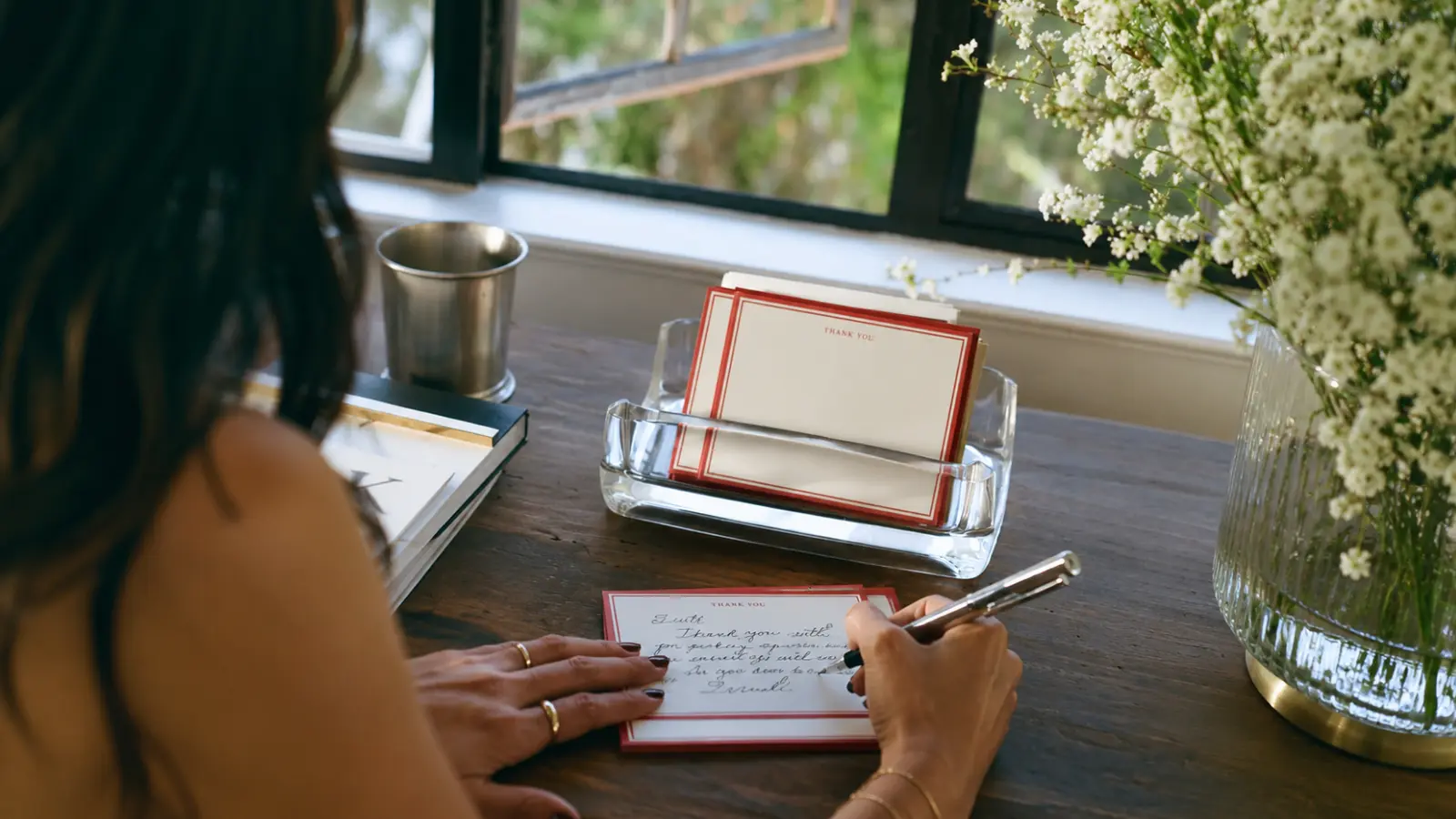
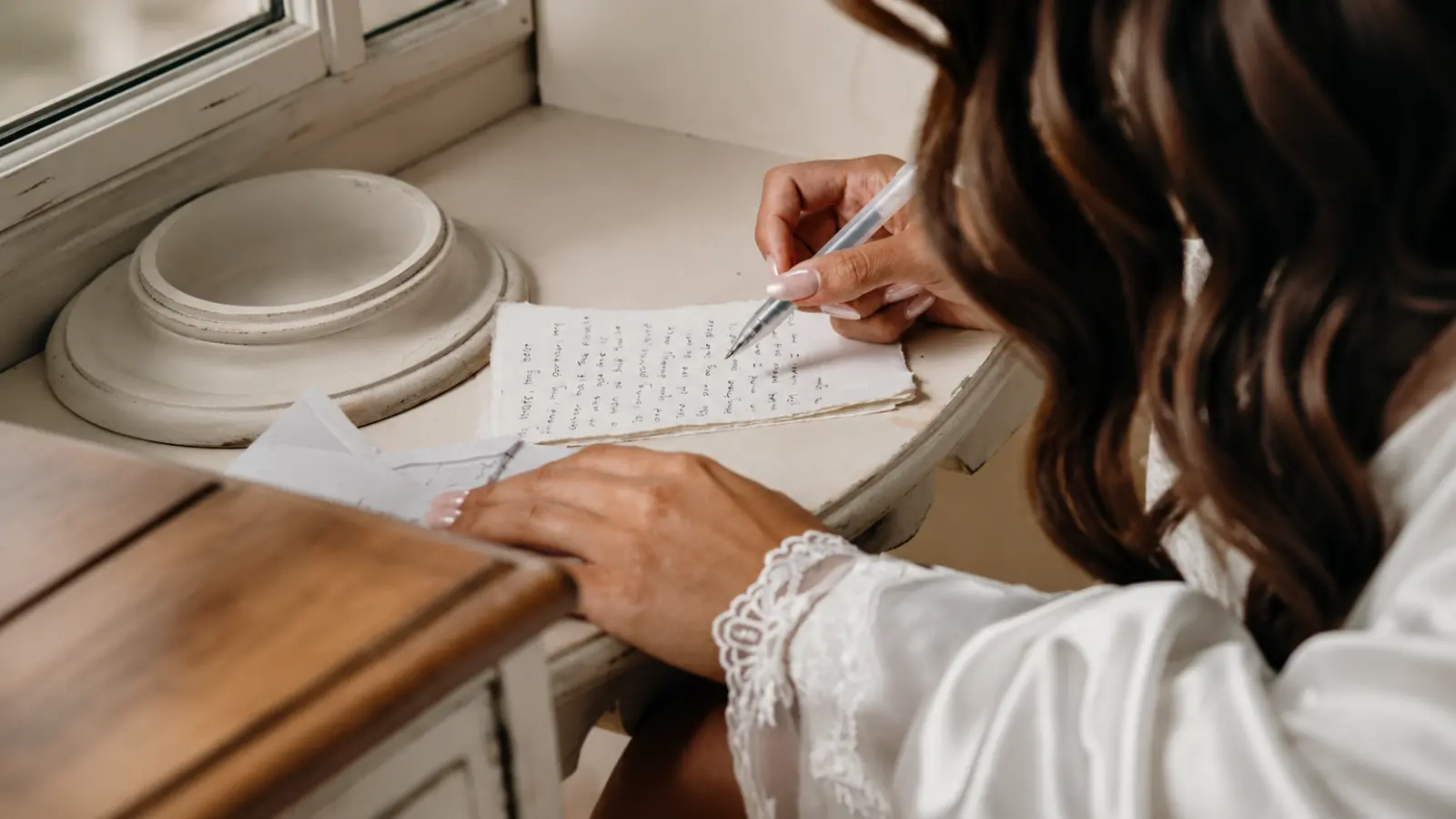
Wedding thank you card wording can feel surprisingly difficult when you’re trying to sound sincere dozens of times without repeating the same message. You know you want to thank each guest personally, but turning a simple thought like “thank you for the beautiful gift” into something warm, specific, and natural can become much harder once you’re staring at a stack of blank cards.
The best wedding thank you messages don’t need to be long or completely different for every person. A simple structure works beautifully when you personalize the greeting, mention the specific gift or gesture, add one genuine detail about how you’ll use it or what their presence meant to you, and choose a closing that reflects your relationship. The wording can then become warmer, more formal, or more casual depending on who you’re thanking.
This guide explains exactly what to write in a wedding thank you card, with wording examples for close friends, family members, coworkers, acquaintances, guests who attended without a gift, and people who sent gifts but couldn’t attend. You’ll also learn how to open and close each note, choose the right tone, personalize repeatable wording, and avoid the phrases that can make a heartfelt thank you sound generic.
What to Write in a Wedding Thank You Card
Every effective wedding thank you card does the same three jobs: it acknowledges the person, names what they gave or did, and closes with something that sounds like you rather than a stationery display case. That’s true whether you think of it as a card or a note; the wording follows the same logic either way. Beyond those three jobs, there’s more room to adapt than most couples assume.
If you’re wondering what to write inside a wedding thank you card versus what belongs on the outside, the short answer is: keep the front simple and let the inside carry the personal message. The examples in this guide are meant to be adapted, not copied word for word. If you prefer a ready-to-use structure, wedding thank you card templates can give you a starting point that you personalize with the gift, the guest’s name, and a detail from your relationship.
The Four-Part Wedding Thank You Message Formula
Most people don’t struggle with sincerity; they struggle with knowing where to start. A simple four-part structure removes the hesitation.
How to Open the Card
Use the recipient’s name rather than a generic salutation. “Dear Aunt Carol” or “Dear Mike and Jenna” signals immediately that the note is personal. Avoid openings like “To our wedding guests,” which read as a mass mailing rather than a message meant for one person.
How to Thank Someone for Attending
If the guest was there, say so specifically. “Thank you for making the trip from Denver” or “Thank you for celebrating with us all night” acknowledges their presence as its own gesture, separate from whatever they may have given.
How to Mention the Gift Naturally
Name the gift directly rather than gesturing vaguely at it. “The blue serving bowl” is more meaningful than “your generous gift.” Specificity is what tells the recipient you noticed, rather than pulled a line from a list.
How to Mention a Gift You Have Already Used
If you’ve already used the item, say so. “We’ve already used the mixer twice this week” or “The frame is already up in our hallway” makes the gratitude feel immediate and real, rather than a promise to use it eventually.
How to End and Sign the Card
Close with a line that fits your relationship, then sign with both names so the note reads as a shared message. “With love” and “warmly” work for most relationships; a closer friend might prefer something more personal, like referencing an inside joke or a shared moment from the day.
Once you have the formula down, the table below shows how the same four parts shift depending on who you’re writing to.
Wedding Thank You Card Wording at a Glance
Different relationships call for slightly different openings and tones, even when the structure stays the same. The examples below show how the formula adapts across common situations.
| Situation | Opening | What to Mention | Complete Example |
|---|---|---|---|
| Close friend who attended with a gift | “Dear Sarah,” | The gift and a shared moment from the day | “Dear Sarah, Thank you for the beautiful serving platter and for dancing with us until midnight. We can’t wait to use it for our first dinner party. Love, Anna and Josh” |
| Guest who attended without a gift | “Dear Mr. and Mrs. Cole,” | Their presence, never the absence of a gift | “Dear Mr. and Mrs. Cole, Having you both there meant so much to us. Thank you for making the trip and celebrating with us all weekend. Warmly, Anna and Josh” |
| Guest who gave a gift but couldn’t attend | “Dear Aunt Rosa,” | The gift, and that you missed having them there | “Dear Aunt Rosa, Thank you for the beautiful quilt. We wish you could have been there, but we felt your love all the same. With love, Anna and Josh” |
| Coworker or acquaintance | “Dear Priya,” | A warm but slightly more composed tone | “Dear Priya, Thank you so much for the picture frame and for celebrating with us. It was wonderful having you there. Best, Anna and Josh” |
| Extended family member | “Dear Uncle Mark,” | A specific detail plus genuine warmth | “Dear Uncle Mark, Thank you for your generous gift toward our honeymoon. We’re so grateful, and we can’t wait to tell you all about the trip. Love, Anna and Josh” |
| Formal or more distant relationship | “Dear Mr. Chen,” | A respectful, gracious tone | “Dear Mr. Chen, Thank you for the lovely gift and for being part of our celebration. We truly appreciate your generosity. Sincerely, Anna and Josh” |
Notice that the structure barely changes from row to row; what shifts is the level of warmth and formality. That’s the piece worth paying attention to as you write your own cards.
Writing for Specific Situations
A few situations come up often enough to have the wording worked out ahead of time, rather than improvising partway through your list.
When the Guest Attended Without a Gift
Keep the entire message focused on their presence. “Thank you for being there to celebrate with us” or “It meant so much having you at our wedding” carries the note without ever needing to reference a gift that wasn’t given. Wedding thank you card etiquette can help clarify who gets a card when attendance, gifts, and other circumstances do not fit the usual pattern.
When Someone Sent a Gift but Could Not Attend
Acknowledge the gift specifically, then let them know they were missed. “We wish you could have celebrated with us, but we’re so grateful for your thoughtfulness” strikes the right note. Avoid dwelling on their absence beyond one brief, genuine mention.
Choosing the Right Tone: Warm, Formal, or Casual
Not every card should sound the same. Matching tone to relationship is part of what makes the wording feel considered rather than mass-produced.
How to Write a Warm but Formal Message
This register suits parents’ friends, older relatives, and guests you respect but don’t know casually. “Dear Mrs. Whitman, Thank you for your generous gift and for being part of such a meaningful day for us. We are so grateful for your presence and your kindness. With warm regards, Anna and Josh” strikes that balance.
How to Write a Casual Message
For close friends and siblings, a lighter tone often feels more genuine than formal phrasing. “Hey Jenna, Seriously, thank you for the espresso machine, we’re already obsessed. So glad you were there for the chaos. Love you, Anna and Josh” reads as authentic, not stiff.
Wedding Thank You Card Wording Examples by Length and Style
Some situations call for brevity, others for a fuller message. Here’s the same core gratitude at different lengths.
Short Wedding Thank You Card Messages
A brief note still works when it’s specific: “Dear Tom, Thank you for the wine set and for celebrating with us. It meant the world. Love, Anna and Josh” says everything it needs to in three sentences.
Simple Wedding Thank You Card Wording
Simple doesn’t mean generic: “Dear Grandma, Thank you for the quilt you made us. We already have it on our bed, and every time we see it, we think of you. Love, Anna and Josh” is plain, direct, and genuinely warm.
Formal Wedding Thank You Card Wording
“Dear Mr. and Mrs. Harper, Thank you for your generous gift and for joining us in celebrating our marriage. Your presence and kindness meant a great deal to us both. Sincerely, Anna and Josh” suits guests you know mainly through a parent or colleague.
Warm and Personal Wedding Thank You Examples
“Dear Marcus, Thank you for the beautiful photo album and for being the friend who always shows up. Watching you give your toast is a memory we’ll keep forever. Love always, Anna and Josh” leans on a specific shared memory.
Wedding Thank You Card Examples by Relationship
The same formula bends naturally depending on who’s receiving the card. These examples show how tone and detail shift across common relationships.
Examples for Close Friends
“Dear Kayla, Thank you for the stand mixer, we’ve already used it twice. Thank you, too, for being by my side through this whole process, from the dress shopping to the day itself. Love, Anna and Josh” nods to the friendship, not just the gift.
Examples for Extended Family
“Dear Cousin Rachel, Thank you for the beautiful vase and for traveling in for the wedding. It was so special having family from both sides there to celebrate. Love, Anna and Josh” covers both the gift and the trip.
Examples for Coworkers and Acquaintances
“Dear David, Thank you for the gift card and for celebrating with us. It was great having you there. Best wishes, Anna and Josh” is warm without overreaching.
Generic Wording That Still Feels Personal
Writing dozens of cards without sounding repetitive is less about finding unique phrasing for every single one and more about knowing which parts of the message need to change and which can stay consistent.
The greeting, the gift, and one personal detail are the three spots that should always be specific to that recipient. The structure, length, and general tone can repeat without anyone noticing, because guests read their own card, not the one you wrote before it.
Wedding Thank You Wording Mistakes to Avoid
A few patterns show up repeatedly in wedding thank you cards and tend to undercut an otherwise sincere message.
- Writing something so generic it could apply to anyone. A message that never names the gift, the person, or a specific detail reads as a task being completed rather than genuine gratitude.
- Copying the exact same wording across every card. A repeatable structure is fine; identical wording with zero personal detail is what guests notice and remember unfavorably.
- Over-explaining or apologizing at length. If a card is going out later than planned, one brief, honest acknowledgment is enough, without shifting the focus away from the gratitude itself.
- Sounding stiff with everyone, regardless of relationship. Matching tone to the person you’re writing to is part of what makes the message land. A close friend written to like a distant acquaintance feels oddly formal.
These are small adjustments, but they’re the difference between a card that gets tucked away with real fondness and one that gets forgotten by the following week.
The Best Thank You Messages Feel Personal, Not Perfect
Wedding thank you card wording doesn’t need to be clever, elaborate, or completely original for every guest. The messages people remember are usually the simplest ones: a specific thank you, a genuine detail, and a few words that could only have been written for them. That personal connection matters far more than finding the perfect phrase.
Use the same basic structure as often as you need, but change the details that make each relationship unique. Mention the gift, remember a moment from the wedding, acknowledge the distance someone traveled, or simply tell them what their presence meant to you. When the message is specific and sincere, even a few sentences can become a meaningful final reminder of how grateful you were to celebrate with them.
Frequently asked questions (FAQ)
What do you write in a wedding thank you card?
A good wedding thank you card should include the recipient’s name, a specific acknowledgment of the gift or gesture, one genuine sentence about how you are using or appreciating it, and a closing that fits your relationship. The message does not need to be long. Specificity is what makes it feel personal.
How do you make a wedding thank you card sound personal?
Use details that could only belong to that recipient. Name the gift, mention a shared moment from the wedding, refer to their travel or support, or say how you have already used what they gave you. You can reuse the same basic structure across many cards as long as at least one or two details are genuinely specific.
How do you thank a guest who attended but did not give a gift?
Focus entirely on the person’s presence. Thank them for celebrating with you, traveling to the wedding, or sharing a particular moment from the day. Do not mention or hint that they did not give a gift. Their attendance is enough to build the message around.
Is it okay to send similar wording to multiple guests?
Yes. A repeatable structure is practical when you have many cards to write. The greeting, the specific gift or gesture, and at least one personal detail should change for each recipient. What feels impersonal is not repeated structure but identical wording that could have been sent to anyone.
How formal should a wedding thank you card sound?
Match the tone to your relationship with the recipient. Close friends and siblings can receive warmer, more casual language, while older relatives, parents’ friends, or professional acquaintances may call for a slightly more formal tone. The wording should still sound natural rather than stiff.
How long should a wedding thank you card message be?
A wedding thank you message can be quite short. Three or four sincere sentences are usually enough when they include a specific gift or gesture and one personal detail. Longer messages make sense for particularly close relationships or significant support, but length alone does not make a note more meaningful.
How do you end and sign a wedding thank you card?
Use a closing that matches the relationship, such as “With love,” “Warmly,” or “Best wishes,” then sign with both names when the note represents gratitude from the couple. A close friend or family member can receive a more personal ending if that feels natural.

About the Author
Débora Justo
Founder and editor of EVORÉ, creating practical wedding planning resources, thoughtful inspiration and useful tools for the decisions that shape a celebration.
Read more about the author →