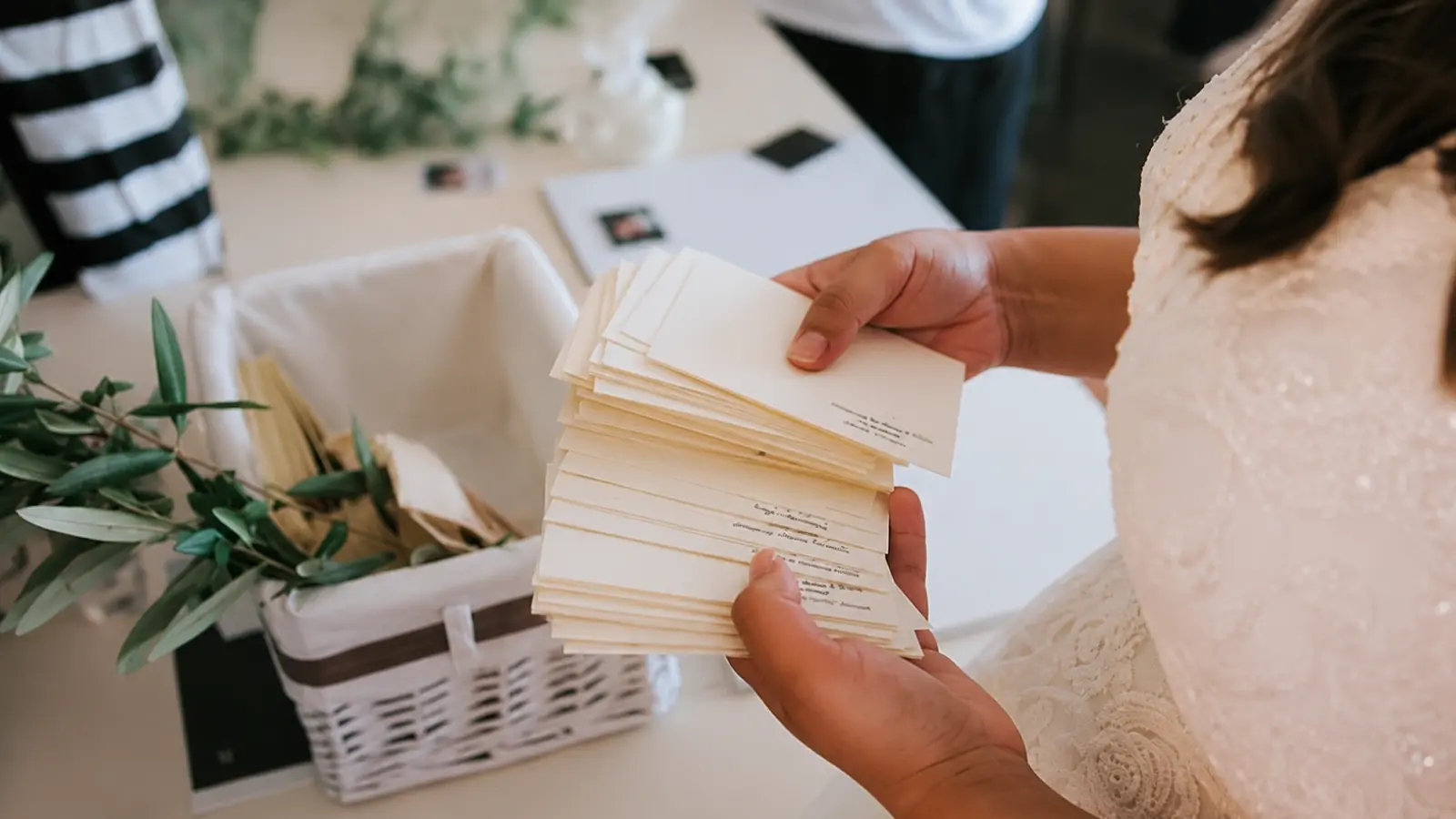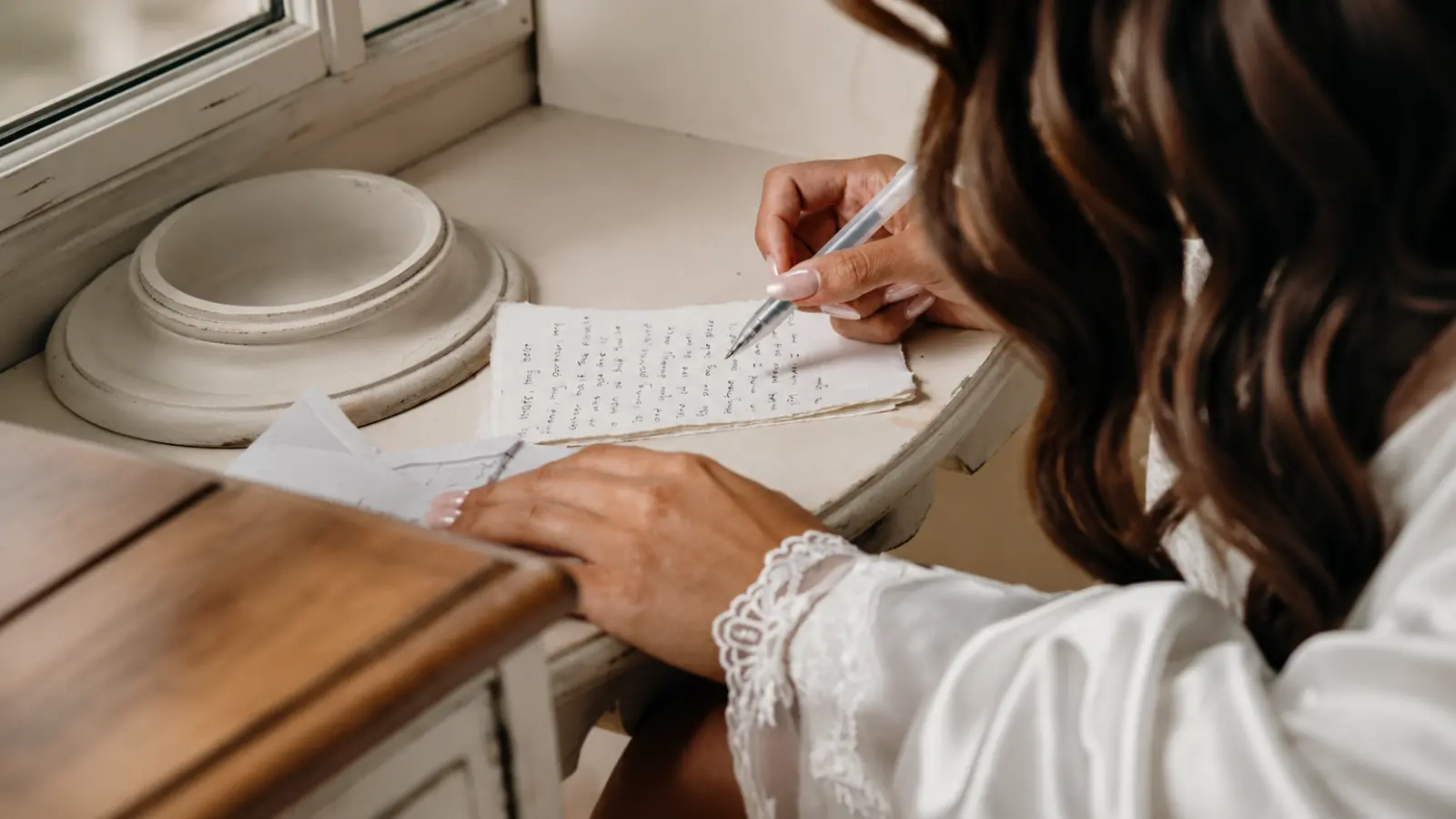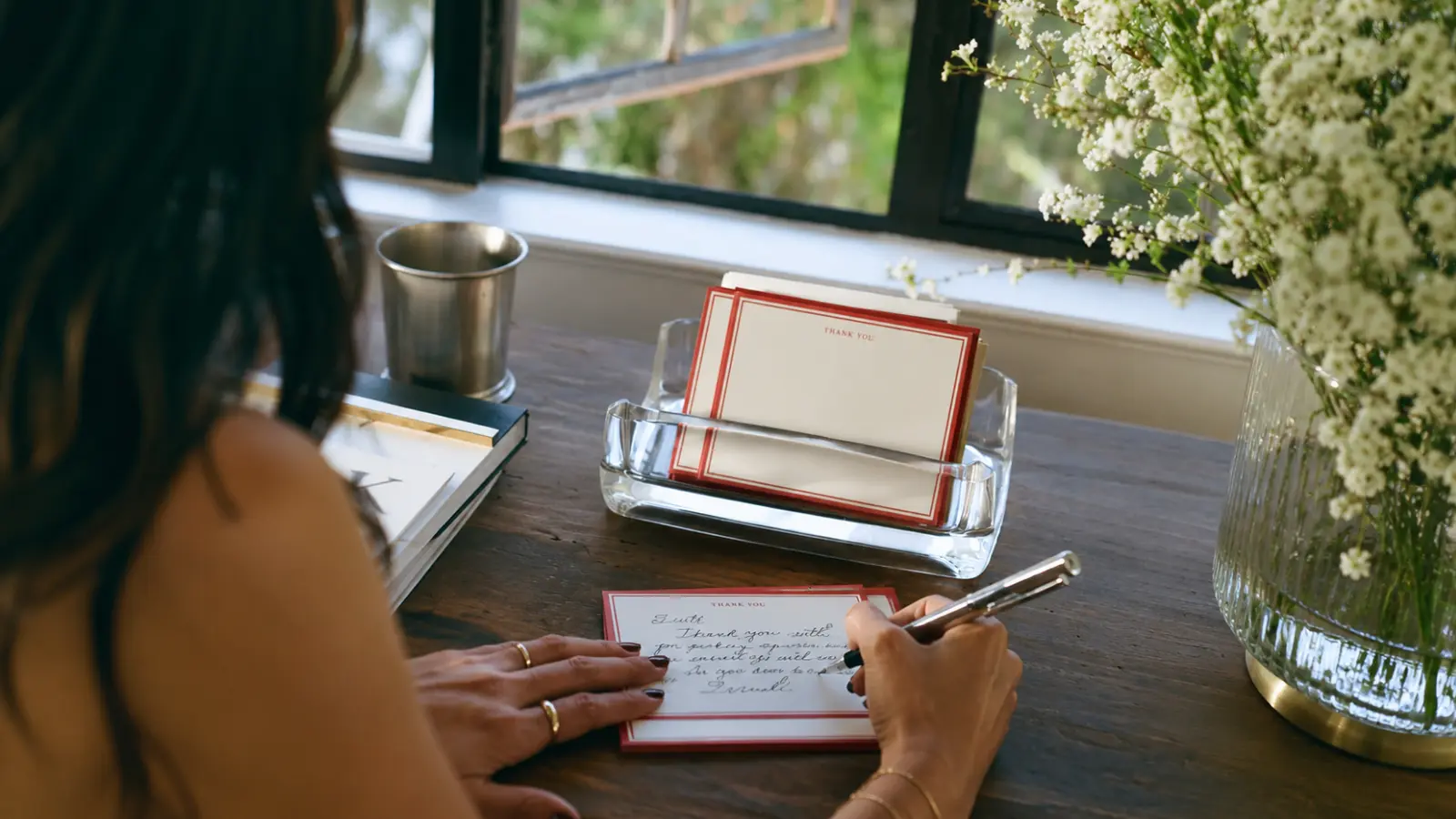

Wedding thank you cards are one of the final traditions of a wedding, but writing dozens of personal notes can quickly feel more complicated than expected. Between remembering who gave what, finding the right words, deciding when to send each card, and making every message feel sincere, a seemingly simple post-wedding task can become surprisingly overwhelming.
The good news is that thank you cards don’t need to be long or perfectly written to feel meaningful. What matters most is acknowledging each person’s gift, generosity, or presence in a way that feels personal and genuine. With a clear system for tracking gifts and a simple structure for writing each message, the entire process becomes much easier to manage.
This guide covers everything you need to know about wedding thank you cards, including etiquette, wording, timing, who should receive one, handwritten versus printed cards, photo card ideas, organization tips, common gift scenarios, and the mistakes to avoid so you can thank every guest thoughtfully and confidently.
What Are Wedding Thank You Cards?
Wedding thank you cards are personal notes sent by the couple after the wedding, and sometimes before for gifts received in advance, to acknowledge gifts and express genuine appreciation to the people who gave them. They can be handwritten notes inside a folded card, photo cards printed with a message, or postcards, but the defining characteristic is the same regardless of format: something personal, addressed specifically to the recipient, that goes beyond a generic acknowledgment.
They’re different from a thank you email, a verbal thank you at the reception, or a social media post. Those expressions of gratitude are welcome and appropriate, but they don’t substitute for a card. The card is the formal, lasting record of your acknowledgment: the thing a grandmother might keep on her refrigerator for months, or that a friend might tuck into a memory box. It carries a weight that a text message simply doesn’t, which is why the expectation for them remains even as so many other wedding formalities have relaxed.
For most couples, wedding thank you cards are one of the final tasks of the wedding planning process, a closing gesture that brings the celebration full circle. The good news is that once you understand what goes into them and have a system in place, they’re far less daunting than they feel at the outset.
Are Wedding Thank You Cards Still Necessary?
In short: yes. The expectation has not disappeared, and the absence of a thank you card is noticed more often than couples realize. Wedding guests invest real money in gifts, along with time, travel costs, and days off from work to attend. A written acknowledgment of that effort is not a formality for its own sake; it’s a genuine expression of respect for the people who showed up for you.
What has changed is the level of rigidity around how that acknowledgment looks. Handwritten thank you notes remain the gold standard, and etiquette traditionalists would say they’re non-negotiable. But the modern consensus is somewhat more flexible — photo cards with a personal note added, printed messages with a handwritten line, or even well-crafted notes sent within a reasonable window are widely accepted as sincere. What remains consistent is the expectation that something personal and intentional is sent to every gift-giver.
If you find yourself wondering whether you truly have to do this, consider how it would feel to give a meaningful gift and hear nothing. For most people, the absence of acknowledgment doesn’t just feel like an oversight; it leaves a small but lasting impression. Thank you cards are the easiest way to make sure that impression is a positive one.
Who Should Receive a Wedding Thank You Card?
The general rule is straightforward: anyone who gave a gift gets a card. But weddings involve a lot of specific situations that the general rule doesn’t immediately cover, so it’s worth being specific.
Wedding guests who gave gifts are the most obvious recipients. Whether they gave a physical gift, cash, a check, or contributed to a registry, each household on your list gets a card. If a couple gives together, one card addressed to both is appropriate. If someone gave a group gift with others, each household still receives its own card; the note can reference the group contribution, but individual acknowledgment matters.
Guests who did not give a gift still came to your wedding, and while a thank you card isn’t technically required, it’s a gracious gesture — especially for people who traveled, took time off, or are close to you. Many couples send cards to all wedding guests as a matter of warmth rather than obligation.
People who gave gifts but couldn’t attend absolutely receive a card. These guests sent a gift without enjoying the celebration, which makes acknowledgment especially important. Don’t let their absence from the guest list make them absent from your card list.
Shower guests who gave gifts at an engagement party or bridal shower should have received a thank you card at the time of that event. If a shower guest also gave a wedding gift, a separate note for the wedding gift is appropriate. Shower thank you cards are a separate process with their own timing and etiquette. See our guide to wedding shower thank you cards for full coverage of that situation.
Parents, the wedding party, and vendors are a slightly different category. Parents who contributed significantly, whether financially, emotionally, or in the planning, deserve personal notes, often more personal and heartfelt than the standard gift acknowledgment. Wedding party members who went above and beyond also merit recognition. Vendors are a professional relationship, and while a thank you note is a kind gesture, it’s generally not held to the same expectation as notes to guests.
What to Include in Every Wedding Thank You Card

One of the most common reasons thank you card writing stalls is not knowing what to say. The simplest answer is also the most effective: keep it specific, keep it warm, and keep it short. A sincere three-sentence note beats an elaborate paragraph that sounds generic every time.
Every wedding thank you card should include four core elements: a personal greeting using the recipient’s name, a specific mention of the gift rather than a vague gesture at it, one sentence about how you’ll use or enjoy it, and a close that feels personal, whether that’s a reference to seeing them at the wedding or simply a warm wish. What you don’t need is a recap of the wedding, an explanation for a delay, or anything that sounds like it came from a template.
For cash and gift cards, you don’t need to mention the amount. Referencing what you plan to use it toward is both more gracious and more personal than stating a dollar figure. For full wording examples across every scenario, see our complete wedding thank you card wording.
Wedding Thank You Card Etiquette at a Glance
Etiquette around thank you cards covers more than just what to write: it includes who signs, how to address envelopes, what to do when you don’t know what someone gave, and how to handle delayed sends. The table below covers the most common scenarios and the expected approach for each.
| Recipient or Situation | What to Mention | Recommended Tone |
|---|---|---|
| Guest who gave a physical gift | The specific gift by name; one way you’ll use it | Warm, specific, brief |
| Guest who gave cash or a check | What you plan to use it toward; gratitude for their generosity | Gracious, personal (no dollar amount) |
| Guest who gave a group gift | The gift; the collective generosity of the group | Each household gets its own card |
| Guest who didn’t attend but gave a gift | The specific gift; an acknowledgment that you missed them | Warm, with genuine acknowledgment of their absence |
| Parents (yours or your partner’s) | Specific contribution; what it meant to you both | More personal and heartfelt than a standard note |
| Wedding party members | Specific support or contribution; a personal memory | Genuine and personal; reference a real moment |
| Guest who attended but gave no gift | Their presence and what it meant; no gift reference needed | Warm; never hint at the absence of a gift |
| Card sent late | Brief, genuine acknowledgment of the delay; then focus on the gift | Honest but not overly apologetic; move forward |
For questions about envelope addressing, who signs the card, and how to handle names after a name change, see our dedicated wedding thank you card etiquette, which covers the technical details that fall outside the scope of wording and format.
When to Send Wedding Thank You Cards
Wedding thank you card timelines vary depending on the etiquette source, but the best approach is to send them as soon as reasonably possible after the wedding. Many couples aim to finish their notes within the first few months, while gifts received before the wedding are best acknowledged soon after they arrive rather than saved for one large post-wedding batch. If your cards take longer than planned, send them anyway—a sincere late thank you is always better than no acknowledgment.
If you’re using wedding photos on your cards, expect your timeline to be shaped by your photographer’s turnaround, which typically runs four to eight weeks. Starting with non-photo cards for pre-wedding gifts and holding the photo batch for later is one practical workaround. For the full etiquette picture on timing, signing, and addressing, see our wedding thank you card etiquette.
The honest takeaway: earlier is almost always better, and a genuine late card is still far better than no card at all. A brief, unapologetic acknowledgment of the delay is enough; don’t let the timeline become a reason to put things off indefinitely.
Handwritten vs. Printed Wedding Thank You Cards
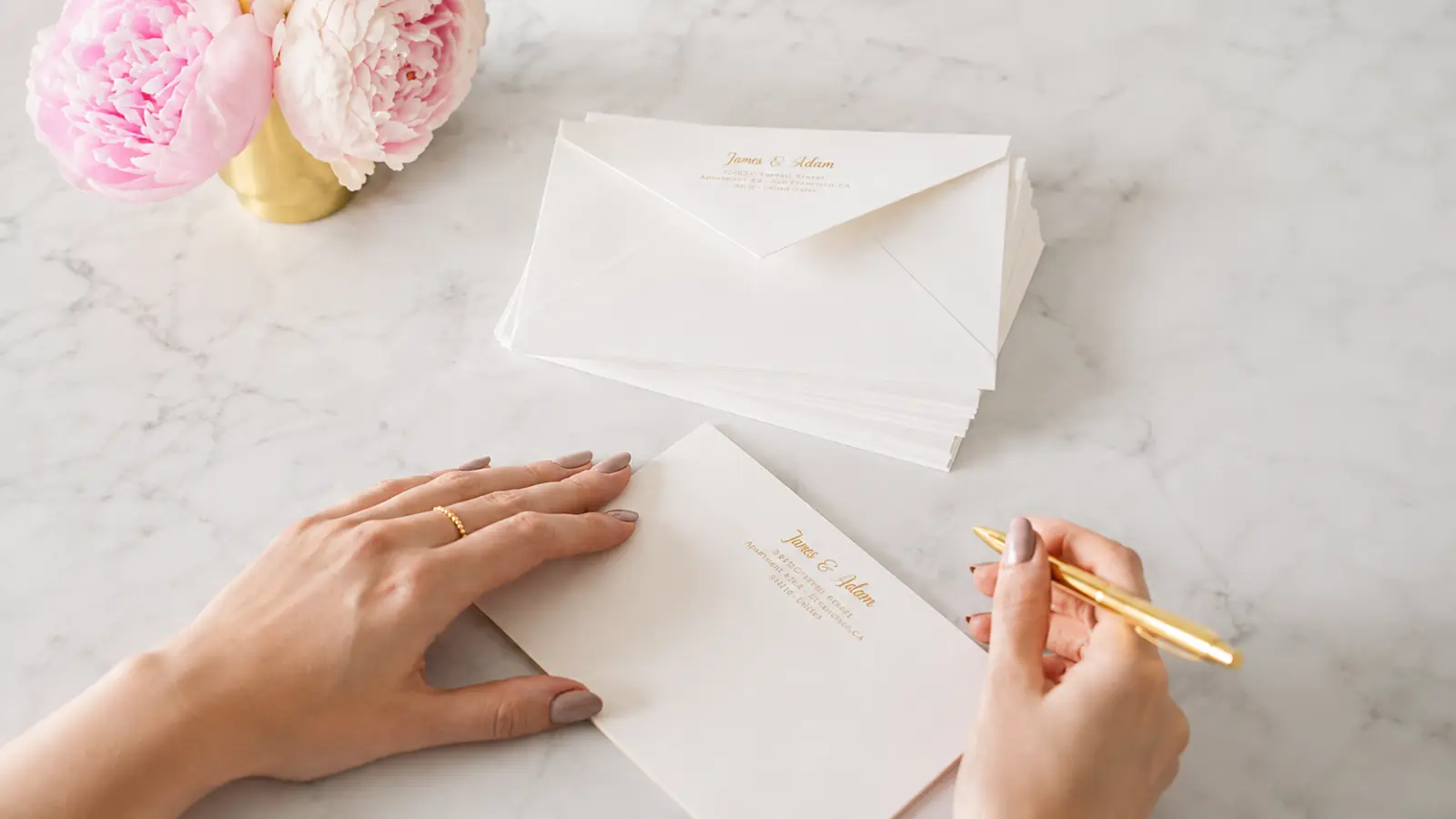
The handwritten note is still the emotional gold standard, and for good reason: something in your own handwriting carries a sincerity a printed message can’t fully replicate. For smaller guest lists and for notes to close family and friends, it’s almost always the right call. That said, handwriting well over a hundred individual cards is a real time commitment, and the pressure to make each one perfect often leads to procrastination.
Fully handwritten cards suit close relationships and smaller guest lists best, with no lead time needed for printing.
Photo cards with a printed message give guests a keepsake and cut down on writing, as long as a handwritten line or two is added to keep them personal.
Printed cards with blank interiors split the difference: a polished printed exterior with room for a fully handwritten note inside.
Digital thank you cards are increasingly available and occasionally convenient, but they remain the least personal format and suit casual communications better than acknowledgments to family members who gave significant gifts. Use your judgment based on your relationships and guest list.
Wedding Thank You Cards With Photos
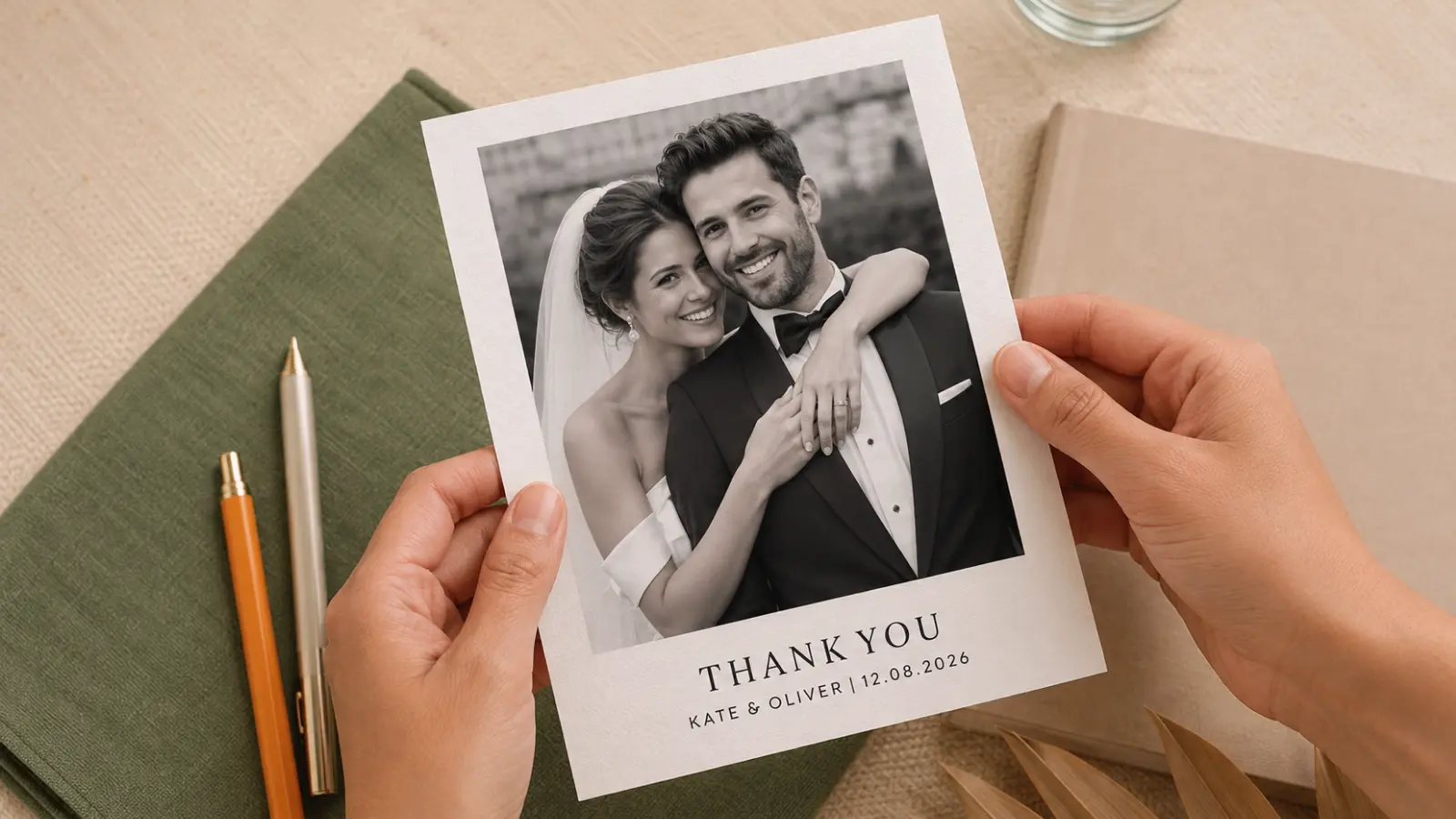
Wedding photo thank you cards have become genuinely popular, and the appeal is easy to understand: they’re a natural extension of the day, they give guests something to keep, and they sidestep the challenge of finding a card design that matches your wedding aesthetic. Many guests display them on the refrigerator or keep them for years.
The format works best as a folded card rather than a flat postcard when you want space to write a personal note inside. A photo on the front with a printed message and blank space inside for a few handwritten lines is the most versatile version. Cards that are pre-printed front and back with no room for personalization lose most of what makes a thank you card meaningful.
One practical consideration is timing. Using your actual wedding photos means waiting for your photographer to deliver the gallery, which typically takes four to eight weeks after the wedding — sometimes longer depending on your photographer’s timeline and editing queue. If you’re committed to a photo card, build that wait into your planning and have a clear conversation with your photographer about the expected delivery date before the wedding. Knowing the gallery will arrive six weeks out lets you set a realistic mailing target rather than feeling like you’re already behind.
Engagement photos are a workable alternative if you want to use a photo without waiting for the wedding gallery. Some couples send engagement-photo cards for gifts received before the wedding and wedding-photo cards for gifts received at or after the celebration. Either way, the photo is a backdrop — the handwritten note inside is what the card is actually about.
Folded Cards vs. Postcards
The format question is more practical than it might seem. Folded cards have an inside surface for writing, which means you have real space for a personal note. They require envelopes and typically cost more to order and mail. They also feel more formal and more substantial in the recipient’s hands, which matters when you’re acknowledging something significant.
Postcards are faster to mail: no envelopes needed, cost less in postage, and are often cheaper to print. They’re a legitimate choice for couples with very large guest lists or tighter budgets. The trade-off is space: you have a small area to write a personal note, usually sharing the back of the card with the address and stamp. Short but sincere notes still land well in this format, but elaborate personalization isn’t realistic.
Wedding thank you postcards work best when the message itself is brief by design — for casual relationships, for acknowledgments of smaller gestures, or when the couple’s aesthetic lends itself naturally to the postcard format (destination weddings, summer celebrations, and informal outdoor ceremonies are natural fits). For close family members and anyone who gave a significant gift, a folded card with room to write is worth the extra effort and cost.
How Many Wedding Thank You Cards to Order
The most common mistake is ordering exactly as many cards as households on your list, which leaves no margin for errors, damaged cards, forgotten guests, or late gifts that arrive after you’ve already sent the first batch. A smarter approach is to calculate the real number and add a reasonable buffer.
Start with the number of households receiving a card, not individual guests. A couple counts as one card, and a family counts as one card. Then add: pre-wedding gift senders not already on your reception list, any vendors or other recipients you want to acknowledge, and a buffer of 10 to 15 percent for mistakes, reprints, and late arrivals. For a 100-household list, ordering 115 to 120 cards is reasonable insurance.
If you’re ordering photo cards from a printer, this buffer matters even more: reordering a small batch of photo cards is rarely cost-efficient, and the new batch may not exactly match the original printing. Order generously the first time and store the extras. Leftover cards are far less inconvenient than running short.
How Many Cards to Order: A Simple Estimate
Count unique households on your gift list → add pre-wedding gift senders → add 10–15% buffer for reprints and late gifts. For a guest list of 120 people split across roughly 80 households, ordering 90–95 cards is a reasonable starting point.
How to Organize Your Gift and Guest List
The couples who find thank you card writing manageable are almost always the ones who started tracking before the wedding, not after. The post-wedding period is not the ideal time to reconstruct who gave what from memory, a stack of cards, a registry notification email, and scattered notes from the reception. A simple tracking system, set up in advance, makes the entire process significantly faster.
Before the wedding, create a spreadsheet with columns for the guest name and address, the gift description, whether a thank you card has been sent, and a notes column for anything personal you want to include in the note — a shared memory, something they mentioned, a reference to their travel. The notes column is what elevates a generic thank you into one that feels genuinely personal.
Assign someone (your maid of honor, a parent, or a trusted friend) to record gift information at the shower and at the reception. This is especially important for physical gifts opened at the event, where the card and the gift can easily be separated in the shuffle of tissue paper and wrapping. A simple system of noting “gift + who gave it” on a notepad or phone app is sufficient. What you don’t want is to find yourself at home a week later holding a beautiful serving bowl with no idea who sent it.
For gifts arriving after the wedding: some guests mail gifts rather than bringing them, sometimes weeks later. Keep the spreadsheet active until you’re confident the list is complete. Online registry purchases generate notifications, but cash, checks, and off-registry gifts require manual tracking. Set a clear end date for your list, add a final buffer of two to three weeks past that date for stragglers, and then begin the writing process in earnest.
A Simple Wedding Thank You Card Formula
Most people don’t struggle with sincerity; they struggle with knowing how to start. The simplest reliable structure for a wedding thank you note has four parts, and it can be written in under five minutes once you know what they are.
Open with the name — “Dear Mike and Carla” rather than a generic salutation, since it’s the first signal the note isn’t a copy-paste.
Acknowledge the specific gift, naming it directly rather than gesturing at it; if you genuinely don’t know what someone gave, acknowledge their generosity warmly instead of guessing.
Say one true thing about it — a single sentence on how you’re using or enjoying it is enough.
Close with something personal, whether that’s a reference to their presence at the wedding or simply a warm wish; this is where the note becomes yours rather than a template.
For complete wording examples across every scenario, see our full wedding thank you card wording, or our wedding thank you card templates for ready-to-adapt options.
Common Wedding Thank You Card Scenarios
A few situations come up repeatedly in post-wedding thank you card writing, and knowing how to handle them in advance removes a lot of second-guessing when you’re sitting down to write.
The gift you can’t identify. If a card was separated from a physical gift at the reception, reach out discreetly to someone who might know, or write a warm note acknowledging “your generous gift” without specifying what it was. Either approach is gracious. What to avoid is ignoring the person entirely.
The gift that arrived late. Some guests mail gifts weeks or months after the wedding. Keep your list active and track these as they arrive; a note sent well after the fact is far better than one that never arrives because you’d already closed out your list.
The significant financial contribution. When a parent or close family member gave a meaningful amount of money, a brief note on a card isn’t enough. A longer, more personal letter is appropriate here, separate from the standard thank you card process. See our guide to wedding thank you cards for parents and special contributors for detailed guidance.
The guest who gave nothing. This happens. Don’t track it, mention it, or hint at it — write as warmly about their presence as you would for anyone else.
The card being sent late. A brief, genuine acknowledgment of the delay, followed immediately by a sincere thank you, is exactly right. Over-explaining the reasons for the delay is more uncomfortable than a simple acknowledgment.
Wedding Thank You Card Mistakes to Avoid
Most thank you card mistakes aren’t about etiquette technicalities; they’re about losing sight of what the card is actually for. The following are the patterns that consistently undermine otherwise well-intentioned notes.
Writing a generic message and changing only the name. Guests who compare notes (and they sometimes do) will notice identical phrasing. More importantly, a generic message doesn’t feel like a thank you; it feels like a task being completed. The small effort of one specific, personal line per card makes the difference between something meaningful and something forgettable.
Mentioning the dollar amount of a cash gift. Even if you’re writing enthusiastically, including the exact figure reads awkwardly in most relationships. Wedding thank you card wording for money should focus on your gratitude and what you plan to use the gift toward rather than the dollar amount itself.
Sending cards signed only by one spouse. Wedding thank you cards should be signed by both people, and ideally written in a voice that reflects both of you. “We loved it” and “we’re so happy you were there” is the natural register of a joint acknowledgment. A card signed by one person and written entirely in first person singular feels slightly off for a joint household gift.
Letting perfection stall the process. Many couples put off writing because they want every note to be perfectly worded. The result is a pile of unsent cards three months after the wedding. A sincere, simple three-sentence note sent within the window is better than a beautifully composed paragraph sent six months late, or never at all.
Forgetting pre-wedding gift senders entirely. Shower guests, friends who mailed gifts before the wedding, and family members who gave contributions at the engagement party are all gift-givers who deserve acknowledgment. Focusing only on the wedding reception guest list and missing everyone else is one of the most common oversights in the process.
Skipping personal notes on photo cards. A photo thank you card with a printed message and no handwritten addition is, essentially, an automated reply. The photo is beautiful and guests appreciate it — but it doesn’t replace the personal note it’s meant to accompany.
A Thoughtful Thank You Is the Final Wedding Detail
Wedding thank you cards may be one of the last items on your wedding checklist, but they carry meaning long after the celebration is over. Every gift, thoughtful gesture, long journey, and helping hand represents someone who chose to be part of an important moment in your life, and a personal note gives you the opportunity to acknowledge that generosity in a way that feels genuine.
You don’t need perfect handwriting or an elaborate message to make someone feel appreciated. Keep an organized gift list, write your cards in manageable batches, mention something specific whenever possible, and focus on sincerity rather than perfection. The best wedding thank you card is ultimately a simple one that leaves the person receiving it feeling remembered, valued, and genuinely thanked.
Frequently asked questions (FAQ)
Are wedding thank you cards still necessary?
Yes. Wedding thank you cards remain an expected part of American wedding etiquette, particularly for anyone who gave a gift. The note does not need to be long or elaborate, but it should feel personal and acknowledge the recipient’s generosity. A written thank you also gives you a chance to recognize the time, travel, and support guests contributed to your celebration.
How long do you have to send wedding thank you cards?
Wedding thank you card timelines vary by etiquette source, but sending them as soon as reasonably possible is the best approach. Many couples aim to complete their notes within the first few months after the wedding, while gifts received beforehand should ideally be acknowledged soon after they arrive. If more time has passed, send the card anyway—a sincere late thank you is always better than no acknowledgment.
Who should receive a wedding thank you card?
Anyone who gave you a wedding gift should receive a thank you card, whether or not they attended the celebration. This includes physical gifts, cash, checks, registry purchases, and group gifts. Parents, wedding party members, and others who made significant contributions may also deserve more personal notes acknowledging the specific support they provided.
Should you send a thank you card to wedding guests who did not give a gift?
A card is not generally required solely because someone attended without giving a gift, but sending one can still be a gracious gesture, especially for guests who traveled, helped with the celebration, or are particularly close to you. If you write one, thank them sincerely for being there and never mention or imply that a gift was expected.
What should you write in a wedding thank you card?
A strong wedding thank you note needs only four elements: the recipient’s name, a specific acknowledgment of the gift or gesture, a sentence about how you will use or appreciate it, and a personal closing. For money or gift cards, you can mention what you plan to use the gift toward without stating the exact amount.
Do wedding thank you cards have to be handwritten?
Handwritten notes remain the most personal and traditional choice, but the entire card does not necessarily have to be handwritten. Printed or photo cards can work well when you add a genuine handwritten message for each recipient. What matters most is avoiding a completely generic card that gives no indication it was created specifically for the person receiving it.
What should you do if your wedding thank you cards are late?
Send them as soon as you can. If several months have passed, briefly acknowledge the delay without turning the note into a long apology, then focus on thanking the recipient for the specific gift or support they gave. There is no point at which being late makes saying thank you worse than saying nothing at all.