
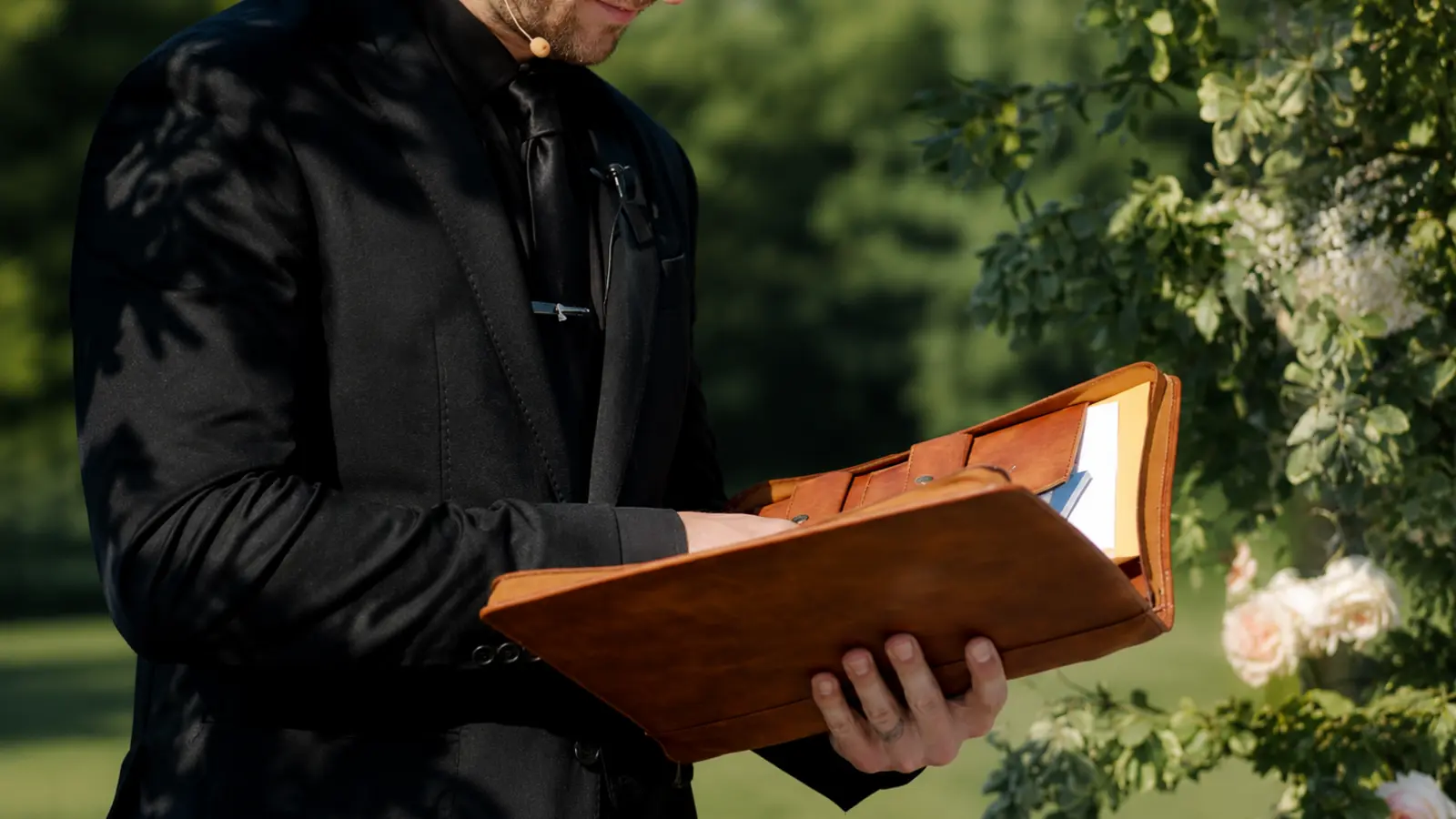
Learning how to officiate a wedding means understanding both the ceremony itself and the legal responsibilities that may come with performing it. The officiant must be properly authorized in the jurisdiction where the wedding takes place, complete any required registration, review the marriage license, lead the required declaration or consent, obtain the correct signatures, and make sure the document is returned according to local instructions.
The ceremonial side requires just as much preparation. A good officiant meets with the couple, builds a clear ceremony structure, coordinates vows, rings, readings and rituals, rehearses important cues, works with the planner and vendors, and knows exactly what to do before, during and after the ceremony. Legal requirements and optional traditions should always be kept separate so that personalization never replaces a step the law requires.
This guide explains how to officiate a wedding step by step, including how to verify legal authority, complete registration, review the marriage license, plan and write the ceremony, conduct the declaration of intent, lead vows and rings, coordinate the rehearsal, sign and return the license, avoid common mistakes, and complete a final officiant checklist.
1. Confirm Your Authority Before You Accept
The first question is not whether the couple wants you to officiate. It is whether the law permits you to solemnize the marriage in the place where the ceremony will occur. Authority is usually controlled by the ceremony jurisdiction, not the couple’s home address, the officiant’s residence, or the location where a credential was issued.
Authorized categories may include clergy, judges, justices, magistrates, clerks, designated public officials, civil celebrants, or people holding a temporary authorization. The exact list is jurisdiction-specific. EVORÉ’s guide to who can officiate a wedding covers those categories and the verification questions in greater detail.
Start with an official source: the state statute, county or city clerk, probate court, vital-records office, or other office identified on the marriage-license website. Ask four precise questions:
- Does my status qualify me to perform this marriage?
- Must I register, file credentials, receive approval, or obtain a temporary designation?
- Does the ceremony location impose a rule different from the license-issuing location?
- What legal statements, witnesses, signatures, and filing steps are required?
Do not rely only on a credential provider, wedding blog, venue, or the couple’s recollection. For example, Washington’s marriage statute identifies who may solemnize a marriage and separately states the ceremony and return requirements. That structure illustrates why “authorized person” is only one part of the legal checklist.
2. Complete Any Required Registration
Authority under state law does not always finish the inquiry. A city, county, or other local jurisdiction may require eligible officiants to register or file credentials before performing a ceremony there. Registration can involve an application, identification, proof of office or credentials, supporting letters, a fee, an oath, a waiting period, or an approval document — though some jurisdictions have no registration process, or apply one only to certain types of officiants.
New York City, for example, maintains a Marriage Officiant Registration process. That does not mean every city follows the same system. It demonstrates why an officiant should check both the broader authorization rule and the local administrative rule.
Complete this work early enough to resolve rejected documents or processing delays. Save the approval, registration number, expiration date, and any required wording for the officiant title. Bring relevant proof to the wedding if the licensing office or venue instructs you to do so.
3. Review the Actual Marriage License
The couple generally obtains the license, but the officiant should review the actual issued document before the ceremony. An application confirmation, payment receipt, decorative certificate, or blank sample is not necessarily the document that must be completed and returned.
The broader marriage license guide explains authorization, issuance, validity, ceremony, signatures, and recording. For officiating, inspect these items:
- the issuing jurisdiction and permitted ceremony area;
- the effective date, waiting period, and expiration date;
- the parties’ names and identifying information;
- the ceremony date and location fields;
- the number and eligibility of required witnesses;
- the officiant name, title, address, credential, or registration fields;
- the required signatures and acceptable ink or electronic method;
- the office, address, return method, and filing deadline.
Couples should verify their own eligibility and required records before applying. The marriage license requirements guide organizes common identification, age, prior-marriage, witness, waiting-period, and translation issues.
If a name, date, or other entry appears wrong, contact the issuing office before writing over it. Do not use correction fluid, erase an entry, improvise a replacement document, or assume an initialed change will be accepted. The office should explain how to correct the specific form.
4. Meet the Couple and Define the Ceremony
A planning meeting should establish both the couple’s preferences and the officiant’s limits. Confirm the legal names, pronunciation, preferred forms of address, ceremony location, start time, wedding-party size, witnesses, readings, music, rituals, vows, ring exchange, accessibility needs, and sensitive topics to avoid.
Ask how the couple wants the ceremony to feel: concise, formal, warm, humorous, secular, spiritual, or culturally specific. Discuss whether they want their relationship story included and which details may be shared publicly. Never surprise the couple with private history, jokes, religious language, advice, or references to former relationships.
Clarify the officiant’s responsibilities in writing:
- who creates and approves the ceremony order;
- who writes each section;
- whether the couple will write personal vows;
- who leads or attends the rehearsal;
- who brings and protects the license;
- who selects qualified witnesses;
- who returns the completed document;
- how the couple will verify that recording occurred.
This meeting is also the time to confirm whether a religious institution, cultural tradition, or venue imposes ceremonial requirements that are separate from civil law.
5. Build a Clear Ceremony Structure
When people search “how to officiate wedding ceremony,” they often expect one universal order. Most ceremonies use a recognizable sequence, but the exact content is flexible unless local law or a religious authority requires a particular element.
A practical order is:
- entrance and positioning;
- welcome and opening remarks;
- brief reflection or couple story;
- readings, music, or rituals if included;
- legal declaration of intent or consent;
- personal or repeat-after-me vows if included;
- ring exchange if included;
- pronouncement and closing;
- license signatures after the ceremony.
The wedding officiant script guide addresses ceremony language in depth. For this operational guide, the essential point is to label every section as legally required, ceremonially important, or optional. That prevents a beautiful custom section from displacing the act that legally expresses consent.
Officiating Wedding Checklist by Stage
| Stage | Responsibility | Legal/Ceremonial | Deadline |
|---|---|---|---|
| Before accepting | Confirm authority in the ceremony jurisdiction | Legal | Before committing to the couple |
| Before planning | Complete any registration or credential filing | Legal | Before the ceremony |
| After license issuance | Review validity, fields, witnesses, and return instructions | Legal | Before the ceremony begins |
| Planning meeting | Confirm preferences, names, order, and responsibilities | Ceremonial and administrative | Several weeks before, when possible |
| Drafting | Prepare the order, remarks, transitions, and cues | Ceremonial | Before final review or rehearsal |
| Rehearsal | Practice entrances, positions, handoffs, and cues | Ceremonial | Before the wedding day or ceremony |
| Ceremony | Obtain the required declaration or consent | Legal | During the valid license period |
| Ceremony | Lead vows, rings, readings, and rituals if selected | Usually ceremonial | During the ceremony |
| Closing | Pronounce the marriage after required elements | Legal and ceremonial, depending on local law | Before presenting the couple |
| Signing | Complete officiant fields and collect required signatures | Legal | Immediately after the ceremony, when possible |
| Filing | Return the completed license as instructed | Legal and administrative | By the jurisdiction’s deadline |
| Follow-up | Retain permitted proof and help confirm recording | Administrative | After delivery and normal processing |
6. Deliver the Welcome, Story and Transitions
The welcome should settle the room, identify the occasion, and establish the tone. It does not need to retell the couple’s entire history. A simple opening can be: “Welcome. We are gathered to witness and celebrate the marriage of [Name] and [Name].”
The relationship story should be accurate, proportionate, and approved. Select two or three details that reveal the couple’s character or shared values rather than reading a chronological biography. Keep private struggles private unless both people clearly want them included.
Transitions tell the couple and guests what is happening next. Short instructions work best: invite a reader forward, ask the couple to face each other, request the rings, or introduce the declaration. Mark these cues in the ceremony copy so that they cannot be confused with spoken remarks. People searching “what to say officiating wedding” usually need a dependable framework more than ornate wording — use the couple’s natural language, short sentences, and intentional pauses, then read the complete draft aloud to find difficult names, long passages, and sections that sound written rather than spoken.
7. Conduct the Declaration of Intent or Legal Consent
The legal center of the ceremony is the parties’ present consent to marry. The terminology and precise legal requirement vary: some jurisdictions describe an assent or declaration made before the officiant and witnesses, while others provide guidance or required language through the licensing office. A familiar question is: “Do you, [Name], take [Name] to be your spouse?” with each person giving a clear affirmative response — but that is an example, not a substitute for the local rule. Confirm whether the law requires specific words, the presence of witnesses, simultaneous presence, or another form of declaration.
Washington provides a useful legal example: its statute says no particular form is necessary, but the parties must assent or declare in the presence of the authorized officiant and two attending witnesses. Another jurisdiction may use different requirements. Never infer a national rule from one state’s procedure.
Pause and listen for an unambiguous response from each person. If someone does not answer, appears unable to consent, withdraws consent, or raises a serious concern, do not rush ahead to preserve the schedule. The legal act matters more than the planned performance.
8. Lead the Vows and Ring Exchange
Vows
Personal vows allow the couple to express promises in their own words. Repeat-after-me vows provide a structured alternative. A couple may also exchange no personalized vows at all while still completing the legally required declaration, if local law allows that format.
Review personal vows for approximate length and practical fit, but do not rewrite the couple into the same voice. Ask whether they want to see each other’s vows in advance, keep them private, or receive only length guidance. Bring a printed backup if the vows are stored on a phone.
The Ring Exchange
Rings are symbolic and generally not what creates the marriage. If the couple exchanges them, establish who holds them, when they are presented, and whether a short ring promise follows. If there are no rings, remove the section cleanly instead of apologizing or drawing attention to the omission.
A courthouse wedding ceremony may be very brief and still include consent, optional rings, signatures, and a pronouncement. A civil wedding can occur in other authorized settings and may contain personalized ceremonial elements while remaining legally civil.
9. Make the Pronouncement at the Correct Time
The pronouncement closes the marriage portion of the ceremony and tells the room that the required act has occurred. Use the couple’s preferred terms and any wording required by the jurisdiction or officiant’s institution.
A concise form is: “Having declared your intent before those gathered here, I now pronounce you married.” The authority phrase may need adjustment to accurately describe the officiant’s status. Do not claim a title, office, or legal power you do not hold.
Place the pronouncement after the required consent and before the final presentation. If a kiss is included, discuss the cue in advance. Then present the couple using the names and wording they chose rather than assuming a shared surname or gendered title.
10. Rehearse the Movement and Cues
A rehearsal is primarily a logistics exercise. It should answer where people stand, when they move, who carries each item, how the microphone is used, and what happens during transitions. The full ceremony normally does not need to be performed word for word.
Practice:
- the processional order and spacing;
- where the couple and officiant stand;
- how attendants sit or reposition;
- reader, musician, and ritual cues;
- the handoff of rings, vow cards, or personal items;
- microphone placement and speaking distance;
- the kiss, presentation, and recessional;
- where and when license signing occurs.
Keep the officiant out of the couple’s first-kiss photograph by stepping aside after the pronouncement. Confirm the movement during rehearsal rather than improvising it on the wedding day.
11. Coordinate With the Planner, Venue and Vendors
Send the final ceremony order to the planner or coordinator and identify every cue that affects music, doors, microphones, readings, rituals, and the recessional. Confirm who gives the start signal and who decides whether weather or venue conditions require a location change.
Ask the photographer and videographer about positions without allowing production needs to interrupt the legal moment. Tell them when the declaration, ring exchange, pronouncement, kiss, and signing will occur. Confirm whether photography is permitted during signing at a government or religious venue.
Perform a sound check with the actual microphone. Learn how to mute it, where to place printed pages, and what backup exists for a battery or equipment failure. Give musicians the exact spoken cue preceding each selection, and confirm the venue’s emergency contact, ceremony end time, accessibility plan, and severe-weather procedure — details that are ceremonial operations even though they are not part of marriage law.
12. Follow a Wedding-Day Workflow
Arrive early enough to inspect the ceremony space, meet the coordinator, test sound, review cues, and examine the license without pressure. Bring the final ceremony copy, a backup copy, a reliable pen that meets document instructions, registration proof if relevant, and any approved personal or ritual items.
Before the processional:
- confirm that both parties are present and ready;
- verify the correct license and its validity window;
- identify required witnesses;
- check names and pronunciations one final time;
- confirm possession of rings, vows, and readings;
- review the start signal and contingency plan.
During the ceremony, speak more slowly than ordinary conversation, look at the couple rather than only at the page, and pause after important lines. If a harmless ceremonial detail goes wrong, recover calmly and continue. If the issue affects consent, authority, the license, or another legal requirement, stop and resolve it appropriately.
13. Complete the License and Required Signatures
After the ceremony, move to a quiet, well-lit place with the spouses, witnesses, and document. Follow the license instructions field by field, using legal names where required and entering the officiant title or capacity exactly as accepted by the jurisdiction. Required signers vary: the spouses and officiant commonly sign, while one or more witnesses may be necessary in some jurisdictions, and the issued document controls. Do not leave a required field blank because another wedding used a different form, and do not add unnecessary information to make the document look complete.
Review dates, locations, signatures, and legibility before anyone leaves. If an error occurs, call the clerk or recording office for correction instructions. Protect the document from food, liquids, folding, loss, and unauthorized photographs containing personal information.
Couples who have not yet applied can use the operational guide on how to get a marriage license. That application remains the couple’s responsibility unless a specific service agreement and local rule provide otherwise.
14. Return the License and Confirm the Next Step
Signing the document does not necessarily mean the marriage has been recorded. The completed license must reach the proper office through the required method and within the applicable period.
The responsible person and deadline vary. California’s official officiant guidance, for example, tells the person solemnizing the marriage to return the original license within 10 days. New York’s Department of Health instructs the officiant to return the original to the town or city clerk where it was purchased. Washington law uses a different stated period. These examples show why the actual jurisdiction and license instructions must control.
Before the wedding, agree on who takes custody after signing. When the officiant is responsible, use the address and method specified by the office, and retain only the copy, receipt, tracking record, or submission confirmation that the office and privacy rules permit. Tell the couple how to check that recording is complete and when they may request a marriage certificate or certified copy — the officiant should not promise an exact processing date unless the recording office provides one.
15. Common Officiating Mistakes
Assuming authority applies everywhere
Recognition can change across state, county, or city lines. Verify the ceremony location before accepting the role or advertising that you can perform the marriage.
Waiting until the wedding day to inspect the license
An expired license, future effective date, wrong jurisdiction, missing witness plan, or incorrect name is much harder to resolve minutes before the processional.
Confusing personal vows with legal consent
Beautiful promises may not contain the declaration required by local law. Keep the legally necessary exchange clearly identified in the ceremony order.
Using an inaccurate title
Enter the capacity the jurisdiction recognizes. Do not embellish a title or copy language from another officiant’s form.
Improvising a document correction
Unauthorized alterations can delay or prevent recording. Contact the issuing or recording office and follow its correction process.
Forgetting a required signature
Gather the spouses, witnesses, and officiant before participants disperse. Review every required field while the signers are still available.
Losing custody of the completed license
Designate one responsible person and one secure location. Passing the document casually among the couple, planner, photographer, and family increases risk.
Missing the return deadline
Calendar the deadline before the ceremony and prepare the envelope, address, online process, or delivery plan in advance.
Overwriting the ceremony
A long story or collection of quotations can obscure the couple and strain the schedule. Keep remarks purposeful and preserve time for the required legal act.
Final Officiating Wedding Checklist
Use this final review shortly before officiating a wedding:
- Authority verified for the exact ceremony location
- Required registration or designation approved
- Government instructions saved and reviewed
- Issued license checked for dates, jurisdiction, and fields
- Witness requirement confirmed
- Couple’s legal names and pronunciations confirmed
- Final ceremony order approved
- Legally required consent or declaration marked
- Vows, rings, readings, and rituals confirmed
- Rehearsal or cue review completed
- Planner, venue, music, sound, photo, and video cues coordinated
- Printed ceremony and backup prepared
- License-signing location and pen prepared
- Required signatures reviewed after the ceremony
- Document custody, return method, and deadline confirmed
- Permitted proof of delivery retained
- Couple told how to confirm recording
Separate the Legal Duties From the Ceremony Choices
Knowing how to officiate a wedding means managing two responsibilities at the same time: creating a ceremony that feels personal to the couple and completing every legal step required by the jurisdiction. Authority, registration, valid consent, signatures, license handling, and filing protect the marriage process, while the welcome, story, vows, rings, readings, rituals, and delivery shape the experience.
Before the wedding day, verify the legal requirements, review the actual marriage license, finalize the ceremony order, coordinate every important cue, and decide exactly who will handle the completed document. After the ceremony, check every required field and signature, return the license through the correct process, and keep any permitted proof of delivery so the couple can confirm that the marriage was properly recorded.
Frequently asked questions (FAQ)
How do you officiate a wedding?
Start by confirming that you are legally authorized to perform the marriage where the ceremony will take place and complete any required registration. Then review the issued marriage license, meet with the couple, prepare the ceremony order, rehearse important cues, conduct the required declaration or consent, obtain all required signatures, and return the completed license according to the jurisdiction’s instructions.
What legal authority do you need to officiate a wedding?
The required authority depends on the law of the ceremony jurisdiction. Authorized officiants may include clergy, judges, magistrates, public officials, civil celebrants, temporary designees, or other categories recognized by local law. Some jurisdictions also require registration, credential filing, or approval before the ceremony.
What do you say when officiating a wedding?
A typical ceremony may include a welcome, brief remarks about the couple, readings or rituals, the legally required declaration of intent or consent, optional personal vows, an optional ring exchange, and a pronouncement. The exact legal wording or required statements vary by jurisdiction, so the officiant should separate mandatory legal elements from customizable ceremony language.
Are vows and rings legally required to get married?
Rings are generally ceremonial and are not what legally creates the marriage. Personalized vows are also commonly optional. However, the jurisdiction may require each person to clearly express consent or declare an intention to enter the marriage. The officiant should confirm the required legal exchange rather than relying on a traditional ceremony script.
What should an officiant do with the marriage license?
Before the ceremony, the officiant should review the actual license for validity dates, jurisdiction, names, witness requirements, officiant fields, signatures, and return instructions. After the ceremony, the required fields and signatures should be completed exactly as directed, and unauthorized corrections should be avoided.
Who returns the marriage license after the wedding?
Responsibility varies by jurisdiction. Many places require the officiant to return the completed marriage license to the issuing or recording office, while others use a different procedure. The officiant should confirm who is responsible, where the document must be sent, the permitted return method, and the filing deadline before the wedding.

About the Author
Débora Justo
Founder and editor of EVORÉ, creating practical wedding planning resources, thoughtful inspiration and useful tools for the decisions that shape a celebration.
Read more about the author →