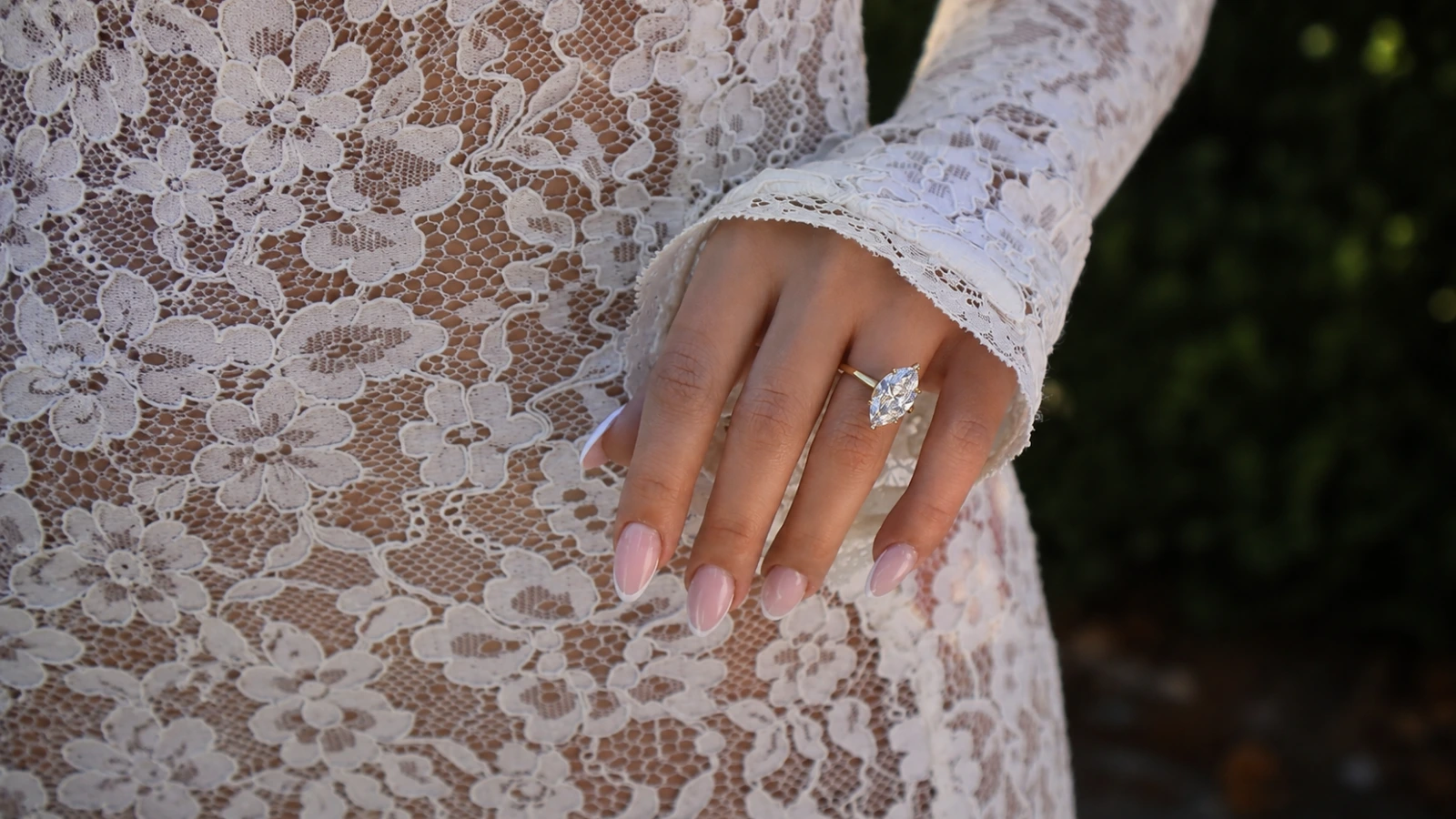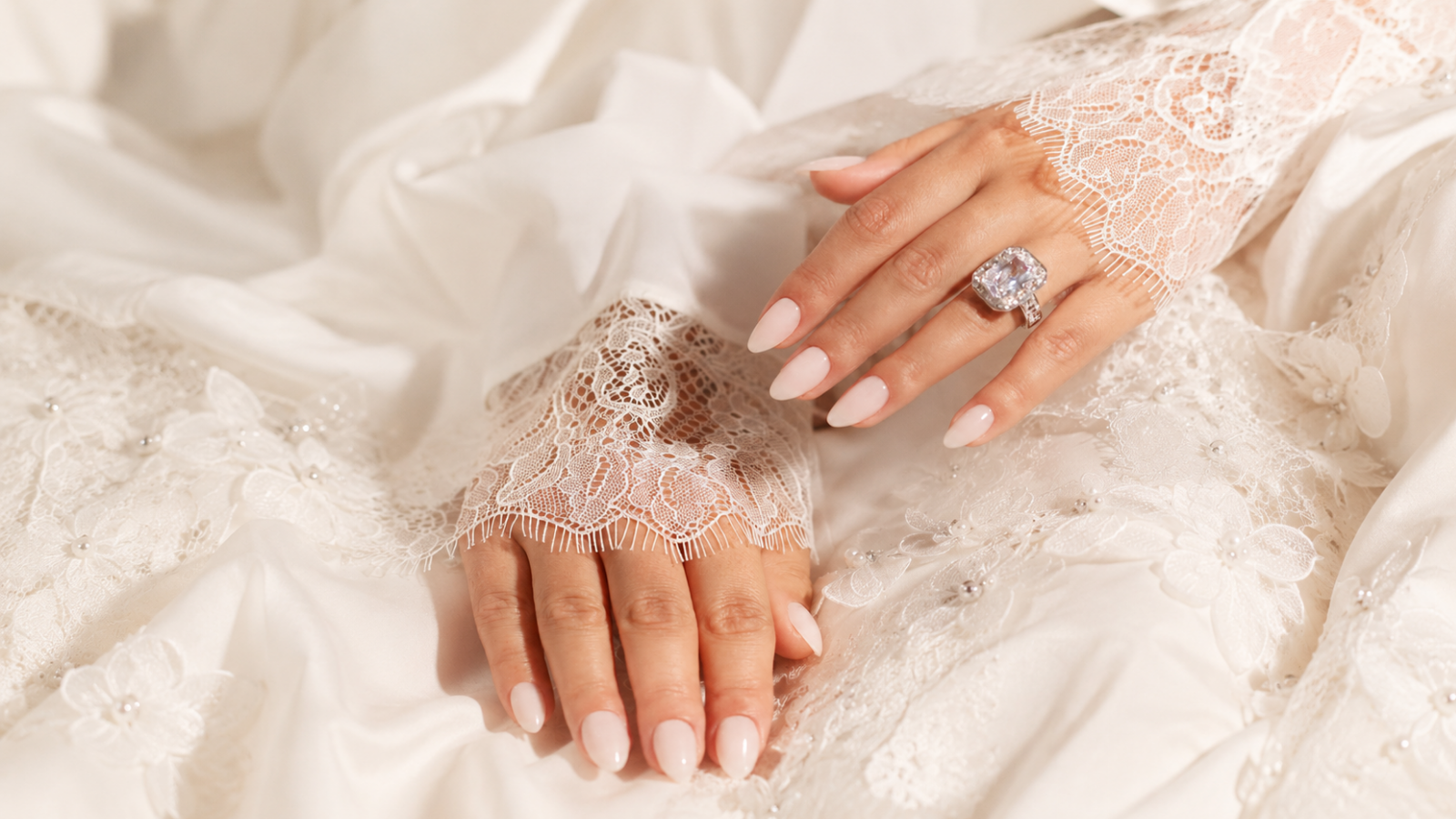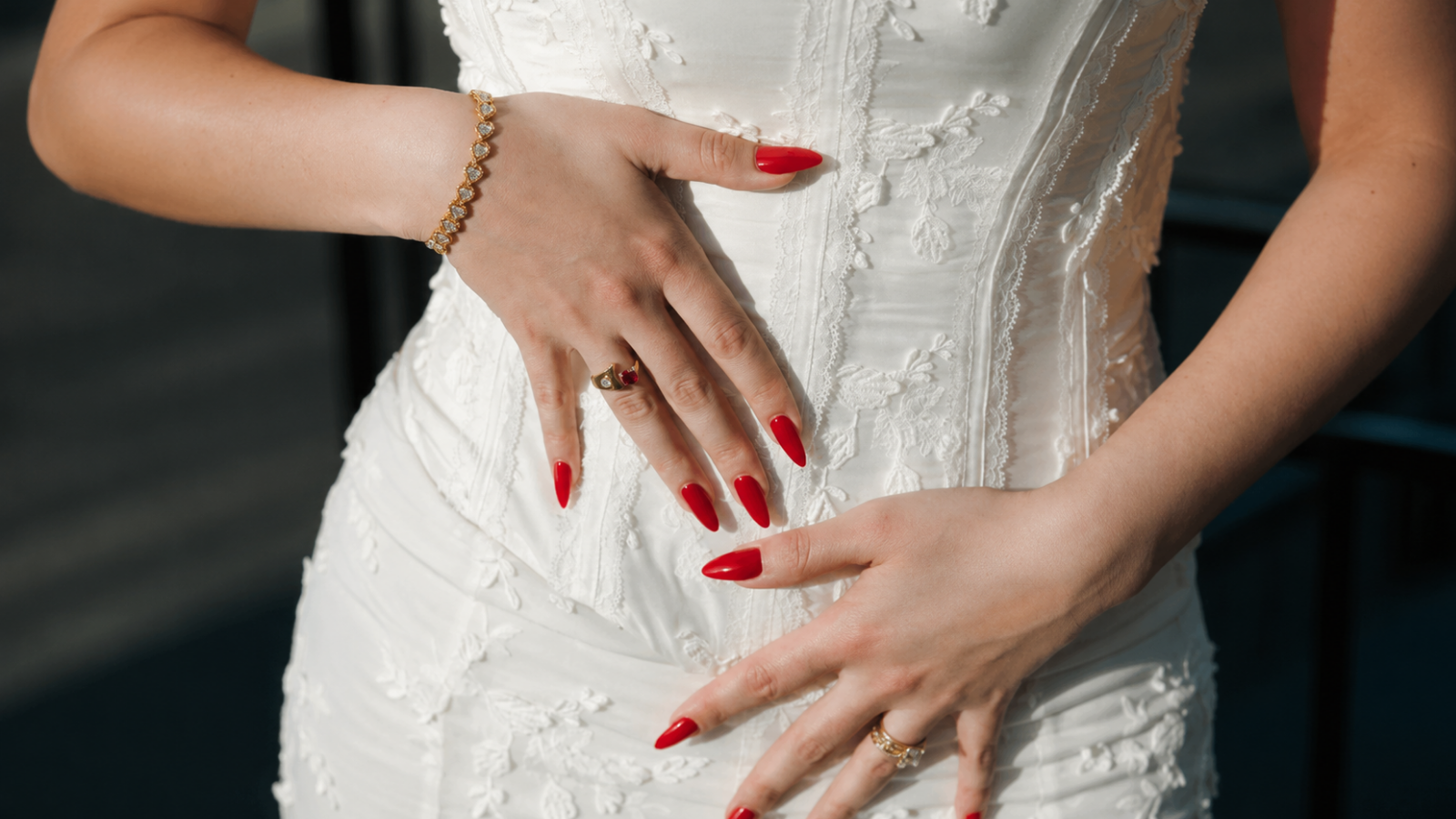
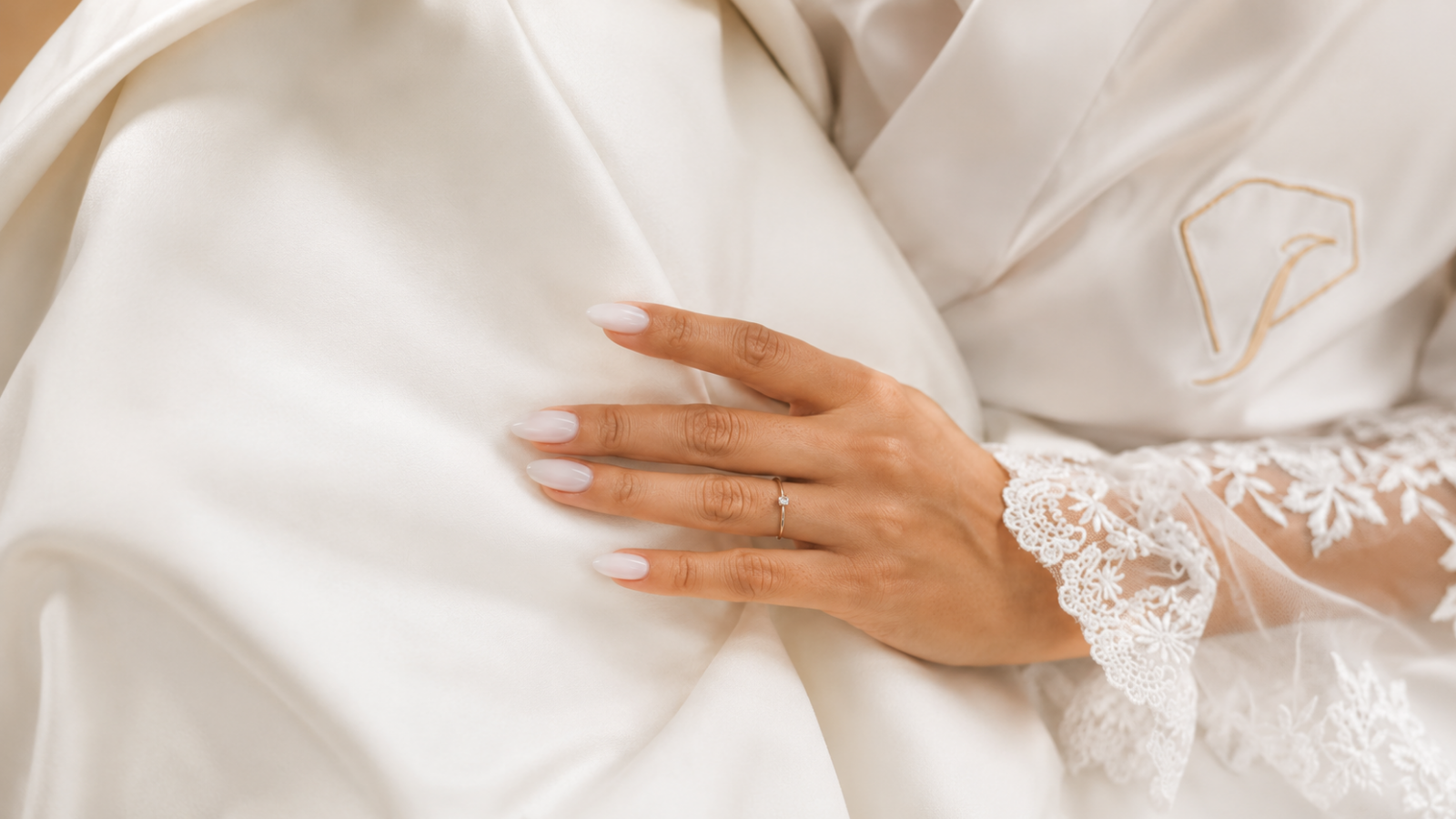
Ombré wedding nails are one of the most elegant bridal manicure choices because they create a soft gradient that looks dimensional in close-up wedding photos.
Ombré wedding nails are bridal or wedding guest manicures where one color gradually blends into another, often moving from nude, pink, or sheer tones into white, shimmer, glitter, or pearl finishes. This soft transition can make the nails look polished, romantic, and refined without the hard line of a classic French tip or the flatness of a single solid color.
This guide covers the best ombré wedding nails for brides and wedding guests, including French ombré nails, pink and white gradients, nude baby boomer styles, glitter ombré, short nail ideas, almond-shaped ombré nails, and the gradient styles that look elegant in real wedding photography.
Why Ombré Nails Photograph So Well at Weddings
Wedding photography does something to wedding nails that everyday life does not: it shows them in extreme close-up, under different lighting conditions, from multiple angles, within the same hour. A flat single-color nail in a ring shot shows exactly what it is — one shade, one surface, no variation. An ombré nail shows something more interesting: a gradient that changes as the light moves across it, a transition that reads differently from above than from the side, a depth that makes the nail look intentional even in a casual candid.
This is not a trivial point. Your nail technician’s most important client is not you at the salon — it is the camera at the ring shot. French ombré, in particular, has become the dominant bridal nail style precisely because of this. The gradual fade from pink or nude to white photographs with a softness that traditional French tip wedding nails cannot replicate. There is no line for the camera to find imperfect. There is only a transition, and transitions always look beautiful.
The other photographic advantage of ombré is that it works in any light. The challenge with some nail finishes — dark colors, certain chromes, glitter with large particles — is that they behave unpredictably under flash photography or bright outdoor light. A soft ombré gradient is forgiving. It does not glare. It does not absorb light and disappear. It gives the camera something to render with consistency across the hundreds of photographs that will be taken on your wedding day.
French Ombré Wedding Nails
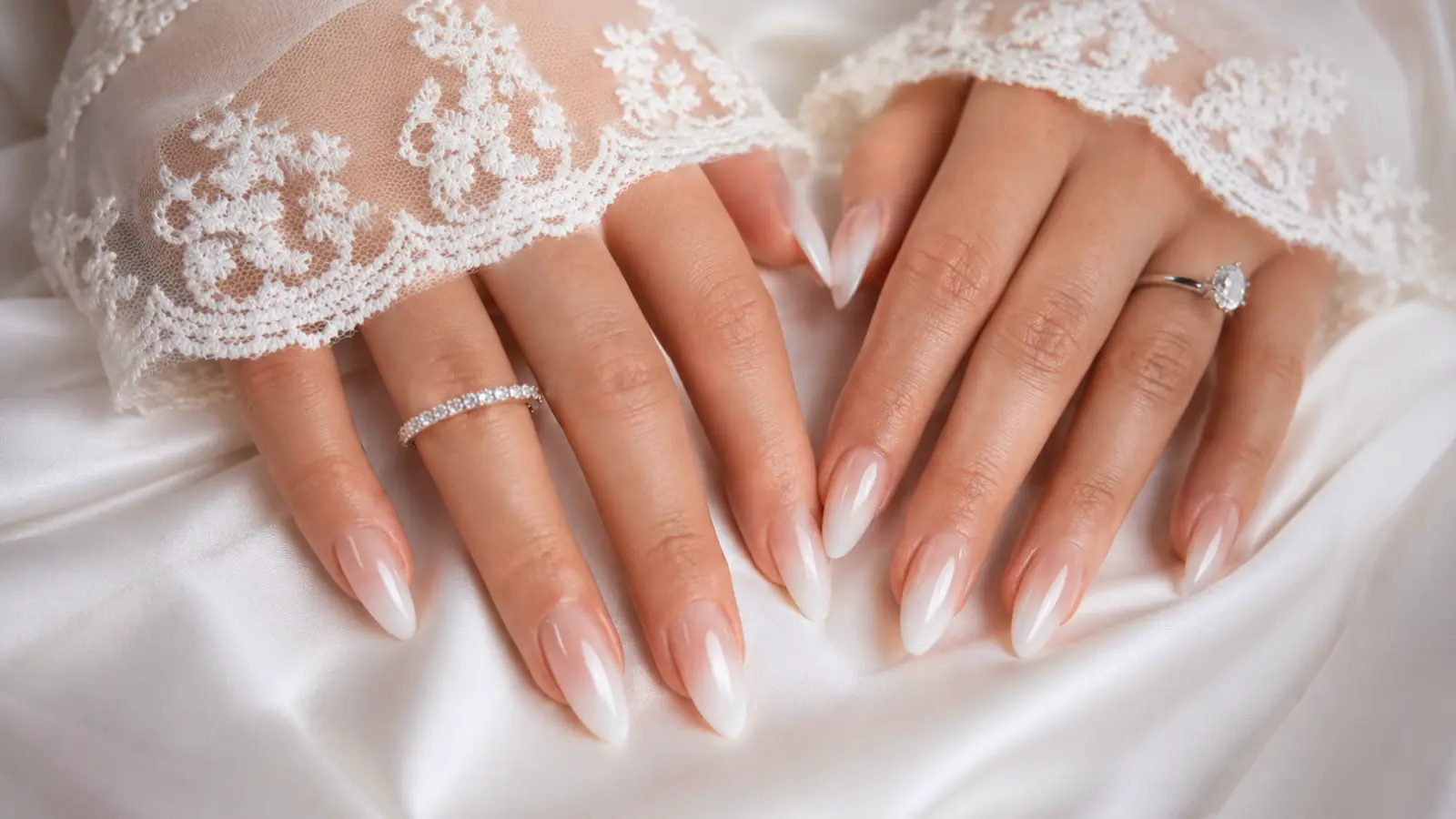
French ombré — also called baby boomer nails, though both terms mean the same thing — is the single most requested bridal nail style in the ombré category, and it has held that position for nearly a decade. The reason is straightforward: it takes everything that makes a classic French manicure work at weddings (the clean look, the pale palette, the sense of careful grooming) and removes the one thing that ages it (the hard smile line).
In a traditional French manicure, the white tip ends in a defined arc. In French ombré, that arc disappears. The pink or nude base fades gradually into a white tip, creating one of the softest alternatives to classic white wedding nails — no line, just a shift. The result looks more natural, more modern, and more sophisticated. It also photographs without the optical distortion that a stark white arc can create in certain lighting conditions, where the smile line can look thicker or more artificial than it does in person.
French ombré styles for brides
Classic baby boomer. The foundational version: a warm nude or soft pink at the base fading to an opaque white at the tip. The transition happens in the middle third of the nail. This is what most U.S. salons produce when asked for French ombré. It is the right starting point for any bride who has not tried the style before.
Sheer French ombré. The same pink-to-white transition, but using a translucent rather than opaque white at the tip. The nail shows through the tip slightly, creating a more delicate and natural version of the style. Particularly beautiful on natural nails without extensions — the sheer tip allows the natural nail’s color to become part of the gradient.
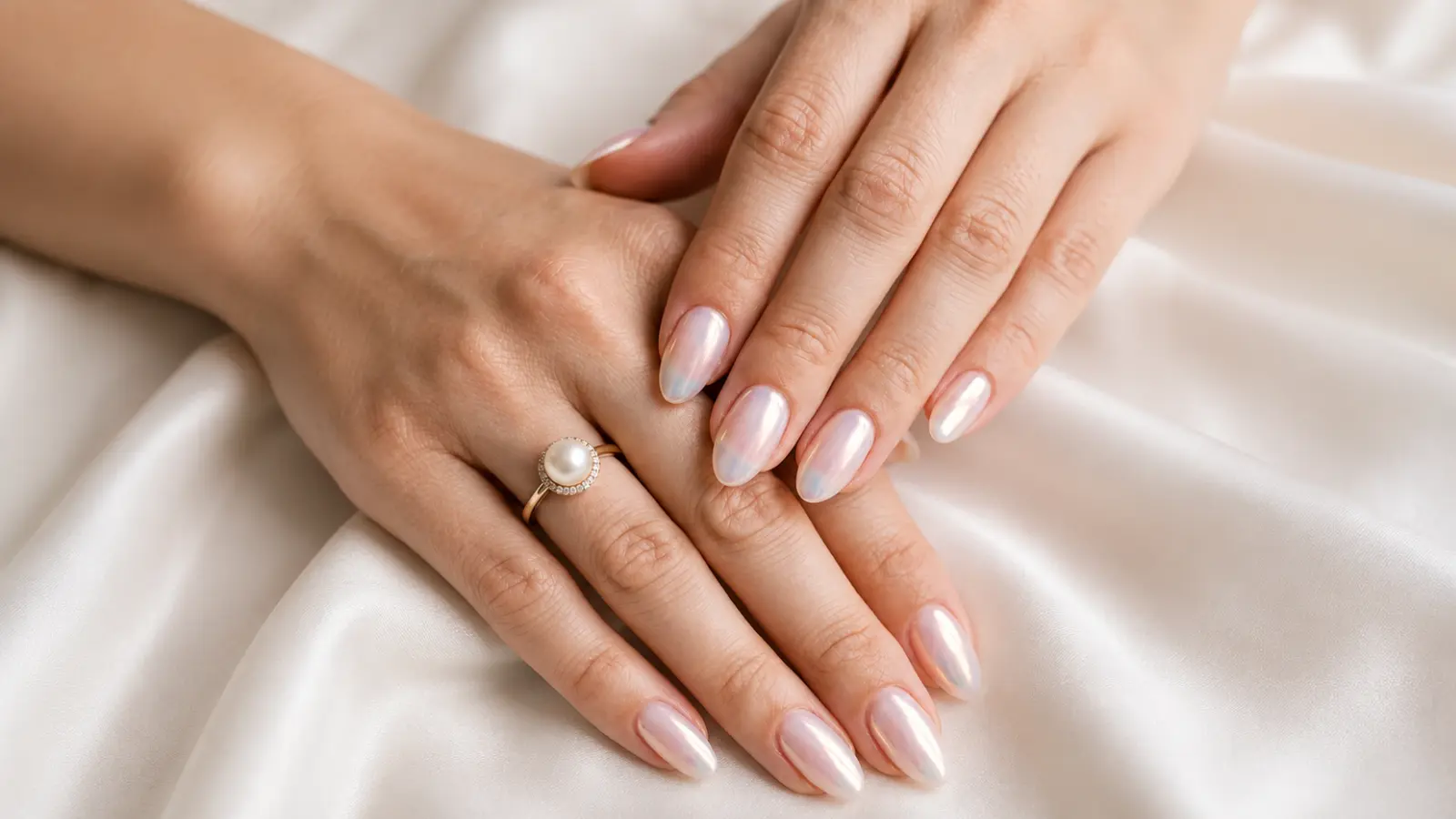
Pearl French ombré. A classic baby boomer base with a pearl or iridescent powder applied over the top. The gradient structure remains; the finish adds a luminous quality that catches light differently from every angle. The most photographically interesting version of French ombré and currently one of the most requested bridal appointments.
Gold-detail French ombré. The baby boomer gradient with a fine gold line painted precisely at the midpoint of the transition — where the pink meets the beginning of the white. The line is subtle but adds warmth and a sense of craftsmanship. Works particularly well for brides wearing gold jewelry or a rose gold engagement ring.
Micro French ombré. An ultra-fine version where the white tip is minimal — a barely-there whisper of white at the very edge of the nail. The gradient is compressed into the final few millimeters. For brides who want the effect of a French ombré but prefer something extremely understated.
| Style | Best For | Photography Result |
|---|---|---|
| Classic baby boomer | Any bride; first-time ombré; any dress style | Soft and clean; the gradient reads clearly in close-up ring shots without any harsh edges |
| Sheer French ombré | Natural nail brides; brides who prefer minimal enhancement | The most natural-looking of the group; the nail itself becomes part of the design |
| Pearl French ombré | Modern brides; glazed donut aesthetic; trend-forward choices | Luminous and dimensional; the pearl finish catches light differently in every photo |
| Gold-detail French ombré | Brides with gold or rose gold jewelry; warm-toned skin | The gold line reads clearly in close-up; adds warmth without adding complexity |
| Micro French ombré | Minimalist brides; brides who find standard French ombré too obvious | Very subtle; the effect is felt more than seen — but registers beautifully in close-up |
One practical note: French ombré is more technically demanding than it looks. The gradient requires a skilled blending technique — typically done by sponging gel between two colors before curing — and the result varies significantly between technicians. Before booking a bridal French ombré appointment, look at your technician’s specific portfolio for this style. A poorly blended ombré has a streaky or patchy midpoint that is visible in photographs. A well-executed one has a transition so smooth it looks like the nail was born that way.
Pink and White Ombré Wedding Nails
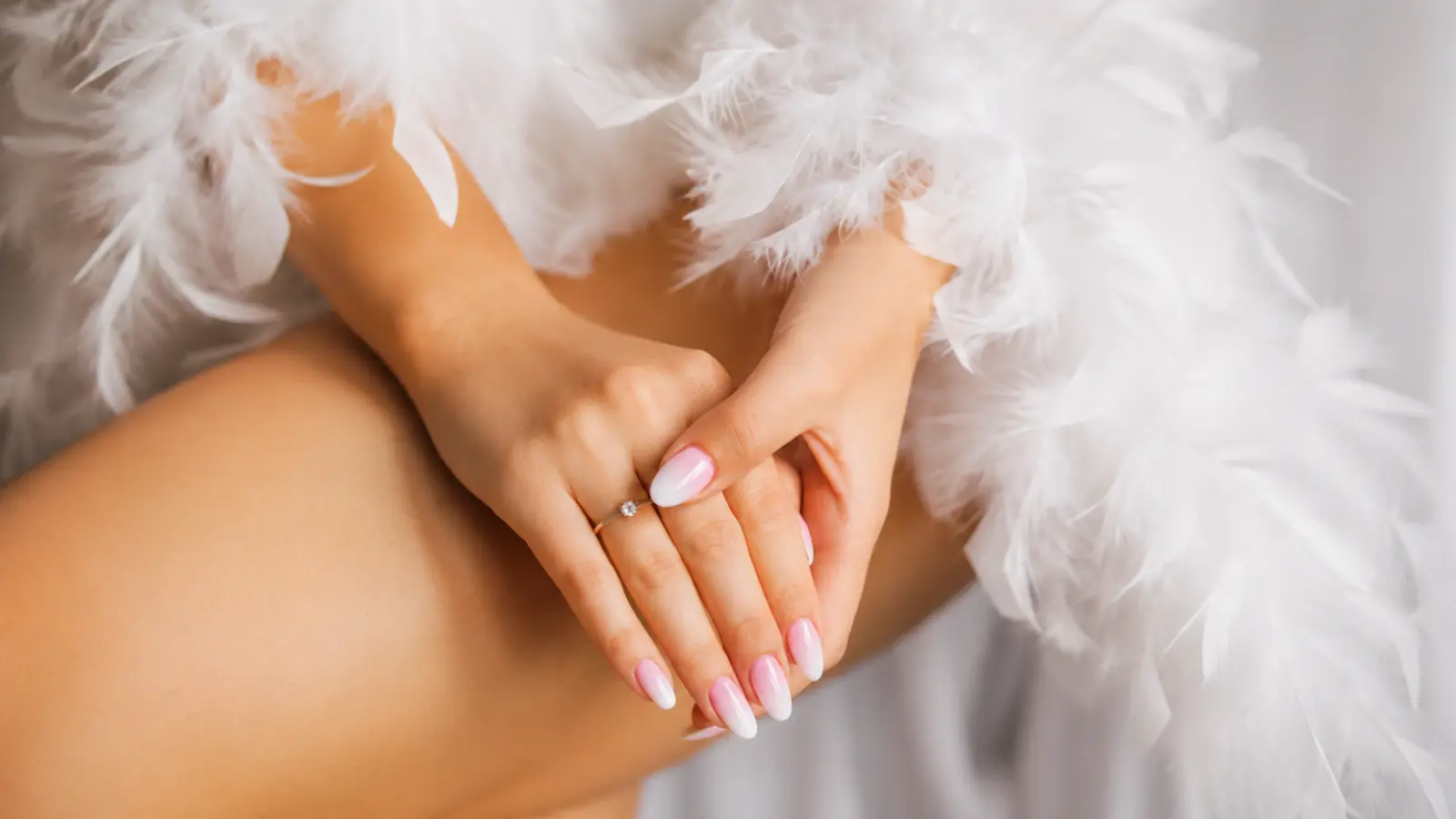
Pink and white ombré is the most overtly romantic version of the gradient — more saturated and visible than a baby boomer nude, more playful than a sheer natural ombré. The pink base is actually pink rather than a skin-toned nude, which means the gradient has more contrast and more personality. It is the choice for brides who want their nails to clearly be a design decision rather than something that could pass for a natural nail.
In photographs, pink and white ombré has a warmth that nude-to-white does not. The pink base reads against the skin tone with more presence, and the transition to white at the tip creates a gradient that is visible from a greater distance — not just in macro ring shots but in full-hand photographs and medium-distance candids. For brides whose wedding aesthetic is specifically romantic and feminine — garden weddings, floral ceremonies, blush-and-ivory color palettes — pink and white ombré is the most cohesive nail choice.
Pink and white ombré variations
Soft blush to white. The most delicate version — a barely-pink blush at the base that fades to white. Close to the classic baby boomer in subtlety, but with a pink tint rather than a neutral one. Works on fair and medium skin tones with particular softness.
Medium pink to white. A clearly pink base that makes the ombré visible and intentional. The contrast between the pink and the white tip is high enough to register in all photography conditions. The most photogenic version for full-hand shots, not just macro ring photography.
Hot pink to white. A bold choice — a saturated, warm pink at the base that fades to white at the tip. For brides who want their nails to make a statement within a still-elegant palette. Works for summer outdoor weddings, colorful receptions, and brides whose personal style is vibrant and unapologetic.
Pink to white with pearl overlay. A medium pink ombré with a pearl or iridescent powder applied on top. The gradient becomes luminous — the pink has a depth, the white tip has a glow, and the transition between them catches the light. Currently one of the top-requested pink ombré styles at bridal appointments.
Pink ombré with accent nail. All nails in the pink-to-white gradient, with the ring finger given a different treatment — a full white nail with a single pearl charm, a fine glitter tip, or a chrome overlay. The accent nail creates a focal point that works specifically in close-up ring photographs.
Nude Ombré Wedding Nails
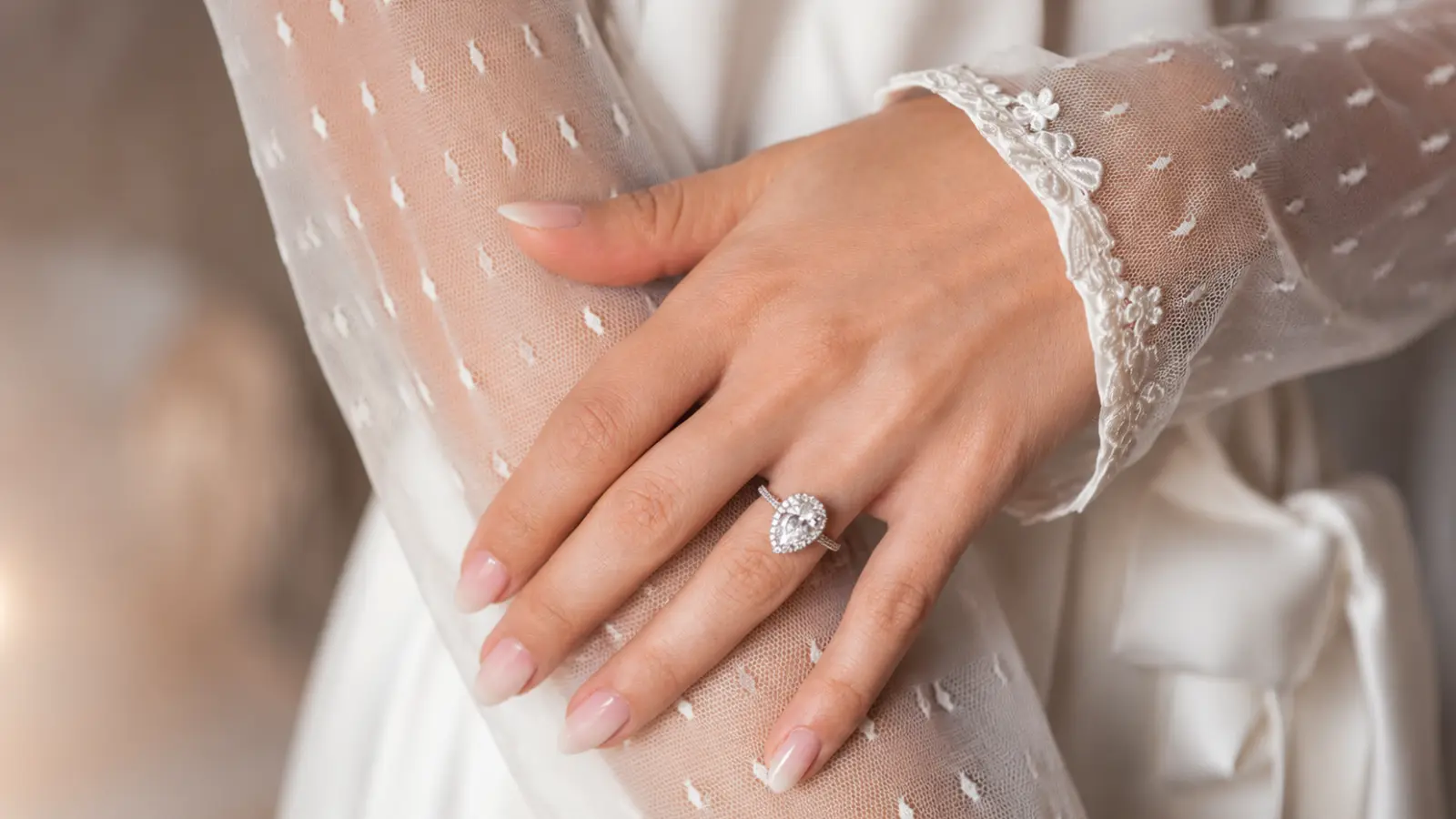
Nude ombré sometimes called “your nail but better” is the most consistently sophisticated choice in the ombré family, and it is the one that ages the best in photographs. Where pink and white ombré reads as a design choice, nude ombré reads as a particularly beautiful version of your natural nail. Ten years from now, looking at your ring shot, nude ombré will look as intentional as it does today.
The key nuance that many brides miss: “nude” is not one color. The right nude ombré and wedding nail colors for your hand depend entirely on your skin tone, and the wrong shade will look muddy, grayish, or washed out in photographs. Finding the right nude requires the same process as finding the right nude lipstick — you have to actually try it against your skin before committing.
Nude ombré by skin tone
Fair to light skin: Soft peachy nudes, light pinks, pale beige at the base fading to white. Avoid nudes that are too white or too cool-toned — they can look chalky. A warm-tinted nude with the faintest peachy quality photographs best on fair skin.
Medium skin: Warm beige, honey nude, warm pink at the base fading to warm white. The mid-toned warm nude family is the most versatile for medium skin and produces the cleanest “natural nail” effect in photographs.
Deep and dark skin: Rich caramel, warm brown-pink, terracotta nude fading to a warm ivory or cream white. The traditional pale pink-to-white gradient can read as too light against deeper skin tones. A deeper, richer base color creates a gradient that complements the skin rather than contrasting with it.
Nude ombré styles for weddings
Baby boomer (classic nude ombré). The original and most requested: a skin-toned nude at the base, a clean white at the tip, a seamless transition between them. The “baby boomer” name comes from the nail industry — outside of salons, it is typically described simply as “nude ombré” or “French ombré.”
Nude to shimmer. Rather than transitioning from nude to white, this version transitions from nude at the base to a pearl or shimmer finish at the tip. The gradient shifts not just in color but in texture. The tip catches light in a way that a flat white does not — particularly beautiful in ceremony lighting and outdoor photography.
Tonal nude ombré. A gradient between two different nudes rather than nude to white — for example, a warm beige at the base fading to a cooler ivory at the tip. The gradient is subtle to the point of being barely perceptible from a distance, but reads as dimensional in close-up photography. The most understated of the nude ombré options.
Matte nude ombré. A nude-to-white ombré finished with a matte top coat rather than a high-shine one. The matte finish gives the gradient a velvety, skin-like quality that is striking in person and photographs with a softness that glossy nails cannot replicate. A strong choice for brides who want something visually distinctive without adding color or sparkle.
Ombré Wedding Nails With Glitter
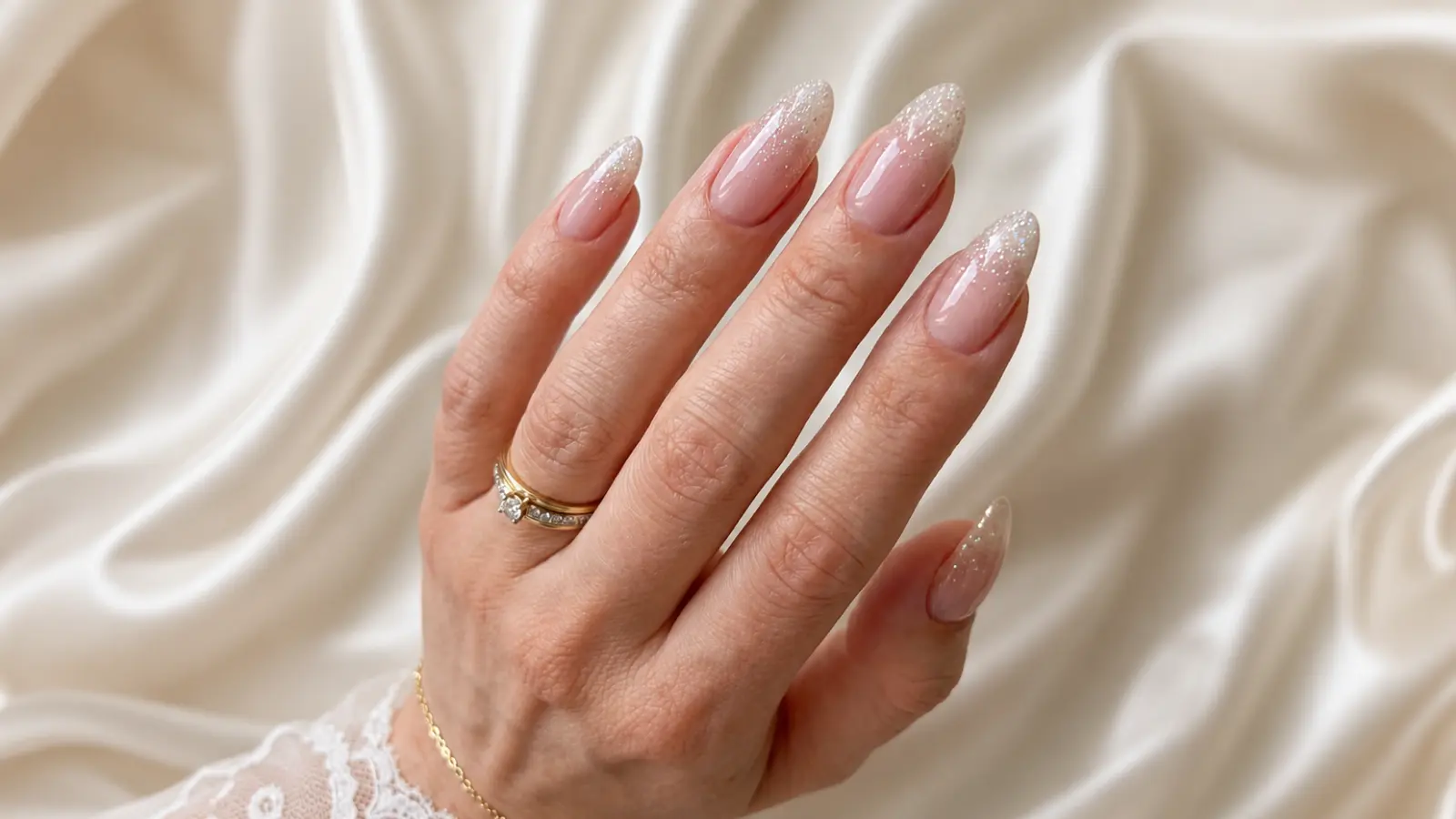
Glitter ombré at a wedding requires more calibration than any other style in this guide — because it is both one of the most dramatic and one of the most frequently overdone choices. The difference between a glitter ombré that reads as glamorous and one that reads as too much comes down to three decisions: the size of the glitter particle, the placement of the gradient, and the base color underneath.
Many brides do not realize that most beautiful glitter ombré nails in bridal photography are not heavily glittered — they are subtly glittered. The effect comes from a micro-glitter or fine shimmer that reads as luminous rather than as individual sparkle pieces. Chunky glitter on a short nail in a close-up ring shot looks like a crafting project. Fine glitter or shimmer ombré on a well-shaped nail looks like light itself is moving across the surface.
Glitter ombré styles for weddings
Fine glitter fade at the tip. The most elegant version: a solid nude, pink, or white base with a fine glitter or micro-shimmer that gradually increases toward the tip. At the base, none. At the midpoint, a whisper. At the tip, a soft sparkle. This is the glitter ombré that works in close-up photographs without looking overdone — the gradient keeps the sparkle contained and intentional.
Glitter at the base (reverse ombré). Instead of sparkle at the tip, the glitter concentrates at the cuticle and fades toward a clean color at the tip. Less common than tip glitter but visually distinctive — the ring sits in a frame of sparkle when the hand is photographed from above. Works well for brides with engagement rings they want to highlight rather than complement.
Full gradient glitter on accent nail. All nails in a solid color — nude, pink, or white — with the ring finger in a glitter ombré. The contrast between the simple nails and the one glitter nail creates a focal point that works directly with close-up ring photography. The most practical way to incorporate glitter without committing the entire manicure to it.
Silver or gold glitter ombré. The classic glitter ombré choice for evening and black-tie weddings. A nude or blush base with a silver or gold fine-particle glitter fading in from the tip. Works in evening light in a way that daytime photography can make look heavy — best suited to weddings with dim, warm lighting where the sparkle activates rather than overwhelms.
Holographic glitter ombré. A fine holographic glitter that produces rainbow light rather than single-color sparkle. More avant-garde than silver or gold — for brides with a distinctly editorial or maximalist aesthetic. Photographs in a way that is either extraordinary or chaotic depending on the lighting conditions.
| Glitter Style | Best Wedding Context | Photography Note |
|---|---|---|
| Fine glitter fade at tip | Any wedding; the most versatile glitter ombré option | Reads as luminous rather than sparkly in photographs — the most photogenic version |
| Reverse glitter (base) | Brides who want the sparkle framing the ring rather than at the tip | Dramatic in overhead ring shots; less visible in side profiles |
| Glitter accent nail only | Brides who want glitter without a full commitment | The contrast between plain and glitter nails creates a clear focal point in ring shots |
| Silver or gold glitter ombré | Evening, black-tie, NYE, or winter weddings | Works best in warm, dim reception lighting; can look heavy in bright outdoor photography |
| Holographic glitter ombré | Editorial or maximalist brides; styled shoots | Extraordinary in the right light; unpredictable under flash — test before committing |
Ombré Nails for Brides — What to Know Before You Book
Ombré nails have a specific set of considerations for brides that casual manicure clients do not need to think about. The wedding day is not the day to troubleshoot a nail technique — every variable should be resolved before the actual appointment.
Always book a trial first. Ombré is a blending technique, and the result varies significantly based on the technician’s skill, the specific gel colors used, and the interaction of those colors with your natural nail tone. What looks perfect in a reference photo may look slightly different on your actual hand. Book a trial ombré appointment 4 to 6 weeks before the wedding — use the same technician who will do your wedding nails, in the same style, on your actual hands. This is the only way to know exactly what you are getting.
Bring reference photos — plural. The word “ombré” describes a technique, not a specific result. Two brides asking for “French ombré” can walk out of the same salon with dramatically different nails depending on which reference photos they showed. Bring at least two or three reference images that clearly show the transition style, the color tones, and the finish you want. The more specific your references, the more consistent the result.
Consider how it interacts with your ring. An ombré that transitions from pink to white creates a different visual frame for your engagement ring than one that transitions from nude to shimmer. The pale tip of a French ombré often complements the metal of a ring setting — it creates contrast. A shimmer or chrome ombré can compete with a pavé band. Try on your ring against your planned ombré style at the trial appointment and photograph your hand to see how they interact.
The medium matters. Ombré done in regular polish will not hold up for a wedding. The blending technique requires gel to cure between sponging applications — any salon offering ombré in regular polish is either using a different technique or will produce a result that chips within days. Confirm that your ombré manicure will be done in gel before booking.
Ask specifically about the transition quality. The most common failure in ombré nails is a patchy or streaky transition — a midpoint that looks uneven rather than gradual. Ask your technician how many blending layers they apply, what their technique is for a smooth transition, and look specifically at this area in their portfolio. A streaky transition in your ring shot is the thing you will notice in every photograph.
Ombré Nails for Wedding Guests
Ombré styles are an excellent choice for wedding guest nails — they are elegant, versatile, and available in versions appropriate for every level of wedding formality. The considerations for guests are simpler than for brides, but there is one principle worth keeping: the ombré you choose as a guest should serve the overall look without drawing focus away from the couple in group photographs.
The most universally appropriate guest ombré styles are the neutral ones — French ombré, nude ombré, and soft pink ombré — because they look polished and deliberate without making a statement that competes with the event. These styles work at brunch weddings, garden ceremonies, formal ballroom receptions, and black-tie evenings equally well.
What works for wedding guests
French ombré / baby boomer. The safest and most elegant guest choice. It reads as a full manicure without being a design statement. Appropriate at any wedding, any season, any formality level.
Nude ombré. Even more understated than French ombré. Works particularly well for guests who want their nails to look beautiful without drawing any attention at all.
Soft pink ombré. A step more visible than nude — works best at spring and summer weddings where the palette is soft and romantic.
Fine glitter ombré for evening weddings. If the wedding is a formal evening or black-tie event, a fine glitter ombré in silver or gold reads as appropriately glamorous rather than overdone. The key is “fine” — micro-glitter rather than chunky.
What guests should avoid
Bright or bold color ombré. A hot pink to white ombré or a cobalt blue gradient draws the eye in group photographs. Save your most statement ombré for events where you are not sharing the frame with a bride and wedding party.
Very maximalist glitter. Chunky glitter, holographic statement finishes, or nails that compete visually with the wedding’s aesthetic. The standard is simple: your nails should look beautiful and intentional, not like a focal point.
Matching the exact bridesmaid style. If you know the bridesmaids are wearing a specific ombré or a specific nail color, choose something that coordinates rather than duplicates. The confusion in photographs is subtle but real.
Best Nail Shapes for Ombré Wedding Nails
Nail shape changes how an ombré gradient reads — both in person and in photographs. The most important factor is how much visual space the gradient has to develop. A very short square nail gives the gradient perhaps 8 to 10mm of length to work with; an almond nail at medium length gives it 15 to 20mm. The longer the canvas, the more defined and beautiful the transition.
| Shape | How It Works With Ombré | Best Ombré Style for This Shape |
|---|---|---|
| Almond | The best shape for ombré wedding nails — the tapered tip elongates the gradient and creates a natural frame for the ring in close-up shots | Any ombré style; particularly beautiful with French ombré and glitter fade |
| Oval | The most flattering all-around shape; gives the gradient enough space to develop without the drama of almond | Pink and white ombré; nude ombré; pearl French ombré |
| Round | Works well on short nails; the gradient is compressed but still reads cleanly in close-up | Nude ombré; sheer French ombré; tonal nude ombré |
| Coffin | The flat tip gives the ombré a graphic quality — the gradient ends abruptly rather than tapering, which reads as modern and bold | Glitter ombré; bold pink ombré; chrome ombré |
| Square / squoval | The cleanest modern shape for ombré; the gradient reads with a slightly structured quality that suits minimalist aesthetics | Matte nude ombré; tonal ombré; micro French ombré |
Ombré Wedding Nails for Short Nails
Short nails carry ombré well — but the technique requires slightly more skill on a shorter canvas, and the style choices that work best are more specific. Many brides with short wedding nails assume that ombré is not for them, which is not true. The gradient simply needs to be adjusted for the available length.
The most important thing to know: on short nails, the transition needs to be more compressed. A standard baby boomer gradient on a nail with 15mm of length transitions gradually from base to tip. The same gradient on a nail with 8mm of length needs to happen faster — the midpoint of the blend shifts upward, and the color difference between base and tip should be slightly softer to avoid looking abrupt on a short surface.
What works best on short nails:
Sheer or tonal ombré. A gradient between two closely related colors — a barely-different ombré — reads as depth on short nails without requiring a dramatic transition that the nail length cannot support.
Nude to white (baby boomer) with an oval or round shape. The classic French ombré on a round or oval short nail looks clean and intentional. The oval shape creates the illusion of a longer nail, giving the gradient slightly more visual space than the nail’s actual length.
Fine glitter at the tip only. On short nails, a glitter fade that stays at the very tip — the last 3 to 4mm — photographs with more precision than a full glitter ombré. The sparkle is concentrated where it photographs best: at the tip of the finger where the ring sits.
Pearl overlay over any ombré base. A pearl or iridescent powder applied on top of a short nail ombré adds dimension that compensates for the limited length. The pearl quality creates visual interest across the whole nail rather than relying on the gradient alone.
What to avoid on short nails: heavy glitter across the full nail, dramatic two-color contrasts that require length to resolve cleanly, and thick white tips (even in ombré form) that can look proportionally large on a short nail.
Are Ombré Nails Still Elegant for Weddings?
Yes — and this question comes up specifically because ombré nails had a peak trend moment that some brides associate with a now-dated aesthetic. The confusion is worth addressing directly.
The ombré nails that dated were the maximalist versions: bold two-color contrasts in bright shades, heavy chunky glitter gradients, and dramatic color-blocked styles that were everywhere on social media around 2018 to 2020. Those specific versions did have a trend cycle. They peaked, and they have receded.
French ombré — the baby boomer pink-to-white or nude-to-white gradient — did not peak and recede. It has been a consistent top-three bridal nail request at U.S. salons for nearly a decade and remains one. It does not have a trend cycle because it is not specifically trendy — it is a technique that produces a genuinely beautiful result that photographs well, works on any hand, complements any dress, and does not look dated because it was never tied to a specific cultural moment.
The ombré styles that remain fully elegant for weddings:
- French ombré / baby boomer in nude or soft pink — timeless and will continue to be
- Sheer ombré with a pearl or iridescent finish — current and sophisticated
- Tonal nude ombré — the most understated and therefore the most reliably elegant
- Fine glitter fade at the tip in silver or gold — appropriate for evening events
- Pink-to-white gradient in a soft blush — romantic and universally flattering
The ombré styles that require more consideration for a wedding:
- Bold two-color contrasts (hot pink to white, cobalt to clear) — statement choices that suit specific aesthetics
- Chunky glitter ombré — works for maximalist brides; dates in photographs faster than fine glitter
- Holographic or color-shifting ombré — editorial and beautiful in person; less predictable in photography
The underlying principle: ombré as a technique is neutral. What makes it timeless or dated is the specific color palette and finish, not the gradient itself. Choose a palette that you would trust to look beautiful in ten years — soft pinks, nudes, sheer whites, fine shimmer and the gradient becomes one of the most enduringly elegant things your nails can do on your wedding day.
Ombré Wedding Nails Inspiration Board
Before choosing your final ombré manicure, it helps to see different gradient styles across nail shapes, lengths, skin tones, finishes, and wedding aesthetics. Explore our ombré wedding nails inspiration board for French ombré nails, pink and white gradients, nude baby boomer styles, glitter ombré, pearl finishes, short ombré nails, and elegant bridal ideas to save for your appointment.
Final thoughts
The best ombré wedding nails are not the boldest ones.
They are the gradients that feel seamless — the transition that softens naturally into the next color, the finish that catches light beautifully in photographs, and the shape that allows the entire manicure to feel elegant instead of overly designed.
That is why French ombré, nude gradients, soft pink fades, and subtle pearl finishes continue to dominate bridal nail appointments year after year. They create dimension without overwhelming the hand, the ring, or the dress itself.
And when the gradient is chosen carefully, the nails stop feeling like a trend and start feeling like part of the wedding aesthetic as a whole.
Frequently asked questions (FAQ)
Are ombré nails good for weddings?
Yes. Ombré nails are one of the most elegant bridal nail styles because the soft gradient photographs beautifully and creates a more natural look than a harsh solid color.
What is the most popular ombré wedding nail style?
French ombré, also called baby boomer nails, is the most popular ombré wedding nail style because the pink-to-white fade looks timeless and works with every dress style.
Do ombré nails work on short wedding nails?
Yes. Soft nude or sheer ombré gradients work especially well on short oval or round nails because they create a clean and elongating effect.
What nail shape looks best with ombré wedding nails?
Almond and oval nail shapes show ombré gradients most beautifully because the longer shape gives the fade more space to blend naturally.
Are glitter ombré nails elegant for weddings?
Yes — when done subtly. Fine glitter ombré over nude, pink, or white nails can look extremely elegant, especially for evening or black-tie weddings.